
In this article
Everybody asks which month to climb Everest. That framing is the first mistake. You don’t climb in a month, you climb a two-to-five-day crack in the weather, and you can sit at Camp 2 for a week with your boots on waiting for it. Ask anyone who tracks the season: the people who get up safely aren’t the ones who picked a date, they’re the ones who learned to read the window. This guide walks the whole timing chain, from the short answer to the jet stream behind it, the crowding trap it creates, and how to plan backward so you’re actually there when the door opens.
Why Almost Everyone Summits in May

Everest is one of the world’s most demanding peaks, and unlike most of them it gives you one realistic season a year. Roughly 70 to 80 percent of every successful summit happens in May. Not April, not October. May. Ask which is the best month to climb Everest and the data barely lets you argue.
If you stacked up every climber among the thousands who’ve stood on top and sorted them by date, the pile would bury the back half of May and barely register the rest of the calendar.
The single most popular successful summit date is May 23, with more than 1,700 climbers logging it since 1950 according to the Himalayan Database, the sport’s official summit record. The proven sweet spot runs roughly May 15 to 25, and that back-half-of-May concentration is exactly why the summit success rate spikes in that stretch. That’s not because the 23rd is magic. It’s because the pre-monsoon spring briefly lines up three things that almost never coexist up there: easing winds, warming temperatures, and weather stable enough to forecast.
Here’s where people get it wrong. They read “May,” book the trip, and mentally arrive ready to walk to the top on a Tuesday. Then they’re sitting at altitude watching the forecast refuse to cooperate, burning patience and acclimatization while the wind hammers the summit. May is the answer. May is also not a promise.
There’s a smaller second season in autumn, after the monsoon, and we’ll get to why almost nobody uses it anymore. For now, the takeaway is simple: if you’re not summiting in spring, you’re playing a much smaller, rougher lottery.
What the Jet Stream Actually Does Up There

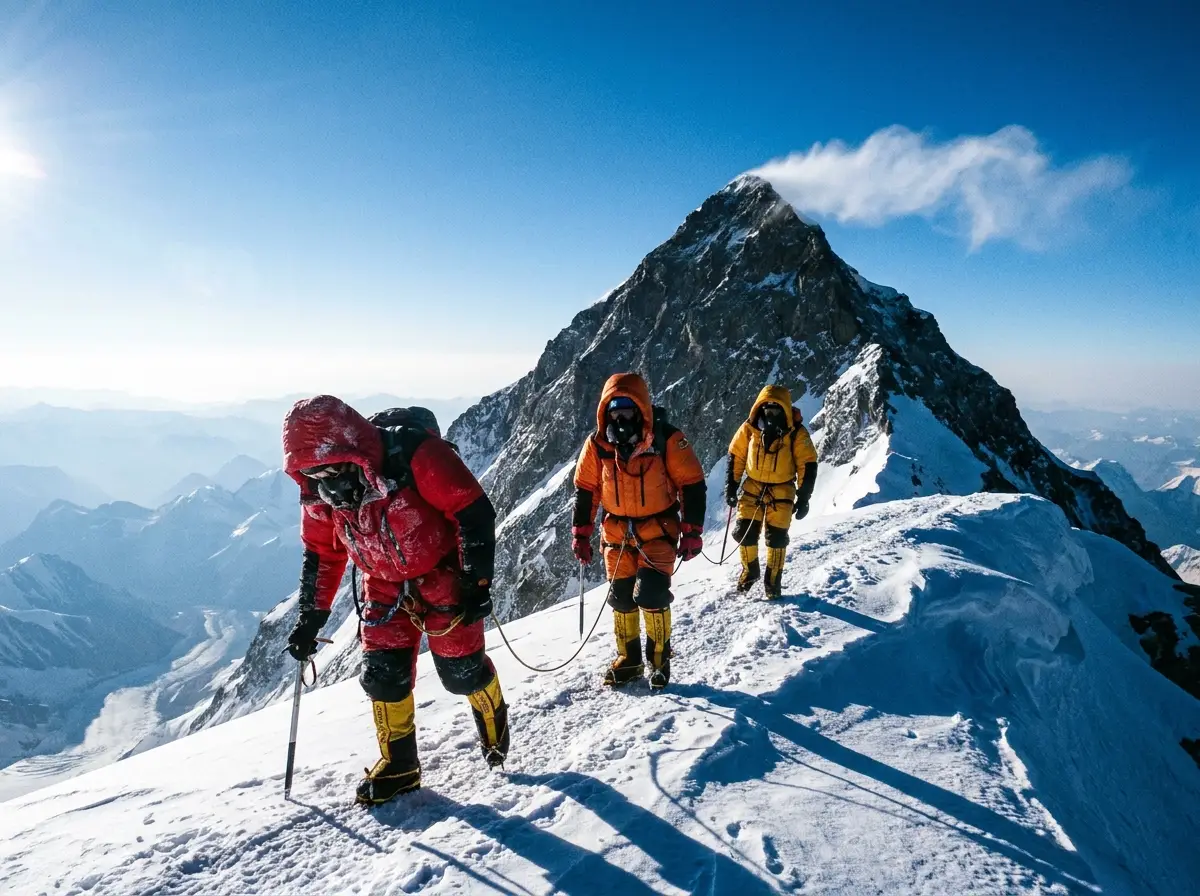
See that plume of snow streaming sideways off the summit in every famous Everest photo? That’s not weather passing through. That’s the jet stream, and it sits parked over the top of the mountain for most of the year, generating sustained winds of 100 to 175 mph. Nothing climbs in that. A person standing in 150 mph wind at 29,000 feet is a person getting blown off the mountain.
And that’s before the wind chill, which at those speeds drops the effective temperature far enough to frostbite exposed skin in minutes.
Twice a year the jet stream migrates north, lifting off the summit. The big migration comes in late spring, right before the monsoon. For a brief stretch, summit winds fall toward something a climber can survive, and that’s the entire reason a season exists.
“Calm” on Everest is relative. Nobody’s waiting for a windless day, because there isn’t one. The real go/no-go number is summit wind under roughly 30 to 40 mph. That’s the threshold forecasters chase. Above it, you wait. Below it, the door is open, assuming everything else lines up.
The catch is how short the lift lasts. The jet stream pulls north for only about 10 to 14 days. The mountain doesn’t get safer in that stretch, the wind just briefly moves somewhere else. Then it comes back and slams the summit shut until autumn.

Why May Really Means a 5-Day Window

This is the part the calendar hides. That 10-to-14-day lull isn’t 14 climbable days. Inside it, typically only two to five days are actually good enough to push for the summit. You booked a two-month expedition to use, at best, a long weekend of it.
Those days don’t announce themselves. Modern forecasting calls them, using ECMWF satellite models and, on the serious expeditions, a dedicated base-camp meteorologist reading the data every morning. A good 24-hour high-altitude forecast now runs better than 80 percent accurate. That’s enough to pick a day.
It is never enough to bet your life blind, because windows still close abruptly and a model is a probability, not a guarantee.
There’s a second gate most people don’t know about. Before any client can summit, the Sherpa rope-fixing team has to reach the top first and set the fixed ropes through the upper mountain. That’s the real opening bell of the season.
In 2025, the rope-fixing team summited on May 9, the first clients followed on May 11, and the forecast flagged a scatter of candidate days after that. No matter how perfect your personal forecast looks, you cannot push before “the fix” is in.
Stop watching the calendar and start watching the wind. The number that decides your summit day is the forecast summit wind speed, not the date on it. Teams that hire a real forecaster don’t ask “is it May yet,” they ask “what’s the summit blowing on the 18th.”
So when you stage up to Camp 2 and Camp 3 and wait, that’s not wasted time, that’s the actual strategy. You position yourself, you watch the models, and you commit to a short push when the window firms up. While you wait, the kit that keeps you alive while you wait is doing more work than your legs are. Patience is a skill up here, and it’s the one nobody trains for.
The Crowding Trap of the Popular Day

Here’s the cruel twist of a short window: everyone reads the same forecast. When the models flag one beautiful day, hundreds of climbers all aim for it at once, and the timing choice quietly becomes a safety choice.
The clearest lesson came in 2019. Nepal issued a record number of permits that spring, around 381, plus roughly 140 more on the Tibet side. A narrow window funneled more than 200 climbers toward the summit on May 22 and 23. Eleven people lost their lives that season, several of them while stuck standing in line above 8,000 meters, running their bottled oxygen down to nothing in a place where you can’t linger.
That’s the trap. Chase the single most popular day and you walk straight into a bottleneck at the Balcony and the Hillary Step, burning oxygen you can’t spare while the queue inches forward. The mountain didn’t get more hazardous that day. The crowd did.
There’s a hard deadline that exists for exactly this reason: the 2 PM turnaround rule. That turnaround time is the line you don’t cross: if you haven’t summited by 2:00 in the afternoon, you turn around, summit or not. As of 2026, Nepal made it an enforced regulation with fines of 750 to 1,500 dollars and possible permit bans, because more than 80 percent of fatalities on Everest happen on the way down, not the way up.
The summit is optional. The descent is not.
Experienced teams often aim for the leading or trailing edge of the window, a day or two off the popular peak, and eat slightly more wind in exchange for far less queueing. A windier summit you walk onto beats a calm one you stand in line for above 8,000 meters.
That waiting game plays out at the highest camp on the route, the South Col camp where climbers wait for the night push before stepping off in the dark. When you time your push to dodge the conga line, that’s where the discipline pays off.
Planning Backward From Summit Day

Now the part that actually controls your trip. “Summit in mid-May” sounds like a date. It’s really an arrival deadline, working backward.
Your body can’t shortcut altitude. Reaching a point where you can survive the upper mountain takes four to six weeks of acclimatization, climbing up to a higher camp, sleeping, and dropping back down to recover. That cycle, repeated, is what nudges your physiology toward tolerating the thin air of the summit push. The whole expedition runs 60 to 75 days door to door.
Do the math backward from a mid-May summit and you land on a late-March or early-April arrival at Base Camp. Miss that, and the timeline no longer closes. You can’t compress six weeks of adaptation into three because your flight was cheaper.
Those weeks of going up and down are the acclimatization rotations up the Western Cwm, and they’re the unglamorous engine of the whole climb. The summit push gets the photos. The rotations get you alive to take them. It’s all about letting your body adapt to thin air slowly enough that the Death Zone doesn’t end your trip on day one.

Permits, logistics, and prerequisites all hang off this same skeleton. The window is fixed by the jet stream, the acclimatization is fixed by your physiology, and everything else has to bend around those two.
North Side vs South Side Timing

People hear the south side is crowded and assume the north side, in Tibet, is some quieter shortcut. It isn’t a shortcut. It’s a different set of trade-offs hung on the same calendar.
Both sides share essentially the same April-to-May window, because the jet stream doesn’t care which flank you’re standing on. When it lifts, it lifts for the whole mountain. So switching sides buys you nothing on timing.
What changes is the access math and the conditions. From the north you reach base on an 8-to-10 day overland drive instead of Nepal’s 12-to-14 day trek through the Khumbu. But the north is drier, colder, and windier, sitting further off the monsoon’s moisture. You trade the hazard of the Khumbu Icefall for more wind and a harder chill.
Understanding the Nepal and Tibet sides of the mountain is less about picking a winner and more about knowing which problems you’d rather have.
There’s also bureaucracy. Tibet access opens and closes on political decisions, and some years it simply doesn’t open on schedule. Nepal is the more reliable bet for actually getting on the mountain, which is part of why the south side carries the crowds in the first place.
Don’t pick a side to escape the window. Pick a side to choose your hazard. Same May timing either way, so decide whether you’d rather manage the Icefall and the crowds on the south, or the wind, the cold, and the politics on the north.
Why Summer, Winter, and Even Autumn Are Off the Table

If spring is the answer, the obvious next question is why the other three seasons aren’t. Quick version: two are off the table outright, and the third is a shadow of what it used to be.
Summer, from June through August, is monsoon season. Rain, fog, and heavy snowfall bury the mountain and load the slopes for avalanches. You can’t forecast a window because there isn’t one, just weeks of socked-in weather. Nobody runs a normal summer expedition.
Winter, December through February, brings record cold and the jet stream parked directly overhead at full strength. A handful of elite climbers have pulled off rare winter ascents, and they’re celebrated precisely because the conditions are so brutal. For a standard expedition, winter is a non-starter.
Autumn, after the monsoon, is the interesting one, because it used to be a real season. Back in the 1970s and 80s, plenty of expeditions climbed in the post-monsoon fall. The problem is what the monsoon leaves behind: deep, fresh snow piled on the upper mountain. That means exhausting trail-breaking, higher avalanche risk, and shorter, less predictable windows than spring offers.
The result is that autumn now sees roughly half the expeditions of spring, and the gap keeps widening. It looks tempting on paper, emptier and quieter, but you pay for that quiet by route-breaking through unstable snow while the windows slam shut faster. Most teams have voted with their feet, and they vote for May.
Conclusion
Three things to carry off this page. First, the best time to climb Everest is mid-to-late May, but the real unit of timing is a two-to-five-day window, not a month. Second, that window only works if you plan backward, which means a late-March arrival at Base Camp for a mid-May summit. Third, the date you choose is a safety decision, and the most popular day on the mountain is often the most hazardous one to be on it.
Before you lock in a summit date, learn to read the window instead. Build the timeline that gets you to Base Camp in time to use it, and treat the forecast, not the calendar, as the thing that decides when you climb.
Frequently Asked Questions
01What month is the best time to climb Everest?
Mid-to-late May, during the pre-monsoon spring season. Roughly 70 to 80 percent of all successful summits happen then, when the jet stream lifts north and summit winds drop to a survivable range.
02Why is there only a short window to climb Everest?
The jet stream sits on the summit most of the year with 100 to 175 mph winds. It migrates north for only about 10 to 14 days in spring, and inside that lull just 2 to 5 days are actually calm enough to summit.
03Can you climb Everest in autumn?
Yes, but few do. The post-monsoon autumn season leaves deep snow on the upper mountain, which means harder trail-breaking, higher avalanche risk, and shorter windows. It now sees about half the expeditions of spring.
04What is the worst time to climb Everest?
Summer, the June to August monsoon, and deep winter from December to February. The monsoon brings rain, fog, and avalanche risk, while winter pairs record cold with the jet stream parked directly over the summit.
05How long does it take to climb Everest from Base Camp?
Plan on 60 to 75 days total, including four to six weeks of acclimatization rotations. That’s why a mid-May summit requires arriving at Base Camp by late March or early April.
Safety Notice: Rock climbing and mountaineering are inherently high-risk
activities that can involve physical trauma or fatal incidents. The information on Rock Climbing Realms is for
educational and informational purposes only. Techniques and advice presented here are not a substitute
for professional, hands-on instruction. Conditions and risks vary by location. Always seek guidance
from a qualified instructor before attempting new techniques. By using this website, you agree that you
are solely responsible for your own safety. Any reliance you place on this information is strictly
at your own risk, and you assume all liability for your actions. Rock Climbing Realms and its authors
will not be held liable for any harm, damage, or loss sustained in connection with the use of this information.
Affiliate Disclosure: We are a participant in the Amazon Services LLC Associates Program, an
affiliate advertising program designed to provide a means for us to earn advertising fees by advertising and linking
to Amazon.com. As an Amazon Associate, we earn from qualifying purchases. We are also an official affiliate partner
of Black Diamond Equipment via the AvantLink network. If you click on a Black Diamond affiliate link and make a
purchase, we may earn a commission at no additional cost to you. We also participate in other affiliate programs.
Additional terms are found in the terms of service.