

In this article
Most climbers can tell you their belay biner is rated 24 kN. Almost none can tell you what the other two numbers stamped next to it mean, and those are the ones that decide whether a sloppy clip stays a sloppy clip or turns into a real problem. Every certified carabiner on the market carries the same three-number system, and every climber who sticks around long enough eventually learns to read the small numbers instead of the big one. This is a walk through all three: what a kilonewton actually measures, why the sideways number collapses to a third of the headline figure, what force a real lead fall puts through your system, what the UIAA stamp is actually certifying, and when a stamped rating quietly stops being true.
What a Kilonewton Actually Measures
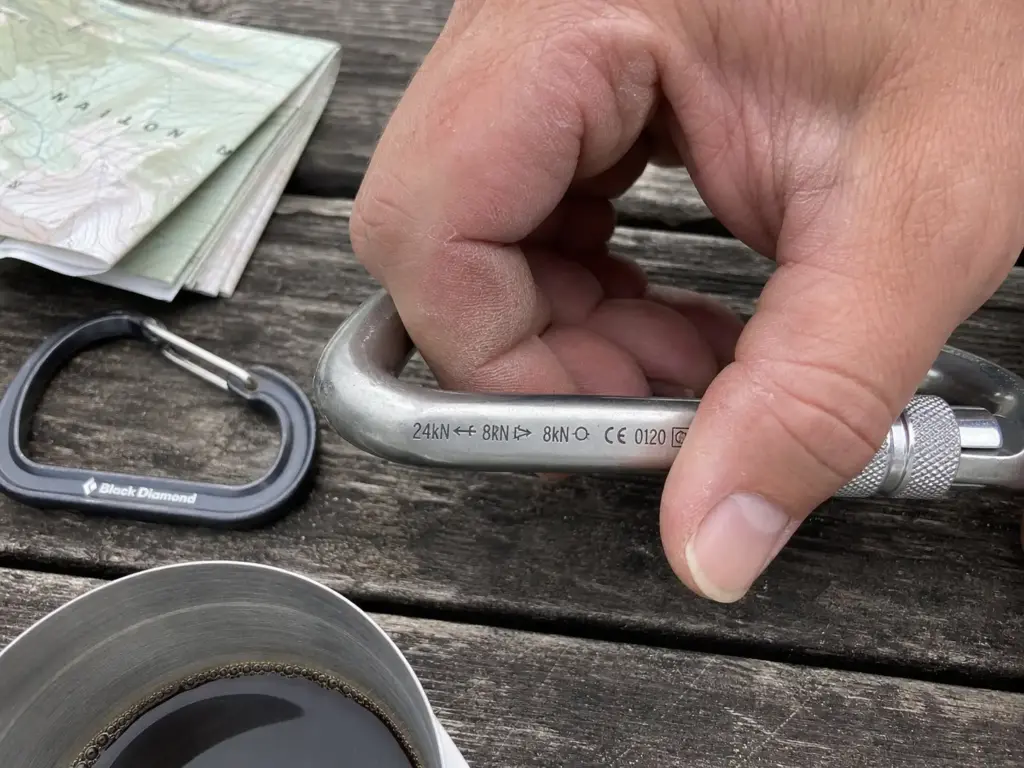
Hand a carabiner to someone who has never climbed and watch what happens. They squeeze the gate, feel how little metal is actually there, and ask some version of the same question: this thin aluminum bar holds how much? That gap between what the part looks like and what the number claims is where every conversation about carabiner strength ratings starts, and it never fully closes. If you want the wider view of how carabiners, quickdraws and belay devices fit together on a rack, the survey version lives elsewhere on the site; this article is the deep dive on the numbers themselves.
Kilonewtons to Pounds, the Conversion Worth Memorizing
One kN equals roughly 225 lbs of force. The precise figure is 224.8, and nobody at a crag has ever needed that second decimal. Multiply from there and a 24 kN carabiner works out to about 5,400 lbs, which is where the pickup truck comparison everyone repeats comes from.
That comparison is genuinely useful the first time you hear it. It is also the source of the misunderstanding this entire article exists to fix, because a truck sitting still on a scale is not what a fall does to a piece of metal. Static weight hanging quietly and dynamic force arriving in a fraction of a second are different events, and the carabiner only cares about the second one.
There is a version of this you have probably seen at the crag: the climber who has confidently used the “holds a pickup truck” line to explain kN to a partner for years, without ever having run the pounds-of-force math themselves. The line is not wrong. It is just doing less work than the person saying it thinks.
Why Gear Is Rated in Force, Not Weight
A newton measures force, not mass. Force is what happens when mass gets accelerated or decelerated, which is exactly what a rope does to a falling climber at the end of a whipper. A 165 lb climber standing on a scale generates about 0.73 kN. That same climber caught by a rope after a real lead fall can put four to nine times that through the system.
This is why nothing in your kit is rated in pounds of climber weight, and why ratings get published in kN rather than in pounds of force. What you weigh on a scale is the least interesting number in the chain. Dead weight hanging quietly on an anchor and a falling climber being decelerated by a rope are not the same load at all.
What actually matters is how fast the system stops you, and that depends on how far you fell relative to how much rope was out to absorb it. That relationship has a name and a formula, and the physics of fall factor is worth a look if you want the underlying math before we get there. We run the climbing-specific version of it further down.
The three numbers themselves live on the spine, stamped or laser-etched into the metal, sitting next to the CE mark and the UIAA logo. They have been there since the day you bought the thing. Most people have never looked.
The Three Numbers Stamped on Every Carabiner
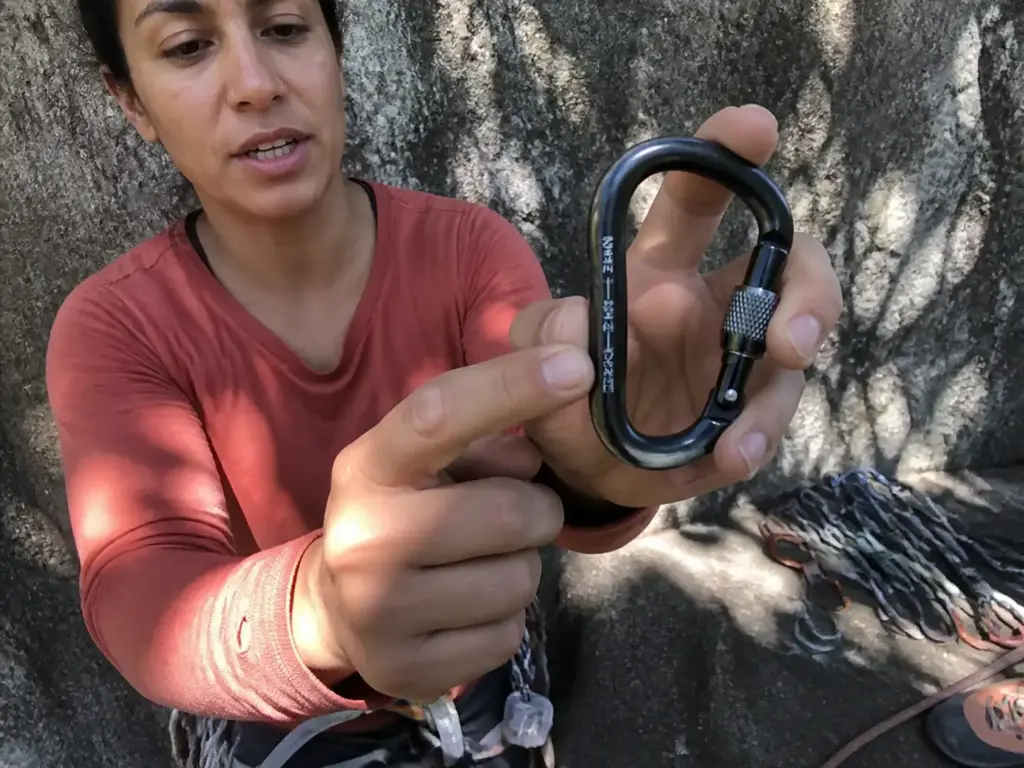
Nobody teaches you to read the spine. You buy the biner, you clip it, and the little pictograms stay decorative for years until someone points at one at a belay and asks what the 8 means. Then you look properly for the first time and realize you have been carrying a spec sheet on your harness the whole season.
Major Axis, the Number on the Box
The major axis rating is the carabiner loaded lengthwise, gate closed, force running end to end straight down the spine. Typical certified numbers land between 20 and 30 kN. This is the figure printed largest on the spine, the one on the packaging, and the one everyone quotes.
It is also a genuinely enormous margin. Loaded this way, a carabiner is not a realistic failure point in normal climbing. Which is precisely why the other two numbers deserve your attention.
Minor Axis, the One That Should Worry You
The minor axis rating is the carabiner cross-loaded, force running across the gate and spine rather than along them. Typical figures sit between 7 and 10 kN, roughly a third of the major-axis number.
That is not a rounding error. That is two-thirds of your margin gone because the metal rotated ninety degrees. The Black Diamond RockLock Screwgate, a hot-forged HMS with a keylock nose, carries a class rating of 24 kN major, 8 kN minor and 8 kN open gate, and that spread is representative of almost every locking carabiner you will handle. Its wide basket end is a design response to exactly this problem: give the rope somewhere to sit so the biner is less inclined to rotate in the first place.
Open Gate, the Number Nobody Plans For
The third pictogram shows the carabiner loaded lengthwise with the gate open. Typical values run 6 to 9 kN. A 25 kN carabiner with its gate open can fail around 9 kN, a reduction north of 60 percent from the headline number.
The trap is that nobody clips a carabiner intending to load it with the gate open. It happens anyway, through gate flutter during a shock load, or through the gate pressing against rock, or through a sling that levers the gate ajar under tension. The rating exists because the failure mode exists. This is also the clearest argument for understanding when a locking gate is worth the extra step, because a locked gate is one that cannot be flicked open by vibration at the worst possible moment.
The single most common mistake in the community is treating the big number as “the” rating and never checking the two small ones. If you take one habit from this article, take that one.
Why the Sideways Number Collapses
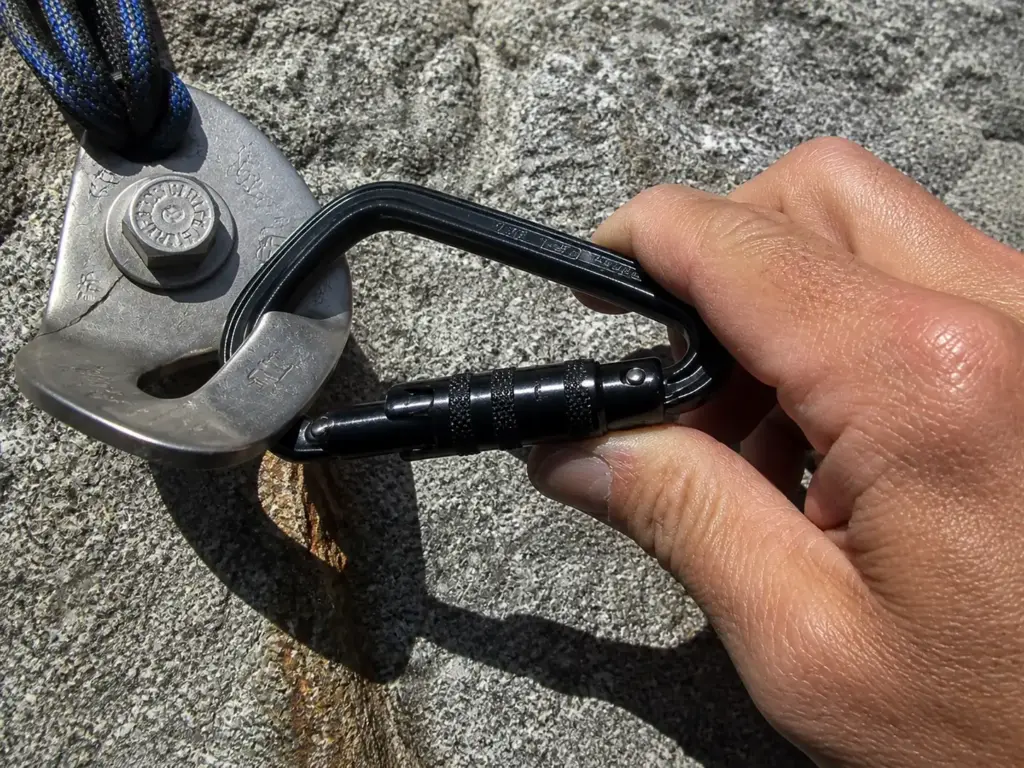
Here is the moment that gets people: a climber realizes their trusted rack biner has been quietly sitting sideways against a wide bolt hanger on every redpoint burn for a season, and nothing happened. Nothing happened because nothing had to. No burn generated enough force to find out. That is a different sentence from “it was fine.”
Every competing page will tell you cross-loading drops strength to roughly 7 to 9 kN. Almost none of them tell you why, and the why is what turns a memorized number into something you can reason with on the wall.
Where the Load Actually Travels
The spine is one continuous piece of forged aluminum, and it is the strong axis by design. Load running end to end passes straight through solid metal from the top eye to the bottom basket. There is no joint in that path, no pin, no moving part. The alloy is doing the whole job.
Rotate that load ninety degrees and the path changes completely. Force no longer runs through the spine; it pushes the frame apart across its width. Documented testing on off-axis carabiner loading describes this well: the load twists the frame rather than running through it, redirecting stress toward the gate side of the part.
The Gate Is a Door, Not a Beam
This is the piece competitors skip. The gate is not a structural member in the way the spine is. Its hinge pin and its nose or latch notch were engineered for one job: hold the gate shut and resist compression along the spine while the strong axis carries the real load. They were never designed to carry tensile load across the frame.
So when you cross-load a carabiner, you are routing force through the two smallest cross-sections in the entire part. The hinge pin is a slender rod. The latch notch is a deliberate absence of metal, a place where material was removed so the gate could seat. Both are fine at their design job and both are structurally modest by comparison to the spine.
That is the real answer to why the number is a third rather than nine-tenths. You are no longer testing the alloy body of the carabiner. You are testing a pin and a notch.
Watch a carabiner while your partner weights it, not before. A biner that sat perfectly on the spine while you clipped it will often rotate a quarter turn the instant load comes on, especially on a fat masterpoint or a bulky knot. The clip you inspect is not the clip that gets loaded.
How Cross-Loading Happens Without You Noticing
The classic setup is a non-locking biner clipped onto something bulky, a fat knot, a wide bolt hanger, a thick anchor masterpoint. Anything that gives the carabiner room to rotate will eventually take that room, because rope tension and your own movement keep nudging it. You clipped it clean. It did not stay clean.
Shape is your real mitigation here, more than any number on the spine. The Petzl Sm’D Triact-Lock is a useful counterpoint to a big pear-shaped locker: a compact D-shape with an auto-locking sleeve and a 23 kN major axis, built so the load naturally sits tight against the spine with very little room to wander. That is geometry doing safety work that no stamped rating can express. Matching the carabiner shape to the job is a decision you make once, at purchase, and it quietly pays out on every route after that.
What a Real Fall Actually Puts Through the System
The number that matters is not what your carabiner can hold. It is what your system will ever ask it to hold. That gap is much wider than it feels mid-air, and once you can estimate it, you stop needing to memorize maximum ratings at all.
Fall Factor in Plain Language
Fall factor is the height you fall divided by the length of rope paid out to catch you. The scale runs from 0 to 2, and the counterintuitive part is the useful part: a short fall high on a pitch is gentler than a short fall right off the belay.
Fall ten feet with sixty feet of rope out and the factor is about 0.17, with all that rope stretching to absorb the energy. Fall those same ten feet with five feet of rope out and the factor is 2, with almost nothing available to soften it. Same distance, radically different impact force. Petzl’s breakdown of fall factor and impact force walks the same relationship from the manufacturer’s side if you want it in more depth.
Run real numbers and a low-factor sport fall, somewhere around 0.25 on a 165 lb climber, generates roughly 4 kN of impact force. A harder lead fall pushes that into the 8 to 9 kN range. Those are the actual forces your gear sees on an ordinary day.
What Your Rope Is Doing to Protect You
The rope is the shock absorber in the system, and that is not a metaphor. UIAA 101 caps single-rope impact force at 12 kN in the standard test fall, and half-ropes at 8 kN. Ropes are engineered specifically not to exceed those figures on the climber they are catching.
That ceiling is the other half of the margin picture. Your system has a designed maximum, and it is a lot lower than the headline number on your locker. Rope dynamic elongation is doing quiet, unglamorous work on every single catch.
Running the Numbers on Your Own Margin
Now line the three figures up and the whole article resolves into one comparison. Your minor axis sits at 7 to 10 kN. Your rope system is engineered to cap force at 12 kN. A normal lead fall lands somewhere between 4 and 9 kN.
Those ranges overlap. That is the real reason cross-loading deserves respect, and it is not because carabiners are weak. On the major axis the margin is enormous, comfortably an order of magnitude above anything a climbing fall produces, which is the factor of safety everyone is implicitly trusting when they clip without thinking.
On the minor axis that margin gets thin enough that you should care how the part is sitting. Worth noting too: most medium and large trad protection rates 10 to 14 kN, so the carabiner is not automatically the strongest link in the chain either.
When a cross-load is even plausible in a setup, stop comparing your carabiner to the major-axis headline and compare it to your rope’s expected impact force instead. Ask whether the minor-axis number still looks comfortable against 8 or 9 kN. That is the comparison that actually describes your margin.
All of this assumes a rope in the system doing its job. Take the rope out and the arithmetic changes completely, which is why shock loading a personal anchor is a different problem with its own rules.
What the UIAA Stamp Is Actually Certifying
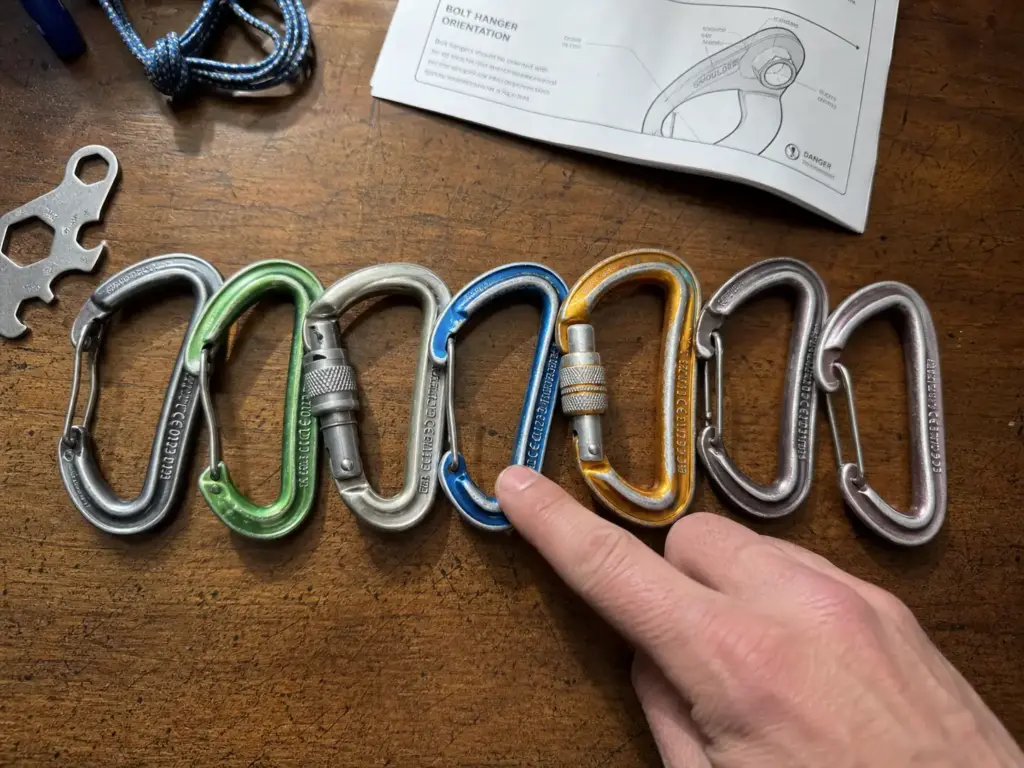
“UIAA certified” gets read like a sticker on a laptop. It is closer to a receipt for a set of destructive pull tests, and knowing which tests changes how much weight the stamped numbers can carry in your head. The UIAA 121 connector standard is the document behind every threshold in this section.
Three Rigs, Three Numbers
Certification is not one test. It is a battery of axis-specific pulls, each with its own minimum threshold, each run on a separate rig with a sample pulled until it fails. The three numbers on your spine are not calculated from a model. They come from parts that were destroyed in a lab so yours does not have to be.
The major-axis rig pulls eye to eye along the spine. The open-gate rig tapes the gate open and pulls eye to basket. The transverse rig pin-loads the frame from spine to gate interior, which is the physical setup that produces the minor-axis figure.
The Minimums a Carabiner Has to Clear
The major axis static strength requirement for certified climbing carabiners sits above 20 kN. Every UIAA-stamped biner in your gear bin has been pulled past the equivalent of two tons before it earned the mark.
The open-gate test carries a 7 kN minimum floor for basic connectors, which is why real-world gate-open strength stamps cluster just above it in the 6 to 9 kN band. Type K connectors, the edge-load rated ones used for via ferrata and some anchor applications, must also hold a minimum of 8 kN loaded over an edge, a scenario the standard three pulls never simulate.
The CE mark next to the UIAA logo points at the same testing through a different door. EN 12275 is the European standard for climbing connectors, and a carabiner sold legally in that market has cleared it before it ever reached the shelf. Two marks, one battery of destructive pulls behind both.
Understanding those thresholds is what converts the stamp from marketing into evidence. The common mistake is reading UIAA certification as a single pass or fail checkbox. It is a set of axis-specific floors, and once you know the floors, the numbers stamped above them start telling you something. The same logic shows up across the rest of your kit, and how UIAA standards work across the rest of your gear is worth understanding once rather than relearning per item.
The Carabiners That Never Get Tested
Then there is the hardware-store keychain biner with “NOT FOR CLIMBING” molded into it, or nothing at all. No stamp, no rig, no data, no test. It is a keyring. Treat it as one.
Shape, Gate and Where the Rating Comes From
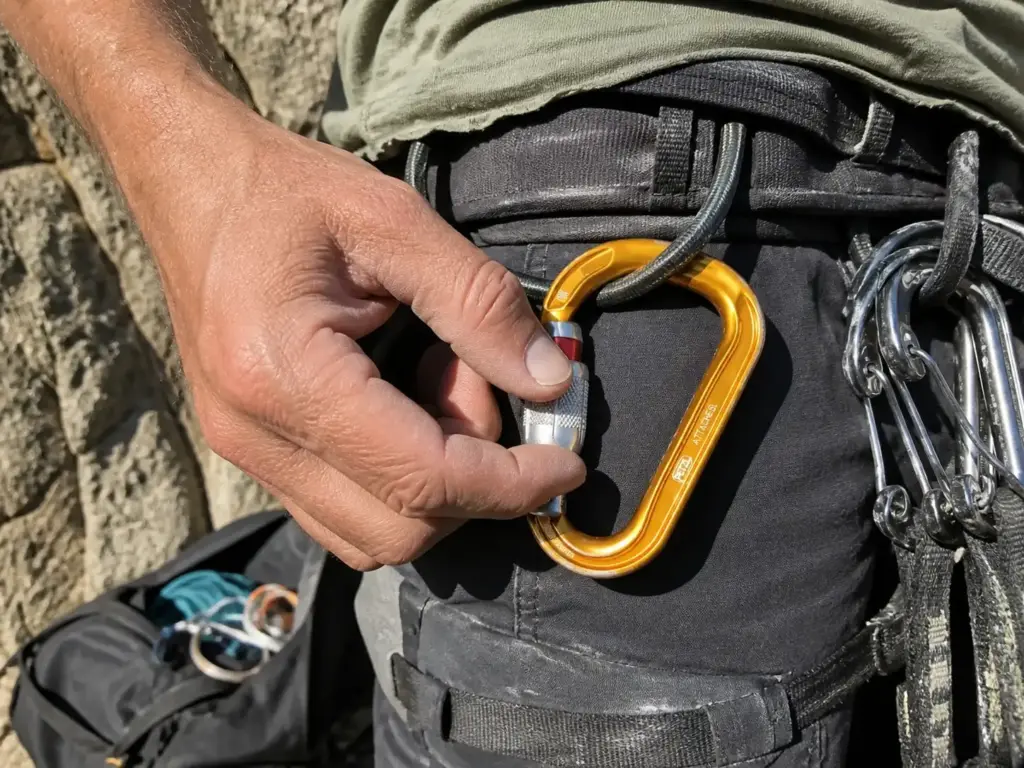
Two biners on the same rack can read 24 kN and 23 kN and behave completely differently in a real cross-load. The stamped number describes a pull test in a lab. The geometry decides whether that pull ever happens on your route.
Why Shape Changes the Numbers
The HMS carabiner, pear or pyriform shaped, is named for Halbmastwurfsicherung, the German word for the Munter hitch it was built to accommodate. Its wide basket end keeps a rope centered and gives it somewhere to sit, which resists rotation in practice even though nothing about that shows up on the spine. The Petzl Attache Screw-Lock is the purpose-built version of this idea, a light HMS screwgate meant for anchors and belays, which is exactly where multidirectional loading is plausible and minor-axis margin earns its keep.
D and offset-D shapes work the opposite way. They push load as close to the spine as the geometry allows, which is why D-shapes often carry the highest major-axis figures for their weight. Neither shape is better in the abstract. They are answers to different questions.
Gate Mass, Flutter and the Open-Gate Rating
Here is an argument that has nothing to do with any stamped number. A wire gate has far less mass than a solid gate, and less mass means less inertia, which means less gate flutter when a shock load rattles through the system. Less flutter means less time spent at open-gate strength during exactly the event where you need full strength.
That is a real safety property that no rating on the spine will ever describe. The Black Diamond MiniWire Rackpack is the physical version of the argument, a six-pack of ultralight wiregates built for rack and quickdraw duty where gate mass matters and a locking sleeve would just slow you down. A non-locking carabiner is not a compromise on strength, incidentally: the certification floors are the same, and plenty of wiregates post major-axis numbers that match their locking cousins. If you are picking the biners that end up on your first rack, the wiregate question is the first fork in that road.
Nose design matters for the same practical reason. A keylock nose has no notch to snag on a bolt hanger or a sling. A notched nose does, and a nose that catches on a hanger is one of the ways a carabiner gets rotated into a cross-load while you are looking somewhere else.
Locking Mechanisms and What They Actually Buy You
Screwgate, twist-lock and tri-lock all solve one problem: keeping the gate shut when you are not watching it. A screwgate is manual, which means it is only locked if you locked it. A twist-lock or tri-lock locks itself, which removes the human error but adds mechanism.
The honest tradeoff is that more automatic locking steps mean more moving parts to gum up with chalk and grit, and more ways to fail an inspection two seasons from now. Auto-lockers are not free. They trade one failure mode for another, and which trade you want depends on whether you trust your habits or your maintenance more.
When the Stamped Number Stops Being True
The rating is stamped into metal, which makes it feel permanent. It is not. It is a measurement of what that specific part could do on the day it left the factory, and that part has been living in your gear bin, in your trunk, and on the back of your harness ever since.
What Actually Degrades
Nothing about the stamped number updates as the carabiner ages. Rope grooves wear into the basket, the anodizing scuffs, the gate action gets gritty, and the number reads exactly the same as it did new.
Here is where honesty matters more than a confident figure: there is no published percentage of strength lost per year of use, and anyone who gives you one is inventing it. What the evidence supports is qualitative and still actionable. Wear does not shave a predictable slice off the rating each season. It changes the part in ways that are either acceptable or disqualifying, and your job is to tell which is which.
The Four Retirement Triggers
Four conditions end a carabiner’s working life regardless of what the spine says.
- Any visible crack anywhere on the frame, gate or nose. No exceptions, no “it’s only small.”
- A gate that will not function correctly after cleaning and lubrication. If it still sticks, hesitates, or fails to seat once it is clean, it is finished.
- Any significant drop, even with no visible damage at all.
- A deep rope-wear groove in the basket.
That last one is a two-part hazard, and the second part rarely gets mentioned. Rope groove wear weakens the carabiner, yes. It also creates a sharp edge that your rope now runs across under tension.
So you can retire a carabiner for the sake of the rope, not just for the sake of the carabiner. The full gate-play and wear inspection covers how to check each of these retirement criteria properly.
Why “It Looks Fine” Isn’t an Inspection
Aluminum alloy has an inconvenient property: a hard impact can alter its internal grain structure without leaving a mark you can see. A biner dropped forty feet onto talus can look showroom-new and still be compromised in ways no visual check will ever reveal. That is why the drop trigger exists as its own rule rather than as a prompt to go looking for dents.
The mistake that keeps showing up in climbing circles is hanging onto a biner with a sticky gate because it “still locks eventually.” A gate that hesitates is a gate that can sit open under load, which drops you to the open-gate rating at the exact moment you are asking the most of the part. Before you retire it, try cleaning and freeing up a sticky gate properly, because grit is a fixable problem and a worn hinge is not. If it still hesitates after that, the verdict is made.
Retire a dropped biner even when it looks perfect. The most common counterargument is that it landed on grass, or that it only fell from the first bolt. Both may be true. Neither tells you anything about the grain structure of the alloy, and a carabiner is the cheapest thing on your harness to replace.
Does a Cheaper Carabiner Mean a Weaker One
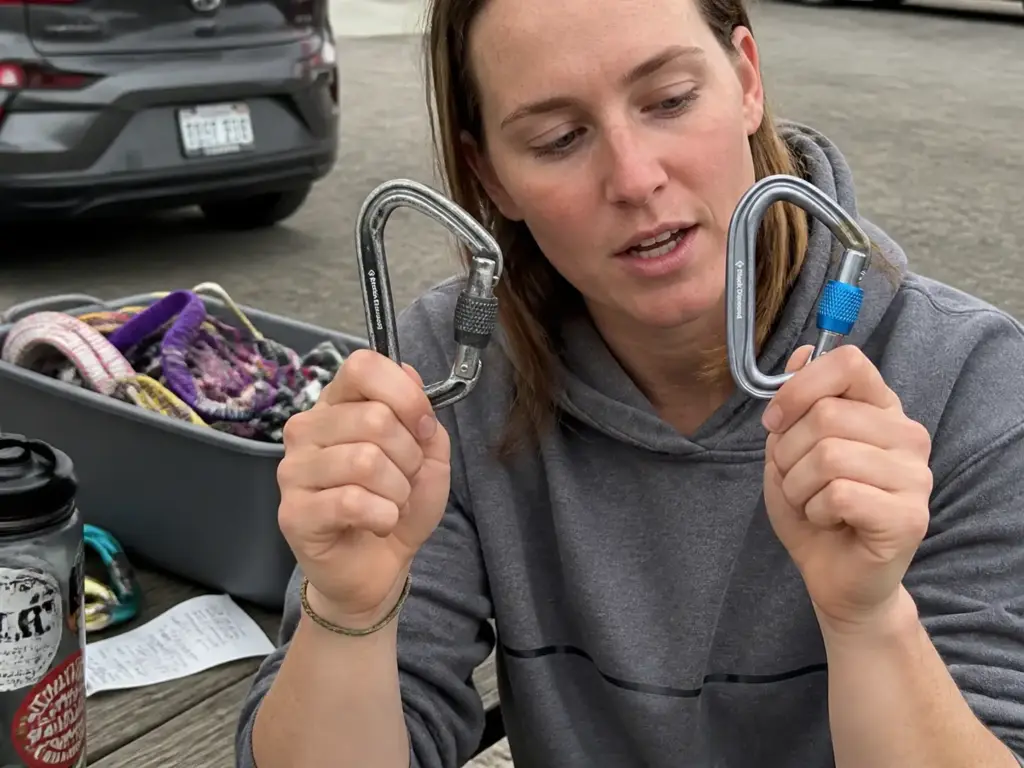
Standing at the gear wall doing the math on a first rack, the cheap biners feel like the corner you should not cut. That instinct is healthy. It is also aimed at the wrong target most of the time.
What the Certification Floor Guarantees
UIAA 121 is a pass or fail floor, not a sliding scale. A budget wiregate and a premium screwgate that both carry the stamp have both cleared the same minimum thresholds on the same rigs. There is no such thing as more certified.
The Black Diamond HotForge Screwgate is the plain example. Hot-forged aluminum, a simple screw sleeve, priced for someone assembling a first rack, and it clears the identical certification floor as anything hanging next to it on the wall. A climber whose entire locker collection is HotForges is not operating with less margin than a climber with a rack of premium lockers.
What Extra Money Actually Buys
Spending more is not pointless. It buys weight savings, better gate action, smoother ergonomics, a keylock nose that will not snag, more sophisticated locking mechanisms, and better anodizing that survives more seasons of grit.
Every one of those is real value, and on a long multi-pitch day the grams and the gate action are worth having. None of them is raw strength margin. You are buying a better tool to use, not a bigger safety buffer.
The One Place It’s Worth Paying Up
Here is the honest version of the exception, and it is not “premium is safer.” It is that a higher minor-axis rating buys margin in setups where cross-loading is genuinely plausible: anchors, a top-rope anchor masterpoint, belay-loop carabiners. That is a setup question, not a price question, and it usually points you toward shape and locking mechanism rather than toward the most expensive item on the shelf. Your belay carabiner in particular gets chosen alongside the belay device it is going to live on, because those two parts have to work together every single day you climb.
Flat position, stated once: if a carabiner is certified and undamaged, the certification floor already provides more than enough margin for normal climbing use. Buying up the price ladder to purchase safety margin you already have is the wrong reason to spend money.
What you should refuse to buy is a different list entirely. Uncertified accessory carabiners. Anything with no stamp on the spine. Used hardware with an unknown drop history, however good the deal looks, because you cannot inspect your way to knowing what happened to it before you owned it.
Reading the Numbers at the Crag

All of this collapses into about four things you actually check, and none of them takes longer than the walk from the car to the base.
The Four Things Worth Checking
First, read the minor-axis and open-gate numbers when you buy, not the major axis. The big number will be fine on anything certified. The two small ones are what constrain your real setups.
Second, match the biner to the load path instead of to the biggest number. HMS on the belay loop where the basket keeps the rope centered, D-shapes where load runs clean through the spine, lockers anywhere rotation is plausible.
Third, do the pre-clip glance: is anything in this setup free to rotate? A bulky knot, a wide hanger, a fat masterpoint, a biner clipped to two things at once, a locker pulled sideways off a gear loop. If the answer is yes, either fix the geometry or accept you are relying on the minor-axis number.
Extending a draw to keep the load running straight is often the fix, and it solves rope drag at the same time. Where two carabiners share a critical clip, the old opposite and opposed habit exists for the same reason: it makes rotation and gate-open loading harder to achieve by accident.
Fourth, run the inspection: cracks, gate function, drop history, groove wear. Four items, ten seconds.
Building the Habit Into Your Rack-Up
At some point you stop reading the stamped numbers, because the check moves into your hands. You feel a gate that hesitates a fraction before you consciously register it. You re-seat a biner sitting crooked on a hanger without deciding to. The reading happens through your fingers, and that only comes from doing it deliberately long enough for it to stop being deliberate.
Two things this article intentionally leaves alone: building the anchor itself, and choosing which quickdraws belong on your rack. Both have their own answers, and both live in their own articles rather than as footnotes here.
Conclusion
The big number describes exactly one load direction. The two small numbers describe every other direction, and those are the ones your real setups can actually reach.
A certified carabiner carries enormous margin on the major axis and thin margin on the minor axis. That is why how you clip matters more than what you paid, and why geometry beats a spec sheet.
The stamped rating is a day-one number. A crack, a hesitant gate, a hard drop, or a deep rope groove ends it regardless of what the metal says.
Next time you rack up, pull one biner off your harness and read all three numbers off the spine. Then look at where it is clipped and ask whether anything in that setup is free to rotate. That is this entire article, done in ten seconds at the base of a route.
Frequently Asked Questions
01What does 25 kN mean on a carabiner?
25 kN is the carabiner’s major-axis strength, about 5,620 lbs of force, loaded lengthwise through the spine with the gate closed. That figure only applies in that exact orientation. The same carabiner rates far lower cross-loaded or with its gate open.
02What does 12 kN mean on a carabiner?
12 kN is roughly 2,700 lbs of force. On a climbing carabiner that figure usually belongs to a minor-axis or specialized rating rather than the major axis, since certified carabiners must clear more than 20 kN lengthwise, so check which axis the stamp describes.
03What does 22 kN mean on a carabiner?
22 kN means the carabiner held about 4,950 lbs in the major-axis pull test before failing. It is a normal certified rating and sits comfortably above the UIAA 121 minimum of 20 kN that every climbing-rated carabiner has to clear.
04How much weight can a 7 kN carabiner hold?
7 kN is approximately 1,575 lbs of force. A 7 kN figure on a carabiner spine almost always refers to the minor-axis or open-gate rating, not the major axis. It is the strength left when the carabiner is loaded sideways or its gate is open.
05How much weight can a 25 kN carabiner hold?
Around 5,620 lbs of force on the major axis, which is where the pickup truck comparison comes from. The caveat matters more than the number: cross-load that same carabiner and you are working with roughly 7 to 10 kN, and open its gate and you are near 6 to 9 kN.
Safety Notice: Rock climbing and mountaineering are inherently high-risk
activities that can involve physical trauma or fatal incidents. The information on Rock Climbing Realms is for
educational and informational purposes only. Techniques and advice presented here are not a substitute
for professional, hands-on instruction. Conditions and risks vary by location. Always seek guidance
from a qualified instructor before attempting new techniques. By using this website, you agree that you
are solely responsible for your own safety. Any reliance you place on this information is strictly
at your own risk, and you assume all liability for your actions. Rock Climbing Realms and its authors
will not be held liable for any harm, damage, or loss sustained in connection with the use of this information.
Affiliate Disclosure: We are a participant in the Amazon Services LLC Associates Program, an
affiliate advertising program designed to provide a means for us to earn advertising fees by advertising and linking
to Amazon.com. As an Amazon Associate, we earn from qualifying purchases. We are also an official affiliate partner
of Black Diamond Equipment via the AvantLink network. If you click on a Black Diamond affiliate link and make a
purchase, we may earn a commission at no additional cost to you. We also participate in other affiliate programs.
Additional terms are found in the terms of service.