


In this article
You are forty feet runout, forearms screaming from the cold, desperately trying to clip a rigid rope into a micro-carabiner the size of a paperclip. That is when you realize “ultralight” gear comes with a brutal trade-off. Everyone loves a light pack on the approach. But when you are pumped solid, dropping an ultra-tiny cam because you cannot feel the trigger wires through your gloves is a real nightmare.
By calculating true strength-to-weight ratios through the strength-to-weight efficiency index, you will learn how to optimize your climbing rack’s mass without compromising critical UIAA safety margins or handling ergonomics when you need them most. Our gear should work for us, not turn into a fumbling liability mid-route. The physics are unambiguous. We have to separate the engineering reality from the trailhead hype.
| Climbing Gear Specifications | |||
|---|---|---|---|
| Gear Item | Weight | Major Axis Strength | Efficiency Ratio |
| Edelrid Nineteen G | 19.5 g | 20 kN | 1.02 kN/g |
| CAMP Nano 22 | 22 g | 21 kN | 0.95 kN/g |
| Black Diamond Z4 (.3) | 55 g | 8 kN | 0.14 kN/g |
| Totem Cam (0.50) | 69 g | 6 kN | 0.08 kN/g |
| Petzl Sitta (Harness) | 275 g | N/A | N/A |
⚡ Quick Answer: Optimizing your climbing rack means analyzing the strength density of your gear, not just buying the lightest piece available. Evaluate the carabiner’s kN/g ratio to balance mass with ergonomic reliability. A sub-20-gram wiregate saves weight but costs you critical handling speed when pumped. True weight optimization requires matching the gear’s physical limits and metallurgical trade-off directly to your specific alpine or sport climbing objective without risking premature wear or catastrophic failure.
The Physics of Strength vs. Weight: Redefining “Light”

The Dynamic Force of a Fall Factor
Most climbers talk about weight as if it is a rigid number dragging them down. They forget that gear is a life-support system built to handle sudden, violent violence. When you peel off a route, you take a massive hit. That energy has to go somewhere. The rope absorbs it, stretching to keep your organs intact. But the gear taking the hit feels an incredible dynamic force.
We measure impact force in kilonewtons (kN). One kN equals about 225 pounds. Taking a massive whip usually keeps the top-piece impact below six kN, but the rope creates a pulley effect through your top carabiner. A 4 kN fall translates to almost 8 kN ripping at that top placement. That is exactly why your gear needs huge safety margins.
Metallurgical Limits: 7075-T6 Aluminum
Manufacturers forge 7075-T6 aluminum into high-end hardware for a reason. Standard 6061 aluminum works fine for water bottles, but 7075-T6 gives you almost double the strength for a tiny four percent mass penalty.
That specific alloy is the only reason engineers can carve hollow channels into carabiners, creating the aggressive I-beam cross-sections we all use. You get the holding power you need without feeling like you are dragging a sack of hammers up a multi-pitch.
UIAA Safety Margins in Real Scenarios
Pro-Tip: Never rack a retired piece next to your active gear. Once a carabiner is downgraded to your dog’s leash, paint the spine bright red. Keep your core rack sacred.
If you spend time understanding UIAA retirement guidelines and impact forces, you quickly learn the baseline minimums. According to the UIAA Standard 121, a standard connector must carry a major axis strength of 20 kN. This means the carabiner can hold over 4,400 pounds when loaded correctly from top to bottom with the gate shut tight.
You might think 20 kN is overkill. You might assume your optimized rack only needs to hold a fraction of that. The physics here are unambiguous: a ground-fall hurts just as much no matter how ‘fast and light’ your rack was. Those massive margins exist to cover you when the material degrades. Sand grinds into the hinges. Sun-baked slings lose their elasticity. That 20 kN rating is your safety net against the inevitable wear and tear of real-world use. This Black Diamond Engineering video illustrates this limit under drop test conditions.
Carabiner Efficiency Index: Calculating the kN/g Ratio
The Threat of Gate Whiplash
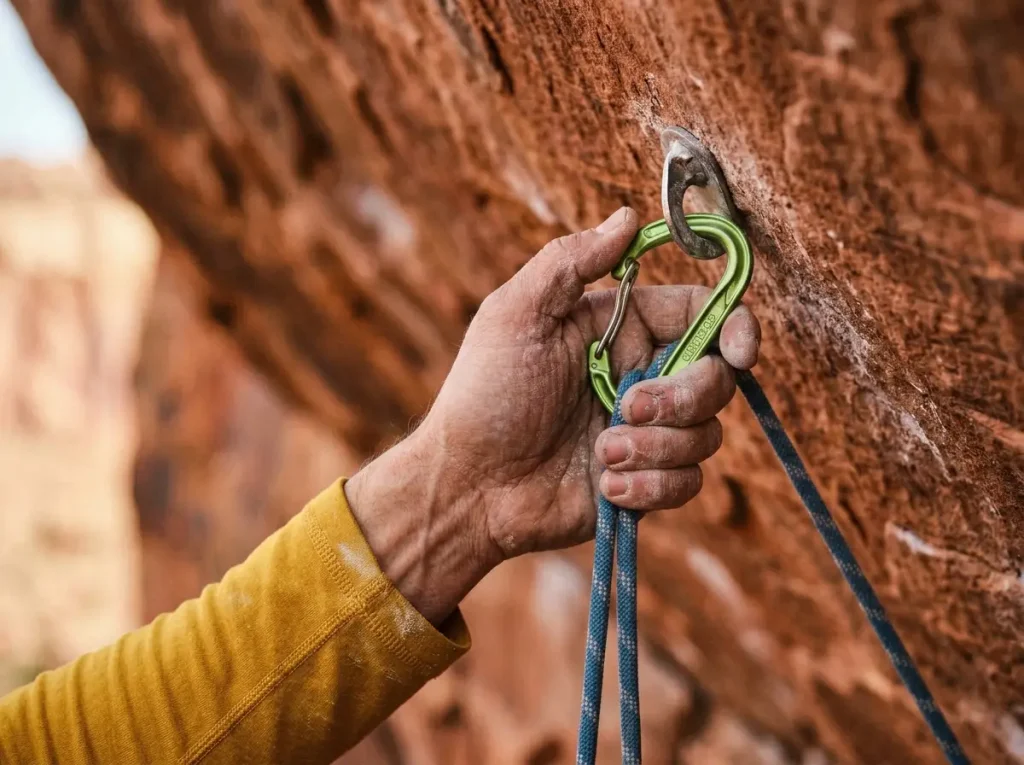
Decades ago, climbers dragged heavy solid-gate oval carabiners. Then wiregates stripped away the excess mass. The primary goal of a wiregate is not just to save weight on the long approach. It solves a terrifying physical problem known as gate whiplash.
When you fall, the carabiner violently slams against the rock or vibrates furiously under the sudden tension of the rope. If the carabiner uses a heavy, solid gate, that mass has its own inertia. The vibration can literally force the heavy gate to overcome its spring tension and snap open for a split second. If the rope loads the device at that exact instant, the carabiner engages its open gate strength. You instantly lose up to sixty percent of the piece’s structural integrity. Because wiregates lack that mass, they reduce rotational inertia. They stay shut when things get violent.
Breaking Down the kN/g Ratio Data
Instead of chasing the lightest carabiner on the market, you should analyze the weight-to-strength ratio. We use the Efficiency Index to map this out: dividing the major axis strength by the actual mass in grams.
The Edelrid Nineteen G weighs 19.5g and holds 20 kN, yielding a 1.02 kN/g ratio. The CAMP Nano 22 weighs 22g giving you 21 kN (0.95 kN/g). You take a three-gram hit, but gain a critical kilonewton of safety density. A standard Petzl Spirit clocks in at 39 grams. Its ratio is lower, but the heavy keylock nose means it will not snag when cleaning overhung routes. True optimization means knowing exactly what you pay for in every gram.
The Ergonomic Penalty of Micro-Carabiners
Using a 19-gram micro-carabiner is an engineering flex until you are pumped solid and fumbling with a 17mm gate opening with numb fingers. When you are sketching out on a runout slab, a microscopic piece of metal suddenly feels impossible to clip.
This ergonomic penalty matters. Consider building alpine draws with micro-carabiners for placements where clipping speed is less critical. Save micro hardware for pieces you clip from comfortable stances. Keep beefy, wide-gated carabiners for desperate redpoint clips.
Active Protection Engineering: The Cam Weight Trap

Material Removal Through Hot Forging
Designing a modern spring-loaded camming device is a nightmare of compromises. You need a wide cam expansion range, insane holding power, and it must weigh nothing. The most common solution is hot forging. By heating aluminum alloys to somewhere between 360 and 520 degrees Celsius, engineers can mold the lobes like clay.
This heat refines the internal grain structure of the metal. It allows brands to sculpt deep weight-saving cutouts into the cam lobes. The Black Diamond Camalot C4 and the Camalot Z4 series use this heavily. They shave away every millimeter of non-structural metal. You get a piece of active protection that holds falls just as well as the solid chunks of aluminum from twenty years ago, but it weighs significantly less.
Single vs. Dual-Axle Physics
A dual-axle cam acts as a static wedge. If it walks deep into a crack and opens like an umbrella, it maintains passive strength. You can weight it without the lobes buckling.
Single-axle micro cams strip out that second axle to save weight, sacrificing that passive umbrella protection. Single-axle cams are required by the UIAA 125 rules to hold at least 5 kN. To bridge this gap, modern ultralight cams replace steel cable stems with a heavily braided Dyneema core. A micro-cam that saves you 40 grams is useless if its single-axle constraints allow it to walk deeper into a crack out of reach. That is precisely why you need a strict maintenance cycle for replacing degraded Dyneema slings. That material is brilliant at holding static loads, but it degrades entirely differently than a rigid steel cable.
Direct Loading Dynamics in Complex Placements
Pro-Tip: Always carry a dedicated nut tool, but learn how to use the wiregate of a loose carabiner to tap a stuck cam lobe backward. Sometimes that blunt metal is all the leverage you need.
Not all cams load force the same way. Standard dual-axle designs channel the energy of a fall down through the stem. But Totem cams flipped the script. They use a proprietary direct loading system that channels the load directly to each of the four individual lobes.
This matters immensely in flared cracks or blown-out pin scars where only two or three lobes achieve decent contact. Because the load hits the lobes individually, the unit resists walking and generates gripping power even in terrible placements. You can actually load only two of the lobes while aid climbing. Doing so cuts the active strength rating in half to roughly six kilonewtons. That is plenty for holding weight weight, but you would never want to take a dynamic whip onto half a cam.
Soft Goods Calibration: Slings, Ropes, and Harnesses

Nylon vs. High-Modulus Polyethylene (Dyneema)
Climbers fixate on hardware, getting obsessed with the shine of fresh anodized aluminum. But soft goods add up fast. The fabric you rack with is where you actually hide your mass. Decades ago, tubular nylon was the absolute standard. It soaked up water like a sponge.
Then came high-modulus polyethylene, which you almost certainly know as Dyneema. It is ridiculously strong for its weight and almost entirely ignores water. A thin 12-millimeter Dyneema sling often holds 22 kN, which easily outperforms thick, bulky nylon. But it has a terrifying dark side. Dyneema has effectively zero elasticity. It will not stretch. It also has a shockingly low melting point. Using Dyneema slings for a dynamic shock load without an elastic rope in the system is a guaranteed hospital trip. It will violently break wdo not toleratever is attached to the ends if forced to absorb a sudden drop.
Harness Load Distribution Without Mass
Your harness is the one piece of gear you stop thinking about when it fits right. Buy cheap, and you will spend the next six months wondering why your legs go numb on long hanging belays. The old solution was sewing bulkier foam padding onto the waistbelt.
Modern engineering tossed the foam. Look at the Petzl Sitta. It uses high-modulus polyethylene strands woven directly into the waistbelt to spread the load across a massive surface area without adding an ounce of bulk. This gives you incredible mobility and shaves your baseline weight down to 275 grams. But the thinner material forces you into taking care of your gear properly. You need to get serious about assessing UV degradation and belay loop wear. Thinner materials have less backup structure when abrasions inevitably begin severing strands.
Dynamic Rope Weight per Meter Analytics
Your rope is the heaviest single item you carry up the wall. Period. We measure rope weight in grams per meter, and every millimeter of diameter forces you to haul significantly more mass. A skinny rope diameter compatibility changes how you build your kit.
The Beal Opera alpine rope weighs 48 grams per meter. Compare that to a beefy 9.8-millimeter sport workhorse at 62 grams per meter. Hauling that thicker rope sixty meters up a vertical face adds enormous drag. But that skinny cord requires a high sheath percentage and strict UIAA water repellent treatments to survive razor-sharp granite. You trade durability for a lighter pack. You will burn through an ultra-skinny rope three times faster at your local sport crag.
The “Anti-Sell”: When Light Gear Increases Fatal Risks
The 3mm Wear Threshold
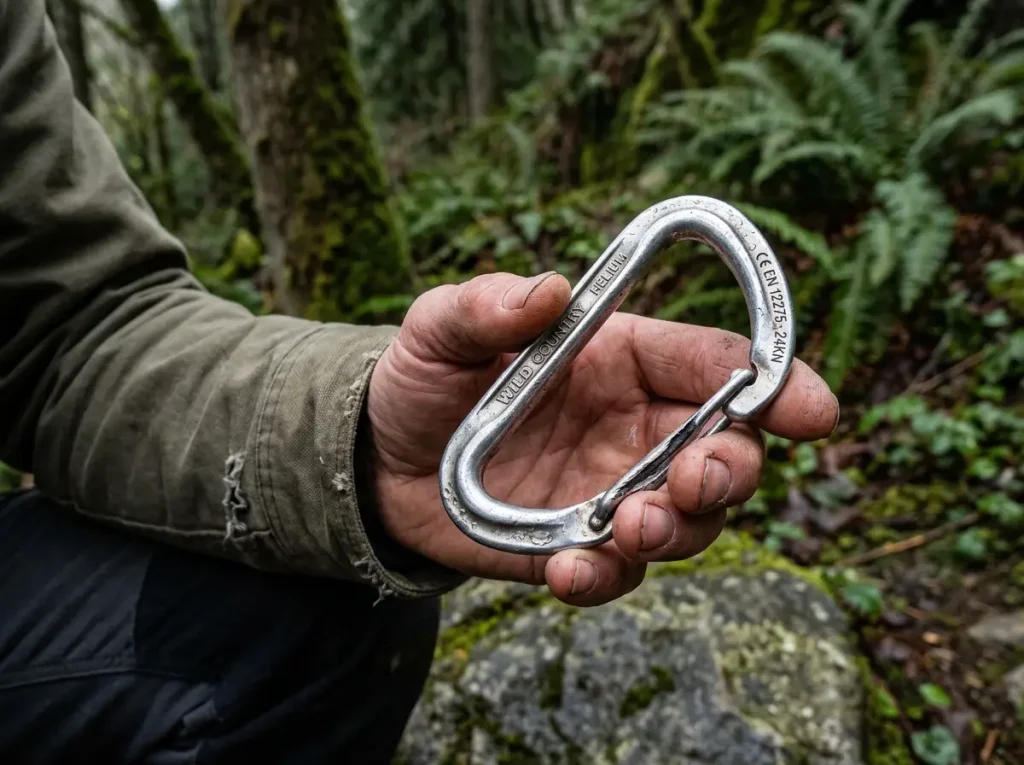
Every gram of metal removed from a carabiner means less material between you and failure. A gritty, dirt-filled rope acts like a bandsaw across an aluminum carabiner basket, carving a groove deep into the metal.
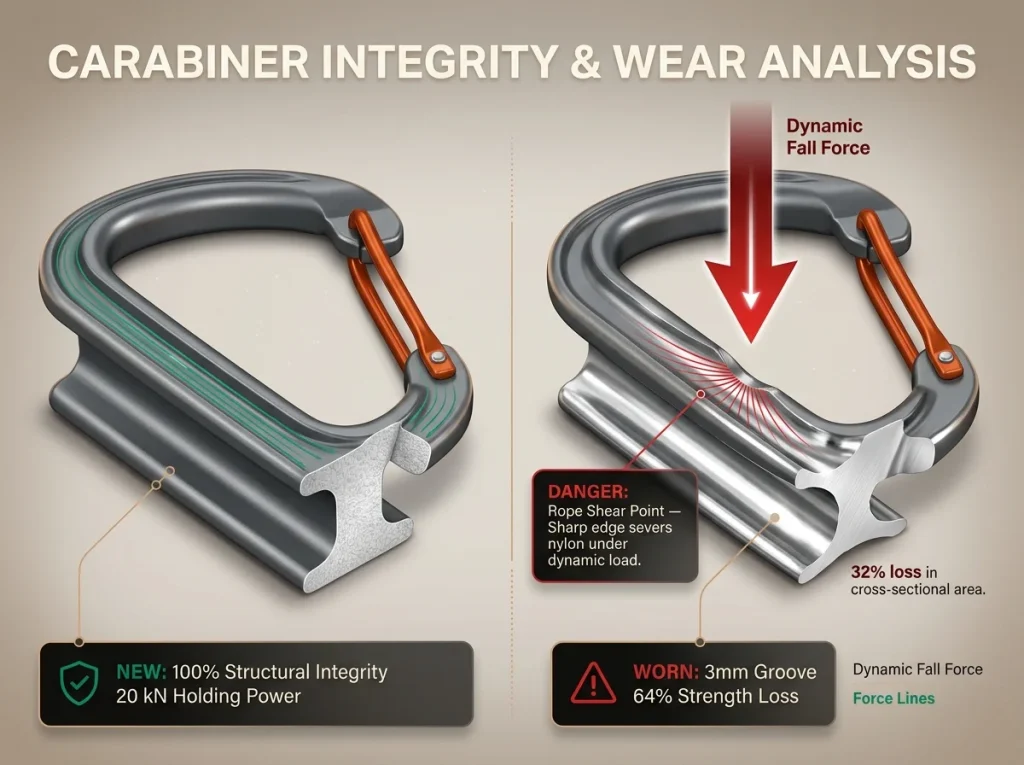
This is the great anti-sell of lightest-in-class gear. As you wear down that I-beam structure, you inch closer to the three-millimeter critical threshold. A three-millimeter deep groove translates to roughly a 32 percent loss in the cross-sectional area of that aluminum stock.
That tiny reduction initiates a staggering 64 percent plunge in load-bearing capacity. The carabiner drops below eight kilonewtons of total strength. A runout above a 3mm-grooved, ultralight aluminum permadraw is essentially a game of Russian Roulette. The rope will shear like warm butter. This is why preventing anchor failures during technical descent relies entirely on inspecting for wear, not just verifying the original safety rating stamped on the side of the gear.
Rope Shearing from Accelerated Deformation
Look closely at the first bolt on any massively popular, overhanging sport route. You will usually find a fixed steel carabiner there. That is not an accident. Steel wears incredibly slowly. If that draw was left with a soft, lightweight 7075-T6 aluminum carabiner, the aggressive swing of falling climbers would rapidly carve sharp edges inside the rope grooves.
Under a high impact, a tight, unrounded groove does not simply hold the rope. It acts as a shear point. It grabs the nylon fibers and violently severs them. Your rope won’t snap from the tension; it gets sliced in half by the very gear meant to catch it. You have to ruthlessly audit your rack. If you can feel a sharp edge inside the basket of your carabiner with your fingernail, that piece is done. Retire it immediately.
Durability Limits of Dyneema Stems
The soft goods on your cams will fail long before the metal lobes stop working. Those sculpted Dyneema cores inside an ultralight cam flex beautifully and save precious grams. But they absolutely do not tolerate ultraviolet light. They do not tolerate abrasion even more.
Dragging an ultralight cam across sandstone damages those exposed fibers. Do not fall into weight traps where you refuse to retire worn gear just because it was expensive. Your post-season durability check must be ruthless. Fraying stems get sent back for a resling or trashed. Do not bet your life on fuzzy webbing.
The Optimized Rack Blueprints

The 5lb Alpine Speed Kit Definition
When you are climbing in the deep alpine, speed directly correlates to safety. Outrunning a thunderstorm requires dropping the dead weight. We define the five-pound alpine speed kit as an incredibly specific loadout that emphasizes a maximized power-to-weight ratio over basic durability.
You build this base with Black Diamond Camalot Ultralights, shaving the weight down to roughly 618 grams for a rack from size .4 through number three. Rack them on the absurdly light Edelrid Nineteen G wiregates. Use Petzl Ange Finesse quickdraws to trim bulk. Add the minimalist Petzl Sitta harness. Wrap it together with a high-end, 9.0-millimeter dry rope. You end up carrying roughly 2.1 kilograms of highly specialized engineering. It climbs like a dream, but you have to treat it with extreme care. You do not yard on this gear while figuring out a project.
The Redpoint Sport Kit Configuration
Pro-Tip: Rack your quickdraws with the gate openings facing out from your weight. You will naturally grab the spine instead of fumbling the gate when pulling them off your harness.
Compare that alpine kit to an aggressive redpoint sport configuration. Here, you accept a heavier penalty precisely because you demand total ergonomic reliability. You are not walking for six hours to reach the base of the route. You need gear that clips fast when your forearms are flooded with lactic acid.
Load up twelve Petzl Spirit Express quickdraws. Put on a heavy padded Black Diamond harness. Drag a thick, massive 9.5-millimeter dynamic workhorse rope behind you. Yes, you are adding nearly a full kilogram of excess weight. But the wide, solid gates of those heavy carabiners clip perfectly every single time. They sit exactly where you expect them to. The thick rope takes hundreds of falls without frying the sheath. This kit prioritizes tactile feeling over gram shedding.
System Synchronization and Final Checks
If you are swapping solid-gate workhorses for 22-gram wiregates on your everyday gym harness, you are sacrificing safety for an ego metric. Ultralight alloys have a specific purpose. You do not drive a Formula One car to the grocery store.
Before every season, lay out your entire rack. Separate your high-traffic redpoint kit from your fast-and-light alpine setups. Check every minor axis strength rating. Run your thumbs inside every rope basket to hunt for the dreaded grooves. Understanding exactly how to implement your optimizing your trad racking strategy means matching the capacity of the metal to the reality of the rock you are about to climb. The best gear logic is completely objective.
Conclusion
Optimization is entirely about tracking strength density, not just minimizing your raw weight. Your ultralight cams and tiny wiregates require meticulous, obsessive inspections to avoid critical wear limits. You now know exactly why the industry relies heavily on 7075-T6 aluminum to build an uncompromised structural backbone that holds violent dynamic forces.
Apply this efficiency index to audit your own kit tonight. Retire your compromised, heavily grooved metal. Intentionally separate your fast-and-light alpine arsenal from your high-traffic project rack. Respect the physics of the fall, build a system you can clip when you are blind with fatigue, and trust the engineering.
FAQ
How much does a full trad rack weigh?
A full trad rack double set of cams from 0.4 to #3, along with a set of nuts and 12 alpine draws, typically weighs between 4.5 and 6 pounds. Transitioning to a heavily optimized setup with micro-carabiners and Dyneema stems can significantly drop this payload by roughly thirty percent.
Are lighter carabiners less safe?
Lighter carabiners are strictly certified to handle UIAA 121 standards of 20 kN, but their aggressive I-beam carving leaves far less metal in the rope basket. This rapidly accelerates deep rope grooving and forces them to hit the critical three-millimeter retirement threshold well before traditional solid stock designs.
What is the lightest climbing harness?
The Petzl Fly, designed for fast ski mountaineering, leads the ultra-minimalist category hitting the scales at just 130 grams. Yet for climbers needing real load distribution and true technical durability, the woven HMPE lines inside the lightest climbing harness models like the 275-gram Petzl Sitta remains the absolute gold standard.
How many grams is a Black Diamond Camalot?
Real weight depends drastically on the exact generation and size of the head. A standard Camalot C4 in size #1 comes in at 124 grams, while its direct Camalot Z4 or Ultralight counterpart drops to 101 grams strictly by stripping the heavy steel cable out and substituting a sculpted Dyneema core.
Safety Notice: Rock climbing and mountaineering are inherently high-risk
activities that can involve physical trauma or fatal incidents. The information on Rock Climbing Realms is for
educational and informational purposes only. Techniques and advice presented here are not a substitute
for professional, hands-on instruction. Conditions and risks vary by location. Always seek guidance
from a qualified instructor before attempting new techniques. By using this website, you agree that you
are solely responsible for your own safety. Any reliance you place on this information is strictly
at your own risk, and you assume all liability for your actions. Rock Climbing Realms and its authors
will not be held liable for any harm, damage, or loss sustained in connection with the use of this information.
Affiliate Disclosure: We are a participant in the Amazon Services LLC Associates Program, an
affiliate advertising program designed to provide a means for us to earn advertising fees by advertising and linking
to Amazon.com. As an Amazon Associate, we earn from qualifying purchases. We are also an official affiliate partner
of Black Diamond Equipment via the AvantLink network. If you click on a Black Diamond affiliate link and make a
purchase, we may earn a commission at no additional cost to you. We also participate in other affiliate programs.
Additional terms are found in the terms of service.