
In this article
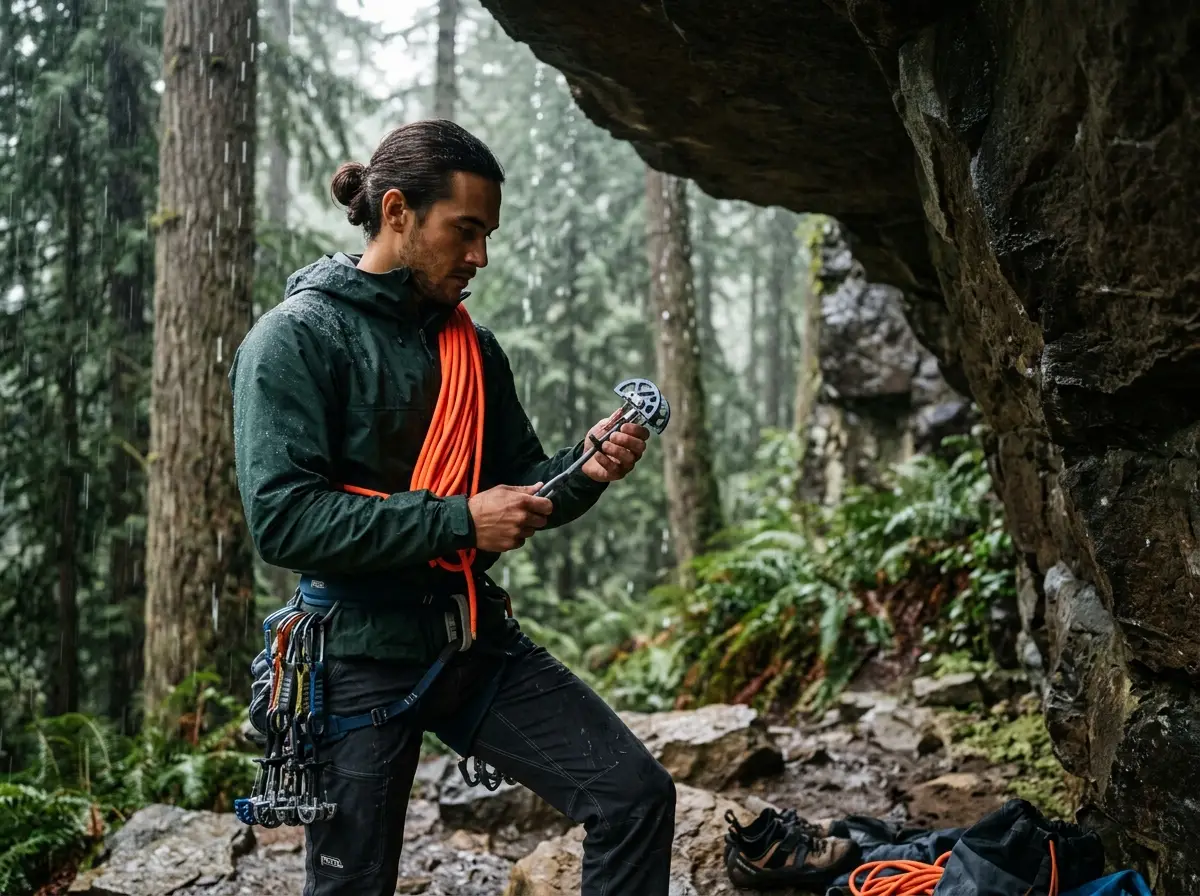
You’re already in the parking lot. Engine off. Rain hammering the windshield in sheets. The sandstone wall you’ve been projecting for six weeks is turning a deep orange-brown as it soaks up every drop. The knot in your chest — not the good kind — starts forming. Most climbers do one of two things at this point: they drive home and sit on the couch, or they rope up anyway. Neither is what the pros do.
A rainy day is not a training holiday. It’s a pivot to a different discipline. Experienced climbers treat it as a scheduled rotation: a geological safety check, an evidence-based indoor session, and a technical systems block that builds skills most people never bother to train. Here’s the exact protocol.
⚡ Quick Answer: Wait a minimum of 48–72 hours after heavy rain on sandstone — regardless of how dry the surface looks. Saturated sandstone loses up to 40% of its compressive strength, and failure happens silently. Hard granite on a south-facing aspect can be ready in 2–4 hours. On rain days, run a structured hangboard session using the Eva Lopez MAW or IntHangs protocol, do antagonist band work, and practice knot mastery or Z-drag rigging. These are not substitutes for cragging — they build skills the rock doesn’t teach you.
Why You Can’t Just “Touch It and Tell” — The Geology of Wet Rock
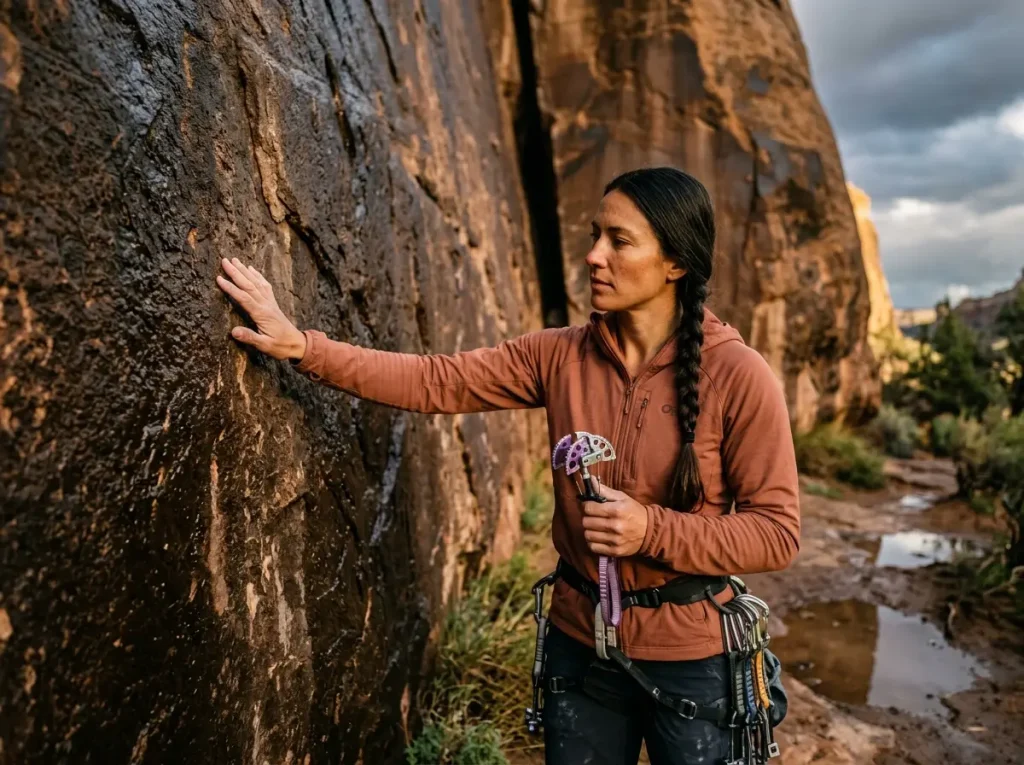
Here’s the thing nobody tells you at the crag: you can’t feel what’s happening inside the rock. Touch a sandstone wall four hours after rain and it might feel surface-dry. It isn’t. The outer layer desiccates while the pore network inside is still saturated, and that interior is where your hold’s structural integrity actually lives.
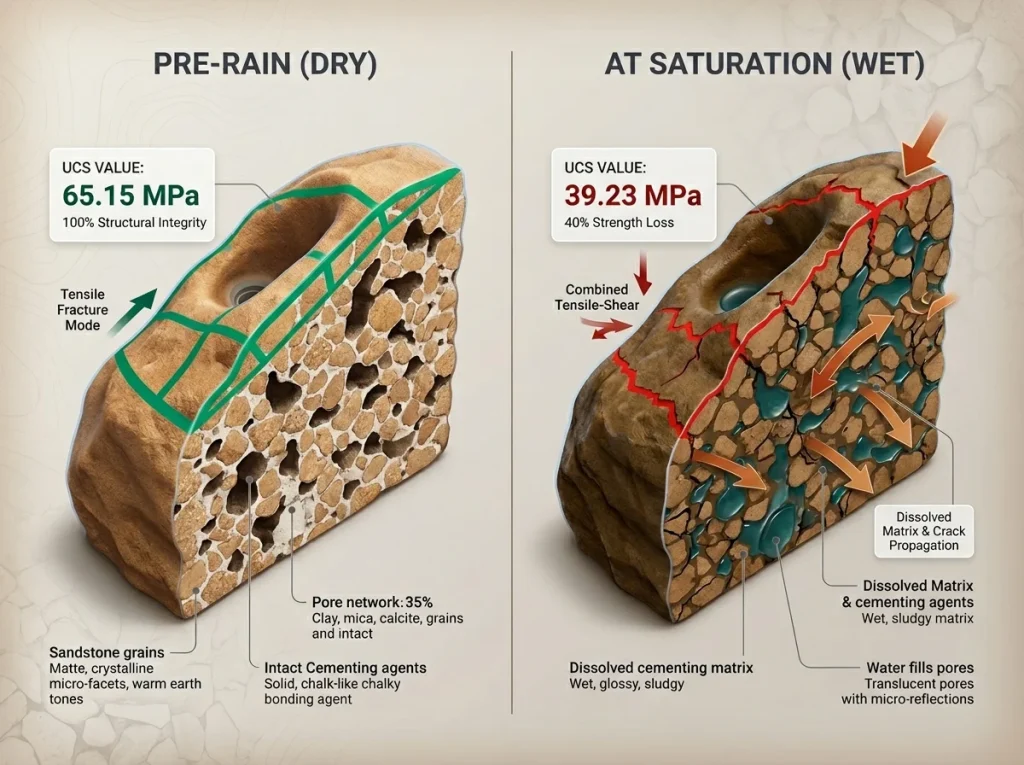
The research on this is unambiguous. Studies on the failure behavior of saturated sandstone show that fully saturated yellow sandstone loses 40% of its compressive strength — dropping from 65 MPa dry to just over 39 MPa wet. Water doesn’t just coat grain boundaries; it dissolves the cementing agents (clay, mica, calcite) that hold the grains together. Once water content crosses a critical saturation threshold in certain sandstone types, the degradation rate stops being linear and accelerates sharply. You can’t “partially wet” sandstone and expect proportional damage.
What makes this genuinely hazardous is that sandstone porosity can reach up to 35% by volume. The rock absorbs water like a sponge and releases it from the inside out. That “colder than surrounding rock” sensation when you press your palm flat against the wall post-rain? That’s ongoing evaporative cooling from deep within the pores. The surface is ahead of the interior by several hours. This is why experienced climbers refer to the wet rock rule for desert climbing before letting anyone touch sandstone before the 48-hour mark. The rule isn’t conservative for its own sake. The geology wrote it.
There’s another failure mode most people don’t know about. Wet sandstone doesn’t crack loudly the way dry rock does under load. Because the water changes how energy moves through the grain structure, saturated rock fails through multiple small, quiet events — the energy signature drops by over 90% compared to dry stone. You won’t hear a creak. You won’t feel the hold shifting. It just comes off. That’s what makes the 48-hour rule non-negotiable on sandstone, not optional.
Sandstone, Limestone, Granite — Not All Rock Reacts the Same
Granite is a fundamentally different material. Its interlocking crystalline structure leaves very little internal space for water, so the structural integrity change after rain is far less severe. South-facing granite on a sunny day can be climbable two to four hours after a shower. Limestone sits in between: calcite slowly dissolves in acidic rainwater, edges polish over time, and 12–24 hours is a reasonable wait after significant precipitation. Sandstone is the one that will get you — and the ground at the base of the crag is your simplest field test. If the soil is still damp, the rock is not ready.
Western and south-facing aspects dry faster because peak daily temperatures coincide with maximum solar exposure in the afternoon. Use aspect and wind as your guide, not just elapsed time. A wall in full afternoon sun with a dry westerly blowing is drying faster than the shaded wall around the corner, even if the rain stopped at the same time.
Pro tip: Crags in areas with high industrial air pollution or naturally acidic rainfall can see accelerated sandstone degradation — up to 41% reduction in stiffness versus neutral environments. If you’re climbing at a crag near mining operations or industrial zones, extend your wait window and inspect holds more critically.
What Wet Rock Does to Your Gear — The Cam Physics You Need to Know
This is where things get technically serious. Cams hold through a geometry where the curved lobe shape creates constant outward force against the crack walls regardless of crack width. The critical condition for a cam to keep holding: the friction between the lobe and the rock must exceed a threshold set by the cam’s angle. On dry granite, aluminum-on-rock friction gives a comfortable safety margin above that threshold.
Wet rock collapses that margin. Friction can drop below the critical cutoff on wet surfaces — and at that point, the cam doesn’t visually walk out. It loses grip and ejects under the sudden load of a fall. Clay and silt introduced into cracks by rain create what engineers call pseudo pore pressure between the cam lobe and wall, further reducing how hard the lobe can push against the rock. A cam may also slip on a wet section of crack and then “bite” into a drier patch, creating a shock load that can exceed what the aluminum axle can handle. For the full baseline on how camming devices generate holding power, that guide covers the geometry and materials in full.
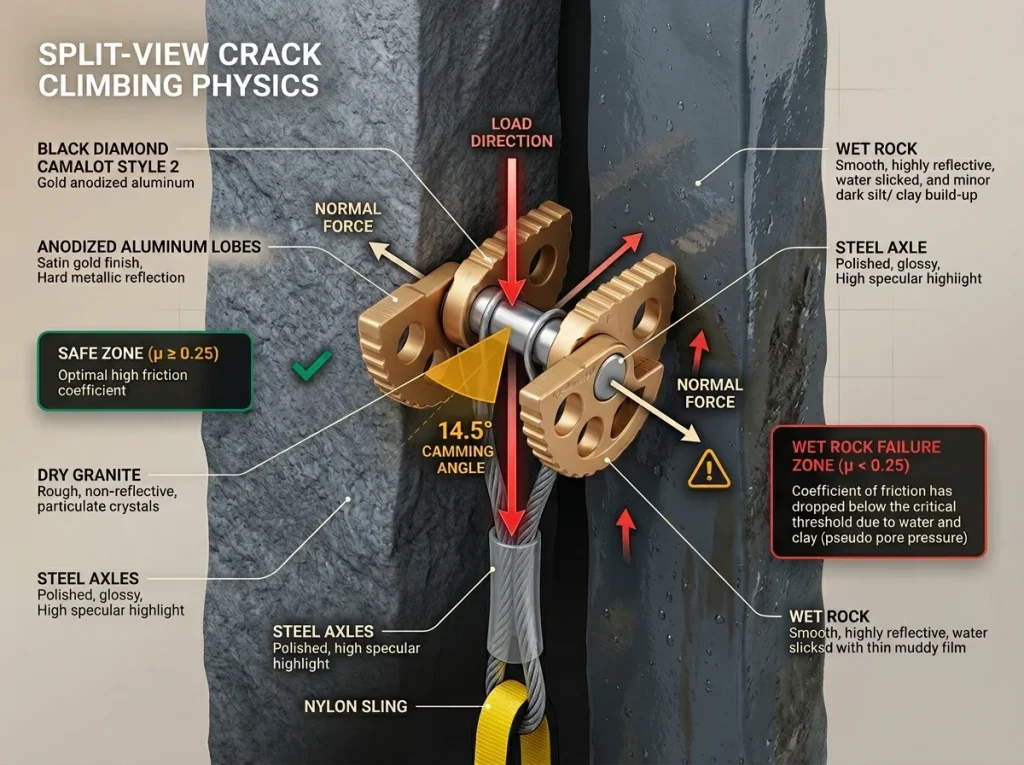
Pro tip: If you must test placements post-rain on granite after a short wait, do a firm but controlled bounce test before committing your full body weight. Don’t just set the cam and clip in — weight it first. A cam that walks under controlled bounce testing is not trustworthy.
Why Your Rubber and Skin Fail on Wet Rock
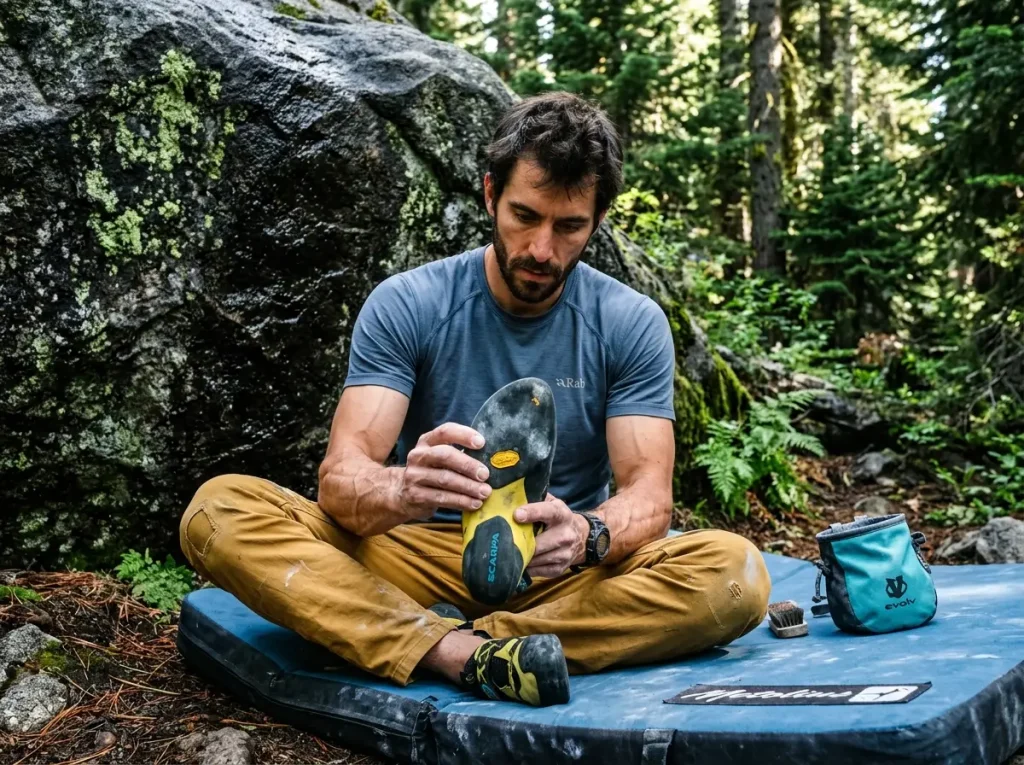
Smearing works because rubber maximizes contact area with the rock surface, and adhesion — molecular contact between rubber and stone — generates the bulk of that friction. Water destroys this at the molecular level. It severs the contact before it can form, and pressing harder doesn’t fix it. That’s the key thing most climbers miss: on a wet slab, more body weight into the foot doesn’t recover the friction. The water layer prevents adhesion from forming in the first place.
The USGS research on friction of rocks documents this across rock types. Dry sandstone friction runs 0.51–0.67; dry granite 0.67–0.84. On wet surfaces, those numbers drop into territory where lead climbing friction-dependent moves become physically unachievable before they become psychologically scary. Vibram XS Edge rubber performs best at cold temperatures. Wet cold rock means adhesion failure. Wet warm rock means both adhesion and rubber stiffness collapse simultaneously — the compound softens and loses edge precision on top of the adhesion problem.
There’s a trap in the data worth knowing. A small amount of water in granular material briefly increases shear resistance by forming tiny capillary bridges between particles. A slightly damp surface can momentarily feel more secure than bone-dry. Then excess water collapses those bridges, and friction falls off fast. The “slightly damp feels okay” sensation is the most hazardous misread at the crag. For a full breakdown of how chalk affects friction on different rock types, that article covers the rock-side chemistry and why magnesium carbonate can’t help you here.
Why Chalk Is Useless on a Wet Route
Chalk pulls moisture off your skin. It cannot remove water from rock. That’s the entire problem. When you chalk up on a wet route, you get the sensory signal of better grip — your hand feels drier — while the rock-side friction remains compromised. It’s an actively misleading cue. If a hold feels slippery with fresh chalk on a “dry-looking” wall after rain, you’re feeling residual rock dampness that chalk can’t touch. Trust what your feet are telling you, not what your hands think they know.
The Skin Factor — Hydrated Tissue and Pulp Deformation
Wet conditions affect skin function in a way that compounds the rock problem. The outer epidermis hydrates and softens in wet conditions, reducing fingertip stiffness. The “pulp” — the soft tissue that deforms over micro-edges to increase contact area — becomes over-hydrated and loses its ability to key into surface features. This is why indoor gyms feel measurably slippier on humid days; the effect is real, not psychological. Extended wet-rock sessions accelerate flappers and skin tears by two to three times over dry conditions. Your skin is part of your friction system. Hydrated skin degrades it from the other side.
The Hangboard Protocol — Maintaining Recruitment During Rain Streaks
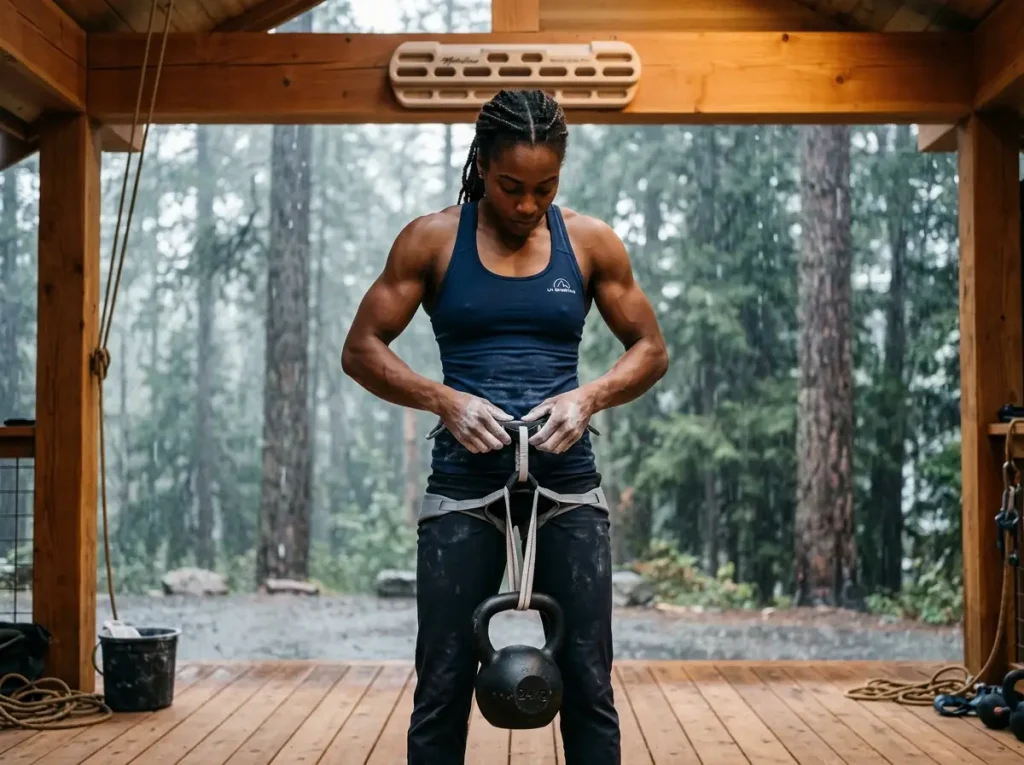
If you’re new to structured hangboard training, start with the hangboard training blueprint for climbers before applying the advanced protocols here. What follows assumes basic dead hang familiarity and pulley health.
Finger strength is the primary physical driver of elite climbing performance — and rain days are when you can build it without competing priorities. The research on determinants of elite climbing performance backs this from multiple directions. But how you structure the session matters as much as what you do.
The Keith Baar finding on tendon adaptation changed how serious climbers program rain days. Tendons become biochemically unresponsive — refractory — after approximately 10 minutes of mechanical loading. Collagen synthesis shuts off. The fix: rest 6 hours, then run another session. This means two properly spaced short sessions do more tendon work than one long grinding session. A rainy-day hangboard binge of three consecutive hours achieves less structural adaptation than two 30-minute sessions with lunch between them. The rest is not wasted time — it’s where the actual adaptation occurs.
MAW Protocol — The Neural Recruitment Session
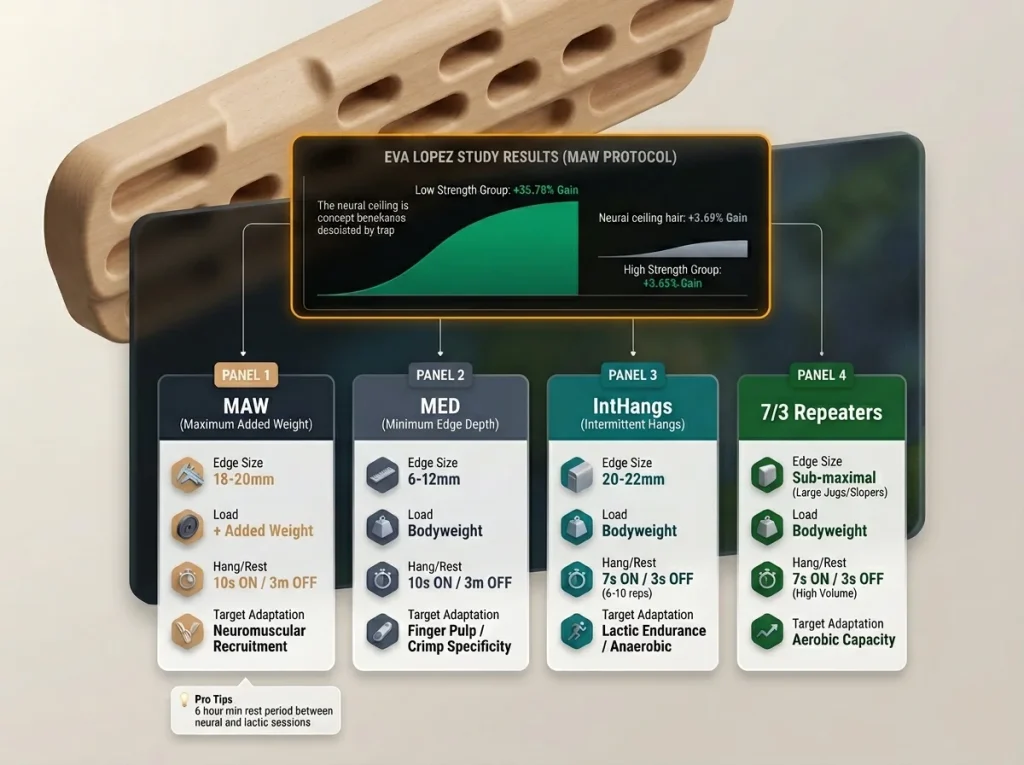
The Eva Lopez Maximum Added Weight protocol targets neuromuscular recruitment — training your nervous system to call up more motor units in the forearm, not adding muscle fiber mass. Equipment: a hangboard with an 18–20mm edge (Metolius, Beastmaker, or similar) and a weight belt or vest for loading.
Session structure: 5-minute gentle warmup (open blood flow to the pulleys), then a 10-second test hang on the target edge to calibrate added weight. Add load until you’d reach failure at 13 seconds, then execute 10-second hangs with a 3-second reserve. Three-minute rest between each hang — full recovery is mandatory, not optional. The neural purpose of the session is defeated if you rush rest intervals.
Use the half-crimp position, not full crimp. The A2 pulley stress in full crimp at added bodyweight is disproportionately high. A 4-week study of 22 climbers at the 8a redpoint level showed the low-strength group gained nearly 36% in finger strength; the high-strength group only 3.7%. MAW works best for climbers who haven’t yet hit their neural ceiling. Stop at the first sign of pain or position breakdown.
Pro tip: Running MAW and IntHangs in the same session is a common mistake that stacks neural fatigue on lactic fatigue. Run MAW first — neural work demands a full, fresh CNS — then wait at least 6 hours before an IntHangs session. This is the Baar logic applied in practice.
IntHangs — The Lactic Endurance Session for Lead Climbers
The Intermittent Hangs protocol targets your anaerobic system — the one that fails on a 30-move sport route when your forearms fill and you start sewing machine-ing. Structure: 7 seconds on, 3 seconds off, 6–10 repetitions per set, 2–3 sets, 1-minute rest between sets. Use a slightly larger edge than MAW (20–22mm) — endurance density is the goal, not maximum force.
Grip strength endurance gains of 45% over eight weeks are documented with this protocol. Monitor quality: if you can’t maintain the same hang position through rep 8 that you held on rep 1, the edge is too small or rest is too short. Adjust before the next session — don’t grind through degrading form.
The Baar 10-Minute Rule — Structuring Your Rain Day
Total tendon loading per session: don’t exceed 10 minutes of actual hang time. After 10 minutes, the tissue stops responding to further stimulus. Mandatory 6-hour window before reloading. Practical application: morning MAW session (6–8 total hang minutes), afternoon IntHangs session (6 minutes), evening light antagonist work. That structure outperforms any single long session every time.
Most climbers treat a rain day as permission to binge the hangboard for two hours straight. The Baar logic says that approach wastes most of the time after the first 10 minutes and adds injury risk without adding adaptation. Two well-timed short sessions is not compromise — it’s the more productive choice.
Antagonist Work and Injury-Proofing — The Half of Training Climbers Skip
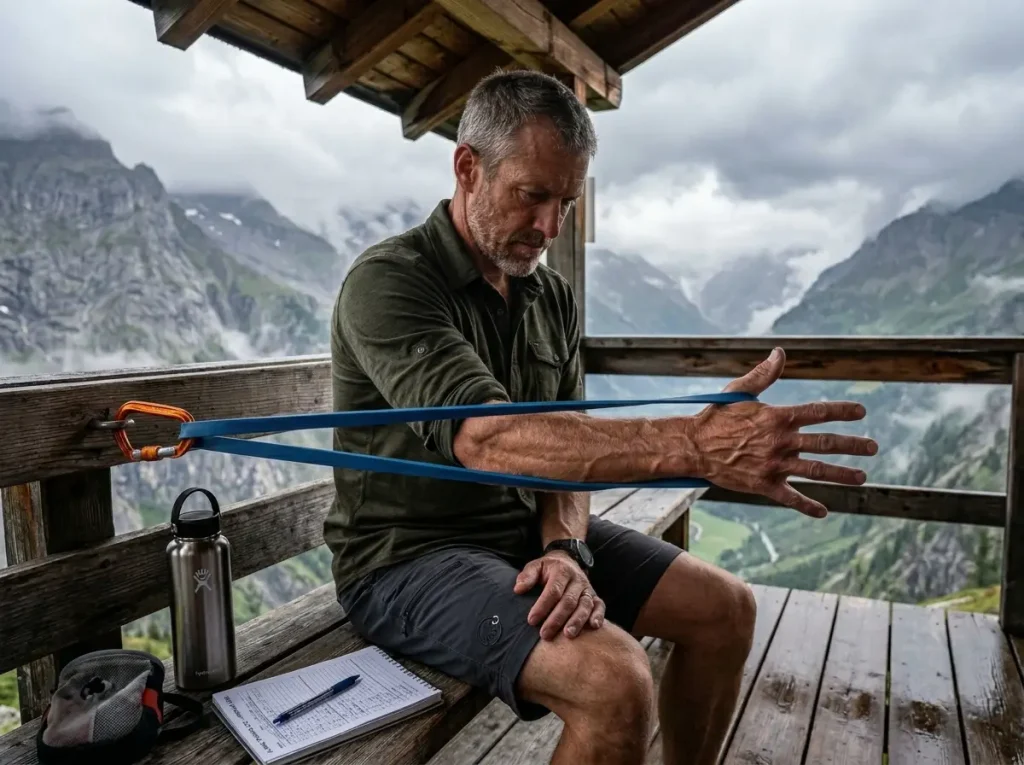
Climbing is a flexor-dominant sport. Every pull, every lock-off, every crimp loads the finger flexors and the elbow flexors while the extensors coast. Do that long enough without corrective work and the imbalance expresses itself as medial epicondylitis — climber’s elbow — or chronic pulley irritation that won’t resolve because the extensors can’t decelerate the load the flexors generate.
Rain days are the only window most climbers have enough unstructured time to do antagonist work properly. At the crag, you’re burning daylight on routes. At the gym, you’re there to climb. But on a rainy Tuesday with nowhere to be, the Jared Vagy Rock Rehab Pyramid makes sense: inflammation reduction first, then kinesthetic awareness, then strength. The sequence matters — skipping straight to loading an irritated pulley extends recovery, not shortens it. For a complete antagonist strength program for injury-free climbing, that guide covers the full routine.
The Carabiner Extensor Drill — Mechanics and Execution
This is the drill worth knowing. Girth-hitch a resistance band to a carabiner. In the half-crimp position on the carabiner gate, pull toward the palm while the extensors actively resist for 7 seconds. Three sets of 8 reps per hand. The extensor digitorum communis is targeted in a climbing-specific position — more transfer than generic wrist curls. Start lighter than you think you need. Isolation quality is the goal.
The reason this drill works is specificity: the half-crimp position means the antagonist is loaded in the exact joint configuration it opposes during climbing. Generic grip trainers and spring squeezers don’t do this. They load the extensors in a neutral, non-climbing position that doesn’t transfer to the wall.
Rotator Cuff Prehab — The Climber’s Invisible Armor
The rotator cuff controls scapulohumeral rhythm — the coordinated movement of the shoulder joint during every overhead reach and lock-off. When that rhythm breaks down, you get impingement. The serratus anterior is frequently the actual weak link: it protracts the scapula and prevents winging, and it’s almost never trained intentionally.
Rain-day rotator protocol: face pulls (3×15), external rotation with band (3×12), prone Y-T-W sequence on the floor (3×10 each position), wall push-ups with exaggerated scapular protraction at end-range. Mobility work can run three times per day. Strength work needs 24–48 hours of recovery. Plan the timing accordingly.
Indoor Systems Mastery — The Technical Rain Day
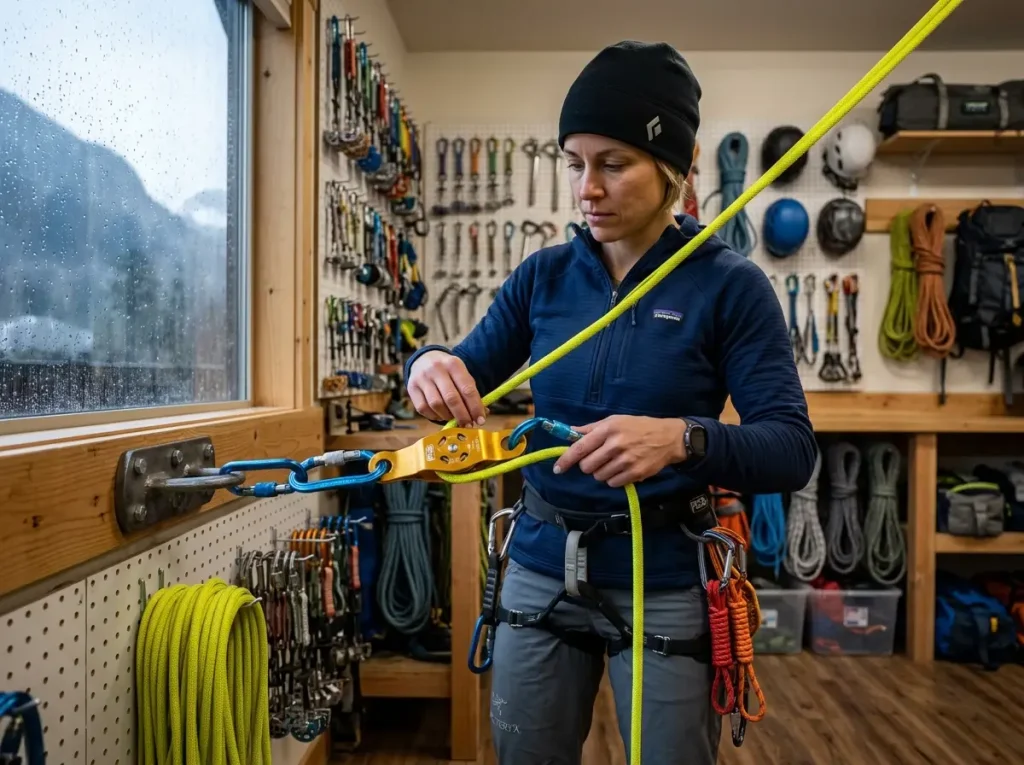
Most self-rescue skills can’t be learned under outdoor pressure. The Z-drag, the belay escape, knot passing — these require cognitive bandwidth and setup space that a real incident doesn’t provide. The climbers who handle emergencies cleanly practiced somewhere safe first. Rain days are when you practice.
The belay escape and rope ascent self-rescue protocol covers the full execution sequence for what follows. The goal here is to understand the structure before you work the steps.
Building the 3:1 Z-Drag Indoors — Step by Step
The 3:1 Z-drag delivers 3:1 theoretical mechanical advantage. In practice, with carabiners instead of pulleys, friction drops that to roughly 1.6:1 real-world advantage. With pulleys, you get approximately 2.6:1. That difference matters when your partner is hanging in space — a carabiner-only system requires significantly more pull force.
Standard rigging: bomber anchor with a locking carabiner, capture Prusik (or Petzl Micro Traxion) on the anchor, traveling Prusik (or Tibloc) on the load strand below the stuck point, pulley rigged through the traveling Prusik, pull toward the anchor. Equipment: static rescue rope at 9mm or larger (dynamic rope acts as a spring, wasting energy in oscillation), 2 locking carabiners, 1–2 pulleys, 2 Prusik loops, a structural anchor point.
Aim to complete full rigging in under 3 minutes from scratch. Time yourself. This is the only way to know whether you own the skill or just understand the concept. Don’t practice by pulling furniture across carpet — the friction is nothing like a free-hanging load and builds the wrong muscle memory.
Pro tip: The best rain-day drill is the blind anchor escape — set up a simulated belayed load, close your eyes, and execute the belay escape by feel alone. If you fumble it with eyes closed, you can’t do it panicking on a ledge at dusk. The hands need to know, not just the brain.
Knot Mastery Under Pressure — The Rain-Day Blind Drill
Identify the five knots that appear most in rescue scenarios: Munter Hitch, Mule Knot, Overhand on a Bight, Prusik, Flemish Bend. Set a 2-minute timer. Tie each knot blind — eyes closed — three times. If you fail one, reset the timer.
Adrenaline narrows motor control precision. Knots you can only tie when you’re thinking carefully will fail in an actual incident. The Flemish Bend (figure-8 bend) for joining ropes in a knot-pass needs 30cm minimum tails — shorter tails can capsize under load. These are not things you want to discover on a ledge at 5pm with a partner hanging.
The Munter-Mule-Overhand combination — the universal lock-off for weighted transitions — must be muscle memory before you need it. Most climbers who haven’t practiced it fumble it under stress. That’s not a character flaw; it’s a practice deficit. Fix it on the couch while it’s raining.
Building a Home Training Station on a Budget
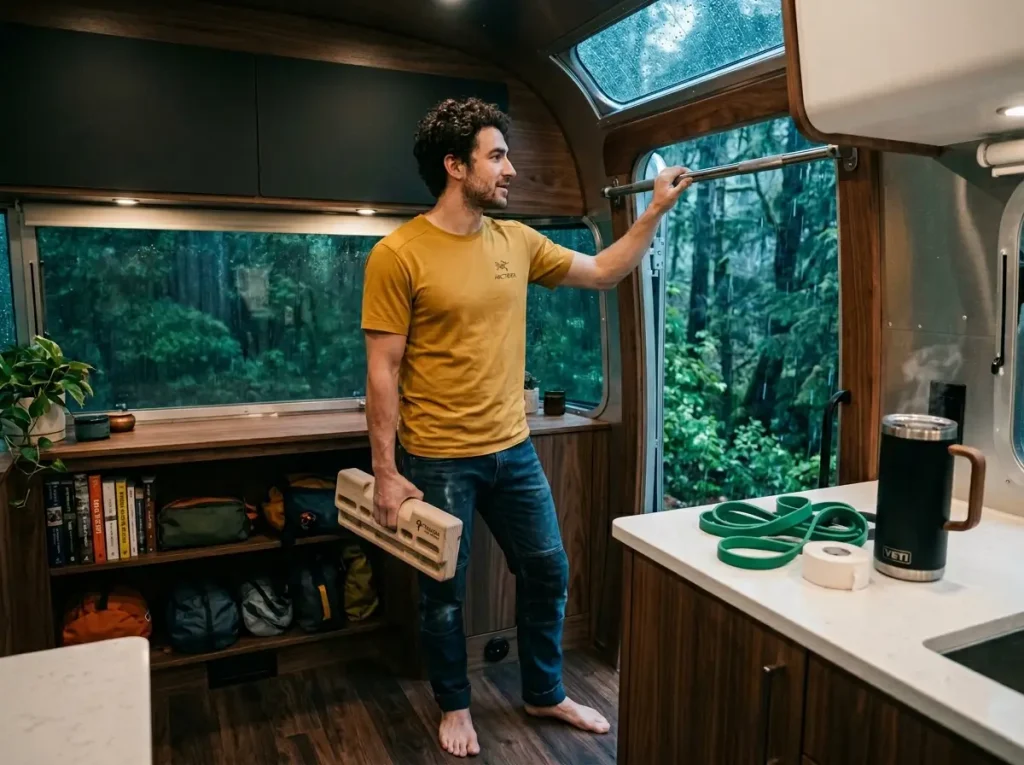
The minimum viable rainy-day setup is a doorframe hangboard, a resistance band set, and a length of static rope for knot practice. Total cost: $60–120. That’s it. Three seasons of sustained strength gains from a $90 hangboard and a set of bands is not a myth — the protocol matters more than the equipment, provided the basics are covered.
For apartment climbers, the hangboard is non-negotiable; the home climbing wall is optional but worth considering seriously. A home climbing wall build guide covers the full engineering — Baltic Birch plywood at 3/4″, 2×6 Douglas Fir stringers, 45-degree overhang angle for training density, and the critical instruction to install T-nuts before assembly, not after. That last point saves hours of retrofit frustration.
The Minimal Viable Rainy-Day Kit (Under $120)
Tier 1 Essential: Metolius Project hangboard (~$60), two resistance band sets (~$25), 10m static rope end for knot practice (~$20). That handles hangboard training, antagonist work, and knot mastery.
Tier 2 Addition: A travel hangboard for consistency on the road (Trango RPTC, YY Vertical Small), and a carabiner practice set using retired non-load-bearing biners for knot work. Skip grip rings and spring squeezers. They don’t replicate the finger strength training at home that actually transfers to hanging — the recruitment pattern isn’t there.
The critical spec on doorframe pull-up bars: most are rated to 300 lbs static, which is fine for deadhanging but not safe for dynamic training or campus-style movements. Tension-mounted bars rely on door frame integrity — and door frames are not structural elements in most modern construction. Load them dynamically and you’re testing drywall and trim, not climbing equipment.
The Home Session Structure — A 90-Minute Rainy-Day Block
| Training Session Schedule | ||
|---|---|---|
| Time Block | Activity | Volume |
| 0:00–0:10 | Warm-up: tendon glides, finger circles, band pull-aparts | 3 rounds |
| 0:10–0:30 | MAW Hangboard Protocol (Eva Lopez) | 4–5 sets |
| 0:30–0:50 | Antagonist block (Carabiner Extensor + Rotator Cuff) | 3 rounds each |
| 0:50–1:10 | IntHangs OR Knot Mastery Drills (alternate rain days) | 6–8 hangs or 5 knots blind |
| 1:10–1:30 | Z-Drag Rigging Practice + Mobility (hip flexors, thoracic rotation) | Timed |
Putting It Together — What the Pro Protocol Actually Looks Like
Three takeaways that should stay with you after the storm passes.
The surface test is not the dryness test. If the soil at the base of the crag is still damp, the sandstone pores are saturated. A hold that looks dry from the ground can be 40% structurally weaker than it was before the rain. Wait the full 48–72 hours.
Short, loaded, and spaced beats long and grinding. The Baar 10-minute rule means two well-structured hangboard sessions with 6 hours between them outperform a two-hour hangboard marathon. The protocol matters more than the hours.
The technical gaps rain reveals are permanent advantages. Most climbers never practice the belay escape because they never have uninterrupted time to do it. A three-day rain streak is 72 hours of skill-building that most of your competitors are wasting on the couch.
Pull the rope out of the bag right now. Girth-hitch a resistance band to a carabiner. Run the belay escape drill once. If you fumble it, you’ve identified the most important gap in your system. Fix it before the storm passes.
FAQ
How long should I wait to climb after rain on sandstone?
Wait a minimum of 48–72 hours after heavy rain on sandstone, regardless of surface appearance. If the ground at the base of the crag is still damp, the rock hasn’t dried through its pore structure. The surface desiccates first; the interior — where your hold’s structural integrity lives — takes significantly longer. Damage to cementing agents at the grain level is ongoing even when the surface feels dry to the touch.
Can you climb on wet granite?
Granite has far lower porosity than sandstone and dries much faster — typically 2–4 hours after light rain on a sunny, south-facing aspect. The structural integrity impact is minor compared to sedimentary rock. However, wet granite still sees a measurable drop in friction, and smearing-dependent routes remain risky even when the rock looks dry. Test friction conservatively and don’t commit to crux sequences until you’ve verified grip on less critical terrain.
What are the best indoor alternatives to rock climbing on a rainy day?
A structured hangboard session using the Eva Lopez MAW or IntHangs protocol, antagonist resistance band work targeting the extensor digitorum and rotator cuff, Z-drag or self-rescue system practice, and blind knot mastery drills. These aren’t substitutes for cragging — they are directed skill-building sessions that improve your outdoor performance in ways that cragging alone cannot.
How do I train finger strength at home without a hangboard?
A doorframe hangboard is the minimum viable tool — avoid grip rings and spring squeezers that don’t replicate finger strength training at home with actual transfer. Bodyweight dead hangs on a doorframe, using a folded towel for edge simulation if needed, work for beginners. The priority is the correct recruitment pattern. Track your progression on a consistent edge.
Why do cams fail on wet rock even when they look well-placed?
The friction between aluminum cam lobes and wet rock can drop below the threshold needed to hold static equilibrium at the cam’s design angle. The cam doesn’t walk out visibly; it loses grip and ejects under the sudden load of a fall. Clay and silt in the crack compound the problem by creating pseudo pore pressure between the lobe and wall, reducing effective holding force. Hydrostatic pressure in cracks and gouge material turn a visually solid placement into a different safety system entirely.
Safety Notice: Rock climbing and mountaineering are inherently high-risk
activities that can involve physical trauma or fatal incidents. The information on Rock Climbing Realms is for
educational and informational purposes only. Techniques and advice presented here are not a substitute
for professional, hands-on instruction. Conditions and risks vary by location. Always seek guidance
from a qualified instructor before attempting new techniques. By using this website, you agree that you
are solely responsible for your own safety. Any reliance you place on this information is strictly
at your own risk, and you assume all liability for your actions. Rock Climbing Realms and its authors
will not be held liable for any harm, damage, or loss sustained in connection with the use of this information.
Affiliate Disclosure: We are a participant in the Amazon Services LLC Associates Program, an
affiliate advertising program designed to provide a means for us to earn advertising fees by advertising and linking
to Amazon.com. As an Amazon Associate, we earn from qualifying purchases. We are also an official affiliate partner
of Black Diamond Equipment via the AvantLink network. If you click on a Black Diamond affiliate link and make a
purchase, we may earn a commission at no additional cost to you. We also participate in other affiliate programs.
Additional terms are found in the terms of service.