In this article
Picture week four. You’re not clipped to a fixed rope high on the mountain. You’re sitting in a tent at Base Camp, down a few pounds, refreshing a forecast that keeps sliding the good weather back, wondering why the most famous climb on Earth involves this much sitting around.
That gap between the Instagram summit shot and the lived reality is the first thing nobody planning a trip to climb Mount Everest sees coming: climbing Mount Everest is the easy part to picture, and it’s the smallest part of the whole thing. The two months of trekking, waiting, and re-adapting are the actual expedition. Here’s the entire arc, start to finish, plus an honest read on whether this is your mountain at all.
How Long the Trip Really Takes (and Why It’s Mostly Waiting)

Ask anyone back from the mountain what surprised them most, and it’s rarely the cold or the altitude. It’s the calendar. A standard Everest expedition runs about 60 to 75 days from Kathmandu and back, and only a sliver of that is spent going up.
The Two-Month Calendar, Broken Down
The trip splits into three rough chunks. The trek to Everest Base Camp eats 12 to 14 days. The acclimatization rotations swallow another 25 to 30.
The actual summit push and descent take just 7 to 10 days at the end. Add travel, buffer days, and weather slack, and you’re gone for the better part of a season.
Put another way, the single overnight climb everyone pictures sits at the far end of roughly six weeks of preparation that looks nothing like climbing. You live at Base Camp, you walk up partway and come back, you rest, you wait. The summit is the punctuation mark, not the sentence.
Why Acclimatization Eats the Schedule
Your body cannot be teleported to 8,849 meters (29,032 feet) and survive. It has to build more oxygen-carrying red cells to cope with air that holds a fraction of what you’re used to, and that adaptation runs on its own clock you can’t rush. The weeks of going up and down are not padding. They are the actual work of the expedition, and skipping them is how people end up sick instead of high.
This is the reframe that matters before you spend a dollar: the boredom is the job. The metabolic grind of slowly wasting at altitude while you wait is harder, for most people, than any single pitch of climbing on the mountain.
Train for the waiting, not just the climbing. The climbers who handle Everest best are the ones who can sit at Base Camp for three weeks without unraveling. Bring books, downloaded shows, and the patience to do nothing while your body does the work.
The Rapid-Ascent Shortcut and What It Trades Away
There’s a faster option. Rapid-ascent or “flash” expeditions compress the climb to roughly 36 to 43 days by having you pre-acclimatize at home, sleeping for weeks in a hypoxic tent that mimics thin air before you ever fly out. It buys back time on the mountain and cuts how often you cross the most hazardous ground.
The trade is real, though. You pay more, and you move the grind into your bedroom for months of pre-acclimatization in a hypoxic tent instead of weeks at Base Camp. You don’t escape the adaptation cost. You just front-load it.
Phase One: The Trek In to Base Camp
The expedition starts with a walk, and that walk is already part of the climb. Most trips take the South Col route from Nepal, a smaller number the North Col route from Tibet, and the South side begins with a white-knuckle flight into Lukla, then a slow trek up the Khumbu Valley toward Base Camp at 5,364 meters.
Flying Into Lukla and Walking Up the Khumbu
From Lukla, the trail climbs for 7 to 12 days through stone villages and across glacier-fed rivers. It helps to know where Everest actually sits on the Nepal–Tibet border before you go, because the approach winds through Sherpa homeland long before the peak comes into view. You gain altitude slowly on purpose, sleeping a little higher each night so your body keeps pace.
Namche and Pheriche, the First Acclimatization Days
Waypoints like Namche Bazaar and Pheriche aren’t just resupply stops. They’re built-in acclimatization days where you climb a nearby hill and come back down to sleep, the same principle you’ll repeat higher up. Rush this stretch and you arrive at Base Camp already behind, fighting a headache you created by moving too fast.
Why the Walk In Is Already Part of the Climb
Here’s the part beginners miss: Base Camp at 5,364 meters is higher than most major peaks on Earth. You don’t arrive there and “rest.” You arrive there and start being slowly broken down, even on the days you do nothing. The trek isn’t the warm-up before the expedition. It’s the first rung of the ladder.
Phase Two: Base Camp and the Acclimatization Rotations
This is the heart of the trip, and the part the brochures skip. Once you reach Base Camp, the real pattern of the expedition begins: go up, feel awful, come back down, recover, repeat.
What Base Camp Life Actually Looks Like
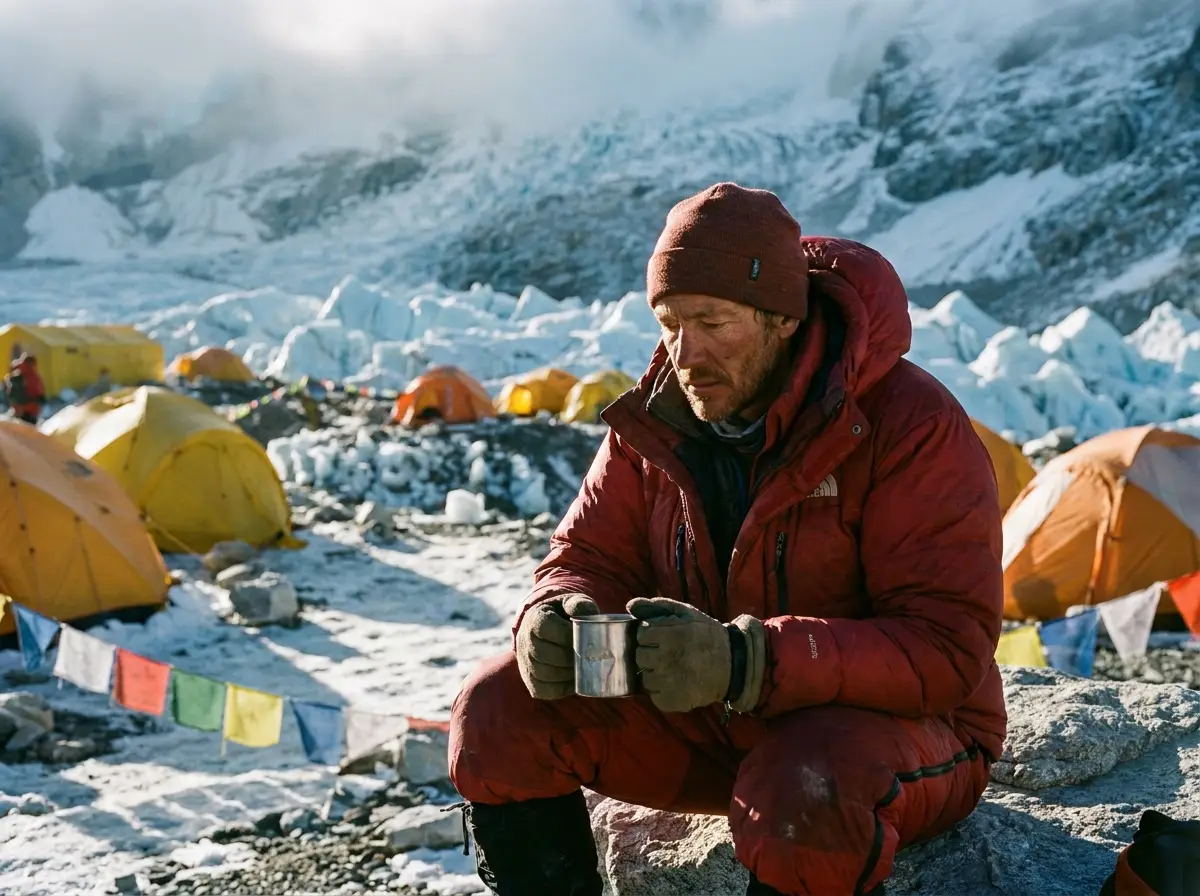
Base Camp is a small tent city on the glacier, and life there is mostly logistics and patience. You eat as much as your shrinking appetite allows, sleep badly, and try to stay healthy enough to be ready when the weather opens. Most of the famous “trip to climb Everest” is this: cards, books, bad sleep, and the quiet anxiety of a forecast that won’t commit.
Climb High, Sleep Low: How Rotations Work
The whole game is climb high, sleep low. You ascend to Camp 1 or 2, spend a night or two, then drop back to Base Camp to recover at lower altitude while your system adapts. A single rotation is a multi-day round trip up the mountain and back, and most climbers do two or three before the summit push.
The first time you push up through the Khumbu Icefall into the freezer-by-night, solar-oven-by-day Western Cwm above Camp 1, you understand why this takes weeks and not days. Crossing the Icefall means clipping an ascender, the metal jumar that grips the fixed ropes, and balancing over deep crevasses on lashed aluminum ladders, crampons biting the ice and an ice axe in hand.
The Camp-by-Camp Altitude Ladder
The mountain is climbed in stages, each camp a rung higher into thinner air, the route from Camp 3 threading past landmarks like the Yellow Band and the Geneva Spur on the way to the South Col. Here’s the South-side ladder most expeditions follow.
| Camp | Elevation | What It Is |
|---|---|---|
| Base Camp | 5,364 m | The tent city and recovery hub between rotations |
| Camp 1 | ~6,065 m | Top of the Khumbu Icefall, edge of the Western Cwm |
| Camp 2 | ~6,400 m | Advanced Base Camp under the Lhotse Face |
| Camp 3 | ~7,200 m | Mid Lhotse Face, first night many use oxygen |
| Camp 4 | ~7,900 m | South Col, launch point for the summit push |
| Summit | 8,849 m | The top, reached and left in a single night-and-day push |
What Extreme Altitude Does to Your Body
Above a certain height, the mountain stops being a climbing problem and becomes a survival one. The numbers that would land you in an emergency room at home are just an ordinary afternoon up high.
Above 8,000 Meters, You’re on a Clock
At the summit, the partial pressure of oxygen is less than a third of what you breathe at sea level. Every breath delivers a fraction of the oxygen your body expects, even at rest. Above 8,000 meters, in the zone climbers call the Death Zone, no one truly acclimatizes. Your body burns through oxygen faster than it can replace it, and the realistic ceiling without bottled gas is somewhere around 16 to 20 hours.
It’s a countdown, not a campsite, which is exactly why supplemental oxygen exists. Researchers who study the conditions up there don’t exaggerate it; there’s even peer-reviewed research on the weather extremes climbers endure in the Death Zone.
HAPE and HACE, the Two That Force You Down
Two conditions do most of the damage. HAPE is fluid building in the lungs, signaled by a wet cough and breathlessness even at rest. HACE is swelling in the brain, which shows up as stumbling, confusion, and poor judgment.
The only real cure for either is immediate descent. A teammate who suddenly can’t walk a straight line isn’t tired; that’s an emergency, and going down beats any medication or rest. It’s worth understanding the acclimatization protocol that keeps AMS from turning into HAPE or HACE before you ever need it.
Learn the difference between a normal Khumbu cough and a warning sign. A dry, hacking cough at altitude is almost universal and usually fine. A wet cough, breathlessness lying down, or a confused, stumbling partner means you go down now, not in the morning.
The Khumbu Cough and the Daily Grind of Altitude
Even when nothing goes badly wrong, altitude grinds you down daily. The dry, persistent Khumbu cough shows up for nearly everyone, fingers and toes sit one careless mistake from frostbite, and milder acute mountain sickness (AMS) is a near-constant companion that a serious case can escalate into a helicopter evacuation.
Appetite fades right when you need calories most, so you lose weight steadily through the trip. None of this is the dramatic part. It’s just the baseline tax of living for weeks at high altitude where humans aren’t built to be.
The Weather Window and the Hardest Decision on the Mountain
The part that ends trips isn’t usually the scary-looking part. It’s a clear, calm afternoon with the summit in sight and a clock telling you to turn around anyway.
Waiting for the Jet Stream to Lift
For most of the year, the jet stream parks over Everest’s summit with winds that would blow a climber off the ridge. The mountain only opens when that stream lifts, usually for a short stretch in that narrow mid-to-late-May summit window. So teams sit at Base Camp, fully acclimatized and ready, watching forecasts and waiting for a 2-to-5-day lull that may or may not arrive before the summer monsoon season closes the mountain. The waiting is its own kind of pressure.
The 2 PM Rule Is Now Nepal Law for 2026
Summit day runs on a hard clock. The 2 PM Rule is simple: if you haven’t topped out by 2 in the afternoon, you turn around, summit or not. For the 2026 season, Nepal turned this from guide advice into an enforced regulation, with fines and permit consequences for ignoring it.
The rule exists because a brain starved of oxygen at 8,700 meters cannot be trusted to make that call in the moment. Summit fever, the obsessive drive to top out, has talked too many capable climbers into pushing past the point of safe return.
Make the turnaround decision before you leave Camp 4, not at 1:55 PM near the top. Set your personal turnaround time at the tent, agree on it with your team, and treat it as non-negotiable. A hypoxic brain will always find a reason to keep going.
Traffic Jams Where Standing Still Is the Hazard
A crowded summit ridge is more than an annoyance. On May 22, 2019, roughly 320 climbers queued at the bottleneck near the Hillary Step, and the delays left people stranded high past their turnaround time, burning through oxygen they needed for the way down. Several did not make it back.
Standing still high on the mountain, waiting your turn in line, is one of the riskiest things you can do up there. Camp 4 on the South Col, where climbers wait rather than rest before the push, is where this all gets staged.
Summit Night and the Long Way Down
The summit photo is the halfway point, not the finish line. The mountain does most of its harm on the descent, when you’re spent, low on gas, and convinced the hard part is behind you.
The Midnight Push From Camp 4
The summit push starts around midnight. Zipped into a down suit and 8000m boots, breathing bottled gas through an oxygen mask, climbers set out from Camp 4 in the dark by headlamp for 10 to 14 hours of slow work through the Death Zone to reach the top. It’s cold, it’s crowded in a good window, and every step costs more than it would anywhere else on Earth. By the time the sun comes up, you’ve already been climbing for hours with the hardest decision still ahead.
The Summit Is Only Halfway
Reaching the top is roughly 50% of the job. That’s the mental trap: the summit feels like the achievement, so people spend everything getting there and have nothing left for the descent. Worth remembering that Everest is the highest mountain, not the hardest to climb, and “highest” is exactly what makes the long way down so punishing. The real test starts the moment you turn around.
Budget your oxygen and your legs for the descent, not the summit. Plan your bottle changes and your energy so you still have reserves after you turn around. The climbers who get in trouble are the ones who spent it all reaching the top.
Why the Descent Is the Most Hazardous Part
The statistics are blunt: over 80% of Everest fatalities happen on the descent. Exhaustion, low oxygen, and fading judgment stack up exactly when you can least afford them. The encouraging side is that the mountain is measurably safer than it used to be. A 2026 study tracking Everest mortality from 1921 to 2024 found the fatality rate has fallen more than 60%, thanks to fixed ropes, better forecasting, and oxygen logistics, not because the mountain got any easier.
The Human Cost and the Honest Gut-Check
Before you price out a permit, look at who actually carries the risk on this mountain. Then have the honest conversation about whether it’s yours to climb.
Who Actually Carries the Risk
The expedition you book runs on Sherpa labor. Of 339 recorded fatalities between 1921 and 2025 in the Himalayan Database, roughly 132, about 39%, were hired workers rather than clients. Around 91 of those losses happened in the Khumbu Icefall, the shifting maze of ice that Sherpa teams cross 15 to 20 times a season hauling loads, against a client’s handful of trips. The Icefall Doctors fix the ropes and ladders through it, spending long days on the most hazardous ground on the mountain.
The pay gap is just as stark. A Sherpa worker often earns around $5,000 for a two-to-three-month season, while a Western guide standing next to them can make $50,000 to $100,000. In 2014, an avalanche in the Icefall took the lives of 16 Sherpa workers in a single morning and shut the season down. These are the Sherpa guides who hold nearly every Everest record, climbers like Kami Rita Sherpa, and they shoulder the cost rarely shown on the brochure long before you ever pay for a Nepal climbing permit.
When you compare operators, ask how they pay and insure their Sherpa staff, not just what the trip costs you. Fair wages, life insurance, and load limits separate the responsible outfits from the ones cutting corners on the people taking the real risk.
Is This Honestly Your Mountain?
Here’s the gut-check this whole guide builds toward. Everest doesn’t reward the dreamer who booked on impulse; it rewards the climber who prepared for the boredom and the descent. Be honest about where you stand before you commit, and let the rest of the planning answer the specific questions.
Start with whether you qualify at all, because the real prerequisites are a qualifying 7,000 m peak and owned technical skills, not the permit. Then price it honestly and see what a real Everest expedition costs in 2026, sort out the 8000 m kit and the rent-versus-buy math, and pin down the timing against that tight spring window. If you want the wider context first, it helps to see how Everest stacks up against the other famous mountain peaks and what each one demands before you make this your goal.
Conclusion
Three things to carry out of this. First, a trip to climb Mount Everest is two months of waiting and re-adapting wrapped around one brutal night, not the summit-day highlight reel. Second, the descent and the turnaround clock, not the summit, decide who comes home. Third, the people carrying the most risk on the mountain are the ones least credited for it.
If the waiting and the descent sound harder than the climbing, you understand Everest better than most people who book it. Run the honest gut-check, read up on the prerequisites, and build toward the boredom and the way down, not just the photo on top.
Frequently Asked Questions
01How long does it take to climb Mount Everest?
A standard Everest expedition takes about two months, roughly 55 to 75 days from Kathmandu and back. Rapid-ascent trips using pre-acclimatization can compress that to around 36 to 43 days. Most of the time is trekking and acclimatizing, not summit climbing.
02How much does a trip to climb Mount Everest cost?
A guided Everest climb runs from the tens of thousands into six figures, depending on operator tier and support level. The permit alone is a large fixed fee before guiding, oxygen, and logistics. See our full breakdown of what an Everest expedition really costs in 2026.
03Do you need experience to climb Mount Everest?
Yes. You need real high-altitude mountaineering experience, typically a qualifying 7,000 m peak, plus owned technical skills in fixed-rope travel and crampon use. The permit and money are the easy part. Read the honest prerequisites for climbing Everest first.
04What is the best time of year to climb Everest?
The main spring climbing season runs through April and May, with summits clustered in a narrow mid-to-late-May window when the jet stream lifts off the peak. Teams arrive in late March and wait at Base Camp for that short lull. Here is more on the best time to climb Everest.
05Why is the descent from Everest more hazardous than the climb?
Over 80% of Everest fatalities happen on the descent. By the time climbers turn around, they are exhausted, low on oxygen, and past the hardest part of their judgment, exactly when the long way down demands the most. The summit is only halfway.
Safety Notice: Rock climbing and mountaineering are inherently high-risk
activities that can involve physical trauma or fatal incidents. The information on Rock Climbing Realms is for
educational and informational purposes only. Techniques and advice presented here are not a substitute
for professional, hands-on instruction. Conditions and risks vary by location. Always seek guidance
from a qualified instructor before attempting new techniques. By using this website, you agree that you
are solely responsible for your own safety. Any reliance you place on this information is strictly
at your own risk, and you assume all liability for your actions. Rock Climbing Realms and its authors
will not be held liable for any harm, damage, or loss sustained in connection with the use of this information.
Affiliate Disclosure: We are a participant in the Amazon Services LLC Associates Program, an
affiliate advertising program designed to provide a means for us to earn advertising fees by advertising and linking
to Amazon.com. As an Amazon Associate, we earn from qualifying purchases. We are also an official affiliate partner
of Black Diamond Equipment via the AvantLink network. If you click on a Black Diamond affiliate link and make a
purchase, we may earn a commission at no additional cost to you. We also participate in other affiliate programs.
Additional terms are found in the terms of service.