
In this article
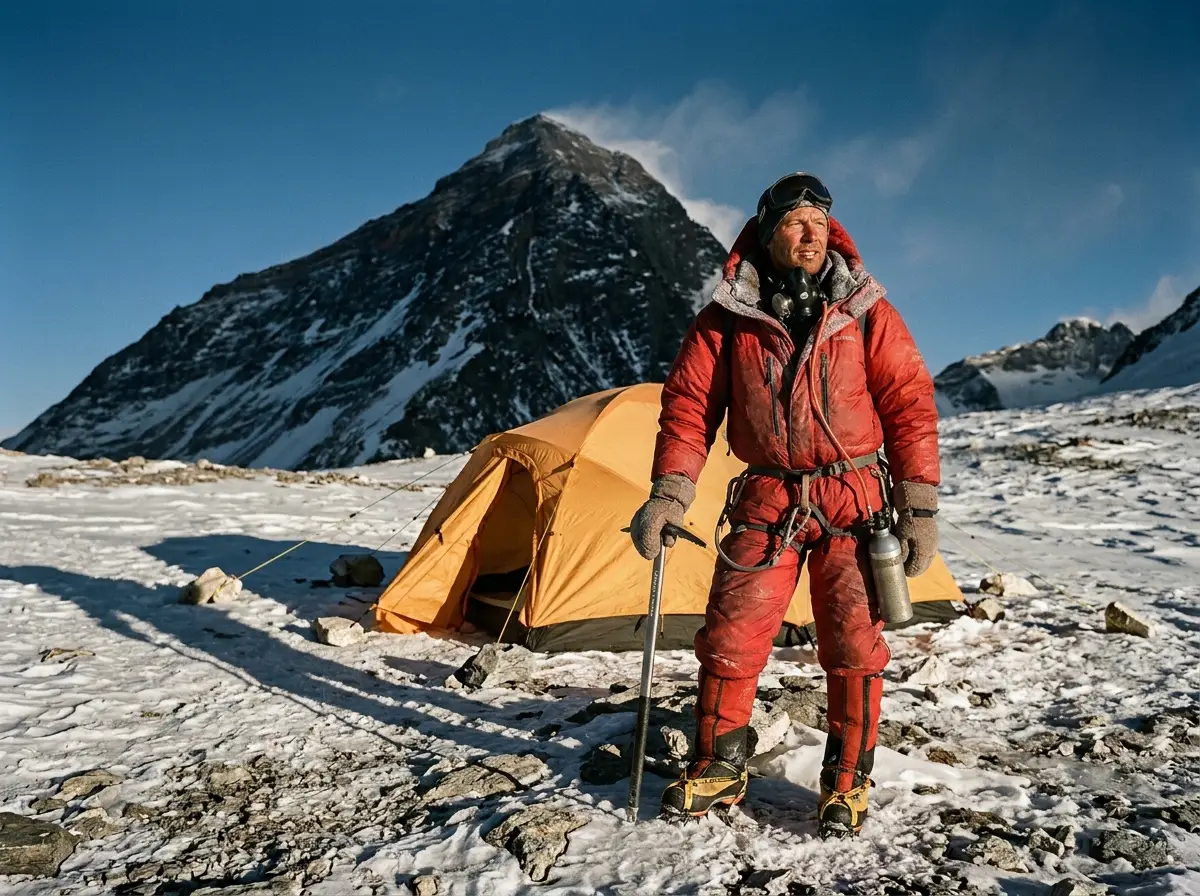
You’re zipped into a tent on the South Col at 26,000 feet, the wind trying to drag the whole thing off the ice, an oxygen mask hissing against your face, and you cannot sleep. The summit is one brutal night away, and every hour you sit here you get weaker, not stronger. That’s the part nobody tells you about Camp 4 on Mount Everest: it isn’t a rest stop, and treating it like one is how climbers get into trouble up high. Ask the guides who work this mountain, or read what the medical literature says about the air this thin, and you land on the same answer. Here’s what Camp 4 actually is, where it sits, and the handful of decisions made here that decide who walks back down.
What Camp 4 Actually Is (and Where It Sits on Everest)
Most people picture Camp 4 as the place where climbers catch their breath before the big day. It’s closer to the opposite. This is the launchpad, not the recovery room, and understanding that one distinction changes how the whole summit attempt makes sense.
The altitude and the numbers
Camp 4, sometimes written Camp IV, sits at roughly 7,900 to 7,920 meters, which is about 26,000 feet. That makes it the highest camp on the standard route up the Nepal side of the mountain. There’s no higher tent, no higher cook stove, nothing above it but the Southeast Ridge and the summit itself.
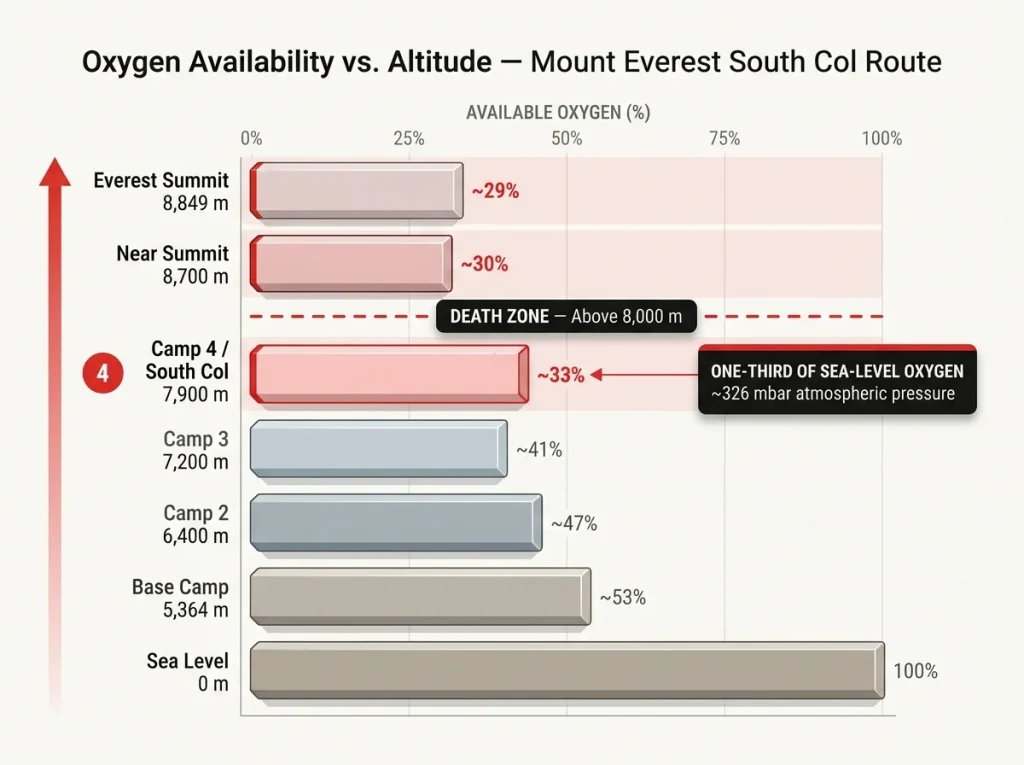
The number matters because of where it puts you. At this height the air holds about a third of the oxygen you’d get at sea level, and that single fact drives everything else that happens here. Everest is the extreme end of what the most demanding peaks ask of the people who climb them, and Camp 4 is where that demand stops being abstract.
Why it’s the final staging ground, not a base camp
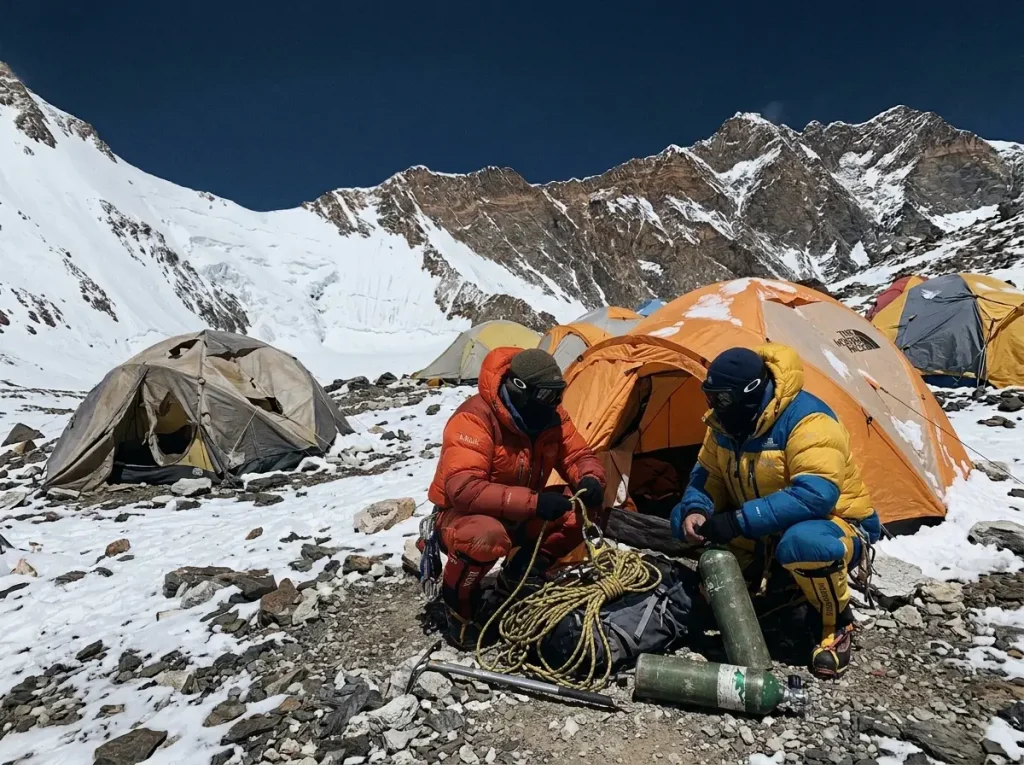
A base camp is somewhere you live for weeks. Camp 4 is somewhere you survive for hours. Climbers arrive in the early afternoon after a long day up from Camp 3, and the clock starts ticking the moment they drop their packs.
Everything that happens here points at one thing: getting out the door for the summit push that same night. You melt snow, force down fluids, check your oxygen, and try to rest without ever really resting. Then you leave in the dark.
The mistake of treating it like a rest stop
The first error climbers make at altitude is mental. They think of Camp 4 as a reward for the slog up the Lhotse Face, a place to recover and gather strength. It doesn’t work that way, because recovery isn’t physically possible up here.
Stay too long and you simply burn the oxygen and the muscle you need higher on the mountain. The veterans put it bluntly: the col is a holding pattern against decay, not a recharge. Get that into your head before you ever set foot on it.
The South Col, a Wind-Scoured Saddle Between Two Giants
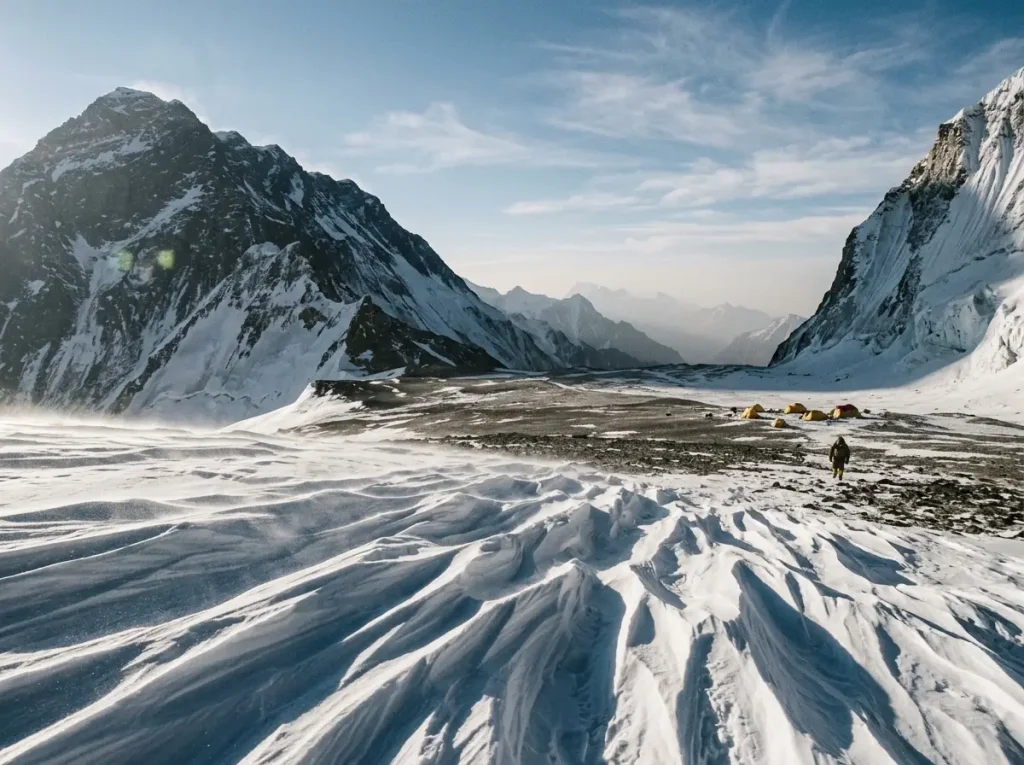
Picture a tilted tabletop of bare rock and hard ice, scoured clean by the wind, slung between two of the biggest mountains on the planet. That’s the South Col. Once you can see it in your mind, the whole geography of a summit attempt clicks into place.
Slung between Everest and Lhotse
The South Col is a saddle, roughly 400 meters by 200 meters, sitting in the gap between Everest and its neighbor Lhotse, the fourth-highest mountain on earth. Wind funnels across it with nothing to slow it down, which is why the col is swept down to rock and rime in places where you’d expect deep snow.
It helps to know where Everest actually sits before you try to map the camps onto it. The col is the last flat-ish ground the route offers before the ridge rears up toward the top. That’s the entire reason a camp exists here and nowhere higher.
Camp 4 or the South Col?
People use the two names interchangeably, and that’s mostly fine, but there’s a clean way to keep them straight. The South Col is the geography, the saddle itself. Camp 4 is the cluster of tents pitched on it. Same spot, two labels.
The route to get there climbs through the lower camps first, starting at Everest’s Camp 1, up through the Western Cwm, and on through the acclimatization rotations that make the top even thinkable. Sherpa teams fix the ropes, the fixed lines the whole climb hangs on. By the time you reach the col, you’ve already seen the mountain from several angles.
South side vs north side
Here’s the confusion worth clearing up. Everything above refers to the standard South Col route on the Nepal side. The Tibet side has its own route over the North Col, and its own highest camp at a different spot and height. So when you read about “Camp 4,” check which side of the mountain the writer means, because the two routes don’t share this camp.
Camp 4 and the Death Zone
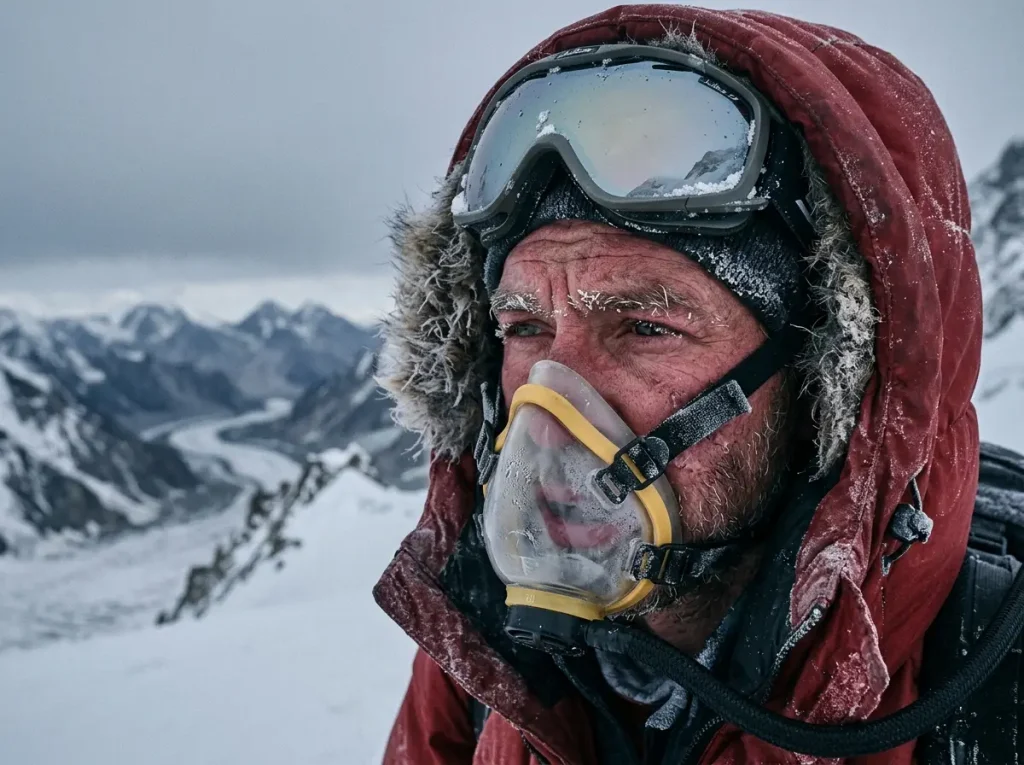
There’s a line on Everest, drawn not on any map but by human physiology, and Camp 4 sits right at its edge. Cross it and the rules change. This is where the mountain stops being hard and starts being unsurvivable over time.
What the Death Zone actually means
The Death Zone is the climbing term for everything above 8,000 meters. Camp 4 sits about 80 meters below that line, but in practice it lives inside the same envelope. The name isn’t drama for its own sake. Above this height your system can no longer recover, no matter how fit you are or how well you’ve acclimatized lower down.
You don’t adapt up here. You only decline. The question stops being “how strong am I” and becomes “how fast am I fading, and can I get up and down before it matters.”
One-third of the oxygen
At Camp 4 the atmospheric pressure is roughly a third of what it is at sea level, around 326 millibars. In plain terms, every breath delivers about a third of the oxygen your lungs are used to, roughly 33 percent of what you’d pull in at sea level. Lie still and you’re already breathing hard.
Peer-reviewed medicine backs up just how close to the edge this is. Measurements taken on climbers near the summit showed oxygen levels barely compatible with life. That isn’t a figure of speech. It’s why this stretch of mountain demands supplemental oxygen for nearly everyone who climbs it.
Just below the line, fully inside the envelope
That 80-meter buffer below the official Death Zone threshold buys you nothing. The same forces apply: no acclimatization, steady decline, an internal clock running down. The fact that other 8,000-meter peaks like Cho Oyu share this exact physiology is why high-altitude mountaineers treat all of them with the same respect.
No amount of clever acclimatization changes the ceiling either. You can prep your system for thin air, and proper high-altitude training makes the lower mountain survivable, but above 8,000 meters the math finally wins. The col is where that becomes real.
Life at Camp 4 — Why You Don’t Rest, You Wait
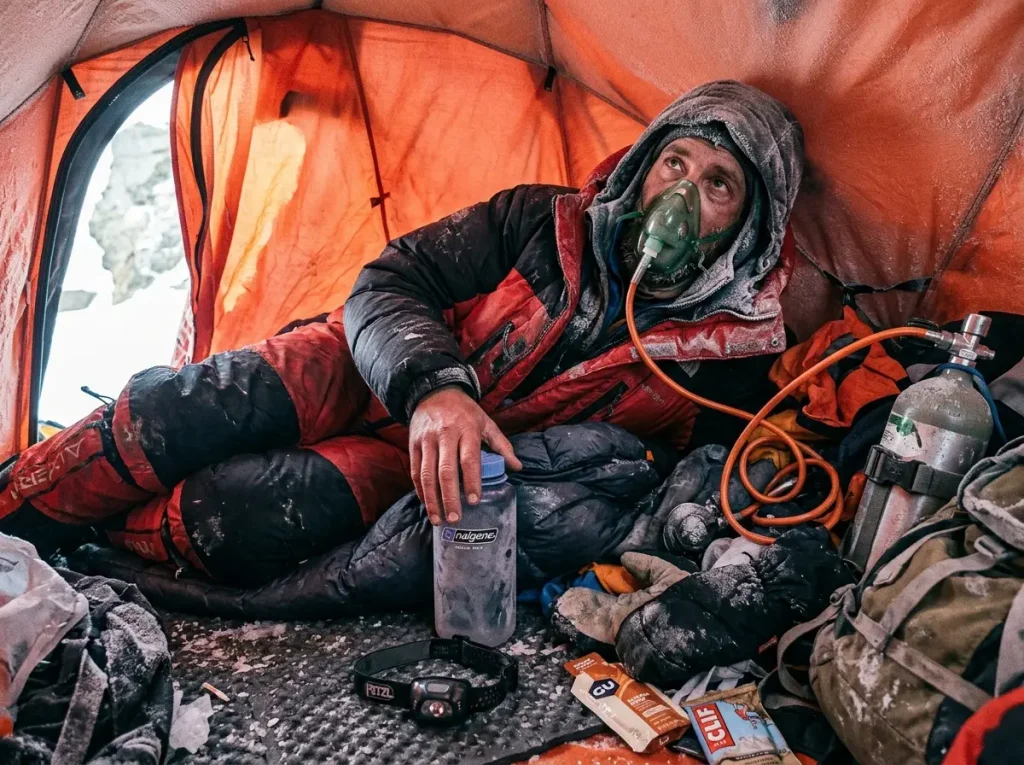
This is the part that never makes it into the highlight reels. The hours at Camp 4 are not heroic. They’re a grim, cold, sleepless wait, and what they do to you physically is the whole reason the camp works the way it does.
Rested wakefulness
Climbers describe their time at Camp 4 as rested wakefulness, which is a polite way of saying you lie there with your eyes closed and never actually sleep. Even with an oxygen mask running, real sleep is mostly off the table at this height. Your breathing won’t settle, your mind won’t switch off, and the night grinds past in a half-conscious haze.
So there’s no true sleep at Camp 4 in any normal sense. You rest your legs, you stay horizontal, and you wait for the start time. That’s it.
The cold, the wind, and the tent that wants to leave
Temperatures on the col run from about minus 30 to minus 40 degrees Celsius, and the jet-stream wind can scream past at well over 160 kilometers per hour. Tents have to be anchored hard to rock and ice or they peel off the saddle and disappear. Exposed skin starts to frostbite in minutes.
Inside the tent it’s marginally better, but only just. Frost coats the inner seams from your own breath, water bottles freeze if you don’t sleep with them, and every small task costs more than it should. People who’ve been there say moving feels like wading through thick treacle.
Burning your own muscle
Above roughly 7,500 meters you start consuming your own muscle for fuel. Over a full expedition climbers can lose 10 to 15 kilograms, and a chunk of that wasting accelerates right here, in the highest camps. The longer you sit on the col, the weaker you get for the hardest day of the climb.
That’s the cruel logic of the place, and it’s why “wait, don’t rest” isn’t just a turn of phrase. Time spent here is time spent getting worse. The skill is doing what you need to do, then leaving before the col takes too much.
Do the energy-sapping chores the second you arrive, while you still have a margin. Melt snow, hydrate hard, and check your oxygen and gear before you lie down. Up here every task takes monumental effort, and it only gets worse the longer you wait to do it.
Oxygen at Camp 4 — Why It’s Non-Negotiable
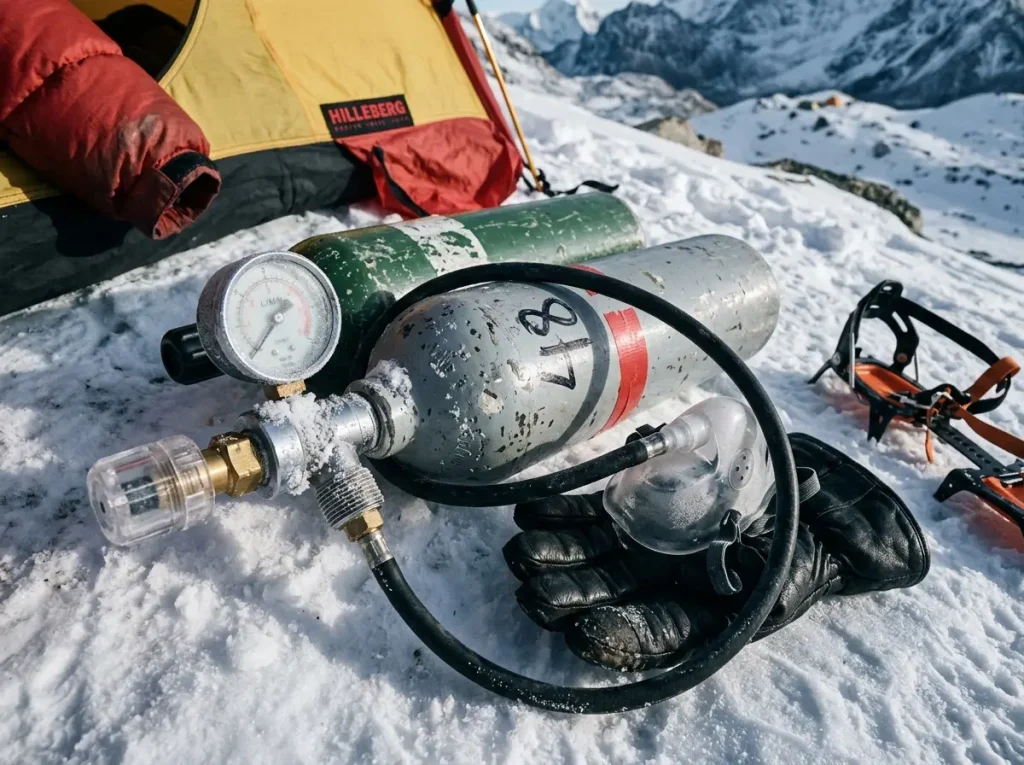
If there’s one piece of gear that decides summit day, it’s the green bottle on your back. Supplemental oxygen isn’t a luxury at Camp 4, and the way you manage it separates the climbers who come home from the ones who run into trouble high on the ridge.
How much oxygen, and when
Standard flow rates run around 2 to 4 liters per minute while climbing and about 0.5 liters per minute resting or “sleeping,” though some teams now push 4 to 8 liters per minute on summit day. The numbers sound small until you do the arithmetic on a finite number of bottles across a 12-to-24-hour round trip.
Climbers call this bottle math, and it’s exactly what it sounds like: matching your flow rate against your supply so you don’t run dry where it counts. Burn too fast early, or idle on high flow while stuck behind slower climbers, and you can empty a bottle in the worst possible place.
What climbing without oxygen really means
There’s a romantic idea in the forums that going without bottled oxygen is the “pure” way to climb Everest. The honest version is starker. Only about 232 people, roughly 1.7 percent of all summiters since 1953, have topped out without supplemental oxygen, according to the running tally kept by Everest statistician Alan Arnette. It’s a tiny elite practicing what amounts to a different, far less survivable sport.
The fatality figures make the point. Among summiters in one long study window, the descent fatality rate was about 8.3 percent without supplemental oxygen versus 3 percent with it. Skipping the bottle doesn’t make you a purist. It roughly triples your odds of not making it down.
Why you never sleep here without it
Trying to sleep at Camp 4 without oxygen is considered catastrophic. It spikes your risk of the altitude illnesses that turn fatal fast, and you wake up measurably worse than you lay down, if you sleep at all. Even the climbers attempting no-oxygen summits treat the resting hours with extreme caution.
For everyone on a commercial expedition, the answer is simple: the mask stays on, the flow stays set, and the bottle gets babied. That’s not weakness. It’s the difference between an attempt and a recovery operation.
Time at Camp 4 and the Summit Push — The Clock That Decides
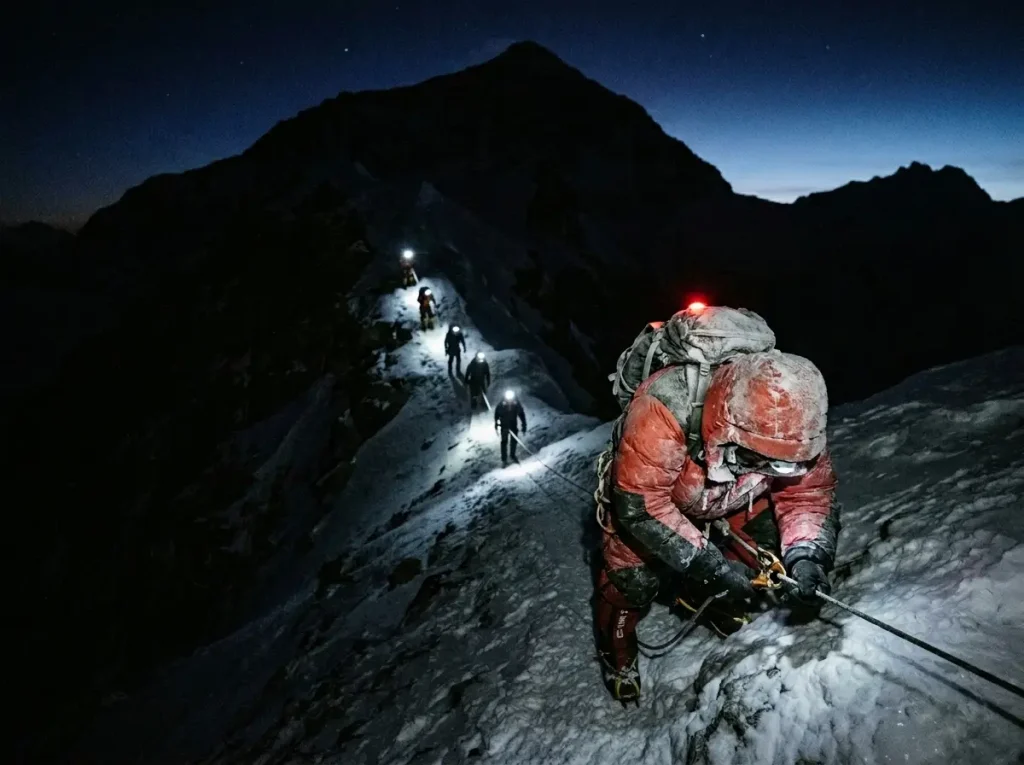
Everything on summit day runs on a clock, and the clock, not the summit, makes the final call. This is the single most important idea on the mountain, and it’s the one beginners understand last.
How long you actually stay
Most climbers spend only about 6 to 12 hours at Camp 4 before leaving for the top. You arrive in the afternoon, you do your chores, you lie down for a few hours of rested wakefulness, and then you’re up and clipping in. Staying significantly longer just drains the oxygen and strength you can’t spare.
That short window is by design. The col is a place to stage from, part of the weeks-long expedition that everything above Base Camp is built around, not a place to settle in.
The midnight start and the 10-to-12-hour climb
The summit push typically leaves Camp 4 in the late evening, somewhere around 9 to 11 PM, climbing through the night by headlamp. You’re sealed into a down summit suit and high-altitude mountaineering boots, crampons biting the snow and an ice axe in hand, sliding an ascender (a jumar) along the fixed lines while your oxygen mask and regulator handle the breathing for you. From the col to the summit takes roughly 10 to 12 hours, sometimes as few as 8 or as many as 16, with a full round trip running 12 to 24 hours. There’s no real rest anywhere in that span, because there’s nowhere in the Death Zone that rest does any good.
The video below is first-person footage from the col toward the summit. It conveys the headlamp-train pace, the cold, and the exposure better than any paragraph can.
Turnaround time — the rule that keeps you alive
Every serious team sets a hard turnaround time, often around 2 PM, and the rule is brutal in its simplicity: when the clock hits it, you turn around, summit or not. It doesn’t matter if the top looks like it’s twenty minutes away. Descending the Southeast Ridge after dark, exhausted and low on oxygen, is what costs climbers their lives.
The phrase you’ll hear over and over is that the summit is only halfway. More climbers are lost on the way down than on the way up, which is why the descent, not the photo on top, is the real test. Descent discipline decides outcomes on every serious peak, from the Matterhorn on up, and on Everest it’s the whole game.
Plan the whole day around getting back to the col alive, not around the summit. Veteran guides preach competence over confidence, because summit fever rewrites your judgment exactly when hypoxia has already fogged it. Pick your turnaround time before you leave the tent, and treat it as non-negotiable once the climb starts.
The Real Hazards Above Camp 4 — Crowds, HACE, HAPE, Frostbite
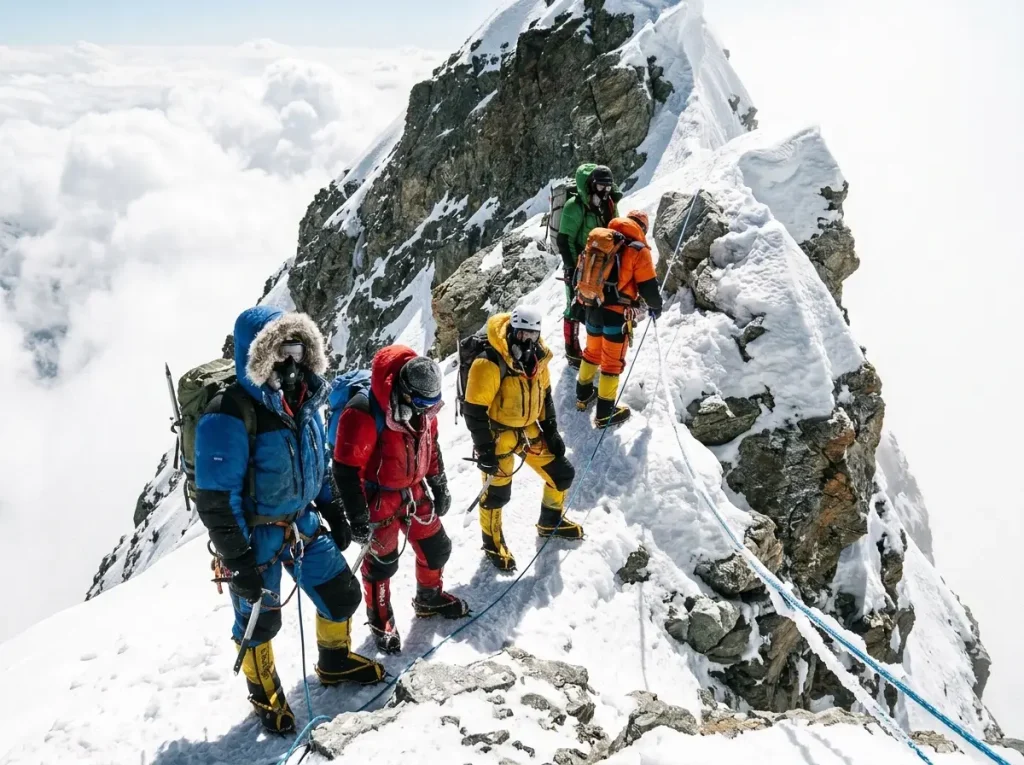
The things that hurt climbers above Camp 4 aren’t the ones that look cinematic. They’re slower and more mundane: a queue that won’t move, a headache that turns sinister, a cold that creeps into your fingers. Knowing them ahead of time is half the defense.
The traffic jam in the Death Zone
The route above the col funnels through single-rope chokepoints, most famously the Hillary Step at about 8,790 meters and the Balcony at about 8,400 meters. One climber passes at a time, and up-traffic and down-traffic often share the same fixed line. When too many people hit those spots at once, everything stalls.
In late May 2019, more than 200 climbers queued for hours in otherwise clear weather, and about seven lost their lives that week. The crowding itself was the hazard. People stood still in the Death Zone, burning through oxygen and warmth they couldn’t replace, until some of them had nothing left for the descent.
Smart teams stagger their departure times from Camp 4 instead of leaving with the herd at 9 PM. A start an hour off the pack can be the difference between walking through the Hillary Step and standing in a two-hour line at 8,790 meters. Ask your guide what the plan is for thinning the bottleneck before summit night.
HACE and HAPE — when your brain and lungs turn on you
Two altitude illnesses haunt this height. HACE, high-altitude cerebral edema, is swelling in the brain. HAPE, high-altitude pulmonary edema, is fluid in the lungs. Untreated, each carries up to roughly 50 percent fatality, and they can come on fast.
The fix is always the same, and it’s counterintuitive when the summit is right there: go down, now. The medical literature on high-altitude pulmonary and cerebral edema is blunt about the only real treatment, which is immediate descent. Going up with either one is how attempts turn fatal, which is why spotting the early signs of altitude sickness and acting on them is a skill, not an afterthought.
Frostbite, summit fever, and running out of oxygen
Then there are the slower thieves. Frostbite takes fingers, toes, and noses, especially when you’re standing still in a queue with the wind up. Running a bottle dry in the wrong place compounds everything, because the moment your oxygen stops, your judgment and your warmth go with it.
And underneath all of it sits summit fever, the urge to keep going past your turnaround time because the top is so close. It’s the quiet one that ties the others together. The climbers who get into the most trouble usually aren’t beaten by the mountain’s worst conditions. They’re beaten by their own decision to ignore the clock.
Conclusion
Camp 4 is the launchpad, not a rest stop. You arrive, you wait, you leave, and you do not recover here, no matter how badly your legs want to. Hold onto that and the rest of the mountain makes sense.
Three things decide more than raw fitness ever will. Your bottle math keeps oxygen where you need it. Your turnaround time keeps you honest when summit fever says otherwise. And the crowd at the chokepoints can undo a perfect day if you don’t plan around it.
Most of all, remember that the summit is only halfway. Getting back down to the col alive is the entire point. If this pulled back the curtain on the highest camp, keep building the real picture by reading up on what it actually takes to plan a climb on Everest before you ever romanticize the top.
Frequently Asked Questions
01Is Camp 4 the same as the South Col?
Effectively yes, with one nuance: the South Col is the wind-scoured saddle between Everest and Lhotse, and Camp 4 is the camp pitched on it at about 7,900 meters. On the standard Nepal-side route they mean the same place. The Tibet-side route has a different highest camp.
02Can you sleep at Camp 4 without oxygen?
You essentially cannot sleep at Camp 4 at all, even on supplemental oxygen, which is why climbers call it rested wakefulness. Trying to sleep without oxygen is considered catastrophic, since it spikes the risk of HAPE and HACE and you wake up weaker than you lay down.
03What is the biggest hazard at Camp 4?
There is no single one, but the deadliest pattern is the descent, since more climbers are lost coming down than going up. Traffic jams at the Hillary Step, running out of oxygen, HACE, HAPE, and frostbite all compound, and blowing the turnaround time ties them together.
04How long do climbers stay at Camp 4 before the summit?
Usually only about 6 to 12 hours. Climbers arrive in the afternoon, force down fluids, prep gear and oxygen, and launch the summit push around 9 to 11 PM. Staying longer just burns the oxygen and muscle you need higher up.
05How long does it take to get from Camp 4 to the summit of Everest?
Roughly 10 to 12 hours up, with a range of 8 to 16, and a full round trip of about 12 to 24 hours. It is a continuous push with no real rest in the Death Zone, which is exactly why turnaround time is enforced regardless of how close the summit looks.
Safety Notice: Rock climbing and mountaineering are inherently high-risk
activities that can involve physical trauma or fatal incidents. The information on Rock Climbing Realms is for
educational and informational purposes only. Techniques and advice presented here are not a substitute
for professional, hands-on instruction. Conditions and risks vary by location. Always seek guidance
from a qualified instructor before attempting new techniques. By using this website, you agree that you
are solely responsible for your own safety. Any reliance you place on this information is strictly
at your own risk, and you assume all liability for your actions. Rock Climbing Realms and its authors
will not be held liable for any harm, damage, or loss sustained in connection with the use of this information.
Affiliate Disclosure: We are a participant in the Amazon Services LLC Associates Program, an
affiliate advertising program designed to provide a means for us to earn advertising fees by advertising and linking
to Amazon.com. As an Amazon Associate, we earn from qualifying purchases. We are also an official affiliate partner
of Black Diamond Equipment via the AvantLink network. If you click on a Black Diamond affiliate link and make a
purchase, we may earn a commission at no additional cost to you. We also participate in other affiliate programs.
Additional terms are found in the terms of service.