
In this article
Cho Oyu has the lowest fatality rate of any of the world’s fourteen 8,000-meter peaks. That single statistic, repeated on every expedition sales page, is exactly what gets underprepared climbers into trouble. The phrase “easiest 8,000er” is true in one narrow sense and hazardous in every other one, because on a mountain this non-technical the thing that hurts you isn’t the climbing, it’s the decision-making at altitude. Ask anyone who guides high peaks and they’ll tell you the same: people don’t fall off Cho Oyu, they get caught by the air. This guide walks the real route, the honest all-in cost, the season, the prerequisites, the gear, and the risk picture nobody puts in a brochure, so you can decide where Cho Oyu sits among what the world’s most famous peaks actually demand and whether you belong on it yet.
Here’s the honest snapshot before we get into it.
| Cho Oyu at a Glance | The Honest Detail |
|---|---|
| Summit elevation | 8,188 m / 26,864 ft (older surveys list 8,201 m) |
| Standard route | Tibet northwest ridge, the “Tichy Route” |
| Technical difficulty | One short ~5.7 rock step; the rest is glacier walking on fixed rope |
| Fatality rate | ~1.3% cumulative, the lowest of all 14 eight-thousanders |
| Best season | Pre-monsoon spring or post-monsoon autumn |
| Supplemental oxygen | Standard on guided climbs |
| Realistic all-in cost | $35,000 to $65,000 |
What Makes Cho Oyu the World’s Second-Most-Climbed 8,000er
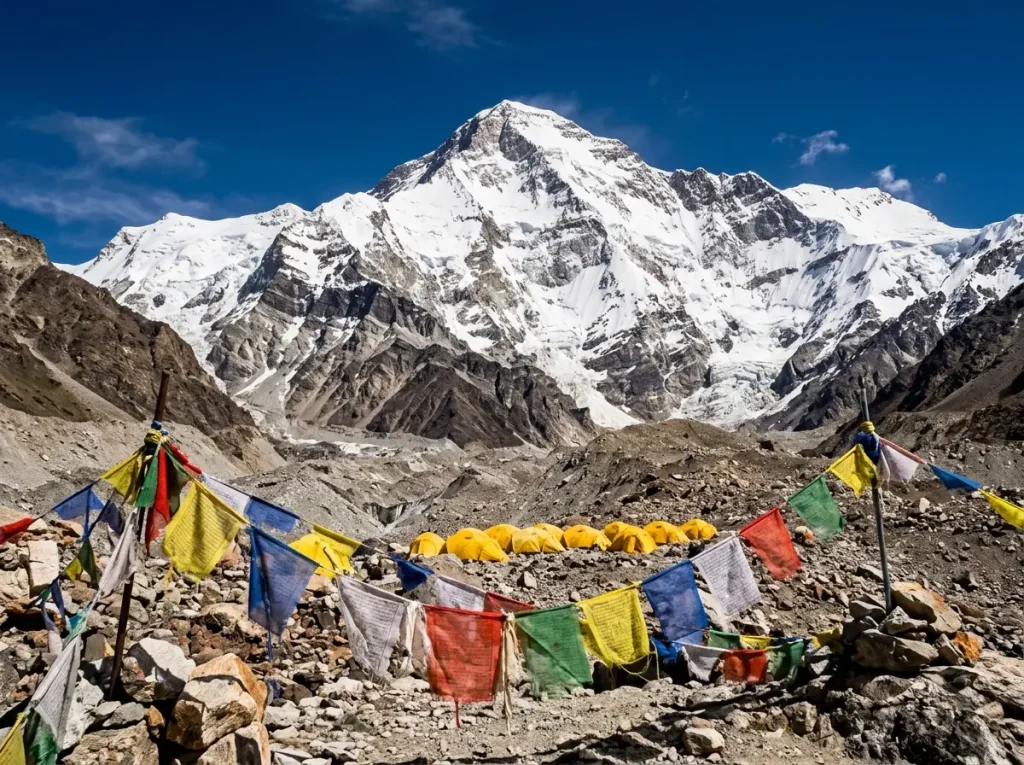
Cho Oyu sits on the Tibet-Nepal border, and its Tibetan name translates to “Turquoise Goddess.” It’s the sixth-highest mountain on Earth, but more useful for a first-timer is its ranking by traffic: it’s the second-most-climbed eight-thousander after Everest, with roughly four times more ascents than the third-most-popular 8,000m peak. That popularity is the whole reason it feels approachable. More than four thousand people have already smoothed the path, which means fixed ropes, established camps, and the most predictable logistics of any peak outside Everest. The standard approach runs in from Lhasa or Kathmandu to the Tibetan town of Tingri, the staging point for the drive to base camp.
The mountain has a long history for the same reason. The first ascent came on October 19, 1954, when Austrians Herbert Tichy and Joseph Jöchler reached the top with Sherpa Pasang Dawa Lama. That made Cho Oyu only the fifth 8,000-meter peak ever climbed, putting it right at the center of Himalayan mountaineering’s golden age. If that era pulls at you, Maurice Herzog’s Annapurna, the account of the first 8,000er ever climbed in 1950, is the book that started the whole genre and reads like a fever dream four years before Cho Oyu fell.
One honest note on the numbers. You’ll see the summit listed as 8,201 m on most operator sites and 8,188 m on modern references. The lower figure comes from current GPS surveys; the higher one is the older measurement that stuck around in marketing copy. It doesn’t change the climb, but it’s a small early tell that the sales pages aren’t always working from the most current information.
The Easiest 8,000-Meter Peak Label, Honestly Examined
The label is real. Cho Oyu’s cumulative fatality rate is roughly 1.3%, with about 52 deaths across more than 4,000 climbs through the end of 2024, according to the Himalayan Database’s cumulative summit and fatality records. Put that next to the other giants and the gap is stark: Annapurna I sits around 13.4%, Dhaulagiri near 13%, Kangchenjunga close to 8%, Makalu near 6%. When operators call Cho Oyu the safest 8,000er, the comparative math actually backs them up.
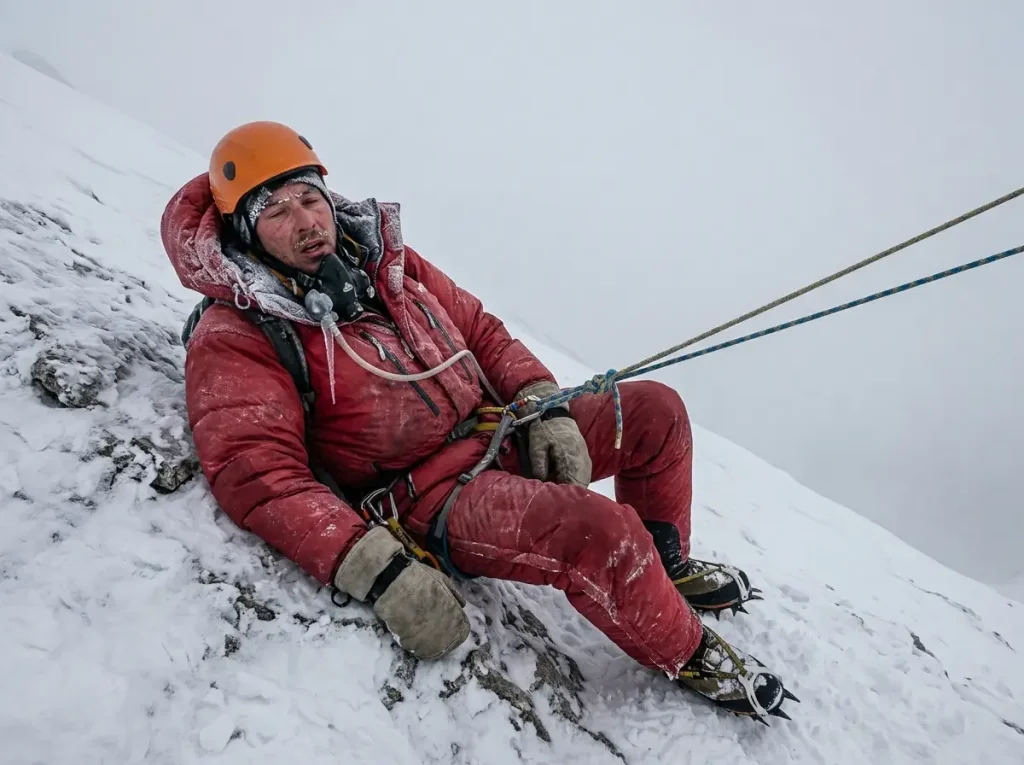
Here’s where the trap springs shut. Low relative risk is not low absolute risk. A 1.3% fatality rate still works out to roughly one climber in 77 dying on the mountain. That’s not a rounding error, and it’s a wildly different bar than the “easy” framing implies. The hazard simply moves. On a technical peak the question is “can I make this move.” On Cho Oyu the question is “can I make good decisions while my brain is starved of oxygen,” and a climber who trained only for fitness never prepared for that shift at all.
This is the most common way the easy label hurts people. The low technical bar lulls underprepared climbers into skipping the real prerequisite peaks, and then altitude sickness or weather catches them on terrain that was never the problem. It’s worth keeping a calibration point in mind: Denis Urubko, who has summited all fourteen 8,000-meter peaks, called his 2009 alpine-style ascent of Cho Oyu’s hard side his most hazardous climb. When someone with that resume flags a part of this mountain as the limit, it pays to understand what actually makes a mountain hazardous, not just tall.
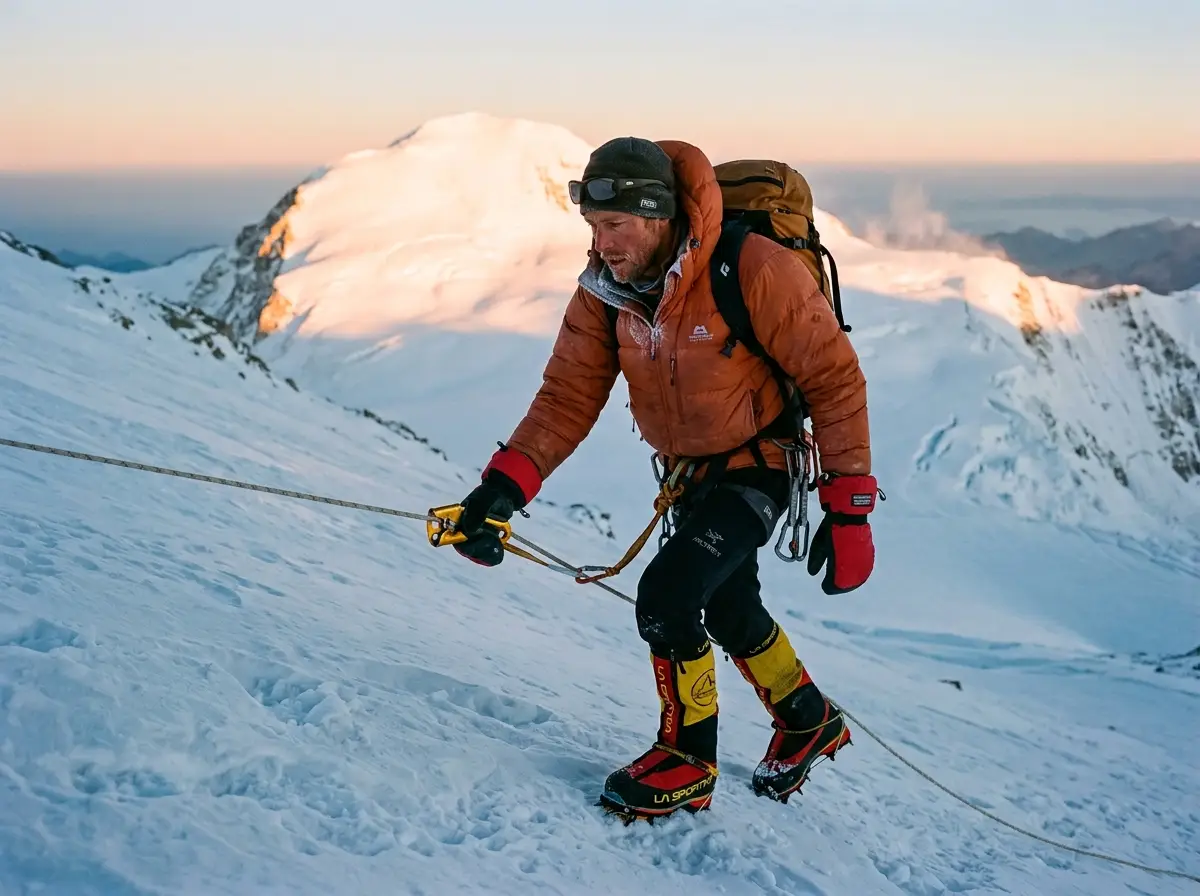
To see what the unsupported version of this climb actually looks like, RMI guide Alex Barber’s solo, no-oxygen ascent strips away the guiding and the bottled air the easy label quietly leans on.
The Standard Route, Tibet’s Northwest Ridge Step by Step
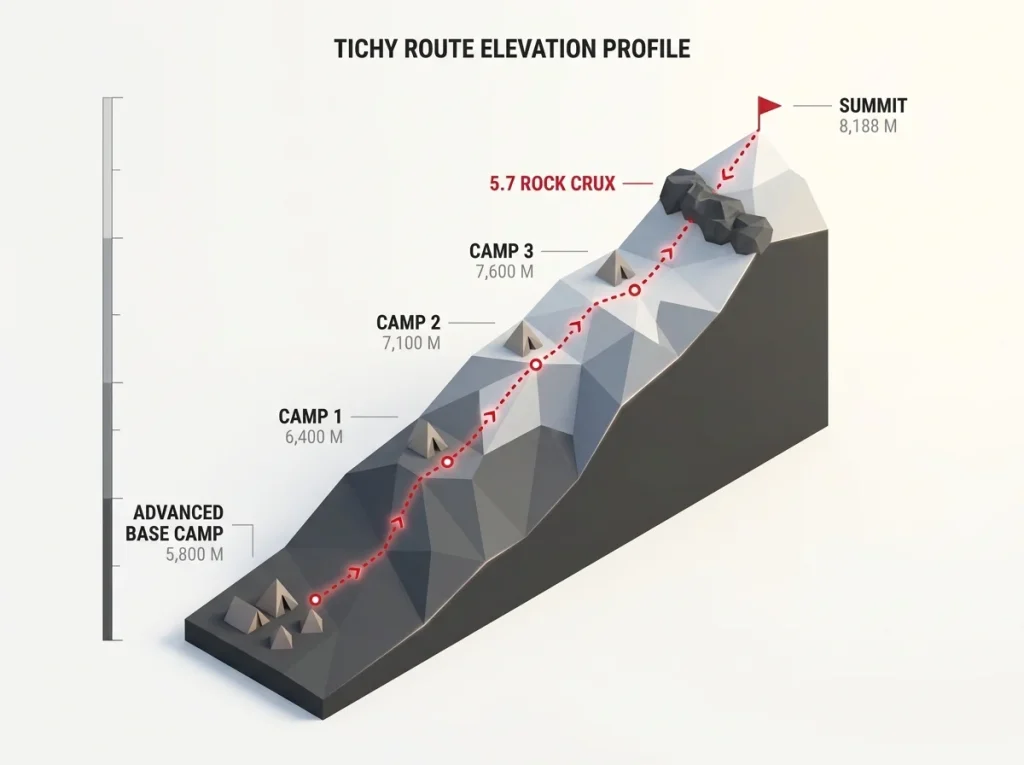
Nearly everyone who climbs Cho Oyu does it on the Tibet side via the northwest ridge, the Tichy Route. The shape of it is simple. From Advanced Base Camp at around 5,800 m, the climb moves up through Camp 1 near 6,400 m, Camp 2 around 7,100 m, and Camp 3 between roughly 7,400 and 7,600 m, before the summit plateau. Most of that is endurance on glacier terrain, clipped to fixed rope, kicking steps in firm snow. It is a walk in a hard place, not a series of moves.
There is exactly one spot that asks for real technique. Below the summit plateau sits the route’s single technical crux, a short rock band rated around 5.7 in the original 1954 and 1984 accounts, where you do actual rock moves in double boots and crampons. It’s brief, but it’s the one section guides consistently flag for skill-specific prep. Everything before it rewards fixed-rope competence and the patience to keep moving slowly; that one band rewards having climbed rock in big boots before.
That doesn’t mean the rest is harmless. The American and Czechoslovak women’s expedition account in the American Alpine Club’s own Cho Oyu climbing report describes clinging to a deeply planted ice axe through a small avalanche on a steep snow gully. That’s the “rare but real” hazard on a route everyone calls a glacier stroll. The terrain is forgiving until the day it isn’t.
Don’t train for the whole mountain, train for the one rock band. Spend a few days climbing easy rock in your mountaineering boots and crampons before the trip. The glacier walking is just fitness, but stepping up 5.7 rock in stiff double boots for the first time at 7,900 m is how people freeze on the crux.
For the real texture of pacing, the fixed-rope crux, oxygen-mask use, and camp life at altitude, Emily Harrington and Adrian Ballinger’s “Lightning Ascent” documentary shows what no written description can.
North Ridge vs South Ridge, Two Completely Different Mountains
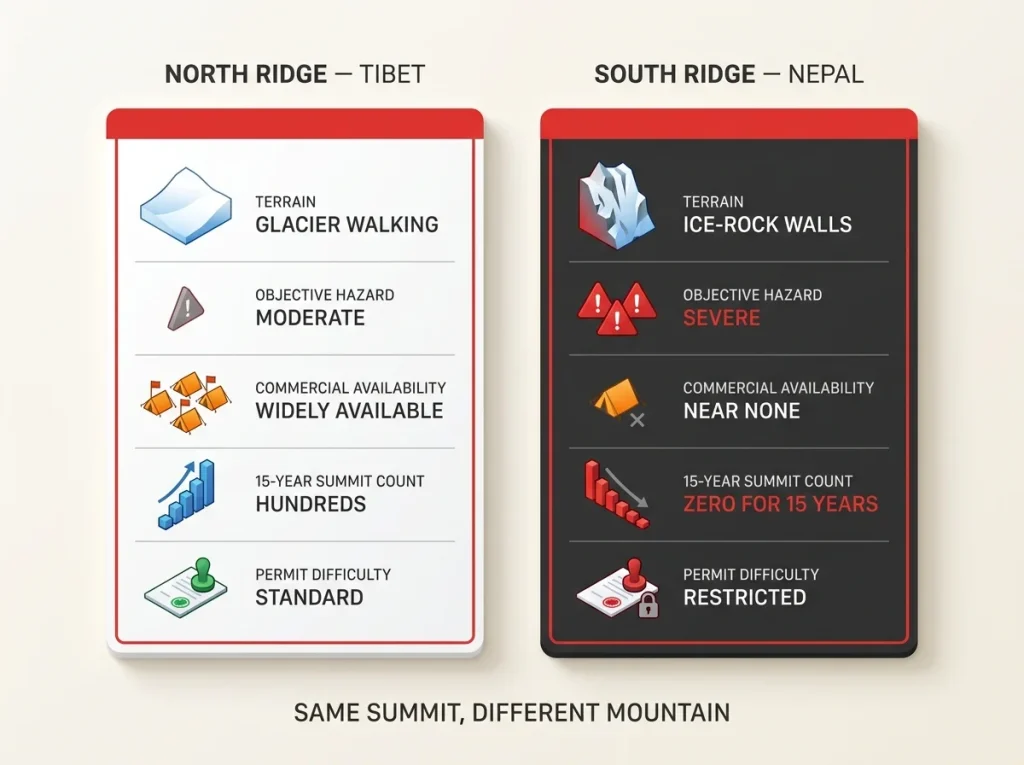
This is the single error that most often shows up in beginner research: treating the Nepal side as “the same climb, just less crowded.” It is not. The two routes share a summit and almost nothing else.
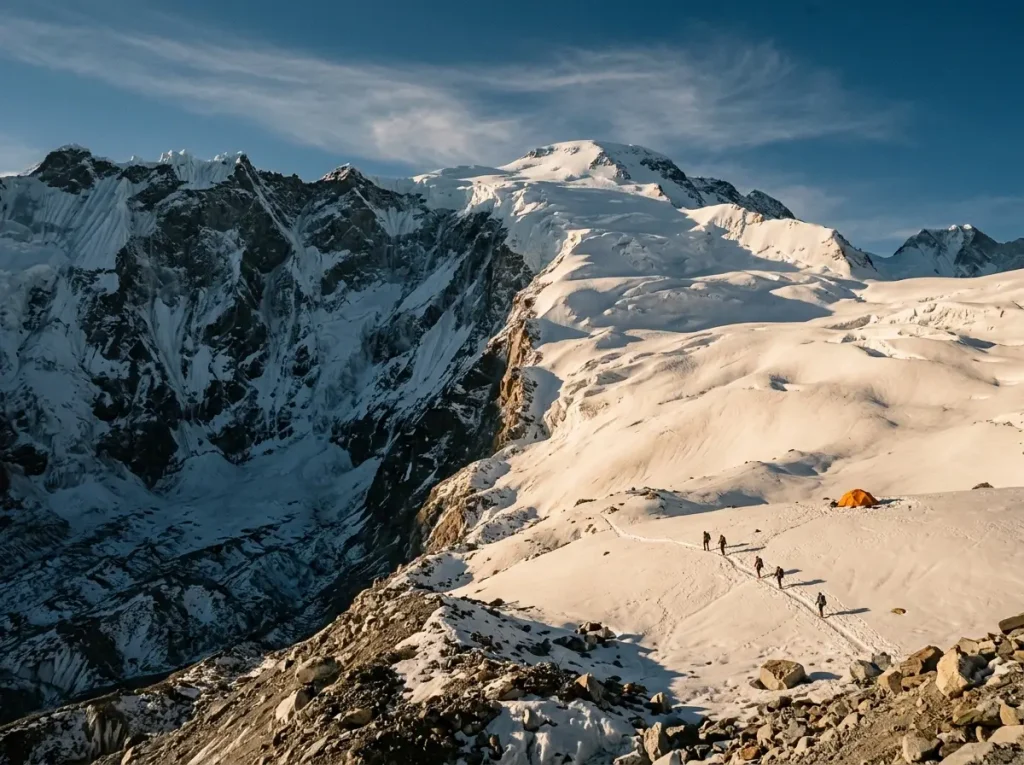
The Tibet northwest ridge is the standard, the one with the stable glacier platform, the fixed ropes, and nearly every commercial expedition. The Nepal South Ridge is a different animal entirely: roughly 3,000 m of ice-saturated rock walls and avalanche-prone plateaus that essentially no commercial operator will run. The numbers tell the story plainly. Between Urubko and Dedeshko’s 2009 alpine-style ascent and a seven-person team’s success in June 2024, there were fifteen straight years with zero South Ridge summits. “Almost nobody” is a figure you can actually point to.
It’s harder bureaucratically, too. After an unauthorized 1978 attempt on the South Ridge, Nepal banned an entire team for five years and hardened the permit regime for that side, which is part of why it stayed essentially unclimbed for decades. So the practical takeaway is clean: if an operator is selling you “Cho Oyu,” it’s the Tibet side, climbed on a China-issued Tibet permit arranged through your outfitter. Confirm it in writing, and understand that the Nepal route is an expert-only, near-non-commercial objective that belongs in a completely different conversation.
Spring or Autumn, Picking Your Season and Weather Window
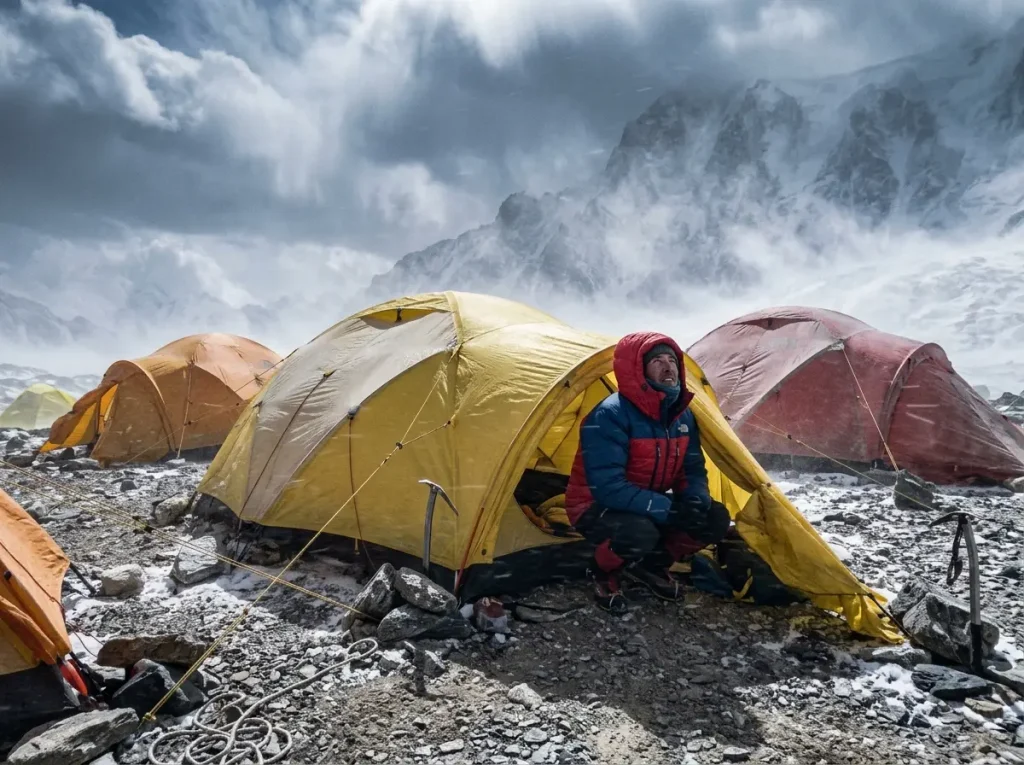
Cho Oyu has two viable seasons: pre-monsoon spring and post-monsoon autumn. Each trades off temperature, snow conditions, and crowds, but neither makes the climbing meaningfully harder or easier. What they really change is your odds of catching a clean summit window, and on a peak this non-technical, weather drives the summit success rate far more than fitness does.
That’s why experienced teams build the entire trip around catching one good window rather than around climbing speed. It also makes turnaround time non-negotiable. Borrowed from Everest’s “2 PM Rule,” a turnaround time is a clock cutoff you agree to before the summit push: when the hour hits, you go down regardless of how close the top looks. The mountain doesn’t care how much you’ve spent to be there, and the discipline of honoring that cutoff is the same logic that governs how a Himalayan summit window really works on every big peak.
Set your turnaround time with your guide before summit night, out loud, and agree that nobody renegotiates it at 8,000 m. Hypoxic you is a worse decision-maker than rested you, and the whole point of the cutoff is that you decided it while your brain still worked.
Supplemental Oxygen, the Death Zone, and the Risk Nobody Brochures
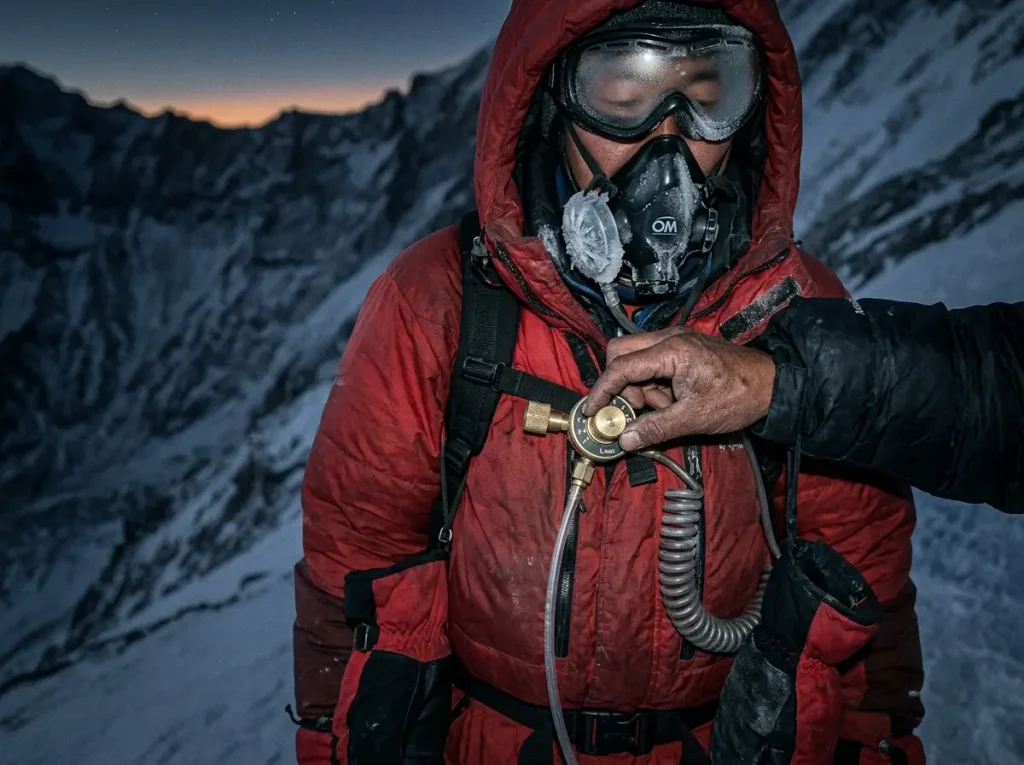
On a peak this non-technical, the real adversary is the air. Supplemental oxygen is standard on guided Cho Oyu climbs, and the Barber video above shows just how much harder the unsupported version is. The bottled oxygen is a big part of what makes the “easy” label hold up, and it’s worth understanding that as a feature you’re buying, not a default state of the mountain.
Above roughly 8,000 m you’re in the Death Zone, where you break down faster than you can recover. Time becomes the enemy, not terrain. The three illnesses to know are AMS (acute mountain sickness), HACE (high-altitude cerebral edema), and HAPE (high-altitude pulmonary edema). AMS is the common, milder warning; HACE and HAPE are the ones that prove fatal, and for all three the only reliable treatment is to go down. Recognizing the early signs while you can still think clearly is the whole game, which is why a real climber’s acclimatization protocol for AMS, HACE, and HAPE matters more here than any rock skill.
This is also where the “easy peak” framing does its quiet damage. Some operators sell a Rapid Ascent option built around hypoxic-tent training at home, sleeping in a low-oxygen tent for weeks so you can summit in roughly half the usual trip length. It’s a legitimate product, but it compresses the schedule without removing the underlying risk. Faster acclimatization is still acclimatization, and the body above C2 still keeps its own clock.
What Climbing Cho Oyu Actually Costs in 2026
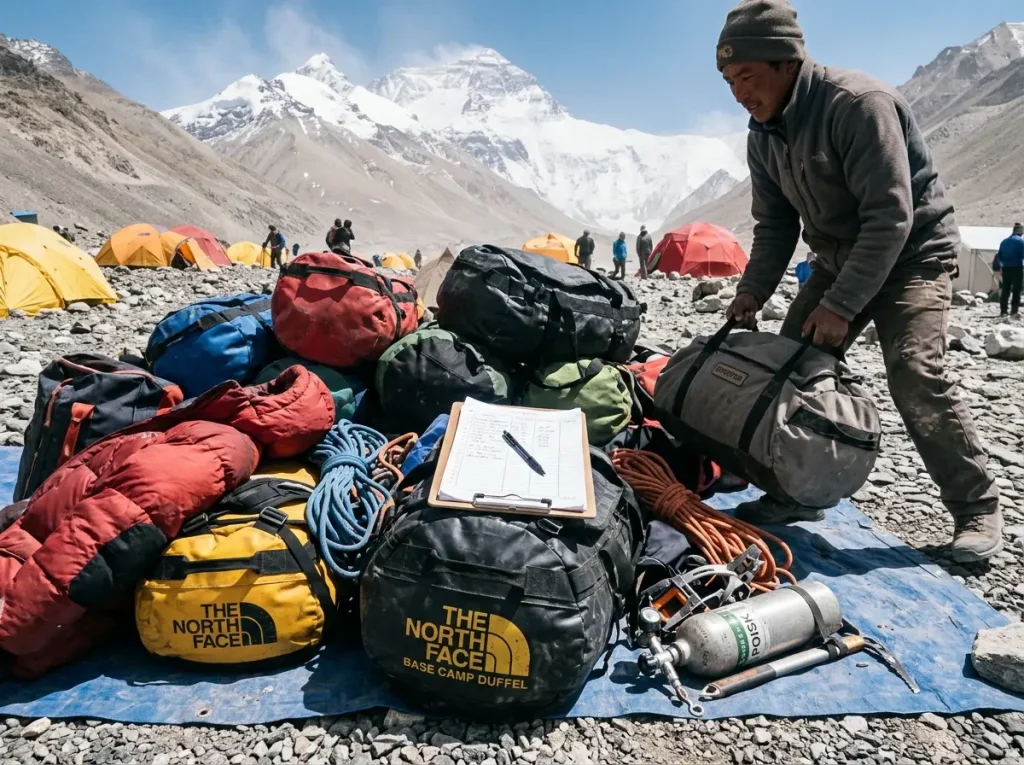
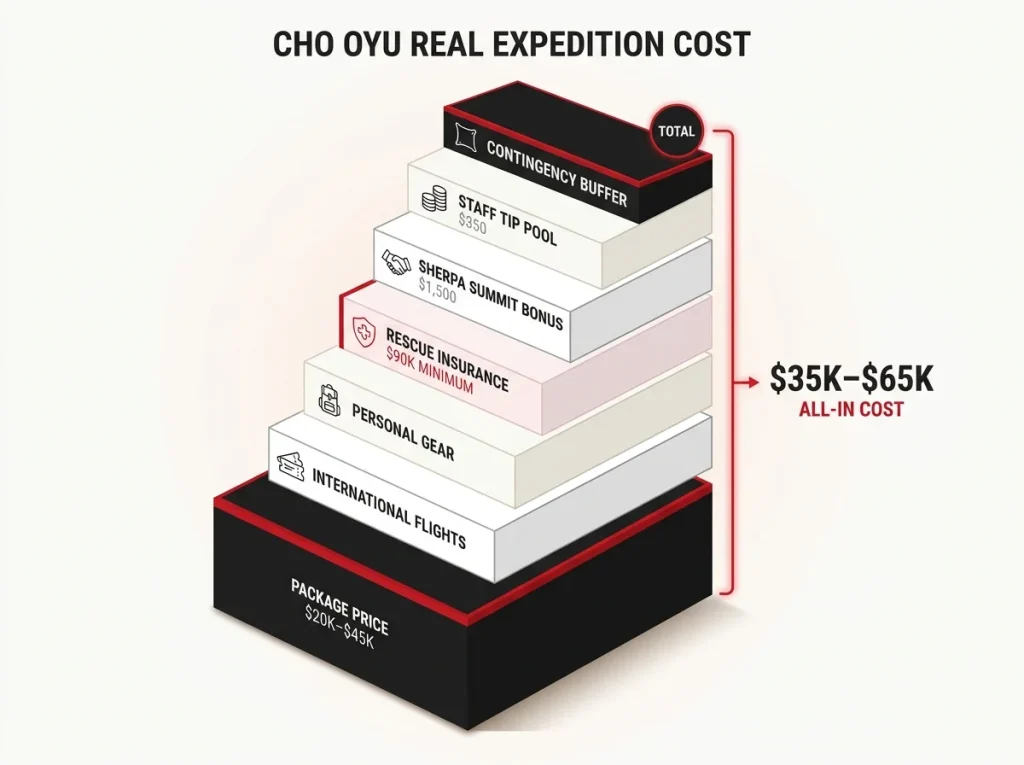
The number on the brochure is never the number you pay. Headline packages run from around $20,000 to $45,000, depending on tier: budget Nepali operators land near $20,000 to $30,000, mid-tier outfits around $25,000 to $35,000, and premium Western companies from roughly $32,000 to $45,000. But the realistic all-in cost, once you add international flights, personal gear, insurance, tips, and a contingency buffer, runs $35,000 to $65,000. Budget another $10,000 to $20,000 beyond the package price before you’ve bought a single boot.
The costs that blindside people are the ones that arrive late, after you’ve already committed. A few rarely show up on the sales page: a customary $1,500 summit bonus paid directly to your personal Sherpa at the high camp, a roughly $350 per-client tip pool for the kitchen and base-camp staff, and a minimum $90,000 in emergency high-altitude rescue and evacuation insurance that most reputable operators require before they’ll take you. That last one is not optional and not cheap, and it’s worth knowing what a high-altitude rescue policy actually needs to cover before you buy the first policy a broker hands you. It’s the same late-arriving-cost pattern you see on an Everest expedition, just at a smaller scale.
So get every line item in writing before you sign: what’s included, what’s extra, and what’s expected of you on summit day. If you want to build the whole picture properly, a step-by-step framework for budgeting a major alpine climb keeps the contingency money in the plan instead of on a credit card at base camp.
Ask one blunt question before signing: “What will I pay that isn’t in this package price?” A good operator answers with the Sherpa bonus, the tip pool, and the insurance minimum without flinching. An operator who waves it off is the one who’ll surprise you at Camp 4.
Are You Ready? The Prerequisite Peaks and Experience Check
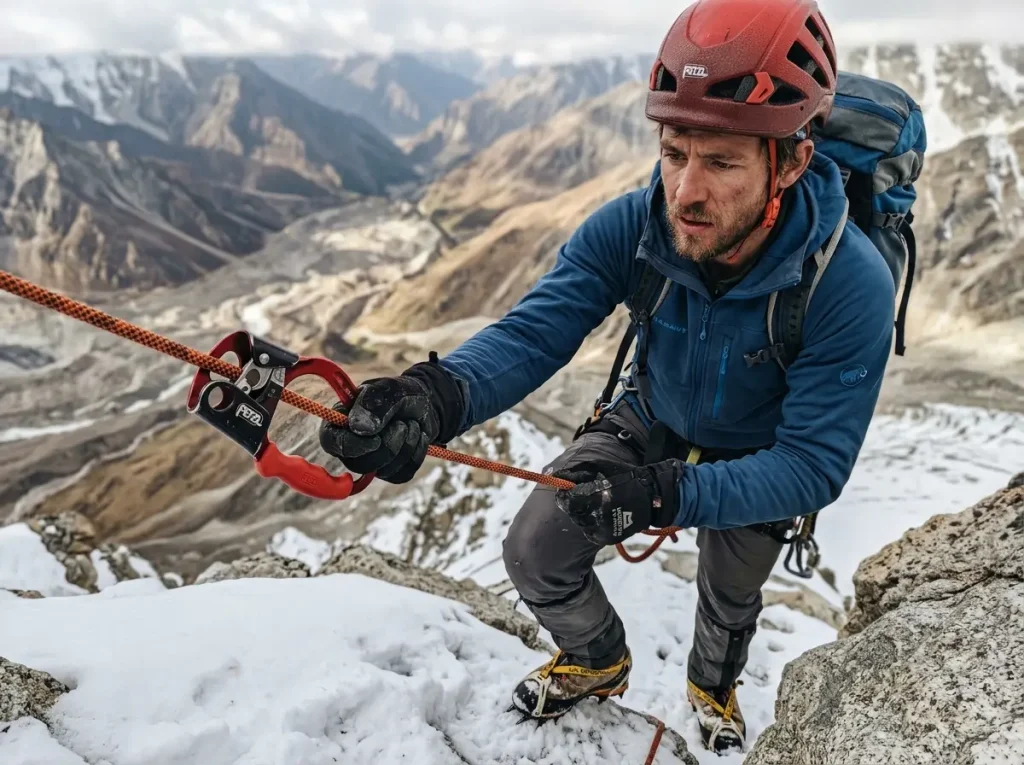
“Be fit” is not a prerequisite. The actual gatekeeping requirement at most reputable operators is a climbing resume: a minimum of two 6,000-meter peaks plus one 7,000-meter peak, alongside 10-plus-hour hiking endurance and demonstrated competence with fixed ropes and crampons. A climber with strong trail-running fitness but zero expedition mountaineering experience is not ready for Cho Oyu, full stop.
Those prerequisite peaks aren’t box-ticking. They’re where you find out how your lungs and your judgment hold up at altitude before the stakes turn lethal, which is the entire point of the ladder. The same logic drives the prerequisite ladder that applies to any 8,000-meter peak: you earn the big mountain by surviving the smaller ones and learning what your own warning signs feel like. A 6,000-meter stepping-stone like Island Peak teaches you fixed-rope movement and how you handle thin air, the exact skills the Tichy Route assumes you already own.
Training for Cho Oyu, A Real Timeline Not Get Fit
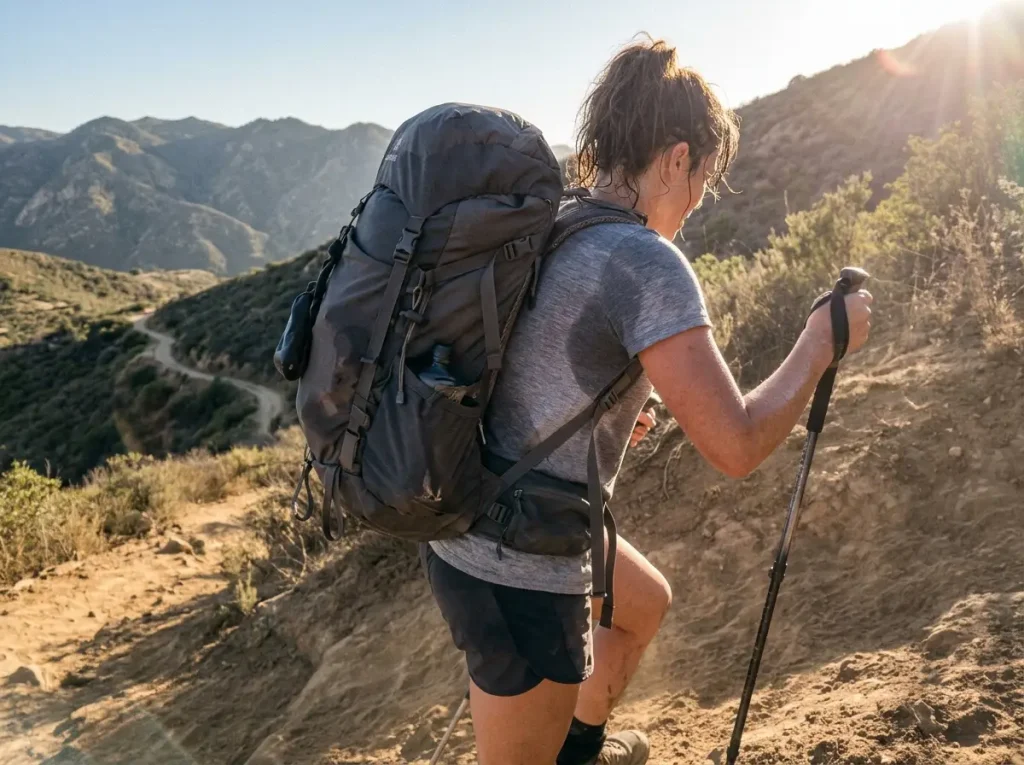
“Get in shape” is not a plan. A real one has a runway of 6 to 12 months and actual numbers attached. The weekly volume benchmarks that show up in serious training plans look like 50 to 60 km of running or 100 to 160 km of cycling, plus 8 to 12 hour weighted hiking days carrying 15 to 20 kg, with load ramping about 10% per week. You pick a weekly distance, add a pack, and progress it on a schedule. That’s the difference between a plan and a wish.
The piece most people skip is altitude itself. Sea-level cardio doesn’t transfer one-to-one to performance at elevation, so a dedicated pre-expedition acclimatization trek to 5,000 m or higher in the months before departure is a real variable you control, not a luxury add-on. Guides consistently report that climbers who do a trek like Everest Base Camp or Annapurna Base Camp beforehand perform measurably better on the demanding ABC-to-C3 acclimatization rotation. A non-technical altitude test like Aconcagua does the same job and doubles as one of your prerequisite high points.
And don’t let the aerobic training crowd out the skills. Rehearse ascending fixed rope and moving on that single 5.7 rock step in your big boots, because raw fitness won’t clip you through the crux.
Put your acclimatization trip about eight weeks before the expedition, not six months before. The altitude adaptation you build fades, so you want it fresh going into the trip, layered on top of a year of base fitness, not used up the previous spring.
Honest Gear Talk, What Actually Works Above Advanced Base Camp
No competitor guide names a single piece of gear. That’s a strange gap, because at -30°C above Advanced Base Camp, vague advice is how fingers and toes get frostbitten. So here’s the actual kit that works on a peak this cold, and an honest word on what to rent versus buy.
The Boots and Suit That Handle the Death Zone Cold
Above ABC you need an integrated double boot built for 8,000-meter cold. The La Sportiva Olympus Mons Cube is the standard guides name for Cho Oyu and Everest-class temperatures, rated to roughly -60°C. There’s no meaningful budget version in this category; the boot is the boot. The honest budget move here isn’t a cheaper model, it’s renting.
For summit day above Camp 3, you want a one-piece down expedition suit, and the The North Face Himalayan Suit is the piece that actually gets worn up high. The 800-fill one-piece design seals the gaps a jacket-and-pant combo leaves open, which matters when the wind is trying to find your kidneys. For a single trip, this is another strong rental candidate, and there’s no shame in it; plenty of one-summit climbers never buy a suit they’ll wear once.
Hands, Crampons, and the Self-Arrest Axe
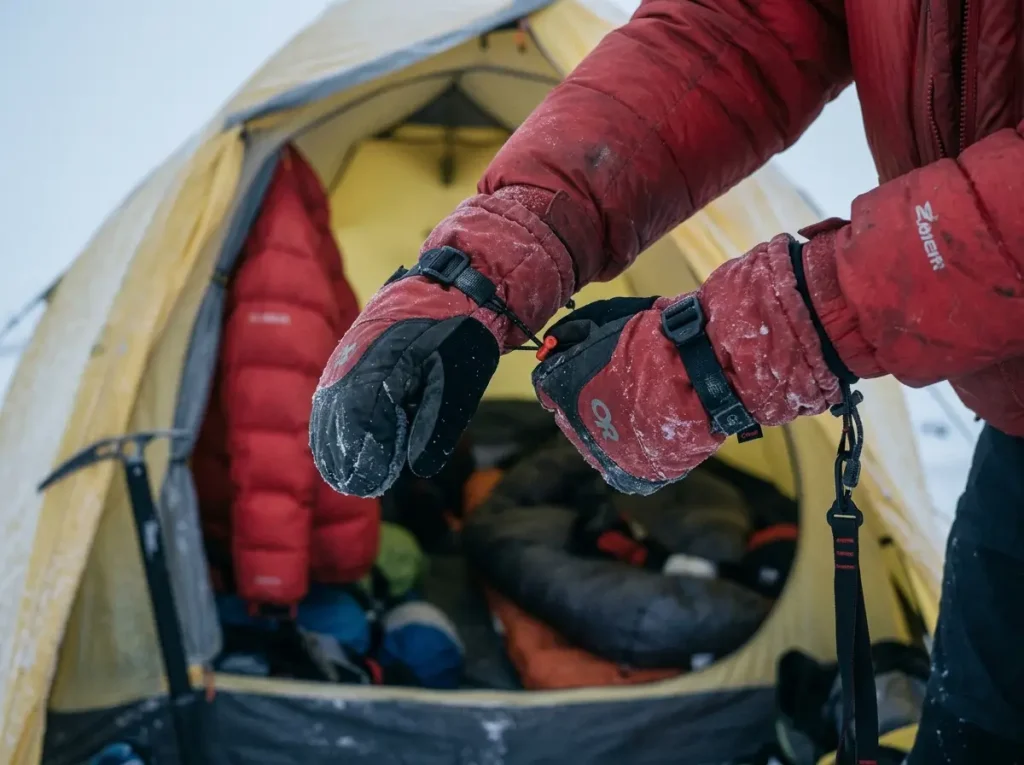
Frostbite of the hands is one of the named ways the “easy” mountain takes a piece of you, so expedition mitts are not the place to economize. The Outdoor Research Alti II GORE-TEX Mitts (men’s · women’s) are the expedition-weight system built for exactly this cold; grab the variant that fits your hand, since the lasts differ.
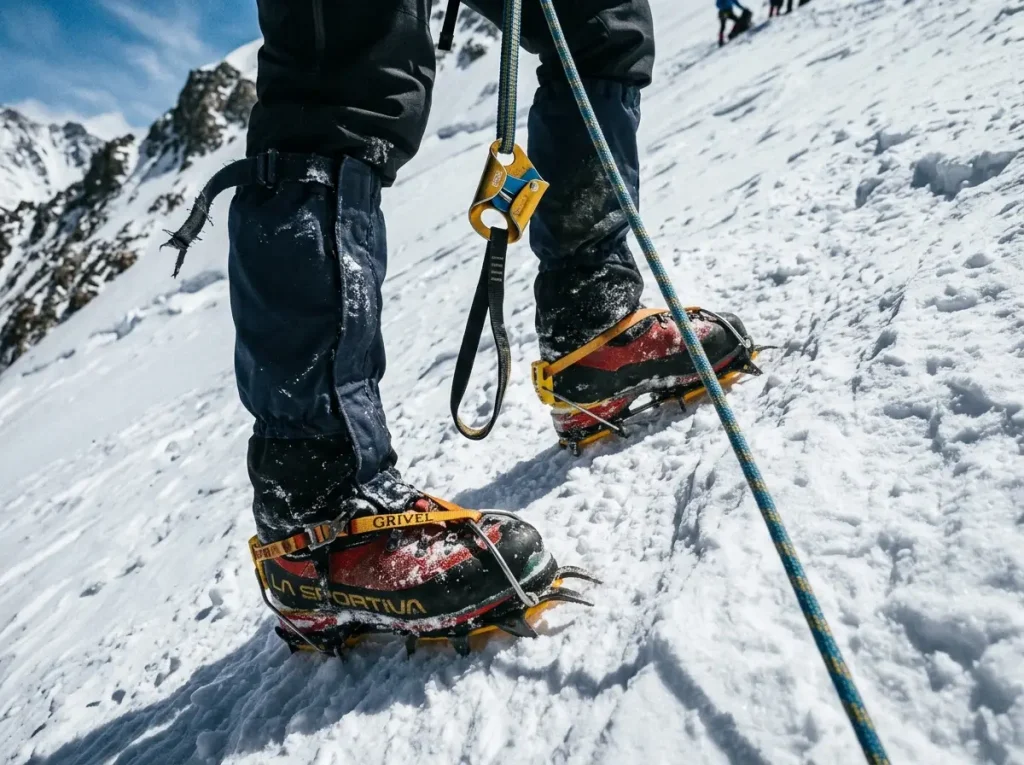
For the fixed-rope sections and the firm snow, the Grivel G12 New Matic Crampons pair a 12-point steel design with a semi-step-in binding that locks onto rigid double boots without fuss. If you want a slightly cheaper option that does the same job, the Black Diamond Sabretooth is the honest budget pick. And for glacier travel and self-arrest, a classic straight-shaft axe like the Black Diamond Raven is all you need; this is a competency tool, not a place to chase features.
Rent or Buy, the One-Trip Math
For a single 8,000-meter trip, the math is straightforward. The boots and the down suit are your prime rental candidates, expensive items you may wear exactly once. The axe, the crampons, and the personal-fit mitts are worth owning, because they’re cheaper, they fit you specifically, and you’ll use them on the prerequisite peaks anyway. If you want to run the full calculation, the rent-vs-buy math on 8,000-meter gear applies directly to a Cho Oyu kit.
Choosing an Operator Without Getting Burned
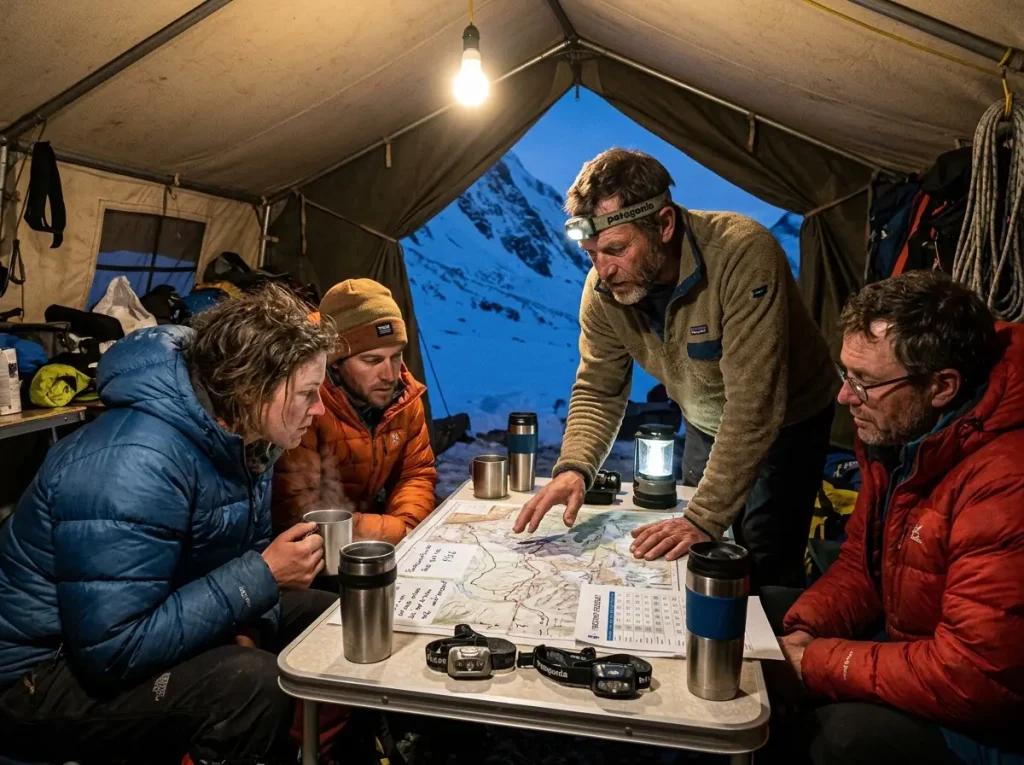
The cheapest package can be the most expensive decision you make. What you’re really buying isn’t a logo on a duffel, it’s oxygen logistics, Sherpa-to-client ratios, weather forecasting, and a culture that honors turnaround times. Those are the things that don’t show up in a glossy photo and absolutely show up at 8,000 m.
The budget-tier trap is that corners get cut exactly where it quietly costs lives: thinner oxygen margins, fewer staff per client, weaker medical support, looser turnaround discipline. So before you sign, ask the blunt questions: How many liters of oxygen are guaranteed, and at what flow rate? What’s the client-to-Sherpa ratio? What’s the written turnaround-time policy? What exactly is included versus extra? A confident operator answers all four without dancing.
One more wrinkle worth understanding. A flash team itinerary built around minimal camp rotations, sometimes skipping a camp, can compress your schedule attractively. That’s a fine choice for an experienced, well-acclimatized climber and a genuinely risky one for someone who arrived underprepared. On a mountain whose entire reputation pulls in clients who haven’t done the homework, the operator’s safety culture matters more, not less, precisely because so many people show up thinking the easy 8,000er will carry them.
Conclusion
Cho Oyu earns its reputation as the least technical of the 8,000-meter peaks, and that’s genuinely worth something on a first Himalayan giant. Just don’t let “least technical” quietly become “safest” in your head. Respect the altitude, not the grade, because the air is what turns climbers back and the air doesn’t read brochures.
Three things to carry out of this. Budget all-in, somewhere between $35,000 and $65,000, and stop trusting the headline number. Earn your prerequisite peaks before you book, because they’re where you learn your own warning signs. And pick your operator on safety culture, not sticker price, since that culture is the thing standing between you and a bad decision at altitude.
If Cho Oyu is the goal, the honest next step isn’t a deposit. It’s logging a 6,000-meter peak and a 7,000-meter peak, then reassessing how your lungs and your judgment actually held up. The mountain rewards readiness, not enthusiasm, and the climbers who treat it that way are the ones who come home with the summit and their fingers.
Frequently Asked Questions
01Is Cho Oyu harder than Everest?
No. Cho Oyu is less technical, lower, and far less lethal than Everest, which is exactly why it’s the most common 8,000-meter first attempt. But easier than Everest still means a serious Death Zone climb with real altitude risk.
02What is the fatality rate on Cho Oyu?
About 1.3% cumulatively, the lowest of all 14 eight-thousanders, but that still works out to roughly 1 climber in 77. Low relative risk is not the same as low absolute risk.
03How much does it really cost to climb Cho Oyu?
Headline packages run $20,000 to $45,000, but the realistic all-in cost is $35,000 to $65,000 once you add flights, gear, insurance, and tips. Budget for the hidden line items like the Sherpa summit bonus and the rescue insurance minimum.
04Do you need supplemental oxygen to climb Cho Oyu?
On guided climbs, yes. Supplemental oxygen is standard above the higher camps and is a big part of what makes the easy label hold up. Climbing without it is possible but a far harder, expert-only undertaking.
05Can you climb Cho Oyu from Nepal?
Almost no one does commercially. The Nepal South Ridge is a categorically harder, more hazardous route that saw zero summits for 15 years. The standard guided climb is on the Tibet side.
Safety Notice: Rock climbing and mountaineering are inherently high-risk
activities that can involve physical trauma or fatal incidents. The information on Rock Climbing Realms is for
educational and informational purposes only. Techniques and advice presented here are not a substitute
for professional, hands-on instruction. Conditions and risks vary by location. Always seek guidance
from a qualified instructor before attempting new techniques. By using this website, you agree that you
are solely responsible for your own safety. Any reliance you place on this information is strictly
at your own risk, and you assume all liability for your actions. Rock Climbing Realms and its authors
will not be held liable for any harm, damage, or loss sustained in connection with the use of this information.
Affiliate Disclosure: We are a participant in the Amazon Services LLC Associates Program, an
affiliate advertising program designed to provide a means for us to earn advertising fees by advertising and linking
to Amazon.com. As an Amazon Associate, we earn from qualifying purchases. We are also an official affiliate partner
of Black Diamond Equipment via the AvantLink network. If you click on a Black Diamond affiliate link and make a
purchase, we may earn a commission at no additional cost to you. We also participate in other affiliate programs.
Additional terms are found in the terms of service.