
In this article
Barry Blanchard is one of the finest alpinists the Canadian Rockies has ever produced, and the Emperor Face turned him back four times over several years before he finally climbed Infinite Patience. That tells you most of what you need to know. This is a wall that says no far more often than yes, even to masters, and in a bad season it sees only one or two ascents total. The American Alpine Club once filed it alongside the great unsolved problems of world alpinism, in the same breath as the Eiger. This guide covers what the Mount Robson Emperor Face actually is, every route and its real grade, the beta on Infinite Patience, the hazards you can’t train away, the weather window that decides everything, the descent nobody warns you about, and an honest answer to whether you belong here yet.
What the Emperor Face Actually Is (and Why Alpinists Fear It)
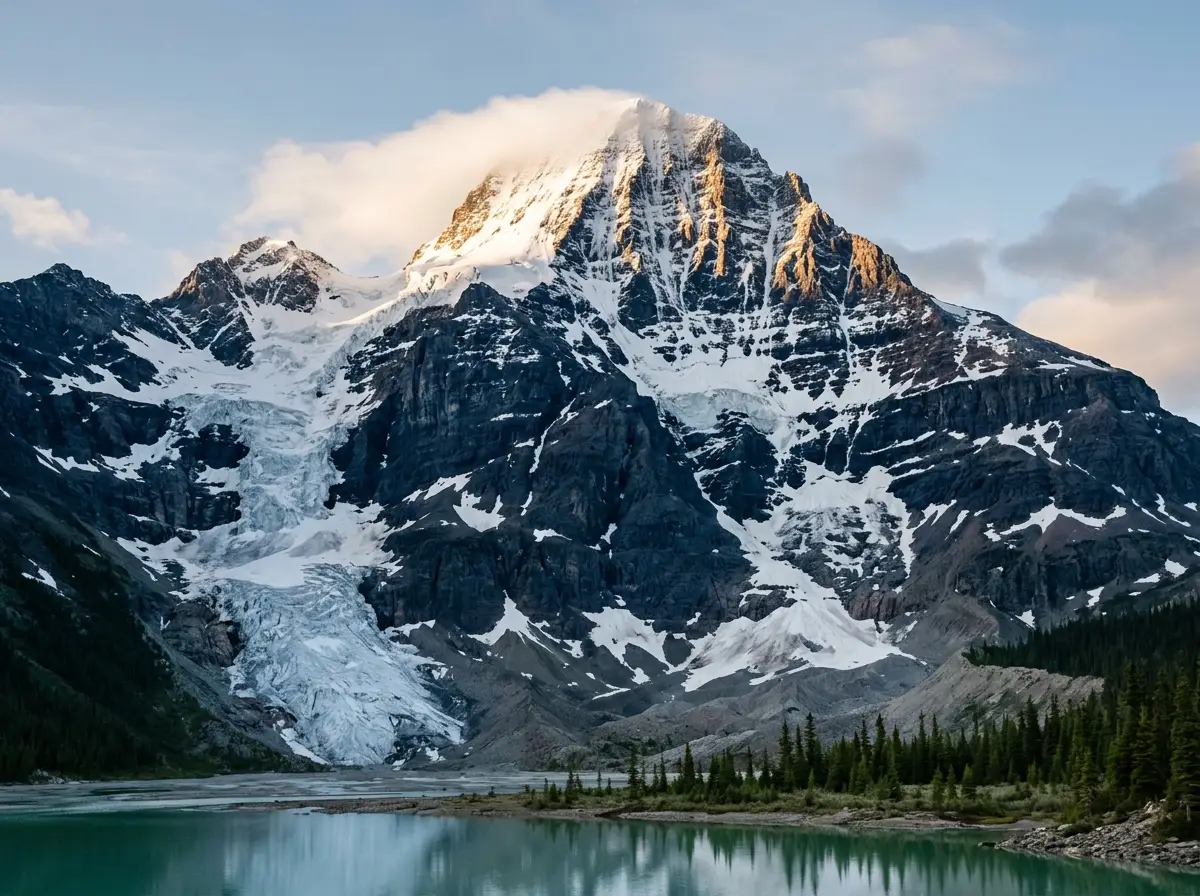
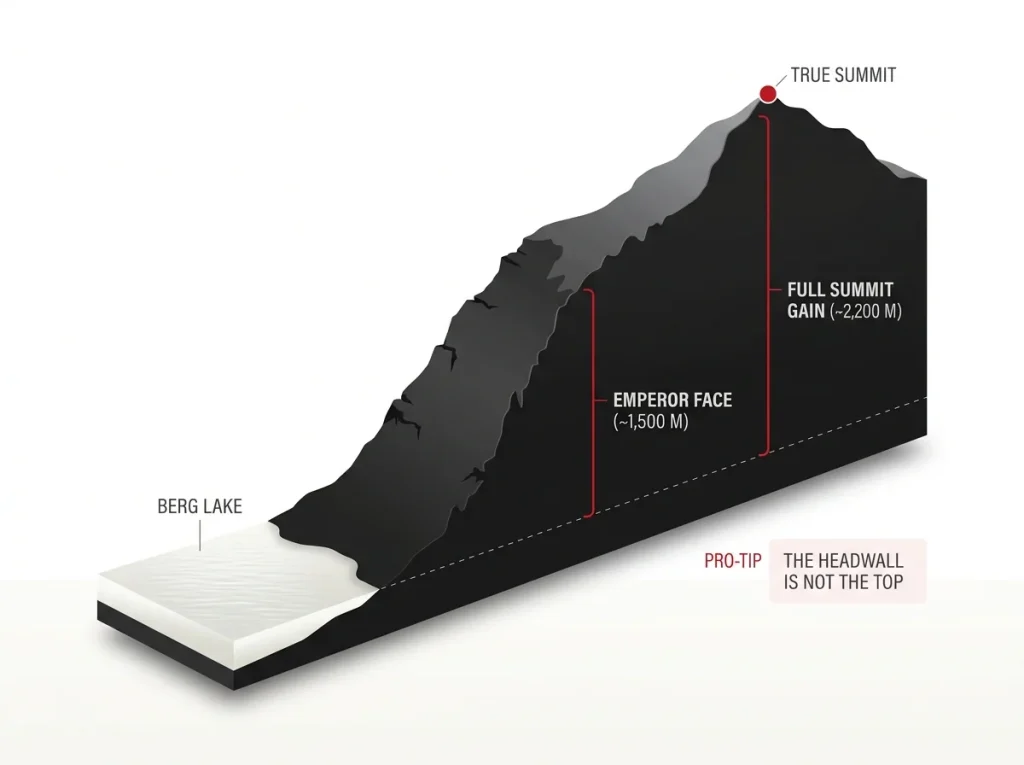
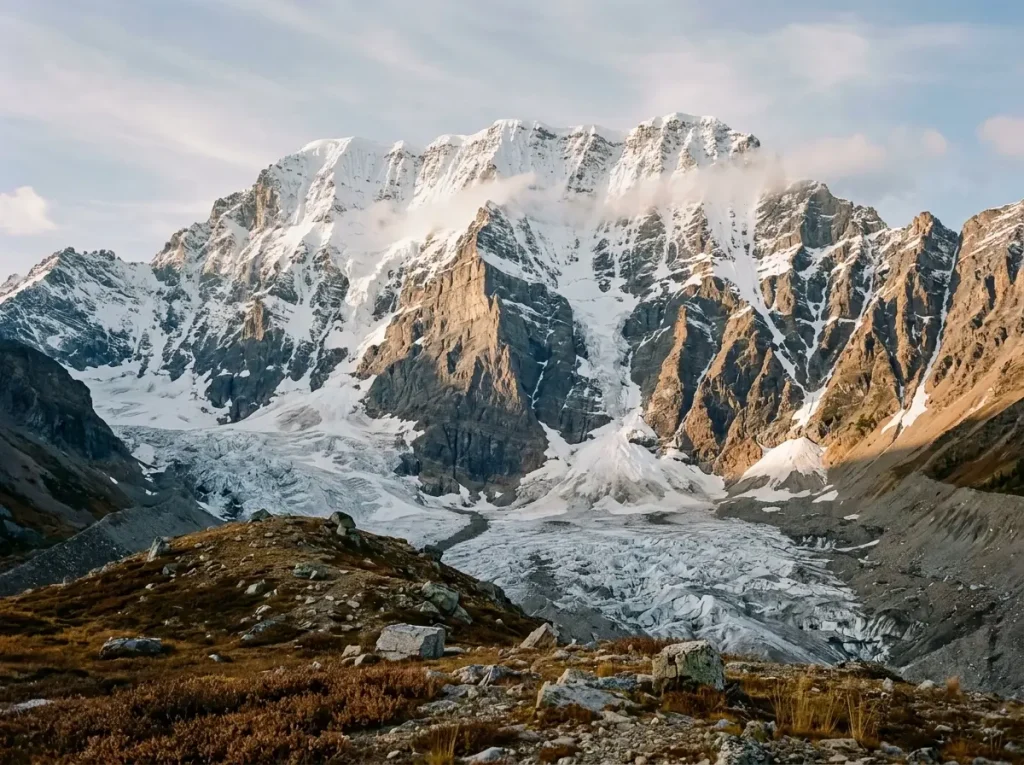
Stand at Berg Lake and look up. The wall rises almost 9,000 feet straight out of the valley floor, a streaked sweep of thin ice, snow runnels, and dark rotten rock. The scale is the first thing that gets you, before you ever rope up. Mount Robson tops out at 3,954 meters (12,972 feet), the highest summit in the Canadian Rockies, and the Emperor Face is its northwest aspect, roughly 1,500 meters of climbing.
Here is the part that catches people off guard: a route up this face gains around 7,500 to 8,000 feet to reach the true summit. You do not finish at the top of the headwall. The technical wall is the famous part, but it sits well below the summit, and that gap has consequences that show up later in this guide. Robson belongs on the short list of famous mountain routes and peaks that test the world’s best alpinists, and it earns its place by being relentless rather than just steep.
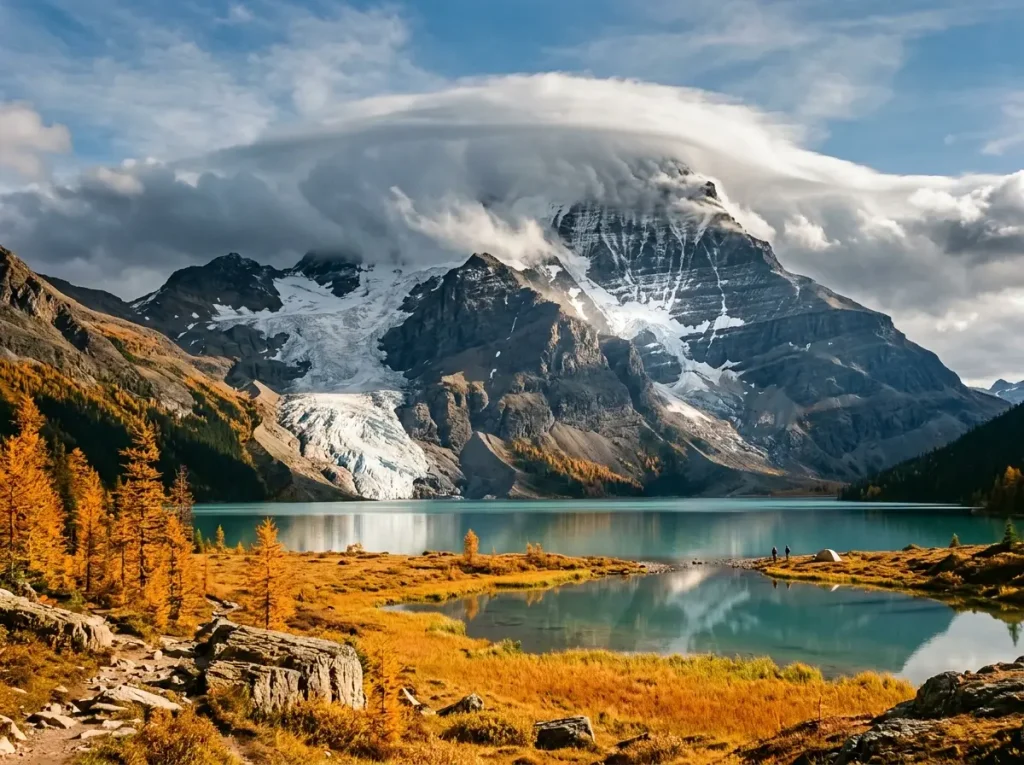
The mountain also makes its own weather. Locals call it Cloud Cap Mountain for a reason. The valley can sit in sunshine while the upper face brews an orographic storm of its own, which is a recurring theme in the accident accounts. Add Robson’s notorious choss, the rotten, hollow rock that the area is infamous for, and you get terrain where a competent climber doing everything right can still get hurt by the mountain itself. If you’ve read about where it sits among the most difficult mountains to climb, the Emperor Face is the case study for why “hard” and “hazardous” are not the same word.
The 1978 First Ascent and the Last Great Problem
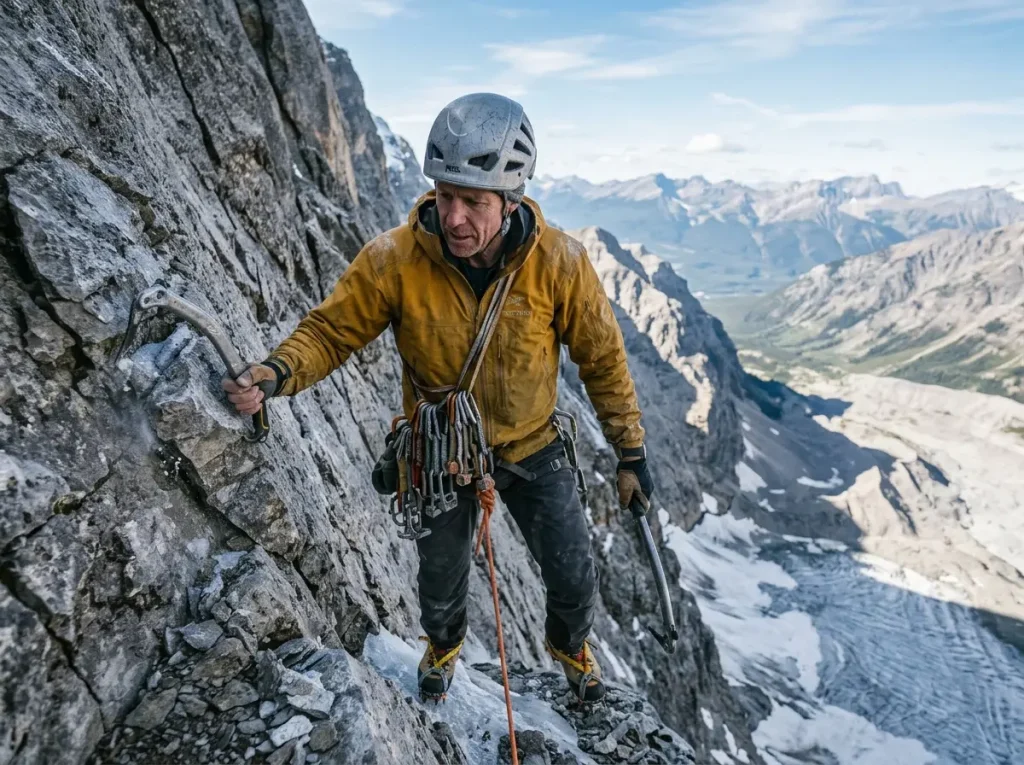
For years the Emperor Face was the wall nobody had cracked. After the great north faces of the Alps fell, climbing writers pointed at Robson and called it one of the last great problems on the continent. It held that status because it punished every attempt.
The standard mountaineering route, the Kain Face named for Conrad Kain, climbs the gentler south side of the peak; the Emperor Face is its hazardous opposite, and the one that defines serious alpine climbing on Robson. Jim Logan and Mugs Stump first cracked it in July 1978. The pair spent four days on a central rib of thin ice and unreliable rock, climbing at ED+ 5.9 A2 with no realistic way to retreat once committed. It was a bold, era-defining effort, and Stump went on to become one of the most respected names in American alpinism. Their line topped the wall, but it did not reach the true summit. That distinction went to Dave Cheesmond and Tony Dick in 1981, who linked the face all the way to the top at ED+ 5.9 A3. For the full story in the climbers’ own words, the American Alpine Club’s account of the 1978 first ascent is worth your time, and it is the kind of record the American Alpine Club has kept on these first ascents for generations.
One detail from that era frames everything that came after: the early efforts went heavy, with racks running to roughly 25 pitons including knifeblades, fixed-line and bivy tactics, days in the firing line. The modern approach looks nothing like it, and that shift is the whole story of how the face gets climbed now.
Every Route Up the Emperor Face, Compared
People talk about “the Emperor Face” as if it were one climb. It is a wall with a handful of very different, very serious lines, and being able to tell them apart is the first sign you’ve actually done your homework instead of scrolling photos. Here is the consolidated picture you won’t find on most pages.
| Route | First Ascent Party | Year | Grade |
|---|---|---|---|
| Logan–Stump (central rib) | Jim Logan & Mugs Stump | 1978 | ED+ VI 5.9 A2 |
| Cheesmond–Dick (first to summit) | Dave Cheesmond & Tony Dick | 1981 | ED+ VI 5.9 A3 |
| Infinite Patience | Blanchard, Dumerac & Pellet | 2002 | VI WI5 M5 5.9 |
| Running in the Shadows | Berman & Hawthorn | 2020 | VI AI5 M6 |
| Emperor Ridge (topout finish) | standard “easier” finish | — | V 5.7 |
The historic lines
The Logan–Stump rib and the Cheesmond–Dick line are the proud, hazardous old-school ascents. Both climb the central and harder ground at ED+, both demand aid, and both put you on Robson’s worst rock for days. They get repeated rarely. They are part of the wall’s lore more than its current traffic.
Infinite Patience, the modern benchmark
When alpinists today say they want the Emperor Face, they almost always mean Infinite Patience, put up by Barry Blanchard, Eric Dumerac, and Philippe Pellet in 2002. At VI WI5 M5 5.9 over roughly 2,200 meters, it offers more sustained but moderate mixed ground up the right side of the wall instead of the brutal aid of the historic lines. It has its own named features, including Bubba’s Couloir, after Blanchard himself.
The new wave and the topout problem
The wall is not a museum piece. Ethan Berman and Uisdean Hawthorn proved that in October 2020 with Running in the Shadows, a VI AI5 M6 line that showed there was still wild, unclimbed terrain up there. Notable repeats and pushes tell the same story of progression: Steve House and Colin Haley in 2007, Jon Walsh and Josh Wharton in a roughly 18-hour single push in 2012, and Marc-André Leclerc’s first solo of the face, via Infinite Patience, on April 17, 2016. The standard “easier” finish along the Emperor Ridge goes at only V 5.7 on paper, and as you’ll see, that modest grade hides the most serious part of the whole climb.
Infinite Patience, Inside the Benchmark Line
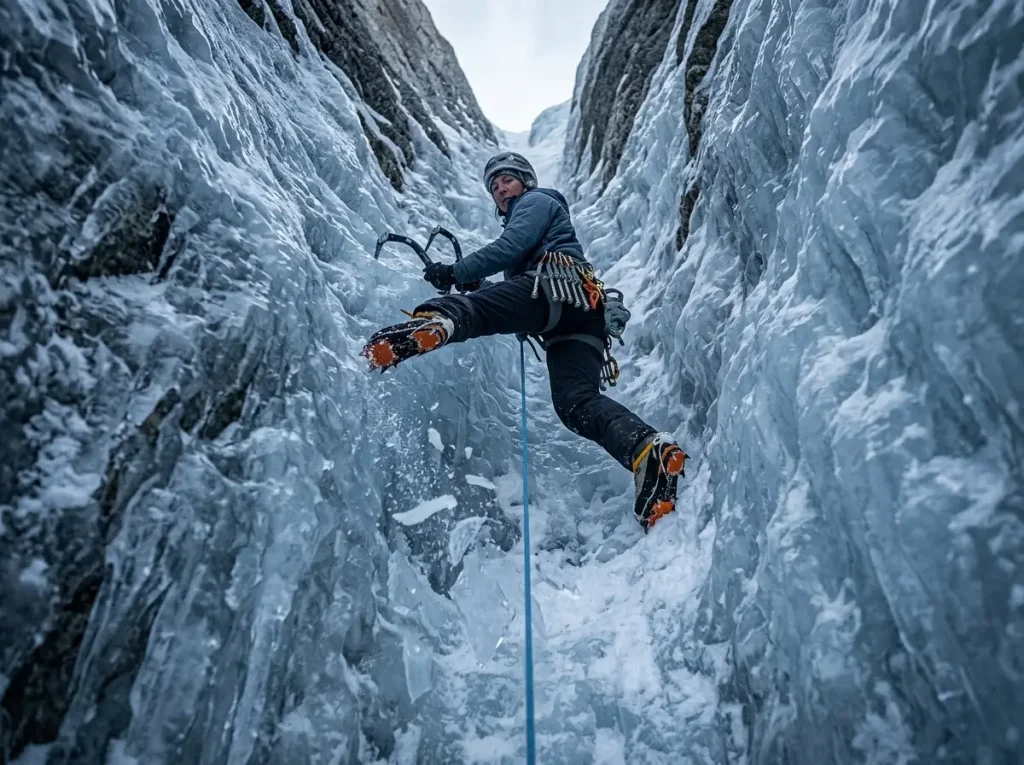
If you’re dreaming about Robson, you’re dreaming about Infinite Patience. So here’s what the line actually asks of you, beyond the grade on the topo.
The number, VI WI5 M5 5.9, undersells the experience because the difficulty is in the sustained nature and the position, not in any single crux move. You’re managing WI5 water ice runnels and M5 mixed climbing sequences for thousands of feet, on a remote wall, with retreat getting harder the higher you go. The moderate grade is exactly what makes it the benchmark. It is climbable by very strong alpinists in good conditions, and merciless to everyone else.
The honest reframe is the failure rate. Blanchard, who knew the Rockies as well as anyone alive, needed four attempts across years before the first ascent went. That is not a story about weakness. It is the wall doing what it does. Ask anyone who has stood under it: the Emperor Face shuts down masters as a matter of routine, and getting turned around is the normal outcome, not the embarrassing one.
Treat a turnaround as a successful trip, not a failed one. The climbers who eventually stand on top of Infinite Patience are almost always the ones who bailed cleanly on an earlier attempt and lived to read the conditions better next time. The mountain rewards repeat visitors, not one-shot tourists.
The cost of success is real, too. The widely shared account of Leclerc’s solo has him topping out at sunset with his feet screaming, too spent to descend, digging a trench in the summit snow, soaking himself when his hot-water bottle spilled, his headlamp dead, then rappelling into the dark with about 500 milliliters of water left. That is what “summiting” this wall can actually cost the very best, and it’s a useful picture to keep in your head when the topo makes it look tidy.
The Objective Hazards You Can’t Train Away
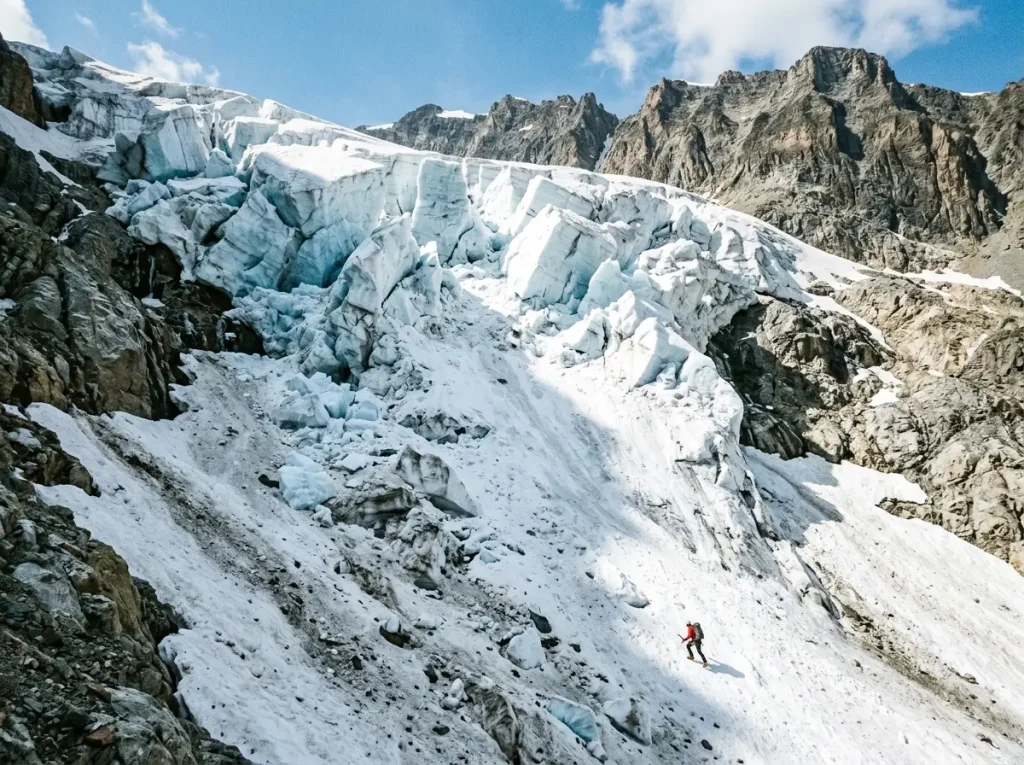
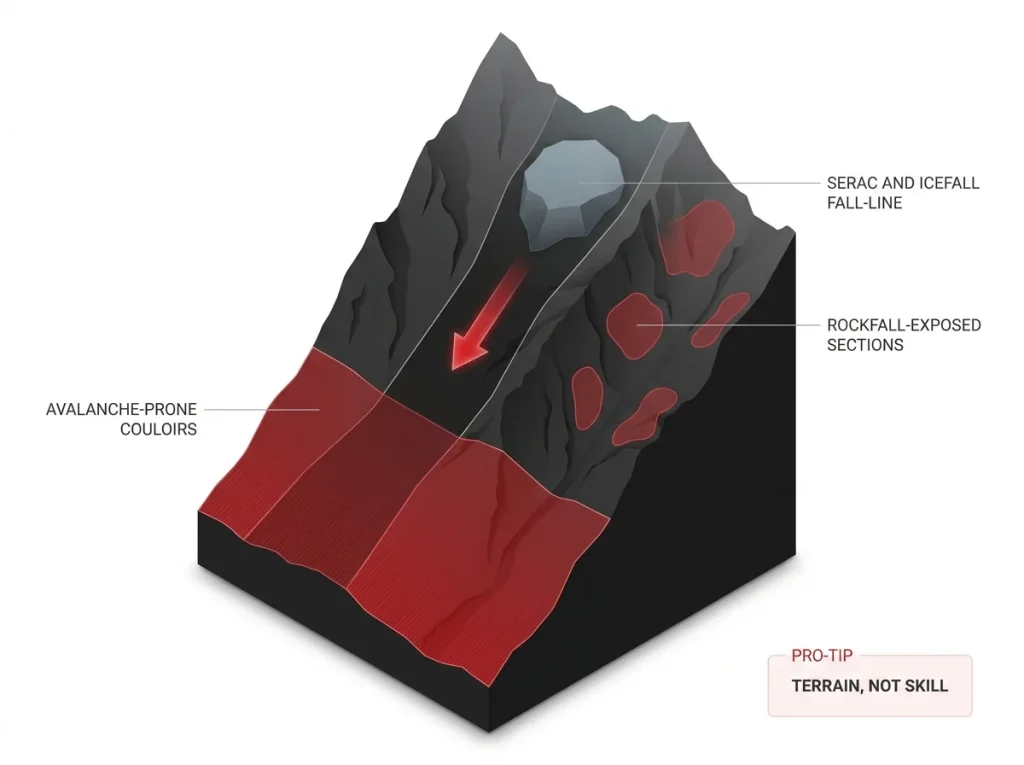
The frightening part of the Emperor Face is not the hard pitch you can see coming. It’s the serac that releases while you’re moving well, on a clear morning, doing everything correctly. These are the objective hazards, the threats that come from the terrain itself rather than from your skill.
Three of them are constant here. Avalanche loads the lower couloirs. Serac and icefall hang off the Emperor Glacier and sweep the fall line below. Rockfall peels off the poor rock all over the wall, especially as the day warms. None of these care how strong you are. That’s the uncomfortable truth the grade can’t capture, and it’s the same family of objective-hazard mistakes that send climbers for rescue on peaks like Mount Hood, where the terrain, not the technical difficulty, is the real threat.
The choss and loose rock make all of it worse. When the rock is rotten, your protection is suspect, your tool placements are suspect, and a hold you trusted can come off in your hand. The wall’s record includes a documented Mount Robson avalanche accident in the AAC’s Accidents in North American Climbing, a sober reminder that fatalities here often have nothing to do with running out of climbing ability.
This is why speed has become the defense. The less time you spend under a serac or in a rockfall runnel, the less you are gambling. That single idea, time equals exposure, drives everything about how the face is climbed today.
Reading the Window, and Why September Can Beat July
Beginners ask what month to go. Veterans ask what the freeze is doing. That difference is the whole game on a wall like this.
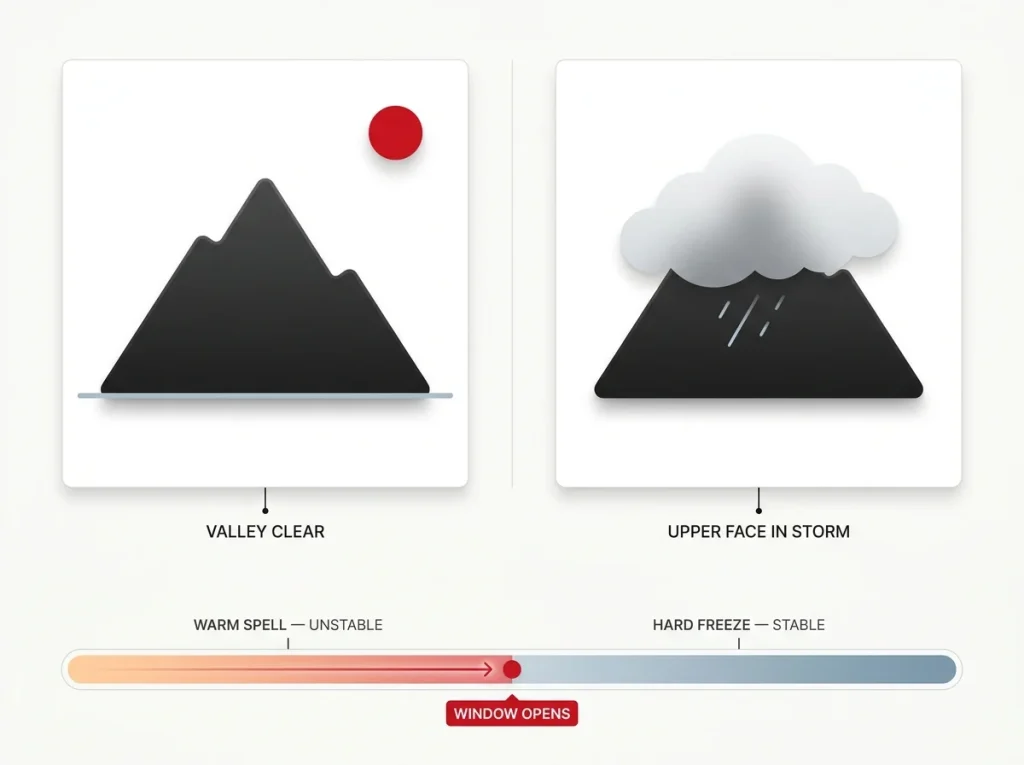
Cold is your friend here, which feels backward until you understand the mechanism. A solid freeze consolidates the ice runnels, stabilizes the snowpack, and bonds the mixed terrain together, so your tools and screws bite into something trustworthy. A warm spell does the opposite. It wakes up the seracs, primes the rockfall, and turns the couloirs avalanche-prone. That’s why a colder, more stable stretch in September can be safer climbing than a sunny week in July, despite the shorter days and the earlier onset of snow. You’re trading daylight for stability, and on this face stability wins.
Then there’s the Cloud Cap problem. Robson generates its own orographic weather, so the summit can be locked in a storm while the trailhead bakes in sun. The forecast you read at Berg Lake is describing the valley, not the upper face. Plenty of parties have committed in valley sunshine and gotten worked over up high.
Read the conditions, not the calendar. A multi-day high-pressure window with a hard overnight freeze beats any “best month” rule of thumb. One clear day is not enough for a 2,200-meter route, so wait for a real window and pre-commit to your bail criteria before you leave the lake, when your judgment is still calm.
The takeaway is to plan around a genuine multi-day weather window with a reliable freeze, not a single bluebird day, and to write down your turnaround conditions in advance. The face has a way of talking strong climbers out of the plan they made when they were thinking clearly.
[CREATOR NOTE] Infographic Suggestion: a two-panel diagram showing “valley clear / upper face in cloud cap storm” to illustrate orographic weather, plus a simple freeze-thaw timeline showing how cold consolidates the ice lines.
The Descent Problem Nobody Warns You About
Here is the part that gets buried in trip reports and shouldn’t be. For many parties, the most serious stretch of the entire Emperor Face begins after the hard climbing is finished.
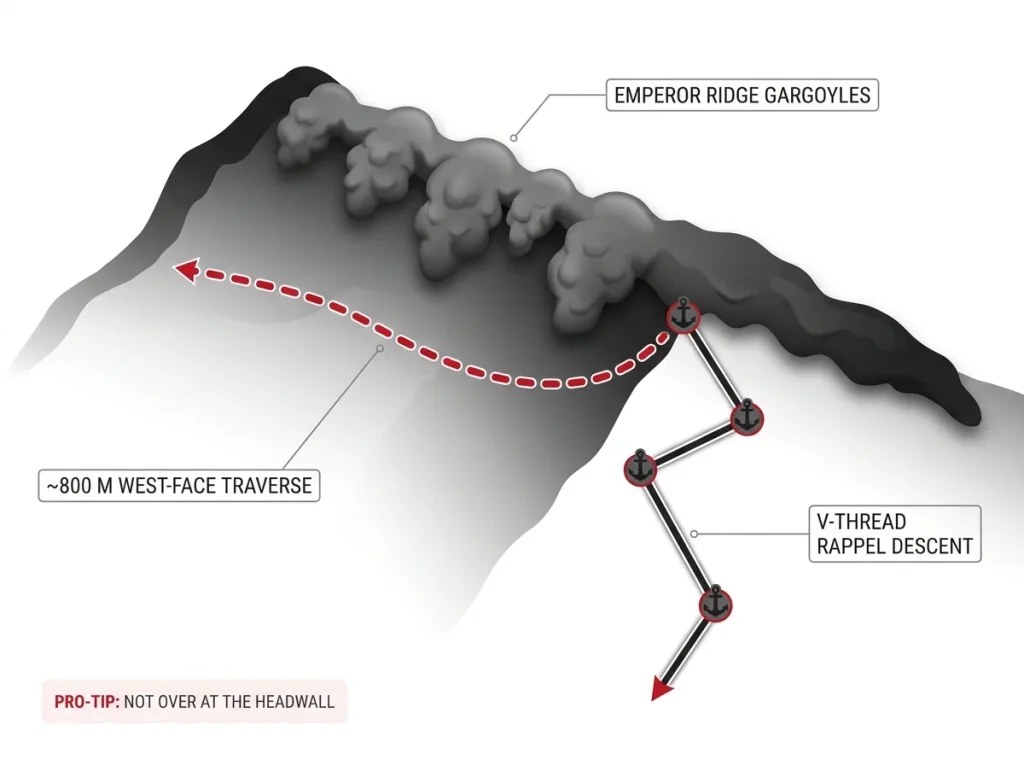
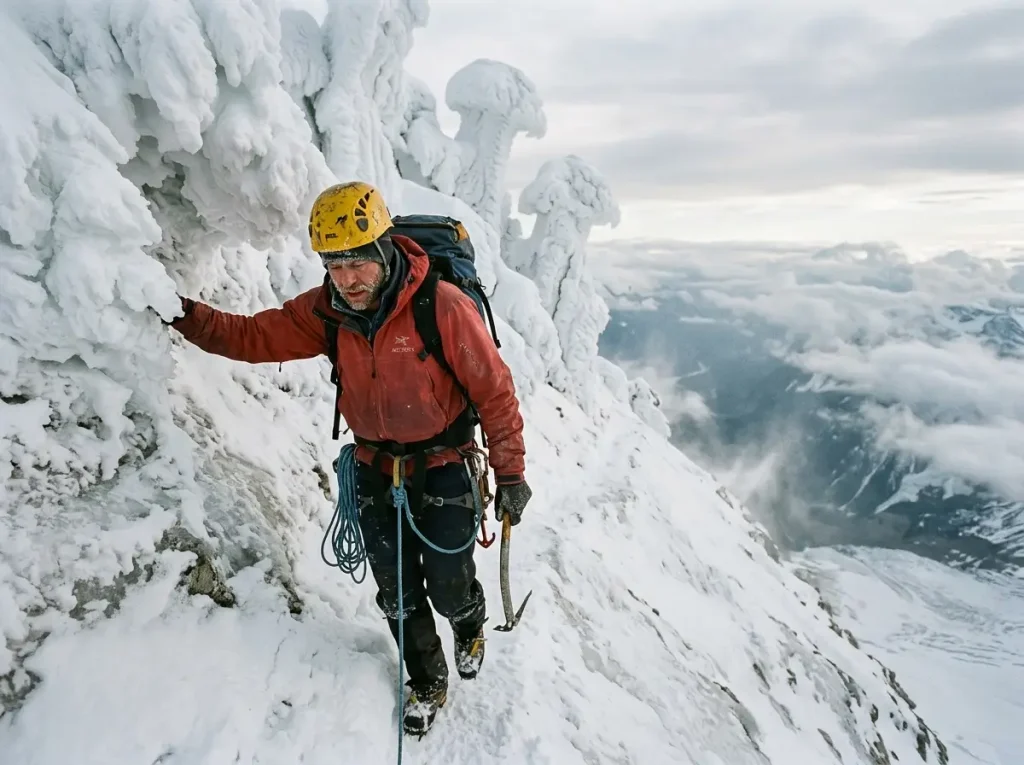
The technical ground eases toward the top, but the route is not over. The topout is guarded by the Emperor Ridge gargoyles, bizarre rime and cornice snow mushrooms that bulge off the ridge like frozen cauliflower and block the way to the summit. Fighting through them directly is slow and serious. The practitioner solution, the one Leclerc and others have used, is to traverse a steep, exposed snow wall, roughly 800 meters across the west face, to get around the worst of the gendarmes. It is committing ground that you reach when you are most tired.
From there, the descent currency is the V-thread. You rappel off Abalakov anchors threaded directly into the ice, leaving minimal gear behind, which is exactly why a dedicated V-thread hook and some cord live on every Emperor Face rack. If your V-threads are sloppy, the descent is where that catches up with you, so this is a skill to have wired cold before you go, the way you’d study the common V-thread mistakes that get ice climbers hurt. The south face gets rejected as a descent by soloists because of its glacier and serac hazard, which leaves the V-thread line down as the standard.
If this all sounds familiar, it’s the same lesson the Matterhorn teaches, where most fatal falls happen on the way down. “Not over at the headwall” is the misconception that has cost people the most on Robson, and it deserves to be the loudest sentence in any honest guide.
The Approach, the Rack, and an Honest Gate
Before the romance, the logistics. And then the hardest question of all, which is whether you belong on this wall yet.
Getting there: the approach and permits
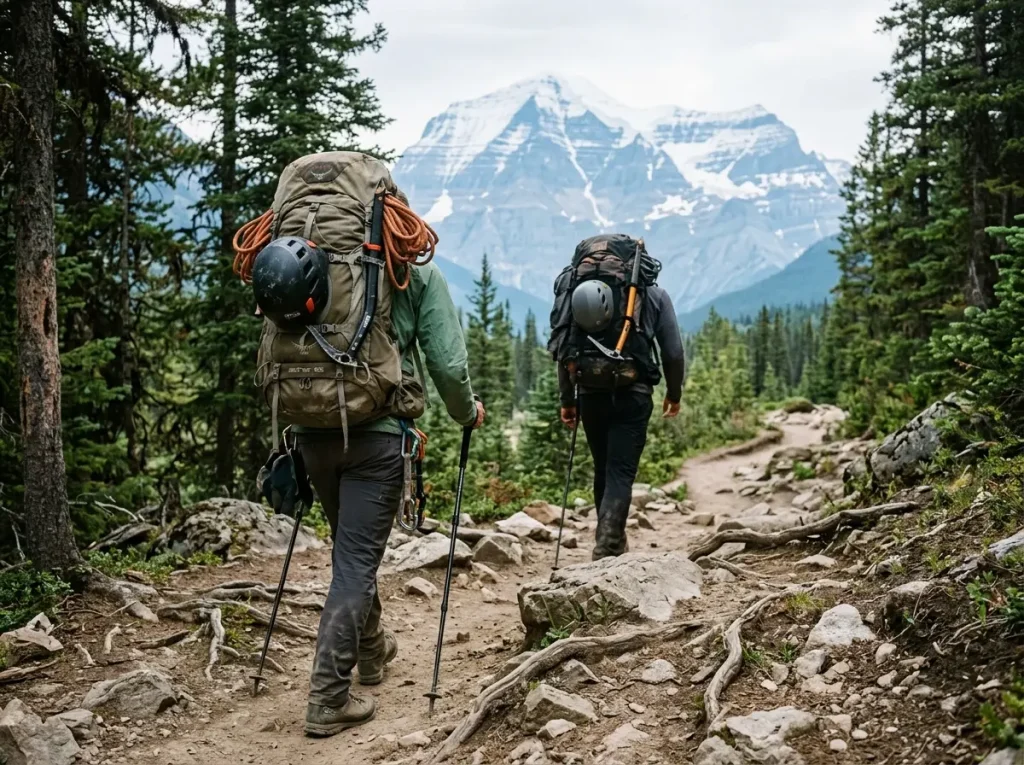
You cannot just show up at Robson and start climbing. Inside Mount Robson Provincial Park, the standard access runs the Berg Lake Trail, around 42 kilometers to the lake, and the backcountry campsites along it are fully reservable, booked months in advance through BC Parks’ Berg Lake Trail reservation system. Plan on a multi-day approach with glacier travel before the technical climbing even begins. The logistics alone weed out a lot of casual interest, which is part of why the face stays quiet.
The modern rack and tactics
The contrast with 1978 is stark. Where the early parties hauled about 25 pitons and settled in for a siege, the modern light-and-fast approach strips the rack to the essentials: leashless ice tools, mono-point crampons on stiff mountaineering boots, a helmet you trust, a light selection of ultralight ice screws, a few pins, a small trad rack of nuts and cams, a V-thread kit, and thin cord for hauling, all aimed at a single push or one bivouac. Walsh and Wharton’s roughly 18-hour ascent is the extreme expression of the idea. The logic is simple and serious: minimize time, minimize exposure. Covering moderate ground efficiently by moving together with simul-climbing and running it out on terrain you can handle is how the fast parties stay out of the firing line, and mono-point crampons sorted for steep mixed ground are part of the same calculus.
A word on gear honesty, since this is a climbing site and not a shop. On a wall this committing, the resume and the conditions matter far more than which brand is hanging on your harness. Buy good tools, keep them sharp, and stop there. No piece of equipment moves the needle the way fitness, judgment, and a good freeze do.
Should you even be here?
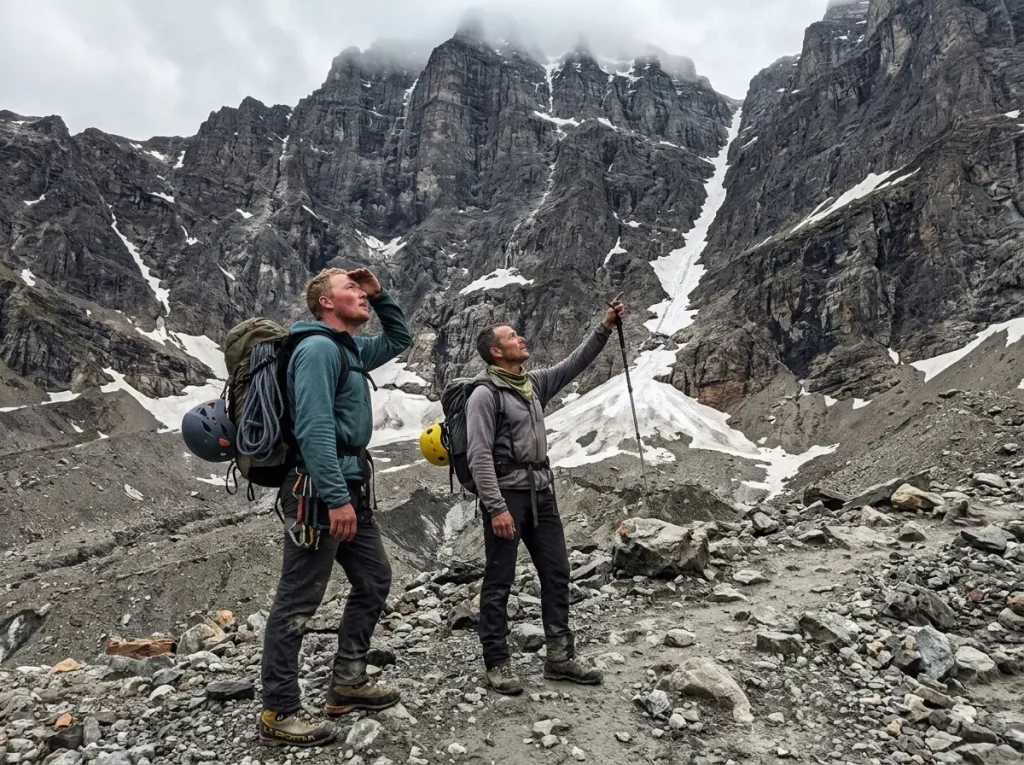
This is the question most guides skip because it doesn’t sell the dream. The Emperor Face is a final exam, not a learning route. A realistic prerequisite looks something like this: you’ve led multi-pitch WI5 ice climbing and M6 mixed alpine routes in the mountains, not just at the crag; you’re comfortable on Rockies choss; you can run a V-thread self-rescue and descent without thinking about it; you’re solid on glacier travel; and you’ve proven, more than once, that you’ll actually turn around when the mountain says no.
If that list isn’t you yet, the path is not to force it. Build on lower-commitment alpine objectives in the Rockies and Cascades first, the same way fit climbers who get shut down on serious peaks learn that fitness was never the gate. It’s the same turn-back reality that stops most climbers on big objectives like Aconcagua, where most people don’t reach the summit. Wanting the Emperor Face is the easy part. Earning it is the long part.
Use the resume as a checklist, not a fantasy. Write down the alpine routes you’ve actually led in the mountains, the V-thread descents you’ve done for real, and the times you turned around. If the page is thin, you’ve found your next two seasons of objectives. The wall will still be there.
Conclusion
Three things to carry away. The Emperor Face is a 2,200-meter commitment, and it is not over at the headwall, where the gargoyles and the descent collect the real toll. The conditions and the weather window decide more than your fitness ever will, and a cold, stable freeze beats a warm calendar date. And the objective hazards, the serac, the rockfall, the avalanche-loaded couloirs, are what humble strong climbers, because no amount of training neutralizes falling ice.
If this wall is your goal, do the unglamorous work. Stack up alpine routes on lower-commitment peaks, learn to read the freeze and the window the way veterans do, get your V-thread descent wired, and make peace with the fact that the Emperor Face says no more often than yes. The climbers who eventually succeed are the ones who respected that from the start.
Frequently Asked Questions
01How hard is the Emperor Face on Mount Robson?
It is widely regarded as the hardest alpine wall in North America. The benchmark line, Infinite Patience, goes at VI WI5 M5 5.9 over roughly 2,200 meters. The grade is moderate but sustained, which is exactly what makes it a true test piece.
02Who first climbed the Emperor Face?
Jim Logan and Mugs Stump made the first ascent of the face in July 1978 at ED+ 5.9 A2. Dave Cheesmond and Tony Dick were the first to climb the face all the way to the true summit in 1981.
03What is Infinite Patience on Mount Robson?
Infinite Patience is the modern benchmark line on the Emperor Face, first climbed by Barry Blanchard, Eric Dumerac, and Philippe Pellet in 2002 at VI WI5 M5 5.9. Marc-André Leclerc made the first solo of it in 2016.
04When is the best time to climb the Emperor Face?
Cold, stable conditions matter more than the month. A hard freeze consolidates the ice and mixed terrain, so a colder spell in September can be safer than warm July weather. Always wait for a multi-day window, not a single clear day.
05How risky is the Emperor Face?
It carries serious risk. Beyond the technical climbing, the objective hazards of serac fall, rockfall, and avalanche threaten even expert parties, and many fatalities involve the long, corniced descent rather than the climbing itself.
Safety Notice: Rock climbing and mountaineering are inherently high-risk
activities that can involve physical trauma or fatal incidents. The information on Rock Climbing Realms is for
educational and informational purposes only. Techniques and advice presented here are not a substitute
for professional, hands-on instruction. Conditions and risks vary by location. Always seek guidance
from a qualified instructor before attempting new techniques. By using this website, you agree that you
are solely responsible for your own safety. Any reliance you place on this information is strictly
at your own risk, and you assume all liability for your actions. Rock Climbing Realms and its authors
will not be held liable for any harm, damage, or loss sustained in connection with the use of this information.
Affiliate Disclosure: We are a participant in the Amazon Services LLC Associates Program, an
affiliate advertising program designed to provide a means for us to earn advertising fees by advertising and linking
to Amazon.com. As an Amazon Associate, we earn from qualifying purchases. We are also an official affiliate partner
of Black Diamond Equipment via the AvantLink network. If you click on a Black Diamond affiliate link and make a
purchase, we may earn a commission at no additional cost to you. We also participate in other affiliate programs.
Additional terms are found in the terms of service.