
In this article
The ice was holding. That was the problem.
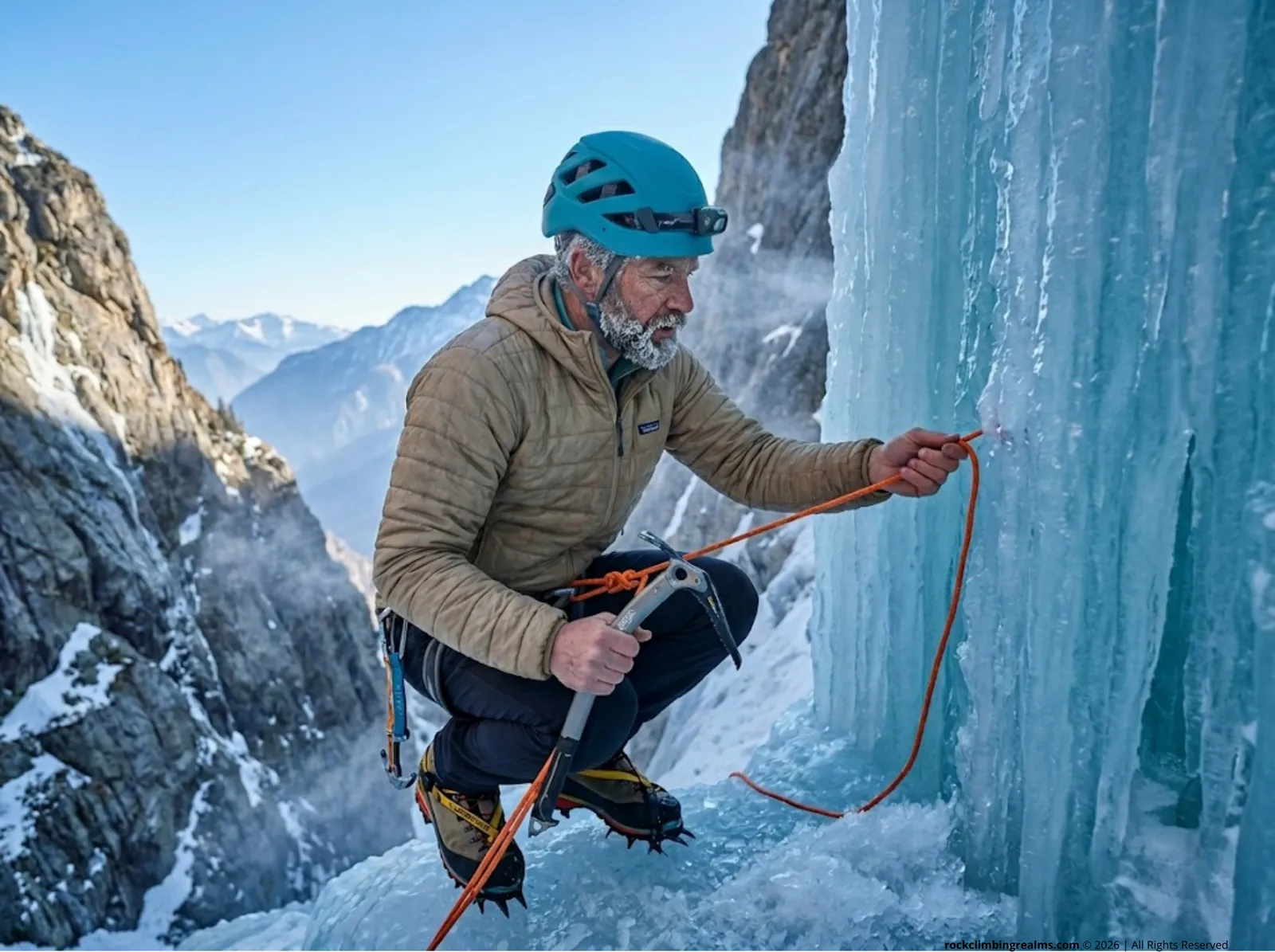
You could see it — solid blue, a thousand feet of it, the north face of the route shining in the morning sun. The V-thread looked textbook: good color, good depth, the cord seated cleanly in both holes. The first climber stepped over the edge, weight coming onto the rope, and then the sound — a crack like a gunshot, followed by the unmistakable ratcheting squeal of ice failing under load. The thread blew. The backup — clipped to the cord instead of the rope — yanked the ice screw clean through a deformed upper hole. Ninety meters of free fall into the glacier below.
This wasn’t a noob mistake. These were experienced alpinists who knew the protocol. They followed it — on paper. The ice was the variable they didn’t account for: not rock, not reliable, not the same medium it had been an hour earlier when the thread was built.
This is the article the climbing community doesn’t want to write: the forensic breakdown of why V-threads — the anchors we trust our lives to on some of the most serious terrain in the mountains — fail, and what the data actually says about how to build them so they don’t.
What you will learn:
- Why ice behaves nothing like rock, and why that distinction determines whether your anchor holds
- The non-negotiable geometry that separates a bombproof thread from a bomb
- The human protocol that experienced climbers break at the exact moment it matters most
- The material science that makes cord diameter a life-or-death variable
- The degradation time bomb that makes even “good” threads go bad after they’re built
Quick Answer: The four mistakes that hurt climbers are: treating ice like rock (ignoring temperature, density, and crystalline structure), violating the 60-degree geometry standard (which maximizes ice plug volume), skipping or misplacing the backup (clipping to cord instead of rope), and assuming the thread is still good after it’s built (ignoring thermal cycling and sublimation degradation). Every one of these is preventable with the right knowledge.
Ice as a Structural Medium — What Most Climbers Get Wrong About the Foundation
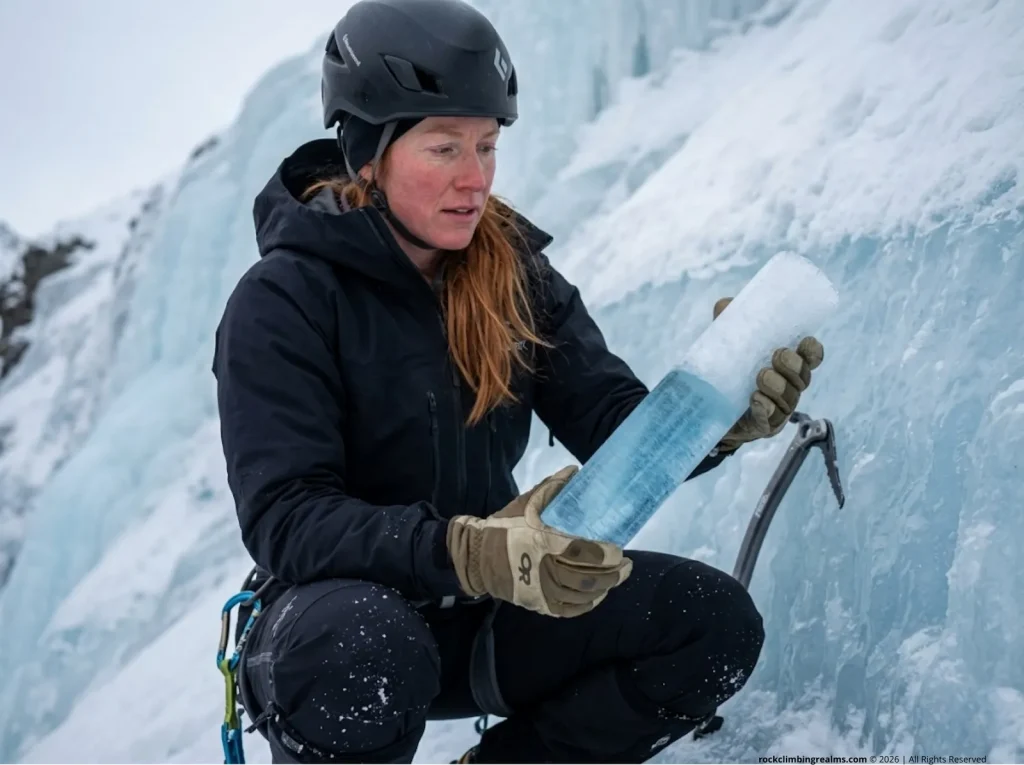
The first mistake in V-thread failure happens before you even pull your drill. It happens at the moment you decide that ice is close enough to rock — a surface you can trust because it looks solid and holds your axe.
It isn’t. Ice is a polycrystalline solid that behaves completely differently depending on loading rate, temperature, and formation history. Rock doesn’t plastically deform under sustained load. Rock doesn’t cheese-wire through a channel over 20 minutes. Rock doesn’t sublime. If you build an anchor in ice using the mental model of rock, you’re already in trouble. Understanding how ice formations behave and what conditions create safe ascents is the baseline literacy this approach skips.
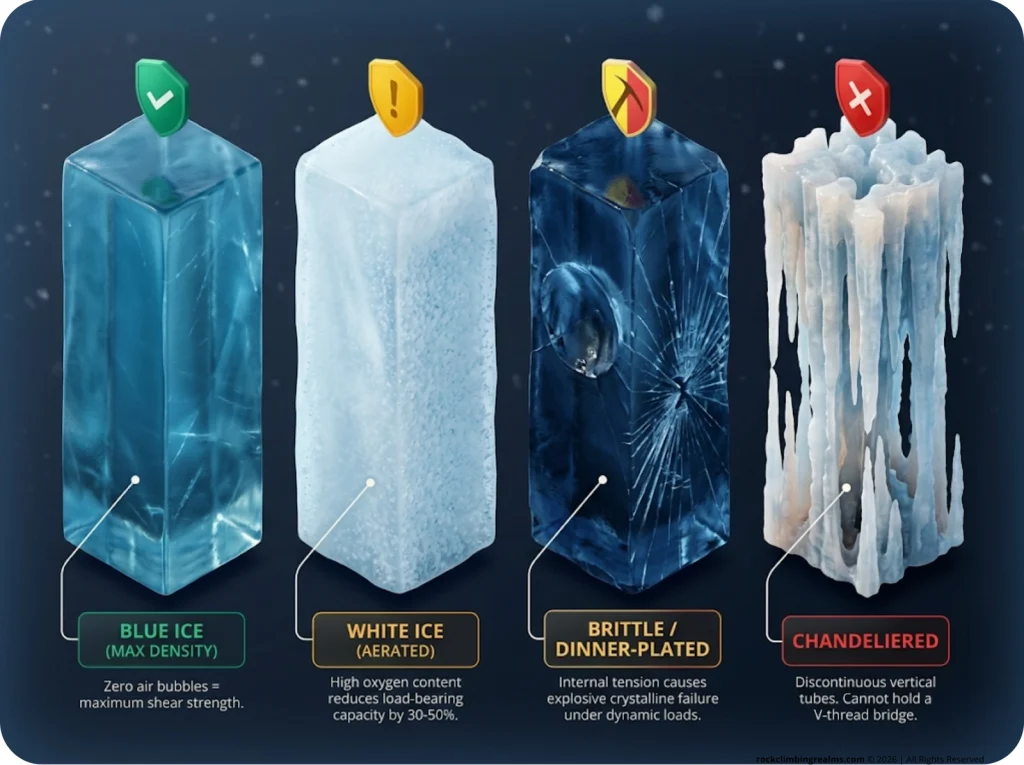
The crystalline architecture of ice is the first thing to understand. Ice formed from slow freezing in stable temperatures — what climbers call blue ice — is dense, has few air bubbles, and exhibits high shear strength. In blue ice, research confirms that metal screw tubes often fail before the ice itself does. That tells you something about the quality of the medium you’re working with. White ice, also called styrofoam ice, forms during rapid temperature drops or high-flow conditions. It has high trapped oxygen content, significantly lower density, and load-bearing capacity that is substantially reduced. You cannot tell the difference from the surface reliably. That’s the problem. For a deeper look at why cold ice shatters through brittle fracture mechanics, the material science is worth understanding before you trust a thread in cold conditions.
Most climbers never clear past the top layer. The top 5 to 10 centimeters of any ice formation is aerated and weak from exposure to air and temperature fluctuation. Proper anchor assessment requires clearing this layer with the adze of your ice axe to reach the denser blue ice beneath. I know climbers who have been embarrassed to admit they didn’t know this — and I’ve talked to them after their threads held.
The temperature window controls the anchor’s fate more than any other single variable. At temperatures near 0 degrees Celsius, ice behaves plastically — under the sustained load of a rappelling climber, the cord may slowly cheese-wire through the bridge as the ice crystals deform under pressure. This failure mode is silent and slow. You won’t hear it. You’ll just gradually realize your rappel is lower than it should be, and by then the thread is compromised.
At temperatures below minus 15 degrees Celsius, ice becomes extremely brittle with high internal tension. In these conditions, it is prone to what climbers call dinner-plating — where large fractures propagate explosively from the point of impact or concentrated load. A dynamic rappel force in brittle ice is the worst possible combination. The failure is not slow. It is instantaneous.
The thermal cycling problem is the one most guidebooks skip. Sun radiation penetrates ice and warms the cord, which has a higher thermal absorption rate than the surrounding ice mass. A small melt pocket forms around the cord, then refreezes when the sun sets or shade returns. Each freeze-thaw cycle weakens the crystalline structure of the ice bridge via thermomechanical fatigue — micro-crack propagation inside the bridge that is invisible from the surface. A thread that was bomber at noon can be marginal by evening. On multi-pitch descents or alpine routes where the thread sits for hours, this is the variable that catches people who thought they did everything right. If you’re building anchors in snow as part of a broader glacier travel and crevasse rescue system, thermal cycling across both mediums compounds the risk.
Pro tip: Test the ice at your proposed anchor point with the front points of your crampon or the pick of your axe before drilling. Solid resistance versus a hollow, chattery sound tells you more about ice quality than color alone.
The Geometry of Strength — Why 60 Degrees Is Non-Negotiable
The second mistake is geometric. And it is the one that has the clearest, most unambiguous data supporting exactly what to do — and exactly what happens when you don’t.
The Abalakov anchor gets its holding power from the ice plug that must be sheared off for the anchor to fail. The volume of this plug is maximized when the two drilled holes form the sides of an equilateral triangle within the ice mass. That geometry occurs at 60 degrees to the ice surface. A 22-centimeter ice screw at 60 degrees creates an intersection depth of approximately 19 centimeters. The bridge is as deep as it is wide, distributing the rappel force across the maximum possible compression surface area.
The math is not complicated. Depth equals screw length times sine of 60 degrees, which gives you roughly 19 centimeters for a standard 22-centimeter screw. At 90 degrees, the intersection is still deep but the bridge span narrows, which reduces total shear area. At 30 degrees, the holes meet close to the surface, producing a thin bridge that blows out under load. Between 60 and 30 degrees, you are progressively building a weaker anchor. Most climbers who build shallow V-threads do so because they are rushing or because the ice formation forced the angle — not because they made a conscious decision to reduce their safety margin.
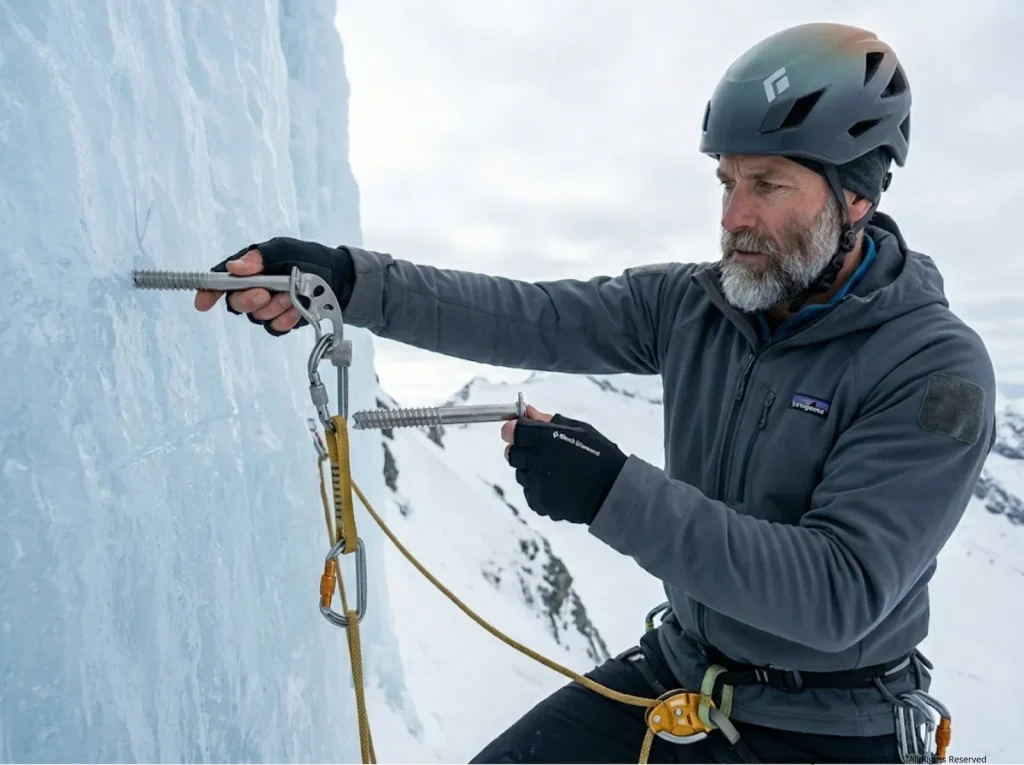
Here is the field technique that most experienced alpinists use: leave the first screw halfway inserted in the hole as a visual reference. The second screw, drilled at the same angle, will intersect at the correct depth. You do not need a protractor. You need one screw and a matched angle.
The orientation of the thread — horizontal V-thread versus vertical A-thread — is a distinction that matters more than most climbers realize. In a horizontal V-thread, off-axis rappel force becomes asymmetrical, putting disproportionate stress on one side of the ice bridge. In a vertical A-thread, the downward force puts the upper hole into direct compression against the entire mass of the ice fall. This configuration leverages the high compressive strength of ice rather than its lower tensile or shear strength. Building bombproof trad anchors using the SERENE/ERNEST principles gives you a framework for thinking about redundancy and equalization that applies directly to ice anchor geometry.
Marc Beverly and Stephen Attaway’s research puts numbers to what experienced climbers had been observing in the field for years. The vertical A-thread averages 14 to 15 kilonewtons of failure load. The standard horizontal V-thread averages 11 kilonewtons. That is a 27 to 36 percent strength increase from a change in orientation alone. At angles below 45 degrees, a shallow V-thread drops to 4 to 7 kilonewtons — catastrophically below acceptable safety margins for a primary descent anchor. The geometry is not a suggestion. The data is settled. For a full breakdown of ice climbing grades, angles, and the conditions that determine what your gear can handle, the WI scale provides context for why the numbers on holding power matter at every grade.
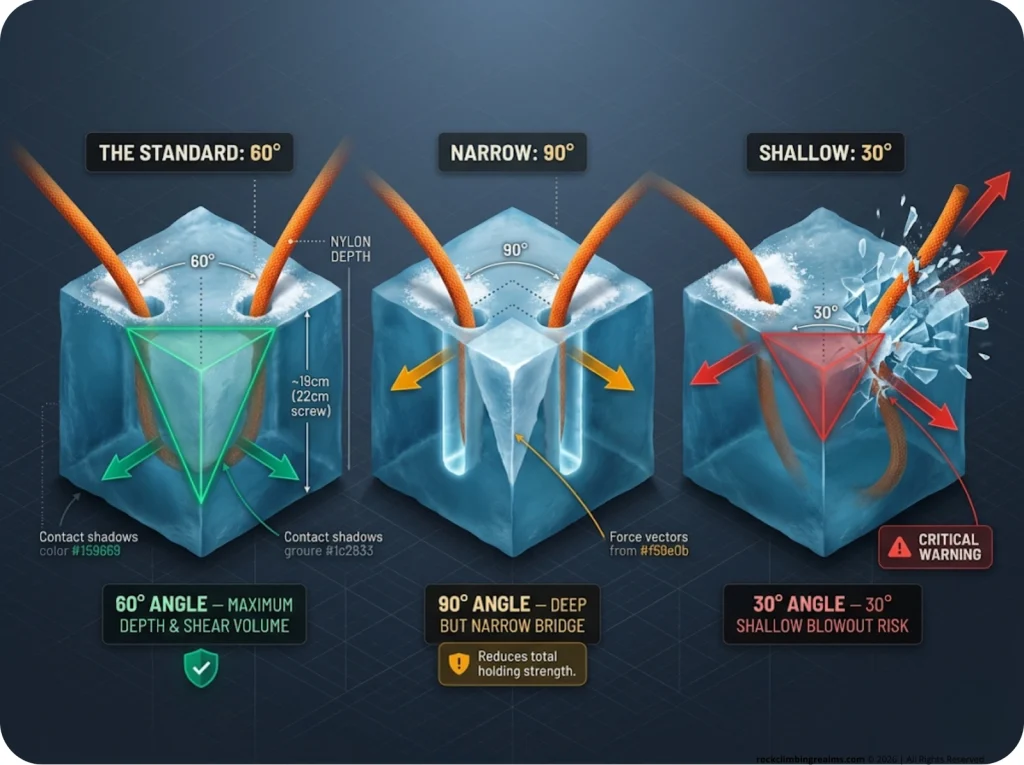
Pro tip: When the ice formation geometry prevents a clean vertical A-thread placement, the fallback is always a horizontal V-thread at the correct 60-degree angle. Never settle for a shallow V-thread at 30 or 40 degrees “because it’s what the ice allowed.” Move the anchor point.
The Backup Betrayal — Why Human Error Catches Climbers at Transition Points
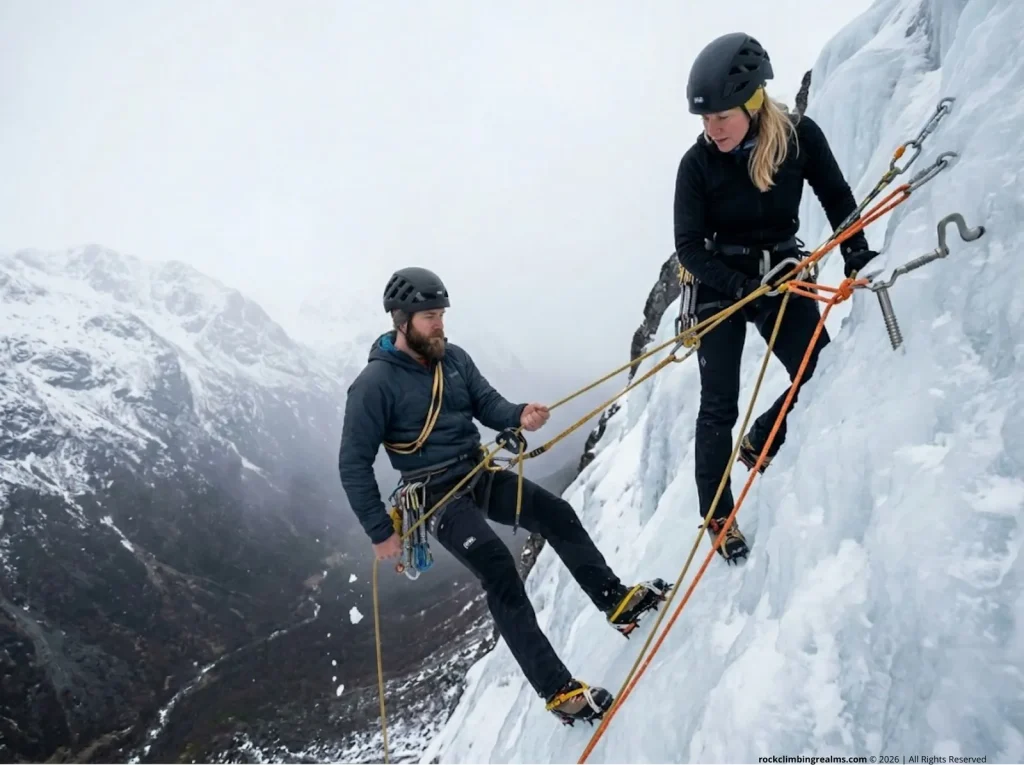
The American Alpine Club’s forensic analysis of ice climbing accidents identifies transition points — the switch from climbing to rappelling — as the most dangerous phase of a climb. This is where the third mistake lives. And it is the one that catches climbers who know better. The AAC’s research on human factors and transition point safety documents how physical and mental exhaustion compromises anchor decision-making at exactly the moment when the protocol matters most.
The professional standard for rappelling on a V-thread is the unweighted backup protocol. The first climber down — typically the heaviest, which means the highest load on the system — must descend with at least one ice screw backup clipped directly to the climbing rope. Not to the cord. Not to a quickdraw. To the rope. Understanding anchor systems and fall forces through the PAS vs daisy chain comparison clarifies why the attachment point to the rope matters so much for shock loading dynamics.
The word “unweighted” is the part people miss. The backup must not take load. Two reasons: first, if the backup takes any significant load, the V-thread is not being tested — the first descent is the crash test dummy for the anchor, and it needs to be an honest one. Second, the last climber rappels on the thread alone with no redundancy. If the first person did not properly test the thread, the last person is on an unverified system. The backup exists so the thread gets verified, not so the system has two load-sharing anchors simultaneously.
In marginal ice, the series backup is the professional standard: two screws equalized to a single master point, both clipped to the rope. The last climber removes the backup only after the first climber has reached the next anchor and confirmed the rope pulls cleanly. If you’re not confident in your self-rescue skills for escaping a belay or ascending a rope, the backup protocol is even more critical — a failed thread in marginal ice leaves you with no second chance if your rope ascension skills aren’t dialed.
The mistake that catches people is clipping the backup screw to the 6-millimeter accessory cord instead of the climbing rope. When the ice bridge fails, the shock load in a static system — where the spring constant is extremely high — generates forces exceeding 10 kilonewtons from a fall of only a few centimeters. A 6-millimeter static cord lacks the energy-absorption characteristics of the main rope. The dynamic rope keeps peak load below the failure threshold of the backup screw. The static cord does not.
On the north face of Ogre II in 2016, Kyle Dempster and Scott Adamson built a V-thread on marginal ice and chose not to place a backup due to gear depletion and fatigue. The V-thread popped. Both climbers fell 90 meters. They survived, but only because they landed in snow. The anchor decision was not made out of ignorance — they knew the protocol. Physical and mental exhaustion compromised their judgment at exactly the moment when the protocol mattered most. Anchors built under exhaustion follow the letter of the safety standard but not its spirit. The thread that catches you is never the one you thought was marginal. It is the one you were too tired to verify.
Pro tip: Before you leave any rappels station, verbalize the backup protocol out loud to your partner. “First one down, backup on the rope, backup removed at the bottom.” Fatigue steals your memory but it rarely steals what you say out loud.
Material Decisions — Cord, Webbing, and the Naked Thread Gamble
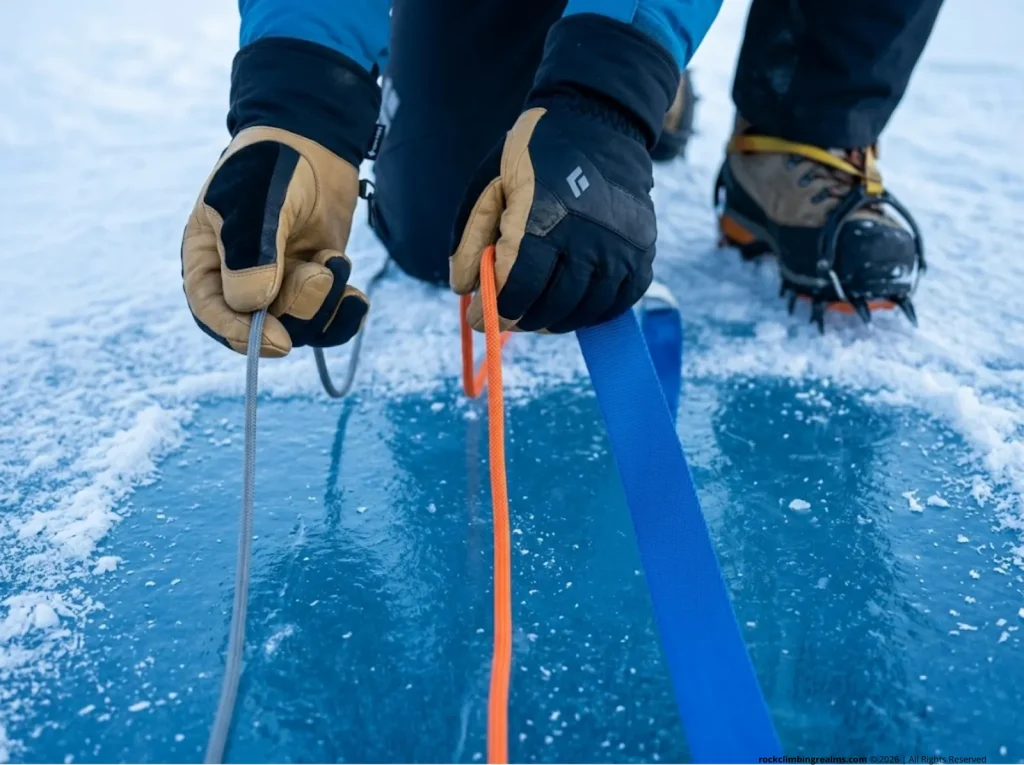
The fourth mistake is the one that gets left out of most V-thread articles because it requires talking about numbers. The cord diameter matters. The material matters. And the naked thread decision requires understanding the trade-offs instead of just the marketing.
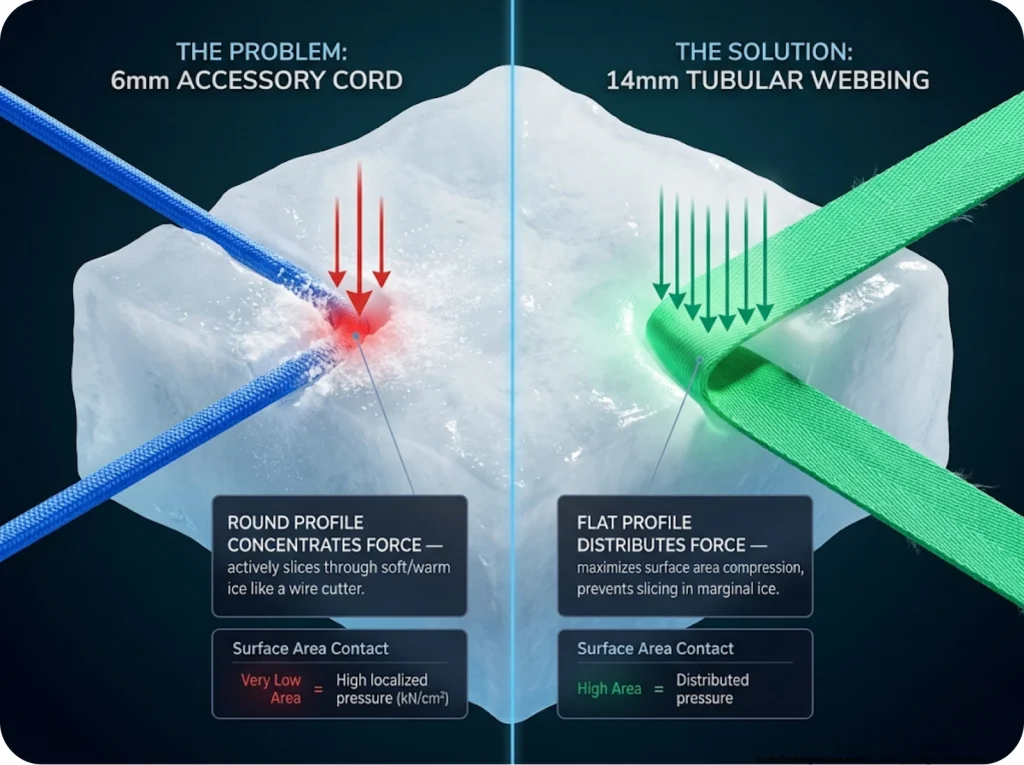
The cheese-wire effect is real. A thinner cord — 5 or 6 millimeters — concentrates pressure on ice crystals under load because the surface area in contact with the ice is smaller. The cord cuts through the bridge like a wire through a block of cheese. This is not a subtle effect. It is the primary failure mode in warm or soft ice, and most climbers have no idea it is happening until they pull the cord and see the channel it carved. A complete breakdown of ice climbing gear systems covers the material properties of cord, webbing, and rope in the context of how they interact with ice.
For standard alpine descents, the professional minimum is 7-millimeter nylon accessory cord. In soft or warm ice — the conditions where cheese-wiring is most aggressive — 14 to 18 millimeter tubular webbing is the correct choice. The flat profile of webbing maximizes surface area in compression against the back of the ice bridge, dramatically increasing the failure threshold. The choice between 7 millimeters of round cord and 14 millimeters of flat webbing is not cosmetic. In soft ice, it is the difference between an anchor that holds and one that punches through. If you’re using ultralight ice screws and concerned about weight savings, the cord diameter trade-off is worth understanding before you go too light on material.
The naked thread — threading the rappel rope directly through ice channels without leaving a cord loop behind — eliminates tat pollution on popular multi-pitch routes. It is a legitimate technique in the right conditions. But it introduces two risks that require honest assessment before you commit.
First, freezing: in wet ice or when temperatures fluctuate around freezing, water inside the channels can freeze the rope in place. The friction of the rappel itself generates enough heat to melt a thin layer of ice, which then refreezes the moment you stop moving. You arrive at the bottom and cannot pull the rope. This forces a hazardous rope ascension that many climbers are not equipped or trained to execute. Second, internal friction: pulling a weighted rope through a 19-millimeter hole creates significant drag against the ice walls, which damages the rope sheath over repeated rappels and increases pull force requirements substantially. Before committing to a naked thread, review partner rescue protocols for stuck or injured climbers — if things go wrong, you need a plan that doesn’t rely on pulling the rope.
In cold, dry conditions, the naked thread is the professional standard. In warm, wet conditions, it is a rope-retrieval trap wearing an environmental virtue badge. The environmental benefit is real — leaving no trace matters — but not at the cost of forcing a roped ascending situation on the party below.
Environmental Degradation — When Good Threads Go Bad
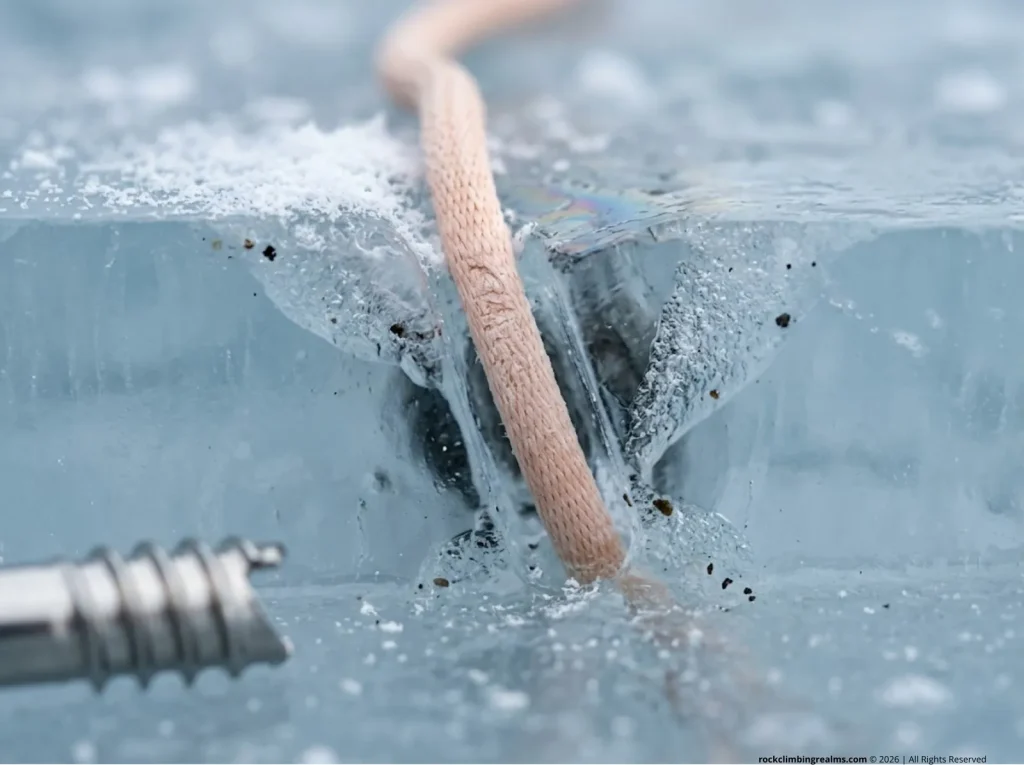
The thread looked perfect when you built it. This is the fifth mistake, and it is the one that is hardest to accept: a thread that was bombproof when you built it can be hazardous by the time the last person descends.
Sublimation — the process where ice turns directly to water vapor without passing through the liquid phase — thins the ice bridge by several millimeters per day in dry, windy, or high-altitude environments. A thread that was bomber on Saturday morning may be marginal by Saturday evening. On popular ice routes where multiple parties descend the same line, the resident V-threads left by earlier parties are not just suspect — they are actively hazardous to trust. The ice bridge that protected the cord has been shrinking since it was built. This is the same degradation mechanism that affects snow anchors over time, which is why the bounce test exists for both systems.
UV radiation adds a second degradation path that is invisible from the surface. The nylon cord inside the holes absorbs UV radiation even when the ice appears perfectly solid from the outside. The cord can be substantially understrengthened without any external indication of damage. In the worst documented cases, the cord inside the holes froze in two separate pieces but maintained a shape that appeared from the surface to be a continuous loop. Climbers have been injured clipping into exactly this invisible failure. If you did not build it, you do not trust it. Build your own thread or treat any existing thread as unverified. The UIAA safety standards explain how gear retirement and material degradation work — UV damage to nylon is part of the retirement matrix for a reason.
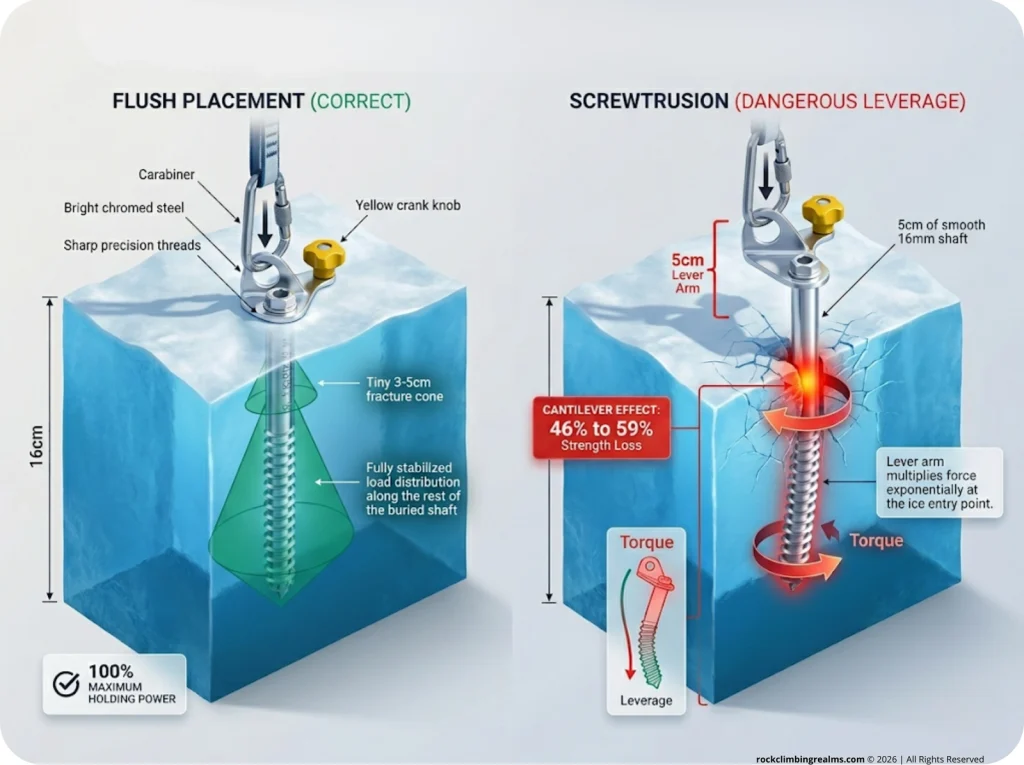
Screwtrusion is the term Black Diamond’s QC Lab uses to describe any placement where the screw body protrudes above the ice surface unsupported. This is not a minor efficiency issue. It creates a cantilever that dramatically reduces holding power.
In a flush placement, the ice supports the full length of the screw. Under load, a small cone — 3 to 5 centimeters — fractures near the hanger, but the rest of the screw remains stable. In a screwtrusion scenario with 5 centimeters of protrusion, a steel screw loses 46 percent of its holding power. An aluminum screw loses 59 percent — effectively useless as a high-strength anchor point in marginal ice. Aluminum’s lower modulus of elasticity makes it far more susceptible to cantilever failure than steel. A screw that looks “mostly buried” from the surface may have lost more than half its rated strength. Choosing the right ice screws for your objective means understanding not just weight but also the steel versus aluminum tradeoff in relation to real-world placement scenarios.
When a screw cannot be buried flush — because you hit rock behind the ice — a tie-off with a sling is required. The traditional teeth up angle is wrong for tie-off scenarios. It allows the sling to migrate toward the hanger under load, increasing leverage and pull-out risk. The correct tie-off is perpendicular — 90 degrees — or slightly teeth down, which prevents the sling from sliding toward the hanger under tension.
The Professional Protocol — From Assessment to Verified Descent
Here is the complete construction sequence. Not the abbreviated version. Not the “good enough for this terrain” version. The sequence that, if executed every time, would have prevented most of the anchor failures documented in the American Alpine Club’s accident database.
Step 1: Medium Assessment and Site Preparation. Find the bluest ice available. Avoid dinner-plating zones and areas with chandeliered ice — the discontinuous vertical tube structure that makes it impossible to find a solid bridge. Clear the top 5 to 10 centimeters of surface ice with your axe. Test the ice at the proposed anchor point with your pick: solid resistance sounds different from a hollow chattering response. If it chatters, move. Assess the sun angle and predicted temperature change for the duration of the descent. Thermal degradation during your rappels must be factored into the decision. This assessment step mirrors the same risk management logic for reading ice formations and conditions — you’re making the same judgment call about medium reliability.
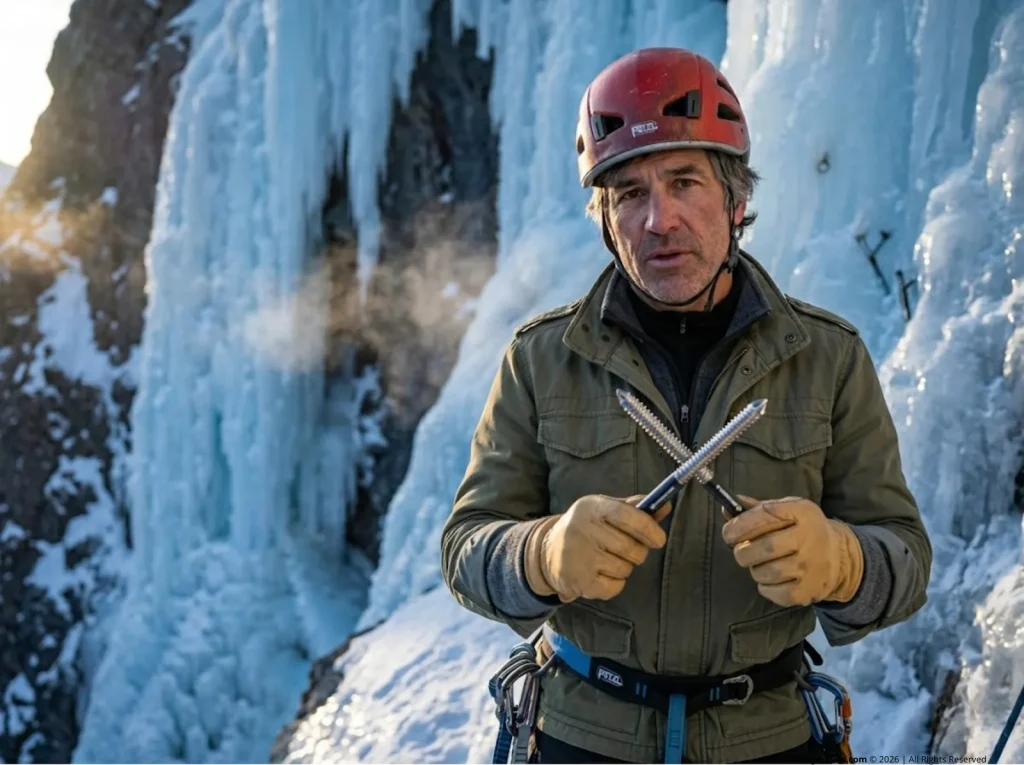
Step 2: Geometric Execution. Always use your longest screw — typically 21 or 22 centimeters. Longer screws create a deeper bridge and a larger shear area. Hole spacing should equal the screw length minus the hanger thickness. For a 22-centimeter screw, 20 centimeters of spacing is the target. Use the halfway-inserted first screw as a visual guide for matching the 60-degree angle on the second hole. Before threading, clear all ice shavings and slush from the channels with a dedicated tool — the Petzl Multihook or Grivel Candela — because debris left in the channel can freeze the cord or rope in place.
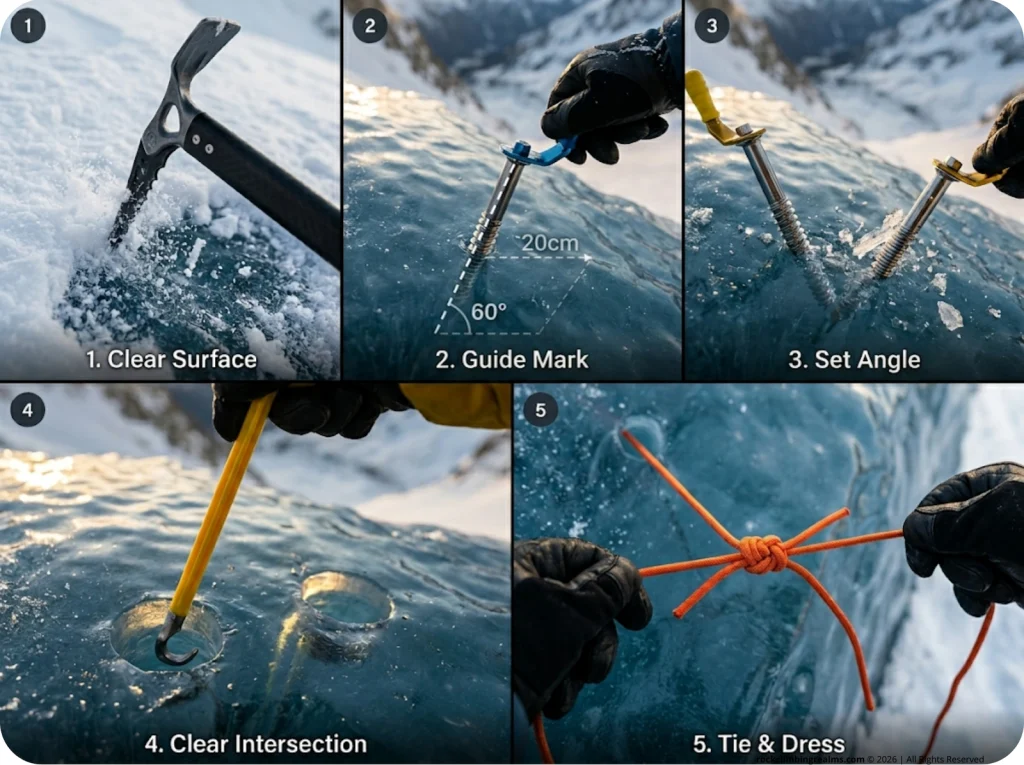
Step 3: Material Selection, Knotting, and Testing. For most alpine conditions, 7-millimeter nylon accessory cord is the professional minimum. For warm, soft, or aerated ice, upgrade to 14 to 18-millimeter tubular webbing. Tie the loop with a Double Fisherman’s or Triple Fisherman’s knot for cord. For webbing, a Water Knot is mandatory, dressed with at least 10 centimeters of tail on each side. For slippery materials like Dyneema, use the Triple Fisherman’s — a standard double can slip under sustained load. Before committing, apply a sharp downward pull while still clipped to your backup screw. That is the only real-world test the anchor gets. Knowing the core climbing knots and when each is appropriate — the Double Fisherman’s, Water Knot, and others — is foundational to executing this step correctly.
Step 4: Backup and Transition Management. The first person down must have a backup screw clipped directly to the rope. Not the cord. Not optional. In marginal ice, use two screws equalized to a single master point, both clipped to the rope. The last climber removes the backup only after the first climber confirms the lower anchor is ready and the rope pulls cleanly. There are no exceptions for short rappels, easy terrain, or running low on gear. No exceptions.
The Tool That Makes the Difference — Candelas, Multihooks, and Threader Design
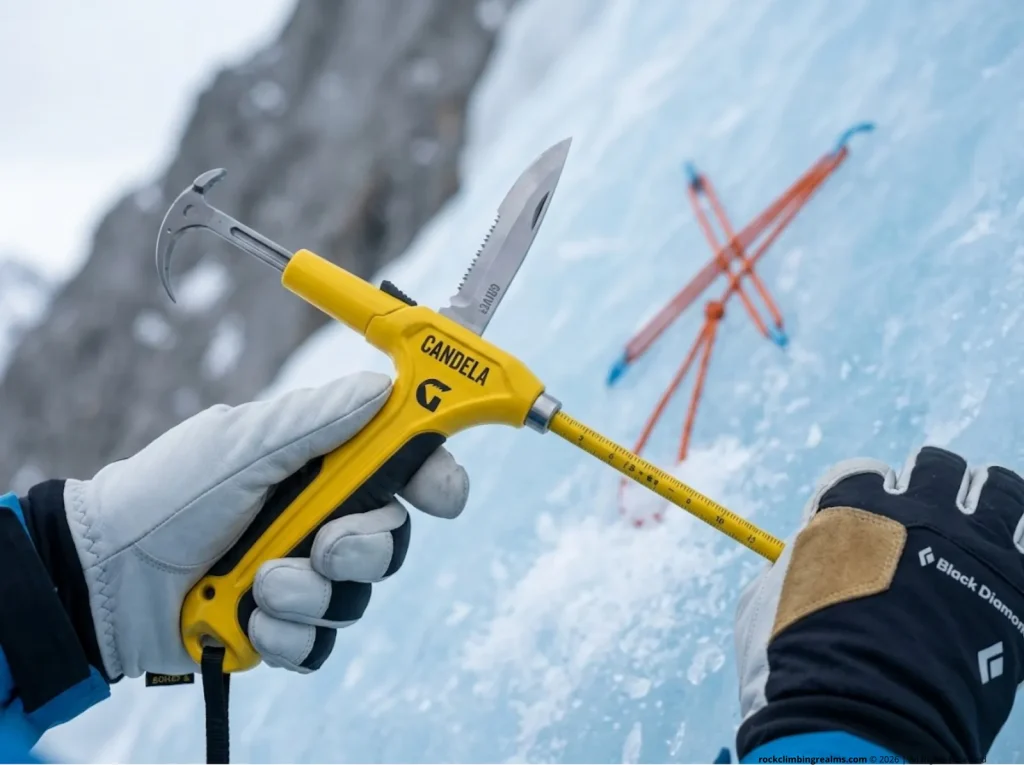
Knowing the physics does not automatically translate into field execution. The tools you carry affect whether you get the geometry right when visibility is poor and your hands are cold.
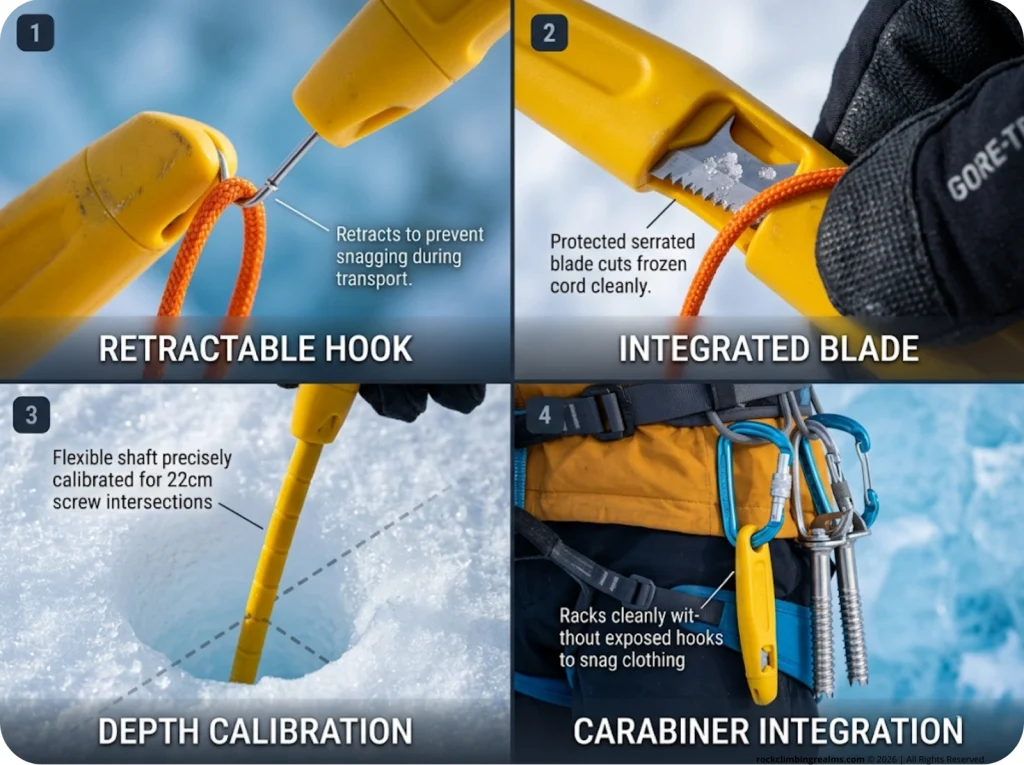
The Grivel Candela is a purpose-built threader with three features that matter in the field. Its retractable hook retrieves cord from deep or slightly misaligned holes. Its built-in blade cuts cord cleanly without leaving frayed ends that can freeze or snag. Its flexible shaft is calibrated to check the intersection depth of a standard 22-centimeter placement — eliminating the guesswork when low sun angle or flat light makes visual judgment unreliable. That calibration feature is the reason you pay for a purpose-built tool instead of improvising with a bent gate.
The Petzl Multihook has a folding design with a rigid hook — an advantage in deep vertical A-thread channels where flexibility becomes a liability. Its serrated blade handles frozen cord or ice-packed holes where clean cuts require more force. The folding mechanism keeps it from snagging on quickdraws or harness gear during the climb. Both tools sharpen ice picks and crampons in the field by maintaining the cutting edges that interact with ice — dull tools make bad holes, which makes bad threads.
Between the two: use the Candela when channels are misaligned, visibility is poor, or you need to retrieve cord from depth. Use the Multihook when building vertical A-threads in deep channels or when cutting frozen frayed cord in cold conditions where rigidity matters. Both tools reduce anchor time, which reduces exposure to objective hazards. On Ogre II, the team built a single marginal anchor instead of a bombproof one partly because they felt they did not have time for a backup. Purpose-built tooling removes minutes from the anchor-building process. That time is the margin between a tested system and a fatal shortcut.
Conclusion
Three things to carry out of this article. First, ice is not rock — its temperature, density, and crystalline structure are the first variable in every anchor decision, and they are the variables most climbers discount until they can’t afford to. Second, the 60-degree geometry of the Abalakov is not a suggestion. It is a load distribution equation that maximizes shear area, and every degree of deviation is borrowed safety that the mountain will eventually collect. Third, the backup protocol exists because humans make mistakes under fatigue — and the thread that fails is never the one you thought was good enough. Treat every anchor as a fresh engineering problem, not a routine task.
Next time you’re on a route where you need to build a V-thread — even if it is a low-consequence training descent on a bolted line — treat it as a deliberate rep. Pick the bluest ice, clear to the right depth, get the angle with the half-screw guide, run the cord or webbing, clip the backup to the rope, do the pull test, then walk away knowing exactly what you built and why. Muscle memory built in low consequence is what holds when the consequences are real.
Now go send something.
FAQ
How strong is a V-thread compared to an ice screw?
A properly built V-thread at 60 degrees in blue ice averages 11 kilonewtons of failure load — comparable to a single steel ice screw. A vertical A-thread in the same conditions averages 14 to 15 kilonewtons, making it consistently stronger than a standard screw. The critical variable is always ice quality: a V-thread in aerated or sun-damaged ice can drop to 4 to 7 kilonewtons, well below safe margins.
Can you rappel off a naked V-thread without leaving cord behind?
Yes, in cold, dry conditions the naked thread is a legitimate and environmentally preferable technique. However, it introduces two real risks: the rope can freeze in the channels if temperatures fluctuate around freezing, making rope retrieval impossible, and internal friction during the pull damages the sheath over time. Assess temperature stability before committing to a naked thread.
Are A-threads actually stronger than V-threads, and should I switch?
Yes. The vertical A-thread consistently outperforms the horizontal V-thread by 27 to 36 percent in failure load testing — 14 to 15 kilonewtons versus 11 kilonewtons. The vertical orientation puts the upper hole into direct compression against the ice fall’s mass, leveraging ice’s high compressive strength. Most professional alpine climbers have adopted the A-thread as their standard configuration.
What is screwtrusion and how do I avoid it?
Screwtrusion is any placement where the screw body protrudes above the ice surface, creating a cantilever that can cut holding power by 46 to 59 percent depending on material — aluminum is more susceptible than steel. Avoid it by confirming the screw is fully flush before clipping the hanger. If flush placement is impossible because you hit rock, use a tie-off with the screw positioned perpendicular or teeth down, never teeth up.
How do you make a V-threader tool at home?
A DIY threader can be fashioned from a bent gate carabiner or a shortened ice screw with the eye filed to a hook. Commercial tools like the Grivel Candela add a calibrated intersection-depth checking feature that DIY improvisations cannot replicate. For regular ice climbing or any serious alpine descent, a purpose-built tool is the professional standard.
Safety Notice: Rock climbing and mountaineering are inherently high-risk
activities that can involve physical trauma or fatal incidents. The information on Rock Climbing Realms is for
educational and informational purposes only. Techniques and advice presented here are not a substitute
for professional, hands-on instruction. Conditions and risks vary by location. Always seek guidance
from a qualified instructor before attempting new techniques. By using this website, you agree that you
are solely responsible for your own safety. Any reliance you place on this information is strictly
at your own risk, and you assume all liability for your actions. Rock Climbing Realms and its authors
will not be held liable for any harm, damage, or loss sustained in connection with the use of this information.
Affiliate Disclosure: We are a participant in the Amazon Services LLC Associates Program, an
affiliate advertising program designed to provide a means for us to earn advertising fees by advertising and linking
to Amazon.com. As an Amazon Associate, we earn from qualifying purchases. We are also an official affiliate partner
of Black Diamond Equipment via the AvantLink network. If you click on a Black Diamond affiliate link and make a
purchase, we may earn a commission at no additional cost to you. We also participate in other affiliate programs.
Additional terms are found in the terms of service.