
In this article
You’re three sessions into the same V6. Three weeks on a single problem. You’ve memorized the beta: left hand crimps the sidepull, right foot smears high, hip turn at the crux, reach for the sloper. You know the sequence. And still, move five shuts you down. The climber on the next pad — no heavier training rack than yours, no better shoes — sends it on their second attempt and walks off without a word.
That moment stings differently than a hard fall. It forces a different question. Not “how do I try harder?” but “where is the system failing?”
That’s what this article answers. A bouldering plateau is not a motivation problem. It’s a diagnostic problem. And before you add another hangboard session or grind more gym volume, you need to know which system is actually broken.
⚡ Quick Answer: A bouldering plateau stuck after 6+ weeks signals one of two failures: a hardware deficit (finger strength below your grade’s benchmark, tendon lag, or slow rate of force development) or a software bug (excess grip force, poor COM management, or movement patterns learned on plastic that don’t transfer). Run the five-question self-diagnostic below to identify which system is failing, then follow the targeted protocol. The right fix on the wrong system wastes months.
Diagnosing Your Plateau — Hardware Failure or Software Bug?
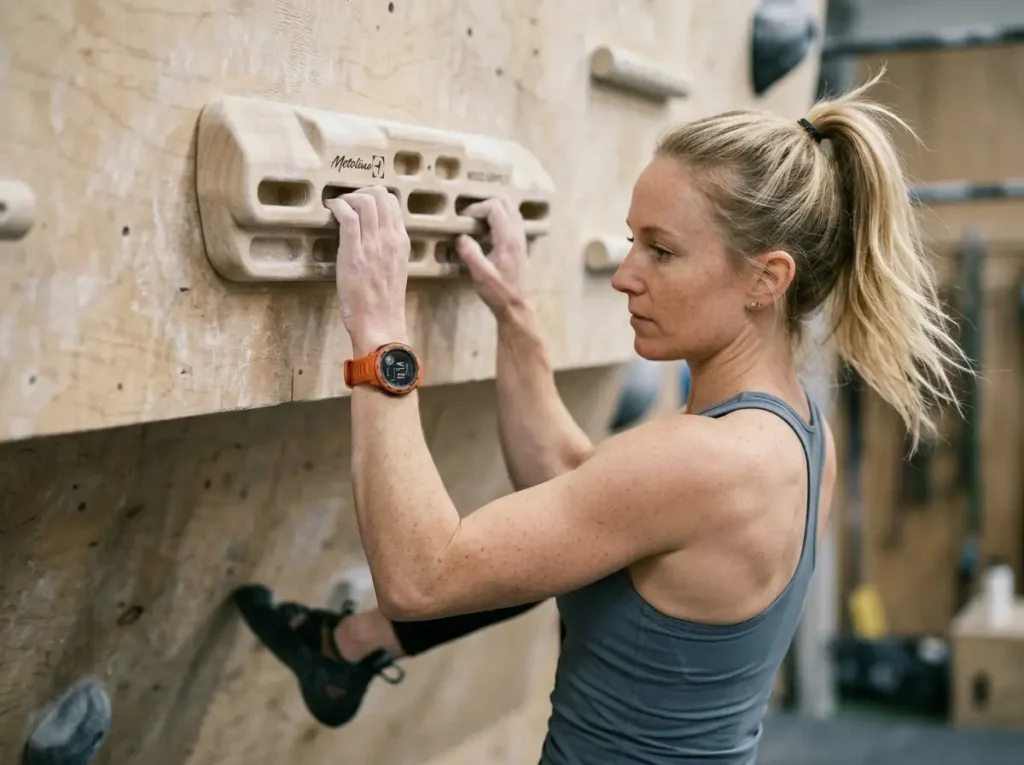
Here’s where everyone goes wrong: they feel stuck, so they train more of the same thing. More laps. More hangboard volume. More projecting. That approach works if you’ve correctly identified the bottleneck. Most people haven’t.
A bouldering plateau at Rock Climbing Realms is six or more consecutive weeks without measurable progress on any validated benchmark — grade ceiling, hangboard load, or timed hang capacity. If you’ve been stuck for less than that, you may just be mid-adaptation. Connective tissue lags behind neural gains by weeks.
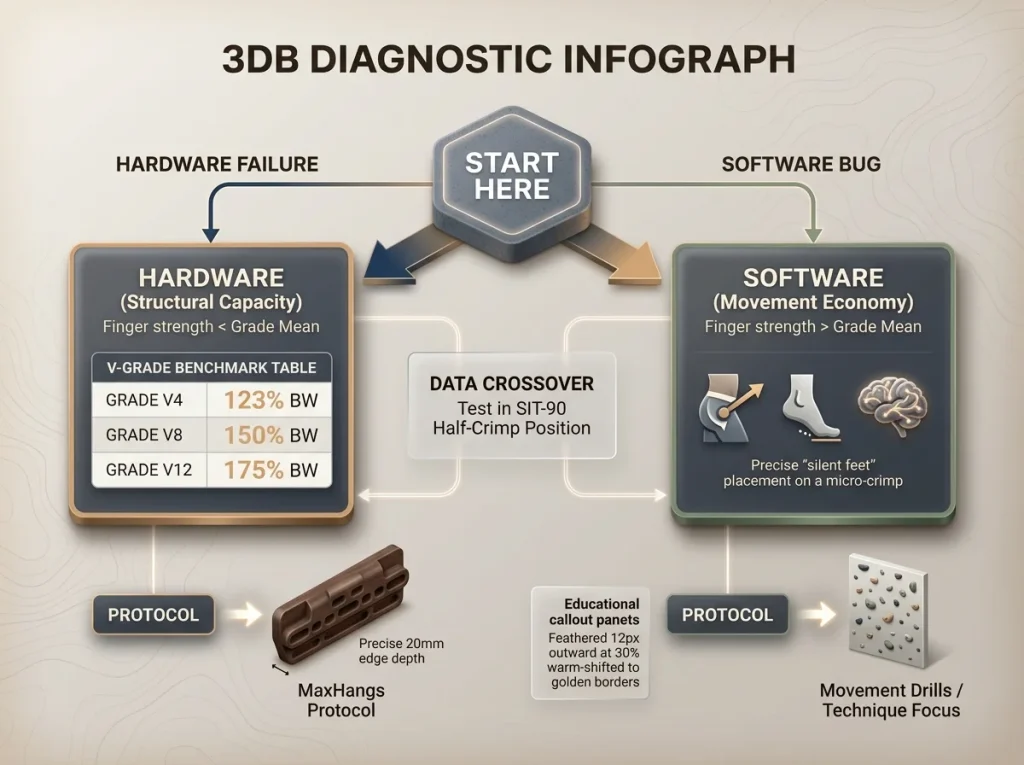
The diagnostic framework is a simple binary: hardware failure or software bug. Hardware failures live in structural capacity — finger strength, tendon stiffness, and metabolic throughput. Software bugs live in movement inefficiency — how you use the strength you already have.
Maximal finger strength explains roughly 50% of grade variance in the V4–V12 range. At V13+, it explains only 4.2%. The fix that got you from V3 to V6 often has no effect from V7 onward — not because your strength is gone, but because movement economy has become the dominant variable. Run a data-backed climbing assessment framework before prescribing a protocol. Without that baseline, you’re guessing.
The Grade Benchmark Table — Where Do You Actually Stand?
The benchmark numbers come from peer-reviewed sport climbing research measuring force on a 20mm edge as a percentage of bodyweight:
- V4 mean: 123.42% BW (±14.12)
- V8 mean: 150.56% BW (±15.34)
- V12 mean: 175.84% BW (±18.06)
If you’re stuck at V4 and testing at 140% BW, your finger strength exceeds the grade mean — that’s not your problem. If you’re testing at 118%, it is. Test in a SIT-90 position, half-crimp grip, progressive load to MVC. Use relative strength (% bodyweight), not absolute — a 55kg climber and a 90kg climber can produce identical raw force but climb at completely different grades.
The Self-Diagnostic — Five Questions That Reveal Your Bottleneck
Forget the hangboard for ten minutes. Answer these five questions honestly:
- Can you hold target-grade holds statically for 10 seconds with near-perfect technique? If not, that’s hardware.
- Do you fall because your arms fail on moves you understand the body position for? Hardware.
- Do you barn-door, slip feet, or get spun off moves despite adequate grip? Software.
- Do you get significantly more pumped than climbers at your grade on the same problem? Tactical inefficiency — software.
- Do you send V7 in the gym but get shut down on V5 granite outdoors? Perception-action coupling failure — software.
Pro tip: Film yourself from the side on your project. Watch your hip position at every move, not your hands. This one data point reveals more about your actual problem than a week of intuitive self-assessment. Most climbers are shocked by how far their hips drift from the wall on overhanging moves.
Once you’ve run the diagnostic, you’ve earned the right to pick a protocol. Hardware deficits and software bugs require completely different interventions.
Hardware Protocol — Building the Physiological Engine
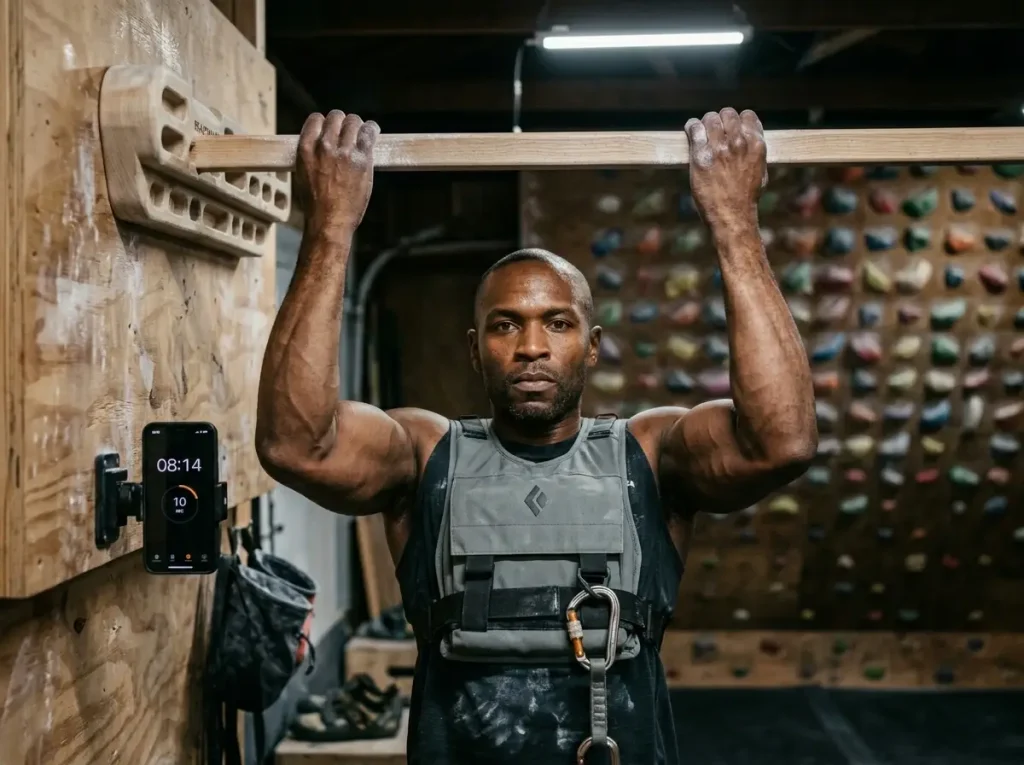
If your diagnostic points to a structural deficit, the fix is concrete and measurable — but it takes 8 weeks minimum before you feel it on the wall, and 12 before the connective tissue catches up.
The two primary hangboard methodologies are MaxHangs MAW (Maximum Added Weight) and MaxHangs MED (Minimum Edge Depth). They’re not the same thing, and running them in the wrong order wastes a training block. Before loading any MaxHangs protocol, build your baseline with hangboard training fundamentals — the form requirements aren’t optional, and the injury vectors here are real.
The full 8-week cycle: weeks 1–4 are the MAW neural recruitment phase, weeks 5–8 are the MED structural stiffness phase. The effects of different loading programs on finger strength in rock climbers validate both phases as producing additive strength gains when run sequentially, not concurrently.
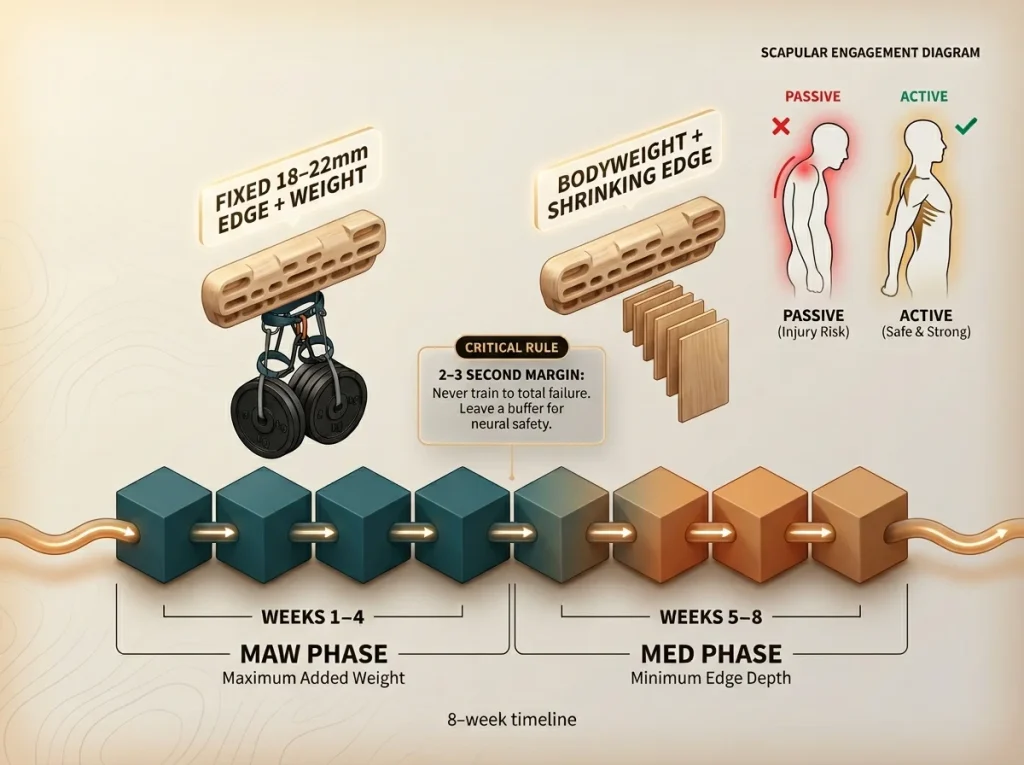
Eva López MaxHangs — The 8-Week Neural Loading Cycle
MAW phase: add weight via a vest or harness clip until you’re at a load you can hold for exactly 10–13 seconds on a fixed 18–22mm edge in a half-crimp. Log the added weight weekly. If you can hold it 15 seconds, you’re under-loaded. If you fail at 8, you’re over-loaded. Precision here is the protocol.
MED phase: drop the added weight, reduce edge depth by 2–3mm per week to the smallest depth you can hold for 10–13 seconds at bodyweight. The edge shrinks; the neural demand increases.
Two rules most people skip: First, actively hang — depress scapulae, retract shoulders, pull the posterior chain into engagement. Passive hanging trains a dysfunctional pattern. Second, stop with 2–3 seconds in reserve. Training to total failure doesn’t add neural benefit — it adds injury risk.
I’ve run two full 8-week MaxHangs cycles. The second one felt like nothing was happening through week six — and then week seven I pulled off a move I’d been fumbling for two months. The lag is real. Trust the protocol enough to not restart early.
Pro tip: Warm up before MaxHangs with 3–4 sets of submaximal hangs at roughly 60% MVC for 10 minutes. Loading cold connective tissue at near-MVC intensity is how A2 pulleys get cranky in early winter. Don’t skip the warm-up to save time.
Abrahangs for Tendon Remodeling — The Slow Medicine
Abrahangs run concurrently with MaxHangs, not instead of them. MaxHangs drives neural recruitment; Abrahangs drive extracellular matrix health and reduce injury exposure from new loads on undertrained connective tissue.
The protocol: below 50% MVC, 10 cumulative minutes per session, daily. The molecular signal for collagen synthesis is triggered by duration and mechanical loading, not peak force. As muscle and tendon adaptation to strength and conditioning shows, tendons take 48–72 hours to return to homeostasis after high-intensity loading. Muscles recover in 24–48 hours. Most intermediate climbers build tendinopathy debt in that gap.
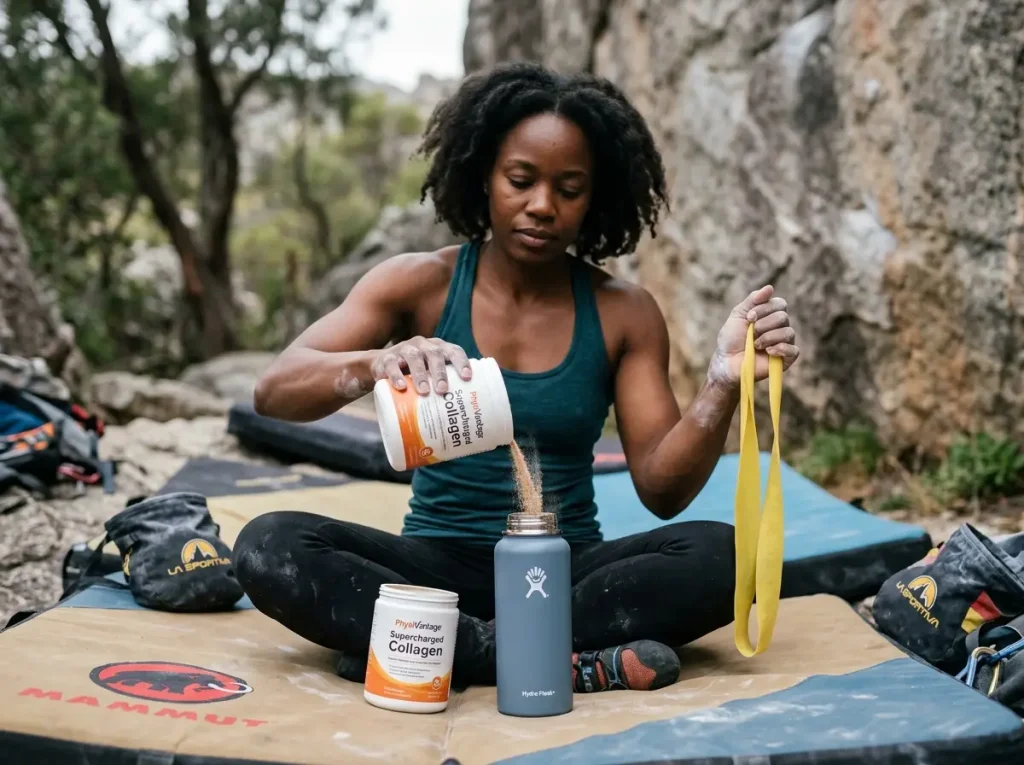
Nutritional protocol: 15–30g of hydrolyzed collagen with 225mg of vitamin C, 60 minutes before each Abrahangs session. The timing matters — that’s when peak serum amino acid availability aligns with mechanical loading.
That recovery gap is also where most plateaus quietly become injuries. The RFD variable operates at the other end of the hardware spectrum.
Rate of Force Development Training — The Elite Discriminator
For climbers stuck at V8 or V9, raw strength may not be the limiter at all. The real separator at those grades is Rate of Force Development (RFD) — the ability to generate force in the first 50–150ms of contraction. Research on Rate of Force Development and maximal strength in sport climbers shows elite climbers produce 1,457 N/s at 50ms vs. 799 N/s for advanced climbers at the same grade. Same grade bracket; nearly double the explosive firing rate. That’s not a strength difference — it’s a neural firing-rate difference.
RFD training tools: campus board footless matching, max-effort one-arm lockoff eccentrics, and bouldering with deliberate explosive contact intention on each move. On campus board, focus on pulling through the rung as fast as possible — the explosive intent in the eccentric phase is where RFD develops, not the static lockoff. Three to four explosive pulls per set, full 3–5 minutes recovery between sets, twice per week maximum. Read campus board biomechanics and CNS fatigue management before scaling intensity — managing CNS fatigue here is the difference between a productive training cycle and a pulley injury.
Software Protocol — Debugging the Movement System
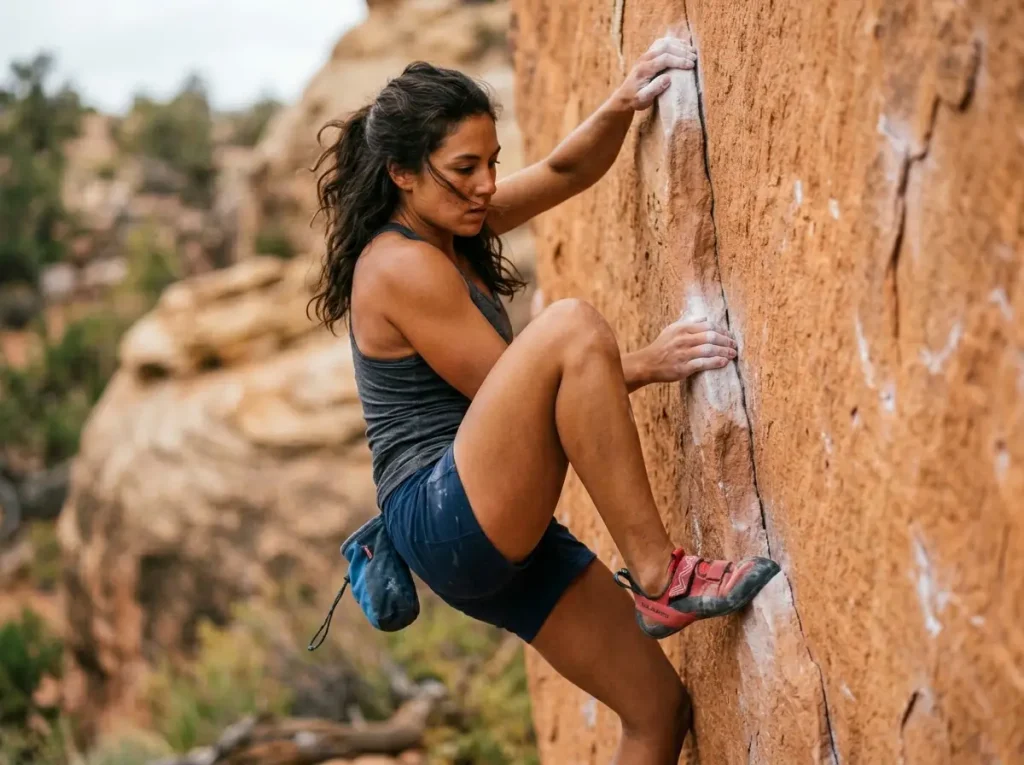
If your finger strength exceeds your grade benchmark and you’re still not sending, the issue is movement economy. The biomechanical principles and techniques in sport climbing research is direct on this: elite performers don’t produce more force per move — they waste less.
The most common software bug is grip excess. Most intermediate climbers grip every move at 90% of their Maximum Voluntary Contraction. Forearm circulation gets occluded once grip intensity passes 20% MVC. If a move requires 40% MVC and you’re applying 70%, you’re pumping yourself off a problem you have the strength to complete.
The second category is form-fit vs. force-fit management. Form-fit connections — heel hooks, toe hooks, knee bars, hand jams — use your body’s geometry to create a near-zero-effort mechanical lock. Force-fit connections — slopers, smears, compression — require sustained MVC. The strategy on hard boulder problems is maximizing form-fit positions between force-fit crux sequences.
The Footwork Physics — Friction, Edge, and the Silent Feet Principle
Static friction is always higher than dynamic friction. The moment a foot slips, the coefficient drops and you’re not recovering it.
Silent feet: place the foot, pause 0.5–1 second to let the rubber deform into the rock’s microstructure, then load. Moving straight from placement to loading skips that deformation step — and that’s where most footwork fails outdoors.
Rubber selection is a tactical specification. Soft compounds like Vibram XS Grip 2 deform into rock microstructure — optimal for smears, overhangs, and polished limestone. Stiff compounds like Vibram XS Edge hold shape under point loading — required for micro-edges on vertical granite. Below 10°C, soft rubber stiffens and loses smear performance; above 27°C, soft rubber gets greasy. For the full breakdown, see the science of edging and smearing.
COM Management and the Lever Arm Problem on Roofs
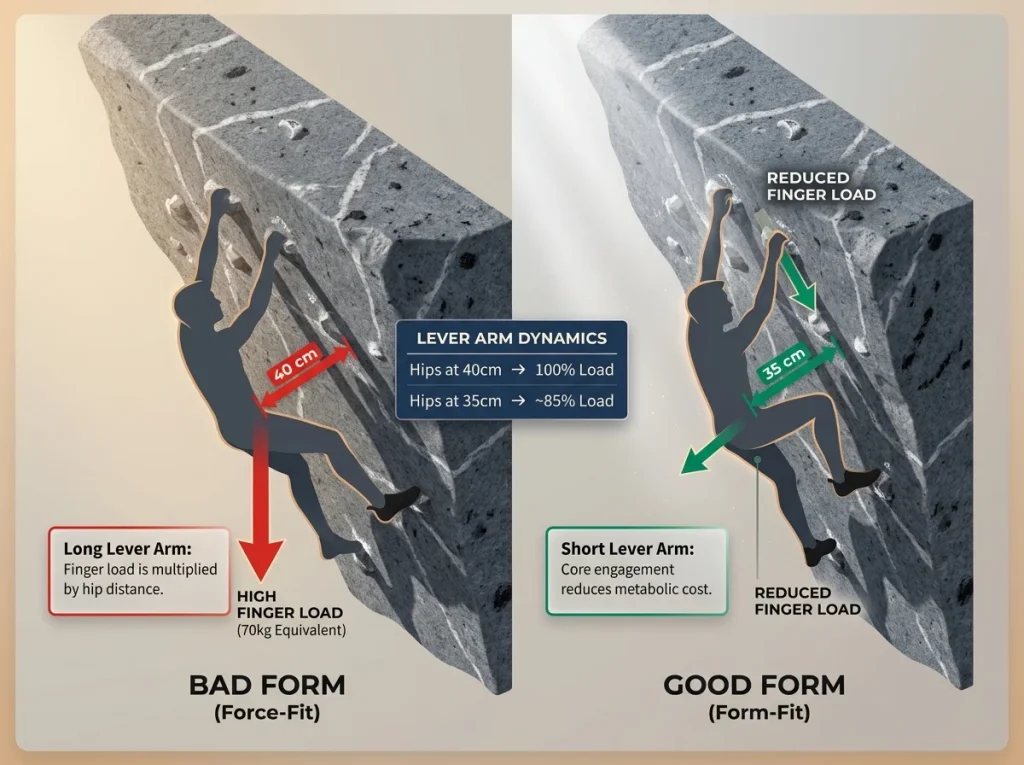
On overhanging terrain, hip distance from the wall acts as a force multiplier on your finger load. A 70kg climber with hips 40cm from the wall generates roughly the same rotational load on their fingers as an 80kg climber with hips 35cm out. Your bodyweight isn’t just a number on a hangboard — it’s a lever arm.
Your core’s job on overhang terrain is not aesthetic. It’s transmission. The posterior chain — glutes, hamstrings, erectors — pulls your hips toward the wall and reduces the finger force requirement on every move. Drop-knee rotates the hip internally to bring the pelvis closer to the wall, directly reducing that lever arm. Heel hooks load the posterior chain and allow hip engagement without additional finger penalty. That’s why they’re not gym tricks — they’re metabolic rest positions on hard overhangs. The execution details on torque management are in roof climbing body position and foot-cutting prevention.
The first time I paid real attention to hip distance on a roof traverse, I realized I’d been essentially swinging from my fingers for two years. The positions were there. I just wasn’t using them.
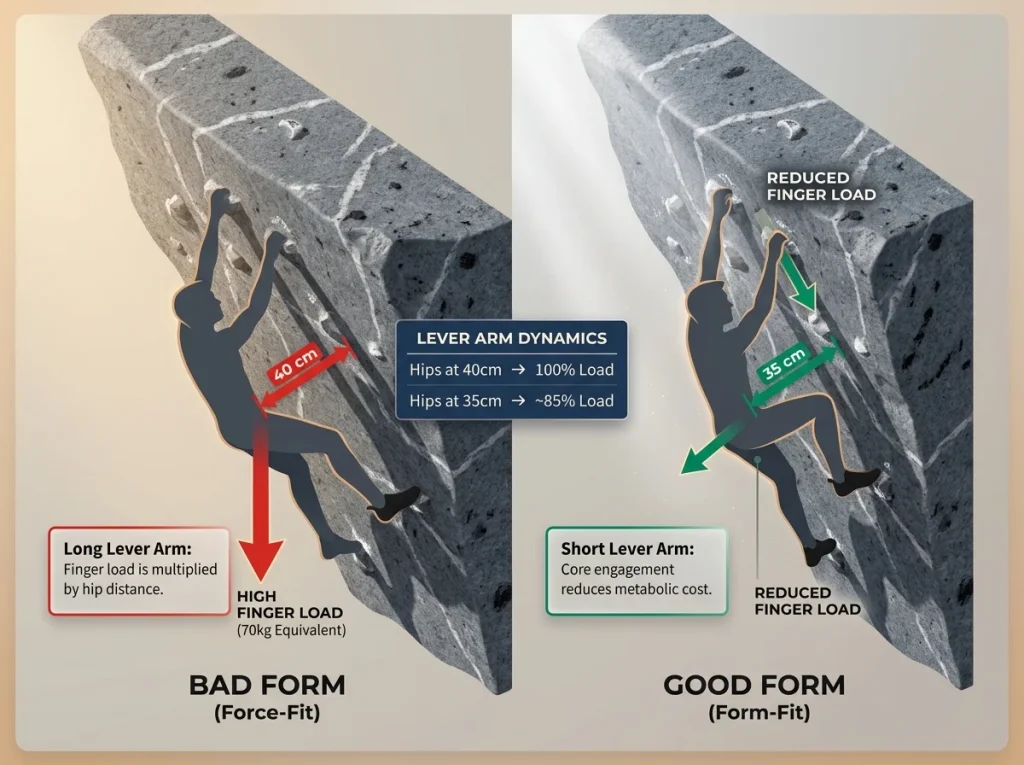
Pro tip: On your next session, climb a V-easy roof problem and focus only on hip-to-wall proximity at each move. Not the holds, not the sequence — just hip distance. The pump reduction will be immediate. This is also the fastest way to understand why better climbers look effortless on terrain that feels desperate.
Perception-Action Coupling — Why Gym Sends Don’t Transfer
Perception-action coupling is your intuitive calibration of movement based on visual and tactile feedback from the environment. Gym holds are manufactured to precise tolerances and polished for consistency. Real rock is irregular, textured, and provides different proprioceptive signals — the movement pattern you trained on plastic doesn’t fully transfer, even when the grade is theoretically the same.
The fix: deliberate introduction of varied surfaces, textures, and hold types. Spray walls with wooden holds, volumes with flat angles, and frequent outdoor sessions that force kinesthetic recalibration. Treat the first 4–6 outdoor sessions each season as pre-season recalibration — not performance sessions. Strength transfers. Movement calibration requires environmental exposure to rebuild.
Friction Science — The Tactical Footwear Specification
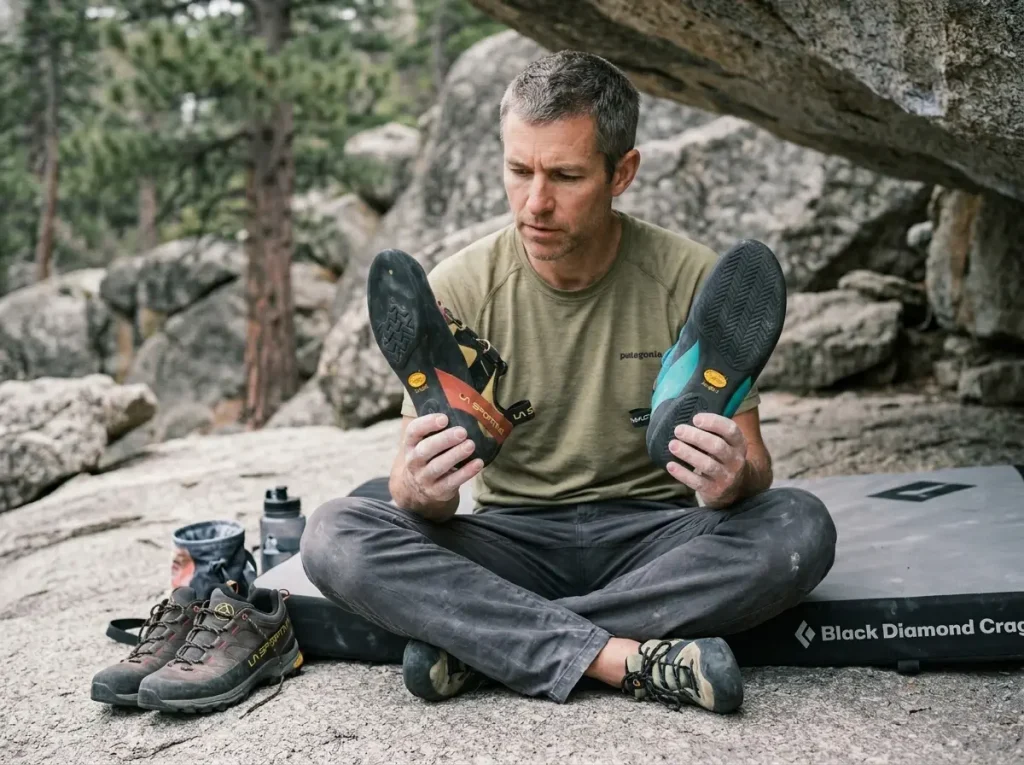
Most climbers buy shoes that fit, break them in until they feel like a second skin, and never think about the rubber compound again. That works until you’re projecting outdoor problems where 3mm of edge support separates a send from a slip.
Shore A hardness is the spec that matters. Most climbing rubbers fall between 60A (very soft) and 85A (very hard). Vibram XS Grip 2 sits at the soft end — maximum deformation into microtexture, optimal for overhangs and polished limestone. Vibram XS Edge is stiff — holds shape under point load, required for micro-edge precision on vertical granite. Stealth C4 covers general outdoor bouldering in the middle. For full compound data, see the definitive climbing shoe rubber guide. The mechanical testing of climbing shoe rubber compounds from Veryst Engineering has the Shore A and viscoelastic behavior numbers.
Matching Rubber to Problem Type — A Decision Framework
- Vertical, crimpy granite → XS Edge. Edge support is the friction mechanism.
- Overhanging, sloper-heavy limestone → XS Grip 2. Deformation into surface microstructure is the only friction source.
- Plastic gym walls and volumes → XS Flash ultra-soft.
- Below 10°C: go softer, or warm shoes inside your jacket between attempts.
- Above 27°C: go slightly stiffer to prevent grease-slip.
Skin Health and Friction — The Variable No One Quantifies
Your skin is a performance surface like rubber. Thin, conditioned skin provides better friction than thick, calloused skin that catches on open-hand holds. Over-chalking — a heavy layer rather than a light coat — can actually reduce contact surface conformity on slopers.
Pro tip: Sand down flappers and raised callouses with a pumice stone. Smooth, even skin provides more consistent friction than jagged callous topography on a sloper. Most gym climbers never hear this until their first outdoor redpoint.
Skin micro-tears after heavy sessions degrade friction for 24–48 hours. Schedule outdoor sloper sessions after skin rest days.
Recovery Engineering — How Rest Becomes a Training Variable
Most climbers add sessions when they plateau. That’s the wrong direction — the more likely explanation is fatigue accumulating faster than adaptation.
Tendons and pulleys take 48–72 hours to return to homeostasis after high-intensity loading. Muscles recover in 24–48 hours. Three days on, one day off means you’re reloading connective tissue that hasn’t finished recovering. Over weeks, that builds a tendinopathy debt.
The neural consolidation lag is the piece most climbers miss: finger strength typically peaks 2–4 weeks after stopping a heavy hangboard cycle. You end the block, it feels like you went backwards, and you restart too early. That peak requires processing time. Let it happen.
Deload weeks are mandatory — not optional. Every 3–4 weeks of hard training should be followed by one week at 50–60% volume. The stimulus converts to adaptation during the deload, not during the heavy weeks. A periodization framework for climbing training covers how to sequence bouldering-specific strength blocks with deload phases.
The overtraining signature: sudden inability to complete moves you were doing two weeks ago. Not a mental block — physiological regression from accumulated fatigue. The fix is removing a session, not adding one.
The Training Frequency Prescription by Plateau Type
For a hardware deficit: 2–3 hangboard sessions per week integrated into 3 bouldering sessions, always at session start before grip fatigue accumulates. For a software deficit: 4–5 bouldering sessions per week, at least two dedicated to footwork drills and COM work. Running max-effort hangboard before technique work produces technique failure from grip fatigue — not useful performance feedback.
The Antagonist Imbalance — The Invisible Plateau Driver
Climbing trains the pulling and gripping side almost exclusively — finger flexors, biceps, lats. Without deliberate antagonist work, structural imbalance develops over months. That imbalance shows up first as subtle biomechanical compensation: restricted ranges of motion, overloaded tendons compensating for weak extensors, movement patterns that degrade at the margins of your grade.
The minimum protocol: push-ups, wrist extension work, and external rotation drills two to three times per week. If you can crimp significantly harder than you can extend your wrist against resistance, you have an antagonist deficit that’s likely showing up as restricted movement or early tendinopathy risk. Full antagonist screening and programming is covered in antagonist strength training for injury-free climbing.
Conclusion
Three things, if nothing else.
Diagnose before you train. The hardware vs. software framework is a protocol to run before every new training block. Treating the wrong system costs months.
Every grip above minimum required force is a deduction from your send budget. Every move out of a form-fit position is metabolically expensive. Elite bouldering is energy accounting, not effort maximizing.
Recovery is where adaptation happens. The neural consolidation lag, the 48–72 hour tendon homeostasis window, the deload week — these aren’t gaps between training. They’re the mechanism.
Film yourself on a problem two grades below your limit before your next session. Watch hip position at every move. Then run the five-question diagnostic. You’ll know in 30 minutes which system needs work.
FAQ
How do I get past a V4 plateau?
Run the hardware diagnostic first — V4 requires approximately 123% of bodyweight force on a 20mm edge. If your strength exceeds that, your plateau is a software problem: COM management, footwork precision, or perception-action calibration. Add two footwork-focused sessions per week on V2–V3 using silent feet, alongside your V4 projecting.
Why am I not getting better at bouldering despite training consistently?
Consistent training only builds adaptation when it applies a novel stimulus. If you’ve been working the same wall angles and hold types for months, the system has reached equilibrium — you’re maintaining fitness, not building it. New surfaces, new hangboard protocols every 8 weeks, and deload weeks every 3–4 weeks break that equilibrium.
Is hangboarding good for intermediate climbers, or is it risky?
Appropriate after 12–18 months of consistent finger loading. The risk isn’t the tool — it’s the load protocol. Start with submaximal Abrahangs before MaxHangs. The A2 pulley has an ultimate breaking load of approximately 400N; crimp forces in a hard fall can exceed that. Ache is adaptation; sharp is injury.
How often should I boulder to break through a plateau?
For a hardware deficit: 2–3 hangboard sessions in 3 bouldering sessions per week, 48–72 hours recovery between intense sessions. For a software deficit: 4–5 bouldering sessions per week, at least two focused on footwork drills and COM work rather than projecting at limit.
What’s the difference between a normal adaptation phase and a real plateau?
Normal adaptation phases last 2–4 weeks — neural lag before structural gains appear. A real plateau is 6+ weeks without progress on any benchmark: grade ceiling, hangboard load, timed hang capacity. If none of those move in six weeks, either the stimulus is insufficient or the recovery is inadequate.
Safety Notice: Rock climbing and mountaineering are inherently high-risk
activities that can involve physical trauma or fatal incidents. The information on Rock Climbing Realms is for
educational and informational purposes only. Techniques and advice presented here are not a substitute
for professional, hands-on instruction. Conditions and risks vary by location. Always seek guidance
from a qualified instructor before attempting new techniques. By using this website, you agree that you
are solely responsible for your own safety. Any reliance you place on this information is strictly
at your own risk, and you assume all liability for your actions. Rock Climbing Realms and its authors
will not be held liable for any harm, damage, or loss sustained in connection with the use of this information.
Affiliate Disclosure: We are a participant in the Amazon Services LLC Associates Program, an
affiliate advertising program designed to provide a means for us to earn advertising fees by advertising and linking
to Amazon.com. As an Amazon Associate, we earn from qualifying purchases. We are also an official affiliate partner
of Black Diamond Equipment via the AvantLink network. If you click on a Black Diamond affiliate link and make a
purchase, we may earn a commission at no additional cost to you. We also participate in other affiliate programs.
Additional terms are found in the terms of service.