
In this article
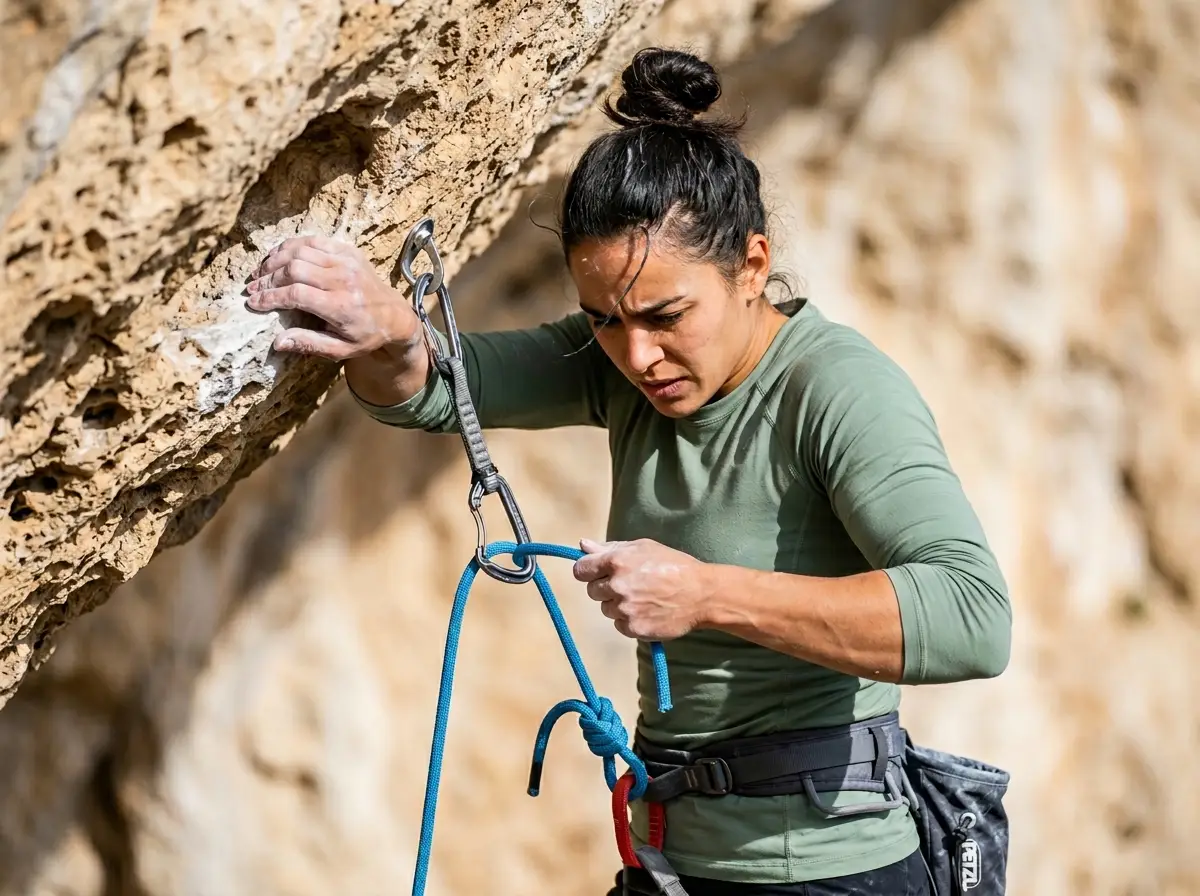
She’d just flashed the crux — a violent, four-move V5 sequence dispatched in under 30 seconds. Forty feet of “easy” headwall later, her forearms were screaming, her grip was gone, and she was falling. Same move. Same pump. The problem wasn’t her fingers. She was a boulderer in a sport climber’s body: optimized for instantaneous loading, completely unprepared for sustained capillary management.
That’s not a training problem. That’s a physics problem. And until you understand what separates these two disciplines mechanically, you’ll keep diagnosing the wrong one.
⚡ Quick Answer: Bouldering and sport climbing are not the same sport at different heights — they are fundamentally different physics problems. Bouldering is a discipline of maximal peak load: explosive power in 30–50 seconds, with a crash pad absorbing impact through foam compression. Sport climbing is a discipline of systemic energy management: a dynamic rope dissipates kinetic energy using fall factor math, and your forearms are limited by clinical ischemia, not lactic acid. Which system you’re operating in determines what you train, what gear you buy, and why you keep falling off the same sequence.
| Climbing Modality Comparison | ||
|---|---|---|
| Factor | Bouldering | Sport Climbing |
| Ascent Height | 3–5 m | 10–40 m |
| Fall Protection | Crash pad (foam compression) | Dynamic rope (axial elongation) |
| Primary Energy System | ATP-PC (≤30 sec burst) | Glycolytic + Oxidative (sustained) |
| Grading Scale | V-Scale / Font Scale | YDS / French |
| Core Physical Demand | Rate of Force Development | Limb Occlusion Management |
The Physics of the Fall — Two Completely Different Problems
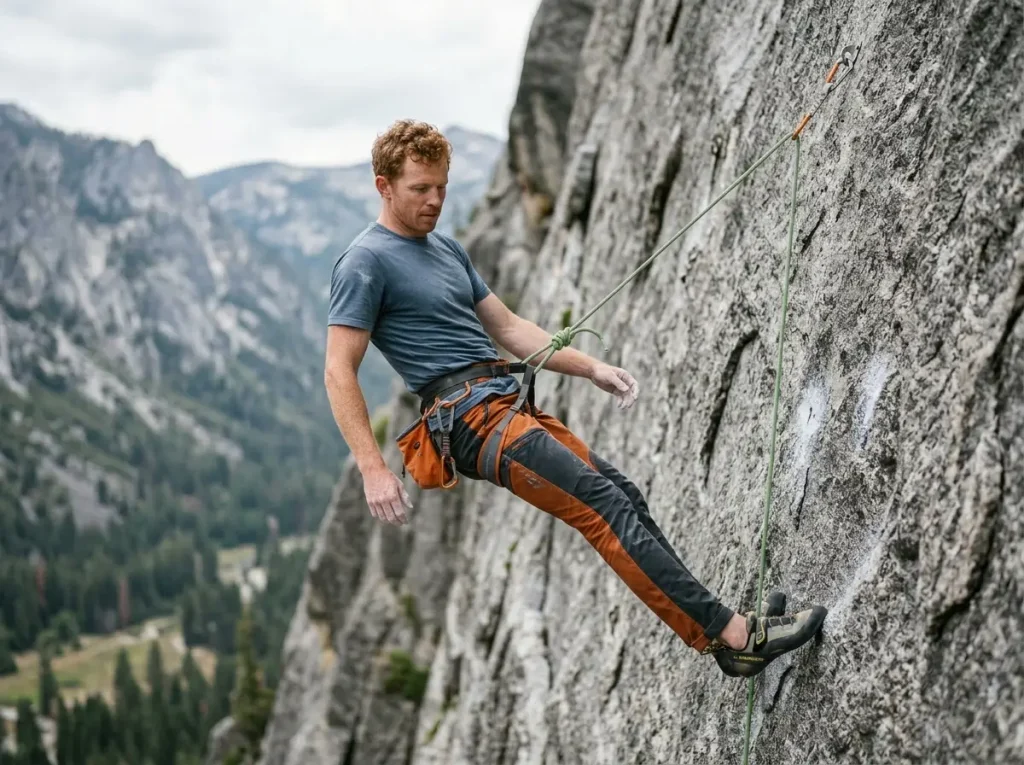
Most climbers think the difference between a bouldering fall and a lead fall is height. It isn’t. They’re different physics events in almost every measurable way.
In sport climbing, a fall is an axial tension event. The rope stretches along its length to absorb kinetic energy through hysteresis — nylon fibers reorganizing at a molecular level, converting kinetic energy to heat. That’s why a dynamic rope feels “soft” compared to getting caught by a static line. In bouldering, a fall is a planar compression event. Foam collapses across its horizontal surface, slowing you down over a few inches of viscoelastic material instead of meters of rope.
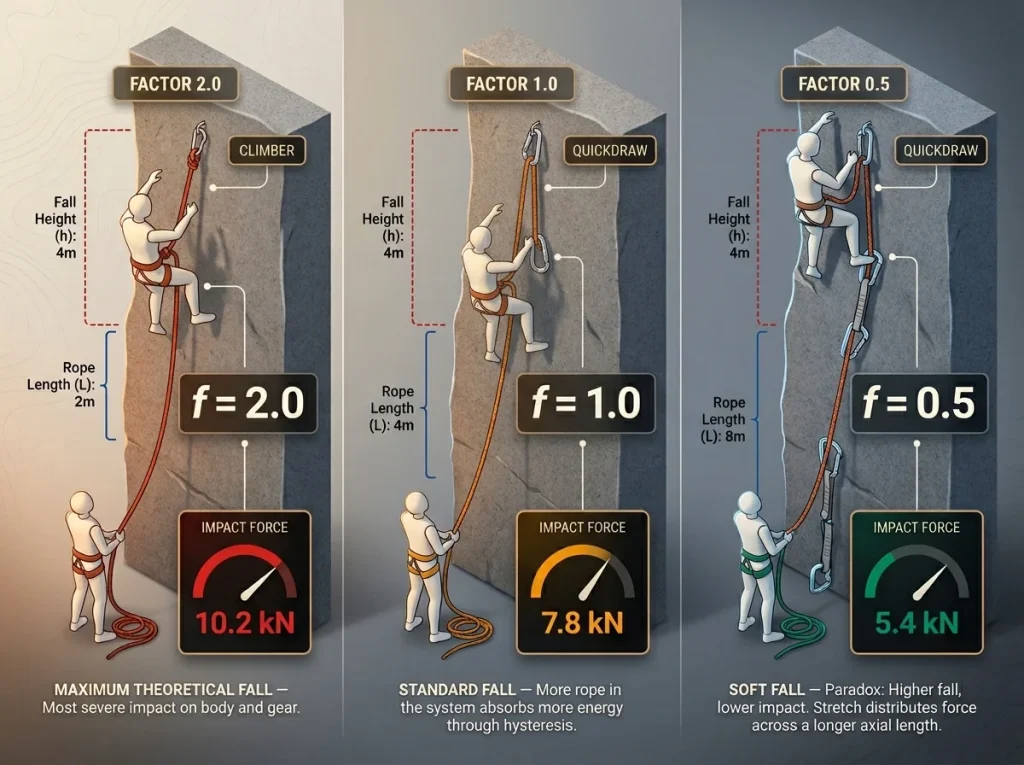
The governing concept for sport climbing is fall factor: f = h ÷ L. A 20-meter fall on 40 meters of rope (f = 0.5) is mechanically softer than a 4-meter fall on 2 meters of rope (f = 2.0). Counter-intuitive, but the math is unambiguous. According to the international UIAA safety standards for climbing gear, impact force is capped at 12 kN on the first test fall. A 165 lb climber in a factor 2.0 fall generates roughly 6 kN at the harness, and the anchor sees about 1.6× that due to the redirect pulley effect.
Sport Climbing Falls — The Fall Factor Formula Decoded
The maximum theoretical fall factor is 2.0, achievable only if you fall directly off the anchor with zero rope below you. UIAA single ropes must survive at least five falls at f = 1.77 with an 80 kg mass — that’s the redundancy threshold. Dynamic elongation cannot exceed 40%; static elongation must stay at or below 10%. These aren’t marketing specs. They’re the mechanical limits of what your body can survive.
The top piece of protection acts as a redirect pulley: anchor load equals roughly the climber’s impact force plus the belayer’s catch force, typically 1.6× the climber’s number. Anchor failure in that moment is catastrophic.
Pro tip: The closer you are to your last bolt, the higher your effective fall factor. The Danger Zone is real — it’s the first 15 feet of any lead route where rope stretch equals or exceeds your fall potential. Stick clip those first two bolts on any serious redpoint burn.
Bouldering Falls — The Foam Physics of Crash Pad Impact
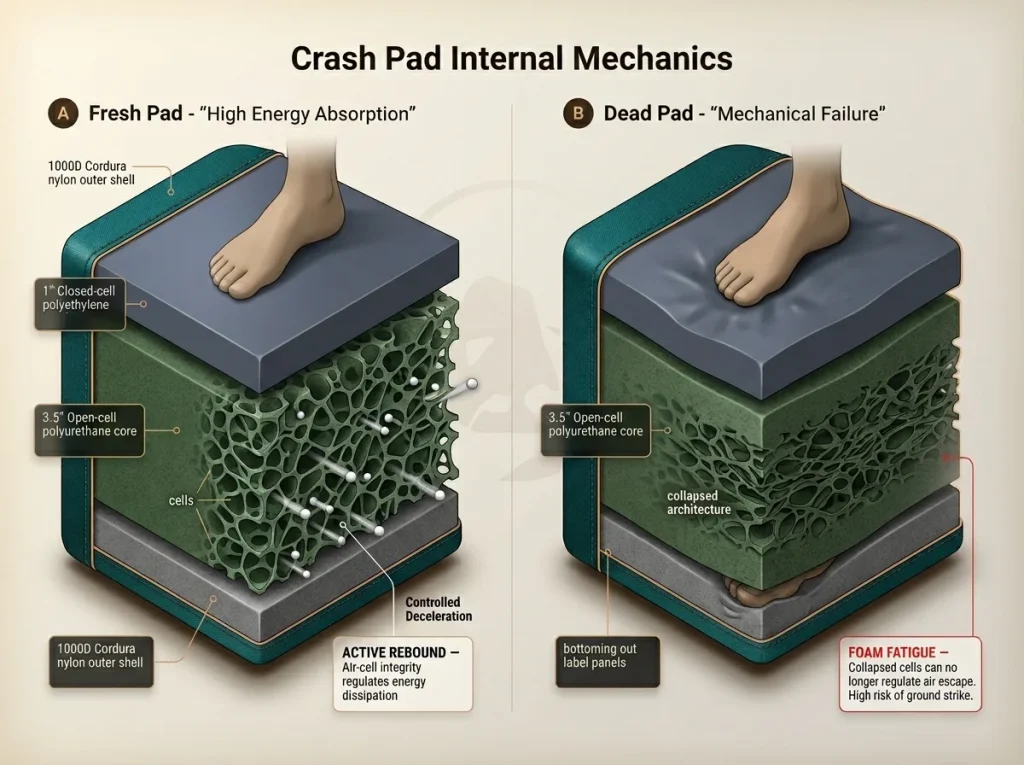
A crash pad is a two-layer engineering system. The top closed-cell polyethylene layer distributes point-load across the full pad surface — without it, you bottom out and hit the ground. The open-cell polyurethane core absorbs energy by forcing air through its interconnected cells. That resistance is your deceleration.
The HIC 400 standard (UIAA 161) defines the “Critical Fall Height” as the maximum height from which a fall keeps the Head Injury Criterion below 400. A pad that slaps when compressed, or has a delayed rebound, has lost its ability to regulate air escape. It will exceed HIC 400 on impact. You can’t feel this failure mode with your hand in the parking lot. Never buy a used crash pad — you are buying unknown foam fatigue with no way to assess compression set without calibrated equipment.
I’ve watched people squeeze a used pad in the parking lot and declare it “still good.” That test tells you nothing. The open-cell core fails gradually — it feels firmer, not mushier. By the time it feels wrong, it’s been wrong for two seasons. We stopped buying used pads after one of our crew took a foot-first fall that should have been clean.
The Ground Fall Paradox — Why Your Rope Won’t Always Save You
Falling when you’re 10 feet above the ground while clipped to 11 feet of rope gets you a ground hit. The rope stretches — up to 40% dynamic elongation — and that stretch consumes the buffer you thought you had. If your belayer is significantly lighter than you, they get pulled upward on the catch, stealing additional rope from the system. The Danger Zone just got taller.
It happens at the base of crags constantly. The fix: stick clip the first one or two bolts. Study the physiological differences between boulder and lead climbers all you want — none of it matters if your belayer goes into the first quickdraw on your warm-up whipper.
Understanding the fall physics of each discipline sets up everything that follows: the energy systems your body runs on are just as discipline-specific as the protection gear managing your falls.
The Physiology of Power vs. Endurance — Energy Systems Decoded
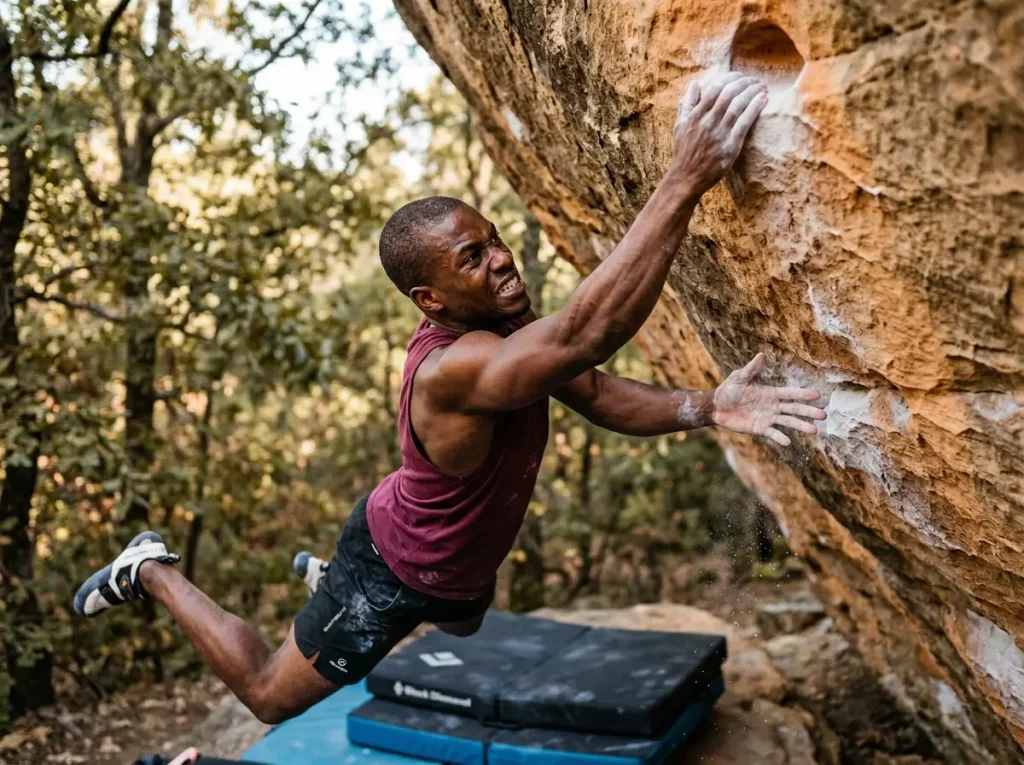
“Bouldering is strength, sport climbing is endurance.” That’s both true and useless. Here’s the version that actually changes how you train.
Bouldering runs on the ATP-PC system — adenosine triphosphate and phosphocreatine, fueling maximal effort for up to 30 seconds. The crux move may require latching a hold in under 200 milliseconds, which demands Rate of Force Development in Type IIx fast-twitch motor units. Research shows boulderers have 34–38% higher RFD than lead climbers and 29–45% greater absolute and relative strength. That’s not noise. It’s a different physical adaptation entirely.
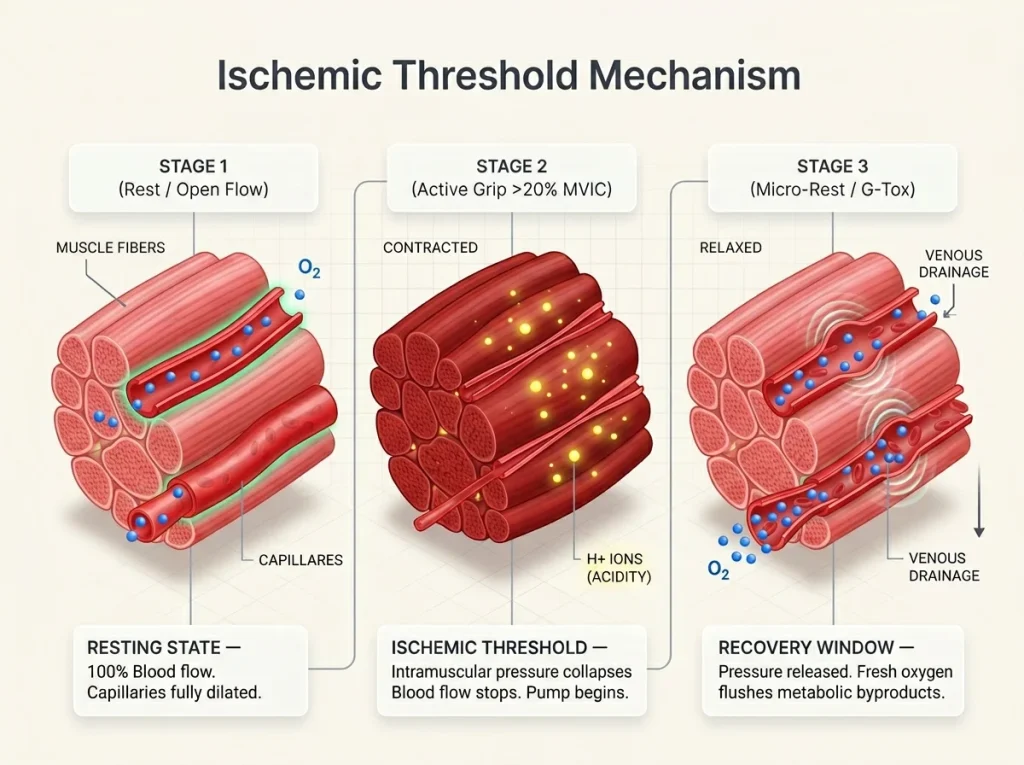
Sport climbing at sustained grades depends on glycolytic and oxidative systems — but the real limiting factor is the ischemic threshold mechanism. When your grip force exceeds roughly 20% of your Maximum Voluntary Isometric Contraction (MVIC), intramuscular pressure in your forearm flexors exceeds Limb Occlusion Pressure. The capillaries collapse. Blood flow stops. Metabolic byproducts — primarily H+ ions, not lactic acid — accumulate. That burning, mechanical failure in your hands is clinical ischemia. The science of the pump turns on this threshold, and most climbers have never heard it explained correctly.
The ATP-PC System — Why Bouldering Is a 30-Second Explosion
The ATP-PC pathway depletes in 10–12 seconds of absolute maximal effort. Phosphocreatine replenishment extends capacity to roughly 30 seconds total — which is why most boulder problems sit in that 30–50 second window. The contraction-to-relaxation ratio in bouldering is approximately 13:1, near-pure concentric effort. Elite boulderers rest 3–5 minutes between hard efforts because the system needs that long to fully reload.
Training RFD means working at 85–90% of max grip force with full recovery between sets. Anything below 80% trains endurance, not explosion. A moderate-intensity circuit doesn’t develop the fast-twitch synchronization that makes a hard boulder problem possible.
Pro tip: Deadhangs at 85–90% of max grip force with 3-minute rests build contact strength. Anything below 80% is building forearm endurance. Know which one your project actually requires before you design the training block.
The Ischemic Pump — Why Sport Climbing Destroys You From the Inside
The pump isn’t lactic acid. Stop training like it is. The 20% MVIC threshold is the clinical tipping point — below it, blood flows freely; above it, capillary collapse is nearly instantaneous. Every second you grip above that threshold accelerates toward forearm failure.
Shaking out works only if your forearm is at or below heart level — the G-Tox position. Hanging the arm straight down uses gravity to accelerate venous drainage. When you rest on a climb while still partially gripping or with your arm elevated, you’re not recovering — you’re slowing the accumulation. Elite sport climbers read rest positions as oxygen-recovery windows with the same precision they use on crux sequences. H+ ions and inorganic phosphate reduce cross-bridge cycling efficiency before you lose grip entirely. The grip feels okay; the force behind it is gone. That’s why you fall somewhere unexpected.
Training the Transition — Moving Between Disciplines Without Losing Your Base
A boulderer going to sport climbing loses RFD before gaining oxidative capacity. The first four to six weeks feel like regression, because they are. ARC training — Aerobic Restoration and Capillarization — must precede redpoint-level endurance work: low intensity, long duration, 8–12 weeks minimum before capillary density in the forearm flexors meaningfully improves.
The reverse transition is physically cleaner but neurologically demanding. Endurance capacity doesn’t impede explosive training, but motor unit recruitment patterns for maximal-effort moves take months to retrain after sustained low-intensity volume. The gear you use in each discipline is as physics-driven as the physiology — which is why both decisions start from the same place.
The Gear Systems — Where Physics Dictates the Rack
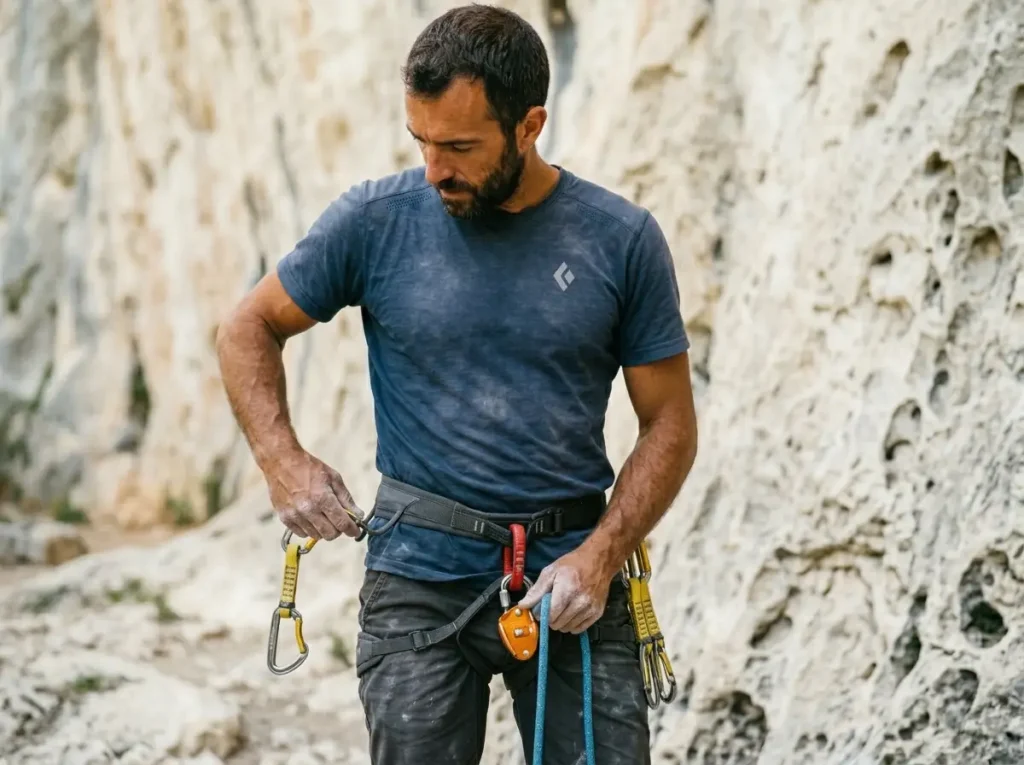
Gear is applied physics. Your crash pad manages planar compression. Your rope manages axial tension. Once you understand what each piece actually does, the purchasing decision is obvious.
In sport climbing, the rope is the primary safety system — not a leash. The hysteresis effect means nylon fibers convert kinetic energy to heat during elongation, but those fibers are partially stressed after a significant fall and need recovery time. A rope that survives one factor 2.0 fall but fails on the second fails on your redpoint burn after your warm-up whipper. That’s not theoretical. UIAA tests involve successive falls specifically to measure this. Rope diameter for sport redpointing sits in the 9.2mm–9.8mm range — the complete guide to climbing rope systems covers the trade-offs if you’re new to lead climbing.
Pro tip: A $90 harness with UIAA-rated bar tacks on the belay loop outperforms a $200 fashion harness with marginal stitching. The UIAA Safety Label means samples were tested by an accredited independent third party. Look for the label, not the logo.
Sport Climbing Gear — The Physics Stack from Shoe to Anchor
Rubber stiffness determines what terrain you can climb. A stiff, downturned shoe concentrates force on small edges. A softer, flatter shoe uses full-sole smearing on slabs. Most climbers buy aggressively downturned shoes because they look serious. Most sport climbing, especially in the early outdoor years, happens on terrain where a flatter shoe serves better.
The harness belay loop sees the redirect pulley load every fall — the highest-load component in your system, not the tie-in points. Check it for core splitting after significant sessions. The GriGri is not a passive device: over-tightening during a fall creates a hard catch, slamming the climber into the wall at full impact force. A soft catch requires the belayer to move INTO the fall, increasing rope pay-out and reducing effective fall factor. Technique, not instinct.
Bouldering Gear — The Crash Pad and Spotting System Decoded
Taco-style pads fold flat for better ground coverage. Hinge-style pads create a raised ridge at the center fold — a trip hazard when someone’s stumbling backward off a problem. Pad placement is physics, not preference: assess the fall vector before you step off the ground. The leading edge of the pad should cover where your center of mass lands on a fall, not the comfortable flat spot next to your bag. Study how to place crash pads using fall vectors before you rely on them on anything serious.
The “hard-on-soft” rule: softer pad on top of stiffer pad, always. A 4-inch gap between pads at falling velocity is a broken ankle. Use the Tetris method — overlapping edges, no gaps.
The Tetris method sounds obvious until you’re setting pads in the dark at 6am with cold fingers. Gaps appear because people rush. The climber who takes 90 extra seconds to close every edge gap is the one who walks away from an ugly sideways fall.
The Weight Disparity Problem — When Gear Has to Compensate for Physics
If you’re 80 kg and your belayer is 50 kg, a hard fall sends them upward. At speed. Into the first quickdraw. The Edelrid Ohm addresses this through Capstan friction: when pulled horizontal during a fall, the rope runs into a V-groove, exponentially increasing friction. Net effect: equivalent to adding 25 kg to your belayer’s effective mass. The DAV recommends a maximum 1:1.5 belayer-to-climber ratio without a friction-resistor device. A ground anchor costs nothing if a fixed point exists. Choose based on your setup, not habit.
Safety Protocols — What “Safe” Actually Means for Each Discipline
Safety in sport climbing is system redundancy. The chain runs: climber → harness → knot → rope → quickdraw → bolt → anchor → belay device → belayer. Every link carries a UIAA kN rating. Standard carabiners rate at 22 kN major axis, 7–8 kN minor axis. Loading the minor axis in a fall is a failure mode. It happens when gates are misoriented or draws are twisted.
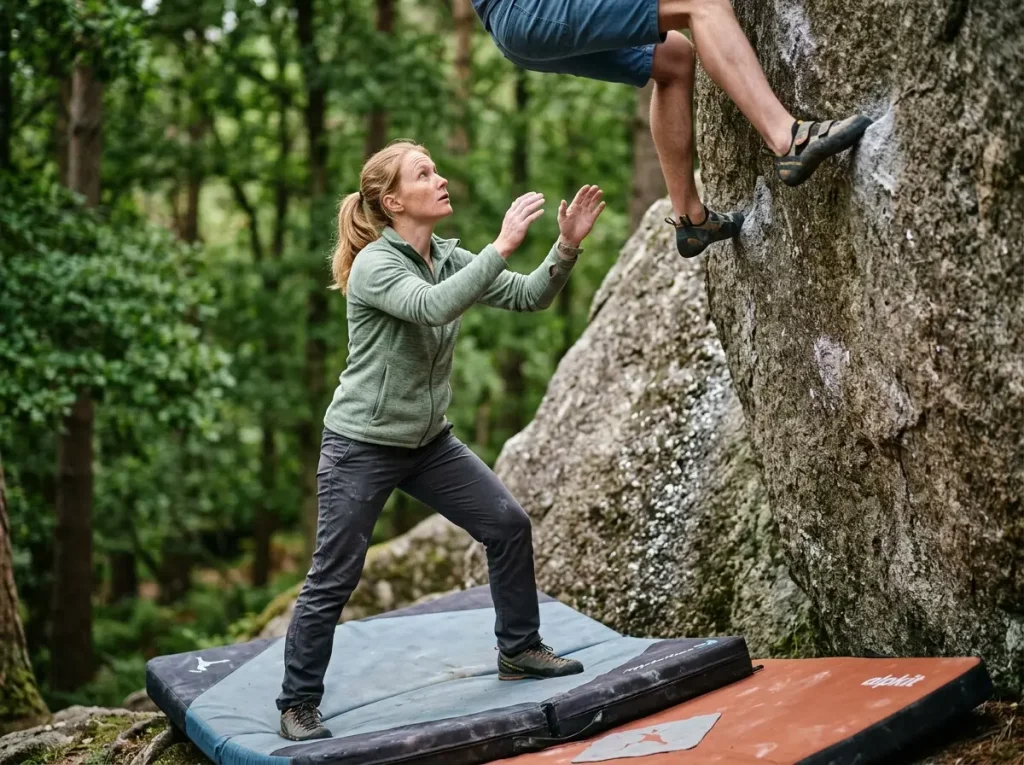
Safety in bouldering is impact geometry. Correct fall technique, accurate pad placement, a present spotter — that’s your entire protection chain. No redundancy. One broken link and the HIC 400 threshold gets exceeded. A static rope used for lead climbing transfers almost all kinetic energy directly to the body. That’s not a beginner warning. It’s physics.
Sport Climbing Safety — The System Chain and Where It Breaks
Treat the first 15 feet of any route as the Danger Zone. Stick clip. Keep the belayer close. Minimize slack. The math doesn’t care about your confidence. Harness inspection: check the belay loop, tie-in points, bar tacks, and load-bearing webbing. UV degradation is invisible. UIAA recommends a 10-year maximum lifespan from the manufacture date — not the purchase date. The figure-eight follow-through knot is the life-safety link. Check it before every climb. Both partners.
Bouldering Safety — Pad Placement, Spotting, and the Ethics of Highball
Highball bouldering beyond 5–6 meters moves outside the design envelope of most crash pads. At that height, how to fall safely in bouldering matters more than pad thickness. The T-Rex arms instinct — extending arms to brace — is how wrists break. Tuck and roll. Feet first, then shoulder.
The spotter’s job is not to catch the climber. It’s to redirect the hips onto the pad. Hands in “spoons” position — fingers together, thumbs tucked — up before the climber leaves the ground, eyes on hips, positioned in the probable fall zone. A spotter looking at their phone on a highball is a liability. Mark pad placement decisions with chalk so the next group knows where coverage ends.
Grading Systems — Translating Difficulty Across Disciplines
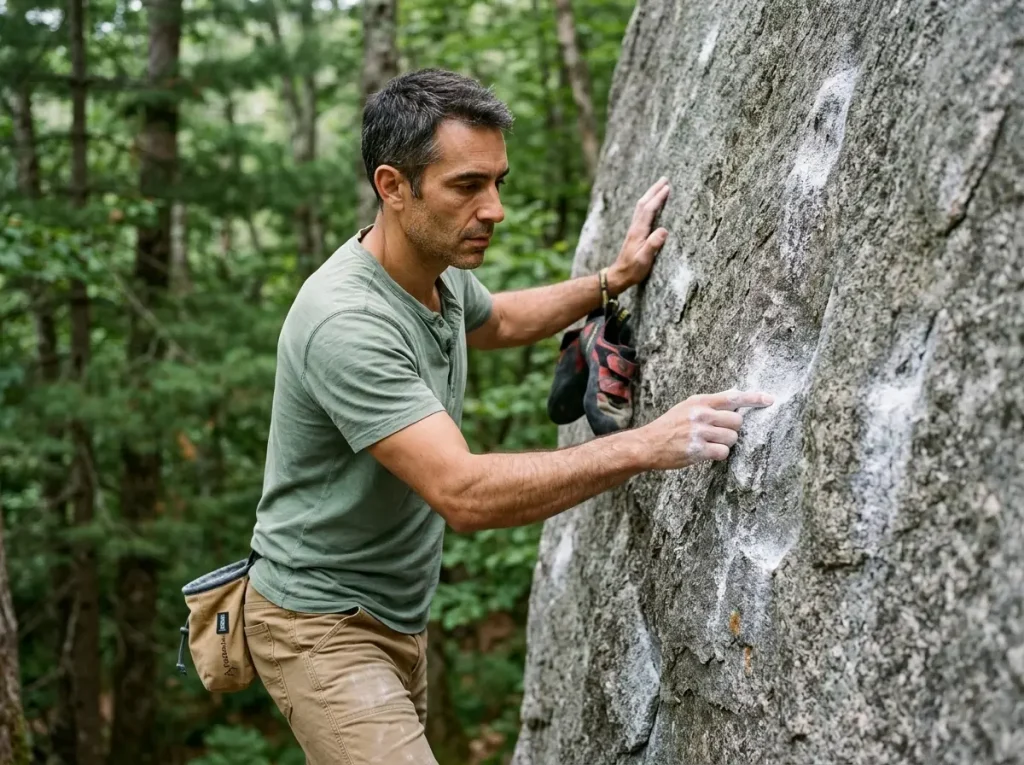
The V-Scale (Hueco Scale), created by John Sherman at Hueco Tanks, grades boulder problems V0–V17 based on the hardest single move. Grades are community consensus — no measuring instrument, no committee — formed over dozens of ascents. The bouldering V-Scale grades explained guide covers the full V-to-Font conversion if you climb in Europe.
The YDS runs 5.0–5.15d with a/b/c/d sub-grades above 5.10. Adam Ondra’s Silence (2017) holds the current consensus at 5.15d. The French system — 7a ≈ 5.11d/5.12a, 8a ≈ 5.13b — is the international standard outside the US. For a full translation guide, YDS vs French vs UIAA sport climbing grades goes deep on the nuances.
Grade conversion is approximate. A V5 boulderer is not automatically a 5.12 sport climber — the explosive demand maps roughly, but sustained ischemic tolerance does not. Grade inflation at new gyms is real; most serious climbers discount gym grades by 1–2 sub-grades when estimating outdoor performance. Sandbagging outdoors isn’t malice — it’s the aggregate of all the variables indoor setting controls and outdoor rock doesn’t.
Movement Physics — Technique That’s Different by Design
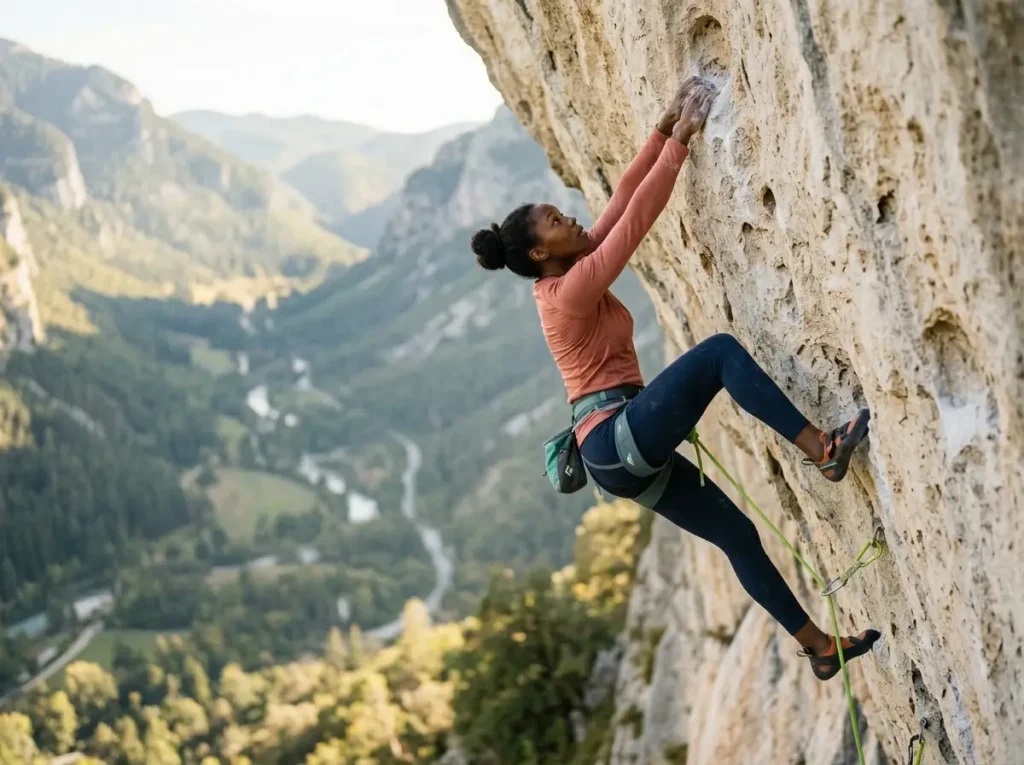
Climbing is a torque management problem. Contact points and a center of mass that creates rotational force relative to those contacts. Every movement is about controlling that rotation.
Barn-dooring happens when your center of mass drifts outside the vertical plane of your contact points. The rotational torque takes over. The fix is flagging — extending a leg to shift the CoM back into plane. Beginners barn-door off V2s. Elite climbers do it rarely, because the correction is automatic.
Economy of movement is the elite sport climber’s primary advantage. Keeping grip force below 20% MVIC stays below the limb occlusion threshold. Straight arms at rest holds, hip-to-wall contact on reaches, clipping from below — every one of these reduces grip demand. Breaking through a climbing performance plateau is almost always a movement economy problem before it’s a strength problem.
Bouldering Movement — Maximal Power, Minimal Time
Dynamic moves require landing at the deadpoint: the apex of the arc, the instant of zero velocity. At that moment, the minimum grip force is required to stabilize. Hit the hold on the way up or down, and you’re fighting momentum on top of gravity. Over-gripping on the approach to a dynamic throw wastes ATP before the critical contact moment — nearly universal in intermediate climbers.
Campus board training builds contact strength and coordination for dynamic moves, but overdone (more than two sessions per week) stresses the A2 pulley faster than tendon remodeling can keep up. The A2 pulley fails quietly: sore after climbing, then during, then it tears on a move you’ve done a hundred times.
Pro tip: Keep your arms straight on rest holds — skeletal structure, not bicep contraction. The moment you bend your elbow at a “rest,” you’re burning energy that belongs to the next hard sequence.
Sport Climbing Movement — Economy, Rest, and the Long Game
The clipping position is a diagnostic tool. If you clipped with a bent elbow in an unstable stance, you wasted grip force before the crux. The correct clip pulls slack from below — not up — from a stance stable enough that grip demand is near zero. Mark it on the first burn. Fix the clip before you try to fix the crux.
True rest positions — no-hands rests, knee bars, stem rests — can extend climbing capacity by several minutes, but they require identification on the first or second attempt, not the redpoint. Read the route with the same precision you’d use to read a boulder problem’s beta complexity. Exhale on the hard moves. Breath-holding increases blood pressure and accelerates pump onset.
Conclusion
Three things that change how you climb if you actually internalize them:
Bouldering is an instantaneous loading problem. Your body generates peak force in under 200 milliseconds. Your protection manages planar compression through a foam composite with a testable HIC 400 threshold. Train RFD, not volume.
Sport climbing is a fluid dynamics problem. Your rope is a viscoelastic shock absorber governed by fall factor math. Your pump is clinical ischemia, not lactic acid. Train below the limb occlusion threshold, not general cardio.
Gear is applied physics, not brand loyalty. A UIAA-rated belay loop on a $90 harness beats an unrated loop on a $200 piece. A fresh crash pad is the difference between HIC 400 and a serious head injury. Know what your gear is doing.
Take your next warm-up session with one question: am I recovering below the ischemic threshold at every rest, or just creating the illusion of rest? If you’re gripping during your shake-out, you’re not recovering — you’re wasting time.
FAQ
Is bouldering harder than sport climbing?
They’re harder in different physiological ways. Bouldering demands peak explosive force — Rate of Force Development — on a 30–50 second horizon. Sport climbing demands sustained capillary management under load for several minutes. A V10 boulderer isn’t automatically a 5.13 sport climber because the energy systems, movement patterns, and gravity management strategies are fundamentally different.
Can I sport climb without bouldering experience?
Yes, but bouldering builds contact strength, movement vocabulary, and fall awareness that accelerates progression significantly. The gym or crag transition gap that catches most climbers is the inability to read rest positions — a skill that bouldering, where you’re always near the ground, never specifically trains.
Which is safer — bouldering or sport climbing?
Both are hazardous if done wrong; the physics just differ. Sport climbing has system redundancy — rope, quickdraws, anchor, belay device — but fall factors near the Danger Zone generate 6+ kN at the harness. Bouldering has no redundancy: one misread fall vector or degraded crash pad, and HIC 400 is exceeded. Neither is categorically safer. Both require genuine competency in their respective physics.
What gear do I need to start sport climbing?
Non-negotiables for gear for sport climbing: a UIAA-rated harness (inspect the belay loop), a dynamic single rope in the 9.2mm–9.9mm range, a certified assisted braking device or tube belay device, UIAA-rated quickdraws, and climbing shoes for your current grade. Never use a static rope. Never skip harness inspection on used equipment.
How do bouldering grades translate to sport climbing grades?
The grading system translation is approximate, not a formula. Community consensus: V4–V5 ≈ 5.11c or d, V6–V7 ≈ 5.12b or c, V8–V9 ≈ 5.13a or b. Outdoor grades often feel harder than gym grades by 1–2 sub-grades due to hold wear, body-type specificity, and the absence of manufactured rest holds on real rock. Treat any V-Scale to YDS conversion as a starting point, not a prediction.
Safety Notice: Rock climbing and mountaineering are inherently high-risk
activities that can involve physical trauma or fatal incidents. The information on Rock Climbing Realms is for
educational and informational purposes only. Techniques and advice presented here are not a substitute
for professional, hands-on instruction. Conditions and risks vary by location. Always seek guidance
from a qualified instructor before attempting new techniques. By using this website, you agree that you
are solely responsible for your own safety. Any reliance you place on this information is strictly
at your own risk, and you assume all liability for your actions. Rock Climbing Realms and its authors
will not be held liable for any harm, damage, or loss sustained in connection with the use of this information.
Affiliate Disclosure: We are a participant in the Amazon Services LLC Associates Program, an
affiliate advertising program designed to provide a means for us to earn advertising fees by advertising and linking
to Amazon.com. As an Amazon Associate, we earn from qualifying purchases. We are also an official affiliate partner
of Black Diamond Equipment via the AvantLink network. If you click on a Black Diamond affiliate link and make a
purchase, we may earn a commission at no additional cost to you. We also participate in other affiliate programs.
Additional terms are found in the terms of service.