
In this article
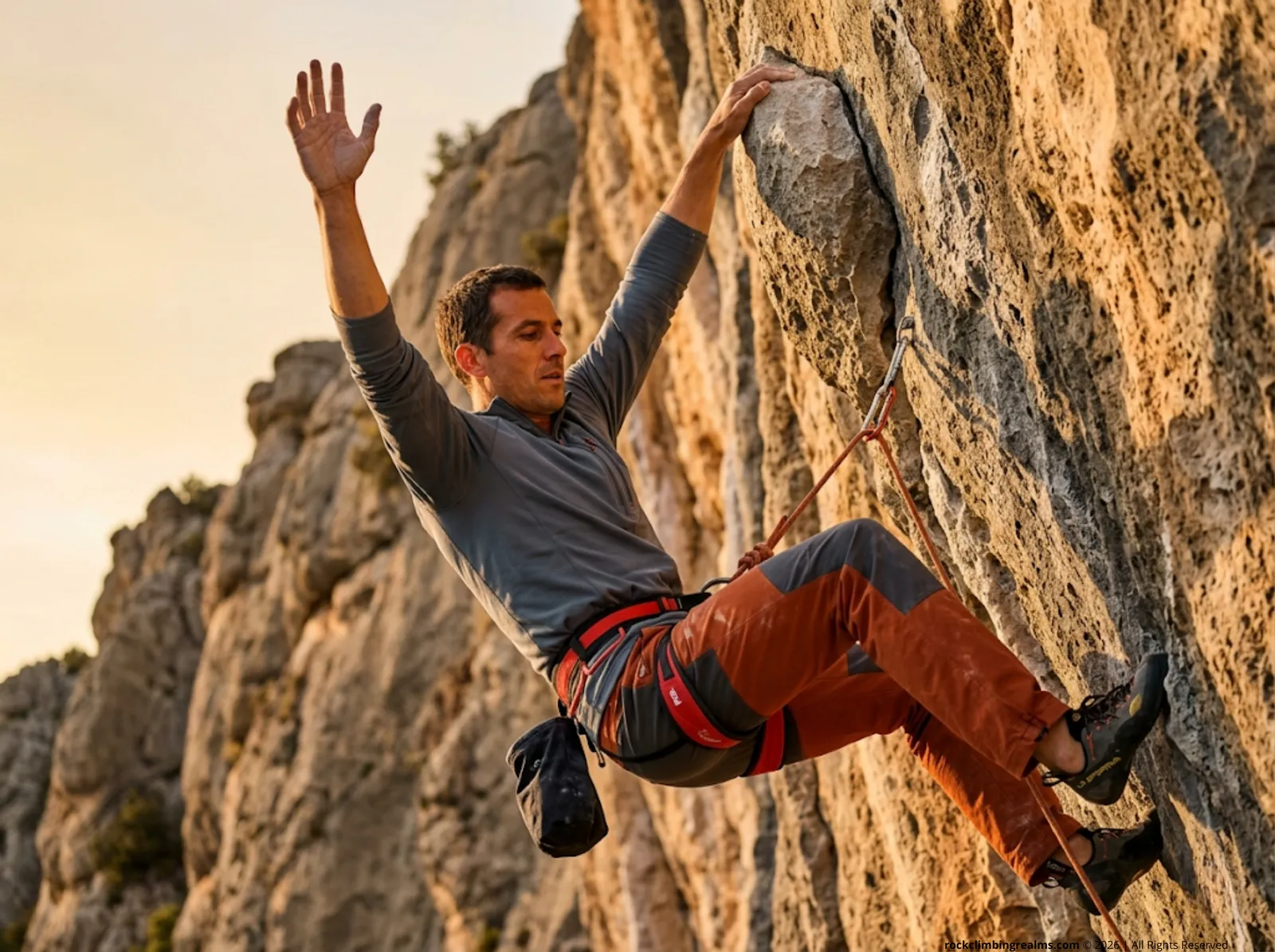
You’re six bolts up. The crux is behind you. Your forearms are already swelling and you can feel the grip slipping out of your hands like wet rope. The anchor is 20 feet above your last clip, and the pump clock has been running since the third bolt. You’ve been here before — shaking out, trying to breathe, watching your fingers curl into useless claws. The chalk stays on. The arms stay pumped. The fall comes anyway.
After years of getting sandbagged by that exact scenario, I figured out what most climbing advice skips entirely: the shakeout is not the strategy. It is the last resort. Resting on a climb is a mechanical and physiological skill, and like any skill, it has a hierarchy. Here is the full blueprint.
⚡ Quick Answer: To rest effectively on a climb, you need to drop your grip intensity below 20% of your Maximum Voluntary Contraction (MVC) — the threshold where blood flow to the forearm reopens. Do this by combining the G-Tox technique (alternating the arm between a down-hang and above-head position every 5–10 seconds), full arm extension to offload muscles onto the skeleton, and stable two-foot triangulation to minimize torque on your hands. Passive hanging restores less than 2% of grip strength in two minutes. A proper G-Tox recovers ~18.4%. The difference is not subtle.
The Pump Is Not a Mystery: The Physiology of Forearm Failure
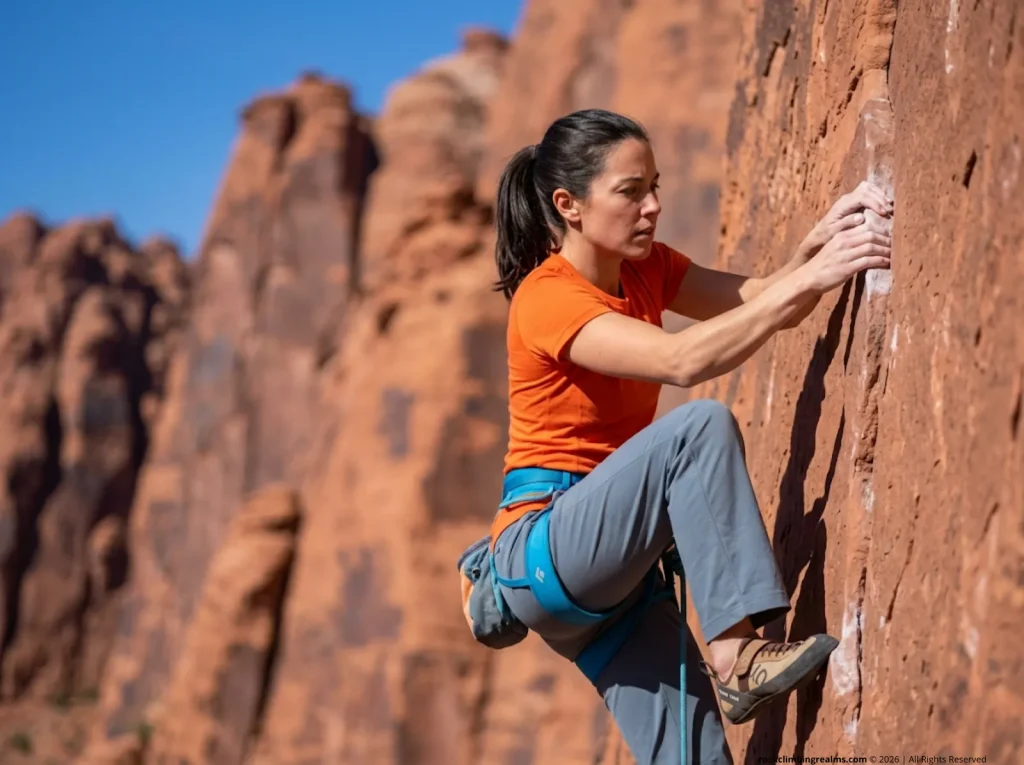
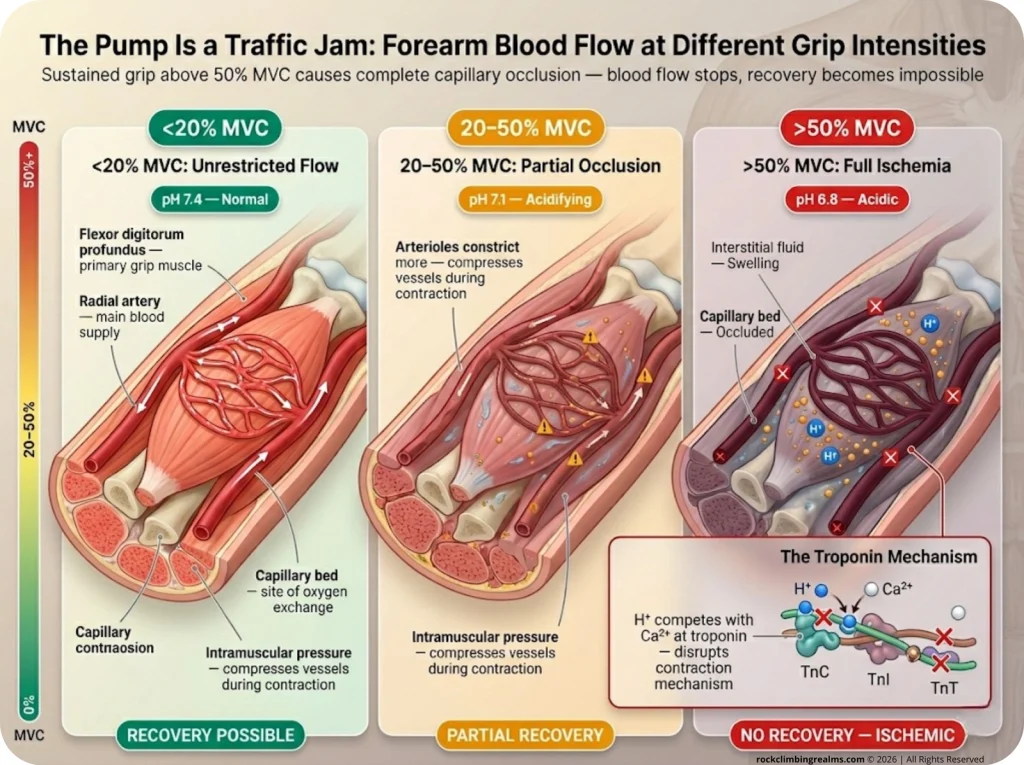
Most climbers feel the pump and grip harder. That is the exact opposite of what works. The pump is not a wall — it is a traffic jam inside your forearm, and understanding the mechanism tells you exactly how to clear it.
Your primary grip muscles — the flexor digitorum profundus and flexor digitorum superficialis — operate in prolonged isometric contractions during climbing, unlike the rhythmic movement of running or cycling. When you grip, intramuscular pressure rises. At just 20% of your Maximum Voluntary Contraction (MVC), local blood flow starts to get pinched off. Above 50% MVC, capillary bed occlusion is essentially complete.
Once blood flow shuts down, the muscle switches to anaerobic glycolysis. Lactic acid clearance stops. Hydrogen ions accumulate and disrupt the calcium-binding process in the muscle — mechanically poisoning the contraction mechanism. After a hard bout, forearm circumference can increase ~1.78% from interstitial fluid accumulation, which raises pressure further and makes the same rest position progressively less effective as the route goes on. This is why “resting twice as long at a junky hold” rarely works late on a route. You have to offload early.
Here is the part that separates trained climbers from everyone else: elite climbers deoxygenate more aggressively on hard moves, but they re-oxygenate significantly faster during rests. That is capillary density at work — a structural adaptation from ARC training that provides more pathways for oxygen to reach muscle tissue. Even the 0.5–1 second of reduced tension between moves allows micro-reperfusion in climbers who have built that base. You can read about the full science of the pump and how to train your forearms aerobically if you want to understand the long game.
Pro tip: Time your hardest moves to stay under 8 seconds of continuous grip. That keeps you in the alactic ATP-PCr window — roughly 10 seconds of peak power before the energy system shifts and the pump clock accelerates hard.
At 100% MVC — a deadpoint, a crux lock-off — you are running entirely on phosphocreatine. You have about 10 seconds. Resting after a crux is about refilling that system, not just catching your breath.
The Shakeout Is Not Enough: The Science of G-Tox and Hemodynamic Recovery
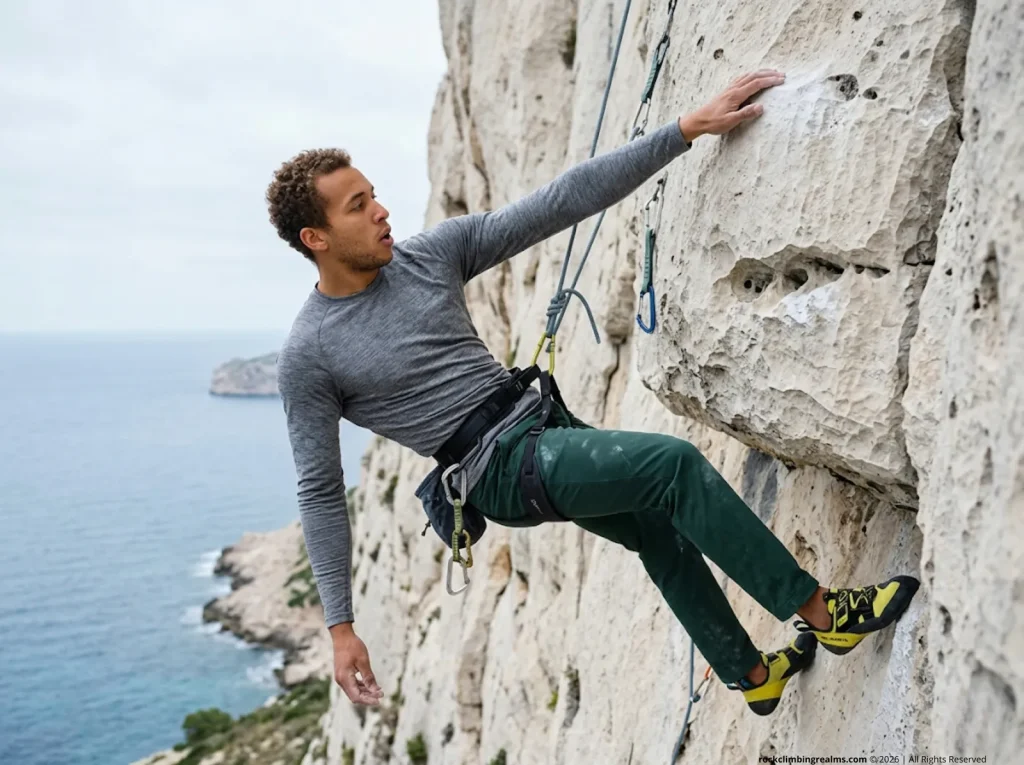
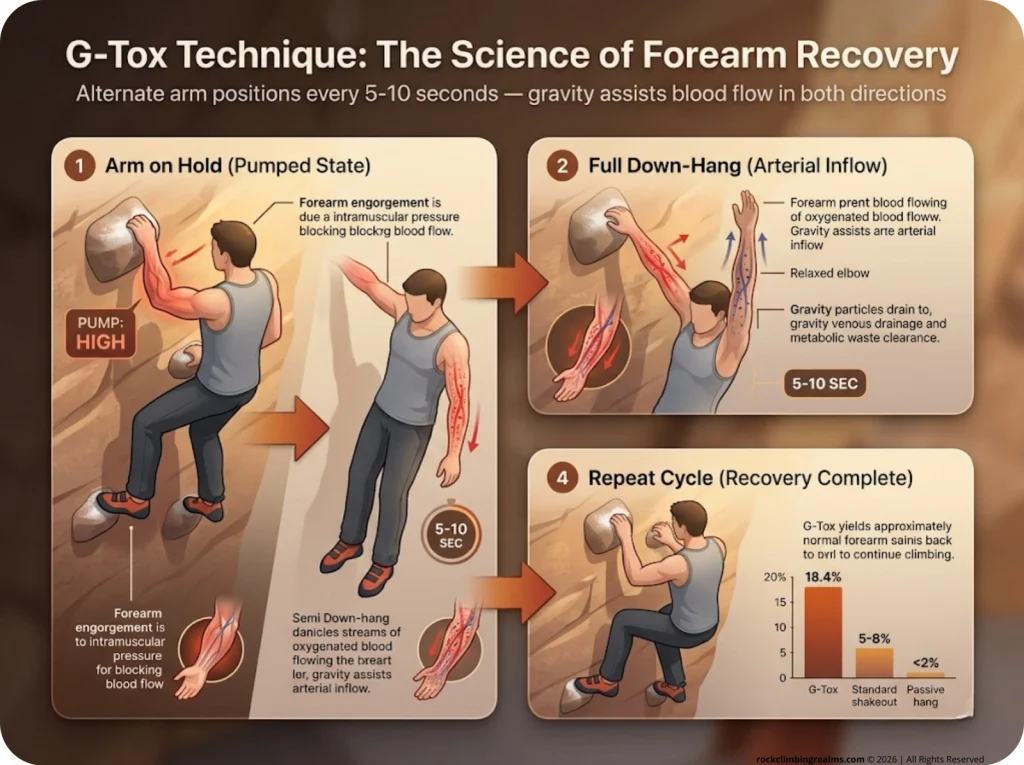
Standard shakeout restores about 5–8% of grip strength in two minutes. Passive hanging gets you under 2%. Most climbers treat the shakeout as the whole strategy and wonder why they keep falling off the same moves.
The problem is hydrostatic pressure. When you dangle your arm, the deoxygenated blood from your forearm has to fight gravity-assisted venous pressure to return to the heart. You feel it immediately — that initial moment where the pump actually intensifies when you first shake out. That is not normal; it is physics. The forearm is engorged and the traffic jam is stalled.
The G-Tox technique, developed by Eric Hörst, solves this. You alternate the arm between a below-waist hang and a raised-above-head position every 5–10 seconds. The downward phase drives oxygenated arterial blood into the muscle. The upward phase uses gravity to drain deoxygenated blood and lactate toward the heart. Research data shows G-Tox achieves approximately 18.4% grip strength restoration in two minutes — three to four times better than passive hanging. That gap matters on a project. It is the difference between your fingers “coming back online” and just hanging there waiting to fall.
Warming up aerobically before the route to delay the onset of the flash pump is the other half of this equation. The better your aerobic base, the faster G-Tox works mid-route.
Pro tip: Combine G-Tox with diaphragmatic breathing — 4-count inhale, 6-count exhale. This triggers parasympathetic vasodilation and amplifies blood flow recovery. Do not hold your breath. Climbers who hold their breath through cruxes accumulate CO2 that extends the time needed to recover at the next rest.
Do not grip the jug harder than necessary just because it feels secure. Conscious grip reduction on good holds is a learnable skill. On marginal terrain where a jug is not available, alternate between a light open-hand contact and releasing completely for 2–3 seconds. It is not as effective as a proper G-Tox, but it will slow the pump clock when your options are limited.
Biomechanical Load Paths: Why Body Position Is the Real Rest Strategy
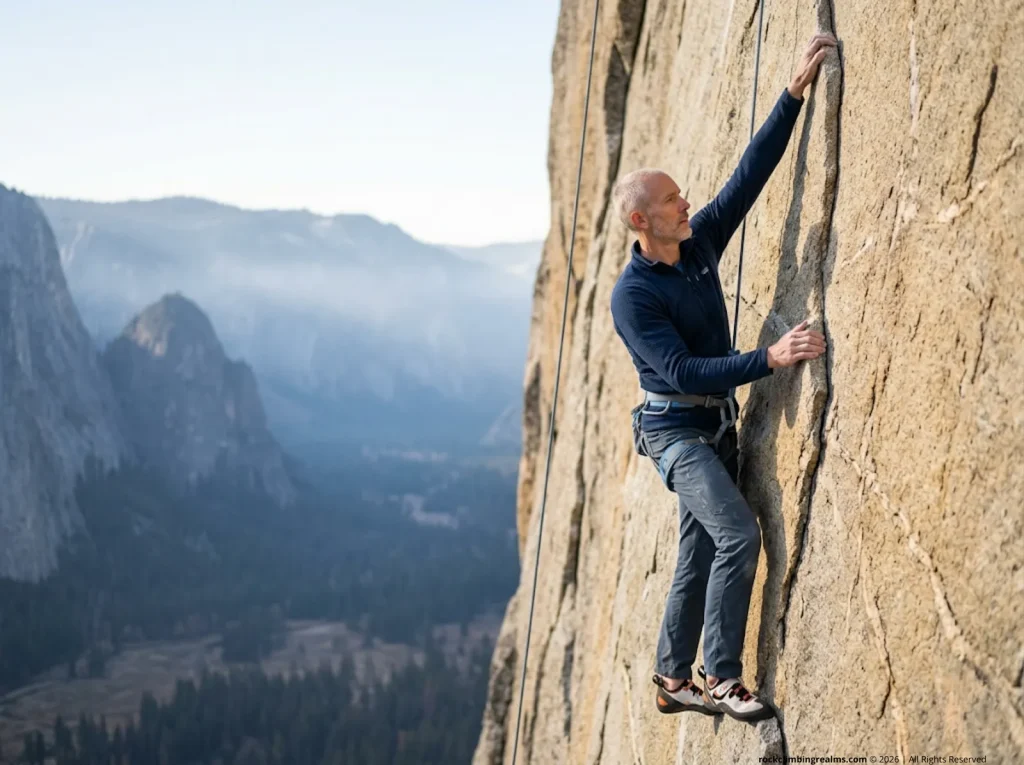
Here is where most intermediate climbers lose the most ground. They find a jug, they start shaking out, and they do not think about their feet. The shakeout fails. They fall. They blame fitness.
The actual problem is torque. The amount of force your fingers must generate to stay on a hold is directly proportional to the horizontal distance between your feet (the pivot point) and your center of gravity. Move your hips two feet away from the wall and that torque multiplies. Move them in, drop your weight over your feet, and your fingers can relax below the ischemic threshold even on a mediocre hold.
A rest position is formally defined as any body configuration that drops finger force below 20% MVC, allowing re-perfusion. It is not “somewhere you feel less scared.” The physical placement of your hips, the angle of your knees, the position of your feet — these are the actual variables determining whether a rest works.
I had a route where I was pumping out at the same jug on every attempt. My coach watched for about 10 seconds and spotted it: straight arms, hips two feet from the wall. I moved my hip in, bent my knee to bring my weight over my foot, and felt the grip load drop. Sent it next burn.
This is why “sag your hips toward the wall” is not a posture cue. It is a mechanical directive to reduce the lever arm and cut the torque on your hands. Maximizing normal force through precise foot weighting on smears and edges is the other half — your feet determine how much weight you can take off your hands.
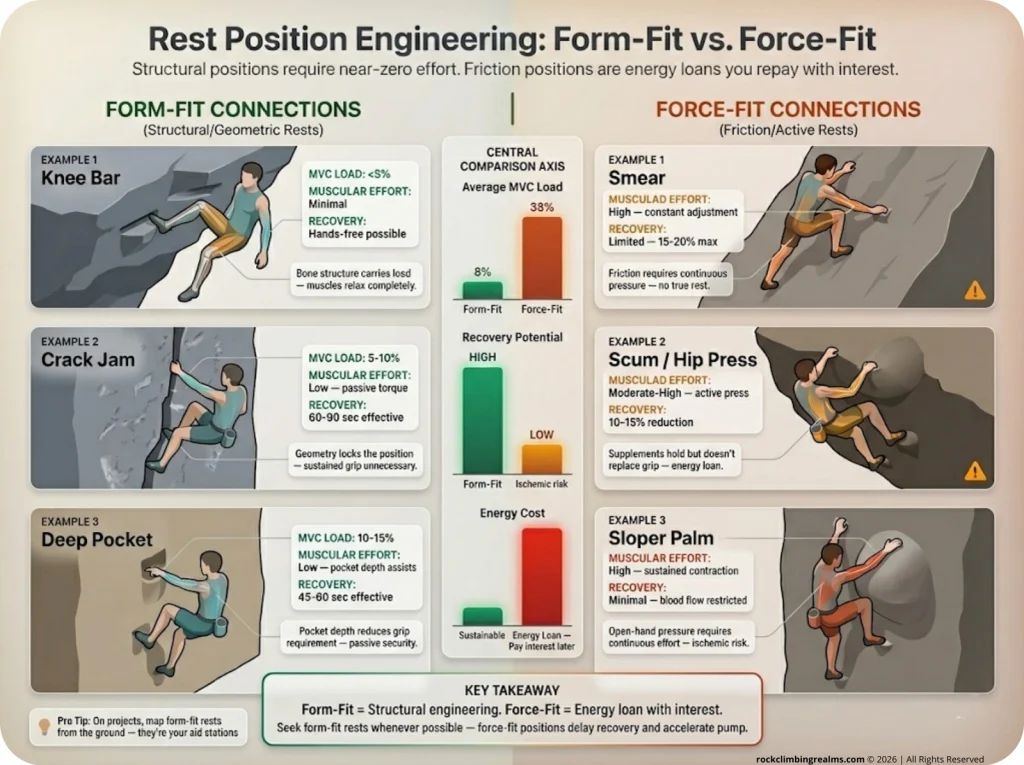
Form-fit connections — crack jams, deep pockets, knee bars — require near-zero muscular effort because the geometry of the contact does the work. Force-fit connections — slopers, smears, scumming — require continuous muscle activation to maintain normal force. Force-fit positions are energy loans. You will pay them back.
Straight arms are a medical directive, not a posture cue. Fully extended elbows transfer the load from the forearm flexors to the skeletal structure — the radius and ulna — and let the muscle relax while maintaining contact. Even a 15–20 degree elbow bend re-engages the brachioradialis meaningfully. Full elbow extension is non-negotiable for proper skeletal loading.
On every jug rest, identify two independent foot placements before you unweight the tired hand. One good foot is rarely enough. Triangulation — two stable foot contacts plus a partially offloaded hand — is the minimum stability requirement to prevent barn-dooring, which burns energy through constant micro-corrections and keeps your pump clock running. According to psychophysiological differences between advanced and novice climbers in fatigue management, elite climbers consistently position themselves to minimize time at high MVC levels — it is not accidental.
Advanced Rest Techniques: Knee Bars, Stemming, and the Physics of Scumming
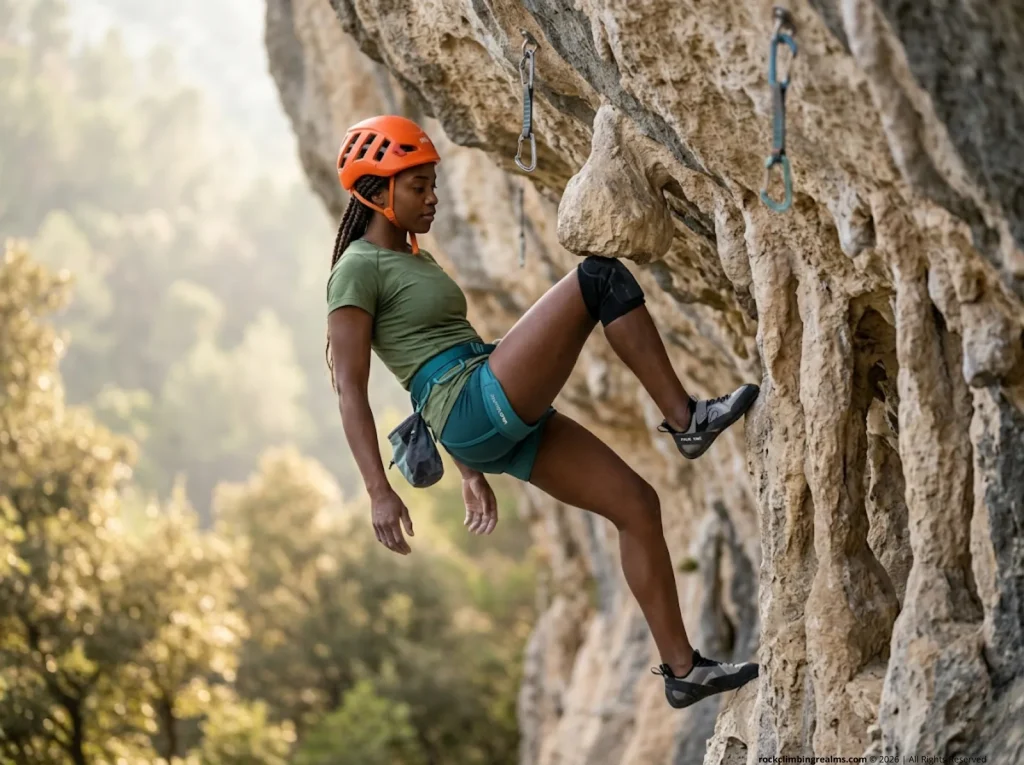
I spent two seasons avoiding knee bars because I thought they were cheating. What I was actually avoiding was the technique that let me send a dozen routes above my apparent fitness ceiling. A knee bar is not a shortcut. It is a structural engineering solution.
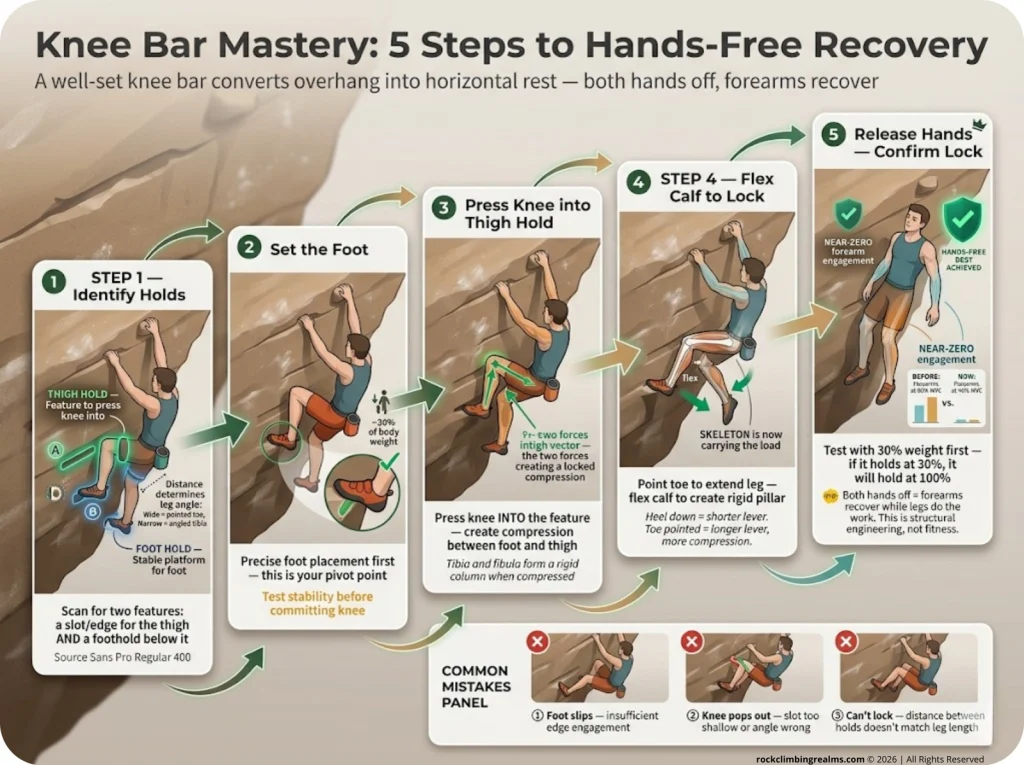
A well-executed knee bar on overhang creates a rigid structural pillar from the tibia and fibula, wedged between a foot hold and a thigh hold. Flex the calf, point the toe, and that leg becomes a column supporting your body weight independently of your hands. A well-set bar converts an overhang into something that functions like a horizontal rest. Both hands come off. Your forearms recover.
The distance between the two contact points is critical. Too wide, and you must point the toe to extend the leg enough to create the wedge. Too narrow, and you need to angle the tibia sideways to shorten the effective length. Test the bar with roughly 30% of your body weight before committing fully. A bar that holds at 30% will almost always hold at 100%. One that shifts or releases at 30% will definitely fail at full weight — usually at the worst moment.
Pointing the toe increases effective leg length. Pressing the heel down decreases it. Mastering that micro-adjustment separates a “bar attempt” from a genuine rest. Read how heel hooks and toe hooks alter the force vector on overhanging terrain to understand why this works mechanically.
On knee pads: thick, bulky pads buffer the proprioceptive feedback from bone-to-rock contact. Over-reliance on heavy padding reduces your ability to feel and set delicate bars that rely on exact bone positioning for stability. Use pads, but develop the feel without them too.
Stemming in dihedral sections uses the quads and glutes to generate opposing friction forces on two walls simultaneously, sparing the forearms entirely. In a corner, even a marginal stem with one foot and one palm can offload 40–60% of load from the free hand — turning a mediocre hold into a real recovery position. Square your chest to the corner and drop your butt. High stems fail not because of friction but because the torso is not square.
Pro tip: On every jug rest, consciously identify two independent foot placements before unweighting the tired hand. On overhanging terrain, a heel hook creates a fourth contact point and can drop the torque vector dramatically — treat it as a rest component, not just a movement tool.
Scumming — using the knee, hip, or shoulder pressed against the rock during a sequence — does not give you a hands-free rest. But it can reduce finger load by 10–15%, which may be the margin between full ischemia and intermittent reperfusion. The stickiness of your clothing against the rock matters enormously here. Clothing against rough sandstone grabs well and can carry real load. Smooth rock against synthetic fabric slides and carries almost nothing. The most effective scums happen perpendicular to the wall, maximizing the force pressing into the rock. Angled scums generate almost no friction. According to biomechanical classification of form-fit vs. force-fit connections in sport climbing, scumming is best understood as micro-resting within a sequence rather than a primary rest strategy.
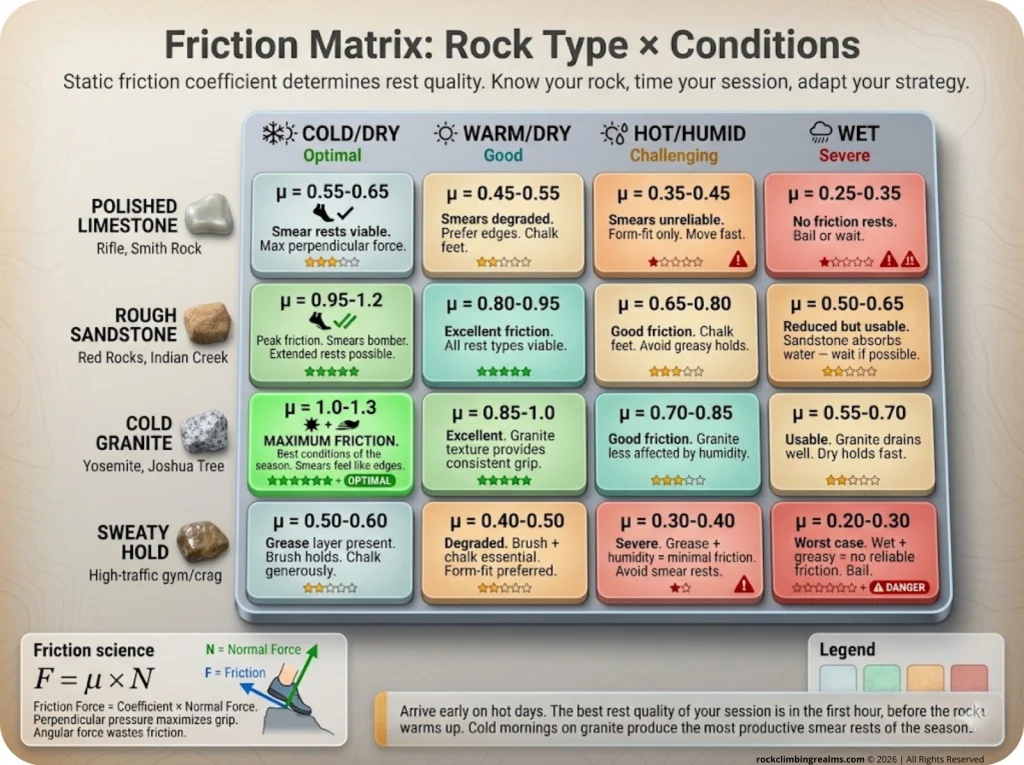
Friction Science at the Rest: How Surface Conditions Change Everything
The first time I climbed at Rifle in August heat, every smear rest I had trained for was useless. Polished limestone, 85°F, sweaty hands. The friction dropped through the floor. The only rests that held were form-fit. That day taught me more about friction and resting than a full season of gym climbing.
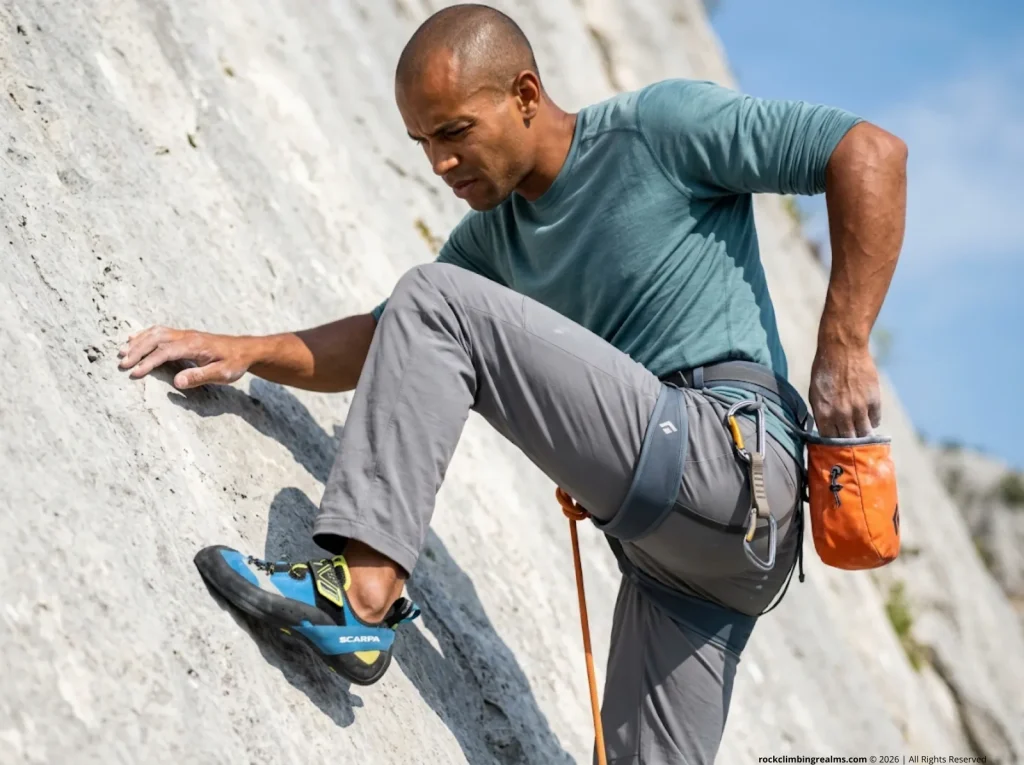
Static friction is what holds you at rest. Once a foot starts sliding, dynamic friction takes over — and dynamic friction is significantly lower than static. Recovery from a slipping smear is nearly impossible. The trick is to commit to maximum perpendicular force from first contact. Climbers who “test” a smear by letting it slip slightly have already wrecked the hold’s effectiveness.
Shoe rubber is viscoelastic — it deforms to fill micro-texture irregularities in the rock, increasing real contact area and friction. Cold rubber stiffens and loses this advantage. That is why cold autumn mornings on granite produce the most productive smear rests of the season. Arrive at the crag early on hot days. The best rest quality of the session is in the first hour, before the rock warms up.
For reference on what you are working with: polished limestone gives you a friction coefficient in the 0.4–0.6 range, requiring perfect perpendicular foot weighting and dry conditions. Sweaty limestone drops below 0.3 — chalk the feet, move quickly, do not rely on smear rests. Rough sandstone sits in the 0.8–1.2 range, and cold dry rock can push past 1.0. The physics of friction and slipping forces in sport climbing applications at KSU covers the full Coulomb model underlying all of this.
Chalk management at rests is a skill, not a habit. Excess chalk on holds fills in the micro-texture that rubber needs to bite and actually reduces friction. Brushing holds before committing to a rest can restore grip significantly. An often-ignored move: chalk the soles of your climbing shoes at a ledge rest. It dramatically improves footwork quality — and therefore rest efficiency — through the next section of the route.
How chalk and rock type interact to change your friction coefficient breaks down this interaction in detail if you want to get specific.
Tactical and Psychological Mastery: Reading Rests Before You Leave the Ground
Adam Ondra has been filmed spending 20 minutes on the ground studying a route before an onsight attempt. He is not memorizing sequences. He is mapping the rest positions like a field medic identifying aid stations before an operation. Recovery opportunism beats memorized choreography when fatigue sets in.
The chalk language on a route is a map. Chalk concentration marks crux sections and popular holds. Isolated chalk on features shows where prior ascensionists rested. Empty features with no chalk marks are not necessarily worthless — they are underused candidates worth testing. When you are projecting a route, deliberately try multiple body positions at each candidate rest. A 10-degree hip rotation can unlock 40% load reduction that a single attempt would never reveal.
Cognitive load during a climb directly degrades grip efficiency. A climber searching for a rest while pumped grips 15–20% harder than necessary, accelerating the ischemic threshold. Route reading solves this. Reading routes for onsight attempts using chalk trails and hold orientation is the methodology in detail.
Breathing is the other lever. Deep, rhythmic diaphragmatic breathing at a rest signals the nervous system to shift from sympathetic activation — the fight-or-flight state that constricts blood vessels and makes your rest 30% less effective — to parasympathetic recovery. The 4-6-8 protocol: 4-count inhale, 6-count hold, 8-count exhale. The pre-rest breath matters as much as anything you do after arriving at the hold. Elite climbers deliberately slow their breathing before reaching the rest position, not after.
On steep terrain, moving quickly between holds minimizes time under tension — which keeps you out of the ischemic zone. At a rest, the strategy reverses entirely: maximize duration until forearm sensation, heart rate, and perceived effort return to a workable baseline before launching the next sequence. Research on effects of active recovery on lactate concentration and heart rate in climbing confirms that active recovery — easy movement maintaining elevated heart rate — clears lactate faster than passive standing.
Between redpoint attempts, do not sit down and do nothing. Ten minutes of easy movement at 60% max heart rate beats lying flat every time. Structuring rest intervals between redpoint burns for peak performance lays out the full between-attempt protocol. The active recovery research shows that easy climbing as an on-wall recovery method produces the fastest lactate reduction and the best performance in subsequent attempts.
Pro tip: When hangdogging a project, time your rests deliberately. Most climbers underestimate rest duration by 40–50% on redpoint attempts. Build the habit of timing in training so that “long enough” has a real number attached to it.
Conclusion
Three things to carry out of this:
First, the pump is a traffic jam, not a wall. Your grip intensity controls whether blood flow resumes. Every technique here — G-Tox, straight arms, triangulated feet, knee bars — exists to drop below 20% MVC and let re-perfusion begin. That is not climbing wisdom. That is physics.
Second, form-fit beats force-fit every time. Engineer your body into structural positions that require near-zero muscular effort. Knee bars, crack jams, stemmed dihedrals, full skeletal loading on straight arms. Force-fit rests are energy loans with high interest.
Third, resting is a skill you practice before the route. Read the chalk language from the ground. Map three candidate rest positions before you leave it. Execute the G-Tox, breathe parasympathetically, and take long enough that your forearms actually come back before you commit to the next sequence.
Your next session: pick something at 80% of your redpoint level and climb it with one goal — find and execute better rest positions than you normally would. Not the grade. The protocol. Come back and do it again on the actual project.
Now go send something.
FAQ
How do you rest your forearms while climbing?
The most effective method is reducing grip intensity below 20% MVC while executing G-Tox — alternating the arm between a below-waist dangle and an above-head raise every 5–10 seconds. Combine this with full arm extension for skeletal loading, two stable foot placements for triangulation, and diaphragmatic breathing to activate the parasympathetic system. Passive hanging restores under 2% of grip strength in two minutes. G-Tox achieves ~18.4%.
Does G-Tox actually work?
Yes, with data. Research cited on Eric Hörst’s training platform shows G-Tox achieves approximately 18.4% grip strength restoration in two minutes, versus 5–8% for standard shakeout and under 2% for passive hanging. The mechanism is hydrostatic: alternating arm positions exploits gravity in both directions — driving oxygenated blood in during the down phase, draining deoxygenated blood and lactate out during the up phase. It works best when combined with controlled breathing.
How long should you rest on a jug?
Long enough for forearm sensation to shift from swollen and uncooperative to present and workable — typically 60–90 seconds minimum on a genuine jug. Quality determines this more than duration. A 60-second G-Tox with diaphragmatic breathing outperforms 3 minutes of passive standing. On redpoint attempts, most climbers underestimate rest duration by 40–50%. Time your rests in training until the calibration is automatic.
How do you get a hands-free rest?
The standard is the knee bar — wedging the lower leg between a foothold and a thigh hold to create a rigid structural pillar that takes body weight off the hands entirely. In dihedrals and corners, stemming with both feet against opposing walls achieves hands-free recovery by using the quads and glutes rather than the forearms. Both require deliberate practice. A knee bar set wrong wastes energy instead of restoring it.
What is scumming in climbing?
Scumming is pressing the knee, hip, shoulder, or side of the leg against the rock during a sequence to create a force-fit friction contact. It does not produce a hands-free rest, but it can reduce finger load by 10–15% — enough to prevent full ischemia and create micro-recovery within a sequence. Its effectiveness depends heavily on the grip between clothing and rock, which varies significantly by fabric, rock texture, and moisture. Scumming perpendicular to the wall maximizes the pressing force; angled scumming generates almost nothing useful.
Safety Notice: Rock climbing and mountaineering are inherently high-risk
activities that can involve physical trauma or fatal incidents. The information on Rock Climbing Realms is for
educational and informational purposes only. Techniques and advice presented here are not a substitute
for professional, hands-on instruction. Conditions and risks vary by location. Always seek guidance
from a qualified instructor before attempting new techniques. By using this website, you agree that you
are solely responsible for your own safety. Any reliance you place on this information is strictly
at your own risk, and you assume all liability for your actions. Rock Climbing Realms and its authors
will not be held liable for any harm, damage, or loss sustained in connection with the use of this information.
Affiliate Disclosure: We are a participant in the Amazon Services LLC Associates Program, an
affiliate advertising program designed to provide a means for us to earn advertising fees by advertising and linking
to Amazon.com. As an Amazon Associate, we earn from qualifying purchases. We are also an official affiliate partner
of Black Diamond Equipment via the AvantLink network. If you click on a Black Diamond affiliate link and make a
purchase, we may earn a commission at no additional cost to you. We also participate in other affiliate programs.
Additional terms are found in the terms of service.