
In this article
Your partner’s weight hits the rope without warning. One moment he’s leading above you, the next he’s hanging silent — no response, a wound on his helmet, 200 meters of void below both of you. The rope through your ATC is the only thing between him and that void. And you are alone.
I’ve been there. Not that exact sequence, but close enough that my hands still remember the cold. The moment a rescue goes from something you practiced in a parking lot to something that is actually happening to you is one of the sharpest lines a climber ever crosses. In this masterclass, you’ll learn the complete protocol for executing a tandem rappel rescue with an incapacitated partner — from escaping the belay to managing 200kg of combined mass down a multi-pitch descent, without calling SAR.
| Quick Reference: Tandem Rescue System Parameters | |
|---|---|
| Tandem System Load | ~200 kg (2.0 kN static) |
| Recommended Device | Black Diamond ATC-Guide (80g thermal mass) |
| Friction Hitch | Sterling Hollowblock (Aramid fiber, heat-resistant) |
| Critical Anchor Angle | Keep interior angle below 60° |
| Max Descent Speed | < 0.5 m/s to prevent rope glazing |
⚡ Quick Answer: A tandem rappel rescue requires you to escape the belay using a Munter-Mule-Overhand sequence, descend to your partner, attach them to a pre-rigged Rescue Spider, and descend together at under 0.5 m/s using a tube device in high-friction mode with a Sterling Hollowblock autoblock on your partner’s belay loop. The physics are unforgiving: 200 kg nearly doubles brake-hand demand, accelerates heat buildup in your device, and can glaze a rope sheath fast enough to strip your friction hitch of all grip. Get it right at the anchor — not mid-air.
Why a Standard Rappel Can Fail You at 200 kg
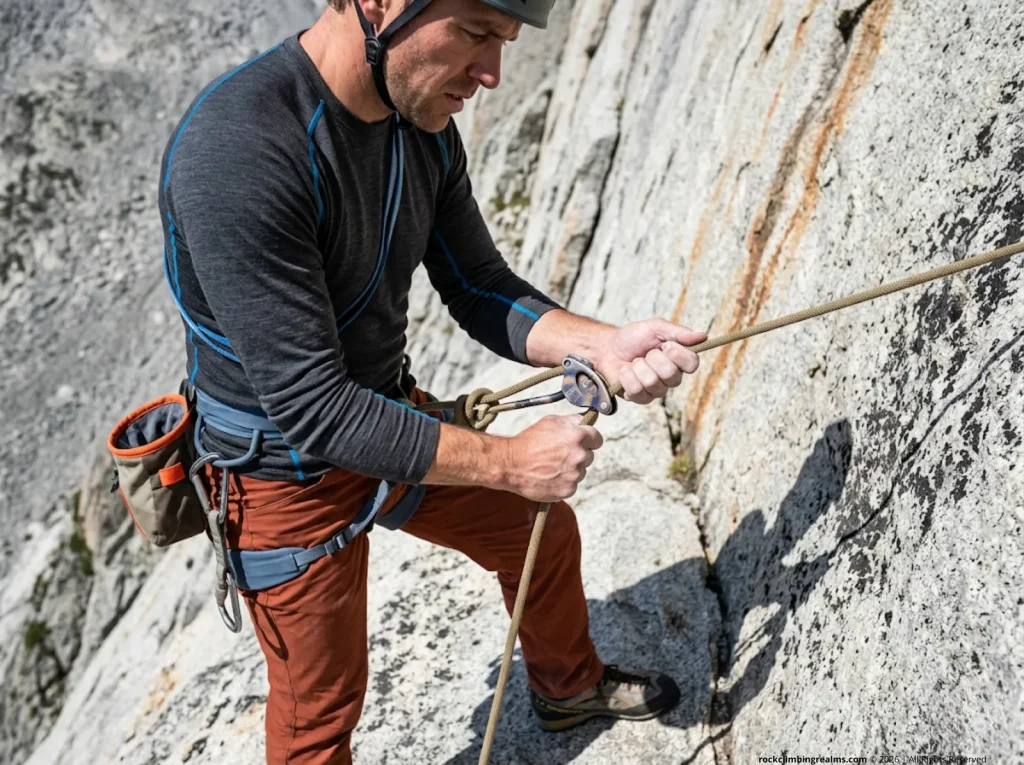
A solo rappel involves roughly 80–100 kg on your device. A tandem rappel brings 200 kg — and what changes is not linear. It is exponential.
The holding force a brake hand needs to control a descending load is governed by the rope wrap angle and the friction coefficient at the device surface. Small increases in wrap angle yield huge gains in braking power — but the flip side is also true. When your load doubles, the demand on your brake hand increases sharply unless you add wrap angle to compensate. That’s the whole physics of friction in one field lesson.
Tube devices like an ATC-Guide or Reverso in standard mode provide around 70–85% friction efficiency. Switch to rescue mode — the deep V-groove orientation — and you push that to 85–95%, which is where you need to be under heavy loads. The Mountaineers self-rescue technical notes on belay device friction validate tube-device behavior at these loads, along with when to supplement them.
Before you commit to a tandem rig, mass matters in another way: thermal mass. A Petzl Reverso weighs 57g. A Black Diamond ATC-Guide weighs 80g. Under 200 kg on a sustained multi-pitch descent, the Reverso reaches critical temperature roughly 40% faster than the ATC-Guide under the same conditions. That 23g difference is the device-selection argument in a single data point. For understanding the physics of descending a closed system in more depth, our core rappel guide covers the friction fundamentals behind every device choice.
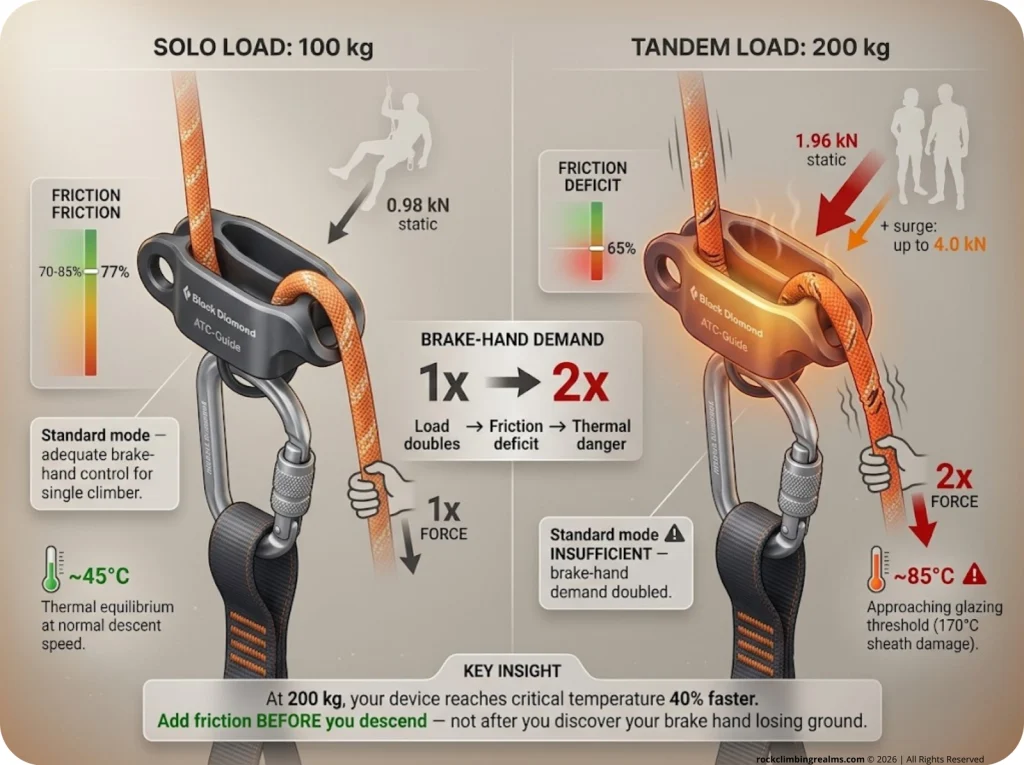
Pro tip: Before you commit to the tandem rig, clip a friction carabiner to the brake side of your ATC-Guide. That single action physically increases the rope wrap angle and multiplies your holding power. It takes five seconds. It can save your life.
Anchor Vectoring — Building for Two Lives, Not One
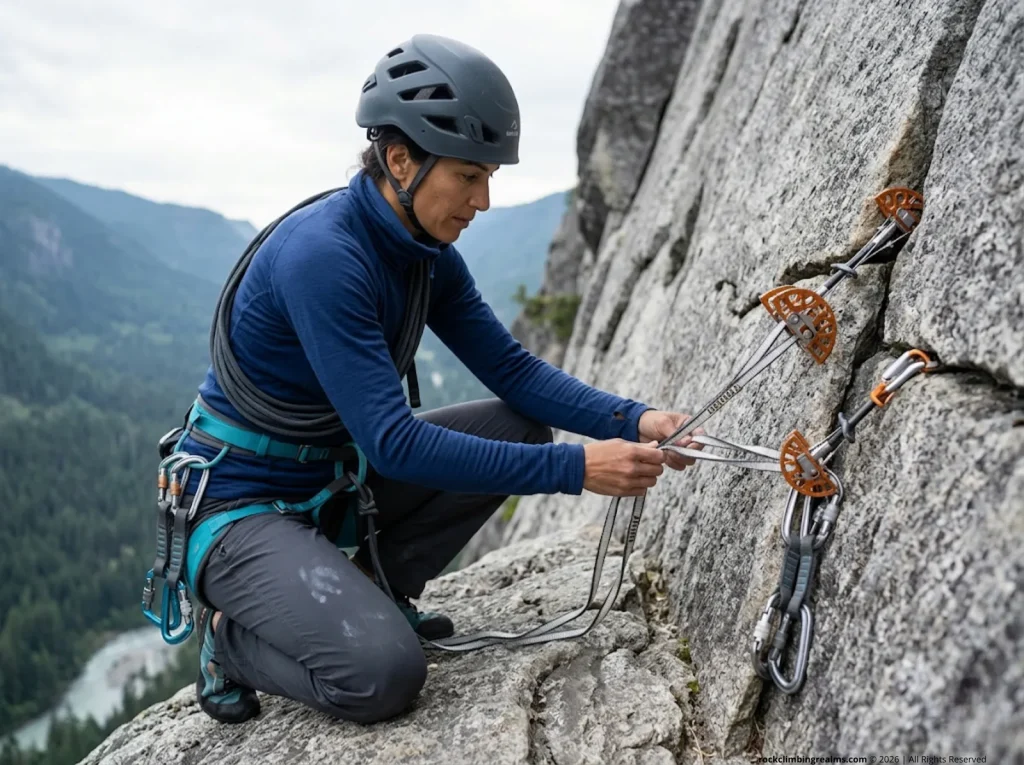
Here’s what gets people into trouble: the load on your master point is not the sum of two weights. It’s a function of static mass, dynamic surge, and the interior anchor angle between your legs.
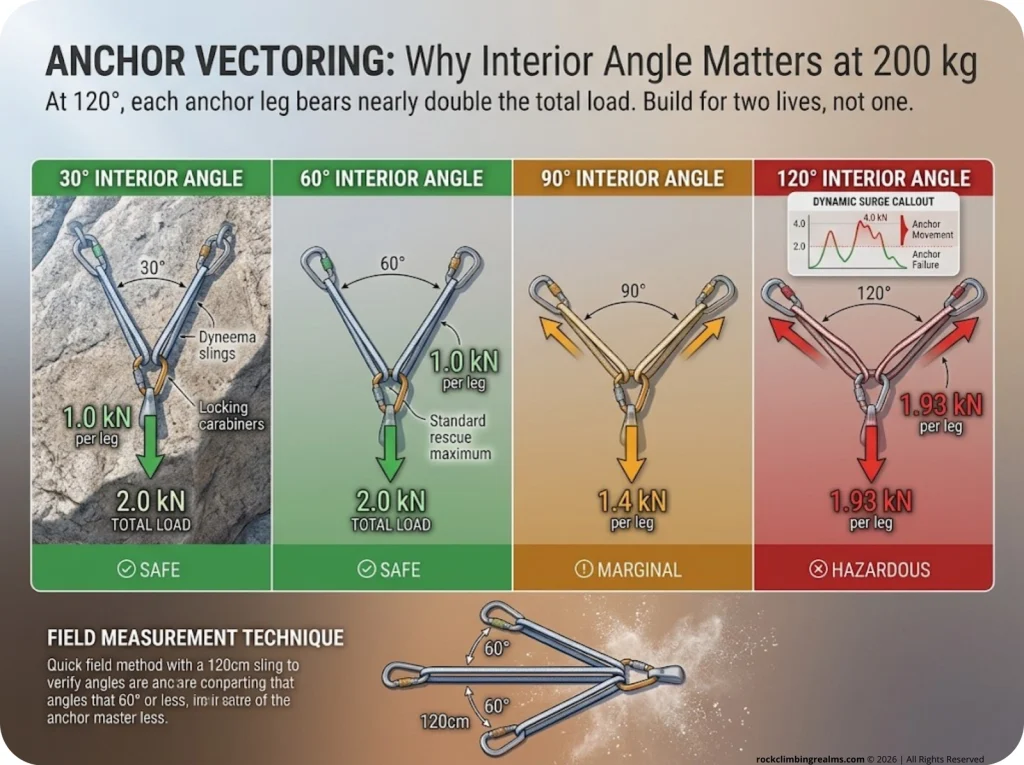
At a 60° interior angle, each leg of the anchor bears the full 2.0 kN of your tandem load. Open that angle to 120° and each leg is taking nearly 3.86 kN — almost double the total weight. That’s not a margin-of-error problem. That’s an anchor-failure scenario. UIAA guidelines for assisting a partner stuck mid-rappel are clear: construct all rescue anchors with interior angles well below 60°.
Dynamic surge makes this worse. During a tandem descent, any stop-start movement — bumping a ledge, grabbing the wall, an abrupt brake — generates a surge of 1.5 to 2.0 times the static weight. On a 200 kg system, that peaks at 4.0 kN on the master point. If one piece of that anchor is a marginal cam in friable rock or a single weathered piton, that surge is your worst-case test — and it happens without warning.
Apply the Triple Redundancy Rule to every component: master point, equalizer, and each individual piece must independently hold the static load before you trust any of them to a 4.0 kN dynamic hit. For the method, SERENE/ERNEST bombproof anchor construction is the framework we build every rescue anchor from.
Phase 1 — Escaping the Belay Without Losing Your Partner
The Munter-Mule-Overhand Sequence
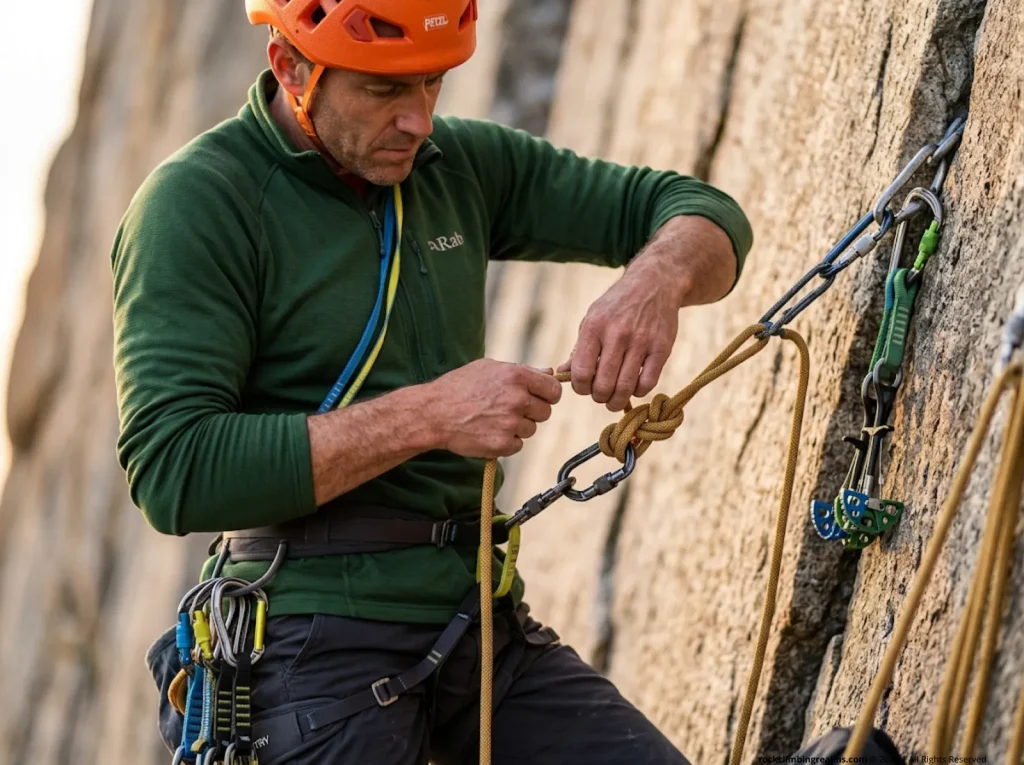
This is the foundational move. You cannot execute a belay escape and keep control of your partner’s weight without the Munter-Mule-Overhand (MMO). Every step matters, and the order is non-negotiable.
Start by locking off your belay device. A Grigri stays engaged on its own. An ATC in guide mode auto-locks under load. A standard ATC requires you to tie a Mule knot before you can go hands-free. Once you’re locked off, tie a figure-8 on a bight below the device and clip it directly to the anchor as a catastrophe backup — this is not optional. If everything else fails during the transition, that knot holds your partner.
Install a French Prusik on the load strand and clip it to the anchor master point. Lower the load gently into the Prusik until the device is unweighted, then remove the rope from the belay device. Now tie the MMO on a dedicated locking carabiner at the anchor. The reason the MMO is the gold standard is load-releasability: if something goes wrong mid-transition — your partner swings, gear shifts, a carabiner spins — you can return the weight to the system. A standard Clove Hitch cannot do that. Per Mountaineers climbing self-rescue protocol for belay escape, this four-step sequence is the field-validated standard.
Once the MMO is set, you’re free to rig the descent system and descend to your partner. For a deeper look at what comes next, escaping the belay and ascending the rope breaks down the full transition sequence in its own dedicated guide.
Pro tip: Practice the MMO with one hand in a cold glove, on a real anchor, at ground level — before you need to do it 80 feet up with shaking hands. Muscle memory built in a parking lot is the only kind that works under stress.
What If the Partner Is Below and Still on Rappel?
If your partner became incapacitated while already rappelling, their weight is on the rope. Secure your end at the anchor via the MMO and descend on the non-load strand. Approach to about 1 meter above them — any closer and you risk tangling in their system.
Before removing anything from your partner’s setup, tie a safety knot — an overhand on a bight — in the rope below them. This closes the system. A 200 kg zip off the end of a rope takes milliseconds. The safety knot is the only thing standing between a transfer error and a fall neither of you recovers from.
Dealing With an Unresponsive Partner Mid-Rappel
An unconscious partner cannot assist you. Their limbs will hang wherever gravity puts them and will tangle if you don’t manage them deliberately. Keep their device on the rope until you’re fully ready to execute the weight transfer — removing it early means they’re hanging only from your connection, before the Rescue Spider is in place.
Talk throughout. Even if they’re not responding, keep narrating your steps out loud. Vocalizing each action — “locking the Munter,” “installing the Prusik” — keeps your own brain in procedural mode. It reduces panic decisions. That’s not soft advice; it’s a clinically documented stress-management tool used in technical rescue contexts.
Phase 2 — The Pick-Off: Reaching and Securing Your Partner
Building the Rescue Spider
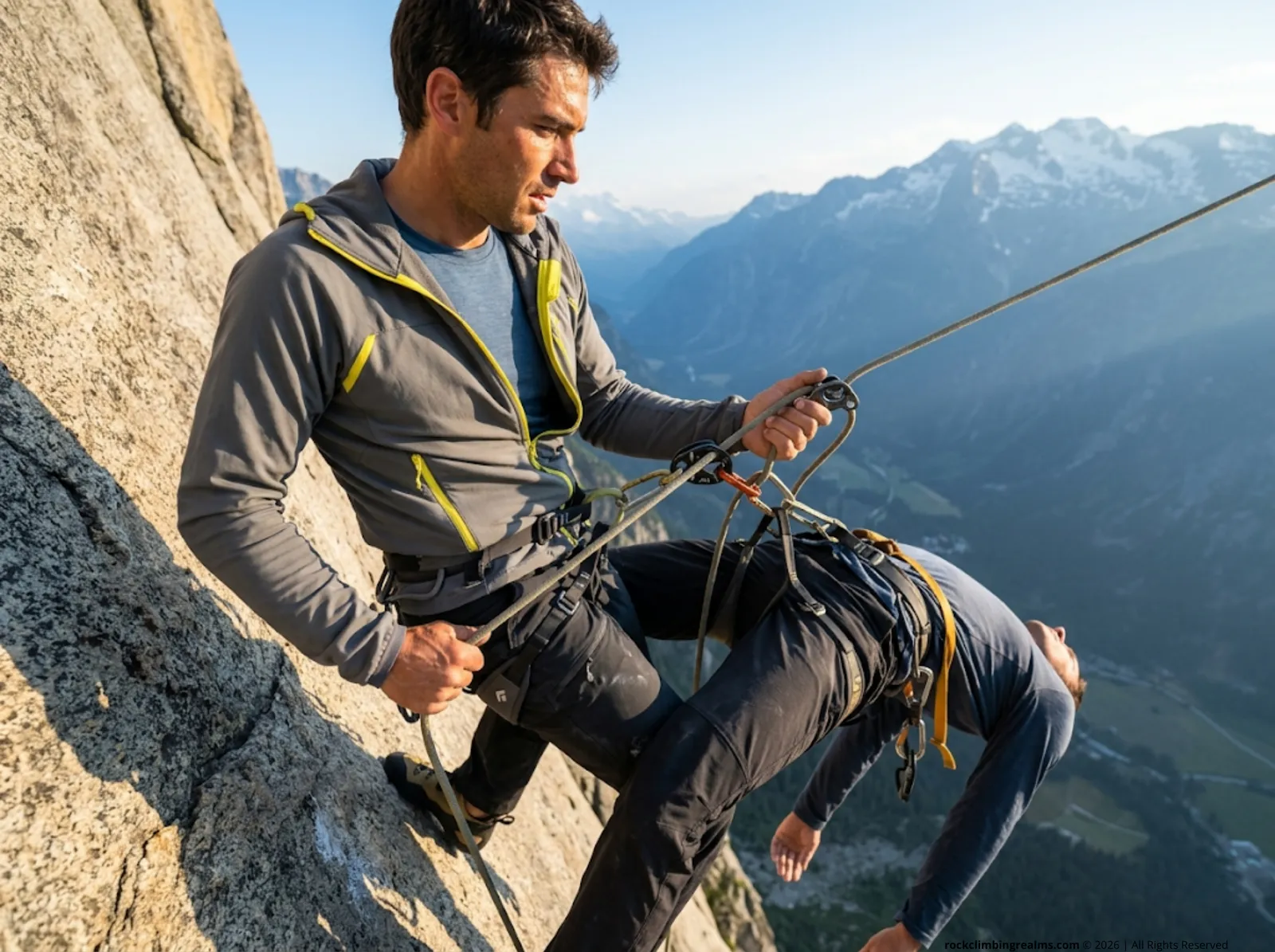
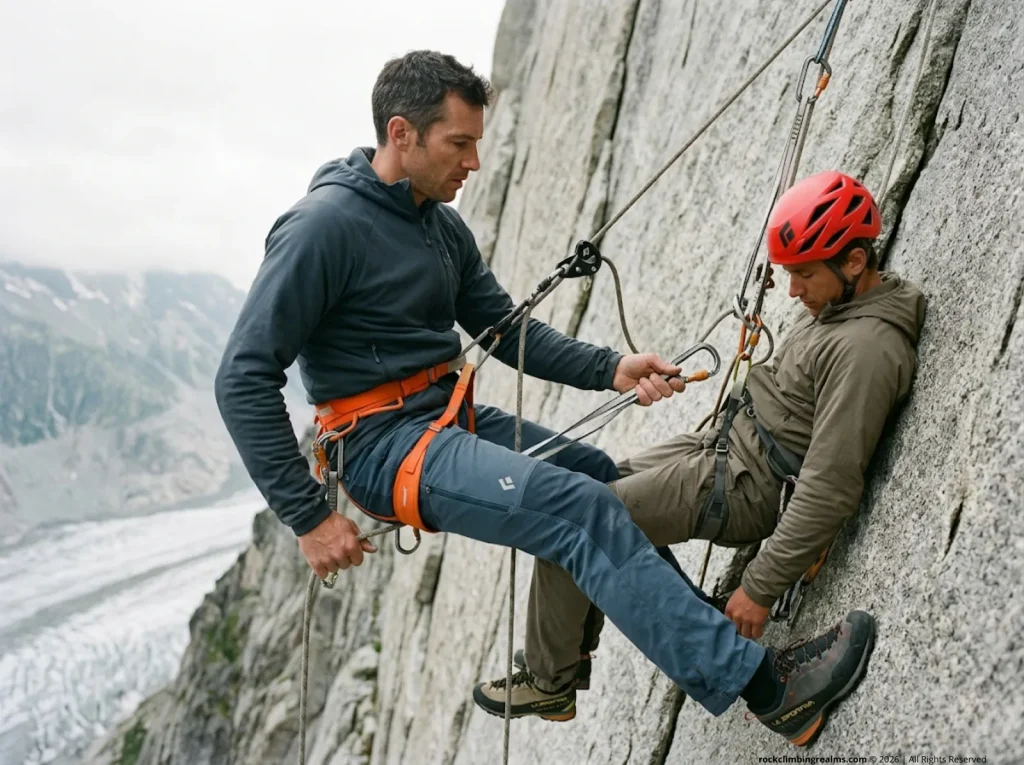
The Rescue Spider is the architectural heart of the tandem descent. It’s what allows one device to control two bodies. Build it at the anchor before you descend. Threading a 120cm runner through a tube device with one hand, at partner depth, on a vertical wall, under load — that’s a failure scenario, not a rescue.
The Rescue Spider has four components:
- Extended Master Point: A 120cm sewn nylon runner extends the DCD away from your belay loop. This keeps your partner’s limbs and their gear separated from your brake hand. Use nylon — not Dyneema — for this runner. Nylon has significantly higher elongation, which means it absorbs shock and is more forgiving if the system catches an unexpected dynamic hit.
- Load-Releasing Hitch: A Radium Release Hitch gives you 3:1 mechanical advantage and lets you transfer your partner’s weight from their old system to the Spider under full tension. You will need this.
- Redundant Tethers: A short leg clips to your partner’s belay loop; a long leg to yours. Partner hangs slightly lower than you. This keeps your brake hand accessible and gives you room to operate.
- Autoblock (Third Hand): Install a Sterling Hollowblock on your partner’s belay loop — not yours. When the Hollowblock is on the partner’s loop, it acts as the backup without restricting your brake hand. This placement detail is the one most guides get wrong.
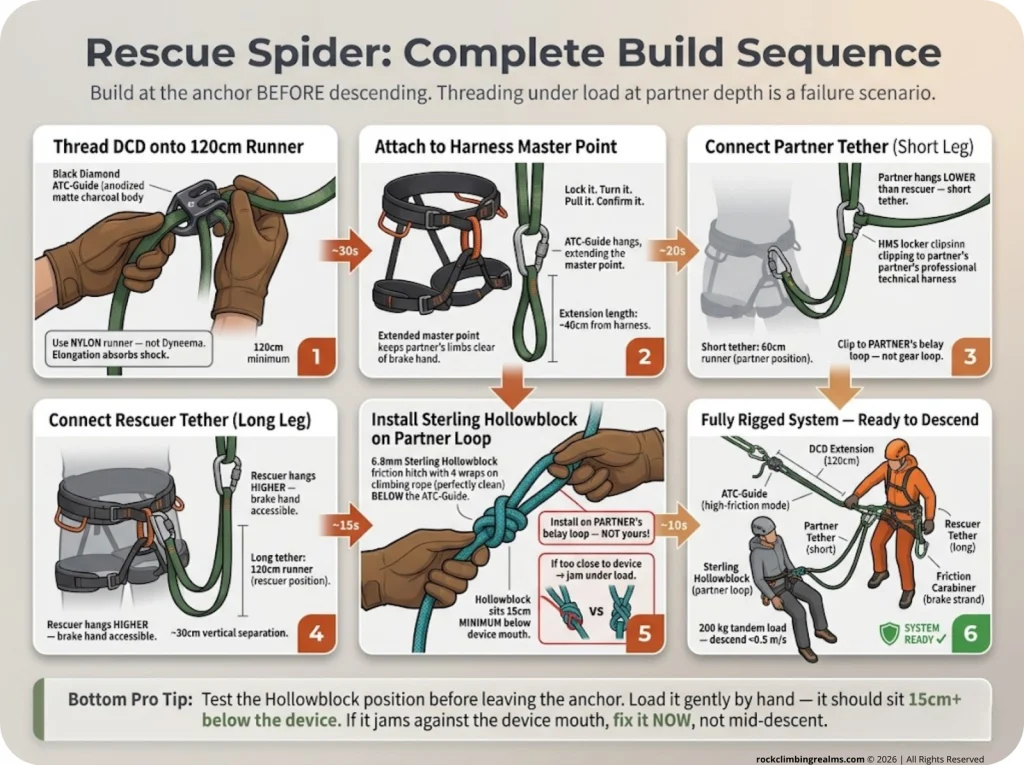
Pro tip: Test the autoblock length before leaving the anchor. Load the Sterling Hollowblock gently by hand — with the full DCD extension deployed, the hitch should sit at least 15 cm below the device mouth. If it doesn’t, it will jam under load. Fix it now, not at partner depth.
Connecting to the Partner and Removing Their Old System
Clip the short leg of the Rescue Spider to your partner’s belay loop with a locking carabiner. Lock it. Turn it. Pull it. Confirm it.
If their weight is still on their original device, use a Block and Tackle — a foot-loop counterweight works — to lift them a few inches and create slack. Once slack appears, remove their old device. Now they’re fully on the Rescue Spider. Before removing their old system, confirm with your hands that the Spider tether is taut and the weight has fully transferred. Never remove their old system while it’s still load-bearing.
For climbers dealing with moderate distress rather than full incapacitation, simpler partner rescue for less severe scenarios provides a cleaner starting point. The tandem protocol here is the full version — when your partner cannot contribute at all.
For a visual walk-through of the pick-off and rigging, this video covers the essential mechanics:
Phase 3 — The Tandem Descent and the Thermal Threat
Friction Management for a 200 kg Descent
You’re down at your partner now. The Rescue Spider is rigged. Both of you are connected. This is the moment when every shortcut you took in preparation becomes a real-time crisis.
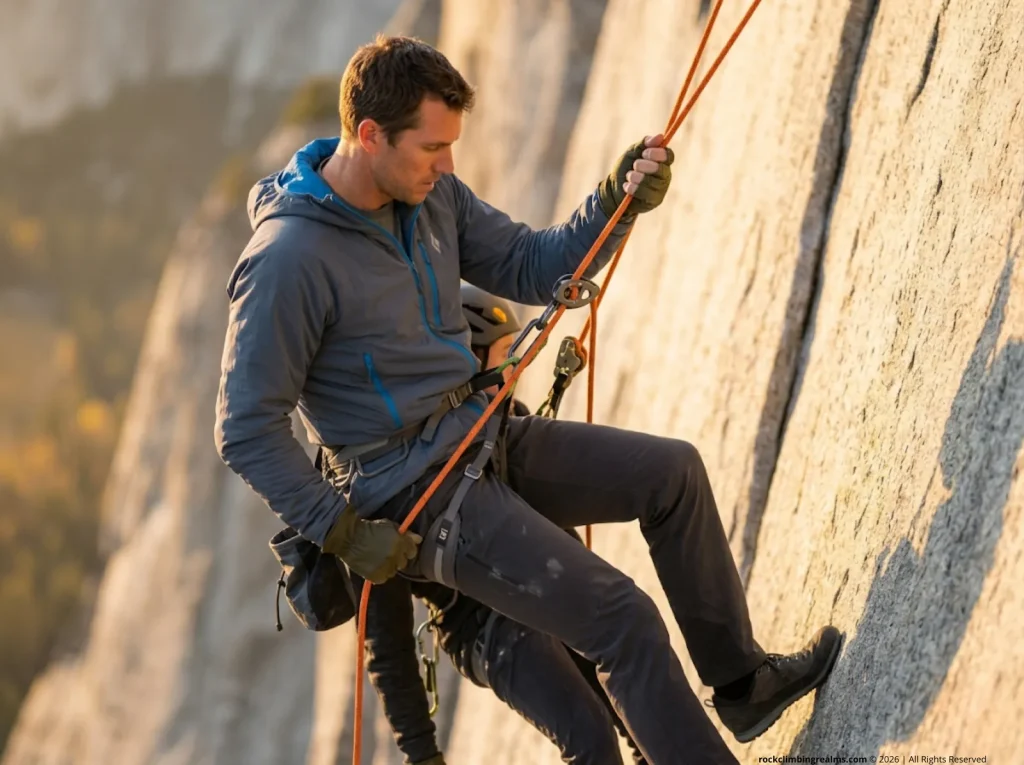
Switch your ATC-Guide to high-friction rescue mode — the deep V-groove orientation. If you haven’t already, add a friction carabiner to the brake strand. This mechanically increases the rope wrap angle, which directly multiplies your holding power. It’s the fastest single modification you can make to the system in your favor.
Gloves are non-negotiable. The brake-hand tension needed to hold 200 kg is roughly double a solo rappel. Rope burn on an ungloved hand causes an involuntary release — your hand will open before your brain tells it to. Leather or synthetic-leather gloves. Not liner gloves. Not hiking gloves. The right gloves.
Keep your descent below 0.5 meters per second. Boulder County SAR data on technical roped climbing rescues documents that technical roped climbers account for nearly 60% of all climbing SAR incidents, with velocity-related device failures cited in a meaningful portion of those cases. Slow and deliberate wins here. As an alternative approach when partner weight disparity allows it, counterbalance rappel rescue offers a different mechanical architecture worth understanding.
Rope Glazing — The Physics Nobody Explains
Every guide tells you to descend slowly. Almost none of them tell you why it matters at a material level — or what breaks when you don’t.
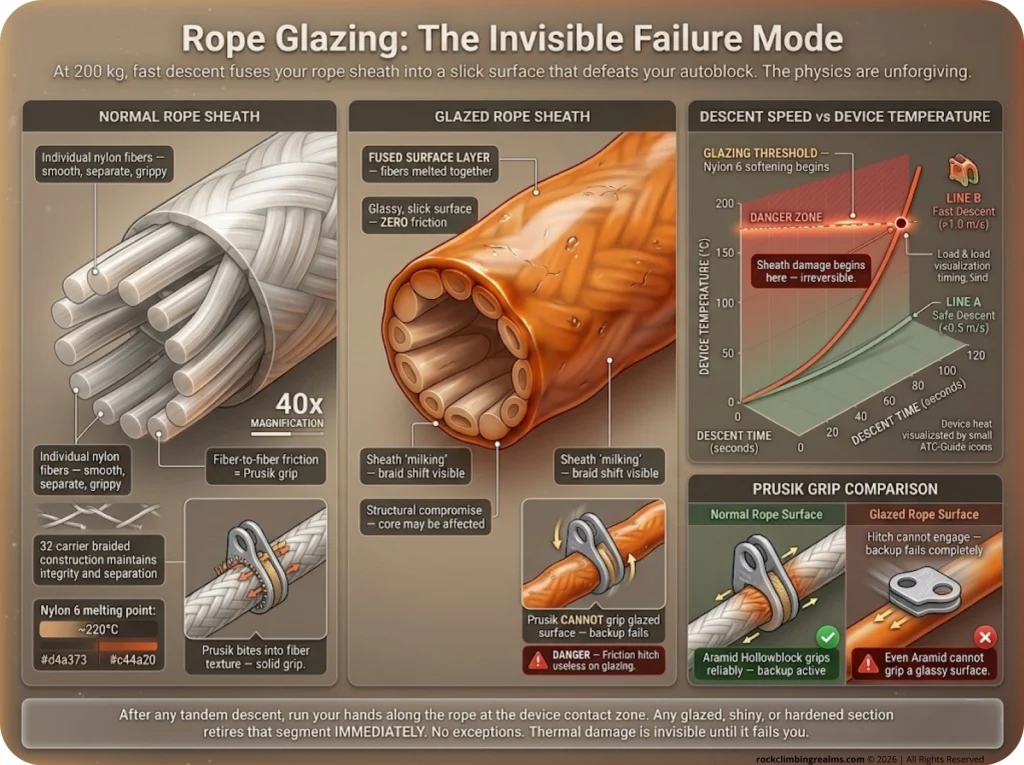
Rope glazing happens when the interface temperature between your rope’s nylon sheath and your descent control device exceeds the softening point of the polyamide fibers. Nylon 6 begins softening around 170°C. When that sheath glazes, the surface fibers fuse into a hard, slick layer. That glassy surface actively prevents friction hitches from gripping. If your Sterling Hollowblock can’t bite, your backup system fails entirely.
Standard 6mm nylon cord melts well before Aramid fiber does. This is why the Hollowblock isn’t a preference — it’s the only friction hitch that maintains grip at elevated heat dissipation temperatures where nylon has already softened. Ropes that have experienced thermal glazing also show visible sheath “milking” — the outer braid bunches or shifts, which compromises structural integrity even once the descent is complete.
After any tandem descent, run your hands along the rope at the DCD contact zone. Any glazed, shiny, or hardened section retires that segment of rope immediately. No exceptions.
Managing the Descent With an Unresponsive Partner’s Body
Your partner’s limbs will not track cleanly along walls. At overhangs, their body swings unpredictably. Keep the short tether of the Rescue Spider snug — it holds them close to your body through traversing sections and reduces pendulum risk at transitions.
At roofs, stop completely. Assess where your partner’s limbs are before committing weight to the next face. Manually guide their body over the edge. Then move. Rushing a roof transition with 200 kg and an unconscious partner is where systems that “mostly work” become systems that fail. Talk through it: “Moving now. Roof coming. Knees down.” Even to someone who can’t respond. It keeps you rational.
Failure Mode Analysis — What Breaks and Why
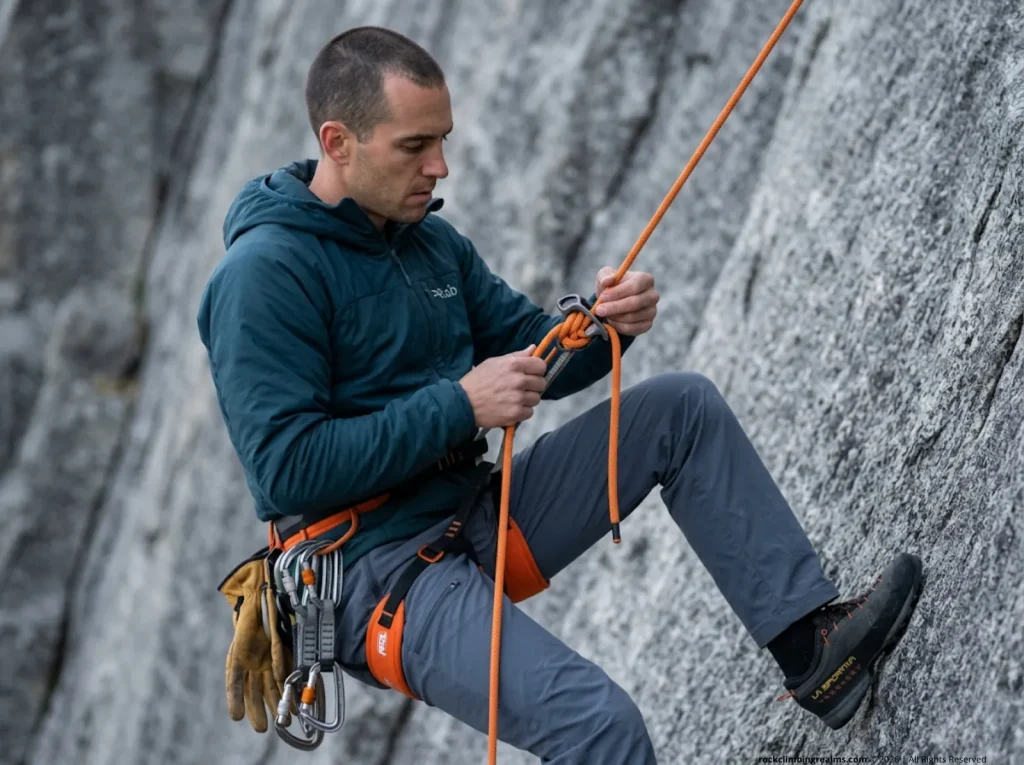
Prusik Creep and Device Jam
Prusik Creep is the single most common in-field failure during tandem rescues. If the autoblock is too long relative to the DCD extension, it gets sucked into the device under load — jamming the system while you’re hanging at full 200 kg with no other backup.
The mandatory 120cm DCD extension exists specifically to prevent this. It keeps the hitch mouth well below the device’s opening. If you skip the extension and clip the device directly to your belay loop, this failure is nearly guaranteed under weight.
If a jam does occur: weight the brake strand to stop descent, clip an emergency tether from your partner’s harness to any available feature, then manually clear the jammed hitch by pinching it open. Do not yank it free under full load. The Sterling Hollowblock (Aramid) is significantly less prone to this than standard nylon cord, especially on warm or wet ropes.
The Open System — Forgetting to Close the Ropes
Tie stopper knots in your rope ends. Every single pitch. Not “I’m only going 20 feet.” Always. A 200 kg tandem system builds zip velocity exponentially faster than a solo rappel. Tie an overhand on a bight rather than a simple overhand — it unties more easily after weighting and passes drag knots more cleanly if you need rope retrieval. For a full accounting of how this failure mode shows up in real accident data, the most common rappelling accident patterns and how to prevent them is required reading before any multi-pitch emergency descent.
Gloves Neglect and the Involuntary Release
This one doesn’t get enough attention. The brake-hand control tension required for 200 kg is double what a solo rappel demands. Rope burn on an ungloved hand doesn’t just hurt — it triggers an involuntary, reflexive release of the brake strand. You cannot override it. Your hand opens. The descent becomes free-fall.
Leather-palm or synthetic-leather gloves are the minimum. Test this if you want to understand it viscerally: rappel 10 meters on a steep face without gloves under your body weight plus a heavy pack. Note the point where the pain exceeds voluntary override. That is the failure mode — and at 200 kg, that point arrives faster.
Gear for Rescue — The Anti-Sell Breakdown
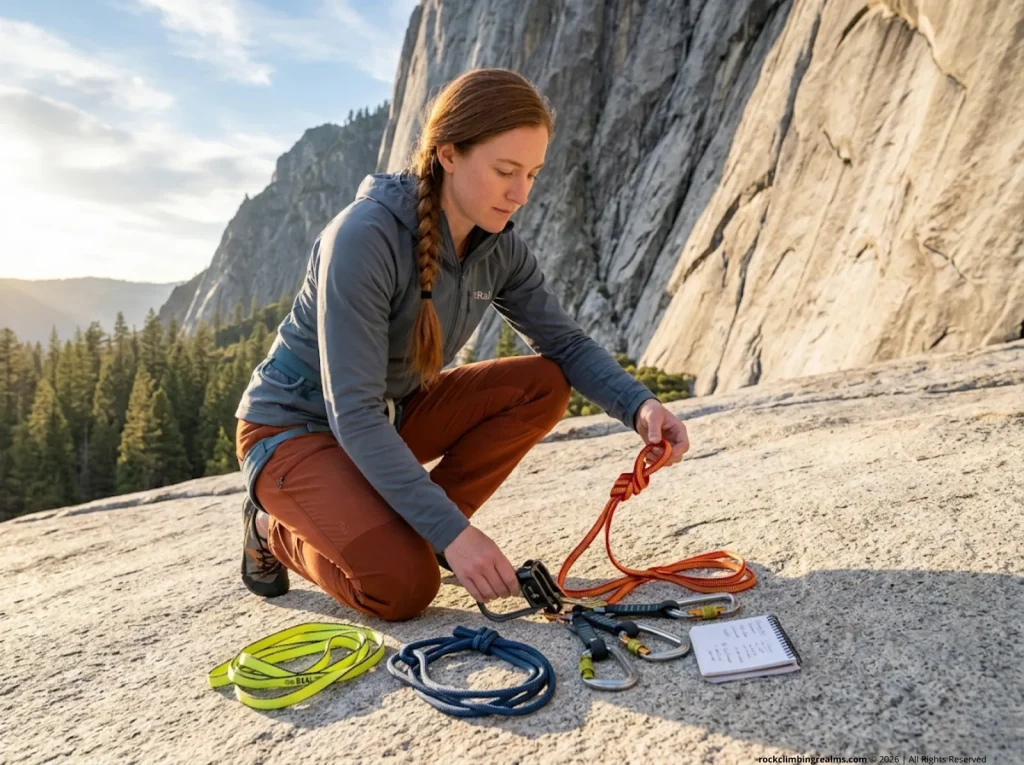
Black Diamond ATC-Guide vs Petzl Reverso for Tandem Rescue
Both are excellent devices for their intended use. At 200 kg, they are not equal.
The Black Diamond ATC-Guide (80g, wider slots, asymmetrical guide ring) versus the Petzl Reverso (57g, shorter slots, standard V-grooves): under extended 200 kg descent, the ATC-Guide’s additional thermal mass delays heat saturation roughly 40% longer. On a two-pitch descent, that’s the difference between arriving at the next station with a functional device and arriving with a glazed rope on pitch two.
The ATC-Guide’s deeper teeth in high-friction mode are also more effective at stopping tandem “creep” — that slow, unintended downward drift under sustained load that happens when brake-hand tension wavers. The Reverso’s standard V-grooves require more sustained brake-hand force to prevent it. On a 200 kg load over multiple pitches, that difference compounds. For the standards framework behind every device you use, what UIAA safety standards actually mean for your rescue gear gives you the full certification context.
Neither device was designed specifically for rescue. The ATC-Guide is the better field choice, but even it should be supplemented with a friction carabiner at 200 kg.
Friction Hitches — Nylon vs. Aramid
Standard 6mm nylon cord melts around 220°C. Under a full-speed 200 kg catch on a warm descent, the instantaneous friction heat at the hitch can approach this in milliseconds. That’s not a fringe scenario — it’s a physics outcome.
The Sterling Hollowblock uses an Aramid/Polyester hybrid that maintains structural integrity and grip at temperatures where nylon has already softened and begun to fail. On wet or warm ropes, its bite is superior. It weighs almost nothing. Every multi-pitch trad climber doing serious routes should carry one alongside their standard cord — it’s the highest-value upgrade for self-rescue preparedness on a per-gram basis.
Slings, Cordelettes, and the Minimalist Rack
The entire Rescue Spider can be built from gear already on your rack: one 120cm sewn nylon runner, a 6mm nylon cordelette (for the MMO and Radium Release Hitch), and two HMS locking carabiners. You don’t need a specialty rescue kit. You need the right setup knowledge and the right cord choices.
Use 6mm Nylon 6,6 for your load-releasing hitches — its superior thermal stability over standard Nylon 6 makes it the correct material for friction-heavy knot sequences. Use nylon (not Dyneema) for the 120cm runner — elongation matters in a shock-load scenario. The system is engineering, not gear accumulation.
Conclusion
Three things to walk away with:
The physics are non-negotiable. A 200 kg tandem rig transforms your rappel into a friction management problem. Add friction before you need it — rescue mode on the device, friction carabiner on the brake strand — not after you’ve discovered your brake hand is losing ground.
Build the system at the anchor, not mid-air. The Rescue Spider, the MMO, the Hollowblock placement on your partner’s loop — every one of these is five times harder to execute hanging at partner depth under stress. Build it before you leave the anchor. Confirm every piece before you weight it.
Thermal damage is invisible until it fails you. Rope glazing from a fast 200 kg descent will strip your autoblock’s grip without warning. Descend at or below 0.5 m/s. Rest the device in shade between pitches. Inspect the sheath contact zone afterward. Every. Single. Pitch.
Set up this system on a low-angle slab this weekend with a sandbag — not a human body 300 meters up a granite face. The Rescue Spider, the MMO, the Hollowblock placement — these movements must be automatic before July, not discovered for the first time in an emergency.
Now go send something.
FAQ
How do you add friction to a tandem rappel?
Add a second friction carabiner to the brake side of your tube device — this increases the rope wrap angle, multiplying holding power significantly. Alternatively, switch your ATC-Guide to high-friction rescue mode using the deep V-groove orientation. Descend at under 0.5 meters per second to manage heat buildup at the device interface.
Can you tandem rappel on a single rope?
Yes, but with real constraints. The rope must reach the next anchor when doubled, and a tandem rappel on a single rope generates more heat and demands more brake-hand force than a half-rope setup. Always close the system with stopper knots. In a rescue context, you use what you have — but understand that every constraint raises the risk profile of every decision.
What is the difference between a pick-off and a tandem rappel?
A pick-off is the discrete technical act of reaching and attaching yourself to an incapacitated partner — it’s Phase 2 of the tandem rappel rescue sequence. The tandem rappel is the complete descent of both climbers as a single unit using one device. The pick-off doesn’t stand alone; it’s the precondition for the descent.
What happens if my Prusik bites too hard during a tandem descent?
If your autoblock seizes and won’t release by hand, thermal glazing of the rope sheath is the likely cause. Do not yank the hitch — that damages the cord or deepens the jam. Weight the brake strand manually to reduce pressure on the hitch, then slowly work it open by pinching with your fingers while easing tension progressively. The Sterling Hollowblock (Aramid) is far less prone to this failure than standard nylon cord under load, which is why it’s the recommended choice here.
How do you pass a knot with two people when on a tandem rappel?
Stop before the knot, weight the autoblock to lock the system, and clip both climbers’ tethers to the nearest anchor point before doing anything else. Remove the rope from the DCD, pass the knot through the anchor redirect, rethread the DCD below the knot, test, release the autoblock, and continue. Passing a knot with two people requires two secure clip-in points — never attempt a knot pass while either climber is unsecured.
Safety Notice: Rock climbing and mountaineering are inherently high-risk
activities that can involve physical trauma or fatal incidents. The information on Rock Climbing Realms is for
educational and informational purposes only. Techniques and advice presented here are not a substitute
for professional, hands-on instruction. Conditions and risks vary by location. Always seek guidance
from a qualified instructor before attempting new techniques. By using this website, you agree that you
are solely responsible for your own safety. Any reliance you place on this information is strictly
at your own risk, and you assume all liability for your actions. Rock Climbing Realms and its authors
will not be held liable for any harm, damage, or loss sustained in connection with the use of this information.
Affiliate Disclosure: We are a participant in the Amazon Services LLC Associates Program, an
affiliate advertising program designed to provide a means for us to earn advertising fees by advertising and linking
to Amazon.com. As an Amazon Associate, we earn from qualifying purchases. We are also an official affiliate partner
of Black Diamond Equipment via the AvantLink network. If you click on a Black Diamond affiliate link and make a
purchase, we may earn a commission at no additional cost to you. We also participate in other affiliate programs.
Additional terms are found in the terms of service.