


In this article
The load stopped moving at two meters. My partner was suspended in the bergschrund, her harness cutting into her hips, and I’d been hauling for six minutes against a rope that felt bolted to the glacier. I had a textbook Z-rig, two pulleys, and the physics working against me — because I didn’t understand that “3:1” was a fiction written by someone who’d never threaded a 9.4mm dynamic rope through a bushing pulley at minus fifteen degrees.
After that day, I rebuilt my understanding of hauling systems from the ground up. What I found is that almost every guide teaches you the geometry of a 3:1 — and skips the part that actually determines whether your victim comes up or stays put. This guide dismantles that gap. You’ll learn how to calculate your real system efficiency, choose hardware that doesn’t rob you of half your force, and avoid the rigging errors that turn a manageable haul into a system stall.
⚡ Quick Answer: A 3:1 Z-rig only delivers true 3:1 in a frictionless vacuum. With standard carabiners at 50% efficiency, your “3:1” collapses to roughly 1.5:1. With sealed ball-bearing pulleys at 95%, you get closer to 2.7:1. The gap between theoretical mechanical advantage (TMA) and practical mechanical advantage (PMA) is entirely determined by your hardware. Use the T-Method to diagnose what the system is actually delivering — then pick gear that stops friction from robbing you.
| Mechanical Advantage & Efficiency Specifications | |
|---|---|
| Key Data Point | Value |
| Theoretical MA (Z-rig) | 3:1 |
| Bearing pulley efficiency | 95–98% → ~2.7–2.8:1 PMA |
| Carabiner-only efficiency | 40–50% → ~1.5:1 PMA |
| Rule of 12 ceiling (3:1) | Max 4 haulers |
| PCD desheathing threshold | ~4 kN |
The Gap Between Theory and Reality in 3:1 Systems

Every rescue manual starts with rope-counting: three strands support the load, so you get 3:1. Clean geometry. The problem is that geometry assumes frictionless pulleys — and frictionless pulleys don’t exist in your rack.
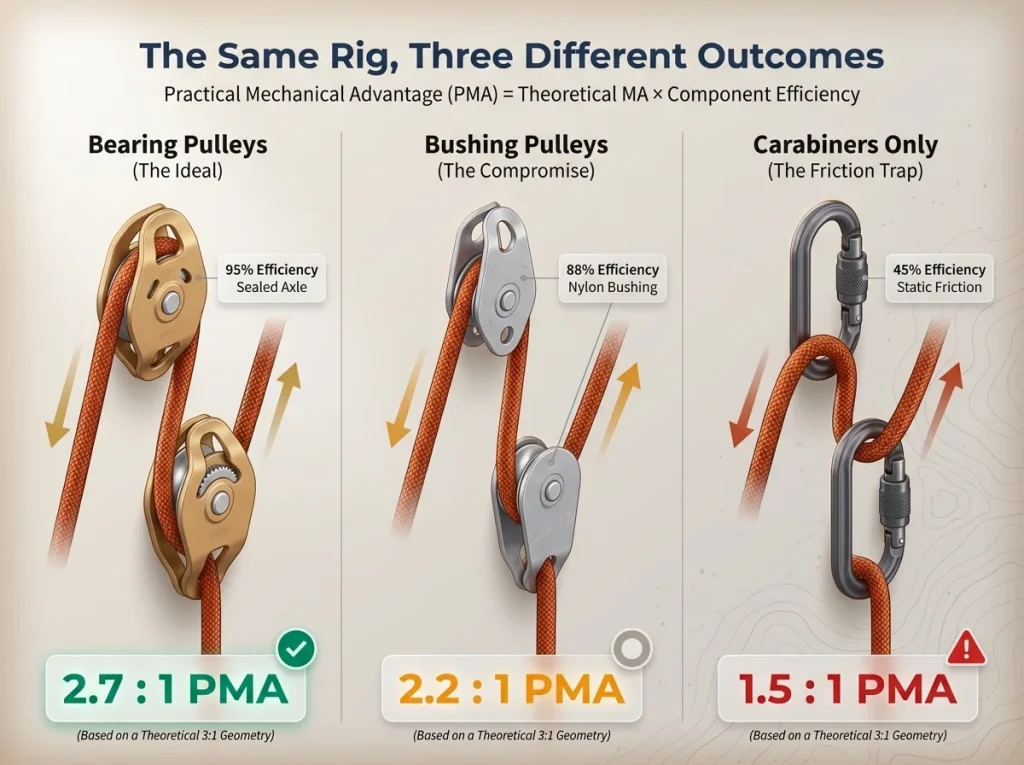
Theoretical Mechanical Advantage (TMA) is what you calculate by counting rope strands. Practical Mechanical Advantage (PMA) is what the load actually feels. PMA equals TMA multiplied by the efficiency of every component in the rope path. Two standard carabiners at 50% efficiency each: 3 × 0.5 × 0.5 = 0.75:1. The load wins. In real rigs with carabiners doing redirect duty, you’re usually looking at around 1.5:1 — less than a basic redirect with one quality pulley.
A 3:1 with sealed ball-bearing pulleys at 95% efficiency lands around 2.7–2.8:1 actual. Bushing pulleys at 88–92% drop you to 2.2–2.4:1. The friction tax compounds multiplicatively — every component’s loss stacks on the next. This is why a 2:1 system with one good bearing pulley often outperforms a 3:1 built from carabiners. The geometry looks worse; the force delivery is better.
System stall — when internal friction exceeds the rescuer’s input force — is the number-one failure mode in amateur rescue rigs. When the Z-rig stops moving, the instinct is to add haulers. Diagnose friction first. Understanding how pulley system geometry translates to actual mechanical advantage before committing a load will save you that guesswork.
Theoretical Mechanical Advantage — The Frictionless Lie
Count the rope strands supporting the load. In a Z-rig, three strands carry the weight: that’s where the 3:1 TMA comes from. To raise the load one meter, you pull three meters of rope. Clean, elegant, and essentially useless without knowing what happens to that number once real hardware enters the equation.
The “rope counting” shortcut also fails in compound systems — 6:1, 9:1 — where the geometry stops being obvious. You can’t simply count and multiply. The T-Method is the only honest accounting tool for those configurations.
As documented in mechanical advantage systems for rope rescue, friction loss is primarily driven by axle resistance (bearings versus bushings) and rope fiber compression through the bend radius. That university research makes the efficiency collapse concrete — not theoretical.
Pro tip: When you calculate 3:1 and the load doesn’t move, resist the instinct to add more haulers. Diagnose friction first. Check every component in the rope path before you call for reinforcements.
Practical Mechanical Advantage — What You Actually Get
Three bushing pulleys at 90% efficiency each: 3 × 0.9 × 0.9 × 0.9 gives you 2.19:1 actual. That’s already down nearly a full ratio point from the theoretical number.
Larger sheave diameter means less bending energy lost. A 38mm sheave outperforms a 20mm sheave in meaningful ways, especially when you’re hauling a full-body weight through multiple cycles. The rope bends less sharply around a large sheave — less compression energy burned, more force delivered to the load.
The T-Method — Diagnosing Force at Every Point
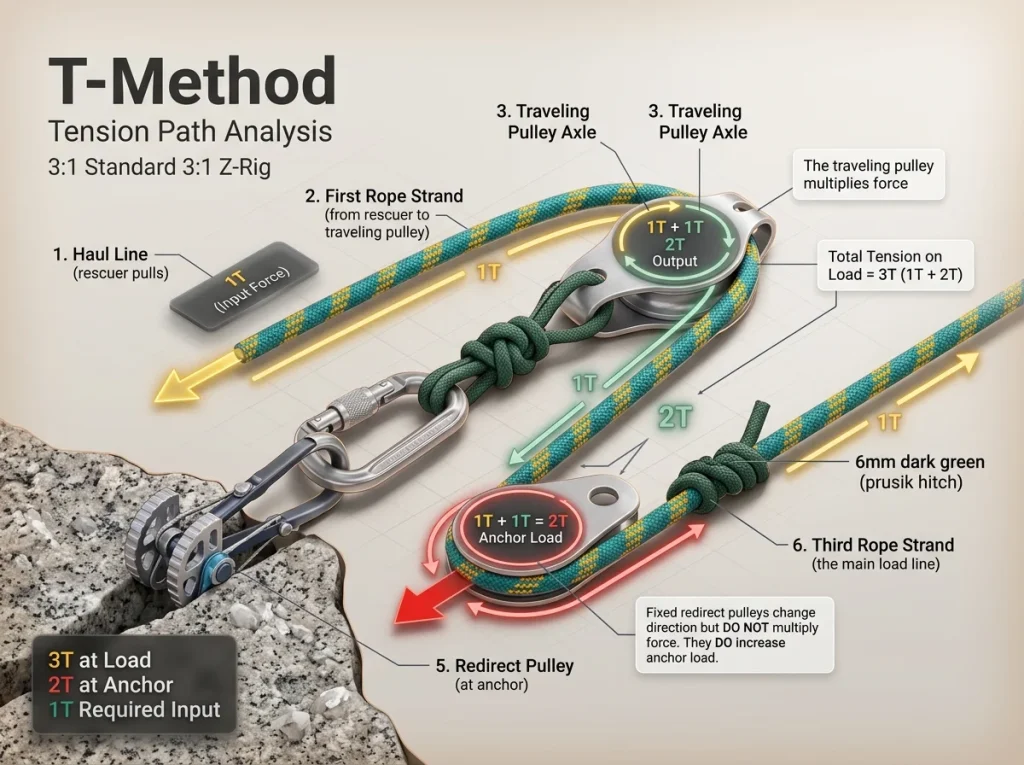
The T-Method — also called Tension Path Analysis — assigns 1T to the haul line and traces tension through every pulley and knot. Fixed redirect pulleys redirect force but don’t multiply it. They do add to anchor load: input plus output tension equals anchor load at that piece.
In a standard Z-rig: haul strand equals 1T, the traveling pulley outputs 2T to the load, and the redirect pulley loads the anchor at 2T simultaneously. The anchor must handle both the load and the redirect forces — often 2T at once. This is why marginal single-bolt anchors fail under Z-rigs that appear to work “fine” right up until they don’t. The T-Method makes that anchor loading visible before it becomes a problem.
Hardware That Earns Its Weight (and Hardware That Steals Yours)

Your hardware selection determines your PMA before you pull a single meter of rope. Sealed ball-bearing pulleys like the Petzl Pro Traxion — 38mm sheave, 95% efficiency — are the correct choice for serious hauling. Bushing pulleys at 88–92% sound close, but that gap compounds across three pulleys. Standard carabiners as static redirect surfaces: 40–50% efficiency. That’s not a pulley substitute. That’s a friction machine.
The standards that govern every pulley in your kit — UIAA 127 pulley strength and efficiency standards — require EN 12278 compliance: minimum 22 kN, far beyond what any human team generates. The limiting factor isn’t breaking strength. It’s efficiency loss under working loads. Review the UIAA ratings that govern every pulley in your kit before deciding bushings are “close enough.”
The Sealed Bearing vs. Bushing Decision
Sealed ball bearings are permanently lubricated and protected from dirt, ice, and moisture — the only defensible choice for alpine hauling. Bushing pulleys work in clean, dry conditions but degrade fast once contamination enters. A wet bushing drops from 90% to around 82% efficiency; at minus fifteen degrees, the gap grows further.
Weight penalty: 30–60 grams per pulley. In exchange, you recover 8–13% of your mechanical advantage in real field conditions. That is not a marginal gain. On a 5-meter haul with a 75 kg victim, that efficiency delta is the difference between a system that moves and one that stalls.
The Progress Capture Device Problem
The Progress Capture Device (PCD) is often where the build goes quietly wrong.
A prusik (3-wrap friction hitch) must be manually minded, or it gets sucked into the pulley — creating substantial additional friction and risk of rope damage. Every time hauling stops and the prusik sets, you lose 1–2cm of vertical progress. Over multiple resets across a 5-meter haul, that compounds to 10–20cm of lost progress. It sounds trivial until the victim is still hanging.
Mechanical PCDs — Petzl Traxion, Petzl Maestro — use a toothed cam that locks instantly with zero back-slip. Superior in almost every scenario. But there’s a real risk: toothed cams will desheath a rope at around 4 kN. In a 6:1 or 9:1 system with a coordinated haul team, exceeding that threshold is genuinely possible. The rule: mechanical PCD is right for 3:1 solo rescue; a prusik becomes the safer call when you can’t control how hard the team is pulling.
Pro tip: Use a prusik-minding pulley like the Petzl Pro Traxion, which keeps the friction hitch away from the sheave automatically. This eliminates the primary cause of prusik jams without requiring constant attention.
When Carabiners Are the Only Option
Emergency substitution is legitimate. Knowing the efficiency penalty before you commit is mandatory.
A standard aluminum carabiner gives you 40–50% efficiency. Two in your Z-rig, and you’re looking at roughly 1.5:1 practical advantage — or less. Large D-shaped lockers perform slightly better than ovals because of the reduced rope bending angle. The Petzl RollClip and DMM Revolver Rig are acceptable hybrid options. The standard DMM Revolver is not — its micro-roller compresses under human-body hauling loads and drops to 50% efficiency, the same as a plain carabiner.
If your calculation shows less than 1.5:1 PMA with carabiner substitutes, build a compound system rather than adding haulers.
Building the Z-Rig Step by Step

The Z-drag earns its name from the rope path: anchor to load, load back to anchor redirect, then down to the haul team. That Z-shape — seen flat — is your 3:1 geometry.
Four component positions: (1) anchor point, (2) fixed redirect pulley at the anchor, (3) traveling pulley (the tractor) attached to the load via the PCD, (4) haul line. The rope’s terminal end must attach to the load — not the anchor. Attach it to the anchor and you’ve built a 2:1 Change of Direction system, not a 3:1. This is one of the most common errors in field rigs.
Rig the traveling pulley as far from the redirect anchor as possible. Maximum throw distance means fewer resets before you’ve moved the load. Short throw equals frequent two-blocking, frequent reset, and compounding lost progress. Keep the haul line parallel to the load line — any angular deviation costs you force through vector resolution.
As described in state-certified rescue technician protocols for mechanical advantage systems, reset protocol is not optional procedure — it’s where most field teams lose ground. Connecticut’s rescue technician curriculum treats the reset as a trained skill, not an improvised step.
Establishing the Anchor
The anchor in a Z-rig handles both the weight of the load and the redirect pulley’s force addition. At a straight haul angle, the anchor pulley load equals twice the haul force. Use SERENE/ERNEST principles: a solid single piece beats two marginal pieces equalized with a cordelette that introduces extension potential.
For ice: two-screw equalized minimum. For rock: a single solid cam is acceptable if it has at least 15mm expansion range in solid stone. Attach the redirect pulley to the master point, not to an individual piece.
The anchor is also where your Z-rig connects to your self-rescue workflow. Understanding the steps for converting your belay system into a functional haul anchor is the prerequisite skill — you typically need to escape the belay before you can build the Z-rig at all.
Rigging the Traveling Pulley and PCD
The traveling pulley is the multiplying component. It attaches to the load strand via the PCD. PCD placement: attach the friction hitch or mechanical cam to the load strand above the traveling pulley — the direction of load pull keeps the cam locked. Do not attach the PCD to the haul line. The PCD must be on the anchored load strand, between the redirect pulley and the load.
Optimal prusik cord: 5–6mm for 9–10mm ropes; 6mm for 10mm-plus ropes. Thinner prusiks slip earlier. Thicker ones jam harder. Test the PCD direction before committing the load — the classic setup error is reversing it so it locks when pulled and releases when you need it to hold.
The Reset Procedure Under Load
Two-blocking — when the traveling pulley contacts the redirect pulley — ends that throw, usually 0.5–1.5 meters of travel. Reset steps: engage the PCD firmly, maintain tension on the haul line, unclip the traveling pulley from the load strand, slide it back to maximum throw, reclip and resume. During reset, the victim feels the system settle. Communicate this before it happens. In cold conditions with cold hands, count on 45–90 seconds per reset — train it until it’s automatic.
Pro tip: Mark the haul line at 1-meter intervals before the approach. You’ll know exactly how much progress each throw delivers instead of guessing whether you’re moving the load or just stretching the rope.
The Rope Science That Changes Everything

Most guides on hauling systems assume static rope. You’re probably using dynamic. The difference matters in ways guides rarely address.
Dynamic ropes (EN 892) have 20–40% elongation by design — that elasticity is a feature for lead climbing and a liability in rope rescue. The first 3–4 haul cycles on a long dynamic rope may move nothing but stretch out of the system. You’re pre-loading a spring, not raising a victim.
The yo-yo effect: dynamic rope elongates during the haul, contracts during reset — so the victim drifts down slightly on every reset despite the PCD holding. Before choosing between dynamic and static rope for technical rescue scenarios, understand that the efficiency tables in rescue literature assume static rope behavior. Your dynamic rope delivers less than the numbers suggest.
Dynamic rope under sustained haul load also creeps — slowly, permanently elongating — which reduces its future energy absorption in a real fall. A hauled dynamic rope is a compromised climbing rope. Static ropes compliant with UIAA 110 static rope elongation standards for rescue operations hold under 2% elongation at 100kg load. That’s what genuine upward progress looks like.
Dynamic vs. Static Rope in a Hauling Context
Dynamic rope (EN 892): designed for fall absorption — 20–40% elongation under load is a feature for lead climbing and a serious liability for hauling. Static rope (EN 1891): designed for rescue and working loads — under 3% elongation at working load, which means the system moves the victim instead of pre-loading a spring.
Low-stretch “semi-static” ropes in the 9–11mm range are the alpine climber’s compromise option — less elastic than full dynamic, lighter and easier to carry than 11mm static. For a one-rope alpine rack, the semi-static wins on both weight and hauling performance.
How Rope Diameter Affects Pulley Efficiency
Thinner ropes conform more easily to small sheaves — less bending resistance, higher efficiency. Field testing: a 5.5mm Spectra cordelette achieves around 87% efficiency in a small system; a 10mm rope drops to approximately 68% in the same rig. The 8.5–9.2mm alpine rope is the sweet spot — efficiency gain over 10.5mm that matters in a compound system, durability and knot strength that still hold up.
Cold stiffens rope. A 9mm dynamic at -20°C behaves like a 10.5mm at +10°C through a pulley. Carry the rope inside your jacket before rigging in alpine conditions — I’ve watched systems lose 10–15% working efficiency from 20 minutes coiled on the glacier.
Pro tip: For a dedicated alpine rescue kit, a 9mm low-stretch rope like the Sterling HTP threads through pulleys more efficiently than heavier static rope and actually fits in an alpine pack — unlike 11mm static.
Body Mechanics and Team Dynamics — The Human Factor
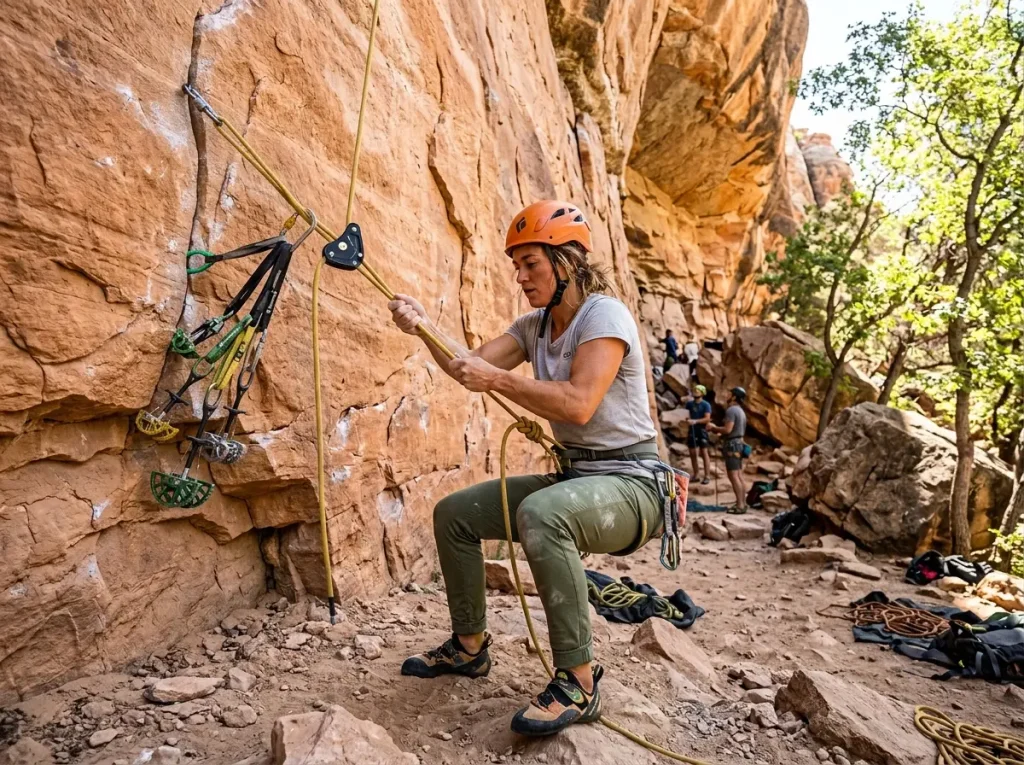
The most efficient rig is useless if the hauler quits after two minutes. Technical hauling is an athletic event, not a brute-force contest.
The Power Zone runs between mid-thigh and mid-chest — the vertical range where human force output peaks. Hauling above or below this zone loads the lumbar spine and cuts output. Check where the haul line meets your hands before pulling the first stroke. If it falls outside the zone at any point, add a change-of-direction pulley.
Pushing outperforms pulling for sustained effort. Add a final change-of-direction pulley at the anchor so the hauler faces the load and pushes downward — converting arm work to leg-and-body-weight work. As documented in Penn State ergonomics research on power zone lifting mechanics, the squat haul posture — feet shoulder-width, natural arch, drive from quads and glutes — is the same pattern as a loaded barbell back squat. Steady continuous pressure beats burst-and-pause hauling. Rotate haulers every 2–3 minutes; tired haulers create jerky pulls that shock-load the anchor.
Solo Hauling — The Most Underestimated Scenario
Solo hauling is exactly what most rescue guides skip, and exactly what most real small-party alpine incidents require.
A solo hauler using a body-weight lean — face away from the anchor, weight into the rope — sustains 60–70% of body weight as output force indefinitely. With a 70kg hauler, a 3:1 rig, and a realistic PMA of 2.4 with quality gear, you’re delivering approximately 480N sustained at the load. Enough to raise a standard-weight victim if edge friction is controlled.
The soloist problem: how do you hold the victim with the PCD while repositioning the tractor? The PCD holds automatically. Clip the haul line to your harness belay loop with a Munter hitch so both hands are free during resets — instant adjustability, no knot commitment.
The Rule of 12 in Two-Person Rescue
The Rule of 12: haulers × mechanical advantage must never exceed 12. For a 3:1 system, four haulers maximum. Exceeding this risks generating enough force to trigger PCD desheathing at the 4 kN threshold — toothed cams will destroy the rope before the anchor sees the load.
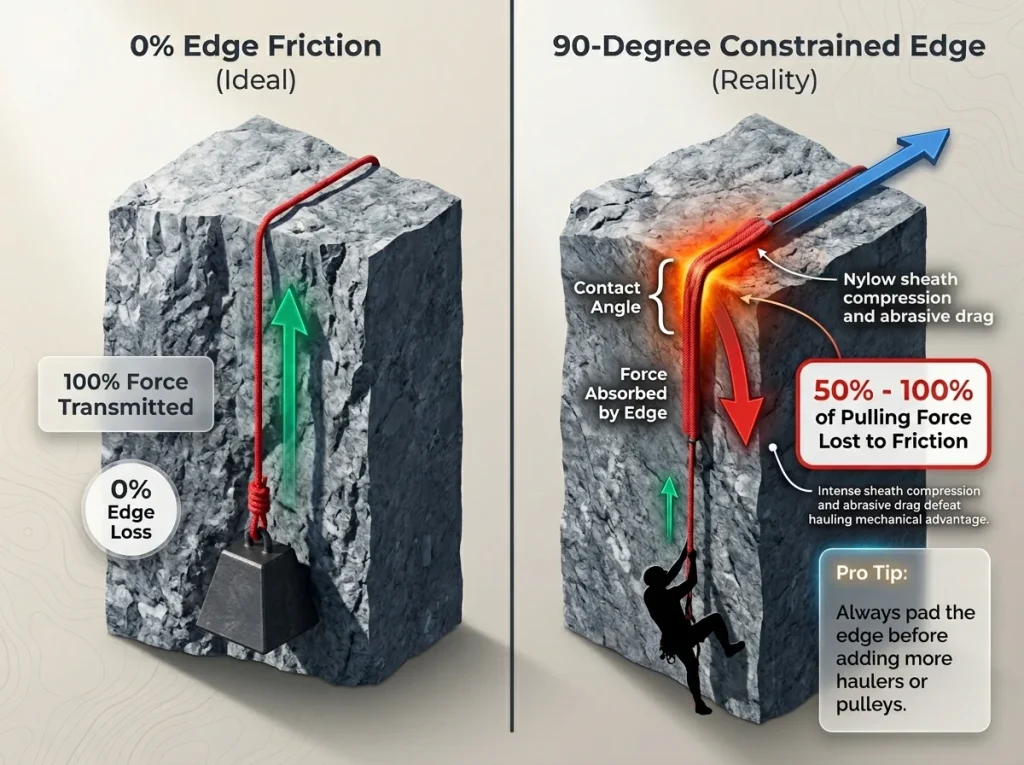
Two haulers on a 3:1 equals 6, well within range. Coordinating calls: “Ready — Haul” on a two-beat count. Never “one-two-three-PULL” — synchronous jerks double the static load through shock-loading. When the load won’t move with four haulers: check the edge before adding anyone. Edge friction absorbs 50–100% of system output and defeats every hauler you add.
For the full decision tree, see the complete protocol for managing a partner who can’t self-rescue.
Scaling the System — When 3:1 Isn’t Enough
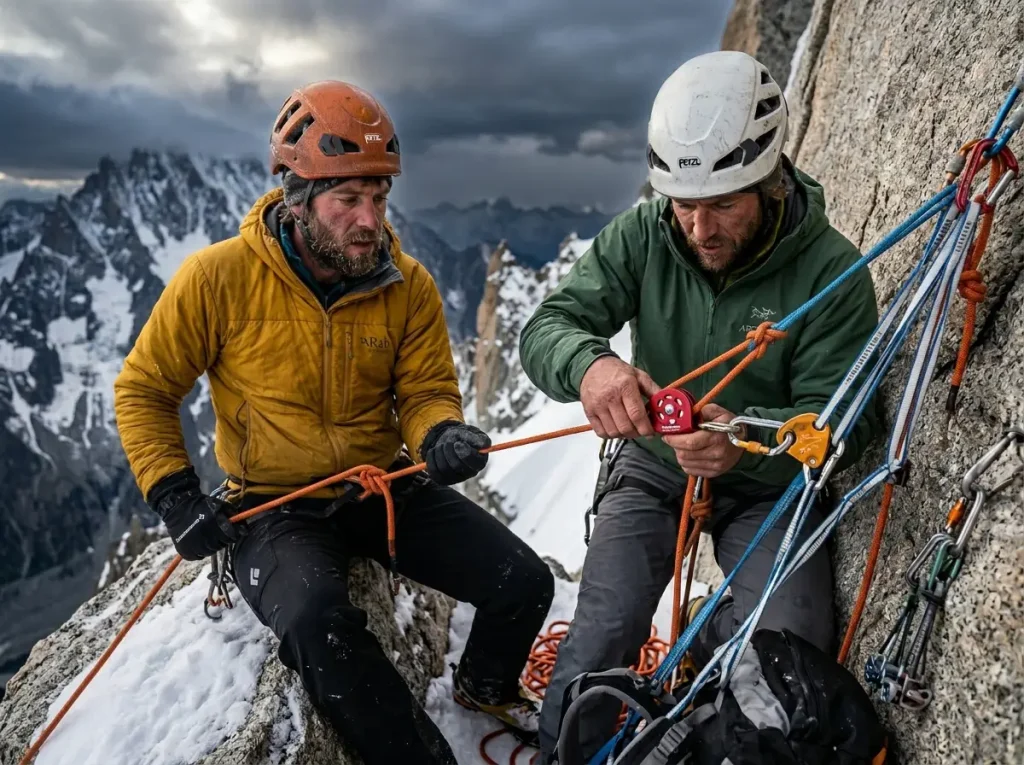
A 3:1 stalls for three reasons: victim weight exceeds hauling capacity, edge friction overwhelms system output, or inefficient hardware throughout. Diagnose which before adding complexity.
The 6:1 compound system pulls a 2:1 on the haul line of a 3:1 — the multiplication is 2 × 3 = 6:1 TMA. Three additional pulleys, two separate anchor attachment points, and six meters of rope pulled to move the load one meter. Reset frequency doubles. But here’s the friction problem: a 6:1 with all-bushing pulleys at 88% efficiency works out to roughly 3.0:1 actual — the same output as a correctly built 3:1 with bearing pulleys, but with twice the hardware and twice the setup time. For scaling from a 3:1 to a compound system in crevasse rescue scenarios, upgrade pulleys before upgrading system complexity. See Petzl’s official mechanical advantage calculation guide for technical rescue for worked PMA calculations.
Building a 6:1 Compound System
Start with the 3:1 Z-rig intact, PCD holding the load. Attach a second pulley to a separate anchor point or secondary master point. Thread the haul line through this second pulley back toward the hauler — that creates the 2:1 component. The 2:1 now pulls the haul line of the 3:1.
Hardware minimum: four pulleys total, two separate anchor attachment points. The compound system loads the original anchor at significantly higher force — verify redundancy before converting. If the anchor was marginal, the 6:1 will find out. A solid single-piece anchor that handles a 3:1 comfortably may not survive the load generated by four haulers on a 6:1.
Edge Friction — The Variable That Breaks Every Calculation
A load hauled over an unprotected rock or ice edge can lose 50–100% of output force to edge friction alone. The compound system meets this same problem — with more force feeding into it.
Edge protection: rope pad, webbing wrap, or a dedicated edge roller like the Edelrid Aramid. For glacier lips: compact the snow edge and lay a foam pad under the rope. This is a two-minute fix that can rescue a stalled system. Do it before you add a pulley.
Pro tip: When you hit system stall and the PMA math says it should be working, check the edge before diagnosing hardware or adding haulers. The edge is almost always the culprit. Fix it and feel mildly embarrassed it took you three minutes.
Three Things Worth Remembering
Friction is not a footnote — it’s the frame. Your real mechanical advantage comes from hardware choices, not rope geometry. Two carabiners will betray you at the moment you need 3:1 most.
The T-Method is the only honest diagnostic tool. Rope counting works in simple systems and fails in compound rigs. It also hides anchor loading that you’ll regret when a bolt pops or a cam walks.
The Rule of 12 protects your gear and your victim. More haulers is rarely the answer. Better hardware, protected edges, and correct body mechanics achieve what a sixth person can’t.
The next time you rack up for a technical alpine route, clip one bearing pulley and one Micro Traxion to your harness. Build the Z-rig in your living room until the resets are automatic. The difference between a field diagnosis and a field disaster is the ten minutes you spend building the system before you need it.
FAQ
Is a Z-rig a 3:1?
Yes — a Z-rig is the most common implementation of a 3:1 mechanical advantage system. The Z describes the shape of the rope path: anchor, down to the load, back up to a redirect pulley, then back down to the hauler. The hardware quality determines how much of that theoretical 3:1 you actually deliver to the load.
How do you calculate 3:1 mechanical advantage?
Count the rope strands supporting the load directly — in a Z-rig, three strands, giving 3:1 TMA. For actual PMA, multiply by the efficiency of every component: TMA × E1 × E2 × E3. With two bearing pulleys at 95% and one PCD at 85%, your real mechanical advantage hauling system delivers approximately 3 × 0.95 × 0.95 × 0.85 = 2.30:1.
What is the difference between a 3:1 and a 5:1 hauling system?
A 3:1 is a simple system — all moving components travel in the same direction as the load. A 5:1 is a complex system that adds a second traveling pulley and redirect, increasing advantage without the full rope-distance penalty of a compound rig. In practice, 5:1 systems are common in confined space rescue but rarely practical in alpine terrain due to hardware weight and rope requirements. For most climbing rescue scenarios, scale from 3:1 to a 6:1 compound before attempting a 5:1.
Can you do a 3:1 without a pulley?
Technically yes — carabiners work as substitutes in a genuine emergency. At 40–50% efficiency loss, two carabiners reduce your 3:1 to approximately 1.5:1 practical advantage. That’s marginally better than a direct haul. A 75kg victim with 1.5:1 MA requires around 500N of sustained input from the hauler. Know this before you commit to the rig — a single bearing pulley in your rescue kit changes that number significantly.
How much weight can a 3:1 haul system handle?
The hardware sets the answer, not the ratio. EN 12278 requires pulleys to sustain 22 kN — far beyond what any human team generates. The practical limits are the PCD (typically holds to 4 kN before rope diameter matters at the desheathing point), the anchor (build to exceed 15 kN for redundancy), and the rope (standard 9mm dynamic at a figure-8 knot: around 8 kN). For standard climbing rescue — a victim of 60–90 kg — a correctly built 3:1 with quality pulleys handles it. The real constraints are edge friction and hauler endurance.
Safety Notice: Rock climbing and mountaineering are inherently high-risk
activities that can involve physical trauma or fatal incidents. The information on Rock Climbing Realms is for
educational and informational purposes only. Techniques and advice presented here are not a substitute
for professional, hands-on instruction. Conditions and risks vary by location. Always seek guidance
from a qualified instructor before attempting new techniques. By using this website, you agree that you
are solely responsible for your own safety. Any reliance you place on this information is strictly
at your own risk, and you assume all liability for your actions. Rock Climbing Realms and its authors
will not be held liable for any harm, damage, or loss sustained in connection with the use of this information.
Affiliate Disclosure: We are a participant in the Amazon Services LLC Associates Program, an
affiliate advertising program designed to provide a means for us to earn advertising fees by advertising and linking
to Amazon.com. As an Amazon Associate, we earn from qualifying purchases. We are also an official affiliate partner
of Black Diamond Equipment via the AvantLink network. If you click on a Black Diamond affiliate link and make a
purchase, we may earn a commission at no additional cost to you. We also participate in other affiliate programs.
Additional terms are found in the terms of service.