
In this article
Gravity enforces a strict binary: you are either securely attached to the wall or you are falling. In the vertical world of rock climbing, language is not social currency; it is a survival mechanism. I have stood at the top of a windy pitch in Eldorado Canyon, unable to see my partner, knowing that a misunderstood command could rapidly convert a routine descent into a catastrophic system failure.
This guide dismantles the “climbing dialect”—or climbing lingo—as a Technical Operating System (TOS). It is designed to manage the physics of falling bodies, the biomechanics of human leverage, and the rigorous protocols of risk mitigation. When you step off the ground, you are entering a contract with your partner and the rock. This is the fine print for every fluent mountaineer.
How do climbers measure difficulty and ensure equipment standards?
Climbers rely on standardized grading systems and rigorous equipment certifications to quantify technical risk and ensure gear reliability.
What do the numbers and grades actually mean?
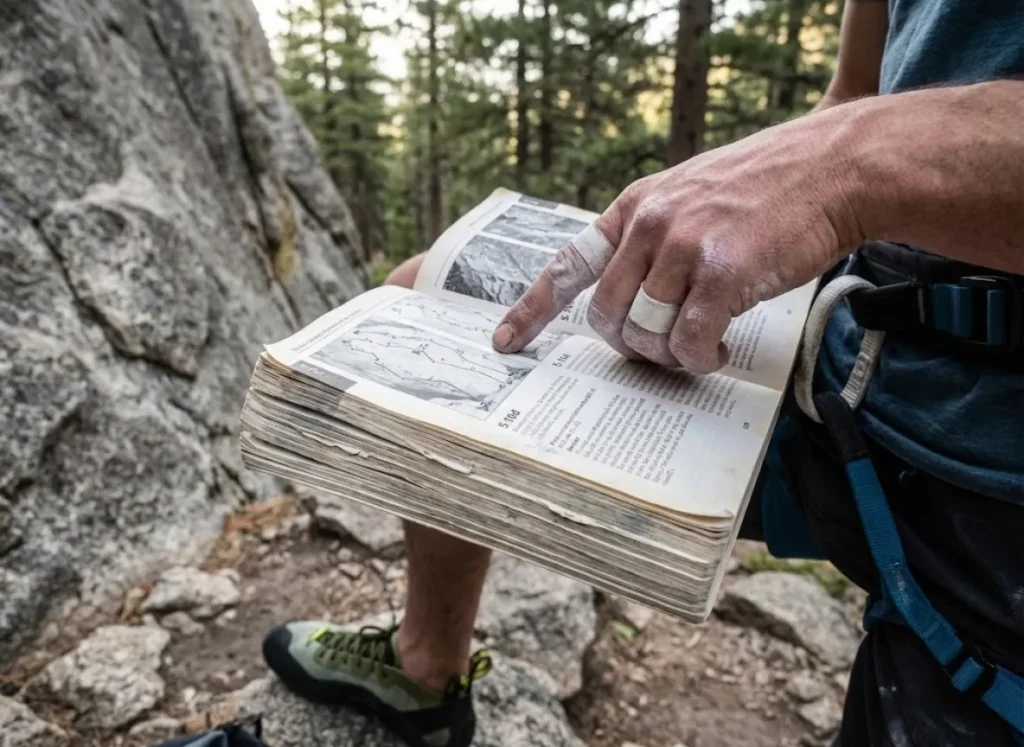
The Yosemite Decimal System (YDS) defines North American technical climbing. While “Class 1” is hiking, “Class 5” denotes vertical rock requiring a climbing rope to mitigate fatal consequences. The decimal following the 5 (e.g., 5.9, 5.10) quantifies difficulty. The scale evolved from a “closed” system ending at 5.9 in the 1970s to an “open” system that currently reaches 5.15d for the hardest sport climbing routes.
Understanding these numbers is vital for travel to any climbing area. A YDS 5.10b equates roughly to a UIAA VII or a French 6a. For a comprehensive sport climbing grades comparison, you must look at how local geologies influence these conversions. Nuance indicators like “a/b/c/d” (YDS) or “+” (French) provide granular detail on the sustained nature or crux intensity of a climbing route.
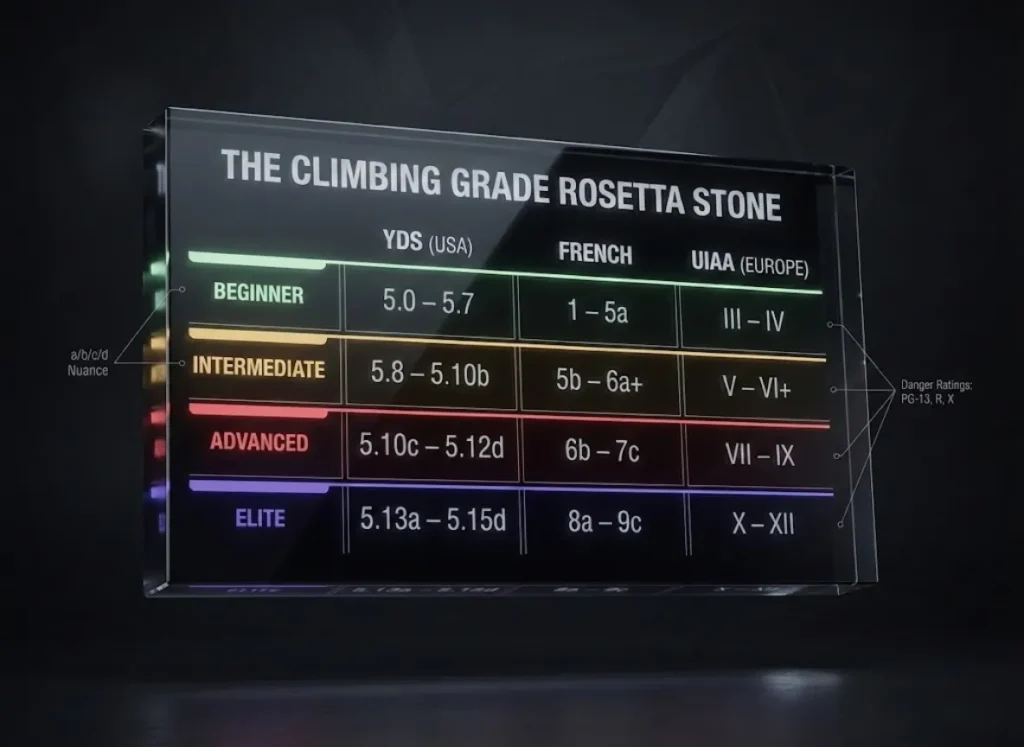
Subjectivity and “sandbagging” complicate the math. Local ethics in historic areas like Joshua Tree or the Gunks often dictate harder grades for the same physical difficulty compared to modern climbing walls. Sport climbing vs. traditional climbing grading also differs significantly. Sport grades often account for the stamina required for a whole pitch, while trad climbing grades may focus on the single hardest move.
You must also master the “Danger Ratings” (PG-13, R, X). These modify the numerical climbing grade to indicate runouts (distance between gear) and the consequence of a fall. Once you can quantify the challenge of the rock, you must verify the reliability of the climbing equipment you trust using the UIAA safety standards for climbing and mountaineering equipment. This ensures gear like your harness and helmet meet ANSI or ASTM standards to withstand the forces generated during a fall.
What are the tools of the trade and how do they work?
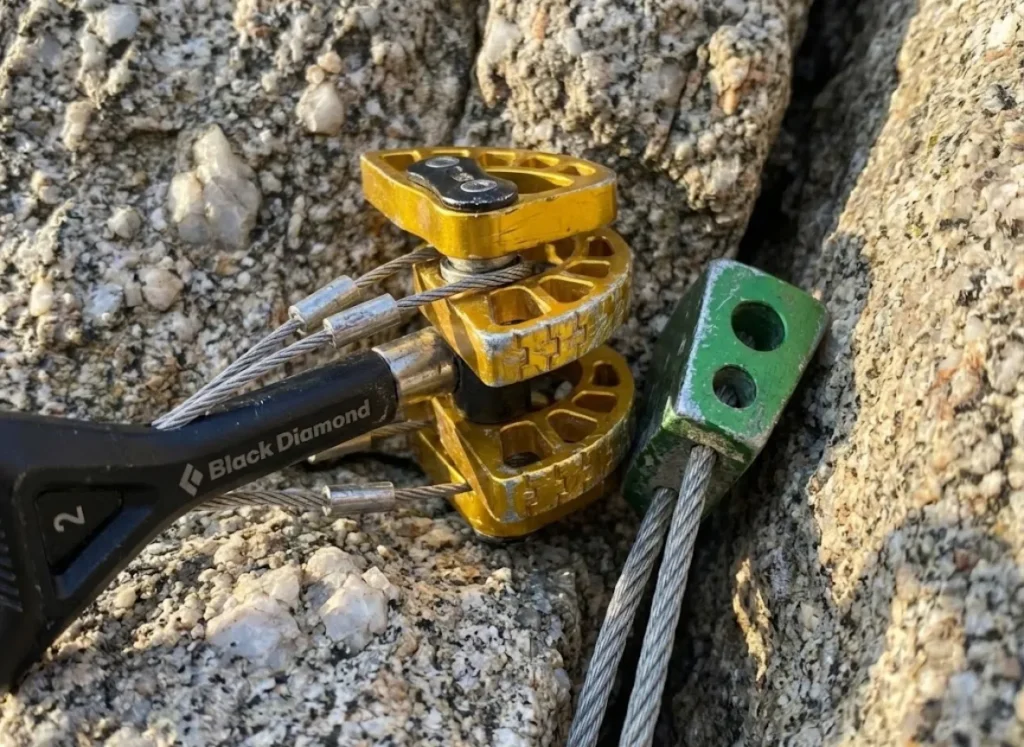
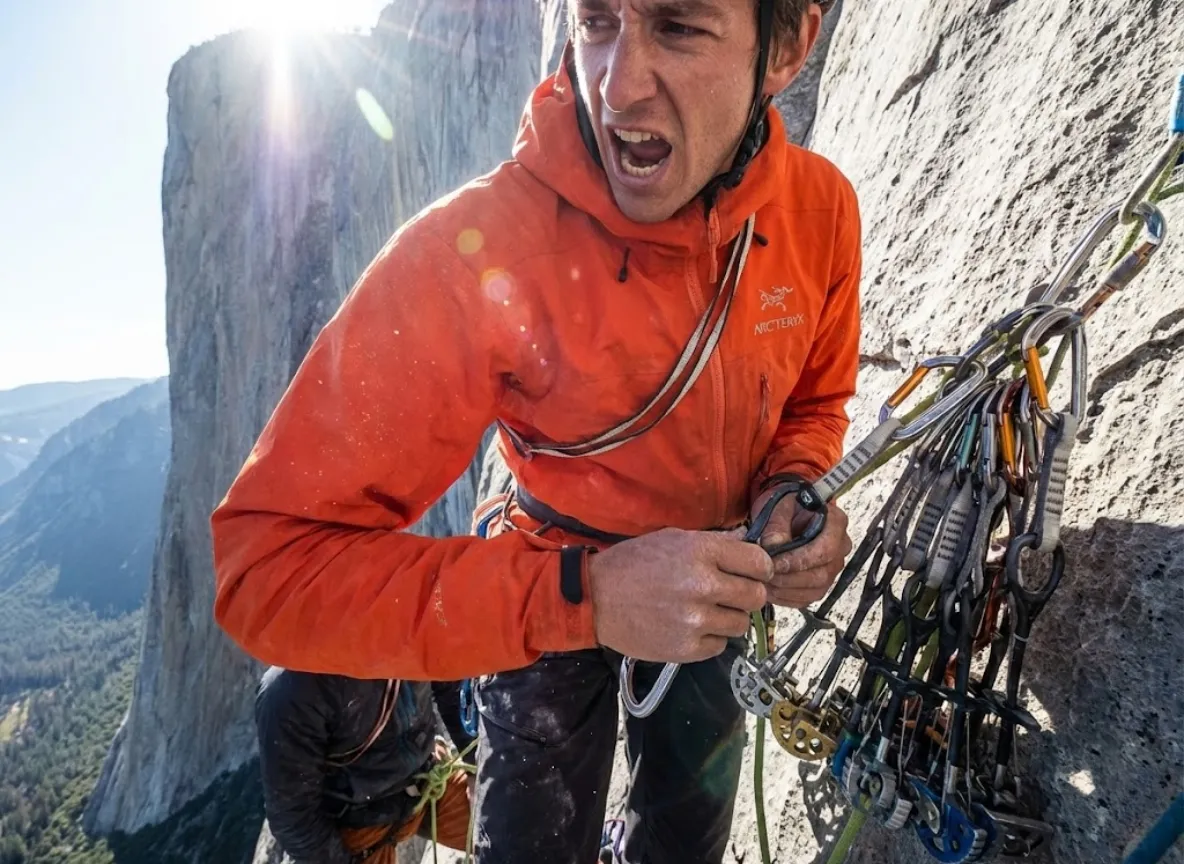
Climbing protection is categorized into “passive” gear (nuts/hexes) that wedges into cracks, and “active” gear (cams) that uses mechanical expansion to hold falls.
How does “Active” vs. “Passive” protection differ?
Passive Protection (Nuts/Stoppers) acts as a simple wedge. These pieces rely on the constriction of a tapering crack to hold a fall without moving parts. They are the foundation of a traditional climbing rack because they are lighter and fail less often than complex machinery. However, placing a nut requires an artist’s eye for rock geometry to create a solid anchor point.
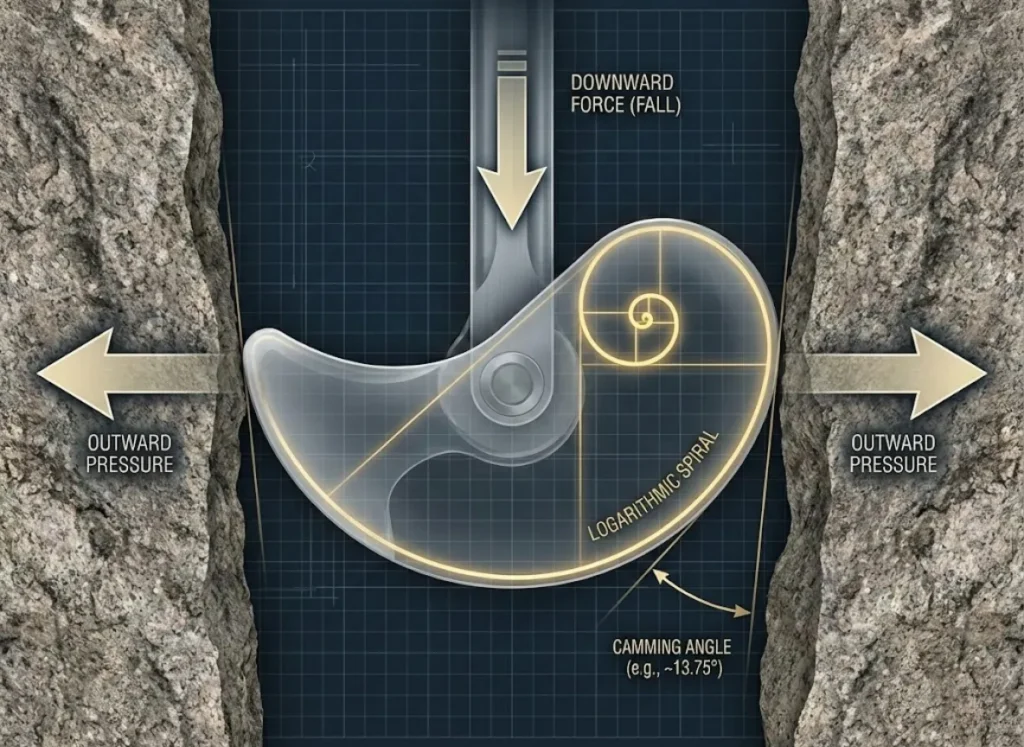
Active Protection (Cams/SLCDs) utilizes a spring-loaded mechanism. They rely on the geometry of the Logarithmic Spiral to translate downward force into outward pressure against parallel crack walls. To trust your life to a mechanical climbing device, you must understand the mechanics of spring-loaded camming devices, specifically how the lobes expand and contract.
Hexentrics (or Hexes) occupy a middle ground. They function primarily as large nuts but are capable of a passive “camming” rotation when weighted. Regardless of the type, the term “Bomber” refers to a placement that is mechanically perfect and unquestionably secure. Whether you are using a nylon sling or a spectra cordelette, redundancy is key.
Pro-Tip: Always extend your placements with “alpine draws” (slings) on wandering routes. This reduces rope drag and prevents “Walking”—a phenomenon where rope movement wiggles a cam deeper into a crack, often making it impossible to retrieve.
Camming Angles dictate performance. A smaller angle (e.g., ~13.75°) generates higher outward holding power but offers a narrower expansion range. Buying criteria usually centers on Expansion Range, balancing the need for a specific fit against versatility. All modern gear, from your belay device (like an ATC or GriGri) to your quickdraws, should meet UIAA certified equipment protocols, ensuring rigorous testing before it hits your climbing harness.
How does the body interact with the rock?
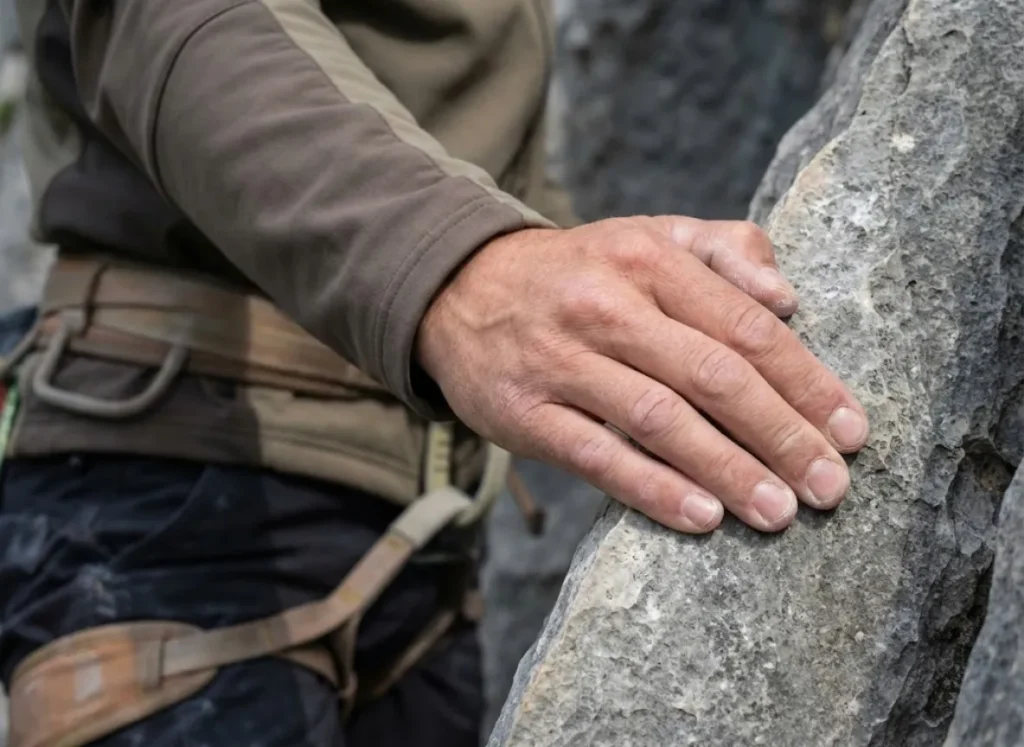
Efficient climbing relies on distinct grip types and body positions that maximize leverage while minimizing strain on connective tissues.
What are the physiological risks of different grips?
The Crimp is the most aggressive grip in rock-climbing technique. It involves flexing the PIP joint to 90-100° and hyperextending the DIP joint to utilize small edges. While effective for hardest moves, it places massive stress on the soft tissue of the fingers. It is often the default on vertical face climbs.
Conversely, the Sloper (Open Hand) relies on friction and surface area contact with the PIP joints extended. This requires significant body tension but spares the fingers, common on bouldering problems. Pockets isolate specific tendons, creating high loads on individual digits, particularly in “mono” or two-finger pockets. A jug is the opposite: a large, secure hold that offers a moment of relief.
The Gaston requires internal rotation and abduction of the shoulder to push outward against a vertical hold, the inverse of a sidepull. This move is notorious for causing shoulder impingement if performed with poor posture. Other complex positions include the undercling (pulling up on an inverted hold) and the pinch (squeezing a feature).
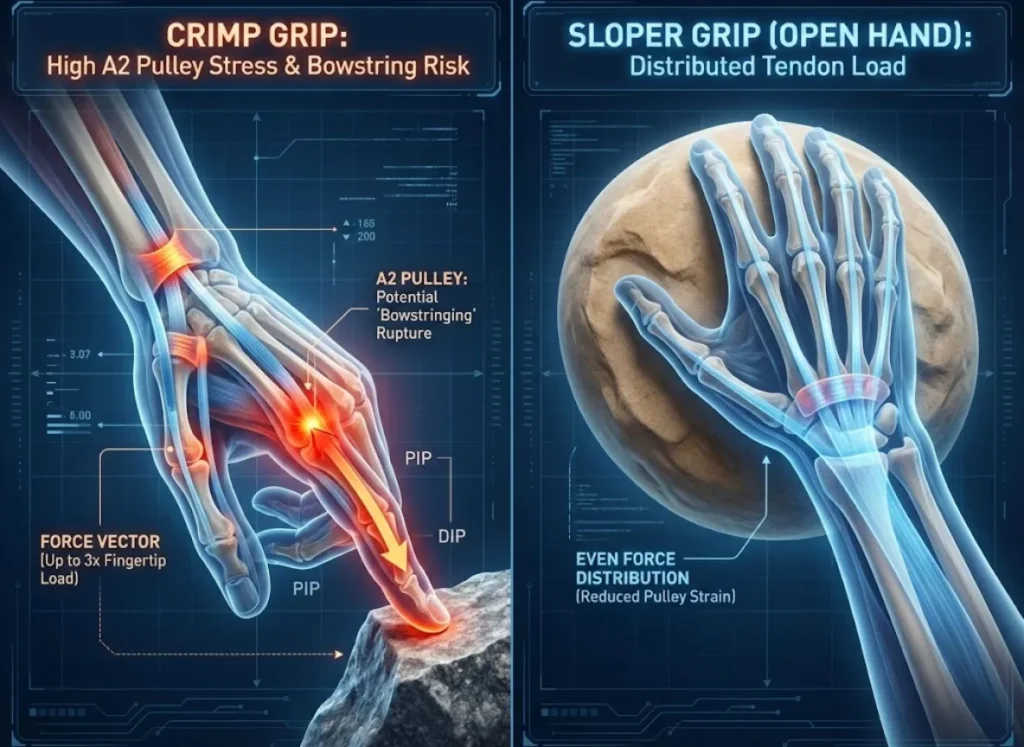
Medical concern centers on A2 Pulley Loads. A specific biomechanical analysis of the crimp grip position shows that crimping can generate forces on the A2 pulley up to three times the load at the fingertip. This can lead to “Bowstringing”, a career-altering rupture of the flexor tendon sheath.
To prevent this, climbers should study a detailed breakdown of climber’s hand anatomy. Understanding your own physiology is the first step in injury prevention. Proper footwork, such as smearing on slab, edging on tiny crystals, or flagging a leg for balance, reduces the load on your hands. Dynamic moves like a dyno or deadpoint transfer energy but increase risk.
Pro-Tip: Prioritize the Open Hand grip during training. It distributes force more evenly across the tendon sheath and reduces pulley strain. Save the full crimp for the crux moves on your project.
What are the protocols that keep climbers alive?
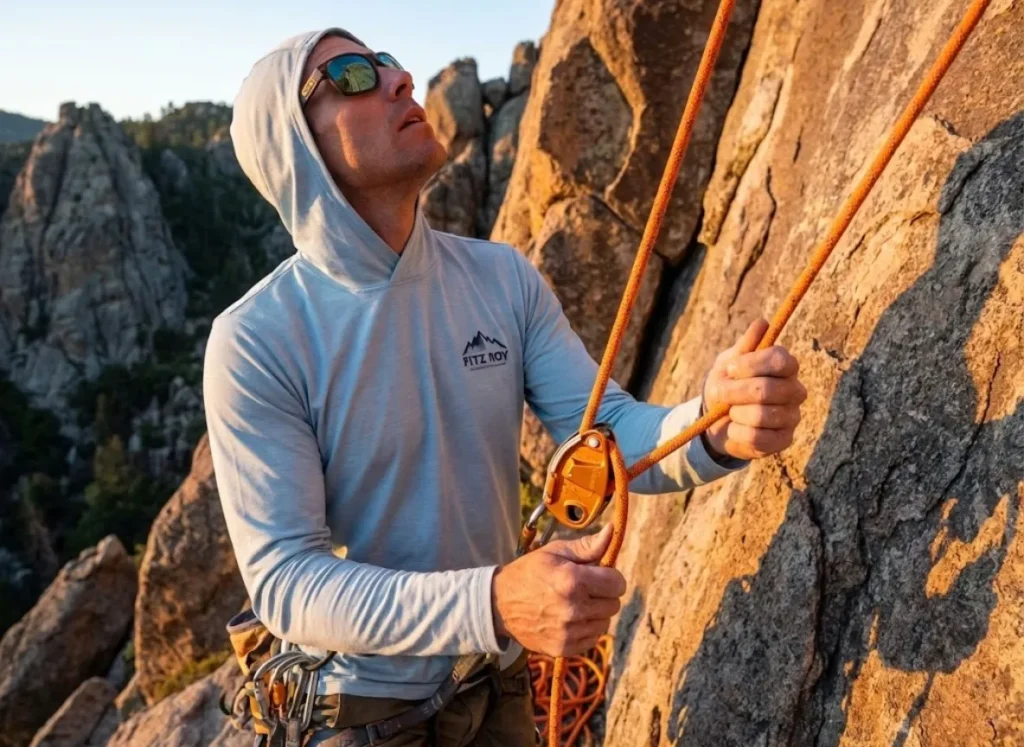
Climbing safety relies on a “closed-loop” communication system where every command is explicitly acknowledged before any action is taken.
What is the “Safety Loop” of verbal commands?
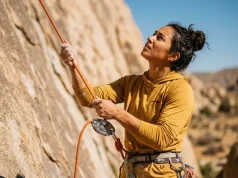
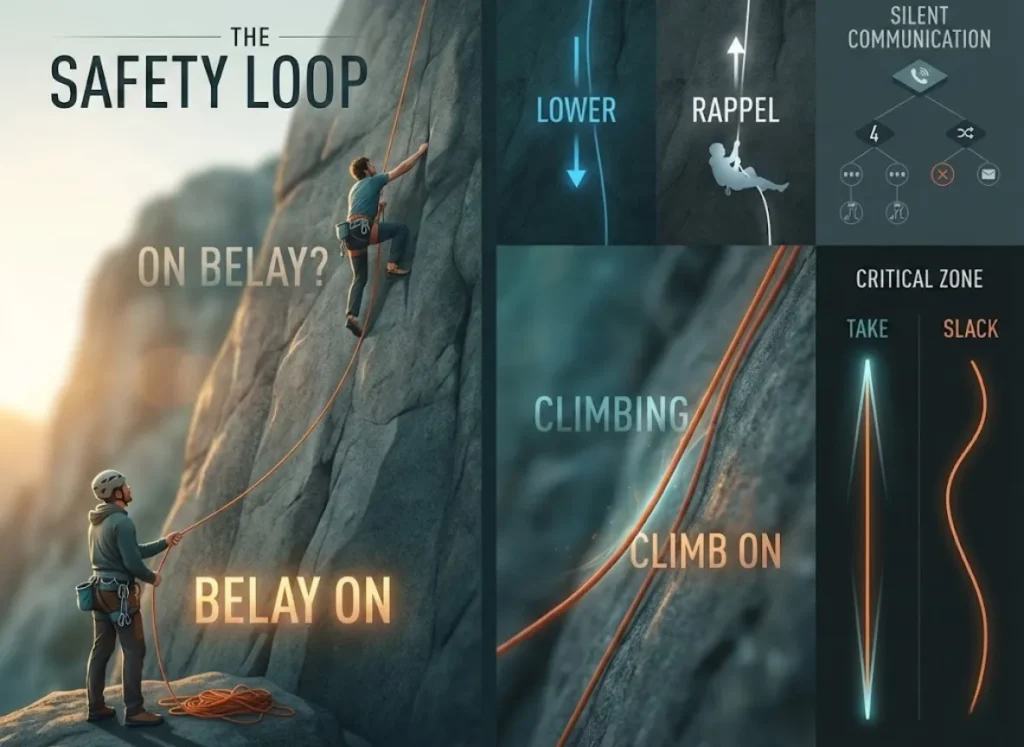
The Standard Exchange (“On Belay?” -> “Belay On” -> “Climbing” -> “Climb On”) is non-negotiable. It creates a closed loop where action cannot proceed without confirmation between the lead climber and the belayer. Ambiguity here is fatal.
“Take” vs. “Slack” are opposite commands often shouted in panic. “Take” demands a static line to support weight. “Slack” requests climbing rope for movement. Mixing these up while a climber is clipping a quickdraw can lead to a ground fall.
“Off Belay” is a binary declaration. It means the climber is independently anchored and safe. It authorizes the belayer to detach from the climbing system completely. Never use this phrase casually.
The most dangerous confusion occurs between “Lower” vs. “Rappel” (or abseil). “Lower” implies the belayer controls the descent using the belay device. “Rappel” implies the climber controls their own descent on the rope. You must master the protocols for cleaning sport anchors safely to understand why miscommunicating this specific transition affects experienced climbers every year.
Communication Failures are statistically significant contributors to trauma. The American Alpine Club provides a sobering analysis of climbing accidents and communication failures that highlights the cost of unclear speech.
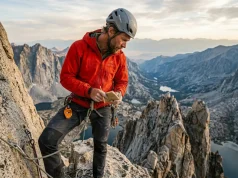
On multi-pitch routes where wind obscures voice, the Silent Communication Protocol (Rope Tugs) becomes mandatory. Standardized tugs (e.g., 4 distinct tugs for “On Belay”) must be agreed upon on the ground. Never detach the belay based on a single felt tug; rope drag on an arête or inside a chimney can mimic a signal.
What are the unwritten rules of the crag?
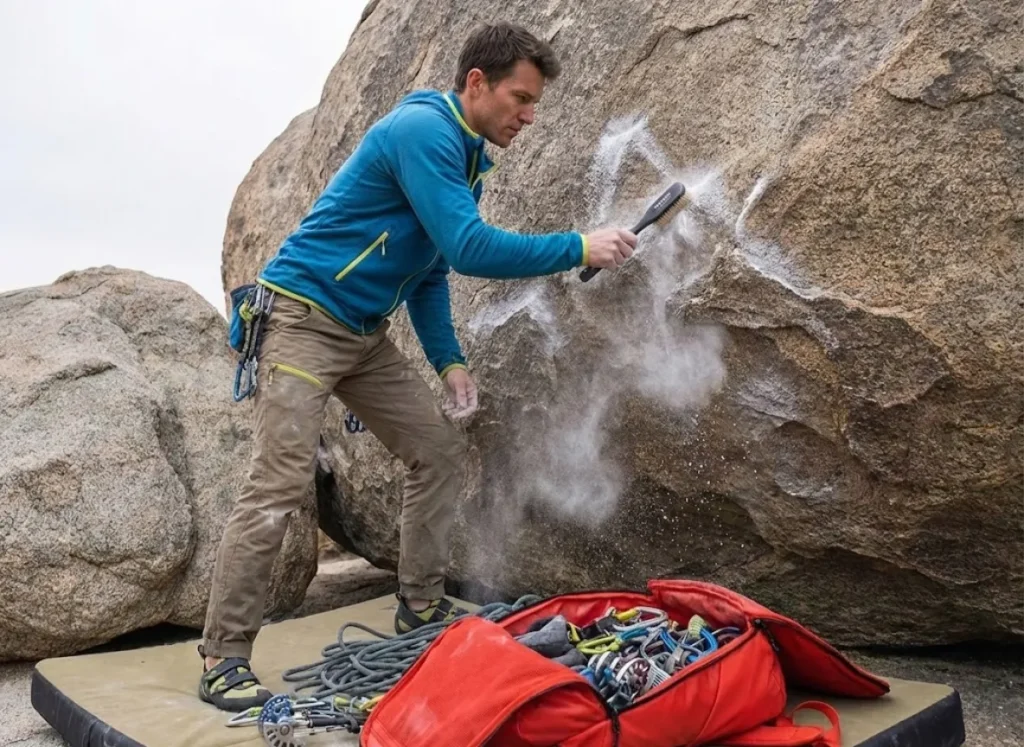
Crag etiquette centers on “Leave No Trace” principles, preserving access, and respecting the shared experience of other climbers.
How does stewardship impact access?
LNT (Leave No Trace) is the baseline ethic. This requires packing out all trash, including micro-trash like tape and cigarette butts. In desert environments like Moab or Red Rocks, “Wag Bags” are mandatory because soil enzymes cannot break down human waste effectively.
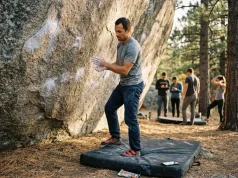
Tick Marks used to highlight holds with climbing chalk must be brushed off after your session. Leaving them is considered visual pollution and robs other climbers of the “on-sight” puzzle. Loose, dangerous rock is known as “Choss.” Climbing on it endangers everyone at the base; trundling rocks without warning is a severe safety violation.
Crag Stewardship involves active participation in maintaining access. This includes respecting closures for raptor nesting or cultural sites. By committing to The Climber’s Pact, you ensure that land managers view climbers as partners rather than liabilities.
Beta Spraying (unsolicited advice) violates the social protocol. Unless safety is at risk, let others solve the bouldering problem or route themselves. Adhering to The Access Fund’s conservation principles helps preserve these climbing areas for the next generation.
Conclusion
Climbing lingo is not about sounding cool; it is about precision under pressure. Grading is nuanced, requiring translation between YDS and French systems to gauge risk accurately. Gear is physics, where understanding “Camming Angles” helps you build anchors that hold. Words save lives, specifically the rigid distinction between “Lower” and “Rappel.” Finally, Grip matters, as biomechanics determine whether you send the route or rupture a pulley.
Take this knowledge to the crag, but start slowly. Practice your communication protocols on the ground before you commit to the vertical world. Share your experiences with learning the “dialect of survival” in the comments below.
FAQ – Frequently Asked Questions
What is the difference between Redpoint and On-sight?
On-sight means climbing a route successfully on the first try with no prior information. Redpoint involves successfully climbing a route freely (no hanging) after projecting or practicing it previously.
Why do climbers say Take?
Take is a command instructing the belayer to remove all slack and support the climber’s weight with the rope immediately. It is used when resting or preventing a fall.
What is a Gumby in climbing slang?
Gumby is a colloquial term for an inexperienced or clumsy climber. It typically describes someone who lacks situational awareness or technical proficiency.
What does Beta mean?
Beta refers to specific information or advice about how to complete a climb. The term originated from the Betamax tape format, as climbers used to record themselves to study moves.
Safety Notice: Rock climbing and mountaineering are inherently high-risk
activities that can involve physical trauma or fatal incidents. The information on Rock Climbing Realms is for
educational and informational purposes only. Techniques and advice presented here are not a substitute
for professional, hands-on instruction. Conditions and risks vary by location. Always seek guidance
from a qualified instructor before attempting new techniques. By using this website, you agree that you
are solely responsible for your own safety. Any reliance you place on this information is strictly
at your own risk, and you assume all liability for your actions. Rock Climbing Realms and its authors
will not be held liable for any harm, damage, or loss sustained in connection with the use of this information.
Affiliate Disclosure: We are a participant in the Amazon Services LLC Associates Program, an
affiliate advertising program designed to provide a means for us to earn advertising fees by advertising and linking
to Amazon.com. As an Amazon Associate, we earn from qualifying purchases. We are also an official affiliate partner
of Black Diamond Equipment via the AvantLink network. If you click on a Black Diamond affiliate link and make a
purchase, we may earn a commission at no additional cost to you. We also participate in other affiliate programs.
Additional terms are found in the terms of service.