
In this article
A 14-year-old walked into the adult 1996 US Open Bouldering Nationals and won it outright. That kid was Chris Sharma, and for the next 25 years he kept doing one strange, specific thing: every few years, he put up a route the whole climbing world agreed was the hardest on Earth.
Most biographies hand you a tick list of grades and call it done. The story worth telling is what each of those sends actually changed, plus the human, anti-ego details that happened around them. Here’s the arc through his five landmark climbs, with the grades decoded for anyone still learning the scale.
Before the Rock, a Gym Rat from Santa Cruz
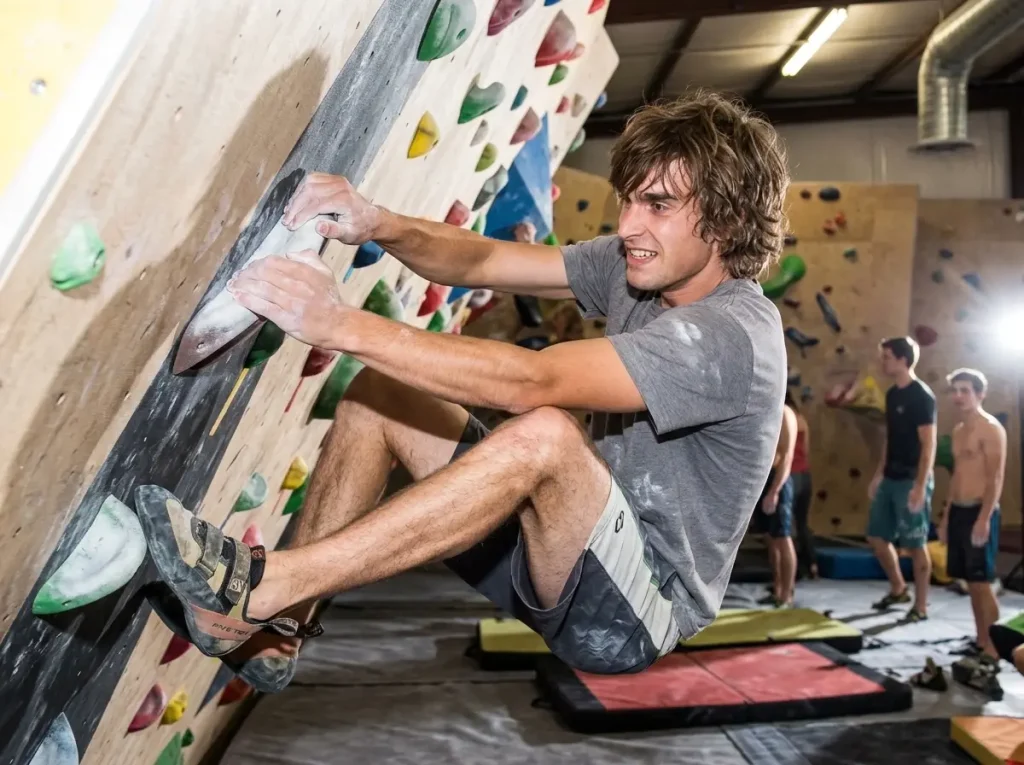
Sharma didn’t come up through alpine clubs or a long trad apprenticeship. He came up on plastic, in a gym, which at the time made him part of the very first generation to do it that way. That one detail explains more about how he moves than any single grade does.
A Buddhist Kid Raised on Plastic
Chris Omprakash Sharma was born April 23, 1981, in Santa Cruz, California, the only child of parents who followed the teacher Baba Hari Dass. The home was Buddhist and quiet, a little countercultural.
People love to call Sharma’s presence on the wall “zen,” like it’s a press line. It isn’t. It’s how he was raised, and it shows up later in the way he treats a 50-move limit route like a meditation instead of a fight.
He started climbing at 12 at Pacific Edge Climbing Gym, a few minutes from home. If you grew up pulling on plastic before you ever touched real stone, you’re walking a path Sharma helped cut. Some of his earliest outdoor sessions happened on the Santa Cruz–area granite near home, the kind of low, friendly rock where a gym kid finally learns what friction actually feels like under real shoes.
Beating Grown Pros at 14
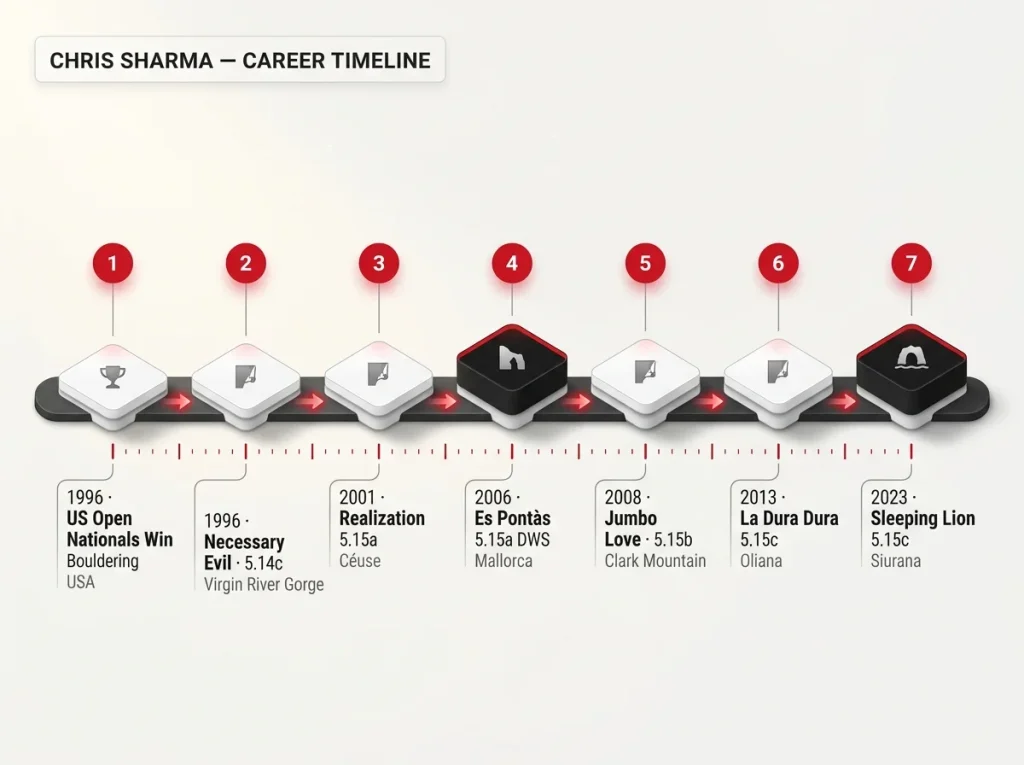
Two years after his first session, Sharma entered the adult 1996 US Open Bouldering Nationals and won. He was 14. Working professionals, people who had been climbing longer than he’d been alive, finished behind a teenager.
That part is hard to oversell. Talent shows up in climbing constantly, but a 14-year-old beating the national field is a different kind of prodigy. The climbing world noticed him immediately, and it never really stopped watching.
The First “Gym-Generation” Climber
At 15, Sharma freed Boone Speed’s project Necessary Evil (5.14c) in Arizona’s Virgin River Gorge, then the hardest sport route in North America. He had done the hardest climb on the continent before he could legally drive himself to the crag.
He later called himself one of the first climbing-gym-generation kids, and the label stuck because it fit. The jump from bouldering power to sport-climbing endurance came easily to him in a way it didn’t for climbers raised on long days of placing gear. He had a boulderer’s explosive strength and the patience to spread it across a 100-foot wall.
From Comp Kid to the World’s Best Sport Climber
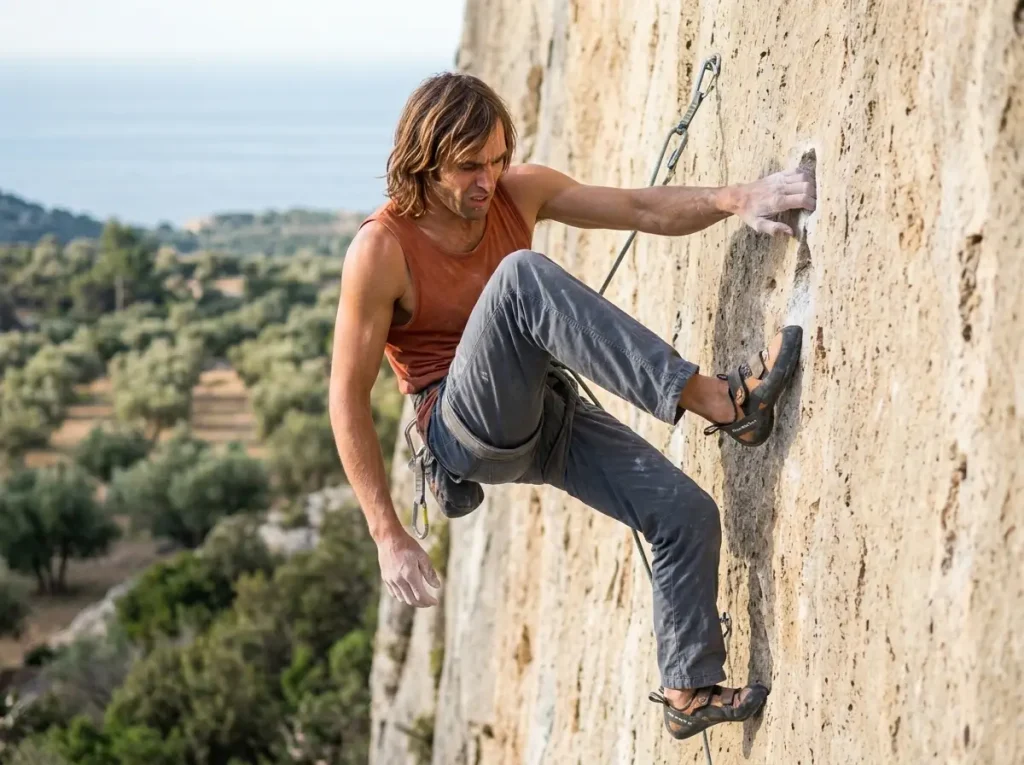
Most people meet Sharma at “the 5.15 guy.” The road there is the fun part, and it ran straight through the American bouldering boom before it ever reached European limestone.
The Bouldering Revolution (Bishop, The Mandala)
Before he was a sport-climbing name, Sharma was a bouldering force. He established The Mandala in the Buttermilks above Bishop, California, then spread that power across the map with the savage Hueco boulder Witness the Fitness and the futuristic Dreamcatcher up in Squamish, one of the hardest routes on the continent at the time. The climbing films of that era, the Rampage and Dosage videos, turned his powerful, ground-up style into the template a whole generation tried to copy.
You can see his full chronology of landmark first ascents laid out plainly, and the pattern jumps out fast: he rarely repeated other people’s hardest routes. He went looking for the next one nobody had done.
Crossing the Atlantic for Limestone
By his early twenties Sharma had relocated his focus to Europe, where the steep limestone of France and Spain rewarded exactly his blend of power and stamina. Céüse, Oliana, Siurana, Margalef: these became his offices. He could onsight hard when he wanted, but his legend was built on projecting: returning to a single route session after session, sometimes for years, until it went.
That willingness to fail on the same moves for months is the least glamorous part of his story and the most important. Bishop made him strong. Spain made him patient.
The Mantle from Güllich to Ondra
For a stretch in the 2000s, Sharma was simply the strongest sport climber alive. He inherited that unofficial title from the German hardman Wolfgang Güllich, the man behind Action Directe, and he held it until a young Czech named Adam Ondra took it around 2012. Sharma is the bridge between those two eras, the link from the 1990s German standard to the modern Ondra-and-Garnbret generation.
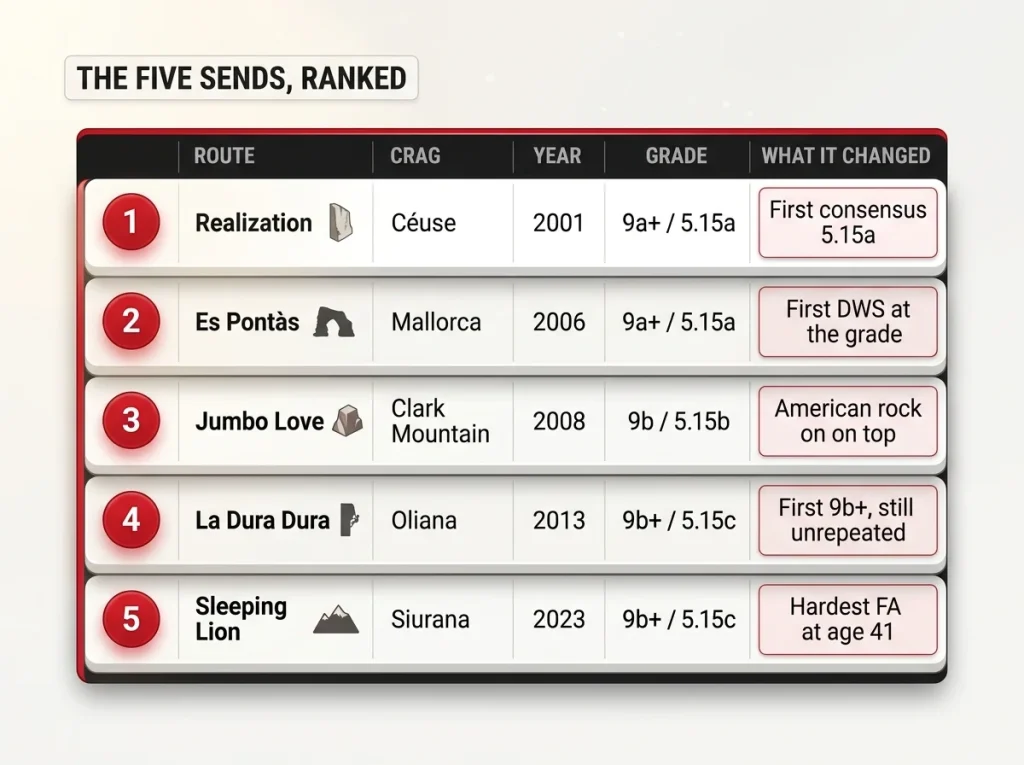
The Five Sends, Ranked by What They Changed
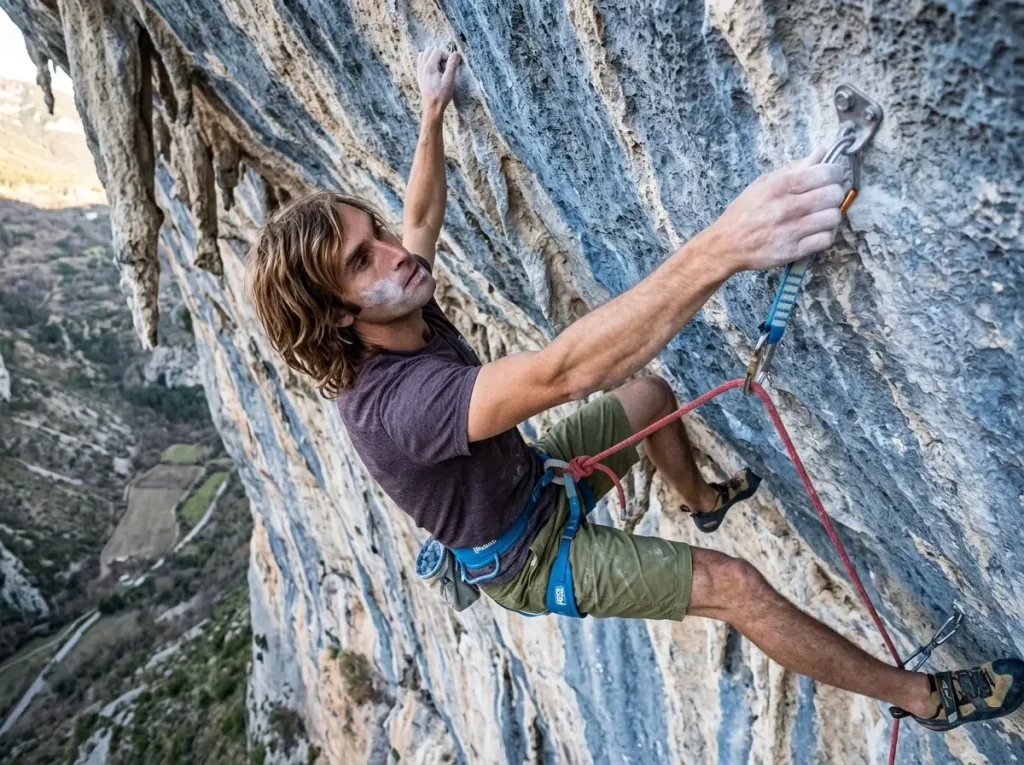
Anyone can list his ticks. What a climbing buddy actually tells you is why each one mattered, and on that scale Sharma’s record is almost unfair. These five sends are the reason his name sits on the short list of legendary American climbers who changed the sport.
Quick grade decoder first, because competitors love to skip it: in the French/UIAA system, 9a+ equals 5.15a, 9b equals 5.15b, and 9b+ equals 5.15c. When you see Sharma credited with the “first 9a+,” read it as the first time anyone climbed something the world agreed deserved a brand-new number at the top of the scale.
Realization and the Birth of 9a+
On July 18, 2001, at Céüse in France, Sharma made the first ascent of Realization, the line the world accepted as the first consensus 5.15a (9a+). He didn’t bolt it from nothing. The lower half had been freed by Arnaud Petit in 1996, and the whole feature was bolted back in 1989 by Jean-Christophe Lafaille, who named it Biographie. Sharma linked the existing pieces into a single route nobody had managed to climb top to bottom, after 30-plus attempts and skipping a Bouldering World Cup to focus on it.
This is the route that became the world’s first consensus 9a+, and its real legacy is everything that came after. Every 5.15 on the planet traces back to the moment Realization proved the grade existed. Margo Hayes made the first female ascent in 2017, which only underlined how far ahead of its time the line had been.
The footage is worth more than any description, because the thing text can’t capture is how fluid he looks on holds most climbers couldn’t hang.
The lesson of Realization isn’t the grade, it’s the 30 attempts. Climbers who break into their own next number almost always do it by returning to one project past the point of being sick of it, not by trying something new every weekend. Pick a route slightly beyond you and stop switching.
Jumbo Love Puts American Limestone on Top
In 2008, at Clark Mountain in California, Sharma redpointed Jumbo Love, the world’s first consensus 5.15b (9b). The significance here is geographic as much as athletic. Up to that point, the very hardest sport routes lived in Europe. Jumbo Love proved American limestone could hold the hardest line on the planet, on home soil, and it announced that the cutting edge wasn’t a European monopoly.
La Dura Dura, the Project He Almost Gave Away
This is the one that shows you who Sharma actually is. He bolted La Dura Dura in Oliana, Spain, back in 2009, looked at it, and figured it was beyond him, something for the next generation. Then Adam Ondra, who sent La Dura Dura first on February 7, 2013, did exactly that, claiming the first ascent of the world’s first 9b+ (5.15c). Sharma followed with the second ascent on March 23, 2013, about six weeks later.
Read that sequence again. He bolted the route, nearly gave it up, watched a younger climber send his project first, and then sent it himself anyway. The community line that it was a “rivalry” gets the whole thing backward. They worked the moves together, shared beta, and pushed each other, which is the same obsessive, shared-suffering projecting that powered Tommy Caldwell’s Dawn Wall a couple of years later.
As of 2026, La Dura Dura still has no third ascent. One send can redraw the map the same way Lynn Hill’s free ascent of the Nose did a generation earlier, and this is one of those sends.
Deep-Water Soloing and the Psicobloc Era
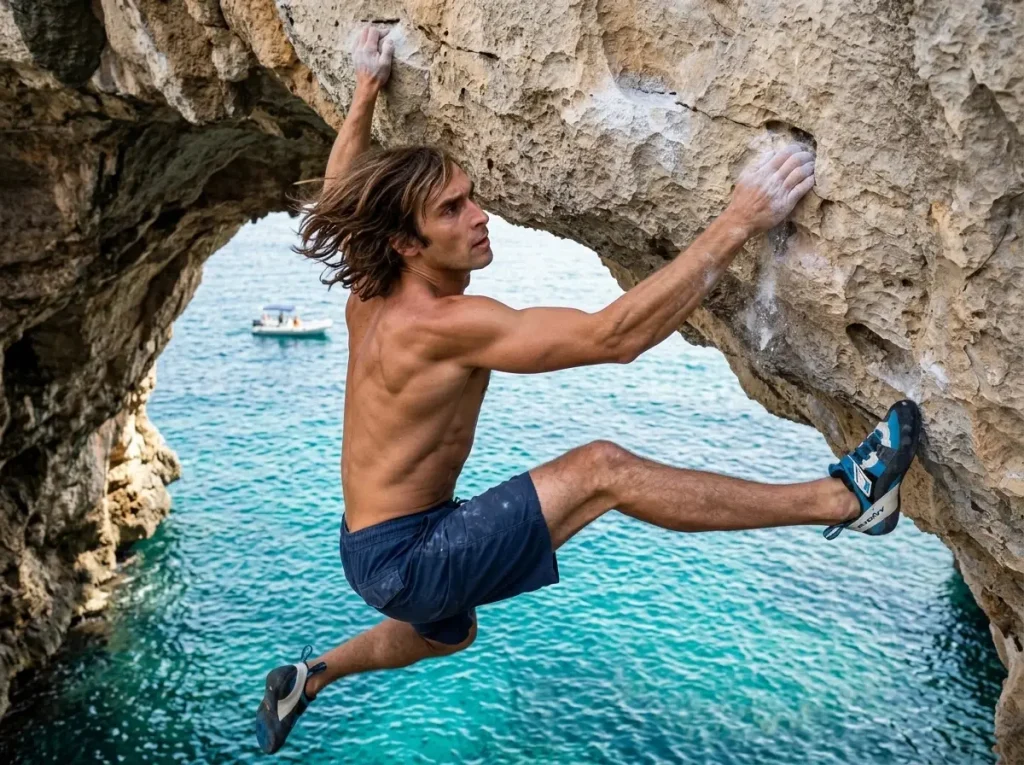
Picture the cleanest version of climbing: no rope, no harness, no gear at all, just you on an overhanging sea cliff with deep water below to catch the fall. That’s deep water solo, and Sharma is the person who pushed it to its modern limit.
The 7-Foot Dyno Over the Mediterranean
In September 2006, off the coast of Mallorca, Sharma made the first ascent of Es Pontàs, a line graded 9a+ (5.15a) and the first deep-water solo at that grade. The crux is a roughly 7-foot dyno, a committing leap off a natural sea arch to a hold you either stick or miss. He missed it something like 50 times, falling into the Mediterranean over and over before the one go that connected. Captured in the film King Lines, it remains one of the most cinematic moments in climbing, and it basically invented hard psicobloc as a discipline.
DWS Is Not Free Soloing (the Honest Version)
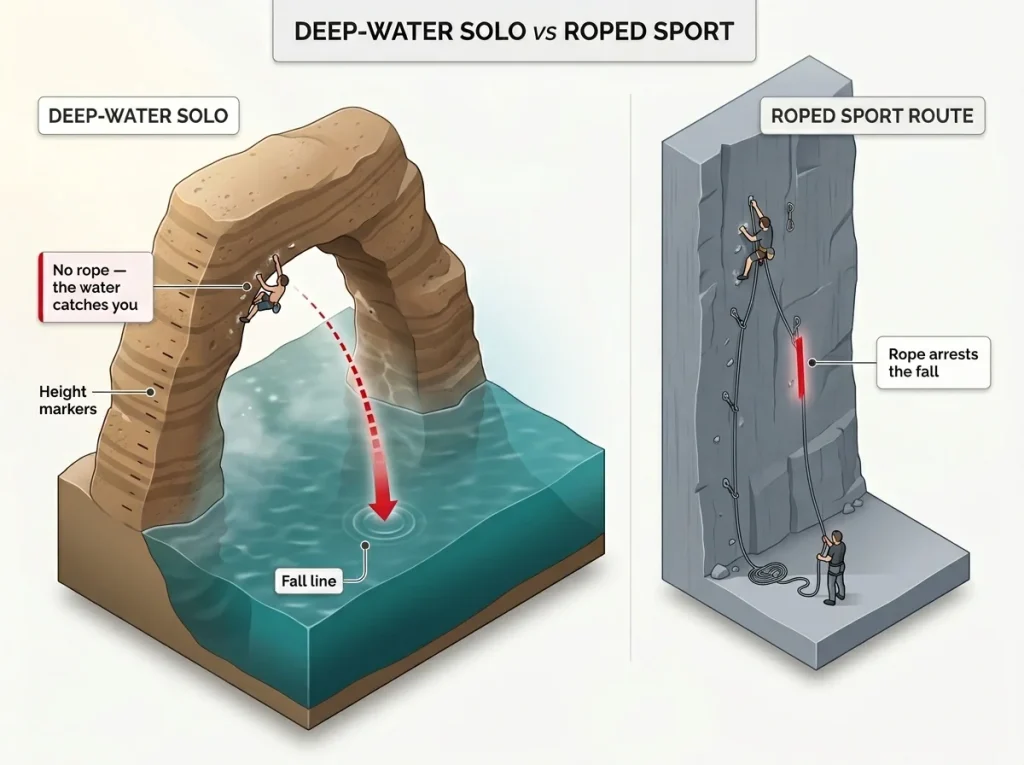
Newer climbers see the no-rope footage and file it next to free soloing. It isn’t the same thing, and the difference matters. In free soloing, a fall ends on the ground. In deep-water soloing, the sea is your rope.
But here’s the honest part most highlight reels skip: the water cushions the fall, it does not erase the risk. From real height a flat back-slap, a bad entry, or hitting the surface wrong is genuinely hazardous, and a long fall can knock the wind out of you before you swim. If the footage made you want to try it, learn the ropes first with a proper guide to getting into deep-water soloing without getting hurt rather than scrambling up the first sea cliff you find.
First-timers on deep water consistently underestimate two things: how hard the water hits from height, and how tiring the swim back to the boat or shore is after a fall. Start low, practice falling on purpose from a height that feels almost boring, and never solo over water you haven’t watched someone else enter first.
Turning Psicobloc Into a Spectator Sport
Sharma didn’t just climb psicobloc, he helped package it for crowds. He co-founded the Psicobloc Masters, a head-to-head competition on a man-made wall over a swimming pool, and if you want the full picture of the Psicobloc Masters format he helped build, it’s one of the few comp formats that translates the raw drama of his Mallorca sends into something a stadium can follow.
Why He Still Climbs 5.15c at 41
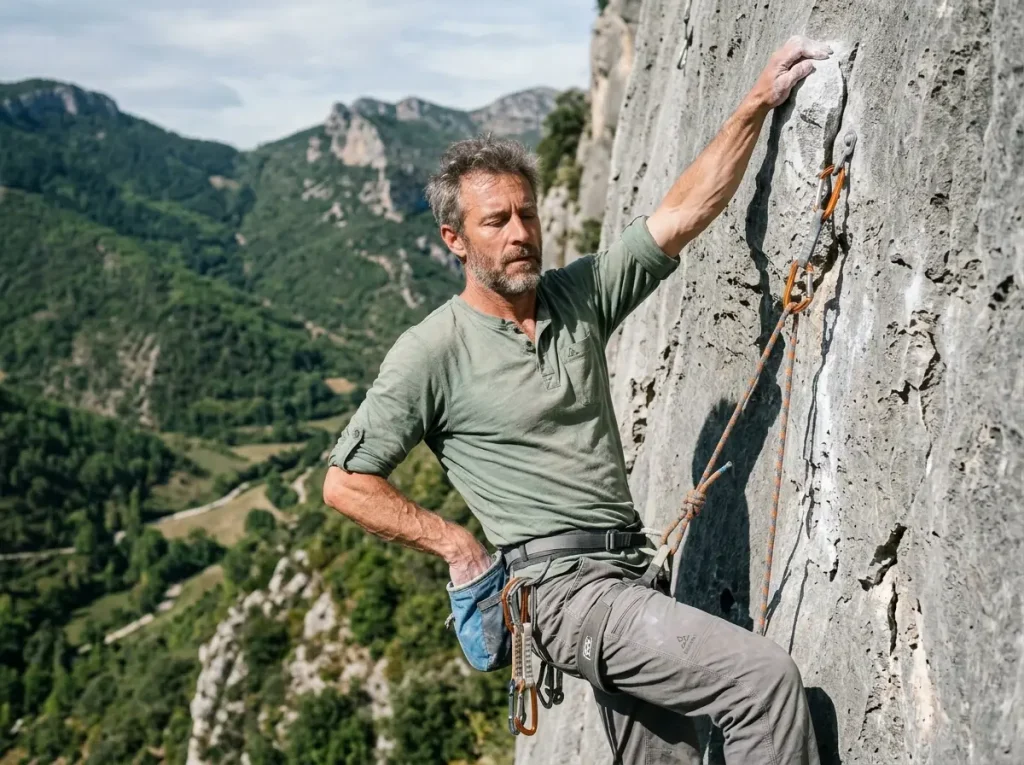
Here’s the section the over-35 crowd actually came for. In March 2023, at age 41, Sharma made the first ascent of Sleeping Lion in Siurana, a 9b+ (5.15c) he called the hardest thing he’d done in over eight years and the hardest first ascent of his entire career. Most pros are coasting at 41. He put up the hardest line of his life.
The Flow-State Style, Decoded
Off the wall, Sharma is soft-spoken and meditative. On it, he is aggressive and explosive, all big dynamic moves, momentum, and the power-endurance to keep firing them deep into a route. That contrast is the whole secret. He doesn’t muscle through sequences so much as fall into a genuine flow state, the rhythm climbers and writers keep tying to his name, where the next move happens before doubt can catch up.
For a regular climber, the steal here is simple to say and hard to do: stop fighting the wall and start moving with it. Hesitation burns more forearm than any single hard move.
Power vs Precision (the Ondra Contrast)
The clearest way to understand Sharma’s style is to put it next to Ondra’s on the same route. Ondra himself noted that La Dura Dura is “more straightforward climbing, but you really need to get everything wired 100%.” Translation: on a true limit route, precision beats raw trying-hard.
Ondra is surgical. Sharma is a wave. Watching them on the identical moves is the best movement lesson available.
Climbing for Love, Not Grades
Ask Sharma how he’s still sending at the top of the scale past 40 and the answer is almost annoyingly simple: he stopped chasing numbers. By his own account he climbs for the feeling now, to reach a meditative state, not to add a grade to a résumé. The patient art of projecting a route at your limit becomes sustainable when the point is the process instead of the tick.
It’s the same longevity question that follows every aging great, including the greatest-of-all-time debates around Alex Honnold. Sharma’s answer is mindset over grade-chasing, and his record at 41 makes it tough to argue with.
If you’re climbing past 40 and the grades have stalled, take a page from Sharma and decouple your sessions from the number. Climbers who keep sending into their fifties almost always report the same shift: they trained for enjoyment and consistency, the grades came back as a side effect, and the injuries dropped when ego left the rope.
What the Over-40 Climber Can Steal
You don’t need to climb 5.15c to use any of this. The transferable parts of Sharma’s late-career game are the boring, durable ones: warm up like you mean it, project something you love instead of something that impresses people, and protect your fingers and shoulders so you’re still climbing in 20 years. Longevity in this sport is mostly the absence of stupid injuries, and a calm head prevents more of those than any tendon does.
The Gyms, the Brand, and the Shoe He Climbs In Now
The last piece of the Sharma story is the one a gear-curious reader wants, because his shoe history actually tracks the way his climbing evolved.
Sender One and Sharma Climbing
Sharma turned his name into a business without turning it into a sellout. He co-founded Sender One, a set of gyms in the Santa Ana and Los Angeles area, and runs Sharma Climbing facilities in Barcelona, Gavà, and Madrid, built in partnership with the wall manufacturer Walltopia. The gym kid grew up to build the gyms.
His reach went well past the walls, too. He carried climbing to mainstream audiences through Reel Rock films and the HBO Max series The Climb, which he co-hosted with the actor Jason Momoa. These days he’s based in Catalonia with his wife Jimena Alarcón and their kids, still projecting hard a short drive from home.
From Evolv Pontas to the Tenaya Mastia
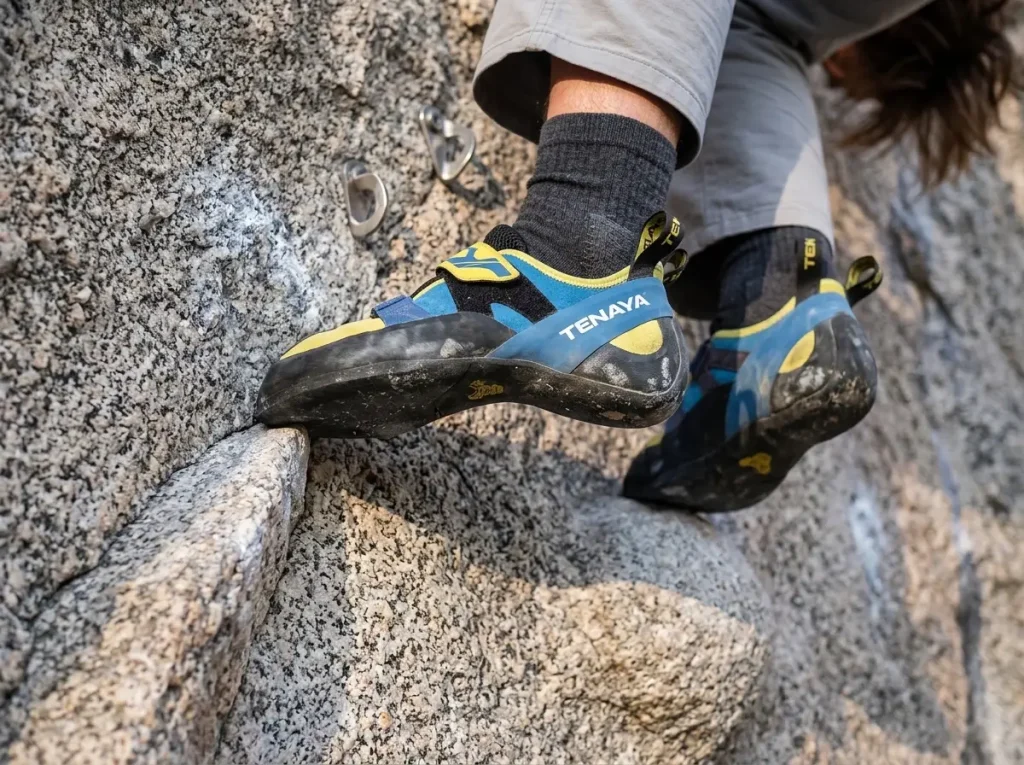
Follow his sponsors and you can read his style changing in real time. He climbed in Five Ten early, then moved to Evolv, which built signature Pontas and Shaman models around his deep-water and dyno-heavy years, shoes made for aggressive, powerful climbing. Since 2018 he’s been with Tenaya for shoes, with Petzl on his harness and hardware, and his go-to model is the Tenaya Mastia, effectively his signature shoe today and a more refined performer that reflects how precise his footwork has become.
The Mastia is a medium-aggressive downturn shoe with an asymmetric last and Vibram XS Grip2 rubber, sized as a single unisex EU fit. It’s built for steep, technical sport and bouldering, the kind of climbing that made Sharma famous.
Why the Mastia Isn’t a Beginner’s First Shoe
Honest version, because this blog doesn’t do sponsored fluff: the Mastia is a great shoe and the wrong first shoe. An aggressive downturn shines on overhangs and tiny edges, but it actively fights you on slab, in cracks, and during the long sessions a newer climber needs to build foot skill. If you’re in your first year, a flatter, neutral shoe will teach you more and hurt less.
Buying the shoe a pro wears is the most common money mistake newer climbers make. The shoe under a 5.15 climber is tuned for terrain you’re not on yet. Match the shoe to your climbing, not to your hero, and your feet and your wallet both win.
Five Sends, One Long Lesson
Strip away the grades and Sharma’s career is a simple shape repeated five times: find the thing that looks impossible, fail at it for as long as it takes, then make it the new normal. Realization opened the 9a+ era, Jumbo Love put American rock on the top table, and La Dura Dura set a 9b+ bar that still stands unrepeated.
The best part isn’t the climbing, it’s the temperament. He bolted his hardest project, almost walked away, got beaten to the send, and came back to do it anyway, then kept going hard enough to put up his life’s hardest route at 41. That’s the takeaway worth carrying to your own crag.
So go watch the Realization footage one more time, then go project something at your actual limit. The lesson was never the number. It was the patience.
Frequently Asked Questions
01What is Chris Sharma’s hardest climb?
By his own account, Sleeping Lion (5.15c, Siurana, 2023) is the hardest first ascent of his career, done at age 41. It shares the 9b+ grade with La Dura Dura, his other top-tier route.
02Has La Dura Dura been repeated?
No. As of 2026, La Dura Dura (5.15c, Oliana) has only two ascents: Adam Ondra in February 2013 and Sharma six weeks later. No third climber has repeated it in over a decade.
03What climbing shoes does Chris Sharma wear?
Sharma has climbed for Tenaya since 2018, primarily in the Tenaya Mastia. Earlier in his career he wore Five Ten, then Evolv, which built signature Pontas and Shaman models around him.
04Why is Chris Sharma so famous?
Sharma repeatedly established the hardest route in the world over two decades, including the first 5.15a, the first 5.15b, and a share of the first 5.15c. He also pioneered hard deep-water soloing and starred in landmark climbing films.
05What is Chris Sharma’s net worth?
Public estimates put Sharma’s net worth in the low millions, built from sponsorships, his Sender One and Sharma Climbing gyms, and film work. Exact figures are not officially confirmed, so treat any specific number as an estimate.
Safety Notice: Rock climbing and mountaineering are inherently high-risk
activities that can involve physical trauma or fatal incidents. The information on Rock Climbing Realms is for
educational and informational purposes only. Techniques and advice presented here are not a substitute
for professional, hands-on instruction. Conditions and risks vary by location. Always seek guidance
from a qualified instructor before attempting new techniques. By using this website, you agree that you
are solely responsible for your own safety. Any reliance you place on this information is strictly
at your own risk, and you assume all liability for your actions. Rock Climbing Realms and its authors
will not be held liable for any harm, damage, or loss sustained in connection with the use of this information.
Affiliate Disclosure: We are a participant in the Amazon Services LLC Associates Program, an
affiliate advertising program designed to provide a means for us to earn advertising fees by advertising and linking
to Amazon.com. As an Amazon Associate, we earn from qualifying purchases. We are also an official affiliate partner
of Black Diamond Equipment via the AvantLink network. If you click on a Black Diamond affiliate link and make a
purchase, we may earn a commission at no additional cost to you. We also participate in other affiliate programs.
Additional terms are found in the terms of service.