
In this article
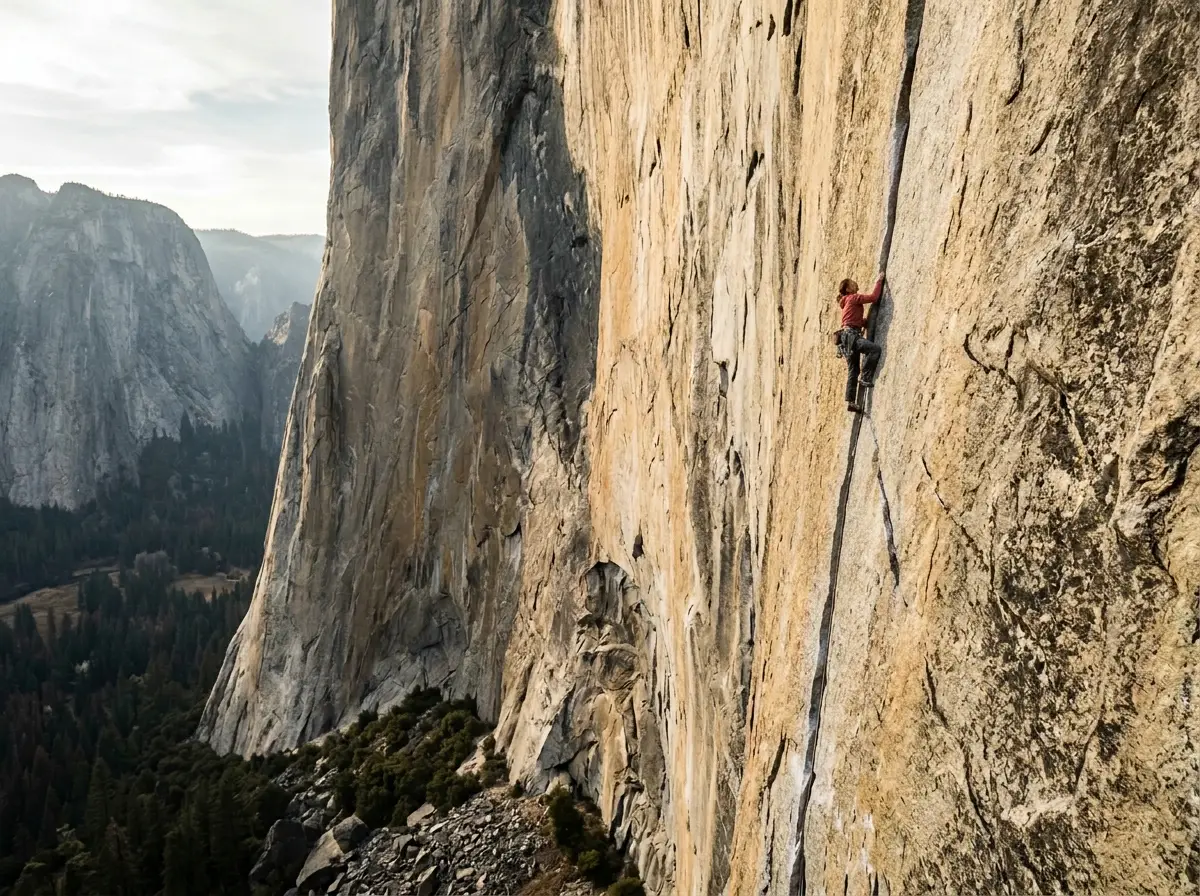
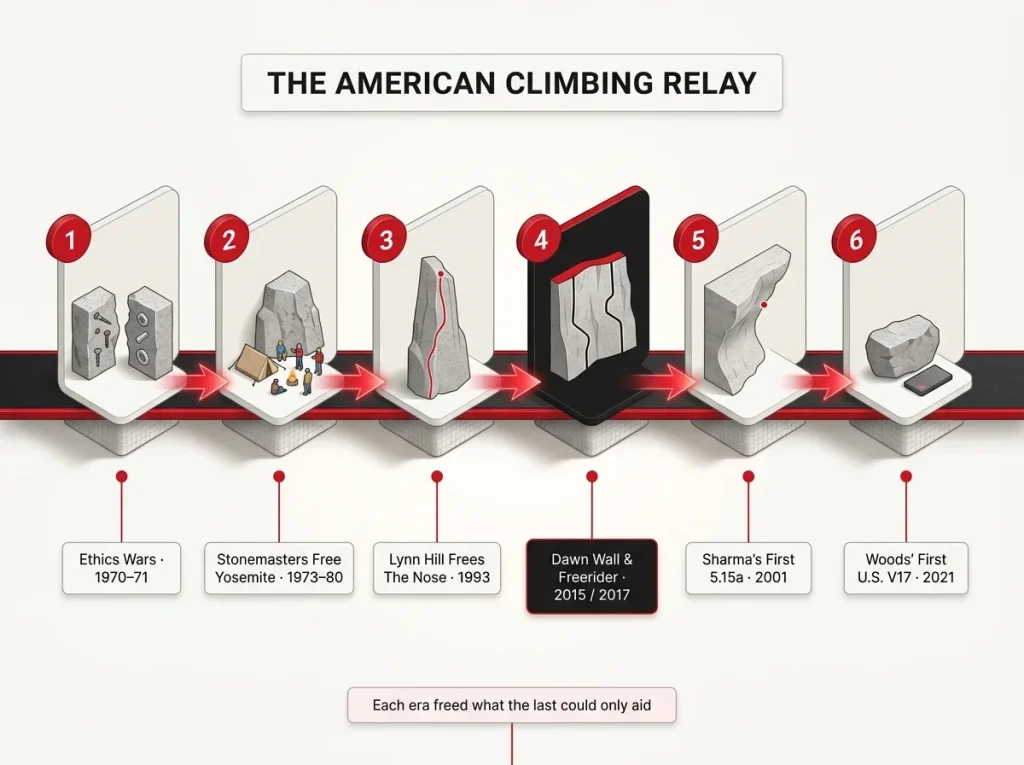
Picture the same 3,000-foot granite wall in Yosemite, climbed four completely different ways across sixty years. It was sieged into submission with hundreds of bolts, then freed by hands and feet alone, then climbed with no rope at all in under four hours. Same rock, different legendary American climbers, each one rewriting what the word impossible was supposed to mean. Ask any climber who the greatest American is and you’ll start an argument, not get an answer, because the honest reply depends on the era and the discipline. This is the canon of American climbing told the way it actually happened, as a relay, with each legend’s signature climb and the reason it mattered.
The Pioneers Who Started the Ethics Wars
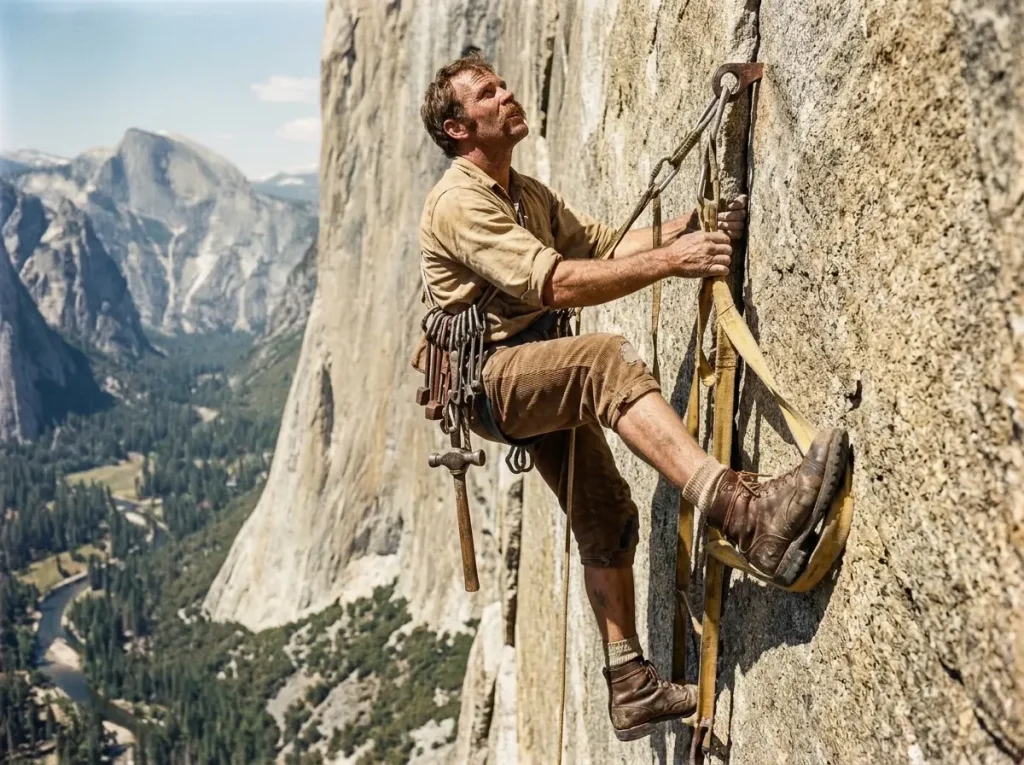
Before anyone freed anything, two men spent a decade arguing about how a wall should be climbed at all. That argument built American climbing, and it still runs underneath every bolt-versus-trad debate at the crag today. The whole sport’s conscience traces back to Royal Robbins and Warren Harding and the way they refused to agree on anything.
Royal Robbins and the Clean-Climbing Creed
Robbins believed a route should be climbed from the ground up, with as little permanent scarring of the rock as possible. His ascents of Half Dome’s Northwest Face and the Salathé Wall on El Capitan set the standard for clean climbing: place your protection, climb past it, take it out, leave the stone the way you found it. He is the man NPR called the pioneer of American rock climbing, and you can read why in NPR’s obituary for Royal Robbins, pioneer of American rock climbing.
What clean climbing meant in practice was a quiet hardware revolution. Instead of hammering pitons into cracks and scarring the stone a little more with every ascent, Robbins pushed American climbers toward removable nuts and chocks that slot into the rock and lift back out, leaving nothing behind. That move from iron to clean protection is the root of modern climbing ethics in the States, and it is why the person who makes a route’s first ascent still gets to set the rules for how it should be climbed.
The ethic mattered more to him than the summit. That is a hard idea to sell a beginner who just wants to get up the thing, but it became the spine of how Americans climb.
It helps to clear up the vocabulary here, because newcomers trip on it constantly. Aid climbing means pulling on gear, ladders, and bolts to make upward progress. Free climbing means moving over the rock with your hands and feet, using the rope and gear only to catch a fall. Robbins wanted walls done with as little aid as humanly possible. Harding did not care.
Warren Harding and the Siege Style
Harding climbed to win, by any method the wall demanded. In 1970, he and Dean Caldwell made the first ascent of the Wall of Early Morning Light, the route everyone now calls the Dawn Wall, in a continuous 27-day push that leaned hard on bolts drilled straight into blank stone. To Harding, a wall was a problem to be solved with persistence and a drill. To Robbins, that was closer to vandalism than climbing. Two philosophies, one piece of rock, no middle ground.
The Dawn Wall Bolt-Chopping Standoff
Here is the part nobody tells the beginner. In 1971, Robbins set out to climb Harding’s Dawn Wall route a second time and erase it as he went, chopping the bolts off the wall to make a point about style. Then, two pitches up, he stopped. The climbing was harder and better than he had expected, and he could not bring himself to keep destroying it.
The purist with the hammer was, by his own later admission, partly motivated by the fact that Harding was getting all the credit. That is the human version of the ethics fight, and it is far more honest than the tidy morality tale the sport sometimes tells about itself.
When you hear old climbers argue about bolts, they are not really arguing about hardware. They are arguing about Robbins and Harding. Knowing that fight gives you the whole context for why a bolted sport route and a clean trad line carry such different cultural weight in the States.
The Stonemasters Who Freed Yosemite
While Robbins and Harding argued, a younger crew was busy proving both of them could be left behind. The Stonemasters were the Camp 4 dirtbags of roughly 1973 to 1980, climbers who lived out of cars and tents in Yosemite so they could climb full time, chasing first free ascents nobody believed were possible. If you have ever heard the word dirtbag used with pride, this is the crew that earned it. They lived in Camp 4, the scrappy climbers’ campground in Yosemite Valley, running on rock music and an anti-establishment streak, and they treated the impossible like a to-do list.
Jim Bridwell, the Ringleader of Camp 4
Jim Bridwell was the loud center of gravity. He had the vision and the mouth to push a generation of climbers past what the previous one thought the rock would allow, and he treated Yosemite’s walls like an open project list. Under his influence, the question stopped being whether a wall could be aided and started being whether it could go free.
John Long, John Bachar, and the Astroman Breakthrough
In 1975, John Long, John Bachar, and Ron Kauk made the first free ascent of Astroman, a 10-pitch line that had previously only gone with aid. Freeing Astroman at 5.11c was the proof of concept for an entire era. A wall thought to need ladders and pulling on gear had just been climbed with hands and feet, and suddenly every aid route in the Valley looked like a question waiting for an answer. That single ascent did more to launch the free-climbing revolution than any manifesto.
The Nose in a Day
The same year, Bridwell, Billy Westbay, and John Long climbed The Nose of El Capitan in a single day. Before that, the route took parties multiple days of hauling and sleeping on the wall. Doing it in a day reset what people thought was humanly possible on a big wall, and it is the direct ancestor of every modern speed record on El Cap. If you ever want to stand under that line yourself, hiring a guide for El Capitan is how most climbers get their first taste of big-wall systems before attempting anything near it.
Lynn Hill and the First Free Ascent of The Nose
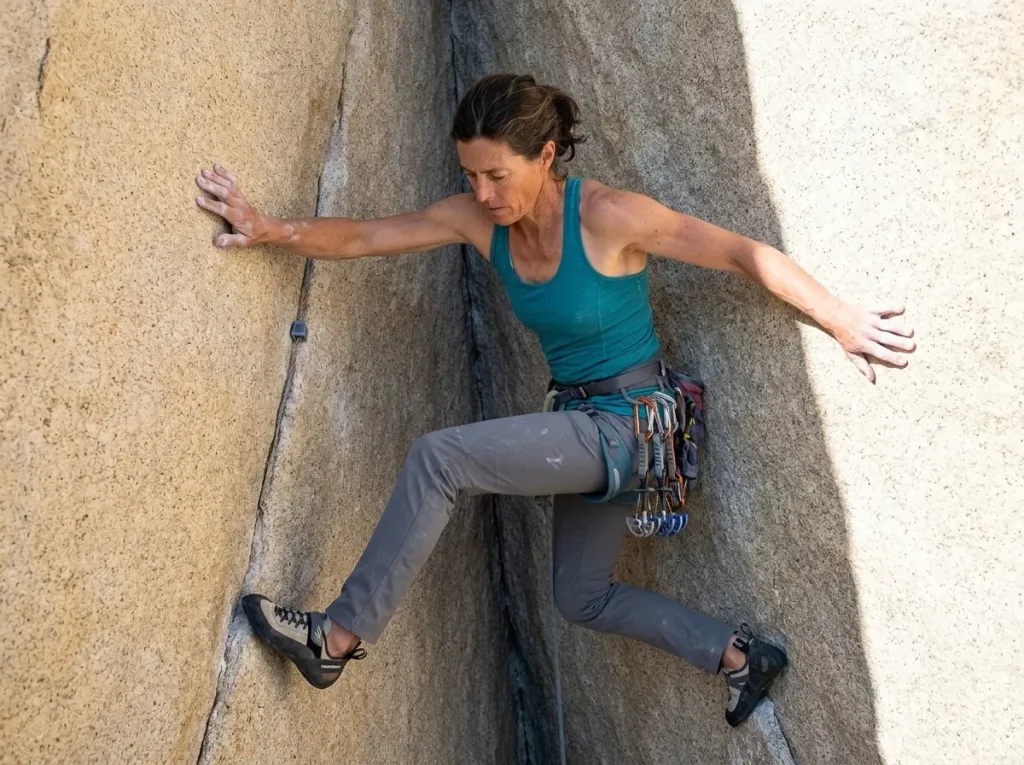
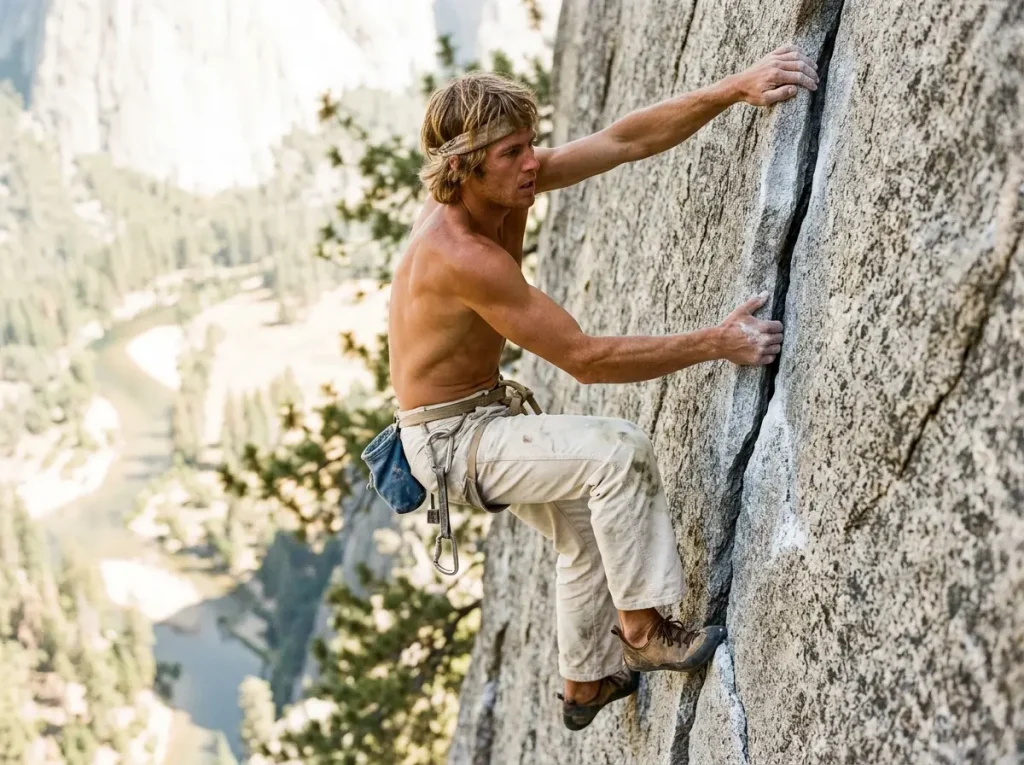
Some climbs change a number. This one changed the sport’s assumptions about who could climb at all. Lynn Hill took the most famous big wall in America and did the thing every strong man had tried and failed to do, then she rubbed it in by coming back and doing it faster.
The Route the Men Called Impossible
In 1993, Hill made the first free ascent of The Nose, freeing the entire route over four days with Brooke Sandahl. The following year she returned and freed it in under 24 hours. For context, the strongest male climbers in the world had been trying to free The Nose for years and writing it off as impossible. The crux, a pitch called the Changing Corners, goes at her grade of 5.13b, and the route as a whole free climbs at 5.14. She did not just complete it. She solved a puzzle the best in the world had declared unsolvable.
Cracking the Changing Corners
The Changing Corners is a shallow, almost featureless granite corner where brute strength does nothing. Hill failed on it three times before she found the answer, and the answer was not power. It was a carefully coordinated sequence of opposite pressures between her feet, hands, elbows, and hips against the thin walls of the corner. Her smaller hands fit the shallow locks that larger hands could not use, and she built a body-tension sequence, a way of linking opposing pressures that climbers later called chunking, rather than trying to muscle through. That is why she freed it when others could not. The holds suited her frame, and she out-thought the pitch.
The lesson climbers still pull from Hill’s ascent is that reach and raw pulling power are overrated on technical rock. Body tension, precise footwork, and a sequence that fits your build will beat a stronger climber who only knows how to pull hard. On thin corners, the smartest climber wins, not the biggest.
It Goes, Boys
Topping out, Hill delivered the most quoted line in American climbing: “It goes, boys!” Three words that flipped the sport’s gender assumptions overnight, and shorthand ever since for proving the doubters wrong. It is worth reading the full story of Lynn Hill’s free ascent of The Nose and its impact, because the ripple effects ran far past that one wall.
And while we are here, clear up the most common mix-up in climbing. The Nose that Hill freed in 1993 is a different route from Freerider, the line Honnold would solo decades later. Both are on El Cap. They are not the same climb, and confusing them is the surest sign someone has only watched one documentary.
Alex Honnold and Tommy Caldwell on El Capitan
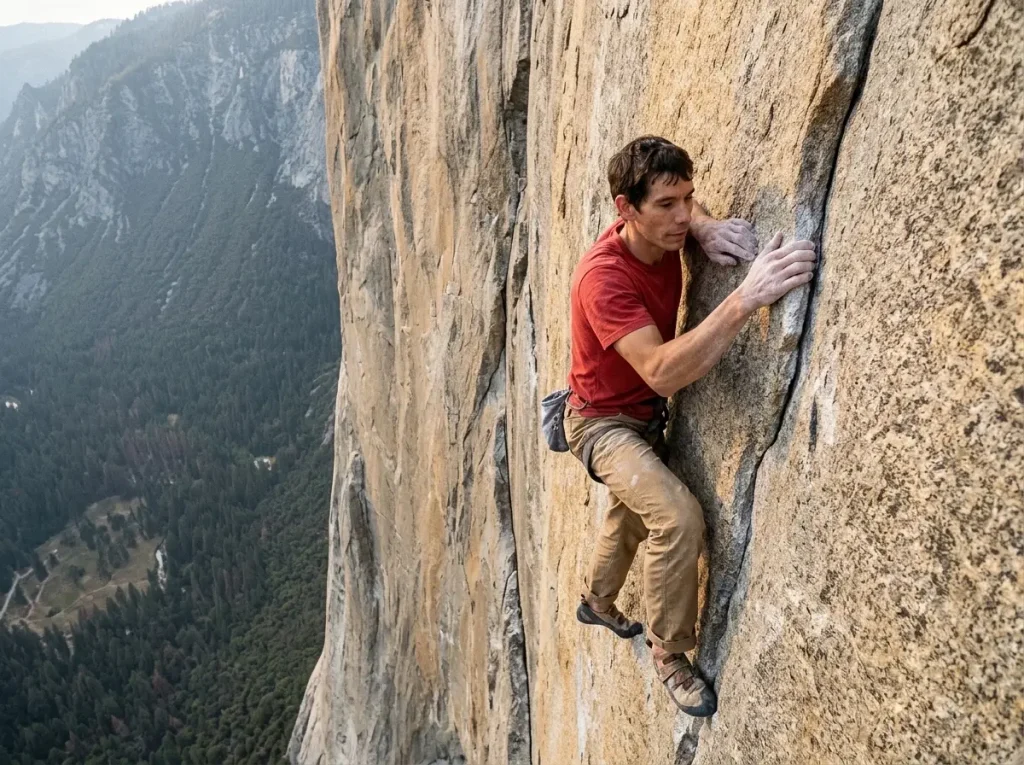
The modern era produced two ascents that both sound like science fiction and are constantly confused for each other. One man removed the rope. Two other men endured 19 days of suffering on the hardest big wall ever freed. Pulling them apart is the whole point of this section.
Honnold and the Freerider Free Solo
On June 3, 2017, Alex Honnold climbed Freerider on El Capitan with no rope and no protection, roughly 2,900 feet of vertical granite at 5.13a, in 3 hours and 56 minutes. It was the first big-wall free solo at that grade, and it is widely called the greatest single feat of pure rock climbing ever performed. A slip anywhere on that wall would have been fatal.
The scale is impossible to convey in words, which is exactly why the footage exists. The ascent is also documented in the American Alpine Club’s account of Freerider if you want the route detail.
What gets lost in the spectacle is the planning. Honnold did not pick the hardest line on El Cap. He picked the smartest one for a ropeless ascent, and how Alex Honnold trained his mind for a ropeless ascent is as much about route choice and rehearsal as it is about nerve.
Honnold soloed Freerider instead of The Nose for one reason: Freerider gives a continuous free path he could rehearse and memorize move by move, while The Nose’s Changing Corners is too insecure to trust without a rope. The route choice was the genius. The nerve only worked because the homework was done first.
Caldwell, Jorgeson, and the Dawn Wall
On January 14, 2015, Tommy Caldwell and Kevin Jorgeson finished the first free ascent of the Dawn Wall, the same blank southeast face Harding had sieged decades earlier. They freed it over 19 days, and it stands as the world’s first multi-pitch route at 5.14d. This was not one bold push.
It was nearly three weeks living on the wall, redpointing brutally hard pitches on holds the width of a credit card, taping split fingertips and waiting for skin to heal before trying again. The obsession and the finger strength behind that climb are the real story, and the training methods Tommy Caldwell used to free the Dawn Wall show how much preparation it took.
Two Kinds of Impossible
People constantly rank Honnold’s solo against Caldwell’s Dawn Wall as if they were the same kind of achievement. They are not even close.
One is a test of how long a body can keep performing at its limit. The Dawn Wall asked Caldwell and Jorgeson for nearly three weeks of redpoint attempts, healthy skin, and the patience to fall off a single move dozens of times until it finally linked. Freerider asked Honnold for the opposite, one continuous performance with no second chances, where the whole effort lived or died on rehearsal and nerve. Both sit at the ceiling of the sport, and they share almost nothing else.
Think of the Dawn Wall as a marathon and the Freerider solo as a knife-edge sprint. One is 19 days of redpoint endurance and skin management on 5.14 pitches. The other is under four hours where a single mistake is final. Different fear, different discipline. Comparing them tells you more about the person ranking than about the climbs.
The casual coda says it all: Honnold topped out Freerider and went to do hangboard pull-ups afterward, as if he had just gone for a jog.
Chris Sharma and the Sport Climbing Revolution
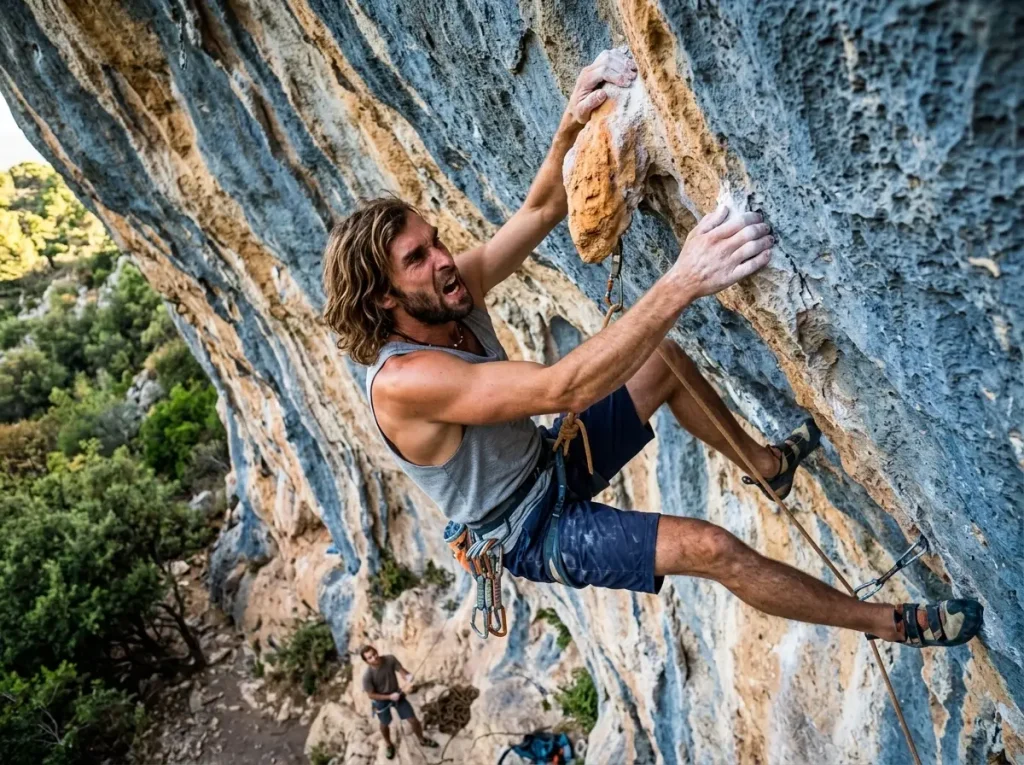
While Yosemite chased walls, a young American was rewriting the hardest number in the world on overhanging limestone an ocean away. Chris Sharma did not just climb hard. He moved the ceiling of the entire sport, twice, and then invented a discipline along the way.
Realization and the First 5.15a
On July 18, 2001, at age 20, Sharma climbed Realization, also called Biographie, at Ceüse in France. It was the world’s first consensus 5.15a, a 9a+ in the French system, and the hardest sport climbing route on Earth at the time.
The baton for strongest sport climber on the planet had passed from Wolfgang Güllich to Sharma, and it would not pass again until the climber who took the strongest-sport-climber baton next, Adam Ondra, came along more than a decade later. That gap is worth sitting with. Sharma held the top of the sport almost by himself for years.
Jumbo Love and Moving the Number
Sharma later climbed Jumbo Love at Clark Mountain in the Mojave Desert, the world’s first 5.15b, or 9b. He is the rare climber who established the hardest grade in the world, then came back and raised it again himself. Most legends move a number once if they are lucky. Sharma moved it twice.
Deep-Water Solo and Es Pontàs
Then he made a whole discipline serious. In 2006, Sharma climbed Es Pontàs, a 5.15a sea arch in Mallorca, with no rope and the ocean as his only crash pad. This is deep-water solo, or psicobloc, the Mallorcan term Sharma popularized: climb a sea arch above open water, and when you fall, you fall into the sea.
The enormous dyno on Es Pontàs is one of the most-filmed moves in climbing history. You can trace the whole arc of Chris Sharma’s deep-water soloing legacy from that single arch, and if it tempts you, read how to start deep-water soloing without getting hurt before you go chasing it, because the soft landing is a myth at that height.
The Boulderers Chasing the Hardest Grades
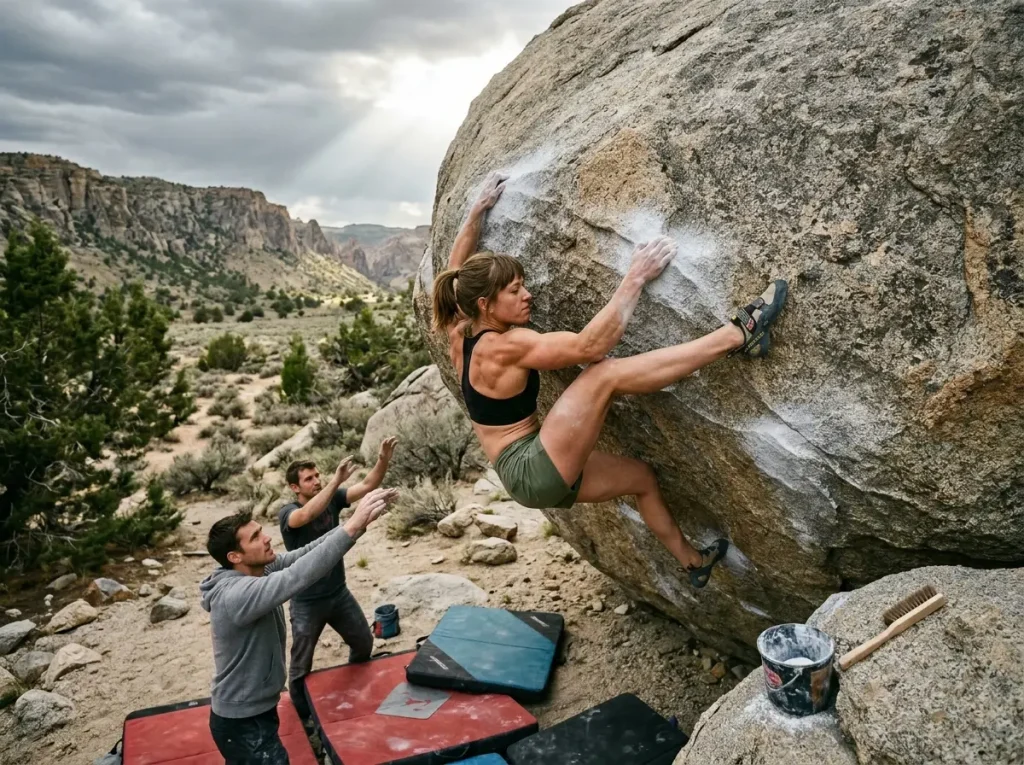
Not every legend needs a wall or a rope. Some of the most important American climbing of the last decade happened a few feet off the ground, on boulder problems so hard that linking five moves can take a month of a person’s life.
Daniel Woods and the First American V17
On March 30, 2021, Daniel Woods made the first ascent of Return of the Sleepwalker in Black Velvet Canyon, Nevada. It was the first V17 in the United States and only the second in the world, after Nalle Hukkataival’s Burden of Dreams. V17 is the current frontier of bouldering difficulty, a grade that did not exist until a few years ago.
The number on a problem hides the cost. To send Return of the Sleepwalker, Woods quit smoking, alcohol, and caffeine and camped alone near the boulder for a month. At the top grades, climbing stops being a hobby and becomes a full lifestyle edit. That is the part the grade chart never shows you.
Margo Hayes Breaks the 5.15a Barrier
On February 26, 2017, Margo Hayes became the first woman to climb 5.15a, sending La Rambla in Siurana, Spain. In a fitting twist, she went on to climb Biographie too, the very line Sharma had established as the world’s first 5.15a sixteen years earlier. It was the female parallel to Sharma’s 2001 milestone, and it ended the quiet assumption that the very top grade was a male ceiling. She is part of a wave that includes the prodigy Ashima Shiraishi, who sent V15 before most adults ever touch real rock, and together they rewrote what the next generation of climbers expects to be possible.
What the Numbers Actually Mean
The grades fly around this article, so here is the plain-language version. Roped climbs in the States use the Yosemite Decimal System, or YDS, which runs up through 5.13, 5.14, and 5.15, with letters a through d marking the steps. Bouldering uses the V-scale, V1 through V17.
They measure different things, and if you want the full picture of how bouldering and sport climbing actually differ, the short version is power and a handful of moves for bouldering, endurance and a long sustained effort for sport. A V17 boulder problem and a 5.15 route are both at the edge of human ability, just in opposite ways.
A few more words you will hear at any crag. To redpoint a route is to lead it cleanly after rehearsing the moves, to on-sight it is to climb it first try with no prior knowledge, and projecting means working a single hard line over many sessions until it finally goes. Almost every climb in this article was a project first, sometimes for years, before it became history.
Peter Croft and Dean Potter, Soloists Who Redefined Risk
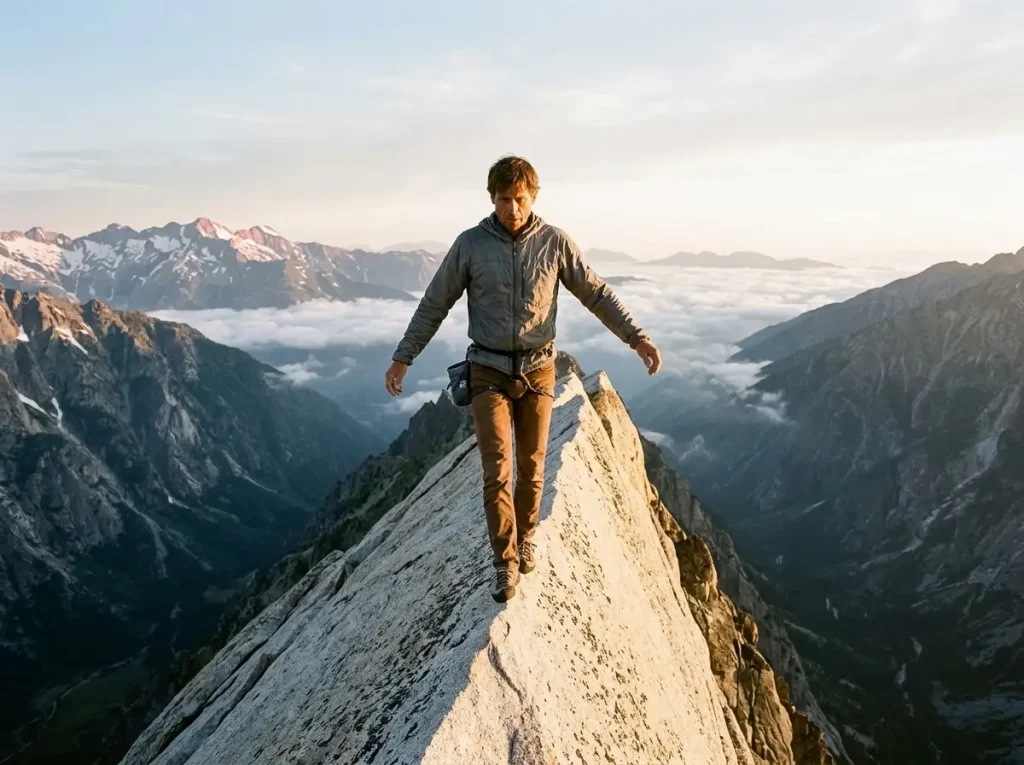
This is the part most roundups skip, partly because it is uncomfortable. The same boundary-pushing that made these climbers legends also took some of their lives. An honest canon names that cost plainly, without dressing it up as romance.
Peter Croft and the Art of the Free Solo Linkup
Peter Croft is one of the most influential soloists Yosemite ever knew, famous for free soloing Astroman and the Rostrum in a single day, a linkup that sounds casual and is anything but. Beyond the Valley, he became known for marathon free-solo linkups in the High Sierra, covering huge alpine ridgelines with a speed and calm that reset what ropeless climbing could look like. One honest note for accuracy: Croft is Canadian, not American. He is named here because his influence on Yosemite’s soloing culture is inseparable from the American story, and leaving him out to keep the roster tidy would be the dishonest choice. He shaped how a generation thought about climbing without a rope, and that matters more than a passport.
Dean Potter and the FreeBASE Frontier
Dean Potter lived at the far edge of several sports at once. He was a free soloist, a highliner, and a BASE jumper, and he invented a hybrid he called FreeBASE, free soloing with a parachute instead of a rope. You will not find Potter in most lists of legendary American climbers, which is exactly why he belongs in this one. He pushed the ropeless frontier further than almost anyone, and pretending he did not exist would leave the picture incomplete.
The Real Cost
Potter died in a wingsuit accident in Yosemite on May 16, 2015, at age 43. The same appetite for the edge that made him legendary is what took him. He was not the first.
Dan Osman, the inventor of controlled free-fall rope jumping, lost his life in 1998 at Leaning Tower in Yosemite when his jump line failed at a knot and melted through itself. Notice the detail that should stay with you: even the man who invented the discipline did not fall from climbing. He was undone by a setup failure, by gear that betrayed him.
The risk in free soloing and human flight is real, unforgiving, and indifferent to talent. Naming it honestly is the opposite of glorifying it, and it is why even the boldest climbers still run the kind of pre-climb safety check that keeps roped climbers alive before they ever leave the ground.
One last correction worth making: free soloing, with no rope at all, is not the same as free climbing, where the rope is there to catch you. Almost every climber in this article free-climbed. Only a handful ever soloed at the edge, and the ones who lived built their boldness on top of obsessive preparation, not in place of it.
Conclusion
American climbing advanced as a relay. Each generation freed what the one before it could only aid or siege, and the baton went from Robbins’ clean ethic to the Stonemasters’ free ascents to Hill’s Nose to Honnold and Caldwell on El Cap and on to Sharma and Woods at the top grades.
“Greatest” turns out to be the wrong question. The most famous American rock climbers, from Robbins and Hill to Honnold, Sharma, and Woods, were each great at completely different things in completely different decades, and the argument only stays fun because there is no final answer. What the honest legends shared was a clear-eyed view of the cost, and they named the risk instead of hiding it.
Pick one name here you did not know before. Find the route on a topo of El Capitan, then watch the footage of the climb. The whole canon makes more sense once you can see the actual wall these people were standing on.
Frequently Asked Questions
01Is free soloing the same as free climbing?
No. Free climbing uses a rope and gear for safety only, while you climb the rock with your hands and feet. Free soloing uses no rope at all. Almost every American legend free-climbed; only a few soloed at the edge.
02Who was the first person to free climb The Nose on El Capitan?
Lynn Hill made the first free ascent of The Nose in 1993, then freed it again in under 24 hours in 1994. The crux Changing Corners pitch goes at 5.13b, with the full route at 5.14.
03Who free soloed El Capitan?
Alex Honnold free soloed El Capitan on the Freerider route on June 3, 2017, in 3 hours and 56 minutes. It was the first big-wall free solo at 5.13a, roughly 2,900 feet of granite with no rope.
04Who is the greatest American rock climber of all time?
There is no single answer, and most climbers will tell you so. It depends on the era and the discipline. Robbins, Hill, Honnold, Sharma, and Woods each defined a different kind of greatness.
05What is the hardest rock climb in the United States?
By grade, two stand out in different disciplines: Daniel Woods’ Return of the Sleepwalker, a V17 boulder in Nevada, and the Dawn Wall on El Capitan, a 5.14d big wall freed by Tommy Caldwell and Kevin Jorgeson.
Safety Notice: Rock climbing and mountaineering are inherently high-risk
activities that can involve physical trauma or fatal incidents. The information on Rock Climbing Realms is for
educational and informational purposes only. Techniques and advice presented here are not a substitute
for professional, hands-on instruction. Conditions and risks vary by location. Always seek guidance
from a qualified instructor before attempting new techniques. By using this website, you agree that you
are solely responsible for your own safety. Any reliance you place on this information is strictly
at your own risk, and you assume all liability for your actions. Rock Climbing Realms and its authors
will not be held liable for any harm, damage, or loss sustained in connection with the use of this information.
Affiliate Disclosure: We are a participant in the Amazon Services LLC Associates Program, an
affiliate advertising program designed to provide a means for us to earn advertising fees by advertising and linking
to Amazon.com. As an Amazon Associate, we earn from qualifying purchases. We are also an official affiliate partner
of Black Diamond Equipment via the AvantLink network. If you click on a Black Diamond affiliate link and make a
purchase, we may earn a commission at no additional cost to you. We also participate in other affiliate programs.
Additional terms are found in the terms of service.