

In this article
You typed rock climbing sneakers into Google because you wanted something comfortable, and Google handed you a wall of downturned competition shoes with banana-shaped soles and price tags that make your eyes water. That mismatch isn’t your fault. The search term points at three completely different shoes, and the results you got answer none of them properly. Here’s what each of the three actually is, why your street shoes fail the moment you step on real rock, and which pairs fit the way you actually climb.
What Rock Climbing Sneakers Actually Means

Search the term and you get eight results, six of which are shopping grids and two of which are generic best-climbing-shoes roundups covering eighteen models each. Nobody stops to ask what you meant. So let’s do that first, because the answer decides everything else you buy.
Meaning One: The Flat, Comfort-Cut Climbing Shoe
This is what most people are after. A genuine climbing shoe built on a flat last, with a velcro closure or a slip-on upper, sized close to your street size instead of two sizes down. It has real sticky rubber and a proper rand, so it climbs like a climbing shoe. It just doesn’t punish you for wearing it.
Rock climbing shoes sort into three profiles, and the vocabulary matters when you shop. Neutral shoes sit flat with your toes lying almost straight. Moderate shoes add a slight downturn and a bit of asymmetry. Aggressive shoes curl hard and point everything at your big toe, which is what you want on steep terrain and nothing you want on a Tuesday night at the gym.
The Black Diamond Momentum, the Evolv Defy, the La Sportiva Finale and the Ocún Jett S all live in this group. If you want the full picture of construction, closures and last shapes before you compare specific pairs, our guide to how climbing shoes are actually built covers the whole category.
What this shoe is not is a performance tool. It gives up the tension rand that loads your toes for a toe hook, and the stiff molded heel that makes a heel hook feel secure. The downturn and asymmetry that make a competition shoe bite into tiny holds also make it hurt after twenty minutes. There’s a moment when that trade becomes worth it, and we’ve written about when a downturned shoe is worth the pain, but that moment is not your third month of climbing.
Meaning Two: The Approach Shoe
The second meaning is a shoe you can hike miles in that still holds on rock. Sticky rubber outsole, a smooth climbing zone at the toe, a walkable midsole. If you searched for climbing sneakers because you’re heading out to scramble around on easy terrain, this is your answer, and the roundups you landed on exclude it by category. It gets its own section further down.
Meaning Three: Your Actual Street Sneakers
The honest answer to can you rock climb in sneakers: yes, for one indoor session on big plastic holds, and no for anything else. Gyms rent shoes for a reason. Rental shoes are ugly and smell like a locker, but they grip.
Do the smear test before you argue with that. Find a slab or a low-angle wall, put your foot flat against it with no edge to stand on, and weight it. In indoor climbing shoes the rubber holds and your foot stays put. In a running shoe it slides the moment you commit, and that’s the whole conversation in two seconds.
Why a Street Sneaker Fails on Rock
This is the part nobody explains, and it’s worth understanding because it changes how you shop.
First, the rubber. Climbing rubber runs roughly Shore A 60 to 85 on the hardness scale. A car tire sits around 70A. A shopping cart wheel is about 95A. The outsole on your running shoe is built to survive pavement, which means it’s up in tire territory or harder. Hard rubber sits on top of the rock’s grain, touching only the high points, and real contact area collapses to a fraction of what it looks like. Soft climbing rubber deforms down into the valleys between crystals and grips the whole surface.
Second, torsional flex. A running shoe is built to bend and cushion. Stand on a foothold the width of a pencil and that thick foam midsole compresses and rolls sideways off the edge. A climbing shoe resists that twist, which is the entire point of edging.
Third, dead space in the toebox. In a climbing shoe your big toe reaches the front of the shoe and loads directly against the rubber. In a sneaker your toe floats a centimeter back from the tip, so there is nothing solid to push through. You can’t stand on a micro-edge you can’t feel.
Fourth, the sole edge itself. Climbing shoes have a rand wrapping the toe and a squared-off perimeter. Sneakers have a rounded, bevelled edge designed to roll forward through a stride. On rock it rolls right off the hold.

Do the thumbnail test in the shop. Press your thumbnail into the outsole of the shoe you’re holding. Climbing rubber gives and leaves a faint mark that fades. A running shoe outsole feels like pressing a countertop. That two-second check tells you more than any spec sheet.
Gym-to-Crag Picks With Real Sneaker DNA
These are the shoes for someone doing gym climbing two or three times a week and starting to take trips outside. Flat, breathable, easy on and off, forgiving on sizing. You will not wince between burns, which matters more than it sounds when a session runs three hours.
Both picks here come in men’s and women’s versions. The lasts genuinely differ in volume and heel shape rather than just colorway, and our breakdown of how women’s climbing shoe lasts actually differ is worth two minutes before you order.

The Momentum is the shoe people describe as feeling like a shoe rather than a device. That knit upper is doing real work: synthetic upper materials that don’t breathe turn into a swamp over a long gym session, and heat is one of the quiet reasons beginners take their shoes off constantly and blame the fit. The trade is that a knit upper packs out slightly over time and the shoe is not built for tiny edges. Neither of those matters if you’re climbing in a gym and easing into outdoor sport climbing.
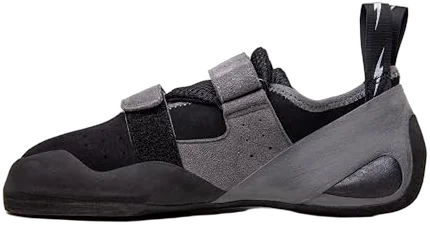
The Defy and its women’s counterpart the Elektra earn their spot on predictability. Leather shoes stretch, sometimes half a size, and a lot of first-time buyers end up in a shoe that fit perfectly for three weeks and then swam. Synthetic doesn’t do that. The Trax SAS rubber at 4.2 mm is thinner than the 5 mm on some picks below, which means slightly better feel and slightly shorter life, a reasonable trade at this price tier.
The All-Day Shoes You Never Take Off
Watch a busy gym for an hour and you’ll see two species of climber. One keeps their shoes on for four hours straight, chatting between attempts with their feet perfectly happy. The other rips their shoes off the second they touch the mat, grimacing, and spends half the session barefoot. Those aren’t different personalities. They’re different purchases.
What Makes a Shoe Wearable All Day
The design signals are consistent once you know to look. A wide toebox with actual room for the fourth and fifth toes instead of folding them under. A flat last that keeps your foot in a neutral position rather than pre-loading the arch. A fit sized at street size or half a size down. And an upper that either breathes or slips on and off in a second.
The industry has been quietly building this category for a few years. Scarpa’s Veloce is the shoe most often named as the one that defined it, with a wide forefoot and rubber tuned for long gym sessions rather than competition-level precision. It’s a useful reference point even though the two picks below are the ones actually worth buying today.
If you’re planning to take this comfort-first shoe outside, the terrain will surprise you before the footwear does, and what changes when you take gym fitness to real rock is the honest version of that adjustment.
The Picks
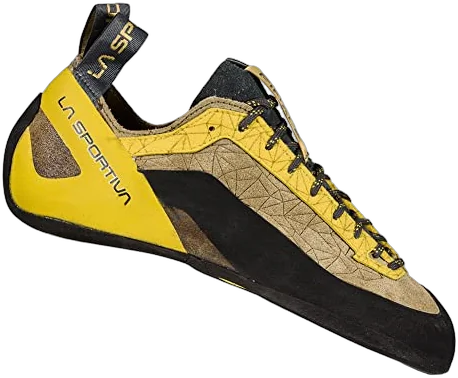
Laces are the underrated feature here. A velcro shoe applies pressure in two fixed bands whether your foot likes it or not. Laces let you leave the toe area open on a hot day and cinch the instep when you need precision, which is why the Finale keeps showing up on multi-pitch and trad climbing recommendations despite being a comfort shoe. The lace-versus-velcro question runs deeper than convenience, and our comparison of closure systems by discipline covers where each one wins.

The Jett S sizes in EU numbers only, so measure rather than guessing from your US size, and remember the microfiber upper won’t give you much stretch to grow into. What you get in exchange is a shoe you stop noticing. That sounds like faint praise until you’ve spent a session watching someone else hobble to the bench every ten minutes.
Count how many times you take your shoes off in one session. Zero means your fit is right and you can shop for performance next time. Five or more means you bought a shoe sized for a competition and you’re paying for it every visit. That number is a better buying guide than any review.
Approach Shoes Are the Real Climbing Sneaker
Here’s the shoe the roundups skipped, and for a lot of people asking this question it’s the correct purchase.
What an Approach Shoe Actually Is
An approach shoe is the hiking-climbing hybrid category: a low-cut shoe you can walk several miles in, with soft sticky rubber on the outsole and a smooth, flat climbing zone under the toe for standing on rock. It laces close to the toe so you can tighten the front for scrambling and loosen it for the walk out on the approach trail.
The mistake people make is assuming a hiking boot does the same job. It doesn’t. Deep lugs are built to bite into dirt and mud, and on smooth rock those hard blocks bridge across the texture with almost no surface actually touching. We took that apart in detail in why hiking boot lugs skate on rock, and it’s the single most common footwear error on easy outdoor terrain.
The Descent Is Where It Matters
This is the part that turns a comfort question into a safety one. According to the American Alpine Club’s accident records, a third of reported climbing injuries happen on the descent, 865 out of 2,724 reported incidents. The 2024 report logged 46 descent accidents against 174 reported injuries overall, a 15 percent rise year over year.
Think about what a descent looks like. You’re tired, you’re carrying a pack, and you’re picking your way down loose third and fourth class ground, often in fading light. That is precisely the moment most people are wearing whatever smooth-soled shoe they hiked in with. Sticky rubber on the way down isn’t a luxury purchase, it’s the least glamorous safety decision in climbing.
Choosing Between the Two Classics
The two benchmark approach shoes split cleanly, and the deciding question isn’t about climbing at all. It’s the shape of your foot.

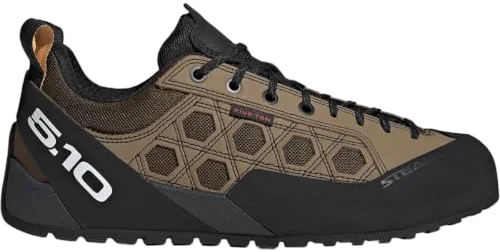
The short version: if you’re going to walk more than you climb, take the TX4 Evo. If you’re going to climb more than you walk, or your foot is wide enough that most shoes pinch, take the Guide Tennie. Both will hold you on third and fourth class ground far better than anything with a foam midsole, and on genuinely easy multi-pitch routes plenty of people climb the whole thing in approach shoes rather than swapping at the base.
Rubber and Sole Stiffness in Plain English

Every roundup throws compound names at you without saying what they change. Here’s the translation.
What the Compounds Actually Do
Vibram XS Edge is firm and holds its shape under a small edge, which is why it shows up on shoes meant for precise footwork on vertical rock. Vibram XS Grip is softer and deforms more, so it wins on smearing and steep bouldering. Trax SAS sits in the middle and prioritizes lasting through gym volume. Stealth C4 from Five Ten is the soft, tacky end of the scale, famous for friction on slab. Megagrip is a hiking-oriented compound tuned for wet and dry traction over distance rather than edging precision.
Match the compound to the job, not to the marketing. Softer compounds like Vibram XS Grip 2 reward the half-smear, half-edge move climbers call smedging, where you roll onto the inside edge of the toe and let the rubber do the rest. Firmer compounds ask you to be precise instead. For a fuller breakdown of every compound and how they wear, we’ve got the full guide to climbing shoe rubber compounds.
How Soft Is Too Soft
Softer sounds better, and the industry leans on that instinct hard. The measurements complicate it. A 2024 tribology study of climbing shoe rubber ran commercial compounds against granite surfaces on lab equipment and found that softer rubber does not reliably produce more friction. Rebound behavior, tear resistance and how the compound performs under shear all feed into whether it actually holds, and hardness alone predicts less than the packaging implies.
For a comfort-first shoe this is good news. The firmer, thicker rubber on a Finale or a Tarantulace isn’t a downgrade you’re accepting to save money. It’s the right compound for a shoe you’ll wear for hundreds of gym hours, and it costs you far less grip than you’d guess.
Thickness and What It Costs You
Most climbing shoes run 3.5 to 5 mm of outsole. Thicker rubber lasts longer and supports your foot on edges, and it dulls the feedback so you feel less of what you’re standing on. Thinner rubber is sensitive and wears through faster. A half-length outsole saves weight and increases flex; a full-length one adds support under the arch.
Thin rubber is what climbers mean by board feel, the sense of reading the rock through your foot instead of guessing at it. It’s genuinely useful, and it costs you sole life. A thin outsole worn through in four months either goes to a resole shop or into the bin, and a resole runs a decent fraction of a new pair.
For a first or second pair, thicker is almost always the right call. Sensitivity is a skill you develop, not a feature you buy on day one.
Sizing a Comfort Shoe Without Wrecking Your Feet

The fastest way to ruin a good comfort shoe is to size it like a performance shoe. It happens constantly.
Street Size, Half Down, and Where Downsizing Stops
An all-day shoe is sized at your street shoe size or half a size down. Not a full size, not a size and a half. The target is snug with no dead space, toes flat or barely curled, no pressure point that makes you flinch when you stand up. If you have to sit down to put them on and hold your breath, you’ve gone too far and the shoe you bought for comfort will live in your closet by spring.
That instinct to squeeze is nearly universal among newer climbers, and we unpacked exactly where it comes from in why most climbers buy their shoes too tight.
Leather Stretches, Synthetic Doesn’t
Unlined leather gives roughly half a size as it molds to your foot. Lined leather gives less. Synthetic and microfiber uppers barely move at all, which is why the Defy and the Jett S should fit correctly the moment you try them on rather than after a break-in period you’re hoping for.
Buy accordingly, straight out of the box. A leather shoe that feels perfect in the shop will feel loose in a month; a synthetic one that pinches in the shop will pinch forever.
Volume, Width, and the Shoes That Fit Each
Length is only half the fit. Volume is the space through the instep and the height of the toebox, and it’s why two shoes in the same size can feel completely different. Low volume models, usually the women’s versions, come with a narrower heel cup and a lower instep, which is what stops the heel lifting when you weight your toe.
Width sorts the rest. Wide feet get pinched by most European lasts and do well in the Guide Tennie. Narrow feet swim in a wide last and end up cinching the laces past comfort, so a lower-volume model serves them better. The TX4 Evo runs average and the Jett S falls between the two with its All-Round last, which is why both show up so often as safe first guesses.
Try shoes on at the end of the day, after you’ve been on your feet. Feet swell measurably over a day, and a fit dialed in at 10am can be brutal by evening. Wear them around the house for twenty minutes before you commit, because most retailers stop taking returns the moment the sole touches rock.

Your First Pair and the Brand Reality Check
Two things left, and both save money.
The Entry-Level Pick
Almost every list of climbing shoes for beginners lands in the same place, and for once the consensus is right. If this is your first pair and you’re not sure yet how deep you’re going, buy shallow and buy flat.

On budget: comfort-cut climbing shoes generally run $80 to $140, and approach shoes $130 to $170. The $200-plus shoes filling your search results are competition tools, and buying one to climb 5.9 in the gym is like buying racing slicks for a commute. If you want more options in this tier, we rounded up the beginner shoes the gym won’t sell you.
Nike Does Not Make Climbing Shoes
People search for Nike climbing shoes constantly, so let’s settle it: Nike has never made a rock climbing shoe. There is no Nike model with sticky rubber and a rand. What happens next is predictable, because someone searching that term ends up buying a Nike gym trainer, wearing it to the climbing gym, and concluding they’re bad at climbing when the shoe was never going to work.
If you want a climbing shoe that looks like a sneaker, search for flat-lasted or neutral climbing shoes instead. That’s the phrase that gets you the Momentum, the Defy and the Jett S.
Adidas Means Five Ten
Adidas has owned Five Ten since 2011, which is why the Guide Tennie now shows up in listings under the adidas name. If you searched for adidas climbing shoes and found Five Ten, you found the right thing.
So iLL is the other name worth knowing. They make genuinely sneaker-styled climbing shoes, and they sell them direct rather than through the big retailers, so they simply won’t appear where most people shop. Not a knock on the brand, just an explanation for why the most sneaker-looking climbing shoes on Instagram never turn up in your search results.
The Bottom Line
Sort out which of the three shoes you were shopping for before you compare a single spec sheet. Once you know whether you want a flat comfort climbing shoe, an approach shoe, or both, the choice gets easy and cheap.
Your street sneakers are not a rock shoe. The rubber is tire-hard, the sole folds on edges, and your toe never reaches the front. That’s mechanics, not skill.
And if most of your day is walking, scrambling and coming back down, the approach shoe is the purchase that changes the day, not the climbing shoe.
Next session, count how many times you take your shoes off. That single number tells you which of these three shoes you should actually be buying, and no spec sheet is going to tell you better.
Frequently Asked Questions
01Can you rock climb in sneakers?
You can get through one indoor session on large plastic holds, but street sneakers do not work on real rock. The outsole rubber is roughly as hard as a car tire, the thick midsole folds on small edges, and your toe never reaches the front of the shoe.
02What shoes should I wear to a rock climbing gym?
A flat-lasted climbing shoe sized at or near your street size, like the Momentum, Defy or Elektra, Finale, or Jett S. Rent for your first visit or two, then buy comfort-cut rather than aggressive. Save downturned shoes for when a specific route demands one.
03Are approach shoes good enough for actual climbing?
For scrambling and easy multi-pitch terrain, yes. The sticky rubber and toe climbing zone are built for exactly that. On steep or technically hard routes you want a real climbing shoe, but approach shoes cover the walk in, the easy ground, and the descent.
04What shoes did Alex Honnold wear?
He has climbed for years in La Sportiva models, most famously the TC Pro on El Capitan. It is a stiff high-top designed for granite cracks and long days, which makes it close to the opposite of what most people mean by a climbing sneaker.
05What are some good rock climbing sneakers for beginners?
The Tarantulace and the Evolv Defy or Elektra are the standard entry points, with the Black Diamond Momentum a step up in comfort. All three use a flat last and forgiving sizing, which is what makes a first pair wearable long enough to actually learn in.
Safety Notice: Rock climbing and mountaineering are inherently high-risk
activities that can involve physical trauma or fatal incidents. The information on Rock Climbing Realms is for
educational and informational purposes only. Techniques and advice presented here are not a substitute
for professional, hands-on instruction. Conditions and risks vary by location. Always seek guidance
from a qualified instructor before attempting new techniques. By using this website, you agree that you
are solely responsible for your own safety. Any reliance you place on this information is strictly
at your own risk, and you assume all liability for your actions. Rock Climbing Realms and its authors
will not be held liable for any harm, damage, or loss sustained in connection with the use of this information.
Affiliate Disclosure: We are a participant in the Amazon Services LLC Associates Program, an
affiliate advertising program designed to provide a means for us to earn advertising fees by advertising and linking
to Amazon.com. As an Amazon Associate, we earn from qualifying purchases. We are also an official affiliate partner
of Black Diamond Equipment via the AvantLink network. If you click on a Black Diamond affiliate link and make a
purchase, we may earn a commission at no additional cost to you. We also participate in other affiliate programs.
Additional terms are found in the terms of service.