


In this article
You walk into a gear shop for “some carabiners,” and forty minutes later you’re holding three different shapes, staring at four gate types, and nobody has mentioned how any of it connects to the belay devices hanging on the next rack over. Ask around at any crag and you’ll hear the same thing: most climbers piece this together slowly, one confusing purchase at a time, because the industry sells carabiners, quickdraws and belay devices as three separate conversations. They aren’t. They’re one connected chain running from your belayer’s hand to the bolt above your head, and this guide walks that chain end to end so you know what to buy first, what to skip, and why the gate is the part that actually matters.
How Carabiners, Quickdraws and Belay Devices Actually Work Together

Follow the rope. It starts at your belayer’s harness, runs through a locking carabiner into a belay device, comes out the other side, climbs up through every quickdraw you’ve clipped, and ends at the knot in your harness. That’s it. That’s the whole system, and every piece of hardware in this guide lives somewhere on that line.
Once you see it as a chain, the shopping problem gets simpler. A quickdraw isn’t a separate category of gear at all. It’s two carabiners and a sewn sling, and the sling is called a dogbone because that’s what it looks like. Half the confusion in a gear shop evaporates the moment you realize you’ve been comparing carabiners to a pair of carabiners.
The belay device doesn’t work alone either. It’s a friction plate with a slot, and it needs a locking carabiner to attach it to the belay loop on your harness. That’s why the shape of your belay carabiner is a real decision and not a color preference, and it’s the reason a lot of new climbers buy a device and then discover their locker doesn’t play nicely with it. If you want the ground floor first, our breakdown of what a carabiner actually is and how its parts are named covers the anatomy before you get to the system.
Here’s what the chain view buys you: the same piece of aluminum has three different right answers depending on where it sits.
The bolt-end carabiner spends its life against steel hangers. The rope-end carabiner spends its life against nylon rope under load. The belay carabiner sits in a harness loop holding a device. Three jobs, three sets of priorities, and a “best carabiner” ranking that ignores position is answering a question nobody asked.
You’ll also start hearing climbers talk like climbers. A biner is a carabiner. A rack is everything you’re carrying for a given climb.
Gate flutter, cross-loading and keylock all come up later in this guide, and they’re not marketing terms. They’re failure modes and the fixes for them. When the chain reaches the belayer’s end, our guide to choosing your first belay setup picks up where this section stops.
Carabiner Shapes and What Each One Is Actually For

Shape isn’t styling. Shape decides where the load sits when everything goes tight, and that’s why your belay biner is fat and pear-shaped while the ones on your quickdraws are narrow and offset.
Asymmetric D: Why It Ended Up on Almost Everything
The asymmetric D is the workhorse of climbing hardware, and it’s the D-shaped carabiner you’ll see on nearly every rack. The offset shape pushes the load toward the spine, which is the solid back bar and the strongest part of the carabiner. Everything else is a compromise around that geometry. It’s why the D dominates quickdraws, why it dominates racking, and why most of the biners on a working rack look basically the same.
Narrow frames also clip cleanly and rack tight. Twenty of them on a harness take up less space than twenty ovals, and on a long trad pitch that matters more than it sounds like it should.
Pear and HMS: The Belay and Anchor Shape
The wide top on a pear-shaped carabiner (also called HMS, from the German for a Munter hitch belay) exists for one reason: room. A belay device’s rope loop needs space to sit and rotate. A Munter hitch needs enough room to roll over on itself without binding. Put both in a narrow D and you get a device that feels notchy every time you feed slack.
That notchy feeling is where a lot of new belayers misdiagnose their gear. They blame the belay device and buy a new one when the actual problem is a D-shaped biner strangling the rope path. Match the shape to the job and the same device suddenly feeds smooth.
Oval: Narrow Use, Real Reasons
The oval carabiner is symmetrical, which means load sits centered instead of shifting toward the spine, and that costs strength for the same weight of aluminum.
So why buy one? Because symmetry keeps things from shifting.
Racking gear like nuts hangs predictably. Pulley setups stay where you put them. Aid climbers and riggers still carry them for exactly that reason.
For a first sport rack, you don’t need any. For anyone building a trad rack, a handful earns their place.
Locking vs Non-Locking and When Each One Is Mandatory
There are exactly three places a locking carabiner is not optional. Memorize those three and you never have to guess again.
The Three Places a Locker Is Not Optional
Belaying. Rappelling. Any anchor connection point. That’s the list.
Everywhere else, non-locking carabiners are the standard and always have been. Both ends of every quickdraw. Racking cams and nuts. Clipping your shoes to your harness on a multi-pitch.
The reason isn’t that lockers are better and we ration them, it’s that a gate you have to open twice is slower, and speed matters on gear you touch fifty times a pitch.
The anchor case is where people get sloppy first, usually because the anchor feels like a resting point rather than a load point. It isn’t. If you’re tethered to it, it’s holding you, and our guide to building a personal anchor system you can actually trust walks through what belongs in that system and what doesn’t.
Screwgate vs Auto-Lock: More Actions Isn’t Always Better
A screwgate is one manual action: you thread a sleeve down over the gate. Simple, cheap, and trusted by more climbers than every other mechanism combined. It’s also the one most often left half-threaded, because it requires you to actually do the thing and then actually look.
The auto-locking carabiner families remove that decision at the cost of speed. Twist-lock takes two actions to open. Triple-action takes three. Ball-lock and magnetic lock systems do the same job with different mechanisms.
Every one of them locks itself the second you let go, which is genuinely better on an anchor you’ll be clipping and unclipping in the dark.
And here’s the part gear shops don’t say: more actions is not automatically the right buy. A triple-action locker is excellent on high-consequence anchor work and genuinely annoying when you’re pumped, cold, and trying to clip in one-handed at a hanging belay. Pick the mechanism for the job, not for the security rating on the packaging. Our full breakdown of how each locking mechanism works in detail goes mechanism by mechanism if you want to compare them properly.
Climbers carry the same locker for years without ever checking whether the gate still snaps fully shut on the first try, or whether the sleeve threads have gone gummy. Nobody checks, because the biner looks fine. Open the gate and let it go. If it closes slowly or stops short of seating, that carabiner is telling you something the finish never will.
The One Locker Everyone Should Own First

The Black Diamond RockLock Screwgate sits in the mid-range and does the three mandatory jobs without complaint, which is exactly what you want from the first locker you buy. The screwgate keeps it simple: one sleeve, one direction, one glance to confirm.
Where it earns its keep is the pear profile. A narrow locker technically works for belaying, right up until you’re feeding slack fast and the device starts binding against the carabiner’s tighter radius. The RockLock’s wide top gives the device room to rotate the way it was designed to. And if you ever need to belay off a Munter hitch because your device went down the gully, the shape is already right.
Honest limitation: a screwgate is a manual mechanism, so it’s on you to thread it. If you know you’re the kind of person who gets distracted mid-conversation at the base, an auto-locking model is the more forgiving purchase and worth the extra fumble time.
Gate Types, Keylock Noses and Why Gates Fail

This is the section that matters most, and it’s the one most gear guides reduce to a sentence about weight savings. The gate is the moving part. The gate is where carabiners fail. Understanding why turns a spec sheet into an actual decision.
Straight, Bent and Wire: Three Gates, Three Jobs
A straight gate is a solid bar with a spring behind it. Predictable, stiff, easy to press against a bolt hanger, which is why it lives on the bolt end of most quickdraws.
A bent gate curves inward. That curve guides the rope toward the opening instead of letting it skate across a flat surface, and that’s the entire reason it exists. Bent gates go on the rope end. Put one on the bolt end and you’ve made clipping harder for no gain.
A wiregate replaces the solid bar with a loop of stainless wire. It’s lighter, it doesn’t ice up the way a hollow spring-loaded gate does, and it costs a little less. Those are the reasons on the packaging. The real reason is below.
Gate Flutter: Why a Lighter Gate Is a Safety Feature
Here’s the mechanism. When a fall loads a carabiner, the whole thing gets hit with a sudden shock. The gate has its own mass, and mass has inertia, so under that shock the gate wants to keep doing what it was doing while the carabiner frame moves.
The result is that the gate whips open for a fraction of a second. Climbers call it gate flutter, and it happens at exactly the worst possible moment.
Now the numbers. A modern carabiner is typically rated around 24 kN along the major axis with the gate closed, which works out to roughly 5,400 pounds. With the gate open, the UIAA’s official connector strength standard requires a minimum of just 7 kN. That’s a drop of roughly 65 to 75 percent, and it happens in the same instant your rope comes tight.
A wire gate has far less mass than a solid gate. Less mass, less inertia, less flutter. That’s not a weight-savings talking point, that’s a physics reason your rope-end carabiner should probably be a wiregate.
Nose-Hooking and the Case for Keylock
The other failure mode is quieter and worse. A traditional notched nose has a small hook that the gate latches into.
That notch can catch on the lip of a bolt hanger. When it does, the hanger levers against the nose sideways, prying at the gate and the spine in a direction the carabiner was never rated to handle. This is nose-hooking, and it’s a documented cause of catastrophic failure and serious injury.
Keylock noses solve it by removing the notch entirely. The gate and nose interlock with a smooth machined shape instead, so there’s nothing for a hanger to catch on. Smooth clipping is the side benefit people notice. Not getting levered off a bolt is the actual point.
The modern quickdraw build is hybrid, and it isn’t a compromise. Keylock solid gate on the bolt end, where you need stiffness and a nose that can’t hook a hanger. Wiregate on the rope end, where you need low gate mass to resist flutter. Each end gets the gate that’s actually best at that specific job, which is why nearly every serious draw on the market now ships this way.
One more thing worth knowing: a gate that no longer snaps fully shut has already failed in the way that matters. It doesn’t need a crack. If it hangs up on the sleeve threads or closes lazily, it’s living in that reduced-strength state a lot more often than you’d like. A sticky gate usually has a field fix that actually works before you write the carabiner off, but if it won’t come back, it’s done.
Quickdraw Anatomy and How Many You Actually Need
Picture clipping your tenth draw on a twelve-bolt route with the anchor still above you and nothing left on your harness. That’s the moment most climbers learn what a rack actually costs, and it’s completely avoidable with one number.
What a Quickdraw Is Made Of, Piece by Piece
Two carabiners, one sewn dogbone, and a small rubber keeper. The keeper isn’t decoration. It holds the rope-end carabiner in a fixed orientation so it can’t spin sideways while you’re clipping, which is a direct cross-load prevention feature disguised as a tidiness feature.
The bolt end hangs free so it can swivel onto a hanger from any angle. The rope end sits captive so it presents the same face every time. Once you know that, you’ll never clip a draw upside down again, and you’ll notice immediately when someone else has. If you want the full selection walkthrough, our guide to picking your first set of quickdraws goes deeper on the buying decision than a single section can.
Dogbone Length and Material: A Rope-Drag Decision
A nylon dogbone is thicker, tougher, and much easier to grab when you’re working a route and need to pull on a draw. A dyneema dogbone is thinner and lighter, and on a big trad or alpine rack that weight difference compounds across twenty pieces.
Length is a rope-drag decision, not a preference. Standard draws run 10 to 12 cm. Long draws at 17 to 18 cm buy you a little more rope alignment on a wandering line.
And a 60 cm alpine draw folds down to draw length but extends fully when you need to straighten a badly zigzagging pitch. If your rope is dragging like an anchor by the third clip, extendable alpine draws and what they solve is the fix worth understanding before you blame your technique.
Building Your First Full Rack in One Buy
Here’s the number nobody says out loud in the shop: twelve. A standard beginner sport rack is about twelve quickdraws. Most single-pitch sport routes carry somewhere between seven and twelve bolts, so twelve draws covers nearly all of them and leaves you two spare to build an anchor at the chains.
Six is not a set. Six is half a rack, and climbers buy six all the time because it’s what comes in the smaller package. Then they get shut down mid-route and have to lower off, which is a slow and public way to learn a number they could have read.
The rack also grows with route length, not with your grade. Routes over 30 meters call for sixteen to eighteen draws, and dedicated sport climbers commonly carry about eighteen, which covers roughly 99 percent of what they’ll ever tie into. A 5.14 climber on a 20-meter route needs the same twelve draws you do.
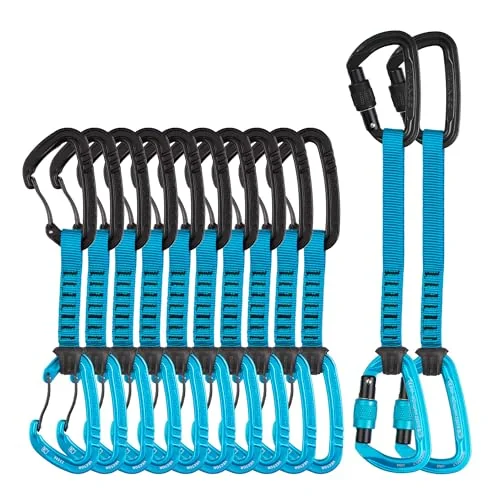
The Trango Vector Quickdraw Package solves the rack-count problem in one transaction, and it does the thing most twelve-packs skip: it includes two 24 cm locking draws. Those are your anchor at the top of a sport route, and buying them separately after the fact is how most people end up with eleven draws and an improvised anchor.
The mid-range positioning is the point here. These aren’t the lightest draws on the market and they aren’t trying to be. They’re 22 kN rated, they have keylock noses so they won’t hook a hanger, and there are twelve of them. For a first rack, twelve adequate draws beat six excellent ones on every route you’ll actually climb this season.
If you’d rather build slowly, the other route is buying one draw at a time. The DMM Chimera Quickdraw in 12 cm is the premium end of that approach, with a clean keylock nose and a noticeably lighter carabiner than most. It costs more per draw and it takes a season to accumulate a rack, but you end up with better hardware. Just don’t confuse “one nice draw” with “a rack” when you’re standing at the base.
Once the draw count is settled, our climbing trip packing list covers what else actually needs to be in the bag.
Belay Device Categories, From Tube to Assisted-Braking
Every belay device does the same job: multiply friction so a smaller person can hold a bigger one. They just disagree about how much of that job is your responsibility.
Tube Devices: Where Everyone Should Start
A tube-style belay device bends the rope through a slot and against a carabiner. The friction comes from that bend plus your brake hand pulling the rope down and back. Nothing about it is automatic. That’s the design, not a shortcoming.
The full mechanics of each family are worth understanding properly, and our breakdown of ATC, GRIGRI and passive devices covers the technique side that pairs with this gear-side guide.
Belay certification courses teach on tube devices first, and they do it deliberately. An AMGA guide put it plainly: the ATC “gives them a very good foundation for how to belay.” Device skill transfers to anything. Device dependency doesn’t transfer to anything.
There’s one situation friction alone doesn’t solve, which is a large weight difference between climber and belayer. That’s a hardware problem, not a technique problem, and when there’s a big weight difference between climber and belayer there’s a specific piece of gear built for it.
Guide Mode and What It Unlocks for Multi-Pitch
A tube device with two rope slots and a small metal loop can be rigged directly off an anchor to belay one or two climbers coming up behind you. Load it and the rope pinches itself against the device frame. Climbers call this guide mode belaying or auto-block, and it’s the feature that turns a cheap piece of aluminum into a multi-pitch tool.
Practically, it means you can belay a second while eating a sandwich, and if they hang, you’re not holding them. On a long route with a tired partner, that’s not comfort, that’s endurance.
The Tube That Grows With You

The Black Diamond ATC-Guide is the answer to “which one device should I buy first” for almost everyone, and the reason is guide mode. A basic tube costs less and belays a leader perfectly well. It also stops being useful the day you tie into your first multi-pitch route, and then you buy this anyway.
The dual friction modes matter more than they sound. Flip the device and the rope runs through a set of grooves that bite harder, which is what you want on a skinny rope or when the climber outweighs you. Flip it back for smooth feeding on a fat gym rope.
The honest counterpoint: if you know for certain you’ll only ever climb single pitch in a gym, a basic non-guide-mode tube does the job for less money. That’s a real option, not a consolation prize. Most people who say that end up on a multi-pitch route within two years.
Figure-8: Still Around, Rarely the Right Buy
The figure-8 descender is a rappel tool (abseiling, if you learned the word in Europe) and rescue tool that some climbers still belay with. It twists the rope, it offers less fine control for lead belaying and catching falls, and it’s mostly held on by tradition and canyoneering. Don’t make it your first device. If you inherit one, it’s a fine rappel backup and that’s about where it belongs on a modern rack.
The Assisted-Braking Reality Check
The GRIGRI is very good and it is not magic. The gap between those two sentences is where people get hurt, so let’s be specific about both halves.
What Assisted Braking Actually Does: and Doesn’t
An assisted-braking device uses cam-assisted blocking: a cam rotates and pinches the rope when the rope moves suddenly. Under a fall, that pinch engages and takes most of the load. What you get is real: holding a hanging climber costs almost nothing, working a route becomes tolerable for the belayer, long belays stop being a grip endurance event, and a lighter belayer catches a heavier climber with less struggle.
Long sessions have a second cost that nobody warns you about, which is your neck. If you’re belaying enough that looking up hurts, belay glasses for people belaying long sessions are the fix, and they’re cheap relative to a chronic problem.
Now the other half. Assisted braking has a steeper learning curve, and feeding slack fast requires a specific technique that has to be learned properly from someone who knows it. The rope has to be loaded in the correct direction, which is printed right on the device and still gets ignored.
And the big one: it creates false confidence. Belayers who trust the cam get lazy with brake-hand position, and a cam that isn’t given a properly dressed rope path doesn’t assist with anything.
The moment that teaches everyone the same lesson: someone loads the rope backwards or lets the path get sloppy, the climber weights it, and the assisted braking assists with nothing at all. The brake hand is the system. The cam is the backup. Belay a GRIGRI exactly like you’d belay a tube device and the cam becomes what it was designed to be, which is margin you hope you never spend.
The GRIGRI, Honestly
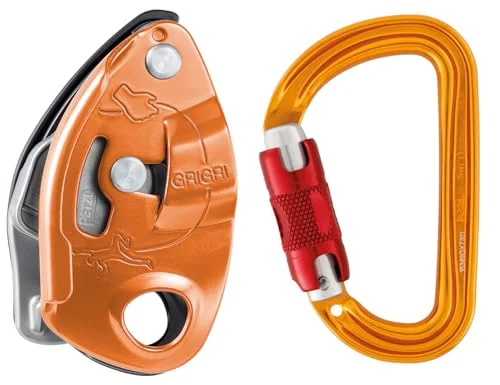
The Petzl GRIGRI is a premium purchase and it earns the position, with one condition attached. Buy it as your second device, after brake-hand technique has stopped being something you think about. Buy it first and you’re learning two skills at once while somebody’s life is on the rope.
What you’re paying for is the cam and thirty years of iteration on it. Feeding slack is fast once you’ve learned the technique. Holding a projecting climber costs you nothing. On a long sport day it’s the difference between belaying comfortably and counting pitches until your turn.
The trade-off is honest: it’s heavier than a tube, it’s a single-rope device so it won’t handle a double-rope rappel, and it demands that you learn its specific slack-feeding motion properly rather than improvising. None of that is a knock. It’s just what a budget tube device does differently from a premium one.
The One Built for People Still Learning
There’s an exception to the “learn on a tube first” rule, and it’s a narrow one. The Petzl GRIGRI+ was designed and marketed for learners specifically, and the reason is the anti-panic handle. On a standard assisted-braking device, a panicking belayer’s instinct is to pull the release lever harder, which does the opposite of what they want. The GRIGRI+ brakes automatically when the handle is pulled too far.
It also has a mode switch for top-rope versus lead, adding friction for top-rope belaying where a new belayer needs the margin most. It’s a premium device that costs more than the standard GRIGRI, and it’s the one assisted-braking device that makes sense in a beginner’s hands, particularly for gyms, courses, or anyone teaching a partner to belay.
That still isn’t a case for skipping the tube. It’s a case for what to buy if an assisted-braking device is going to a new belayer regardless.
Left-Handed Belaying: The Thing Nobody Mentions
Almost nothing gets written about this, so here it is. The GRIGRI’s finger-lip guide sits on the right plate only, which means the standard slack-feeding technique assumes a right-handed brake hand. Left-handed belayers adapt, but they’re adapting to a device that wasn’t shaped for them.
The Edelrid Pinch is the alternative that comes up most in that conversation, because it lets you feed slack with the brake hand underhand and doesn’t build the same handedness assumption into its geometry. It’s worth knowing about if you belay left-handed and have been quietly assuming the awkwardness was your technique.
What the Numbers on Your Gear Actually Mean

Every carabiner has three numbers stamped into the spine, and almost nobody knows the smallest one is the one that matters. Our full breakdown of how to read carabiner strength ratings before you fall goes deeper on the testing side, but here’s what those stamps mean in the field.
Reading the Three Numbers on the Spine
Look at the flat back bar of any carabiner. You’ll find three figures in kN, which stands for kilonewton, roughly 225 pounds of force each.
The first is major axis with the gate closed, typically around 24 kN on a modern carabiner. That’s the number on the packaging and it describes the carabiner being loaded exactly as designed, top to bottom, gate shut.
The second is the minor axis, which is the carabiner loaded sideways across its narrow dimension. This one drops to roughly 7 to 9 kN.
The third is gate-open strength along the major axis, with a UIAA minimum of 7 kN. Alongside those you’ll find CE certification and UIAA certification marks, and what the UIAA and CE marks actually certify is worth understanding, because certification tells you the piece passed a defined test protocol rather than a manufacturer’s own claim.
Cross-Loading: How 24 kN Becomes 8 kN
Put those first two numbers next to each other and the picture changes. 24 kN is about 5,400 pounds. The minor axis at 7 to 9 kN is about 1,575 pounds. Same piece of aluminum, roughly a third of the strength, and the only variable is how it happened to be sitting when the rope came tight.
That’s cross-loading, and it’s why your belay carabiner’s orientation is a real concern and not fussiness. It’s also why captive-eye lockers exist: a small plastic or wire retainer that stops the carabiner from rotating out of position while you belay. A hard fall can generate loads in the range where 1,575 pounds stops being a comfortable margin.
Hot-Forged, I-Beam and What’s Actually Worth Paying For
Hot-forging shapes the aluminum carabiner blank while it’s hot, unlike cold-forged or plain round stock construction, letting the manufacturer put material exactly where the stress goes and remove it everywhere else. I-beam construction hollows the cross-section into an I profile, the same trick that makes steel building beams strong for their weight. Both are real engineering, not marketing.
Here’s the honest calibration though: for a recreational sport rack, these features matter far less than owning enough draws. A hot-forged I-beam carabiner saves grams. Being two draws short of the anchor costs you the route. Weight-optimized hardware starts genuinely paying off on long trad and alpine days where you’re carrying forty pieces uphill, and the American Alpine Club’s breakdown of sport and trad protection is a good primer on how those two disciplines diverge in what they demand from hardware.
The single most useful thing in this whole section is a clipping habit. On bolted routes, clip the quickdraw so the carabiner gate faces away from your direction of travel. On angled hangers, clip toward the nut side rather than the head side. Both rules exist to stop the rope from twisting the carabiner into a cross-load or prying the gate open during a sideways fall, and you can start doing it on your very next clip.
When to Retire a Carabiner or Belay Device

The scary one isn’t the obviously cracked carabiner. It’s the one that looks completely fine and shouldn’t be on your harness anymore.
Start with age, because age alone retires hardware. Petzl, Black Diamond, DMM and CAMP all cap carabiner lifespan at 10 years from the date of manufacture even if the piece has never been used. A carabiner that sat in a drawer since 2015 is done. Not because aluminum rots, but because the manufacturer will not stand behind it and neither should you.
With regular use, meaning something like 50 to 100 days a year, the practical service life runs 3 to 5 years. The UIAA Safety Commission’s own guidance on when to retire a carabiner is the reference worth reading in full if you’re building a habit around this.
The retirement criteria make a gear inspection short enough to run at the base of a route:
- Visible cracks, burrs or corrosion anywhere on the frame
- A deep or sharp-edged groove worn into the rope-bearing surface
- A gate that doesn’t snap fully closed on its own
- Loose or missing rivets at the gate hinge
- Any piece that took a direct load in a fall factor greater than 1
Belay devices retire on the same logic. Rope running under load slowly cuts a groove into the metal at the slot, and once that groove develops a sharp edge, the device has stopped being a friction surface and started being something that abrades your rope every time you lower.
Run a fingernail across it. If it catches, look closer. Our full gate-play and wear inspection checklist walks the whole procedure piece by piece.
The check people skip is the gate test, and it takes two seconds. Open it, let go, watch it close. It should snap. If it drifts, hesitates, or stops just short of seating in the nose, that carabiner has been spending time in its weak state without telling you.
Building the Right Rack for How You Actually Climb

Everything above turns into three shopping lists. Find the one that matches how you actually climb, not how you plan to climb in three years.
The Minimum Viable First Rack
One locking HMS carabiner for belaying and anchors. One tube-style belay device with guide mode. About twelve quickdraws, including two that can serve anchor duty at the chains.
That’s a complete first sport rack. Not a stripped-down version of a real one, not a starter kit you replace later. That specific combination gets you safely up and down almost any single-pitch sport route in the country, and the only piece you’ll eventually add rather than replace is a second locker.
Assembled from mid-tier gear, that whole list is a single mid-range purchase rather than an ongoing project, which is the real answer most beginners are looking for when they ask about individual products one at a time.
The Dialed Sport Rack
Sixteen to eighteen draws, because you’ve started tying into routes over 30 meters and running out of hardware two clips from the anchor has stopped being funny. A second locking carabiner, because anchors go faster with two. And this is the point where an assisted-braking device earns its cost, since you’re belaying long enough sessions that the difference compounds.
Notice what didn’t change: the same shapes, the same gate logic, the same three mandatory locker positions. A dialed rack is a bigger version of the first rack, not a different philosophy.
Where Trad and Alpine Racks Diverge
This is where the priorities genuinely shift. Dyneema dogbones and the extendable quickdraw, because rope drag on a wandering trad climbing pitch is a real problem that quickdraw length actually solves. Wiregates nearly everywhere, because forty carabiners of saved grams is a pound off your harness. A handful of ovals for racking nuts, where predictable positioning beats maximum strength.
Alpine climbing and trad also pull in hardware sport climbing never touches, and if the day might include going back up a fixed line, hardware for ascending a fixed rope is the next system to understand.
What Not to Buy First
Three specific mistakes, in the order people make them.
Premium single carabiners before you own enough draws. A beautiful hot-forged locker does nothing for you on a route you had to bail off. Buy quantity first, quality second.
A figure-8 as your first belay device. It’s a rappel tool wearing a belay device’s job description, and every reason to own one is a reason you’ll discover later.
Auto-locking triple-action carabiners as your only belay locker. They’re excellent hardware and they’re slow, and a beginner who fumbles a three-action gate at the base of a route is a beginner who eventually stops locking it properly out of frustration. Start with a screwgate and one habit: look at it before you climb.
One last thing worth saying plainly. The rack grows with route length and climbing style, never with your grade. That’s why copying a strong climber’s rack is the wrong shortcut.
Their eighteen draws and titanium-light hardware exist because of the specific routes they climb, and if you’re on 25-meter sport pitches, twelve solid draws and an ATC-Guide is not a lesser rack. It’s the correct one.
The Short Version
Three things to walk away with.
The three categories are one chain. Pick each piece for the job it does in that chain, not off a ranking that ignores where the hardware sits.
The gate is the failure point. Wiregates on the rope end, keylock noses on the bolt end, and a gate that snaps fully shut every single time you check it.
Buy enough draws before you buy nice ones. Twelve solid quickdraws beat six excellent ones on every route you’ll actually get on this season.
Before your next session, pull one locking carabiner off your harness and run the two checks from this guide. Thumb along the rope-bearing groove, then open the gate and let it close on its own. Thirty seconds, and you’ll know something about your rack you didn’t know this morning.
Frequently Asked Questions
01How many quickdraws do I need for sport climbing?
Twelve quickdraws covers nearly every single-pitch sport route. Most routes carry seven to twelve bolts, and twelve draws leaves two spare to build an anchor at the chains. Routes over 30 meters call for sixteen to eighteen.
02Is a GRIGRI better than an ATC for beginners?
No. Guides teach on tube devices first because brake-hand technique has to become automatic before assisted braking is layered on top. The one exception is the GRIGRI+, whose anti-panic handle was built specifically for learners.
03What is the difference between a locking and non-locking carabiner?
A locking carabiner has a sleeve or mechanism that secures the gate shut, and it is mandatory in exactly three places: belaying, rappelling, and anchor connections. Non-locking carabiners are standard everywhere else, including both ends of every quickdraw.
04When should I retire a carabiner?
Retire it at 10 years from manufacture even unused, or after 3 to 5 years of regular climbing. Retire it immediately on any crack, burr, deep rope groove, loose rivet, or a gate that no longer snaps fully closed.
05Why do carabiners have three different strength numbers stamped on them?
They rate three loading scenarios: gate closed on the major axis at around 24 kN, cross-loaded on the minor axis at roughly 7 to 9 kN, and gate open at a 7 kN minimum. The smallest numbers describe how carabiners are loaded when something goes wrong.
Safety Notice: Rock climbing and mountaineering are inherently high-risk
activities that can involve physical trauma or fatal incidents. The information on Rock Climbing Realms is for
educational and informational purposes only. Techniques and advice presented here are not a substitute
for professional, hands-on instruction. Conditions and risks vary by location. Always seek guidance
from a qualified instructor before attempting new techniques. By using this website, you agree that you
are solely responsible for your own safety. Any reliance you place on this information is strictly
at your own risk, and you assume all liability for your actions. Rock Climbing Realms and its authors
will not be held liable for any harm, damage, or loss sustained in connection with the use of this information.
Affiliate Disclosure: We are a participant in the Amazon Services LLC Associates Program, an
affiliate advertising program designed to provide a means for us to earn advertising fees by advertising and linking
to Amazon.com. As an Amazon Associate, we earn from qualifying purchases. We are also an official affiliate partner
of Black Diamond Equipment via the AvantLink network. If you click on a Black Diamond affiliate link and make a
purchase, we may earn a commission at no additional cost to you. We also participate in other affiliate programs.
Additional terms are found in the terms of service.