
In this article
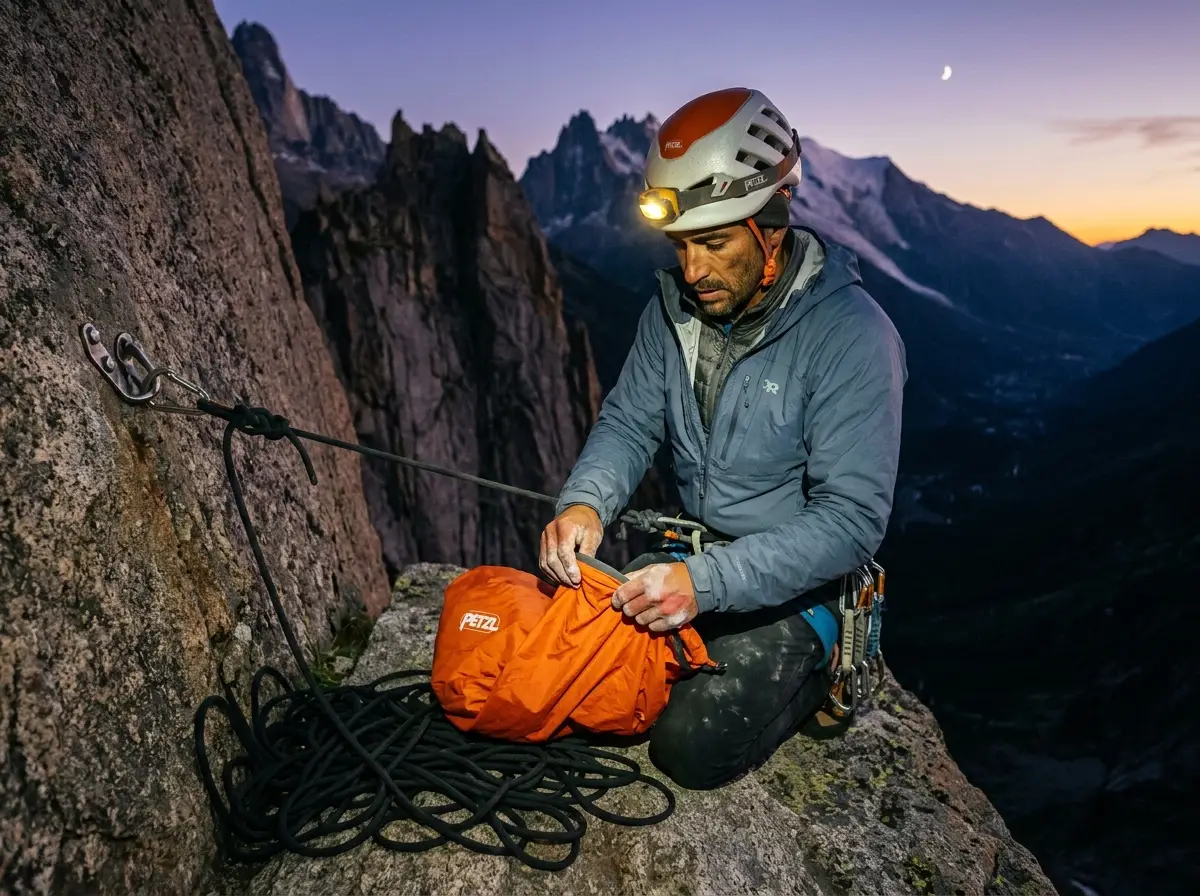
It’s 9pm at pitch fourteen, your headlamp is down to its reserve battery, the wind just shifted, and the rappel you planned to be off by dark is now a problem for tomorrow. I’ve been in some version of that exact spot more than once, and the night that rattled me wasn’t cold — it was wet, and I had the wrong gear to deal with it. An unplanned bivouac isn’t a serious situation because of the temperature on the thermometer; it becomes one because of the handful of mistakes people make in the first thirty minutes. This guide walks through the real bivouac survival skills for climbers that get you through the night: building a kit, picking a site, sleeping anchored without hanging, managing wet insulation, fueling your core, and reading hypothermia before it reads you.
Why Climbers End Up Benighted — And Why It Happens to the Prepared Too
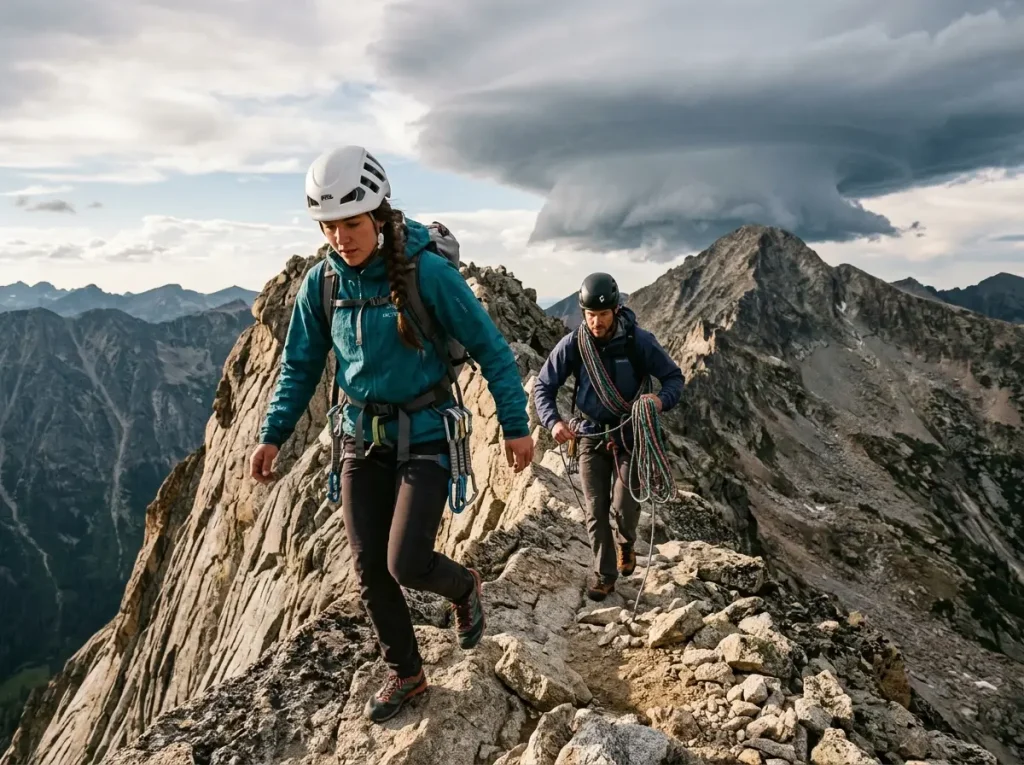
Here’s the uncomfortable truth: most benightments don’t happen to bad climbers. They happen to competent people moving fast on a long line who hit one variable they didn’t price in. If you climb long enough, a forced night out is less a question of whether and more a question of when, which is exactly why this belongs in the same toolkit as the alpinism approach to alpine objectives — the broader mindset for big alpine routes treats a bivy as a planned contingency, not a failure.
The Most Common Causes of an Unplanned Bivy
Route-finding errors are the big one. A wrong gully, a missed rappel station, an hour spent re-climbing to find the line — those minutes stack into a night. Add unexpected weather that slows everything down, a minor injury, or a stuck rope, and a clean single-day route turns into an overnight. The climbers most exposed to this are the ones moving fast and light, because a light pack has no buffer in it. There’s no spare layer, no extra battery, nothing to absorb the one thing that goes wrong.
The Bivy Paradox: Fast and Light Has a Price
The Alpine Institute calls this the bivy paradox, and it’s worth sitting with. Every gram you save on safety gear is a gram you’re betting against the route going sideways. The paradox is that the climbers most likely to move fast and light are exactly the ones most likely to need bivy gear when the weather turns. As guide Mike Pond puts it, “light and fast” has a way of becoming “cold and miserable” the moment the route takes twice as long as planned. Fast is a strategy, not a guarantee.
The Decision That Turns a Bivy Into an Emergency
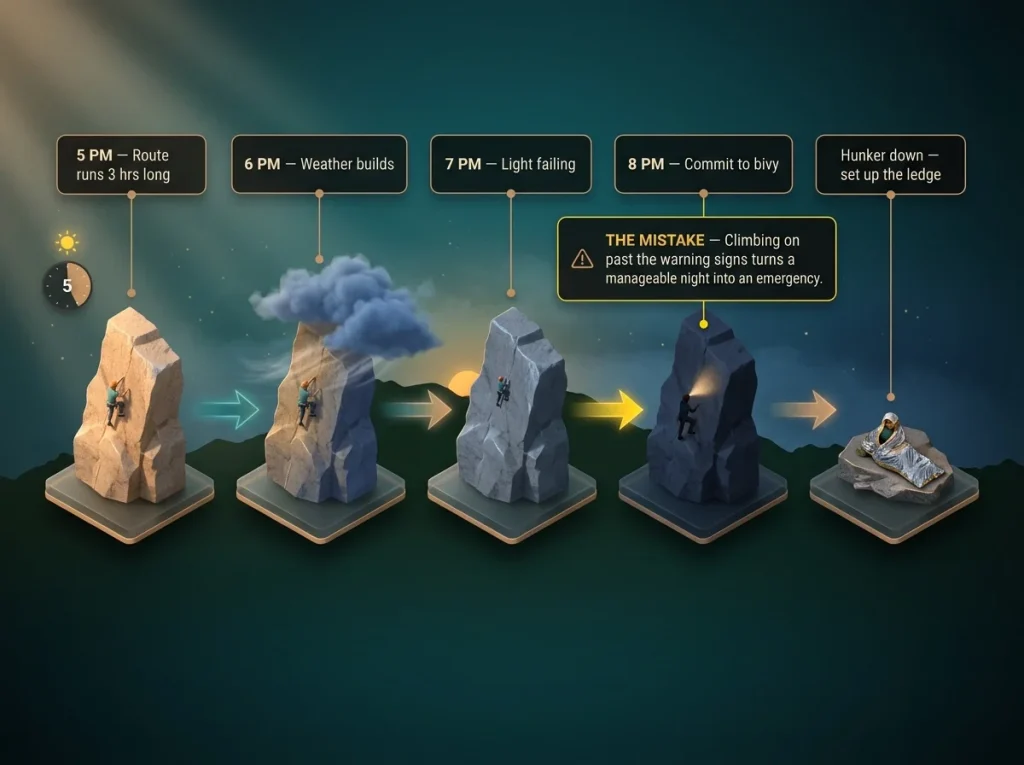
The single worst move in a benightment is climbing on after the warning signs show up. You see the weather building, the light failing, and you push for the summit or one more pitch, hoping for a better spot. That’s the decision that turns a manageable night into a serious one. Jordan Cannon learned this on El Gigante, benighted at pitch fourteen, soaked to his underwear, two hundred feet below the food cache where his bivy sack was stashed. He and his partner survived by sharing a portaledge and what warmth they had between them, later describing the night as “waiting it out in a poor position with inadequate gear.” Hunkering down early at a good site, with daylight left to set it up, beats fighting for a better one in the dark almost every time.
Building Your Bivouac Kit — What Goes In, What Doesn’t
What’s in your summit pack right now? If you can’t answer “emergency bivy sack” within three seconds, this section is for you. Not what should theoretically be in there — what actually fits and earns its weight.
The Non-Negotiable: Emergency Bivy Sack
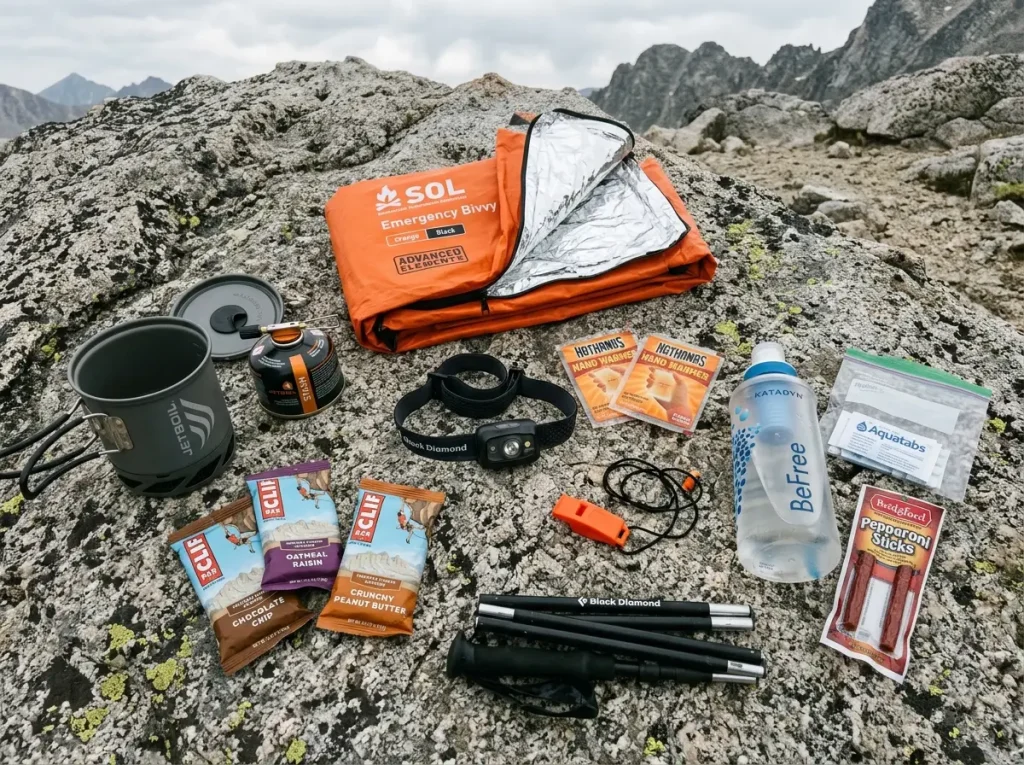
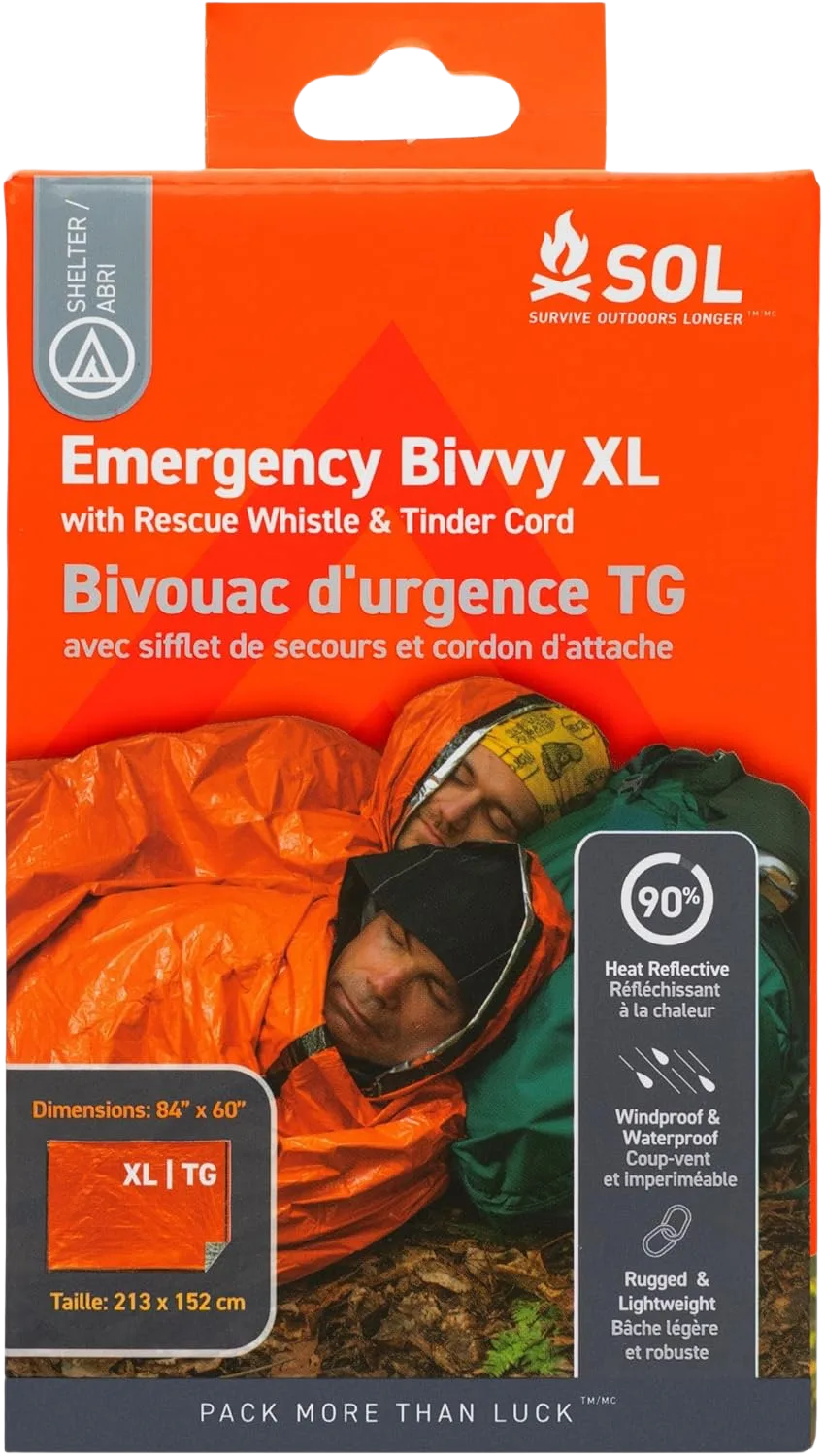
The one item with no excuse to skip is an emergency bivy sack. The SOL Emergency Bivvy XL weighs 5.8 ounces, packs down smaller than a fist, and reflects up to 90% of the heat you give off — it goes in the pack on every technical climb and stays there. If you expect multi-night exposure or genuinely cold conditions, the breathable SOL Escape Bivvy with Hood XL trades some of that reflective number for far less internal condensation, which matters when you’re going to be inside it for ten hours instead of two. A pure Mylar sack keeps you warm and slowly soaks you in your own moisture; the breathable version is the upgrade for longer sits.
Calibrating Your Kit to the Route (3-Tier System)
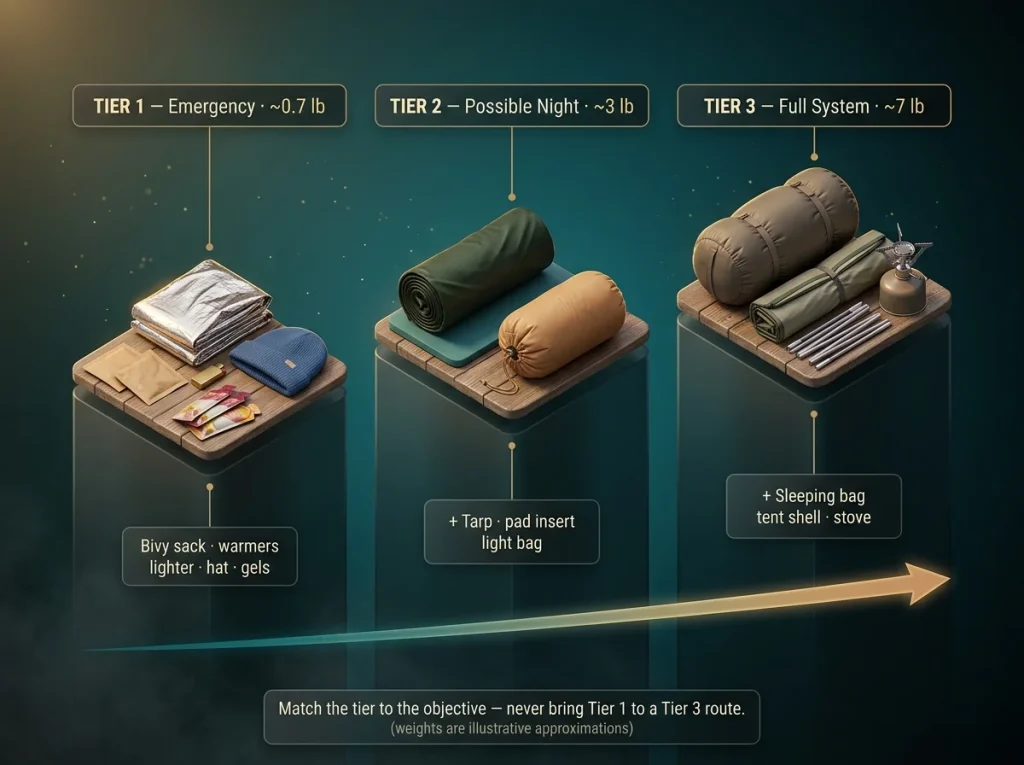
The Alpine Institute breaks bivy kits into three tiers, and the framework maps cleanly onto climbing. Tier one is the sandwich-bag emergency kit: a bivy sack or blanket, hand warmers, a lighter, a hat, and a few gels. Tier two adds a tarp, a pad insert, and a light sleeping bag for routes where a night out is a real possibility. Tier three is the full system — sleeping bag, tent shell, and stove — for alpine objectives with overnight potential built in. The mistake is bringing tier one on a tier three route. A summer sport route in Zion is a tier one day; a Cascade glacier in July is not. Matching the kit to the objective is one of the core alpine skills every climber needs before pushing into big routes, and we cover the full progression of those fundamentals in its own piece.
Food, Water, and Light — The Support Layer
Three support items get cited constantly and specified rarely. Your headlamp needs a backup battery or a quality rechargeable, because a bivy lasts all night and most headlamps last two to four hours on high — picking the right headlamp for alpine climbing is half about the spare battery. For water, carry purification tablets, since you can’t melt snow without a stove. For food, pack fatty snacks and a freeze-dried meal as an emergency ration, not a fistful of energy gels — more on why that matters below.
Choosing a Bivouac Site — Where You Sleep Is as Important as How You Sleep
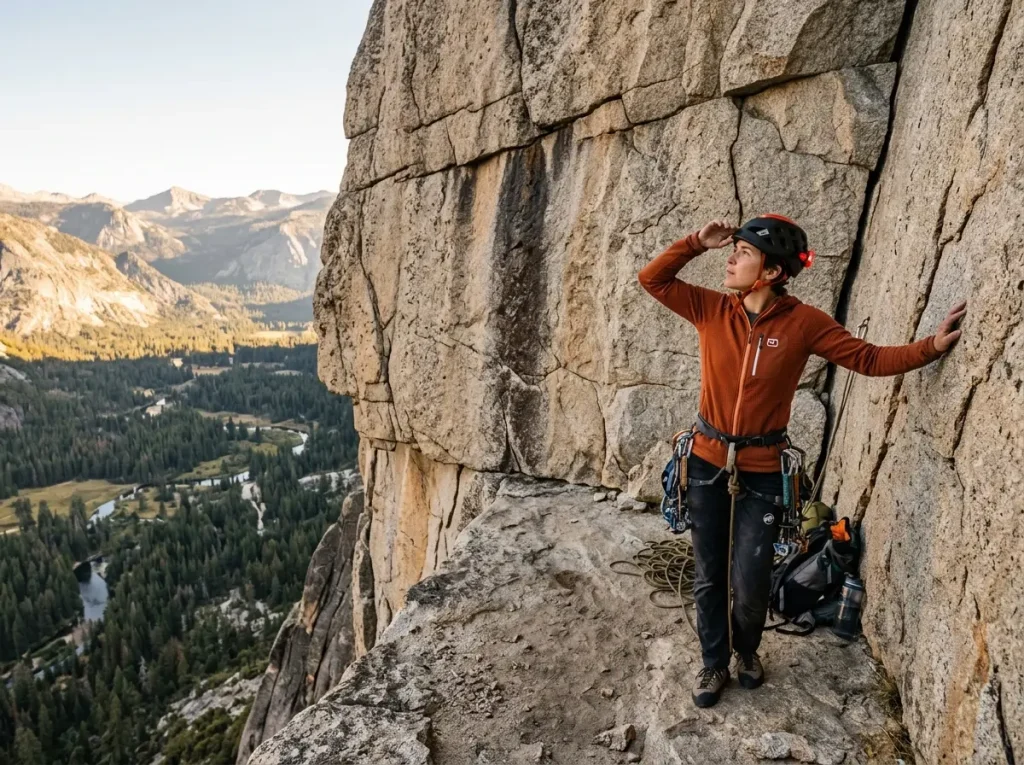
In an emergency, the urge is to stop right where you are and deal with it. That’s usually the wrong call. Moving fifty meters to a safer spot, even in the dark, is almost always worth the effort.
Reading Terrain for Hazard-Free Shelter
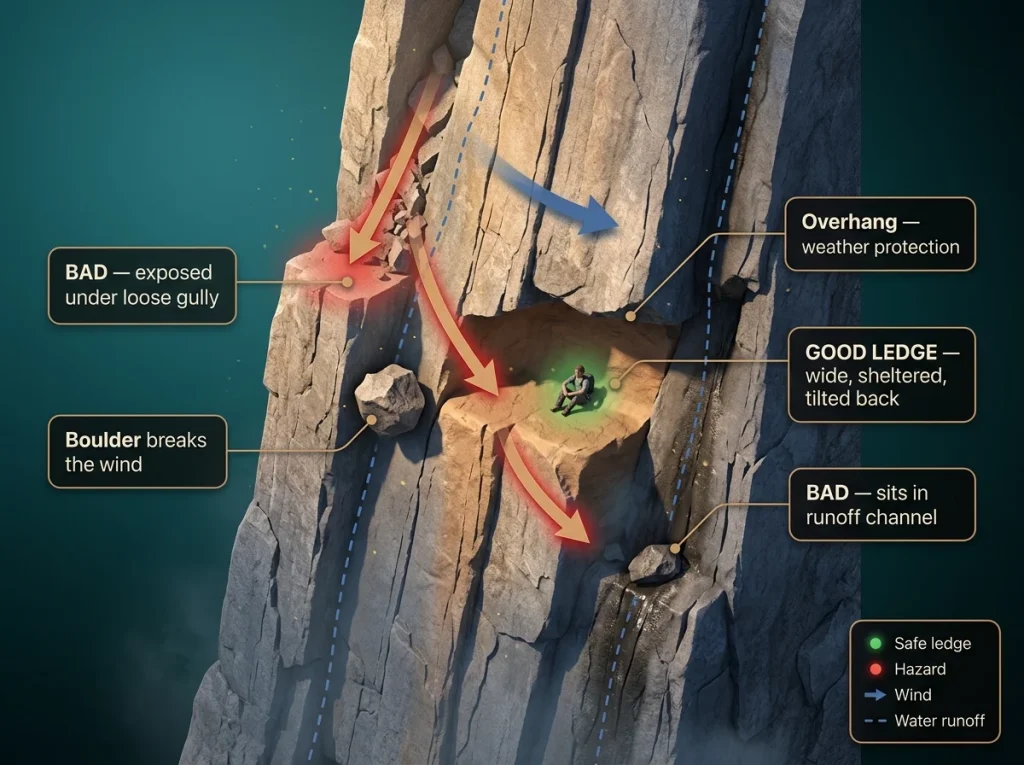
Before you commit to a ledge, run a three-look hazard check: above, across, and below. Look up first, not down — rockfall and ice come from overhead, and a comfortable ledge under a loose gully is a trap. Scan for water runoff lines, because a dry ledge at 9pm becomes a small waterfall by midnight once rain hits the face above it. In winter and spring, factor avalanche runout. The same instinct you’d use to assess rockfall risk before you stop on any climb applies double when you’re about to sit in one place for ten hours.
Using Natural Features — What’s Worth Moving For
Once the hazards check out, look for features that do work for you. An overhang gives weather protection. A large boulder breaks the wind. A recessed scoop in the rock blocks horizontal precipitation that an open ledge won’t. The ledge itself should be wide enough to sit without your legs dangling, ideally tilted slightly back into the wall so you can’t slide off, and out of the wind funnel. A flat, exposed perch that catches every gust is worse than a cramped, sheltered one.
Anchoring In: The Setup Nobody Fully Explains
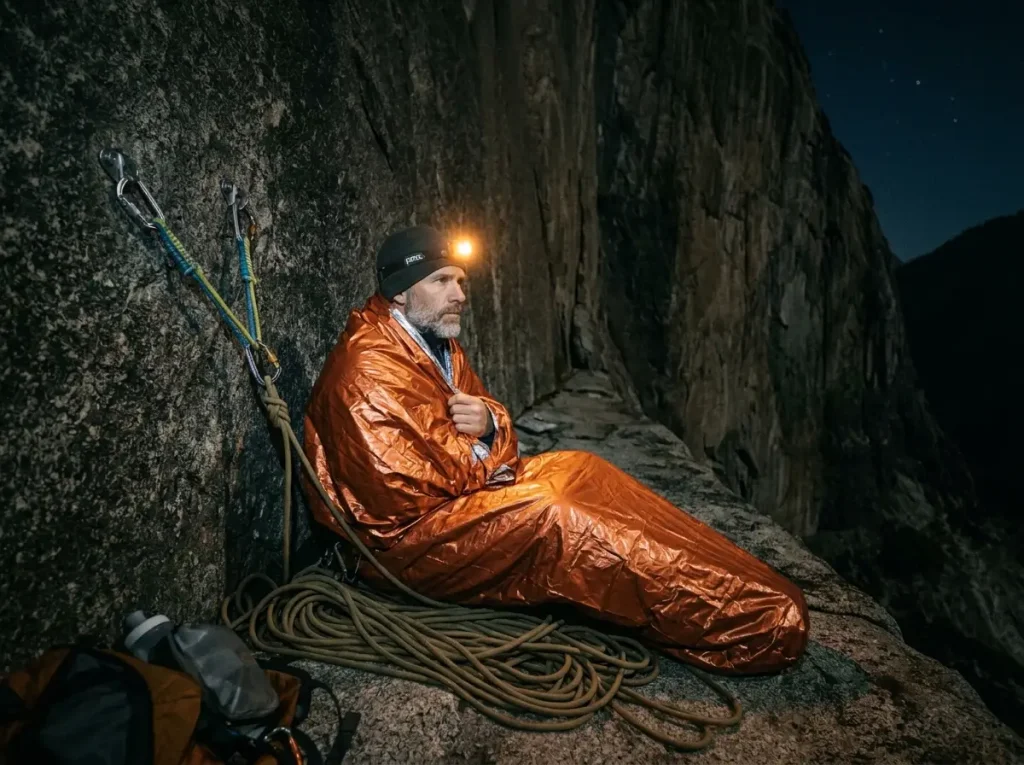
Here’s the distinction that matters: in a bivy, your anchor is fall prevention, not weight support. You clove hitch from your belay loop to a redundant master point so you can’t roll off the ledge in your sleep — but your weight rests on the ledge, your pack, or your coiled rope, never on the harness. The same redundancy principles behind anchor systems that hold in alpine conditions apply here; the anchor has to be bomber, because you’ll be unconscious or close to it, but it’s a backup, not a hammock.
Mark potential bivy ledges on your GPS or topo during the approach, while you can see them in daylight and think clearly. At 9pm, cold and tired, your judgment is shot and every ledge looks the same. And always sleep with your head uphill — head-down at altitude raises the pressure in your skull and guarantees a pounding headache exactly when you need a clear head to get down.
Anchor Sleeping — How to Survive the Night on Vertical Terrain
“Anchor yourself.” That’s the advice every guide gives and every article repeats in one sentence. Here’s what it actually means in the dark, at 11pm, after fourteen pitches, when your hands are numb and your judgment is half gone — because this is the part where people who did everything else right can still get hurt.
Why Hanging Freely in Your Harness Can Become an Emergency
If you clip in and simply hang in your harness all night, you’re not just going to be sore. You’re risking suspension syndrome, sometimes called harness hang syndrome. When you hang motionless, the leg loops compress the large veins in your thighs, circulation pools in your lower legs instead of returning to your heart, and your heart has less and less to pump. The research on suspension trauma from the National Library of Medicine documents symptoms starting in as little as eight minutes in lab conditions, with real risk of a cardiac event past the fifteen to thirty minute mark. This is a documented and avoidable cause of cardiac emergencies in climbers who anchored correctly but positioned themselves wrong.
The Correct Anchor Sleeping Setup
The fix is anchor sleeping, not anchor hanging. Sit on the ledge — or on your pack and coiled rope if the ledge is thin — with the clove hitch from your belay loop to the master point set just snug enough to catch you, not hold you. Your weight goes onto solid surfaces. Sit upright or slightly reclined, pack against your back, legs stretched out or bent at the knee, with as much of you as possible in contact with something insulating and as little pressure as possible on the big arteries in your legs. The anchor stops you rolling into space. The ledge holds you up.
The 20-Minute Rule — Moving Beats Sleeping for Circulation
Even seated, on a cramped ledge you need to keep moving. Set a timer for twenty minutes, and every time it goes off, wiggle your legs, pump your calf muscles, bend your knees repeatedly, and stand and bounce if there’s room. Climbers call this the G-Tox — the same rhythmic calf pumping that keeps circulation moving on a long flight. It feels excessive when you’re exhausted and just want to sleep, but it’s what keeps the physiology working through the night. If two of you are out there, split the night into watches: one person moving and keeping watch while the other rests, then switch. If you ever find yourself with no ledge at all, that’s a self-rescue problem, and the same alpine self-rescue skills in technical terrain that get you off bad ground apply to getting yourself onto survivable ground before dark.
Don’t trust yourself to wake up and move on instinct — cold makes you want to curl up and stay still, which is exactly the wrong move. Set a hard timer on your watch or phone for every twenty minutes and treat it like a belay command. Move, then rest. The night you most want to skip the alarm is the night it matters most.
Managing Warmth — The Wet Insulation Problem Nobody Talks About
Jordan Cannon had gear. He had warm layers. He still nearly didn’t make it through the night on El Gigante, because he got wet — and wet is the failure mode the gear lists never explain. The question that matters at 11pm isn’t what you carried. It’s what happens to what you carried when conditions go wrong.
Synthetic vs Down in the Alpine — What El Gigante Proved
Wet down is the quiet killer of warmth. An 800-fill puffy loses more than 90% of its loft the moment it’s soaked, and a flattened down jacket is a heavy, cold sponge with zero insulating value. Synthetic insulation, by contrast, holds most of its warmth when wet. For alpine routes where the weather is a coin flip, synthetic base and outer layers aren’t a downgrade — they’re the safer bet, which is exactly the lesson in the American Alpine Club’s analysis of the El Gigante bivy survival. This is also where the breathable SOL Escape Bivvy with Hood XL earns its place: the more breathable the sack, the less condensation soaks the very insulation you’re depending on to keep you alive.
Order of Operations When You’re Wet and Cold
The sequence matters as much as the gear. Get into the bivy sack first, then pull your dry insulation over yourself inside the sack, then seal the opening. Do it in that order and your warm layers stay dry. Do it in reverse — spreading your puffy out in the rain and then climbing in — and everything you own is wet before it ever warms you.
Once you’re sealed in, deploy your heat sources smartly. A set of HotHands Body & Hand Super Warmers runs up to eighteen hours each, and the trick most people miss is to put them against your core — one at the stomach, one at the kidney area — not in your hands. Warmth gets routed to your core first, so heating it directly lets circulation reach your fingers and toes more effectively than warming the extremities ever will.
Ground Heat Loss — The Silent Heat Thief
The fastest way you lose heat overnight isn’t the air — it’s the cold rock under you. Conductive contact with the ground pulls warmth out of you far faster than the breeze around you, which is why insulating from below comes before everything else. Coil your rope under your hips and torso, slide your pack under your legs, and put anything you’ve got between you and the stone. A 60-meter rope folded three times gives you roughly four inches of insulation you were already carrying. No pad? The rope is your pad.
Slip a plastic bag over each sock, inside your boot liner, before you settle in. The vapor barrier traps the warmth your feet are already making and stops the cold from wicking up through your soles into the rock. It’s the oldest trick in the alpine playbook, it weighs nothing, and your feet will thank you at 4am. Empty them out before you start moving in the morning.
Fueling the Furnace — Nutrition and Hydration Through the Night
You’re not climbing anymore. You’re not generating heat from movement. You’re now a furnace running on whatever you last fed it — and energy gels are the wrong fuel for a long, slow burn.
Why Fatty Foods Beat Energy Gels at Night
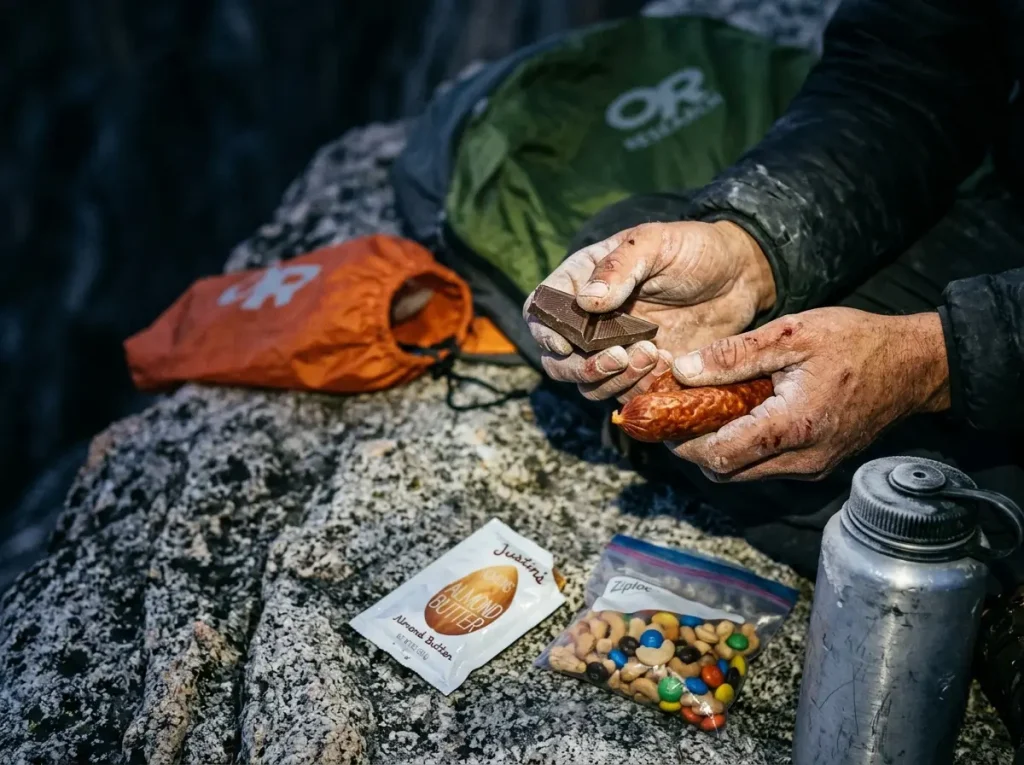
After dark, fat beats sugar. Fatty foods — pepperoni, chocolate, nuts, cheese — metabolize slowly and put out sustained heat for hours. Carbohydrate gels spike fast and burn off just as fast, which is great while you’re moving and useless when you’re sitting still trying to stay warm. This is Charlie Boscoe’s field strategy on routes like the Grandes Jorasses, and it’s why experienced alpinists stash a coil of sausage and a chocolate bar for exactly these nights. Save the gels for the climb. Bring fat for the bivy.
Eating on a Schedule — Don’t Wait for Hunger
Cold and exhaustion both suppress your appetite, so hunger is a liar on a bivy. Don’t wait to feel like eating, because that signal won’t come reliably. Set an alarm for every ninety minutes to two hours and eat something on schedule, even a few bites, even when you don’t want it. The calories you put in are the fuel your furnace burns to keep your core temperature up while you sit motionless in the dark.
Eat your richest, fattiest food the moment you commit to the bivy, not at 2am. Early on your hands still work, your stomach still cooperates, and you get fuel in the tank before the cold shuts your appetite down. By the time you feel too cold to eat, chewing and swallowing are already a chore. Front-load the calories while it’s easy.
Water, Snow, and the Nalgene Warmer Hack
Dehydration speeds up hypothermia, and at altitude you lose water through your breath at two to three times the normal rate even without sweating. If you have a stove, melt snow; if not, fill a bottle before dark and drop in purification tablets. The bonus move: boil water before it gets dark, seal it in a hard Nalgene, and tuck it against your core as a warmer that lasts two to three hours — hydration and heat from one item. Planning calorie-dense food and water for nights like this is part of how to pack calorie-dense food for alpine routes on any multi-day objective.
Reading the Hypothermia Clock — The Cascade That Creeps Up Quietly
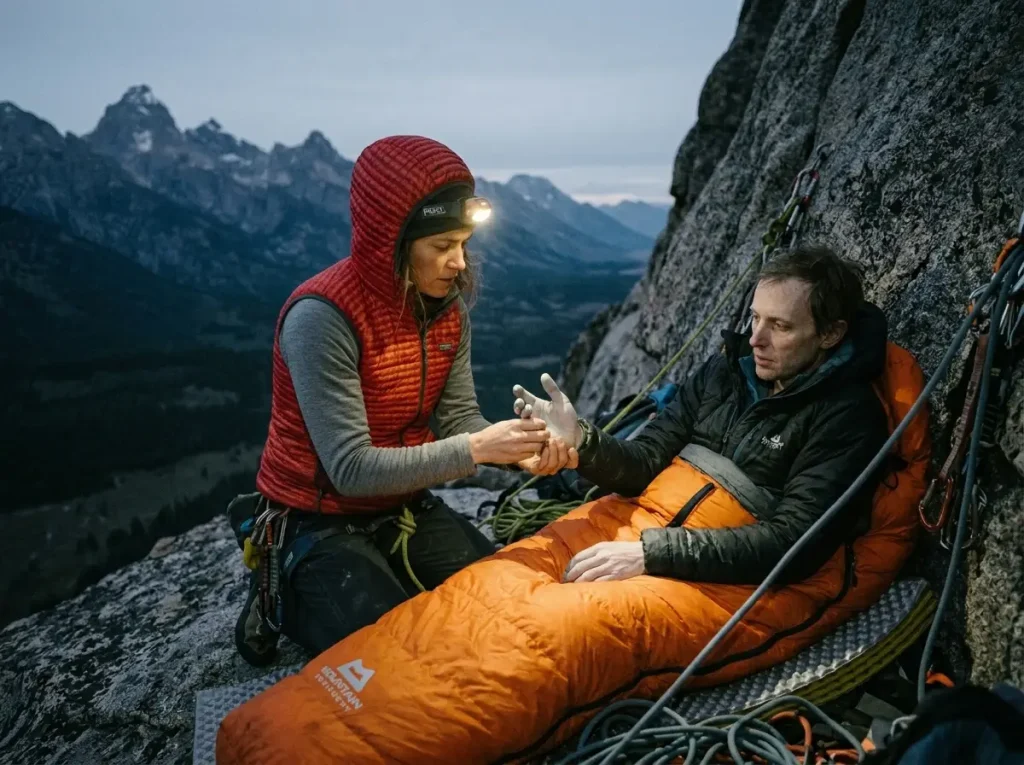
There’s a reason hypothermia gets called the creeping cold: it doesn’t feel like an emergency until it’s very late. Here’s what it actually looks like, stage by stage, and how to catch it before your partner stops making sense.
Stage 1 vs Stage 2 — The Difference That Saves Lives
The International Commission for Alpine Rescue stages hypothermia, and the line you have to know sits between the first two. In Stage 1 (core temp roughly 35 to 32°C), the climber is shivering hard, fumbling with gear, and slurring slightly — the classic “umbles”: stumbles, mumbles, fumbles, grumbles. Shivering means you’re still fighting, and this stage is manageable. Stage 2 (32 to 28°C) is where it flips: the shivering stops. That isn’t recovery. It means you’ve run out of the fuel to keep shivering, and judgment is already going. The quietest person in the bivy is the one to worry about. For the full breakdown of what to watch for, the full field guide to hypothermia and dehydration signs goes deeper on the umbles and the early tells.
Field Checks Without a Thermometer
You don’t need a thermometer to stage a partner — you need five seconds. Ask them to touch their thumb to their little finger. If they can’t make their fingers do it, motor control is compromised and they’re likely sliding into Stage 2. Check their speech for slurring and their answers for confusion. And watch for paradoxical undressing: in the Stage 2 to 3 transition, the cold climber suddenly feels warm and starts stripping off layers as their vessels malfunction and dilate. They cannot recognize it in themselves — that’s why you check each other on a schedule, the same way you trade leg-movement watches.
When to Escalate to Rescue — The Dawn Decision
Know your line, and act before you’re too cold to act. The moment a partner hits Stage 2, loses consciousness, or can’t generate warmth or movement on their own, it’s time to call for help — don’t wait for Stage 3. Activate your Garmin inReach or satellite messenger while your hands still work well enough to operate it — a rescue call is useless if you wait until your fingers won’t cooperate. Building this kind of systematic readiness into every trip is exactly what The Mountaineers’ Ten Essentials framework is for. And when dawn comes, don’t bolt the second it’s light — cold, stiff muscles on an empty stomach are an injury waiting to happen. Eat, move your legs, warm up for a few minutes, then start down.
Bringing It All Together
A forced night out is one of those skills you hope to never use and have to own anyway. Three things carry the most weight:
- An emergency bivy sack weighs about six ounces. Carry one on every technical climb, no exceptions.
- When shivering stops, act immediately — that’s Stage 2 hypothermia setting in, not a sign you’re recovering.
- Anchor sleeping keeps you tied in and keeps your circulation moving. It does not mean hanging in your harness all night.
Before your next alpine objective, build your bivy kit to match the route — and pack it before you pack anything else. It’s the last thing most climbers add to the pile. It should be the first.
Frequently Asked Questions
01What is a bivouac in climbing?
A bivouac is an overnight stay on a route without a tent, usually unplanned, using minimal shelter like an emergency bivy sack on a ledge or wall. Climbers get benighted when a route runs long or weather turns. Surviving one comes down to insulation, site choice, and warmth management.
02How do you stay warm in an emergency bivy?
Insulate from the ground first, since cold rock pulls heat faster than cold air. Get into your bivy sack, then pull dry layers on inside it. Tuck a hand warmer against your core, eat fatty food, and keep your legs moving to hold warmth through the night.
03What gear should you always carry for an unplanned bivouac?
Carry an emergency bivy sack, a headlamp with a backup battery, fatty food, water or purification tablets, and a lighter at minimum. On bigger alpine routes, add a pad, tarp, and synthetic insulation. The bivy sack is the one item with no excuse to skip.
04Is it safe to sleep while tied to an anchor on a cliff?
Yes, if you sit on a ledge with the anchor as backup and keep your weight off the harness. Hanging freely for long stretches risks suspension syndrome. Set a redundant anchor, rest on the ledge or your pack, and move your legs every twenty minutes.
Safety Notice: Rock climbing and mountaineering are inherently high-risk
activities that can involve physical trauma or fatal incidents. The information on Rock Climbing Realms is for
educational and informational purposes only. Techniques and advice presented here are not a substitute
for professional, hands-on instruction. Conditions and risks vary by location. Always seek guidance
from a qualified instructor before attempting new techniques. By using this website, you agree that you
are solely responsible for your own safety. Any reliance you place on this information is strictly
at your own risk, and you assume all liability for your actions. Rock Climbing Realms and its authors
will not be held liable for any harm, damage, or loss sustained in connection with the use of this information.
Affiliate Disclosure: We are a participant in the Amazon Services LLC Associates Program, an
affiliate advertising program designed to provide a means for us to earn advertising fees by advertising and linking
to Amazon.com. As an Amazon Associate, we earn from qualifying purchases. We are also an official affiliate partner
of Black Diamond Equipment via the AvantLink network. If you click on a Black Diamond affiliate link and make a
purchase, we may earn a commission at no additional cost to you. We also participate in other affiliate programs.
Additional terms are found in the terms of service.