
In this article
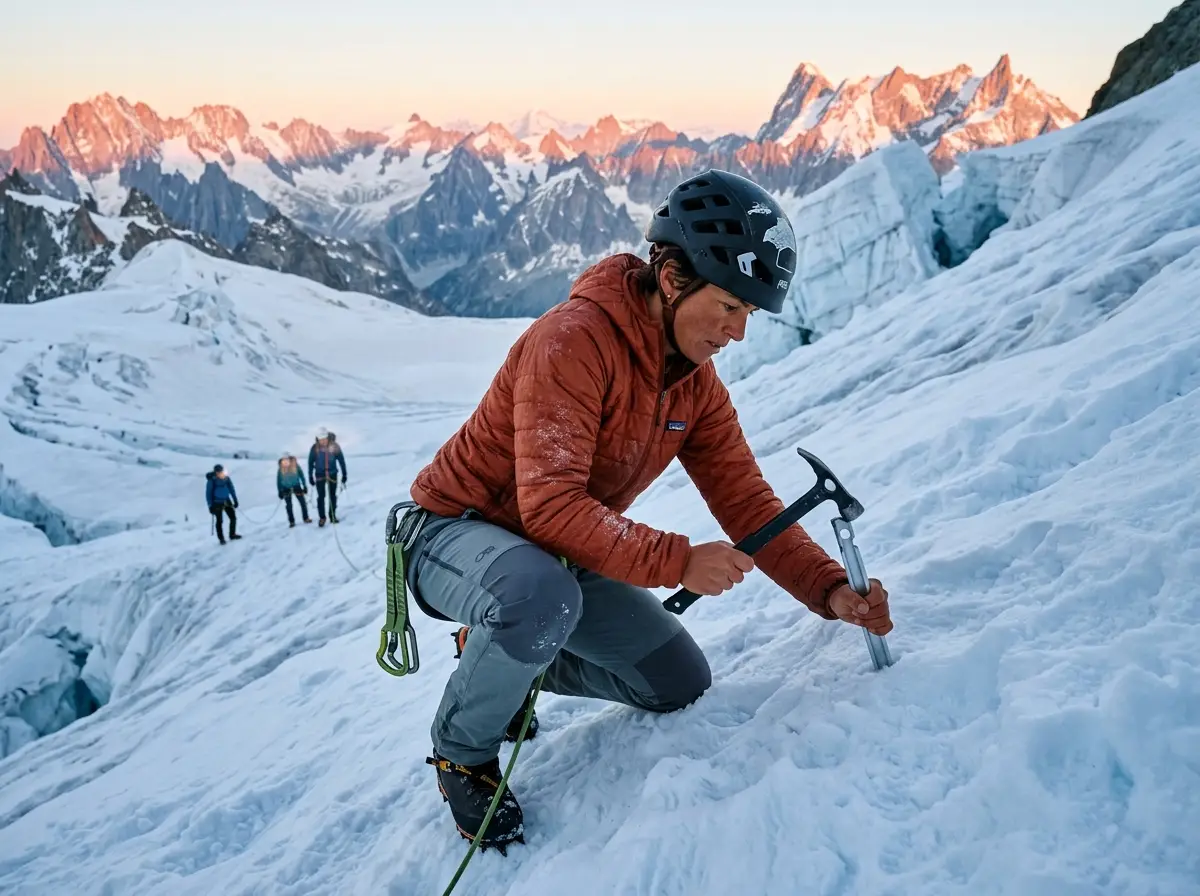
Your partner punches through a snow bridge and drops into the crevasse, and the only thing between them and a deeper fall is whatever you can build into the slope in the next ninety seconds. I have set anchors on glaciated routes from the Cascades to the Alps, and the snow is never the same twice. A picket that bites like concrete at dawn can pull out by lunch. This guide walks through every snow anchor worth knowing, and more importantly, how to read the snow so you pick the right one before you commit.
Building a snow anchor that holds comes down to six moves, in order:
Read the Snow Before You Build Anything
Hand a picket to a guide and the first thing they say is: tell me what you are putting it in. Hardware is the easy part. The snow is the variable, and reading it correctly is the one skill that sits underneath every anchor in this guide.
Snow anchors are one piece of a larger system, and if you want the full picture of how movement, protection, and rescue fit together on glaciated terrain, start with our complete alpinism guide. Pre-build assessment is not optional. It is the foundation, and it lines up with the American Alpine Club’s anchor-building principles.
The Snowball Test for Anchor Selection
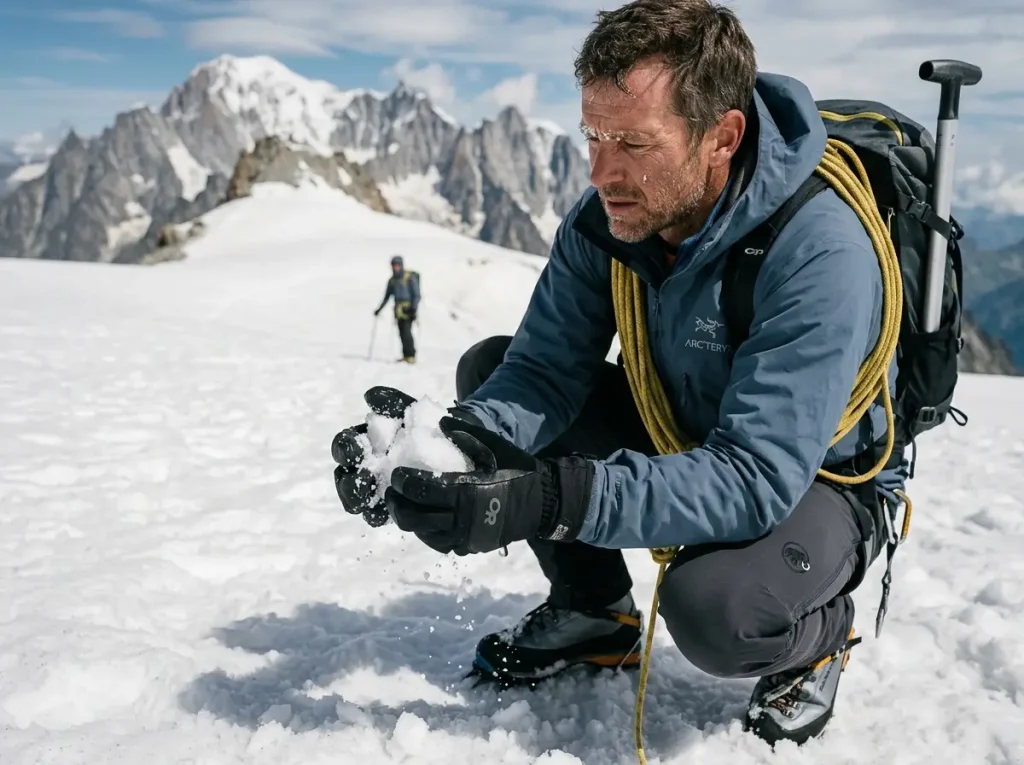
Squeeze a fistful of snow with your glove on. If it packs into a firm ball that holds its shape, you have snow dense enough for a vertical picket. If it crumbles and won’t hold together, that snow won’t grip a vertical placement, so move to a T-trench.
If you can push a gloved finger into the surface with no resistance at all, you are in soft snow that needs a buried deadman or a bollard, full stop. This takes three seconds, and it is the difference between an anchor and a decoration.
The 10-Strike Rule for Picket Firmness
Mark Smiley’s field shortcut is the 10-strike rule: as you drive a picket with the flat of your axe, count your strikes. If the picket sinks fully home in fewer than ten solid hits, the snow is too soft to trust a vertical placement, so switch to a T-trench or a reinforced T-slot.
The number behind this matters. A top-clipped vertical picket in finger-soft snow lets go around 500 pounds, roughly 2.2 kN, which is bodyweight on a hanging load. That is not a margin. That is a coin flip.
How Slope Aspect and Time of Day Affect Your Read
Snow is not a fixed material. It tracks the sun. A south-facing slope that tests firm at nine in the morning can go to mush by early afternoon, while north-facing and shaded features stay far more consistent across the day.
Read the snow where the anchor will actually sit, not where you happen to be standing. On a long route, read it twice: once when you build, once before you weight it on the way down. That second read sets up the temperature section at the end of this guide.
Run the squeeze test and the strike count every single time, even when the snow looks obvious. The anchors that pull are almost always the ones somebody was sure about: tired, time-pressured, and skipping the ten seconds that would have told them to dig instead of drive.
The Vertical Picket Anchor
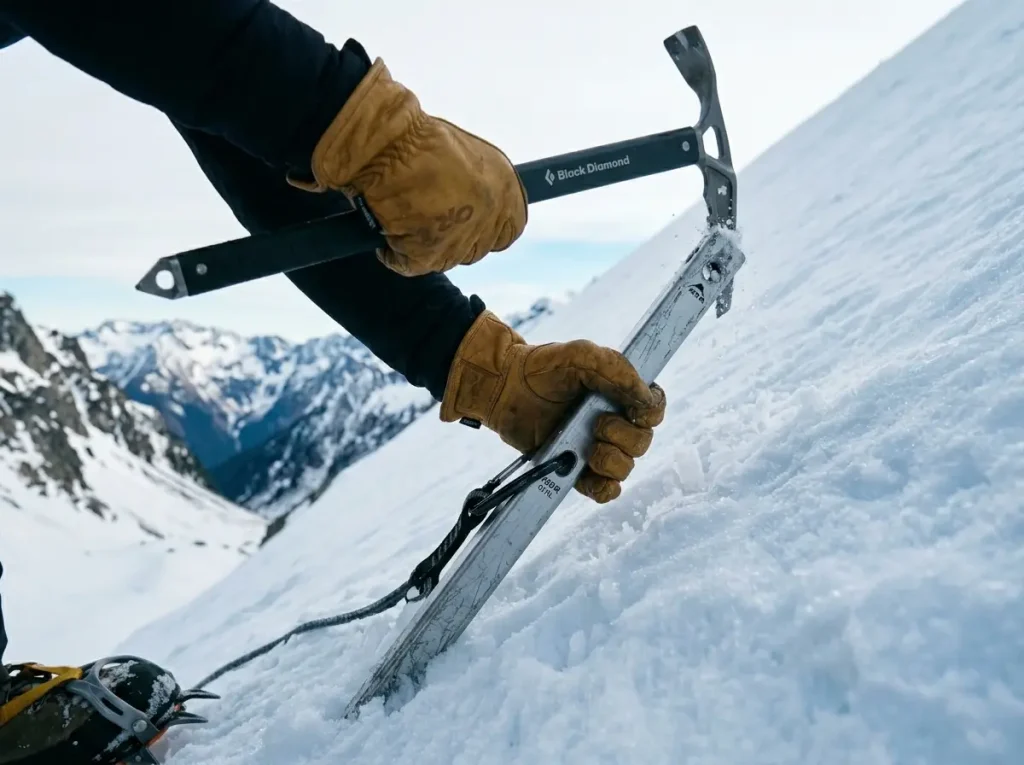
The vertical picket is the fastest anchor you can build in firm snow, and the most commonly built wrong. The mistake is always the same. Someone drives a picket straight up, clips the top, gives it a tug, and calls it good.
Then they bounce on it for real and it walks right out of the slope. The angle and the clip point are what separate a solid placement from a scare.
Top-Clip vs. Mid-Clip: Why the Difference Matters
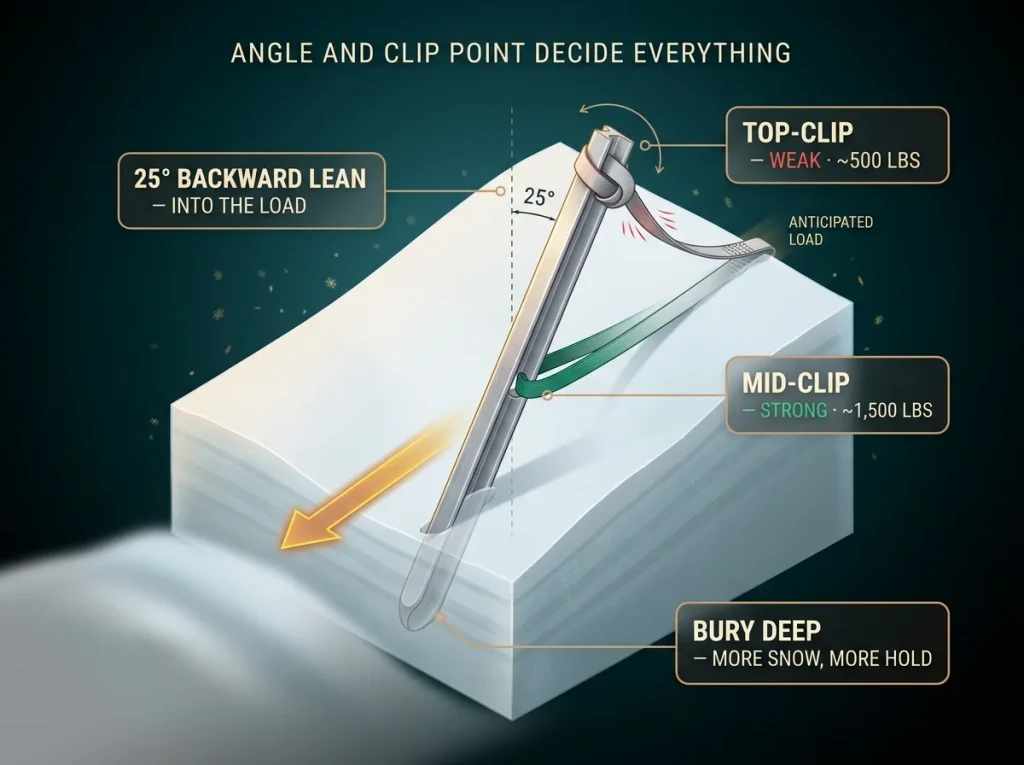
Where you clip changes the strength by a factor of three. A top-clip placement, with the sling girth-hitched at the head, is quick but weak; in soft snow it fails around 500 pounds because the picket levers forward and peels out. A mid-clip placement, where you attach at the shaft’s midpoint, pulls roughly 1,500 pounds, about 6.7 kN, in firm snow at proper depth.
That etched mark in the middle of your picket shaft is not decoration. It is the maker telling you where the strength lives. The MSR Snow Picket, a 90 cm aircraft-aluminum T-beam with the mid-clip hole machined into the center, buries deep enough to stack real snow over the attachment point, which is exactly where holding power comes from.
Driving Angle, Depth, and Hammering Technique
Drive the pointed end at about a 25-degree backward lean from vertical, tilted into the direction you expect the load to pull. Lean it the wrong way and the load geometry helps the picket lever out; lean it back against the load and that same force drives it deeper.
Use the flat adze of your axe to hammer, not the pick, which saves both the pick’s edge and the picket’s head. Drive until the mid-clip hole sits just above the surface. More buried picket means more snow resisting the pull.
Bounce Test Protocol Before You Weight the Anchor
Before you weight any anchor with your life, bounce test it. Clip your belay loop to the anchor, lean back, and bounce three times with increasing force.
Here is the part people skip: build a backup first. If your primary fails during the test, the backup is what catches you instead of the slope below. A bounce test on an un-backed anchor is just a slower way to find out it was bad.
Your bounce test only protects you if the anchor is backed up. Stomp out a quick second placement or sit-belay before you load the primary. The whole point of testing is to find the failure on purpose, with a safety net, not by surprise with your full weight on it.
The T-Trench Deadman Anchor
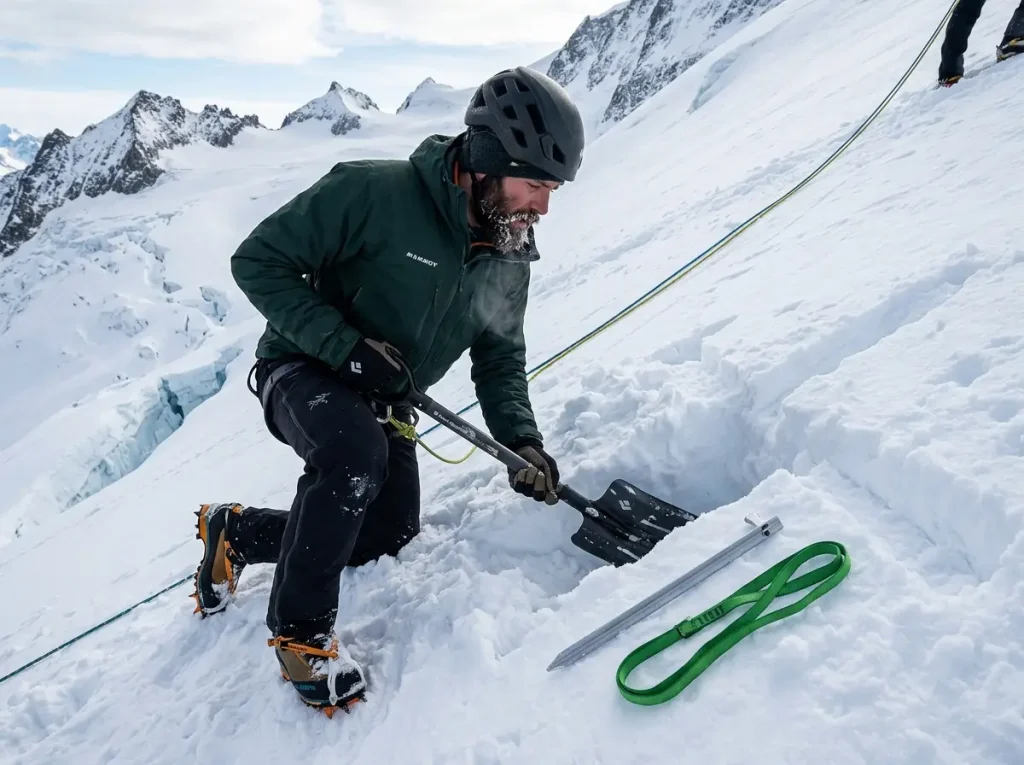
The T-trench, also called a buried deadman, takes about five minutes and holds when a vertical picket won’t. This is the anchor guides default to whenever conditions are uncertain, soft, or high-consequence, which on a glacier descent is most of the time. You trade speed for reliability, and on serious terrain that is almost always the right trade.
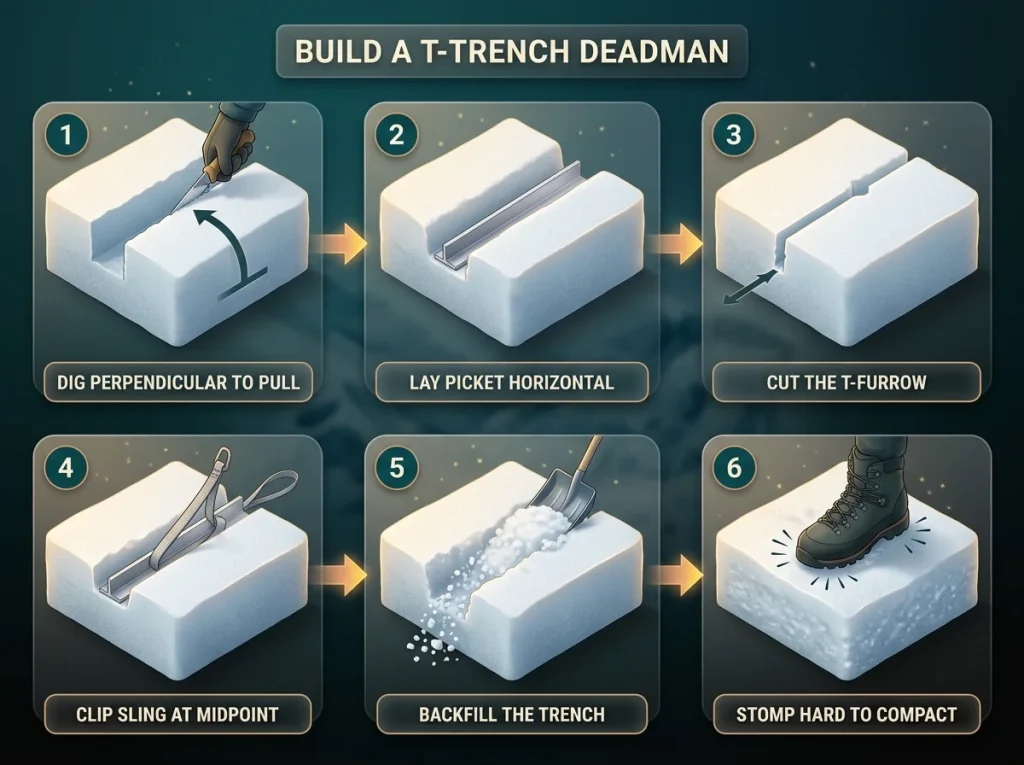
Digging the Trench: Depth, Width, and Orientation
Dig a trench perpendicular to the direction of pull, square to the load and not angled. Go at least 30 cm deep; 50 cm in consolidated snow is the real target, and the extra 20 cm roughly doubles your holding power for the cost of a few more shovel strokes.
Cut a narrow T-furrow down the fall line from the middle of the trench so the sling can exit toward the load without levering the picket up. Orientation precision is not fussiness here. A trench cut off-square loses strength fast.
Attaching the Sling and Backfilling Correctly
Lay the picket horizontally in the trench and attach the sling at its midpoint, routed down through the T-furrow. The MSR Cable Picket carries a galvanized steel cable pre-rigged at that midpoint, an AMGA-developed design that skips the step of tying a sling at the center, which counts when you are setting a rescue anchor against the clock.
Then backfill and stomp. Loose backfill returns almost nothing; snow you compact hard with your boots becomes a consolidation plug that does most of the holding. A standard T-slot at 60 cm tests around 4 kN, fine for a rappel or belay but on the low side for a crevasse load, because crevasse rescue requires a different standard of anchor than a simple descent.
When the T-Trench Is Your Default Anchor
Default to the T-trench any time the snowball test fails, on any afternoon descent over sun-exposed snow, and any time you are setting the first anchor on a slope you don’t know yet.
The habit is the point. When you are tired and the snow is questionable, you don’t want to be deciding. You want a default that is already conservative.
Stomp the whole area before you bury anything. Compacted snow holds; loose powder shoved back into a trench barely counts. Two minutes of boot-packing the burial zone adds more strength than another 10 cm of depth in soft conditions.
The Reinforced T-Slot: Double Anchor Strength in 90 Extra Seconds
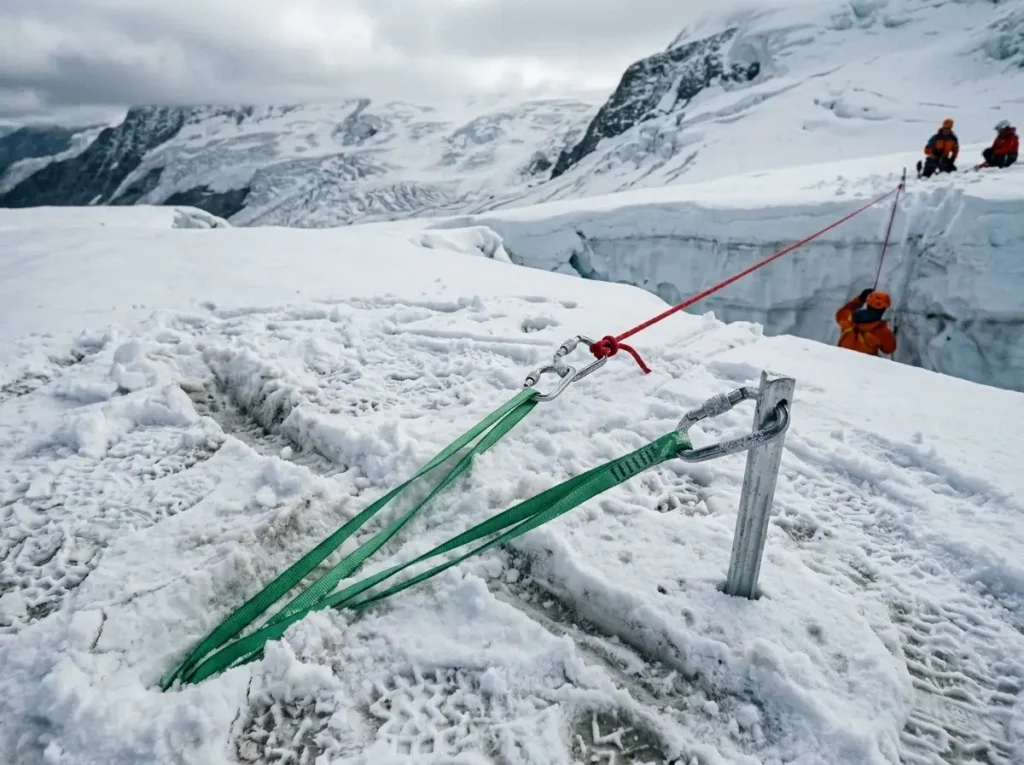
Here is the single most valuable upgrade in this guide, and most people have never built it. Take a standard T-trench and add one vertical picket behind it, equalized to the same master point, and you nearly double the anchor’s strength, from about 4 kN to about 8 kN. That is the reinforced T-slot, and it costs you sixty to ninety extra seconds of digging.
Adding the Vertical Component: Placement and Connection
Build the horizontal T-trench first, exactly as above. Then drive a second picket vertically into the snow 15 to 20 cm downslope of the buried one, to the same depth, and equalize both pieces to a single master point with a sling.
The vertical piece backs up the horizontal burial and shares the load, so no single placement carries the whole pull on its own. The geometry rules here are the same ones that govern rock anchors: redundancy, equalization, and no extension if a piece shifts.
The kN Numbers: Why This Matters for Rescue Loads
The numbers come from Black Diamond’s QC Lab testing with mountain guide Mark Smiley: a standard T-slot holds around 4 kN, the reinforced version around 8 kN. For context, in that same round of testing, only 10 of 16 common anchor builds even met the 3 kN minimum, a standard validated against The Mountaineers’ technical guidelines for snow anchor systems.
A fallen climber hanging in a crevasse puts a sustained load on the anchor the whole time you are rigging the haul, so it has to hold continuously, not just survive one shock.
When to Build Reinforced vs. Standard T-Slot
Build the reinforced T-slot any time a crevasse is in play, any time the consequence of failure is severe, such as a single-rope descent in committing terrain, and any time your standard T-slot felt borderline on the bounce.
The reinforced anchor is what makes the Z-pulley haul system that goes on top of it viable, because a 3:1 raise multiplies force at the anchor just as much as it multiplies it at the load.
On any crevasse-rescue anchor, budget two pickets, not one. The anchor holds the hanging climber’s full weight the entire time you are rigging the pulley, with nobody backing it up. That is the worst possible place to learn your single picket was marginal.
The Snow Bollard
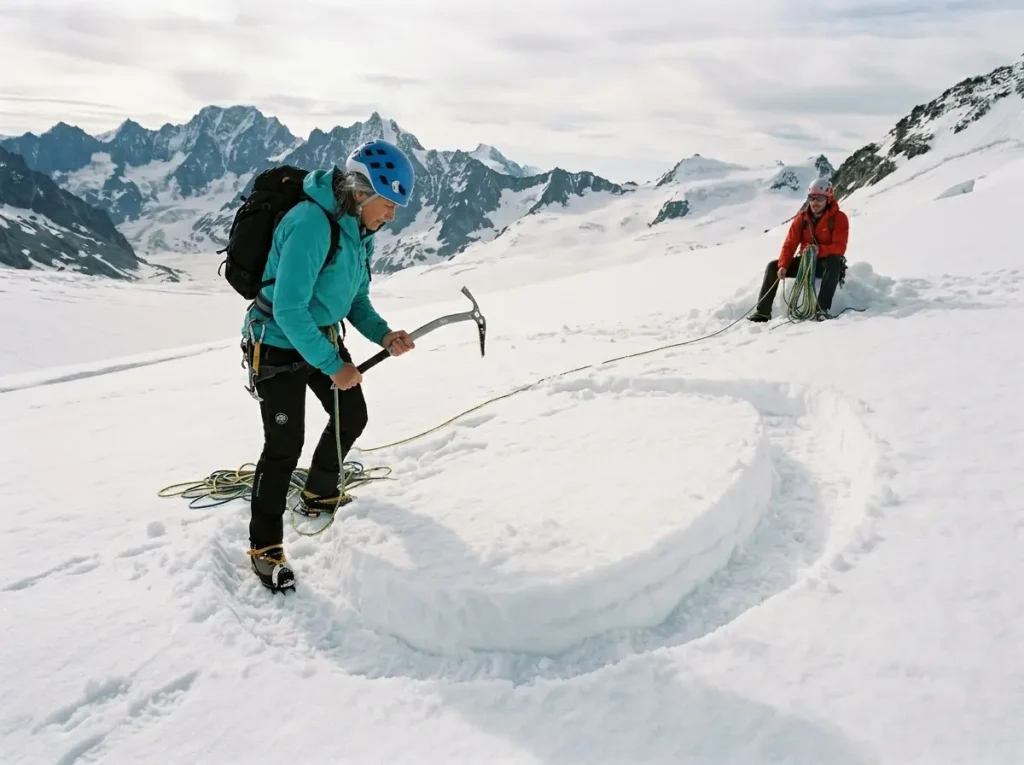
When pickets won’t hold and you have none left to bury, the snow bollard is the anchor that still works. It is a horseshoe of snow you carve out of the slope and seat the rope around: no hardware, no failure point in the metal, just a large mass of snow doing the work. It takes the longest to build, and most people get the shape or the size wrong.
Cutting the Horseshoe: Shape, Size, and Orientation
Carve a horseshoe, not a teardrop, with the open end facing downslope. A teardrop shape has weak junctions where the rope concentrates load, and it collapses; the horseshoe spreads the pull across a broad arc.
Cut the trench 30 to 50 cm deep all the way around, and keep the snow inside the horseshoe undisturbed. That packed core is the anchor, so you protect it, you don’t carve into it.
How Snow Quality Determines Bollard Diameter
Size scales with snow quality, and the range is not a suggestion. In hard, dense snow, 1.5 m across the widest point is enough. Average snow wants about 2.5 m.
In soft snow you may need up to 3 m, because the only thing holding is the sheer mass of snow behind the rope. Undersize a bollard and the rope simply saws through it under load, which is the failure mode nobody sees coming until they are already weighting it.
Rope Seating, Testing, and Limitations
Seat the rope directly in the trench: no knots, no carabiners, nothing metal touching the snow. Then load it with your full weight before you commit to a rappel; if the bollard shifts, rebuild it wider and deeper.
The real limitation is time. A proper bollard takes 10 to 15 minutes, so it is not your move when speed matters, and it gives up strength fast in snow that is actively melting.
Improvised Anchors When You Don’t Have Pickets
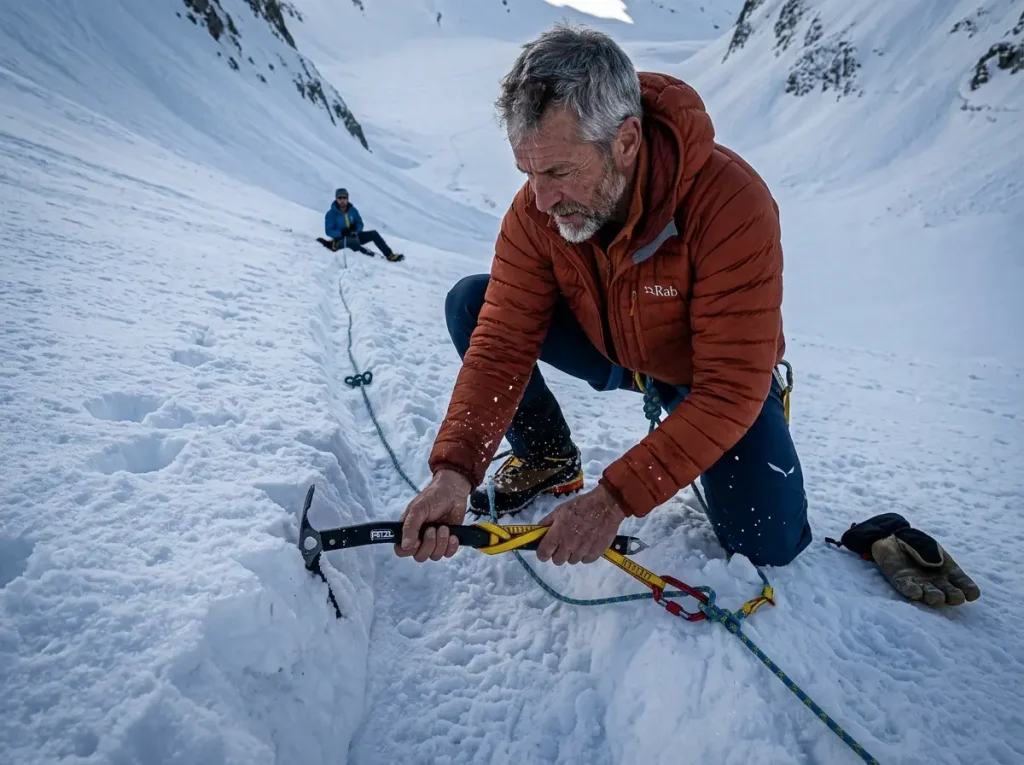
This is the scenario most guides skip: you are on crevassed terrain, you are out of pickets, and you need an anchor before you can haul. The object you bury matters less than getting the geometry right. An ice axe, a ski, even a stuffed pack will hold if you place it correctly.
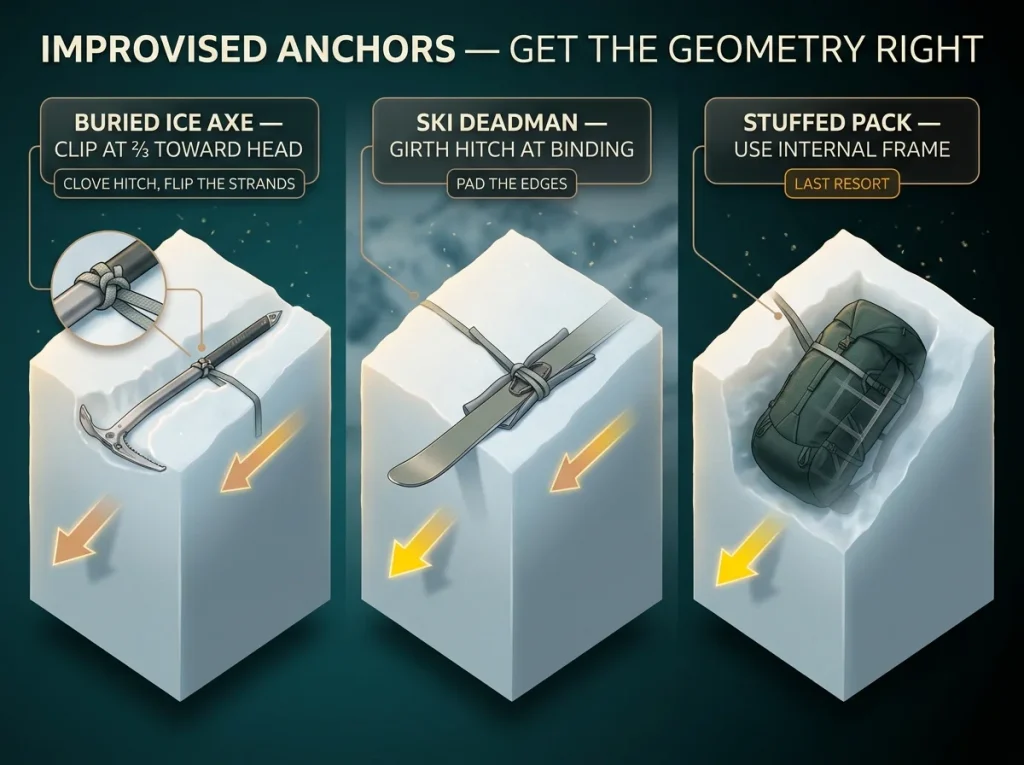
The Buried Ice Axe: Attachment Point and Clove Hitch Detail
The buried ice axe is the go-to. Dig a 30 cm trench, then lay the axe horizontally and perpendicular to the load. The same tool you rely on for your ice axe’s role in snow self-arrest now becomes your anchor.
Attach the sling at the two-thirds point toward the head, not the true middle. The head is heavier; clip the real midpoint and the axe rotates under load and loses surface contact. Use a clove hitch and flip the strands so the load cinches the connection tighter instead of working it loose.
Skis and Trekking Poles as Deadman Anchors
Skis make excellent deadmen, wider than a picket, so more surface area and more hold in soft snow. Girth-hitch a sling at the binding plate, pad the sharp edges so they don’t cut the sling, and bury it with the same T-trench geometry.
For soft snow where even an axe T-slot is marginal, the MSR Snow Fluke is purpose-built: its angled aluminum plate presents far more surface area than a T-beam and digs in under load instead of pulling free. Trekking poles work crossed at the burial point, but they are a last-tier option, not a plan.
Backpacks and Other Field Improvisations
A buried pack is a genuine last resort. It only works fully stuffed, because an empty pack compresses and fails, and you connect through the internal frame attachment points, not the external gear loops, which tear out.
Expect it to be weaker than any picket system and slow to build without a shovel. And bounce test it like anything else. Improvised never means untested.
Why Temperature and Time Can Pull Your Anchor Out
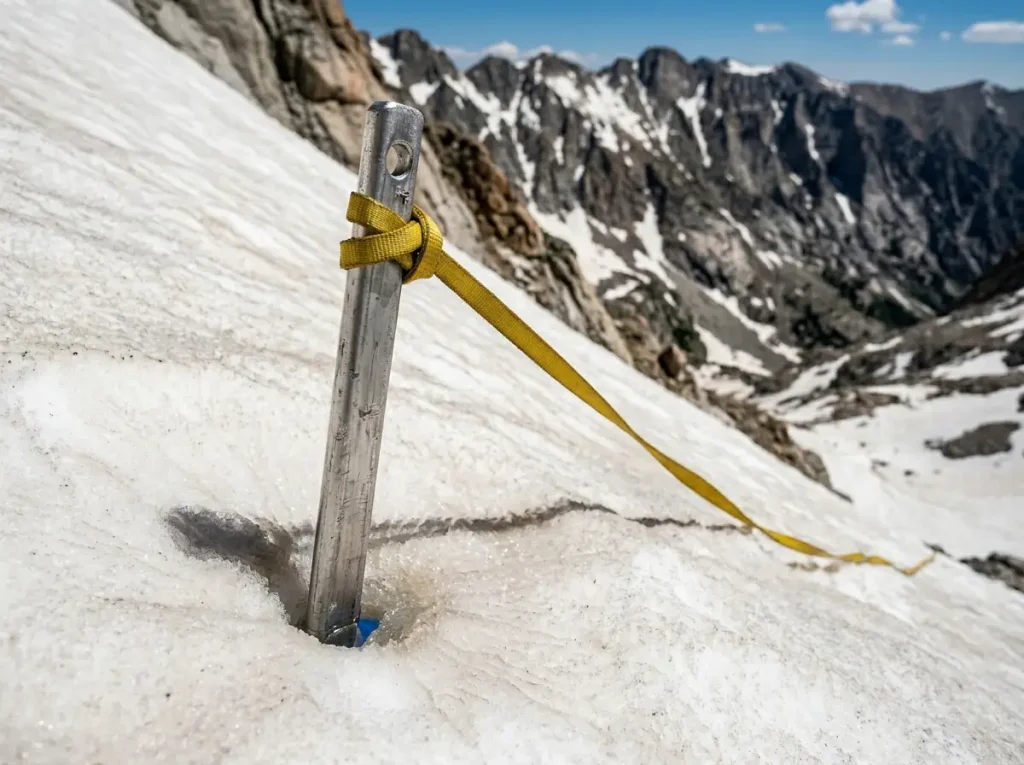
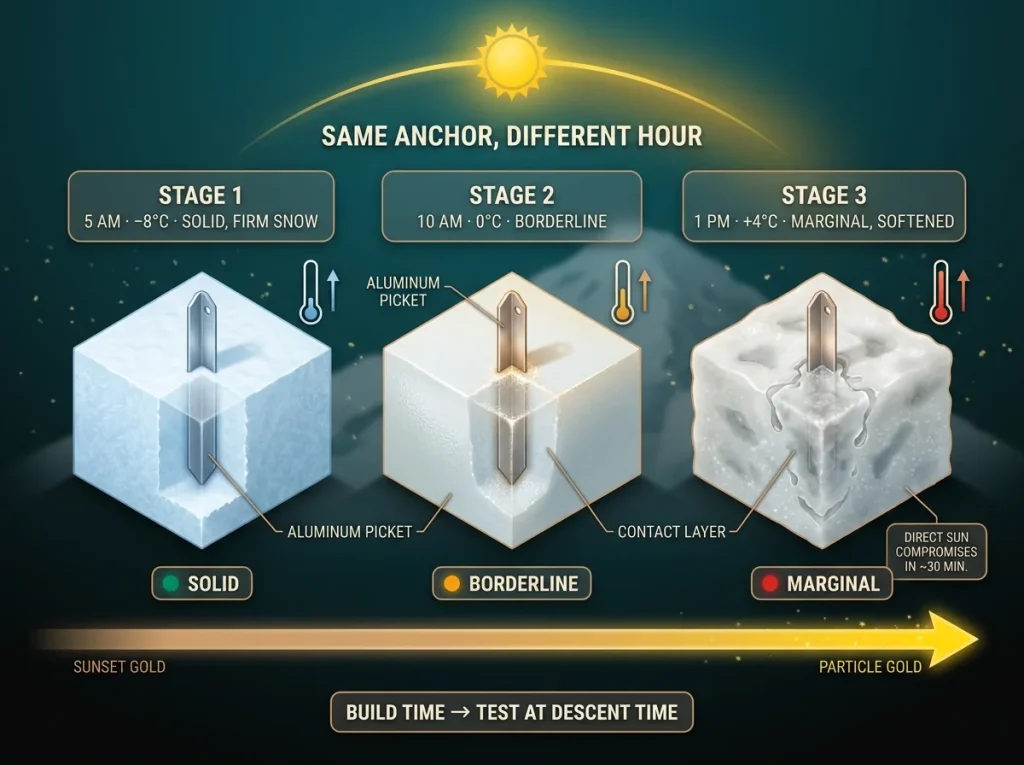
Here is the failure nobody writes about. You build a textbook anchor at five in the morning in cold, firm snow, and by late morning the same anchor is pulling out under bodyweight.
Nothing was wrong with how you built it. The sun came up. Temperature at the moment you descend matters more than temperature when you built, and that single idea explains a whole category of accidents filed under the anchor just pulled out.
How Solar Radiation Degrades Snowpack Around Buried Anchors
Direct sun can compromise a snow anchor in about 30 minutes, even when the air is well below freezing, because the metal absorbs radiation and warms the snow in immediate contact with it. Once that contact layer reaches the melt point, it cycles between melting and refreezing, and that slick micro-layer gives up the friction the anchor depends on.
The snow ten centimeters away can still be bone-firm while the snow touching your picket has quietly turned to slush.
South-Facing Slopes and Afternoon Descent Timing
South-facing slopes and east-facing couloirs in the afternoon are the highest-risk combination; north-facing and shaded features hold their strength far longer. The protocol is simple: assess sun exposure at the descent point before you build, and put your anchor in shade whenever the terrain gives you the option.
Expect the fastest degradation between ten and two on a clear day, which is exactly when you are often descending off a Cascade or Sierra summit. This is the same temperature-swing problem that makes overnight bivouac scenarios, where anchor reliability through big temperature swings becomes a survival issue, so unforgiving.
Building Multi-Piece Systems as Insurance Against Thermal Failure
Two equalized pieces are your insurance against one of them quietly failing from thermal decay: not a workaround, but a hedge against conditions you can’t fully predict. Bounce test at the moment of use, not just at construction; an anchor that passed at dawn earns a fresh test before you weight it at noon.
Learn to read a thermally compromised anchor before you commit, by feel and by eye: a looser, mushier give on the bounce, visible melt channels in the snow around the picket. If the read is bad enough, that is part of knowing when to reassess and bail rather than descend on a compromised system.
And remember the load is partly in your hands. A jerky, aggressive rappel can generate over three times bodyweight on the anchor, while a smooth hanging descent generates about 1.2 times. A warm anchor plus a sloppy rappel is the combination that fails.
Conclusion
Three things carry every snow anchor you will ever build. First, read the snow before you choose the anchor: the squeeze test and the strike count decide everything that follows. Second, the reinforced T-slot is the ninety-second upgrade worth building on any crevassed route, because 4 kN versus 8 kN is the difference between an anchor that holds a hanging climber and one that doesn’t. Third, build in the shade and test at descent time, not just at construction.
Go practice all of these on a flat, safe snowfield before you need them on a real route. Muscle memory built where the stakes are zero is what keeps your hands steady when they aren’t.
Frequently Asked Questions
01What is the strongest type of snow anchor for mountaineering?
The reinforced T-slot is the strongest practical snow anchor, testing around 8 kN versus 4 kN for a standard T-trench. It pairs a buried horizontal picket with a vertical picket behind it, equalized to one master point, and it is the standard for crevasse-rescue loads.
02How deep should a picket be buried for a deadman anchor?
Bury a deadman picket at least 30 cm deep, with 50 cm the target in consolidated snow. Depth is holding power: the extra 20 cm roughly doubles strength. Set the picket perpendicular to the load with the sling routed out through a T-furrow.
03What can I use as a snow anchor if I don’t have a picket?
A buried ice axe is the best improvised snow anchor, laid horizontally with the sling clipped at the two-thirds point toward the head. Skis, a snow fluke, or a fully stuffed pack also work using the same T-trench geometry.
04How do you test a snow anchor before trusting it?
Bounce test it: back up the anchor first, clip your belay loop in, then load it and bounce three times with increasing force. Build the backup before testing so a failure during the test catches you instead of letting you fall.
05When should you use a snow bollard instead of a picket?
Use a snow bollard when you have no pickets, or in soft or wet snow where pickets won’t hold. Carve a downslope-facing horseshoe 1.5 to 3 m wide depending on snow quality. The tradeoff is build time, usually 10 to 15 minutes.
Safety Notice: Rock climbing and mountaineering are inherently high-risk
activities that can involve physical trauma or fatal incidents. The information on Rock Climbing Realms is for
educational and informational purposes only. Techniques and advice presented here are not a substitute
for professional, hands-on instruction. Conditions and risks vary by location. Always seek guidance
from a qualified instructor before attempting new techniques. By using this website, you agree that you
are solely responsible for your own safety. Any reliance you place on this information is strictly
at your own risk, and you assume all liability for your actions. Rock Climbing Realms and its authors
will not be held liable for any harm, damage, or loss sustained in connection with the use of this information.
Affiliate Disclosure: We are a participant in the Amazon Services LLC Associates Program, an
affiliate advertising program designed to provide a means for us to earn advertising fees by advertising and linking
to Amazon.com. As an Amazon Associate, we earn from qualifying purchases. We are also an official affiliate partner
of Black Diamond Equipment via the AvantLink network. If you click on a Black Diamond affiliate link and make a
purchase, we may earn a commission at no additional cost to you. We also participate in other affiliate programs.
Additional terms are found in the terms of service.