
In this article
You pull onto the start holds of a V3, expecting the same fluid movement you perfected in the gym on Tuesday night. Instead, you are immediately shut down by a crystalline crimp that feels less like a hold and more like a razor blade. The number on the guidebook page is static, but the experience of gravity here feels violently subjective.
Understanding bouldering grades is not about memorizing a chart; it is about deciphering the language of the rock itself. Throughout my career guiding clients from their first outdoor top-outs to projection-level sends, I have seen grades cause more confusion than almost any other aspect of the sport. This guide translates the abstract arithmetic of the V-Scale (or Vermin Scale) into the tangible biomechanics, history, and technique required to move from the gym floor to the cutting edge of human potential.
What Are the Origins and Philosophy of the V-Scale?
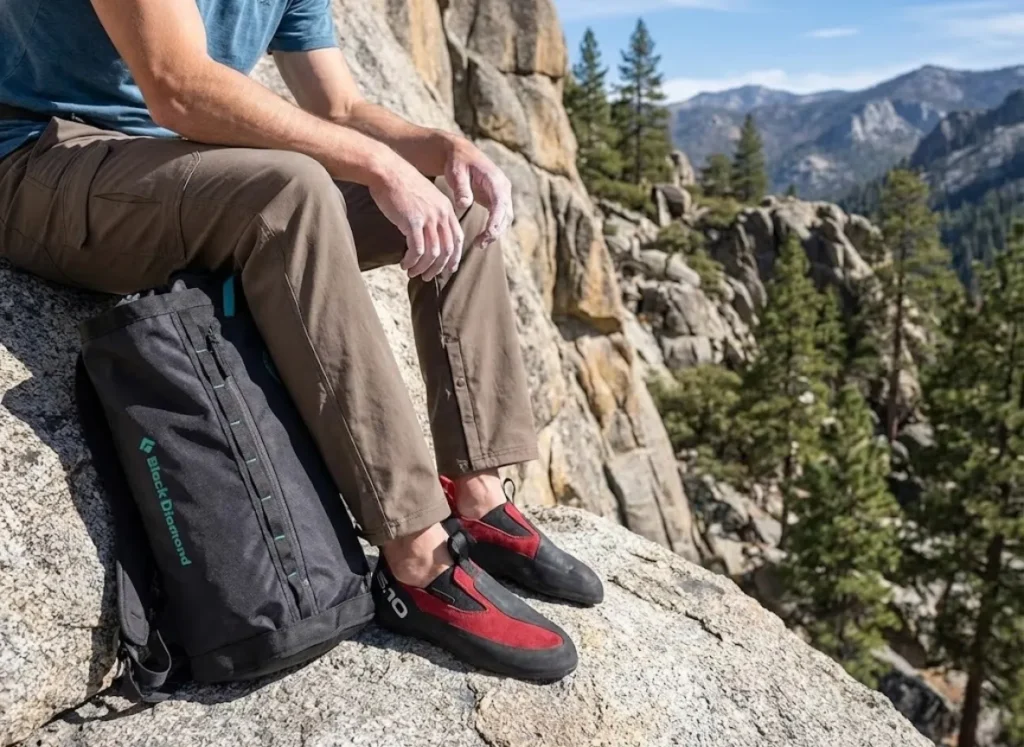
To move from viewing grades as arbitrary numbers to understanding them as a consensus-based historical record, we have to go back to the source. The system wasn’t built in a boardroom; it was forged in the desert.
How did Hueco Tanks give birth to the V-Scale?
In the late 1980s, the American bouldering scene was fragmented. Climbers relied on the “B-Scale,” developed by the legendary John Gill. The B-Scale was a closed-ended system (B1, B2, B3) that failed to account for the exploding standards of difficulty. A B1 was “difficult,” a B2 was “very difficult,” and a B3 was something that had only been done once. As soon as a B3 was repeated, it was downgraded to B2. This fluidity made it impossible to track progress or history accurately.
John “Vermin” Sherman, a prolific developer at Hueco Tanks, Texas, faced pressure from his publisher to organize the chaos of thousands of new boulder problems for a guidebook. Sherman devised an open-ended alphanumerical system, the “V-Scale,” starting at V0 for technical entry and originally capping at V10. This created a static ruler for difficulty. Unlike the Gill system, a V10 was designed to remain a V10 forever, regardless of how many people climbed it.
The grading process relied—and still relies—heavily on “consensus.” The First Ascentist (FA) proposes a grade, which is subsequently verified or rejected by a community of elite peers. This system solidified Hueco Tanks as the “iron meter bar” of bouldering. Whether you are climbing in Rocky Mountain National Park, Stone Fort, or planning a bouldering trip to Hueco Tanks, know that the grades established there are the baseline. If you can climb V5 in Hueco, you can likely climb V5 anywhere.
How does the V-Scale compare to the Fontainebleau System?
With the historical ledger established in the Texas desert, we must look across the Atlantic to understand the other dominant language of difficulty. While the American V-Scale isolates the difficulty of the hardest single sequence, the French “Font Scale” (e.g., 6A, 7C) originated in the forest of Fontainebleau with a different philosophy.
The Font system traditionally emphasized the “circuit.” Climbers were expected to complete a color-coded series of problems (often painted directly on the rock as a yellow circuit or purple circuit) to test flow, endurance, and mastery of style. Conversion is non-linear. A V3 roughly equates to Font 6A, but the stylistic differences often make Font grades feel significantly more technical and friction-dependent.
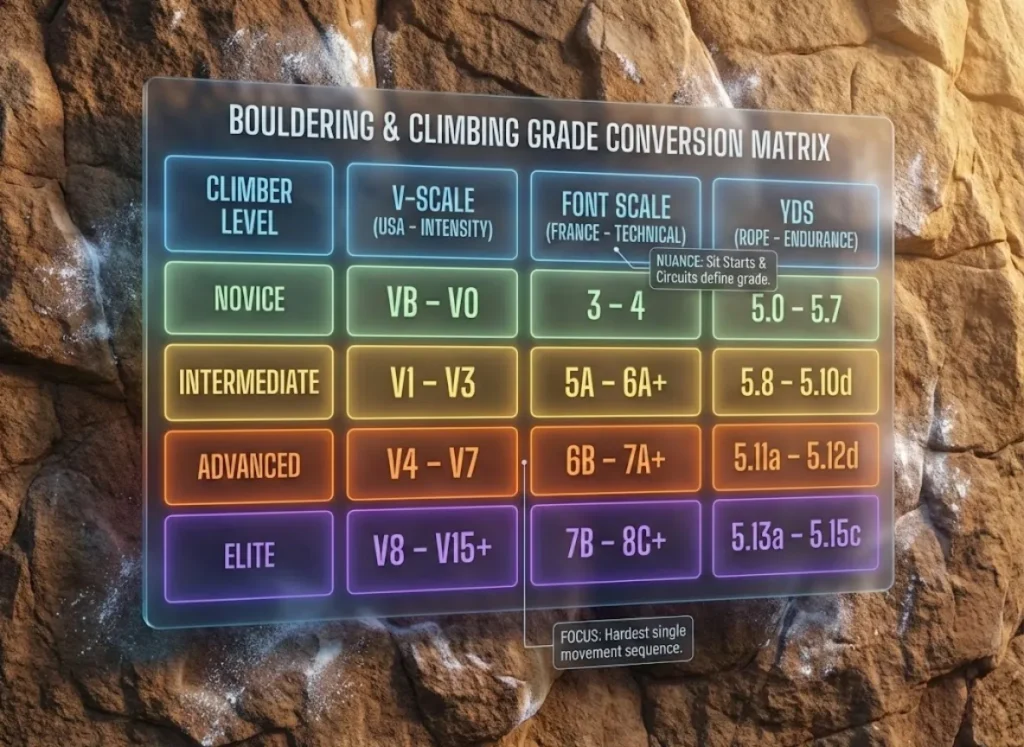
A critical distinction is the start position. Font grades often change dramatically based on whether you perform a sit start or a standing start. V-grades typically assume the hardest possible start is mandatory unless specified. Also, the Font scale uses plus (+) modifiers to denote subtle increases in difficulty that don’t warrant a full number jump. This offers more granularity in the intermediate ranges.
This stands in contrast to rope grades used in sport climbing or trad climbing, such as the Yosemite Decimal System (YDS) (e.g., 5.10a) or the British E-grade. While YDS measures endurance over a long pitch, bouldering grades measure pure intensity over a short distance. Understanding these nuances is essential when decoding climbing guidebook symbols, as modern apps like Mountain Project or 8a.nu often swap between these scales.
What Are the Physiological Determinants of Bouldering Grades?
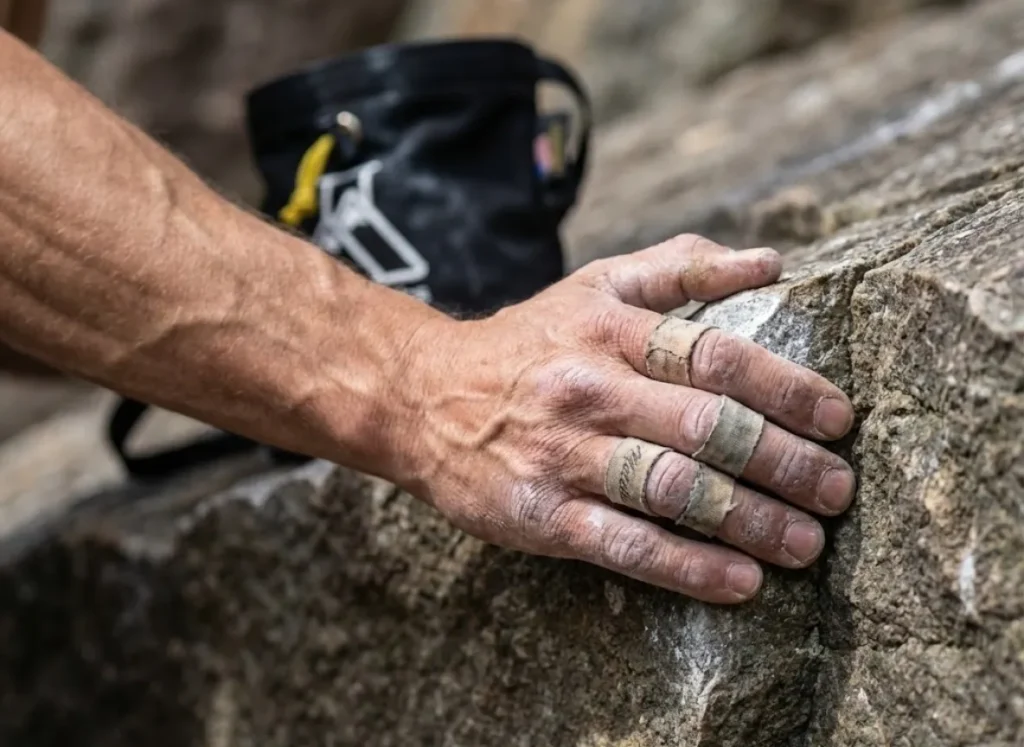
Grades are not just numbers; they are biological requirements. As you progress, specific biomechanical “limiters” dictate your potential on natural rock formations.
How does finger strength dictate grade potential?
The primary correlate for bouldering performance is not pull-up power. It is isometric grip strength relative to body mass, specifically measured on a 20mm crimp or edge. If you cannot hang onto the hold, you cannot make the move.
Research indicates that a V3–V5 climber can typically hang 100-110% of their body weight. This means they can support themselves but possess little reserve for generating force on small holds. To break into the V10 (7C+) tier, a climber generally requires a max hang capability of 145-175% of body weight. A study on climbing performance determinants confirms that specific strength in the fingers is the strongest predictor of bouldering ability, necessitating years of structural tendon adaptation.
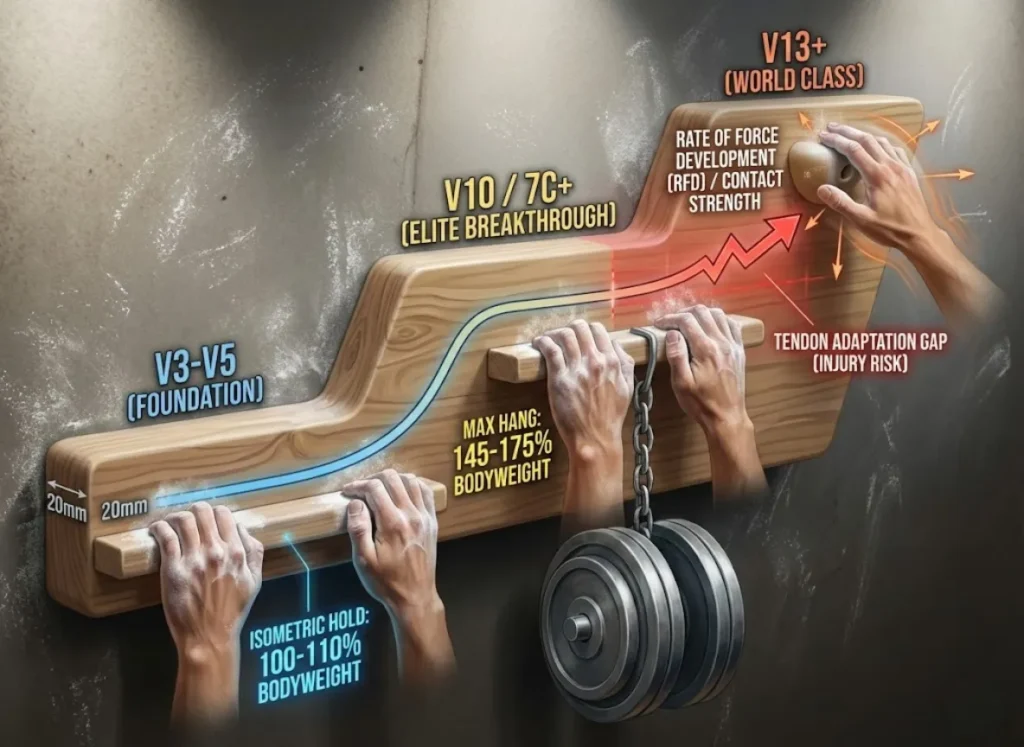
Beyond raw static strength, elite climbing (V13+) requires “Contact Strength” or Rate of Force Development (RFD). This is the speed at which fingers can reach peak force upon impact. The danger of rapid grade chasing is that muscular power develops faster than connective tissue. Ignoring the structural benchmarks often leads to pulley injuries. You must incorporate rock climbing finger training techniques cautiously to build this density over time.
What role does body composition and anthropometry play?
Elite boulderers consistently display optimized strength-to-weight ratios. They possess high functional mass in the forearm flexors and latissimus dorsi. While absolute low body weight was historically emphasized, modern analysis suggests that functional power—the ability to generate momentum—is more critical than starvation.
Anthropometric factors can alter the perceived grade of a problem. The ape index in rock climbing, which is your wingspan relative to your height, plays a massive role. A V10 might feel like V8 for a climber with a plus-four-inch ape index who can skip a desperate intermediate hold.
Research on anthropometric parameters in elite climbers highlights that specific morphology impacts style. Shorter climbers often excel on sit-starts and cramped roofs where leverage works against taller athletes. Conversely, taller climbers have advantages on dynamic, reach-dependent faces. Understanding your body type allows you to select boulder problems that suit your leverage, rather than fighting against physics on climbs that are “anti-style.”
What Defines the Benchmarks from V0 to V17?
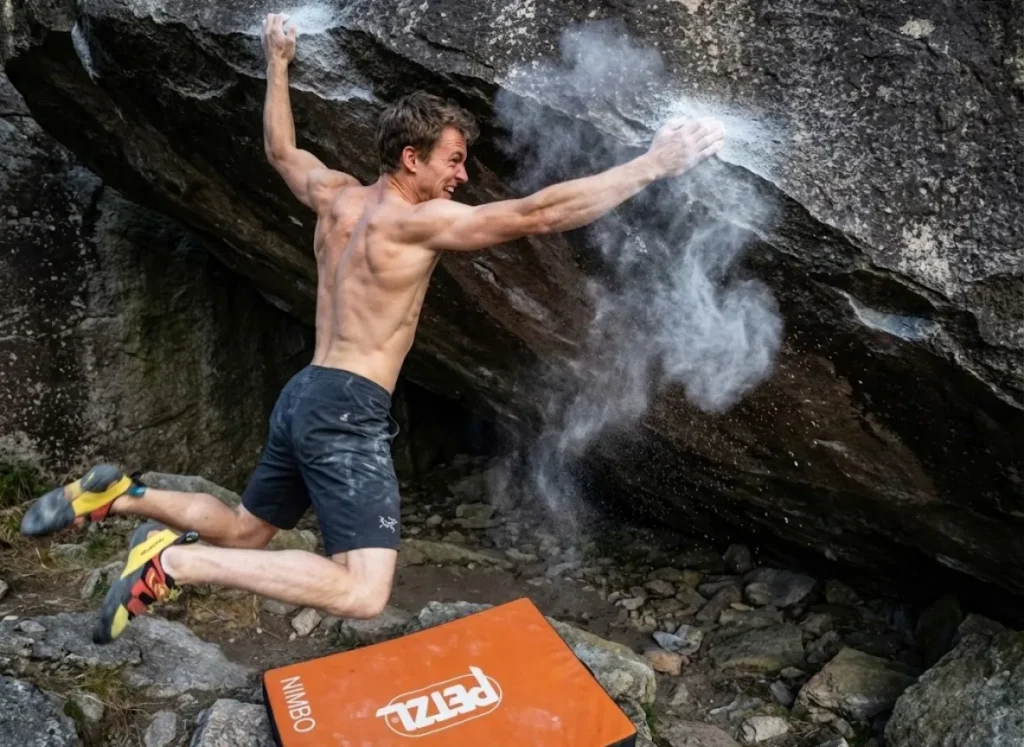
Let’s look at the road map. These are the specific technical benchmarks and physical milestones that define the progression through the V-Scale.
What technical hurdles define the Novice Tier (V0-V5)?
VB-V2 (The Foundation): VB (V-Basic) to V2 covers the entry-level. Success here relies on movement literacy. You must learn to keep your arms straight to conserve energy, trust rubber friction on large footholds, and move your hips close to the wall. It is less about strength and more about suppressing the “gumby” instinct to over-grip on jugs.
V3-V4 (The Technical Filter): This range introduces the first mandatory dynamic movements (dynos). You cannot simply reach every hold statically. You must also begin using the heel as a third hand (heel hooks) to offload weight from your fingers on overhanging terrain.
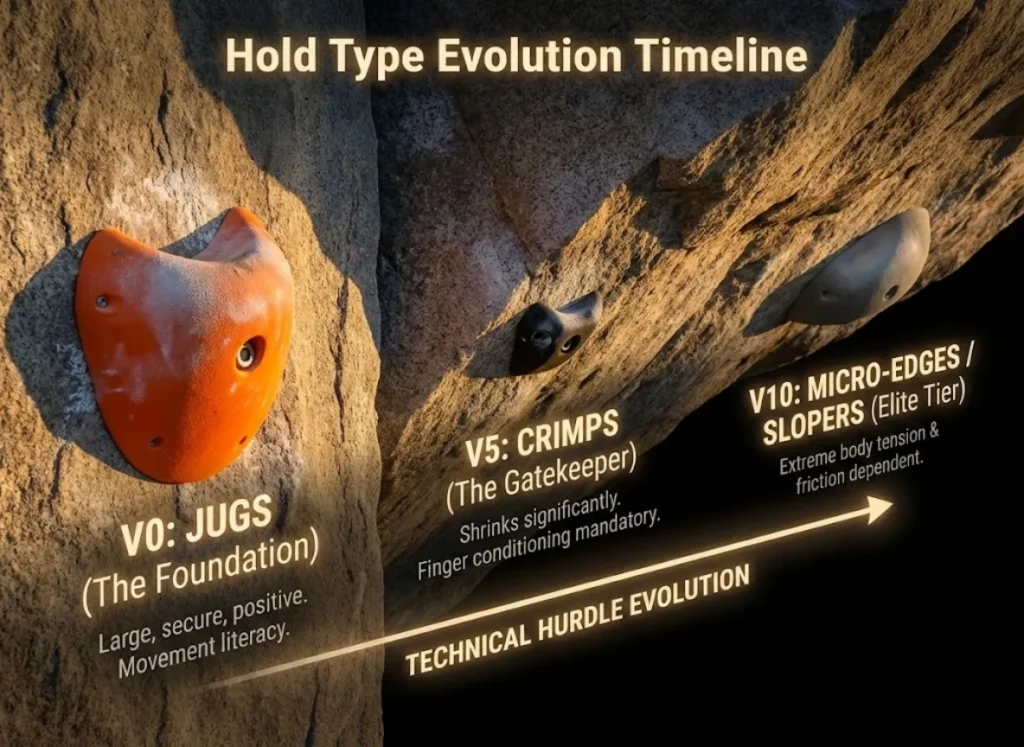
V5 (The Gatekeeper): This is the most notorious plateau. Holds shrink significantly to crimps and slopers. Casual athleticism fails here without specific finger conditioning. Route reading becomes mandatory. You can no longer “ladder” up the rock. You must identify non-intuitive sequences like cross-throughs and flagging to maintain balance. If you are stuck here, you need to study the science of how to climb V5, which focuses on body tension and micro-beta.
Pro-Tip: If you are plateauing at V3/V4, stop doing pull-ups. Focus entirely on “quiet feet.” Watch your foot placement until the moment of contact. Precise footwork offloads weight from your hands, which is the secret to breaking into the V5 grade.
What distinguishes the Elite Tier (V10-V17)?
V10-V12 (The Expert): Climbers at this level operate with extreme body tension. They utilize toe hooks and “bicycles” to keep their feet on overhanging terrain where gravity pulls at 45+ degrees. It is no longer about just holding on; it is about creating leverage on micro-crimps where none seems to exist.
V13-V15 (The Professional): Success requires lifestyle optimization. Sleep, diet, and recovery strategies are as important as training. You must possess the ability to apply one-arm hang strength to complex, insecurity-inducing holds.
V17 (The Limit): This is the current ceiling of human capability, roughly equivalent to Font 9A. As exemplified by climbs like Burden of Dreams, this grade requires the convergence of genetic potential, years of specific recruitment, and perfect atmospheric conditions. When asking what is the hardest climbing route in the world, you are looking at problems where “micro-beta” is the deciding factor. A millimeter adjustment of the thumb or the specific humidity of the air can determine success or failure on these hardest bouldering grades.
Why Is There a Discrepancy Between Gym and Outdoor Grades?
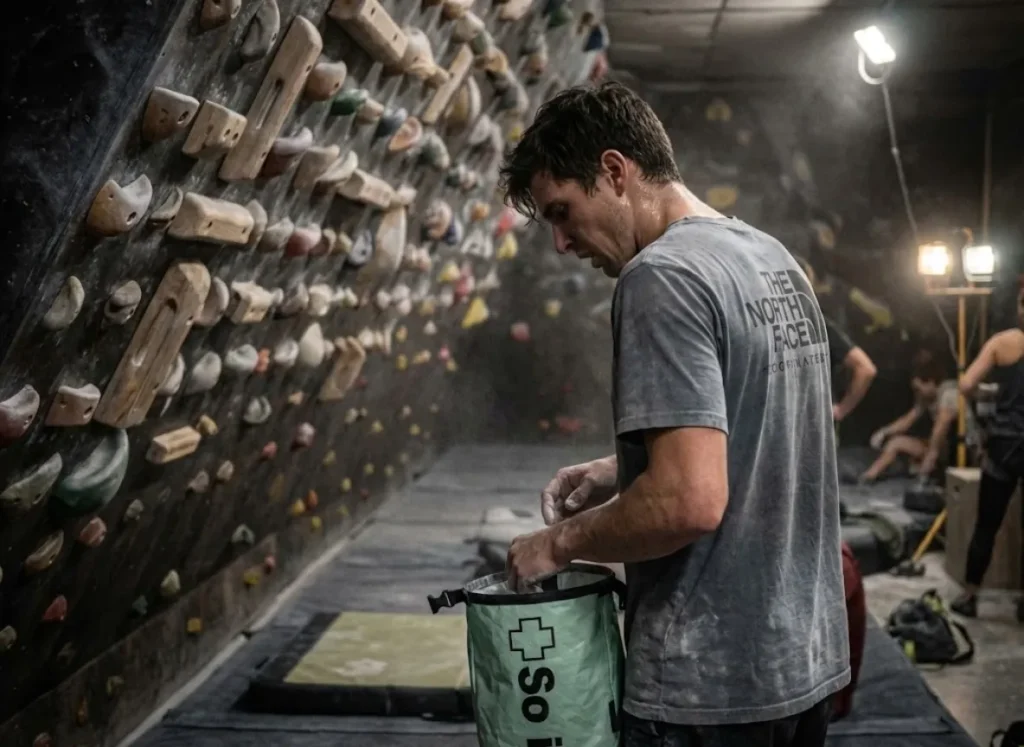
One of the most jarring experiences for a climber is flashing V5 in the gym and falling off a V1 outdoors. This isn’t a failure of your ability; it’s a difference in environment and commerce.
Why do gym grades often feel “softer” than outdoor benchmarks?
Climbing gyms operate as businesses. They need to retain members. “Vanity grading” (or soft grades) gives climbers a sense of rapid progression, encouraging them to renew memberships. If you struggle on V0 for six months, you are likely to quit. Therefore, the early grades in gyms are often compressed to facilitate quick wins.
Additionally, the style of indoor bouldering—often called “Parkour” style—emphasizes coordination and running jumps on large ergonomic volumes. This rarely translates to the small, sharp holds of outdoor bouldering. Outdoor grades are consensus-based and historical. A V3 established in 1990 retains its difficulty. In contrast, gym grades are ephemeral, set by route setters and reset weekly.
This “Gym-to-Crag Gap” creates a dangerous feedback loop. Climbers attempt outdoor highballs (tall boulders where a fall carries significant risk) based on their gym grade, lacking the tendon density or skin conditioning required. Real rock requires “finding” the hold and trusting invisible friction. To understand this process better, it helps to learn how gym climb grades emerge from the perspective of the setters themselves. View gym grades as internal training metrics for that specific facility, not absolute values of your worth as a climber.
Pro-Tip: When transitioning to outdoor climbing, drop your expected grade by at least two full numbers (e.g., if you climb V5 indoors, start on V3 outdoors). This protects your ego and, more importantly, your tendons.
Final Thoughts
The V-Scale is an open-ended, consensus-based grading system rooted in the history of Hueco Tanks, distinct from the circuit-based Font scale. Progressing through these grades is not linear; it requires distinct physiological leaps in finger strength-to-weight ratios and connective tissue health. Benchmarks like V5 and V10 serve as major filters, requiring the transition from gross motor learning to specific structural adaptation.
Gym grades are subjective commercial tools, while true competence is measured by the ability to adapt to the indifferent, chaotic nature of real rock. Stop chasing the number and start chasing the movement. Explore our full library of technique guides to build the skills that make the grades follow.
FAQ – Frequently Asked Questions
What does V3 mean in bouldering?
V3 represents the entry into intermediate bouldering. It typically requires the ability to perform dynamic moves (dynos), use heel hooks, and hold smaller edges that filter out pure beginners who rely solely on arm strength.
Is indoor bouldering harder than outdoor?
Generally, no. Indoor grades are often softer (easier) to encourage progress and member retention. Outdoor grades are historically fixed and require specific skin conditioning, route-reading skills, and finger strength that gyms don’t always replicate.
What is the hardest bouldering grade?
As of 2025, the hardest confirmed bouldering grade is V17 (Font 9A). There are only a handful of established problems worldwide at this level, such as Burden of Dreams and Return of the Sleepwalker.
How do I convert V-Scale to Font Scale?
Conversion is approximate, but generally: V0 = Font 4, V3 = Font 6A, V6 = Font 7A, and V10 = Font 7C+. The Font scale often uses + to denote nuance that the V-Scale integers might miss.
Safety Notice: Rock climbing and mountaineering are inherently high-risk
activities that can involve physical trauma or fatal incidents. The information on Rock Climbing Realms is for
educational and informational purposes only. Techniques and advice presented here are not a substitute
for professional, hands-on instruction. Conditions and risks vary by location. Always seek guidance
from a qualified instructor before attempting new techniques. By using this website, you agree that you
are solely responsible for your own safety. Any reliance you place on this information is strictly
at your own risk, and you assume all liability for your actions. Rock Climbing Realms and its authors
will not be held liable for any harm, damage, or loss sustained in connection with the use of this information.
Affiliate Disclosure: We are a participant in the Amazon Services LLC Associates Program, an
affiliate advertising program designed to provide a means for us to earn advertising fees by advertising and linking
to Amazon.com. As an Amazon Associate, we earn from qualifying purchases. We are also an official affiliate partner
of Black Diamond Equipment via the AvantLink network. If you click on a Black Diamond affiliate link and make a
purchase, we may earn a commission at no additional cost to you. We also participate in other affiliate programs.
Additional terms are found in the terms of service.