
In this article
The “WI4” rating in a guidebook is a dangerous fiction—or at best, a fleeting snapshot of a ghost. Unlike rock, which remains static for millennia, waterfall ice is a living medium that metamorphoses hourly.
A route that climbs like a secure, plastic ladder at 10:00 AM can become a brittle, shatter-prone serious hazard by 2:00 PM as temperatures drop. In my two decades of guiding, I’ve seen strong rock climbers crumble on “moderate” ice climbs because they looked at the integer in the topo rather than the quality of the freeze.
True alpinism requires looking past the grade. You must learn to read the ice forms themselves, understanding that the number is strictly a baseline hypothesis of difficulty that nature can rewrite without warning. This guide deconstructs the structural taxonomy of frozen water, the “conditionality factor” that shifts ice climbing grades, and how to manage the biomechanical “pump clock” that dictates your survival.
What Defines the Primary Scales of Ice Difficulty?

Climbing grades on ice are not measurements of gymnastic ability; they are assessments of sustained steepness, verticality, and the availability of rest. Understanding the structural differences between the WI scale, AI scale, and Mixed climbing grades is the first step in choosing an objective that matches your skillset.
How is the Water Ice (WI) Scale structured?
The Water Ice (WI) scale specifically rates seasonal water ice formed by freezing flows, typical of ice climbing routes in canyons and crags like the Canadian Rockies or Ouray Ice Park. The progression is linear, defined largely by the ice angle and the security of the stance.
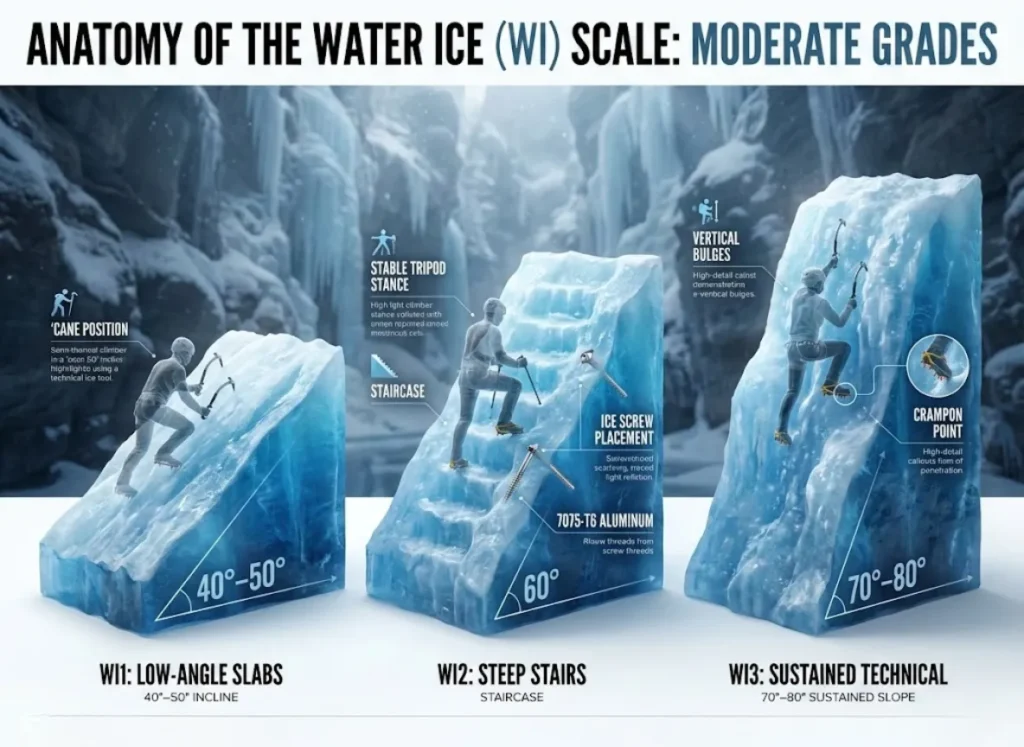
The Moderate Grades (WI1-WI3)
The scale begins with WI1, characterized by low-angle ice slabs (40-50°) where ice tools are used primarily for balance in the “cane position.” You can often ascend these snow slopes and slabs with just boots and crampons.
As the angle steepens to 60 degrees, we enter WI2. This resembles a steep staircase, offering excellent protection and stable “tripod” stances where you can stand flat-footed to place ice screws.
WI3 marks the threshold of technical ice. Here, you encounter sustained 70 degrees ice with short steps of 80-90°. Crucially, WI3 is distinguished by the availability of “armchair” rests—large ledges or pods where you can fully recover your heart rate. If you are working on ice climbing kickstart gear and foundational moves, this is the terrain where those mechanics are solidified.
The Technical Grades (WI4-WI7)
WI4 represents a critical jump in difficulty. It features sustained vertical ice (80 degrees) with long sections (10-15m). Rests here are semi-hanging; you cannot let go fully, requiring active energy management. The UIAA scales of difficulty in climbing—established by the International Climbing and Mountaineering Federation—define this as the point where technique must override brute strength.
WI5 is the “Pump Barrier.” Expect a full rope length of 85-90 degrees ice with few to no rests. This places high demands on your endurance and requires efficient screw placement from strenuous, locked-off stances.
The elite spectrum (WI6–WI7) is characterized by dead vertical or overhanging ice structures. These routes often feature hanging daggers and precarious protection that demands absolute psychological commitment.
Pro-Tip: If you can’t place an ice screw in under 30 seconds from a hanging stance, you are not ready to lead WI4. Practice ground-level placements until it is muscle memory.
What distinguishes Alpine Ice (AI) from Water Ice (WI)?
While WI grades rate seasonal flows, Alpine Ice (AI) refers to permanent alpine ice or hard nevé found in high-mountain environments.
Formation & Longevity
The AI scale applies to permanent icefields formed by years of compression and metamorphic cycles, distinct from the seasonal freeze-thaw of waterfall ice climbing. It is typically more uniform and sheet-like.
Navigation here prioritizes efficiency and speed over technical gymnastics. While the movement is similar, the fundamental skills for alpine success differ, focusing on route finding and speed to mitigate objective hazards like icefall.
Density & Climbing Feel
Glacier ice is generally denser and more plastic than seasonal ice. This allows for “hero sticks”—secure, predictable tool placements—but makes screw placement labor-intensive.
An AI4 rating suggests the same steepness as a WI4, but the climbing is generally less complex due to the lack of fragile features like chandeliers. However, the commitment is higher. As noted in NPS guidelines for high-altitude mountaineering, the hazards shift from structural ice column collapse to rockfall, serac danger, and crevasse navigation.
When does a route transition to Mixed (M) or Dry Tooling (D)?
The grade shifts to the M-scale when the ice becomes discontinuous, forcing the ice climber to use tools on rock to connect patches of frozen water.
The M-Scale Definitions
The scale progresses from M1-M3 (scrambling with tools) to M4-M5, which involves vertical dry tooling requiring torqueing cracks. Grades M6–M7 introduce overhanging terrain and advanced gymnastics. Unlike pure rock climbing, M-grades account for the mechanical advantage of the tools, which allow for extended reach and positive leverage on blank faces. Note that this differs from the Scottish Winter Grade system, which uses Roman numerals (I-X) to combine technical difficulty with commitment.
Mixed vs. Dry Distinction
Mixed climbing implies a traditional mountain setting where ice is present, protection is often traditional (cams, nuts), and objective hazards exist. Historical context from AAC publications on mixed climbing standards emphasizes this alpine setting, championed by pioneers like Jeff Lowe and Will Gadd.
Dry Tooling (D-grades) denotes routes climbed exclusively on rock, often bolted sport-style in caves, with no ice interaction. Technique shifts radically here; high-end M and D grades require maneuvers like the Steinpull (inverted tool leverage) and the Figure-4. If you are looking to advance, mastering the ice to rock mixed climb transition is essential for moving between these mediums efficiently.
Why is the “Conditionality Factor” Critical for Safety?

A grade is static; ice is dynamic. The “Effective Grade” is the difficulty you encounter on the day, shaped by temperature, wind, and water volume.
How do temperature and hydrology shift the Effective Grade?
Temperature Gradients
Ideal “plastic ice” occurs between -5°C and -10°C. In this zone, tools stick with a single swing and ice displaces without shattering. A WI4 can feel like a WI3+.
However, below -20°C, we encounter brittle ice. The internal tension causes “dinner-plating”—large lenses of ice shattering upon impact. This raises the difficulty by removing secure hooks and forcing you to swing repeatedly to clear bad ice.

This cold also brings the “Scream Barf”—a physiological reaction to re-warming hands after climbing in brittle cold, where intense pain can induce nausea and incapacitate a climber at the belay. National Snow and Ice Data Center on ice mechanics provides the scientific basis for how these temperature shifts alter structural integrity.
Hydration & Volume
“Fat conditions,” where high-volume flows fill in technical steps, can lower a grade significantly. Conversely, “lean conditions” feature thin veneers of ice over rock.
This creates a condition-adjusted grading shift: a standard WI4 can escalate to a WI5 R (Runout) because screws bottom out against the rock. You must learn to decode ice formations and conditions for safe ascents to recognize when a route has shifted from “hard” to “dangerous.”
How do complex ice formations alter technical difficulty?
Aerated Features
Chandeliers are formed by individual dripping icicles that fail to fuse. They resemble organ pipes and offer poor protection because screws hit air pockets. Climbing them requires delicate hooking to avoid shattering the structure. Encountering sustained chandeliers on a WI4 route effectively raises the technical demand to WI5 due to the psychological stress of unsecured climbing.
Structural Hazards
Free-standing ice columns, cigars, and hanging daggers are high-stress features. Aggressive swinging here can induce radial fractures, risking total collapse. These features often carry an “X” safety rating. Cauliflowers and mushrooms—bulbous, aerated growths—complicate foot placements.

Navigating this terrain often requires specialized gear strategies, such as selecting the lightest ice screw to reduce weight and leverage on fragile placements. As highlighted by Avalanche.org on ice and snow structure stability, understanding the stress limits of unsupported frozen structures is vital for survival.
How Do Gear and Biomechanics Determine Success?

Success on high-grade ice is a function of the “Machine”—the interaction between your physiology and your mechanical extensions.
What is the “Pump Clock” and how does it dictate strategy?
Physiological Constraints
The “Pump Clock” is the finite window of grip strength available before lactic acid accumulation causes muscle failure (the pump). PubMed study on forearm muscle oxygenation during climbing confirms that raising the arm above the heart restricts blood flow, accelerating this failure. The primary difference between WI4 and WI5 is not the moves, but the lack of resting stances that keep the clock ticking.
Strategic Mitigation
Beating the clock requires a “one-swing” mentality. You must trust your first stick and move your feet immediately. Maintaining a stable body position with feet wide allows you to hang on your skeletal structure rather than muscular tension. Proper training for ice climbing strength and endurance focuses specifically on extending this anaerobic window.
How do modern tools and crampons change the perception of difficulty?
Tool Evolution
Early straight-shafted ice axes made WI4 feel desperate. Modern ice tools with hydroformed, offset handles allow you to reach over bulges and cauliflowers without smashing your knuckles. This geometry makes WI5 terrain mechanically accessible.
Aggressive pick angles penetrate hard ice with less force, preserving energy. Check our ultimate ice axe and tool guide for a detailed look at how geometry affects swing mechanics.
Crampon Configuration
On WI5+ and Mixed terrain, mono points (single front point crampons) act like a scalpel. They allow for precise pivoting in tool holes without shattering the ice.
Dual points offer stability for lower grades but can displace too much ice on brittle, vertical pillars. Equipment must meet rigorous UIAA Safety Standards for Ice Tools, but selecting the right configuration for the grade is up to the climber.
Pro-Tip: For WI5 and above, switch to mono-point crampons. The ability to pivot your foot on a single point allows you to keep your hips close to the ice, reducing arm strain significantly.
Final Thoughts
The numbers in the guidebook are a hypothesis, not a promise. The progression from WI3 to WI6 is defined by the steepening of the angle and the systematic removal of rest stances. But remember, the “Effective Grade” is decided by the temperature, the sun, and the wind.
To survive and thrive on waterfall ice, you must respect the “Pump Clock” and understand that safety ratings (R/X) are far more consequential here than on rock. Before you lead, calibrate your assessment skills on top-rope.
protection.
FAQ – Frequently Asked Questions
What is the main difference between WI4 and WI5?
WI4 features sustained vertical sections with semi-rests, while WI5 consists of a full rope length of vertical (85-90°) ice with virtually no good rests. The defining factor is the sustained physical demand on your grip strength and endurance.
How do ice climbing grades compare to rock climbing grades?
Physically, a WI4 is roughly equivalent to a 5.9 YDS rock grade equivalent or a 5b or 5c in French sport grades. However, the mental demand and risk are significantly higher on ice. Falling is generally not an acceptable option due to the risk of injury from crampons and ice screws.
What is the difference between Mixed (M) and Dry Tooling (D) grades?
Mixed climbing (M) routes are climbed in a mountain environment with ice present, often using traditional protection. Dry Tooling (D) routes are climbed exclusively on rock, typically bolted like sport climbs, with no ice interaction.
What is the hardest ice climbing grade currently?
Pure ice climbing generally tops out around WI7+, as ice structures steeper than this tend to collapse under their own weight. Specialized spray ice routes, like those at Helmcken Falls (e.g., Wolverine), have reached grades of WI13 due to their unique formation and bolted
Safety Notice: Rock climbing and mountaineering are inherently high-risk
activities that can involve physical trauma or fatal incidents. The information on Rock Climbing Realms is for
educational and informational purposes only. Techniques and advice presented here are not a substitute
for professional, hands-on instruction. Conditions and risks vary by location. Always seek guidance
from a qualified instructor before attempting new techniques. By using this website, you agree that you
are solely responsible for your own safety. Any reliance you place on this information is strictly
at your own risk, and you assume all liability for your actions. Rock Climbing Realms and its authors
will not be held liable for any harm, damage, or loss sustained in connection with the use of this information.
Affiliate Disclosure: We are a participant in the Amazon Services LLC Associates Program, an
affiliate advertising program designed to provide a means for us to earn advertising fees by advertising and linking
to Amazon.com. As an Amazon Associate, we earn from qualifying purchases. We are also an official affiliate partner
of Black Diamond Equipment via the AvantLink network. If you click on a Black Diamond affiliate link and make a
purchase, we may earn a commission at no additional cost to you. We also participate in other affiliate programs.
Additional terms are found in the terms of service.