
In this article
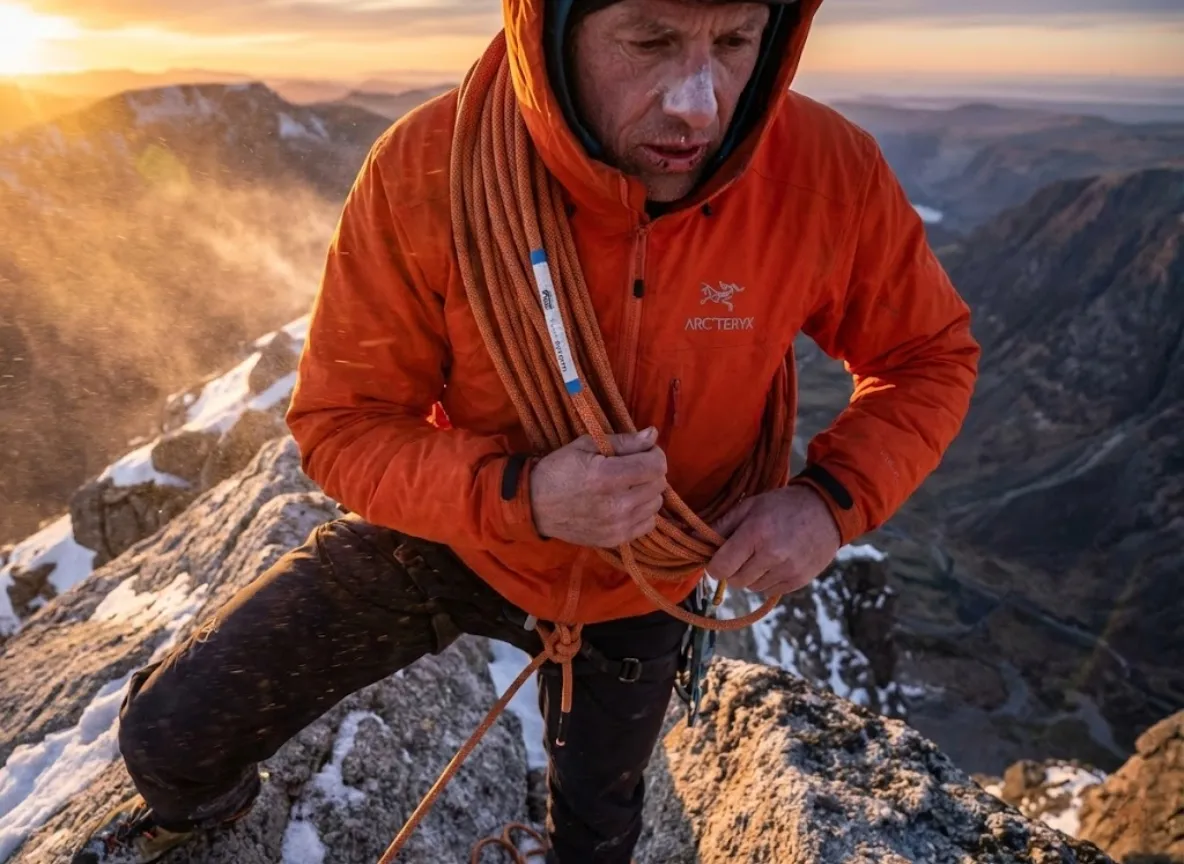
The wind on an exposed alpine ridge screams at 40mph, stripping the heat from your layers while the sun dips precariously close to the horizon. In this environment, a tangled rope is not just an inconvenience; it is an objective hazard that forces unplanned bivouacs and exposes the team to hypothermia.
Alpine rope management is not a housekeeping task; it is the central nervous system of your advanced rope logistics. It governs the tempo of the ascent, the security of the rope team, and the safety of the descent.
As a mountain guide, I have seen technically strong climbers crumble because they could not manage their lifeline. I have also seen modest climbers move with incredible speed because their rope-handling skills were airtight. This article moves beyond basic coiling. We will examine the rope stack as a defensive system against wind, time, and gravity, transforming your dynamic rope from a source of frustration into your most efficient tool for technical mountaineering.
Why is Logistics Synonymous with Safety in Alpinism?
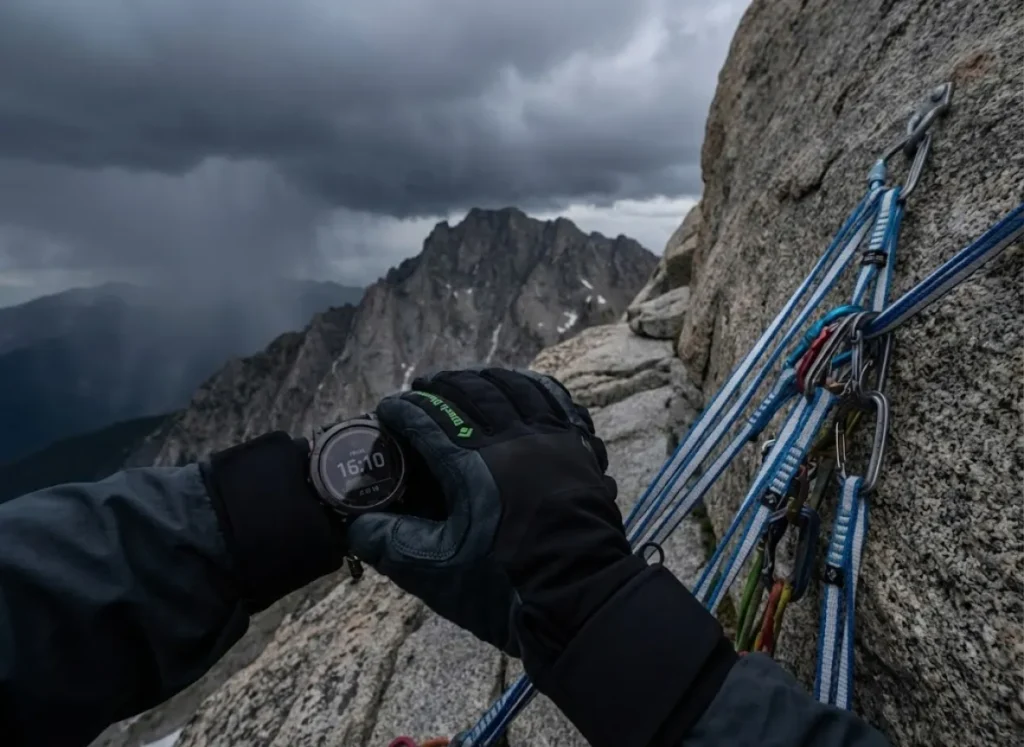
In the vertical world, speed is a function of organized systems. Efficiency creates the time buffer needed to handle emergencies. If you are fighting your gear, you are losing the race against the sun. Time equals safety.
How does the “20 Pitches = 1 Hour” rule define efficiency?
The “20 Pitches = 1 Hour” rule posits a simple but brutal mathematical reality: saving just three minutes per belay transition on a long route aggregates to a full hour of daylight gained. That hour is the difference between rappelling in twilight and navigating a complex descent in pitch blackness.
To achieve this, the system must begin the moment the lead climber anchors. You must utilize the “dead time” while the second follows to organize the stack. The primary metric for success is the seamless transition from “belaying the second” to “belaying the leader” without pausing to untangle the cord. Seconds per transition count.

Inefficiency at the belay anchor compounds exponentially. A tangled rope halts momentum, allowing body temperatures to drop and mental fatigue to set in. Speed acts as the primary safety buffer in the mountains.
Referencing the AMGA Single Pitch Instructor Program Handbook, we see that transition efficiency is categorized as a fundamental risk management tool. By mastering multi-pitch systems, you transform the single rope from a source of rope friction into a tool for rapid vertical movement.
What is the “Stack Inversion Problem” in block leading?
“Block leading,” where one climber leads multiple pitches in a row, creates a topological problem. As the second is belayed up, the rope piles onto the ledge. Consequently, the “leader’s end” of the rope ends up buried at the very bottom of the stack.
If the lead climber attempts to climb immediately, the rope will feed from the bottom. This causes the entire pile to lift, snag, and tangle violently, often exacerbated by hockles or torsional kinks. Conversely, “swinging leads” (alternating leaders) naturally maintains the correct stack order, as the second’s end becomes the top of the new stack.
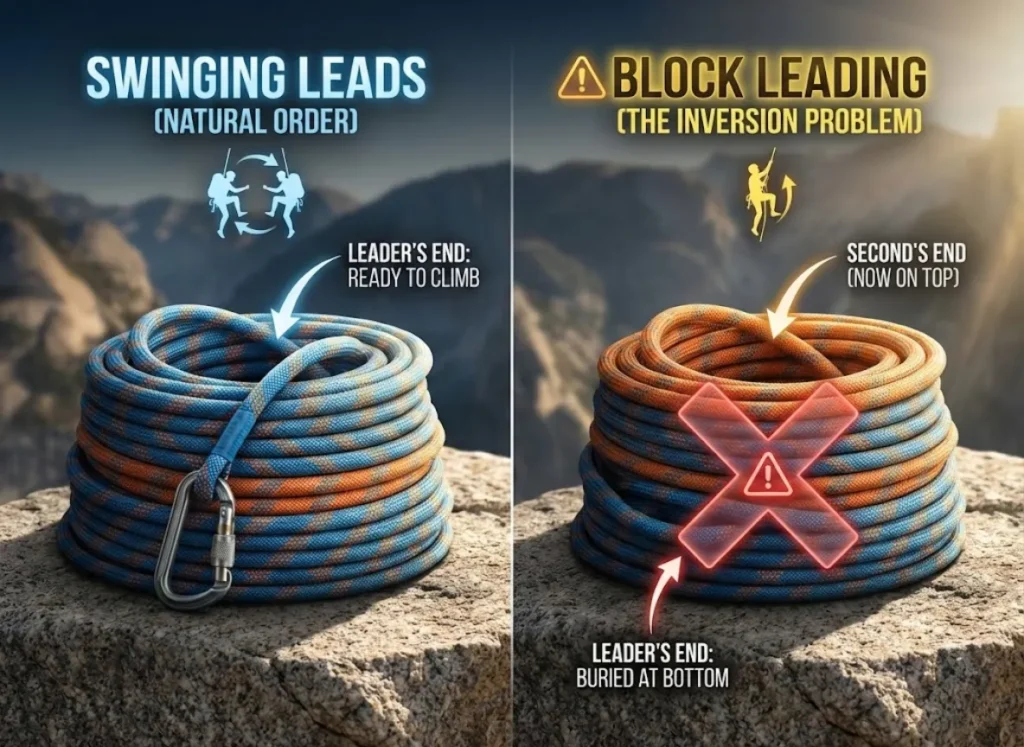
Ignoring stack topology is the leading cause of “mid-pitch paralysis,” where the belayer must halt the leader to fix a jam. According to Pisgah Climbing School: Managing the Rope, failing to address this inversion before the leader departs is a critical workflow error.
You must execute a kinetic intervention—flipping the stack or utilizing the Carabiner Knot Method—before the climber leaves the station. Understanding this tangle dynamics is vital to understanding your climbing rope and how it behaves under load.
How do Environmental Conditions Dictate Your System?
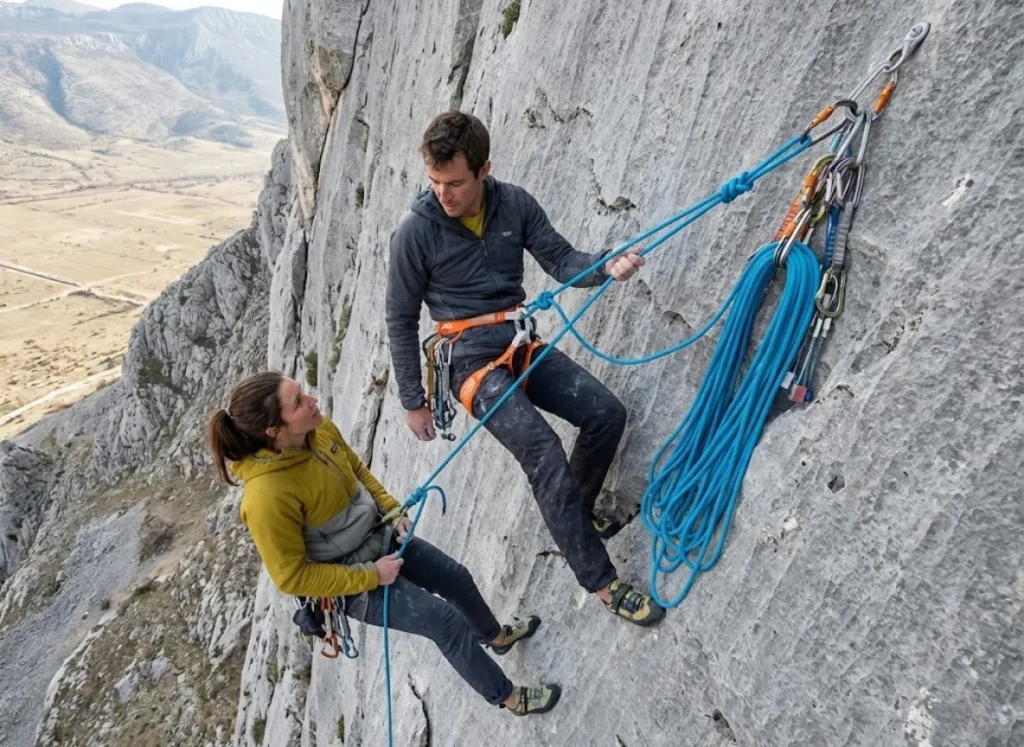
You cannot force a single technique onto every mountain face. You must diagnose the terrain—Wind Speed, Large Ledge, and Loose Terrain—to select the correct management strategy. This is the “Environmental Matrix.”
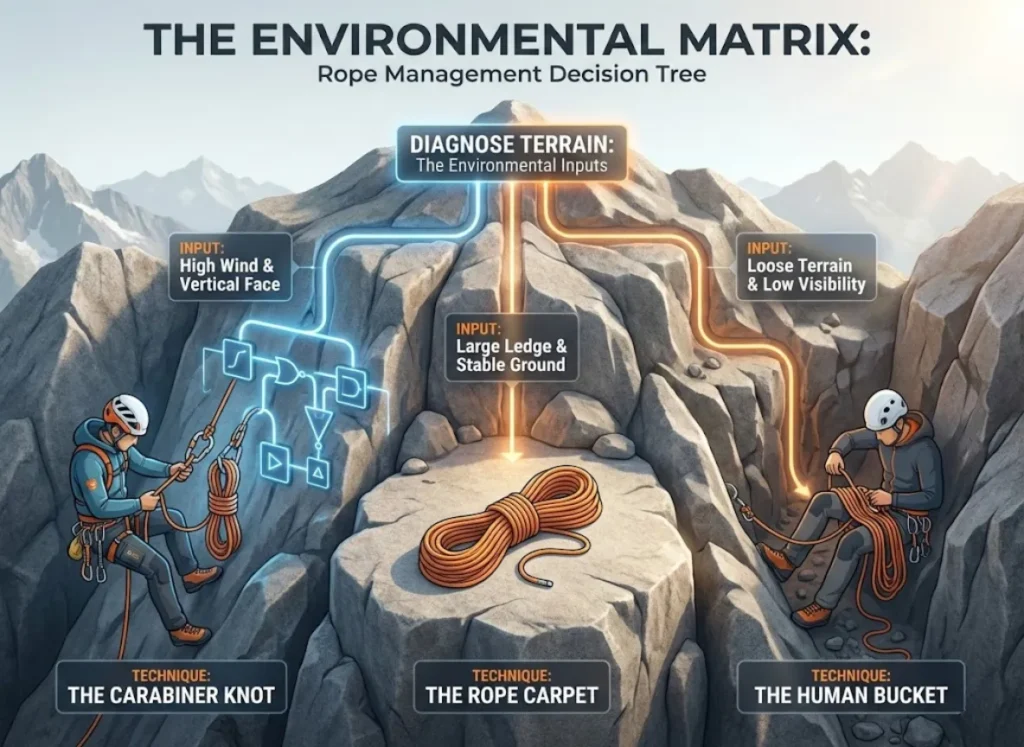
When should you use the “Rope Carpet” versus the “Pancake Flip”?
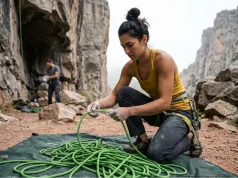
The “Rope Carpet” creates a wide, flat stack on large, clean granite ledges. It prioritizes speed and visual inspection of the cord. However, when block leading on such a ledge, the “Pancake Flip” is employed.
The team sandwiches the stack between their arms and physically rotates the entire pile 180 degrees. This instantly corrects the inversion problem, placing the rope end back on top.
Pro-Tip: Never attempt a Pancake Flip alone if the rope is 60m or longer. The weight is unwieldy, and you will likely drop the stack, creating a worse tangle. Ask your partner to help you flip it like a mattress.
However, the Pancake Flip is strictly contraindicated on “choss” or loose terrain. Flipping the rope on loose ground acts as a scoop, driving sharp debris into the sheath causing rope abrasion. The IFMGA Mountain Guide Standards highlight that rope management must account for rockfall hazard.
Dragging a rope across loose gravel risks knocking rocks onto parties below. In these scenarios, the stack must be isolated from the ground, potentially using a “human bucket” (stacking across the belayer’s feet or tether) or a rope bag if available. This relates closely to the principles of building reliable trad anchors that optimize workspace.
How does the “Carabiner Knot Method” solve the hanging belay?
Also known as the “Hook Method,” this technique is the gold standard for hanging belays or steep stances. It involves tying a simple slipknot loop (overhand on a bight) in the brake strand every 5 to 10 meters as the second ascends. Each loop is clipped into a large-capacity HMS locking carabiner attached to the master point.
This system creates a vertical, segmented stack that hangs cleanly below the anchor, occupying zero ledge space. As noted by Alpine Savvy: Rope Management, this method provides superior wind defense. The knots act as localized ballast, preventing updrafts from whipping the rope into a horizontal “spaghetti” tangle.
Beyond wind defense, it offers instant rope management for inversion. To switch to block leading, the belayer simply rotates the carabiner 180 degrees. The last loop clipped (top of the stack) naturally becomes the first to feed. Effective execution requires specific hardware, so ensure you are selecting the right locking carabiners with wide gates to accommodate the bulk.
How do you Defend Against Wind and Gravity?
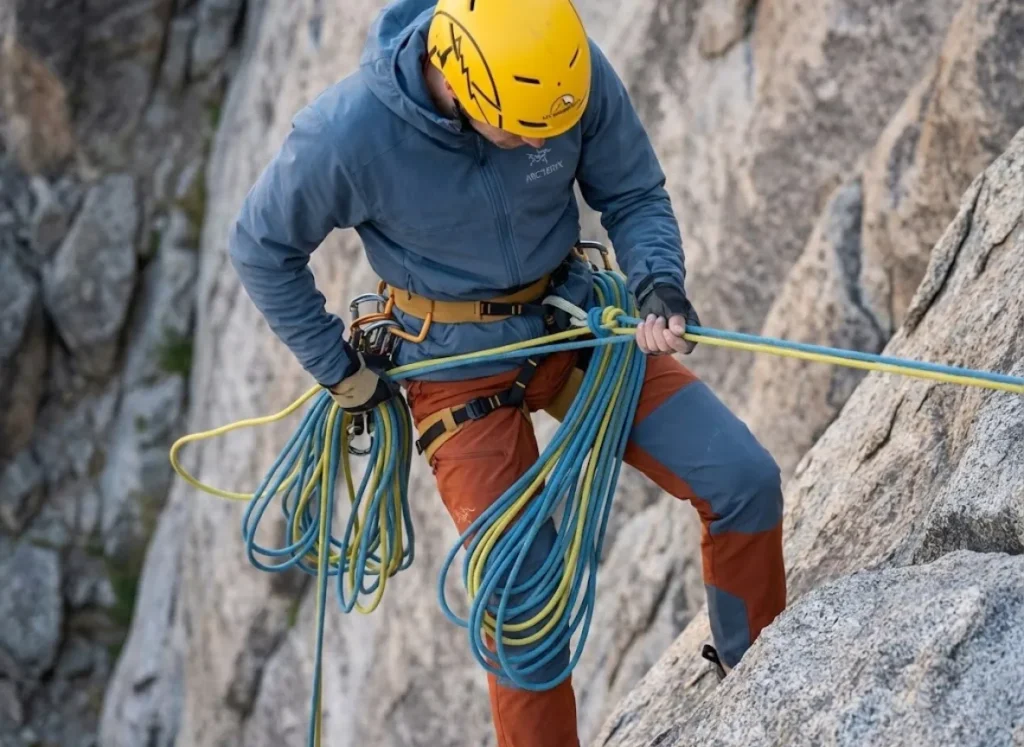
Stationary management is only half the battle. Eventually, the rope must move, often against the violent resistance of the atmosphere. We call these “Defensive Logistics.”
What is the “Alpine Torpedo” and when is it deployed?
The “Alpine Torpedo” (or Warhead) is a specialized rope coil technique for throwing ropes during abseiling in high winds. Standard loose coils will act like a sail, blowing back onto the wall or tangling around the climber.
To execute this, the climber coils the rope into tight butterfly stacks but balls the final 3-4 meters into a dense, heavy knot. The throw utilizes a forceful, overhand motion to launch the heavy knot first. The American Alpine Institute: Rappel Technique describes this ballistics approach as essential for punching through updrafts.
The heavy knot drags the lighter coils down behind it, maintaining a vertical trajectory. This prevents the rope from drifting into cracks or snagging on flakes—a critical skill when anticipating mountain meteorology suggests a storm is inbound.
How does “Saddlebagging” mitigate risk during descent?
Sometimes, throwing the rope is too dangerous. “Saddlebagging” involves butterflying the rope into two balanced stacks and clipping them into dyneema slings on the climber’s harness gear loops. Instead of throwing the rope, the climber descends while the rope feeds out incrementally from their lap.
This is the primary defense against high winds wrapping a free-hanging rope around rock towers or causing a stuck rappel rope. It also mitigates rockfall; by keeping the rope off the cliff face, you prevent the cord from dislodging loose choss onto your rope partner.
Pro-Tip: When saddlebagging, keep the loops slightly shorter than your legs. If the loops are too long, you might step into them mid-rappel, creating a self-arrest situation that is difficult to escape.
American Alpine Institute: Saddlebags validates this as a critical skill for preventing stuck ropes in unknown terrain. It connects directly to the broader protocols on how to rappel safely, emphasizing control over speed.
How does Hardware Selection Impact Efficiency?
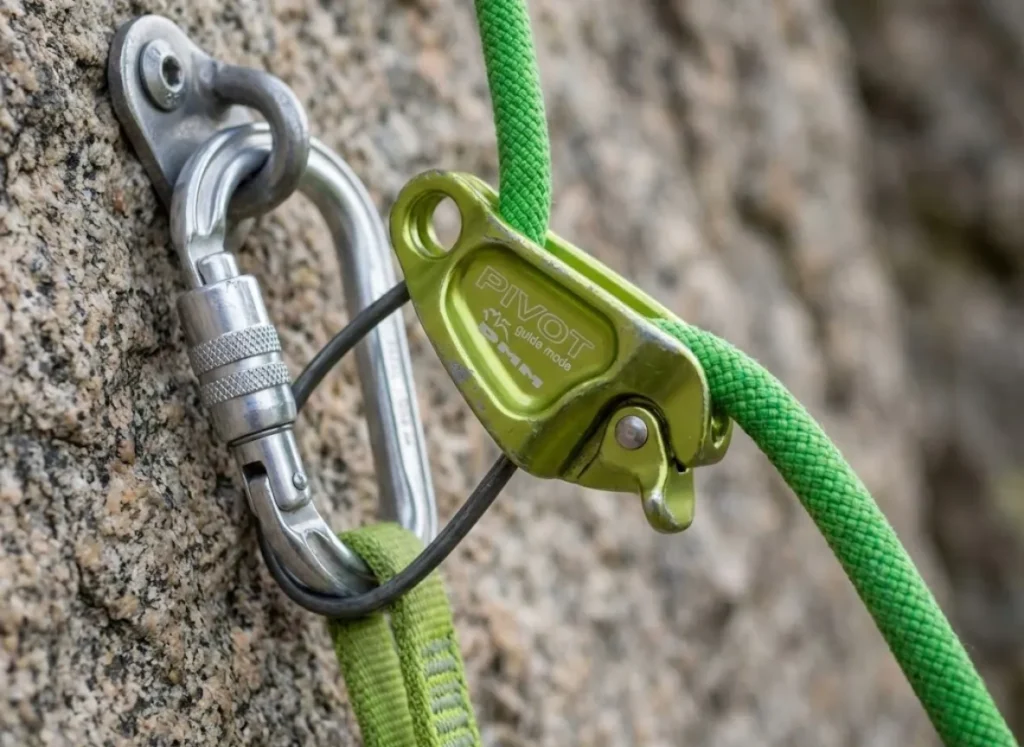
Gear and technique are symbiotic. Specific mechanical attributes of belay devices and carabiners can either fight you or facilitate advanced rope craft.
Why does “Guide Mode” friction vary between devices?
Plaquette-style devices like the ATC Guide and Petzl Reverso use an auto-blocking geometry to belay a follower directly from the anchor. However, the internal geometry differs significantly. The DMM Pivot features a hinged clip-loop that changes the leverage angle when weighted.
According to independent testing reviewed by WeighMyRack: DMM Pivot Review, this pivoting action significantly reduces the force required to release the device when lowering a second. In contrast, releasing a loaded fixed-eye device can require extreme force.
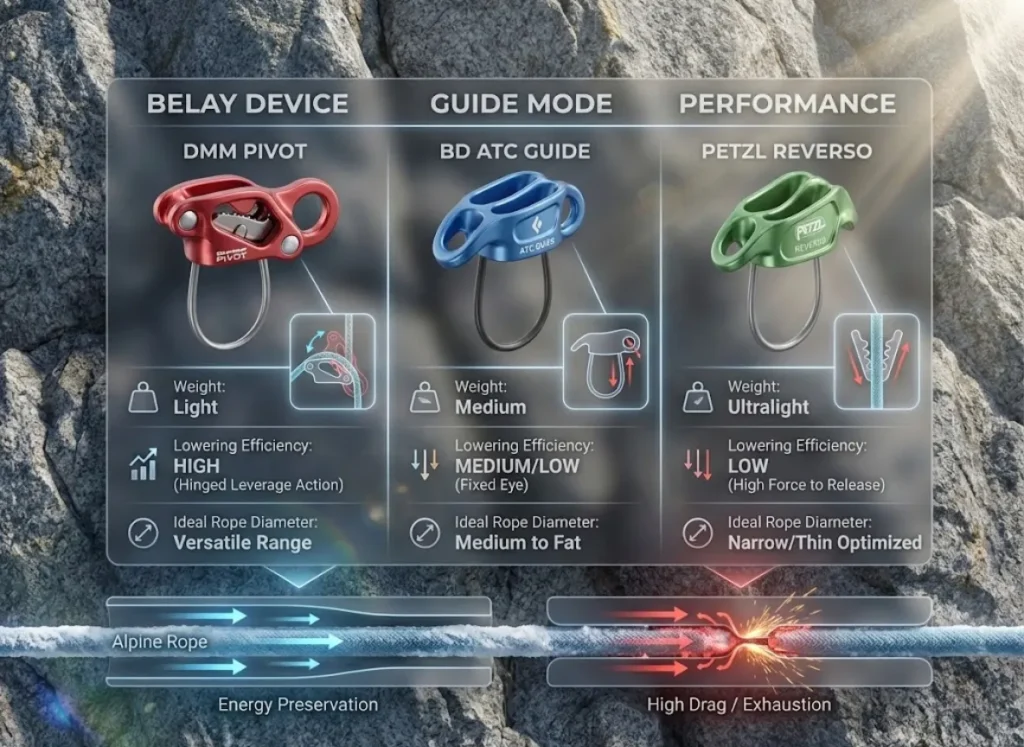
Narrower channels (like on the Reverso) hold thin ropes well but create exhausting rope drag with fatter, frozen, or fuzzy alpine ropes. Understanding these differences in belay devices allows you to preserve energy over thousands of feet of alpine climbing.
What role does carabiner geometry play in rope handling?
The “Carabiner Knot Method” and Munter hitch belays require specific carabiner attributes. You need a wide gate opening and a large internal volume. Round Stock carabiners (like the Petzl Attache) provide a smoother surface for ropes to run over compared to I-Beam constructions.
Petzl Technical Tips: Attache notes that round-stock baskets offer smoother clean rope handling and reduced sheath wear. While I-Beam carabiners are lighter, they create higher rope friction.
For the “master point” carabiner in a knot stack, a high-strength HMS is preferred to handle the multi-directional forces. This nuance in understanding carabiner shapes is the hallmark of logistical refinement.
Strategic Summary
True outdoor competence is the ability to turn theoretical knowledge into confident action. We have established three pillars of alpine rope management:
- Logistics = Safety: Efficiency at the belay is your most effective defense against darkness and cold.
- The Environmental Matrix: Terrain features strictly dictate technique. Use the Carabiner Knot for wind, and the Rope Carpet only for clean ledges.
- The Inversion Rule: Always account for stack topology. Block leading requires an inversion strategy to prevent catastrophic jams.
Before your next multi-pitch objective, do not just read this. Practice the Carabiner Knot Method and Saddlebagging in a low-consequence environment. Build the muscle memory on the ground so it becomes instinct on the climb.
FAQ – Frequently Asked Questions about Alpine Rope Management
How do you fix a rope stack inversion if you forgot to flip it?
Do not pull from the bottom of the pile. You must physically re-flake the rope (invert the stack) onto a new pile or over your feet before the lead climber departs. Attempting to feed from a buried end will almost guarantee a jam once the leader places gear and rope drag increases.
Is the Carabiner Knot Method safe for the rope?
Yes. Standard overhand knots used for stacking do not damage the rope core. These knots are not load-bearing in a fall scenario; they are purely for organization and are untied as the rope feeds out.
What is the best way to coil a rope for a hanging belay?
The Carabiner Knot (Hook) method is superior to lap coils for hanging belays. Lap coils draped over the harness or a cordalette often cinch down on the climber’s legs, restricting blood flow and mobility. The knot method transfers the weight of the rope directly to the belay anchor.
When should I use a tag line for rappelling?
Use a tag line (thin 5.5mm cord) when you need to make full-length (60m) rappels but want to climb on a single lightweight rope. Be aware that this system introduces significant complexity in rope management and requires specific knot-blocking techniques to retrieve the rope safely.
Safety Notice: Rock climbing and mountaineering are inherently high-risk
activities that can involve physical trauma or fatal incidents. The information on Rock Climbing Realms is for
educational and informational purposes only. Techniques and advice presented here are not a substitute
for professional, hands-on instruction. Conditions and risks vary by location. Always seek guidance
from a qualified instructor before attempting new techniques. By using this website, you agree that you
are solely responsible for your own safety. Any reliance you place on this information is strictly
at your own risk, and you assume all liability for your actions. Rock Climbing Realms and its authors
will not be held liable for any harm, damage, or loss sustained in connection with the use of this information.
Affiliate Disclosure: We are a participant in the Amazon Services LLC Associates Program, an
affiliate advertising program designed to provide a means for us to earn advertising fees by advertising and linking
to Amazon.com. As an Amazon Associate, we earn from qualifying purchases. We are also an official affiliate partner
of Black Diamond Equipment via the AvantLink network. If you click on a Black Diamond affiliate link and make a
purchase, we may earn a commission at no additional cost to you. We also participate in other affiliate programs.
Additional terms are found in the terms of service.