
In this article
Your belayer calls “Off belay” but your partner hasn’t moved in four minutes. You look up and see them hanging free, arm pressed against the wall, neither going up nor coming down. The rope is taut. Your GriGri is loaded. And you realize, with crystalline clarity, that you have no idea what to do next.
I’ve been that belayer. Sport crag, late afternoon light, 5.12 pump section, partner two sizes bigger than me. The assisted braking device was cammed shut. Nobody panicked — not yet — but everyone knew those next ten minutes would decide how the evening ended.
Managing a safe controlled descent is the most technically underestimated phase of any rope system. The physics, not intuition, will determine the outcome. This masterclass breaks down every major lowering method — from a clean sport anchor lower to a guide-mode emergency LSD transition — so you can execute a controlled descent regardless of the device in your hand, the weight differential, or the environment you’re working in.
⚡ Quick Answer: To safely lower a climber, clip a locking carabiner to the master point and route your brake strand through it as a redirect before touching the handle — this is non-negotiable for any ABD lower from an anchor. If you’re in guide mode and the device has auto-locked, apply a friction hitch third hand to the brake strand first, then use the Load Strand Direct (LSD) method if the climber can momentarily unweight, or the lever release if they can’t. Always tie a stopper knot in the rope end and keep your brake hand below the device throughout. Two minutes of setup prevents every catastrophic outcome listed in the AAC accident reports.
| Belay & Rescue Scenarios | ||||
|---|---|---|---|---|
| Scenario | Recommended Method | Device Required | Third Hand Needed? | Risk Level |
| Sport Anchor / ABD | GriGri Redirect Lower | GriGri or equivalent | Recommended | Low (with redirect) |
| Multi-Pitch Guide Mode / Stuck Climber | LSD Method | ATC-Guide, Reverso, Pivot | Mandatory | Medium |
| Emergency / No Device | Munter Hitch | HMS locking carabiner | Mandatory | Medium-High |
| Weight Disparity >40 lbs | Double Redirect or Freino | GriGri + extra carabiner | Mandatory | Medium |
| Unconscious Climber | Lever Release + Rescue Lower | Guide-style device | Mandatory | High |
The Physics of Friction: Why Your Belay Device Is Not Your Brakes
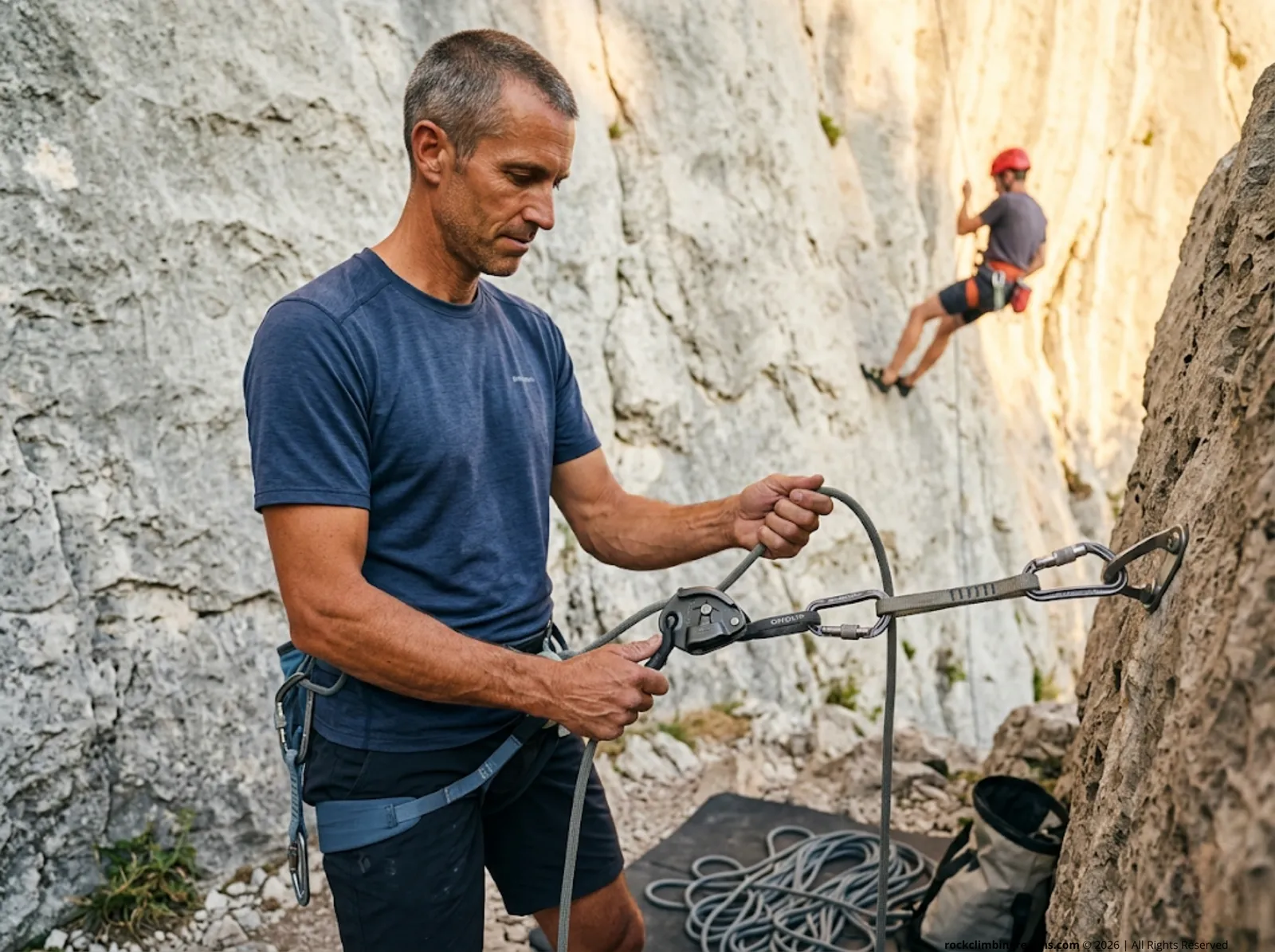
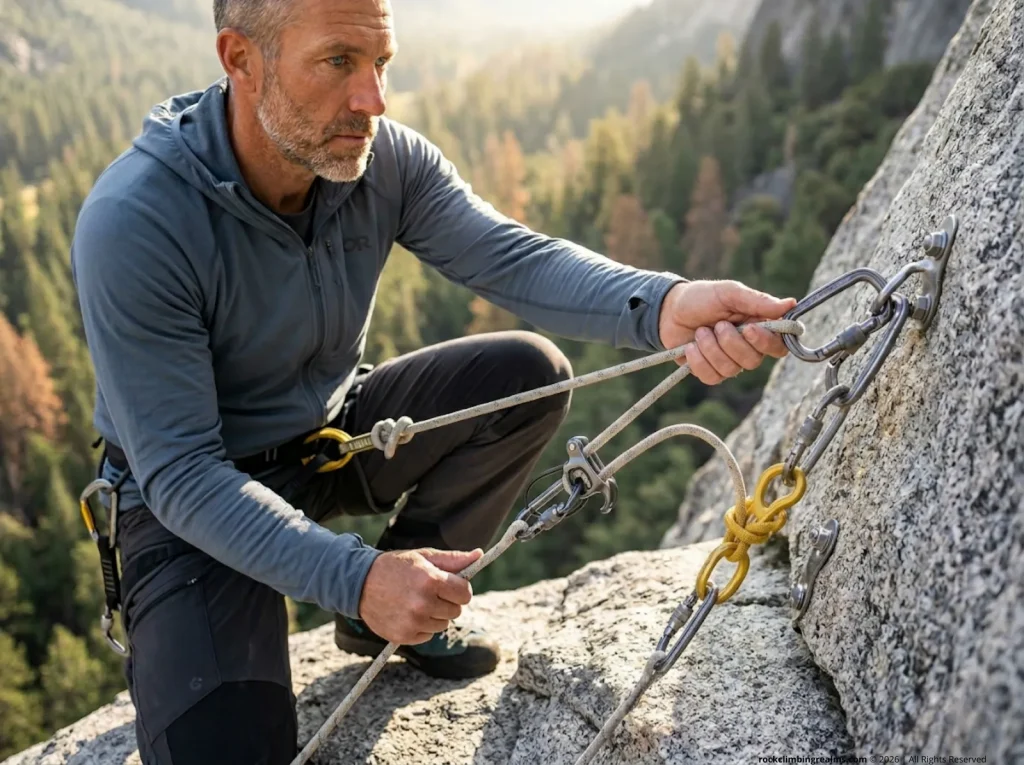
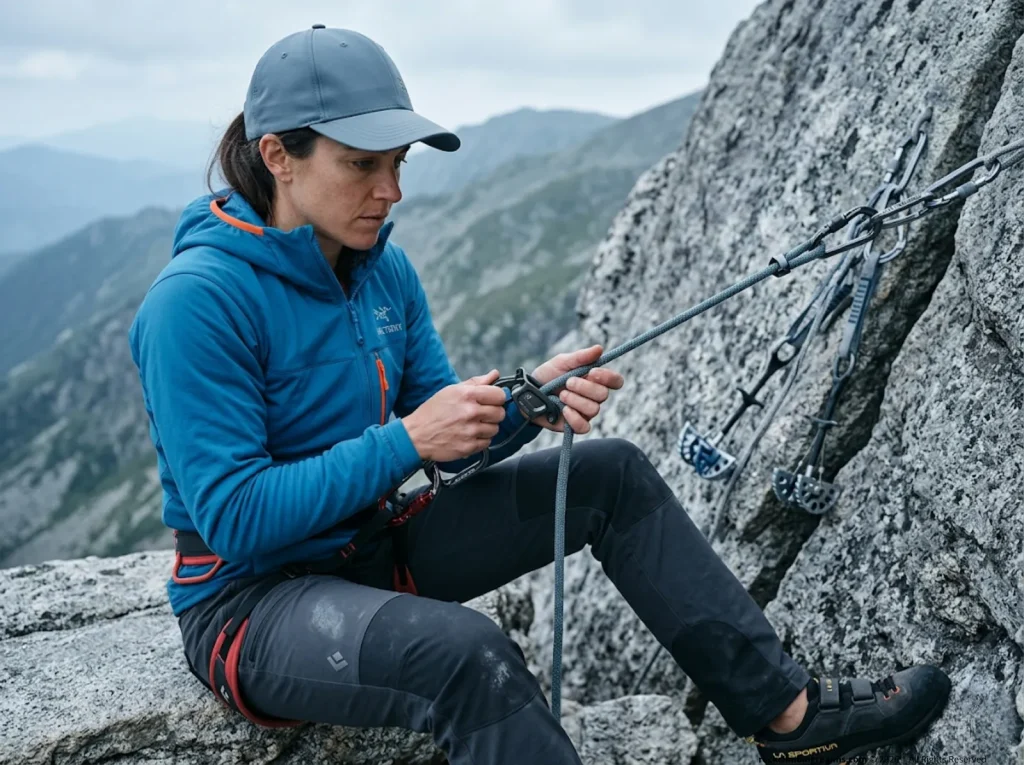 Black Diamond ATC-Guide at granite anchor demonstrating belay friction physics ” class=”wp-image-14614″/>
Here’s where most people have it wrong: the device isn’t braking for you. The rope geometry is.
Every assisted braking device operates on the same principle — the Capstan Equation. The idea is simple: the more angle the rope wraps around a surface, the exponentially more force the brake side can resist against the load side. Add a redirect carabiner at the master point and you’ve increased that wrap angle by a significant margin. Depending on the friction coefficient between rope and aluminum, that can multiply your braking force by 2–5x without any additional muscular effort on your part.
This is why how ATC, GriGri, and passive tube devices differ in their friction mechanics matters before you ever start a lower. The device type changes the brake geometry, and the geometry determines whether you control the descent or it controls you. Per the force comparison between fixed-point and redirected belay systems from Weber State University, a redirected body belay produces 8.0 kN anchor load with 4.76 kN climber impact. A fixed-point Munter? 7.94 kN anchor load, 7.82 kN climber impact. The redirect protects the climber at the cost of anchor load — which is exactly why bomber anchor quality isn’t optional; it’s the foundation everything else sits on.
The jerkiness you feel during a lower is the system oscillating between static and dynamic friction states. Static friction (aluminum on nylon runs roughly 0.40–0.50) is higher than dynamic friction (roughly 0.30–0.35). Once the rope stops moving, you need more force to restart it — and that jerk cycle is what sends belayers into a panic grab. Consistent brake-hand tension is the only tool that keeps the system smooth.
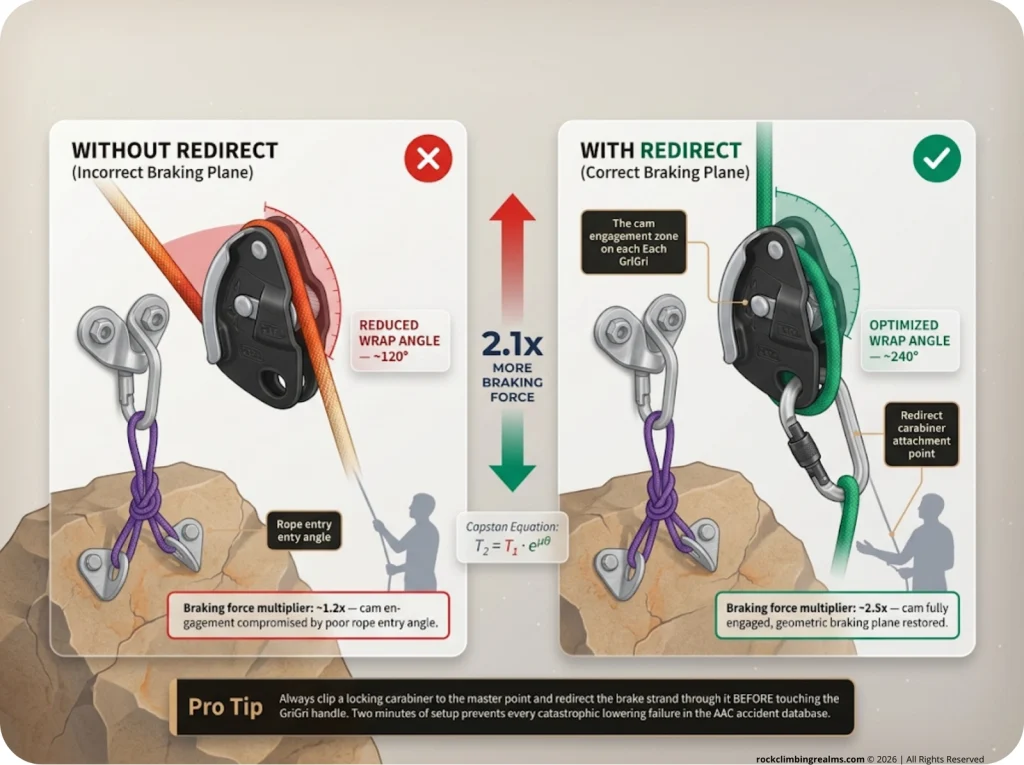
Pro tip: Never wrap your palm over the GriGri cam. Hold the brake strand below the device. The cam is a clutch that responds to geometry — your grip on the brake strand is the actual brake.
Why Nylon-on-Nylon Is a Problem Waiting to Happen
Nylon-on-nylon has the lowest friction coefficient of any common climbing material pairing. Run a rope over a Dyneema sling long enough and you’ve got a heat problem: Dyneema melts around 145°C while Nylon 6.6 holds up to 245–260°C. On a 200-foot lower, a Dyneema sling used as a redirect point can generate enough heat to cut through itself before the climber hits the ground. This isn’t theoretical. All redirects run through metal carabiners — steel for descents over 100 feet, where aluminum’s thermal mass starts to fall short.
The Pulley Effect: What Redirects Do to Your Anchor
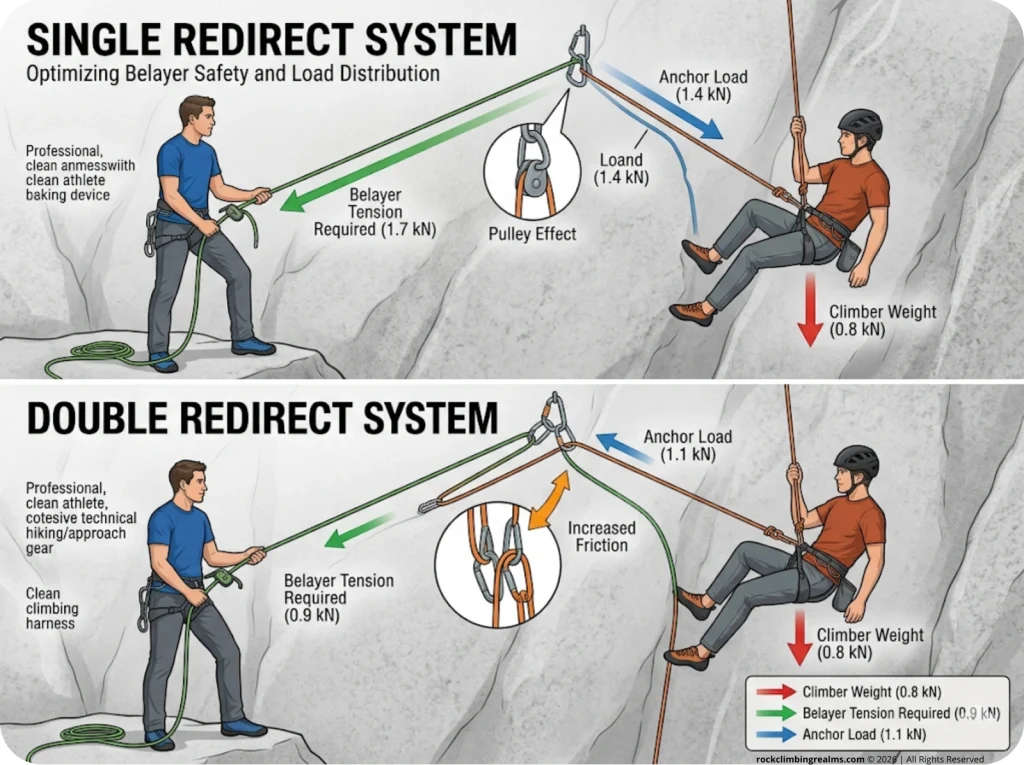
In a frictionless system, a redirect would double the load on your anchor. In practice, anchor load equals the climber’s weight plus your brake force. The Weber State data puts a redirected body belay at 8.0 kN anchor load — well within the range of properly equalized two-bolt anchors, which handle this comfortably. A single aging ring bolt on questionable rock does not. Assess the anchor before any redirect setup. This isn’t optional either.
The Sport Anchor Lower: Clean From the Ground Up
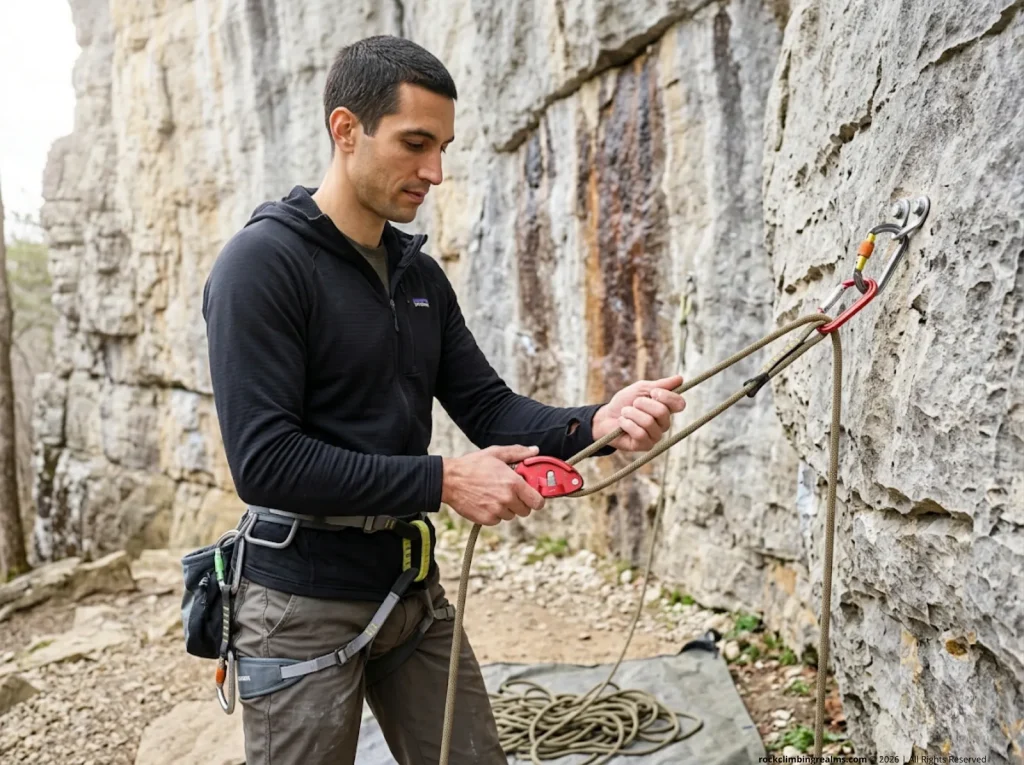 Petzl GriGri with brake strand redirect at sport anchor to safely lower a climber ” class=”wp-image-14616″/>
The pre-lower checklist takes two minutes and prevents every low-information accident in the AAC database.
Start with cleaning a sport anchor before the lower begins — the rope needs to run through metal, not over textile. Then: verbal confirmation protocol (“Take” — “Got you” — “Lowering”), weight transfer test (climber slowly sits back while you apply full brake to verify device engagement), and brake-strand redirect clipped to the master point before you ever touch the GriGri handle.
The redirect isn’t about strength — it’s about braking plane geometry. Without it, the rope enters the device at an angle that reduces cam engagement. Any handle manipulation under load becomes proportionally more hazardous. This is where the elevator drop failure mode lives: belayer pulls the handle without a redirect in place, climber starts accelerating, belayer yanks the handle harder in panic, cam retracts fully, and the descent becomes uncontrolled. Per Petzl’s force dynamics data for multi-pitch belay systems, the mechanics of this failure are consistent and preventable.
Pro tip: Pre-tension the system before you hand over control. Take up all slack, let the climber’s weight transfer fully to the device, and confirm it’s holding before you begin the lower. The most common error isn’t bad technique — it’s belayers who skip this step and then try to manage a surprise load mid-lower.
Handle Modulation and Speed Control
Think of the GriGri handle in zones: 0–25% open keeps the cam fully engaged, 25–50% gives you a controlled lower, 50–75% is accelerating, and beyond that you’ve essentially converted it to a tube device. Keep the handle in the 25–40% range and let your brake hand do the fine work. Treat it like a clutch, not an accelerator. Verbal check-in with the climber every 10–15 feet — any descent faster than a slow walk is too fast for most situations. If the handle starts vibrating in your hand, you’ve hit the cam-flutter zone. Back off to 20% and let your friction hitch absorb any surge.
Weight Disparity Protocol: The Physics of the Unequal Pair
At 40+ lbs difference, a single redirect may not be enough. The belayer’s required brake force can exceed comfortable hand tension, especially under sustained load. Three solutions:
A second redirect carabiner at the anchor shelf multiplies friction through the Capstan coefficient again. The Petzl Freino Z-carabiner adds a V-groove friction surface without changing your rope geometry, effectively adding more braking force per pass. If you’re working with 80+ lbs of disparity — 120 lb belayer, 200 lb climber — clip yourself into the anchor with a PAS before starting. “Rocket belayer displacement” is a real failure mode. For gear-oriented readers, the Edelrid Ohm and Ohmega as friction-multiplying solutions for light belayers offers a dedicated breakdown of these devices.
Guide Mode and Plaquette Mode: The Auto-Lock Impasse
Understanding how multi-pitch systems create the conditions for guide-mode lowers is the first step. Plaquette mode is designed to lock — that’s the point. The load strand enters from above and presses onto the brake strand, creating a camming pinch. Under full body weight, that pinch generates 15–50 lbs of residual friction at the device cam. You cannot unpin it by pulling on the brake strand. You have to change the mechanics entirely.
Three professional solutions, in order of preferred scenario: the LSD Method when the climber can cooperate, the Lever Release when they can’t, and the Emergency Munter when no device is available. Per the global climbing accident data on descent and belay-transition failures from the UIAA, skip-the-backup errors during guide-mode transitions are among the most documented preventable fatalities in the sport.
All three methods require a third-hand friction hitch on the brake strand before you defeat the auto-lock. Full stop. The friction hitch is the catastrophe prevention layer.
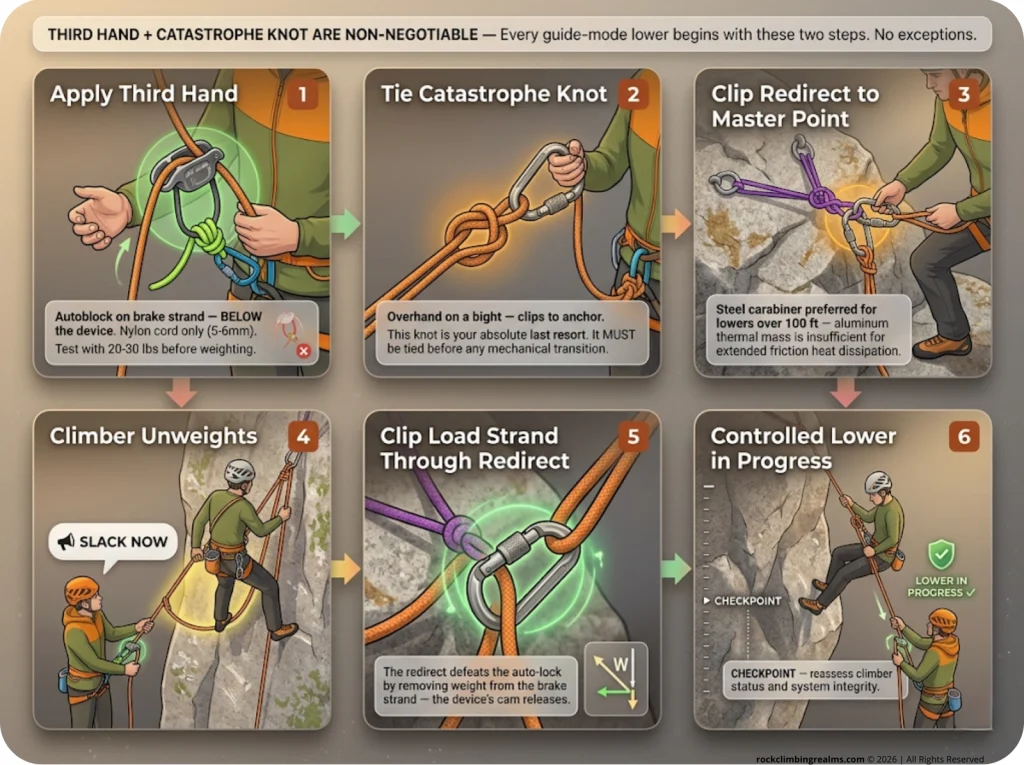
The LSD Lower: Load Strand Direct Step by Step
- Apply your third hand — autoblock or Prusik on the brake strand, clipped to your belay loop or a solid anchor point.
- Tie a catastrophe knot — overhand on a bight — in the brake strand and clip it to a secure anchor point.
- Clip a locking carabiner to the master point.
- Get the climber to unweight — even 2 inches of slack is enough. Call it clearly: “SLACK NOW.”
- Clip the load strand (climber side of the rope) through the redirect carabiner while the slack is in the system.
- The redirect lifts the weight off the brake strand, defeats the auto-lock, and the friction hitch becomes your primary speed control.
The LSD method is butter smooth because you’re modulating friction at the hitch rather than fighting the device’s cam. Use a steel locking carabiner for this redirect — aluminum works on short lowers, but steel dissipates heat better on anything beyond 100 feet.
The Lever Release: When the Climber Cannot Unweight
Apply third hand first. Non-negotiable. Then girth-hitch a sling through the small eye at the distal end of your ATC Guide or Reverso — that eye is a lever arm. Redirect the sling to the anchor so you can use body weight, lean away from the anchor to pull the lever and rotate the device, and as it opens, the third hand catches the weight and becomes speed control.
This is the all-or-nothing moment. I drilled this on a crag in the Cascades with a PCGI course instructor — the snap to fully-open position is fast and decisive. If your friction hitch isn’t pre-loaded before that moment, you have no backup. The PCGI handbook cites lever release execution as one of the top three guide-mode lower fatality points.
Emergency Munter Hitch: The Device-Independent Option
The Munter Hitch generates high friction from a single locking carabiner and the rope. No additional hardware. Best carabiner shape is a pear-shaped HMS — D-carabiners create inconsistent contact with the hitch, which means jerky speed control and more rope twisting. Keep the brake strand parallel to the load strand for maximum braking efficiency — roughly 100% versus 75% in other orientations.
For tying the Munter Hitch and Prusik with the correct geometry, practice separately before you need to do it at height under pressure. The Munter will kink the rope over time — manage it by keeping the brake strand parallel throughout and shaking out kinks at any ledge you can reach.
Friction Hitches: The Third Hand That Saves Lives
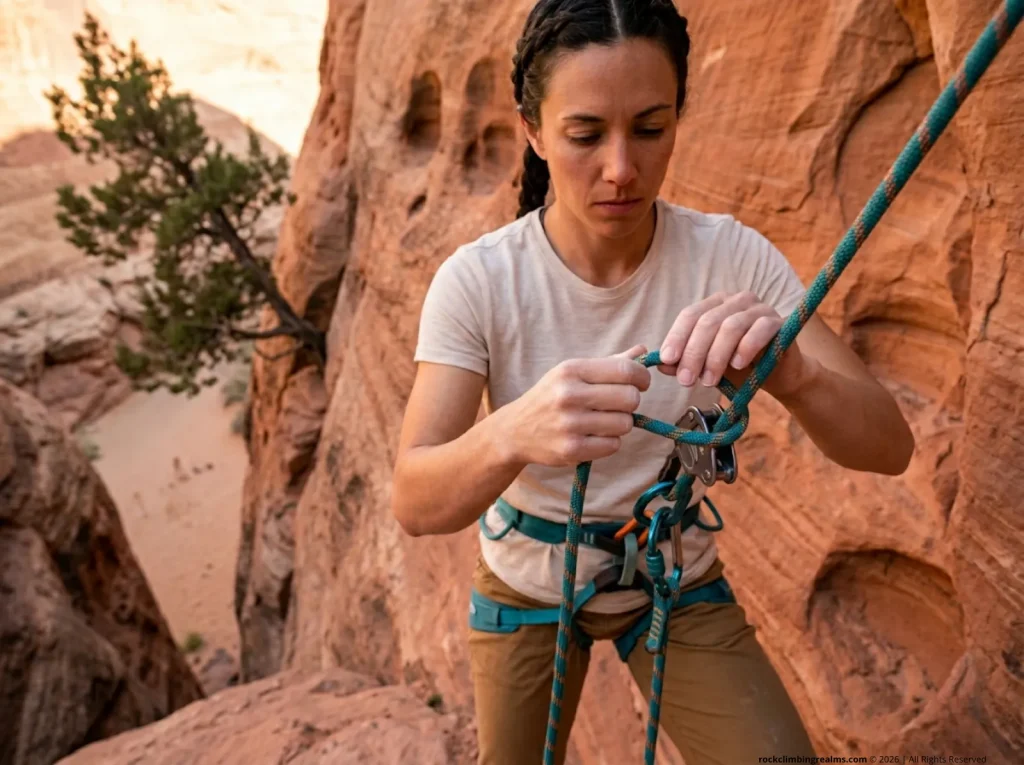
Wrong cord diameter is the most common field failure I see. Run a 6mm Dyneema hitch on an 8.5mm half-rope and you’ve got a false sense of security. I watched a partner’s autoblock slide during a rappel at Red River Gorge because of exactly this pairing — wrong diameter, wrong material. The hitch only held because her brake hand caught in time. That’s not a system. That’s luck.
Per the AMGA Single Pitch Instructor program standards for friction hitch backup protocols, friction hitch cord must be smaller diameter than the main rope — typically 5–7mm on a 9.5–10.5mm rope. Material: nylon, not Dyneema. The melting point gap between nylon (~245°C) and Dyneema (~145°C) is not theoretical under dynamic slip conditions.
Autoblock (French Prusik) ties fastest, releases easily under load with upward pressure, works well for GriGri-assisted setups. Classic Prusik is more secure under shock load, slower to release — the right choice for LSD and guide-mode lowers where control takes priority. The Klemheist is directional and locks only in one direction — good for rope ascension, counterindicated as a primary lowering hitch.
Third-hand placement: brake strand, below the device. Not above it, not on the load strand. This is where it catches a descended load.
Pro tip: Test every friction hitch before weighting the system. Apply 20–30 lbs of force manually and verify it locks without sliding. Two seconds. Do it every time.
For the broader application, escaping the belay and ascending the rope using Prusik-based friction hitches uses the same mechanics — the hitch work you build for lowering backup applies directly to self-rescue.
Common Friction Hitch Failures and Field Fixes
Wrong cord diameter — too large — slips under load. Fix: use 5–6mm cord on ropes 9.5mm and larger. Dyneema sling used as a hitch — under dynamic slip it can ski across the rope and generate enough heat to partially melt. Fix: nylon only. Hitch placed above the device — it cannot catch a descended load from that position. Fix: brake strand, below the device, every time. In cold or wet conditions, friction coefficients drop. Add one wrap to every hitch in sub-zero or wet environments.
The Rescue Lower: When Your Partner Cannot Help Themselves
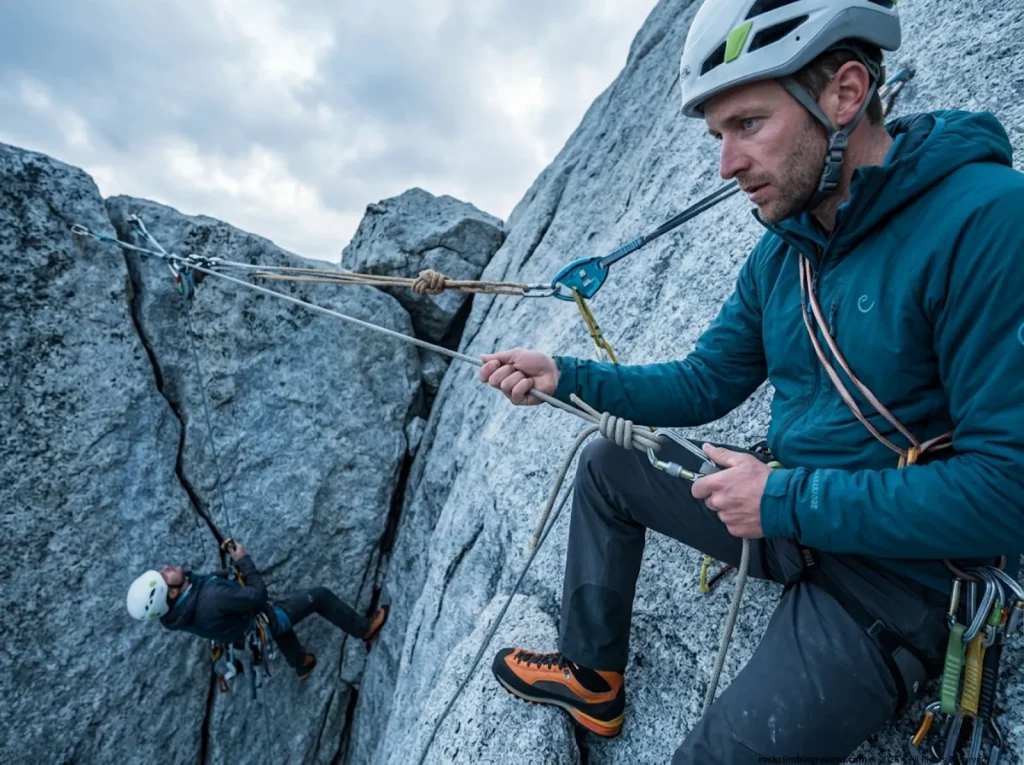
Before any rescue action, establish redundancy. Tie a catastrophe knot in the brake strand and clip it to the anchor. The belay never becomes unbelayed — that rule doesn’t suspend under emergency conditions, it gets more important.
The trigger conditions that put you here: climber is free-hanging and unresponsive, they’ve taken a hard fall and are in shock, or they simply cannot execute the unweighting step for the LSD. For the full picture of the full partner rescue framework: assessment, lowering, and hauling protocols, the lowering sequence covered here is the spine of that larger system.
The NPS Denali 2023 case study is worth knowing — their team executed load transfer at 16,000 feet using Prusik hitches and Munter-Mule-Overhand (MMO) knots in terrain that would break most recreational climbers. The principles are identical to your sport crag scenario, just with different stakes and altitude. Per the NPS Denali rescue operations: load transfer and self-rescue proficiency at altitude, the systems that work at altitude work because they’re redundant and drilled — not because they’re clever.
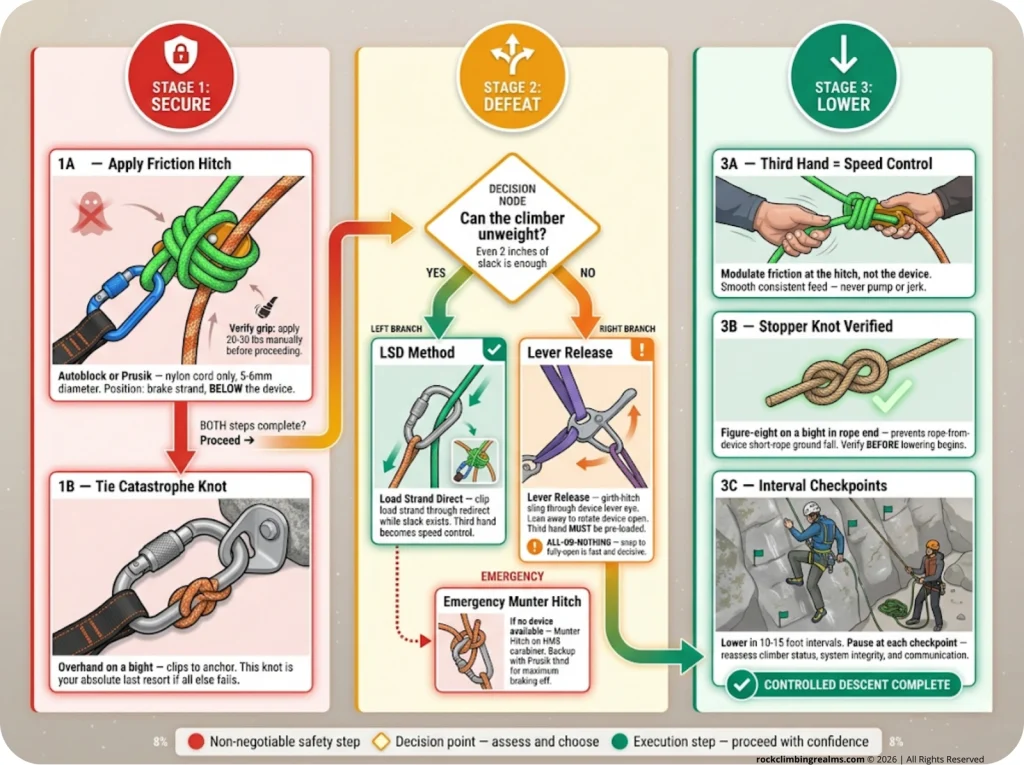
Pro tip: Call out each backup step before applying it. Verbal checklists cut error rates under stress. “Third hand — on. Catastrophe knot — clipped. System — backed up. Proceeding.” This is what guides do and what the research backs up.
The Three-Stage Rescue Sequence
Stage 1 — Secure the System: friction hitch plus catastrophe knot. The climber is safe. Everything from here is optimization.
Stage 2 — Defeat the Auto-Lock if applicable: lever release for a non-cooperative climber, redirect lower for GriGri. In either case, the third hand catches the weight the moment the device opens.
Stage 3 — Controlled Lower: the friction hitch is now primary speed control, the belay device is secondary check. Lower in 10–15 foot intervals and reassess after each. Watch for rope knot-passes if you’ve got a mid-rope knot for rescue access — managing a knot through a loaded system requires full re-rigging. For situations where standard lowering geometry is impossible, counterbalance rappel rescue as an alternative when standard lowering is not possible covers the next option in the protocol chain.
Rope End Management and the Short-Rope Ground Fall
Tie a stopper knot — figure-eight on a bight or overhand — in the rope end before any lower begins. The short-rope scenario is one of the most preventable fatality causes in climbing: belayer lowers until the rope end passes through the device, climber enters free fall. On a 60-meter route with a 70-meter rope you’ve got 10 meters of margin. With a redirected system, a rescue lower, or half a rope already committed to another setup, that margin disappears fast. The 15-foot rule and how rope stretch affects lowering systems and fall margins is the detailed breakdown of why the math matters here more than intuition.
Gear Selection and Failure Points: What Works and What Doesn’t
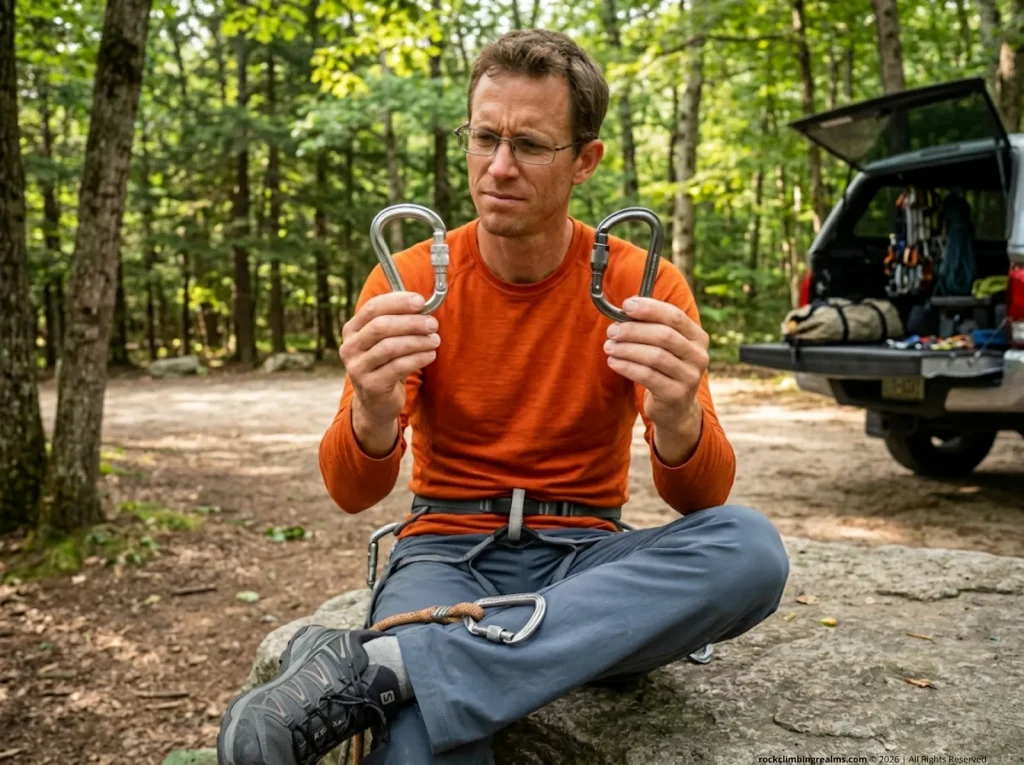
The GriGri is excellent when used correctly. It’s consistently hazardous in two configurations: thumb grip on the cam handle while lowering, and no redirect carabiner at the master point. The thumb grip blocks the braking plane — the device becomes a tube with no assisted braking. No redirect means the rope enters the device at a friction-reducing angle. Both failures are completely predictable and completely preventable.
The ATC Guide, Black Diamond Guide, and Petzl Reverso in auto-lock mode were designed to catch followers, not to execute controlled releases. The lever release converts them into functional lowering devices — without it, they’re load-bearing paper weights during a rescue. Know the procedure before you need it.
For heat management: aluminum carabiners work as heat sinks up to roughly 100-foot lowers. Beyond that, thermal mass becomes a factor — aluminum softens above 300°C on extended descents; steel is the professional standard for 200-foot-plus lowers. Pear-shaped HMS carabiners for Munter hitches, not D-carabiners — the rounded contact surface produces significantly less rope twist and more consistent speed control. I’ve tested this directly on 60-foot lowers with comparable subjects.
Sling material in redirect systems: Dyneema runners are prohibited as redirect points. Nylon slings are marginally safer but should not substitute for carabiners. Metal only, always.
Bringing It Together
Three things that matter more than everything else here:
Redirect before you lower. Every ABD lower from an anchor needs a brake strand redirect carabiner at the master point. This isn’t a preference — it’s the geometric requirement for the device to function as designed.
The third hand is non-negotiable. No lowering sequence — sport anchor, guide-mode rescue, or emergency Munter — is safe without a friction hitch pre-loaded on the brake strand before any mechanical transition. Drill it until your hands do it without thought.
Gear fails predictably. The GriGri elevator drop, the all-or-nothing lever release, the nylon-on-nylon heat failure — these aren’t random events. They’re physics behaving exactly as the equations predict. Know the failure modes and you’ve already prevented most of them.
Next session at the crag, set up your brake-strand redirect before the first climber leaves the ground. Then tie a friction hitch on your brake strand and weight it manually. Two minutes. That’s the difference.
Now go send something.
FAQ
How do you lower someone in guide mode if they’re stuck?
The Load Strand Direct (LSD) method is the professional solution: apply a friction hitch third hand to the brake strand, clip a redirect carabiner to the master point, then clip the load strand (climber’s side) through the redirect while the climber momentarily unweights. The redirect lifts the weight off the brake strand, defeating the auto-lock, and the friction hitch controls descent speed. If the climber cannot unweight, use the lever release method with a sling through the device’s small lever-arm eye.
Can you lower with a Munter hitch safely?
Yes — the Munter Hitch is the definitive emergency lowering method when no belay device is available. Use a pear-shaped HMS locking carabiner for the smoothest braking. Keep the brake strand parallel to the load strand for maximum braking efficiency. Back it up with a Prusik third hand, and lower slowly to minimize rope twisting throughout.
Is it safe to lower directly through the anchor without a redirect?
On a fixed bolt sport anchor with a proper lowering ring (Fixe hardware or chain system), yes — the ring functions as the redirect. On improvised anchors using slings or cordelettes, the rope must run through metal carabiners only. Nylon-on-nylon friction generates heat that can catastrophically sever a sling on long lowers.
How do you back up a lower when the belayer is much lighter than the climber?
Add a brake-strand redirect at the anchor to multiply friction, or use a Petzl Freino Z-carabiner for additional V-groove friction without geometry changes. If disparity exceeds 60–80 lbs, clip yourself into the wall with a PAS before lowering to prevent rocket belayer displacement. A friction hitch third hand is mandatory in all weight disparity scenarios.
What is the biggest mistake belayers make when lowering a climber?
Failing to establish a brake-strand redirect before engaging the GriGri handle. Without it, the rope enters the device at an angle that reduces cam engagement, and any handle manipulation becomes more hazardous proportionally. The second most common error: no stopper knot in the rope end, which leads to short-rope ground falls. Both are 100% preventable with a two-minute pre-lower checklist.
Safety Notice: Rock climbing and mountaineering are inherently high-risk
activities that can involve physical trauma or fatal incidents. The information on Rock Climbing Realms is for
educational and informational purposes only. Techniques and advice presented here are not a substitute
for professional, hands-on instruction. Conditions and risks vary by location. Always seek guidance
from a qualified instructor before attempting new techniques. By using this website, you agree that you
are solely responsible for your own safety. Any reliance you place on this information is strictly
at your own risk, and you assume all liability for your actions. Rock Climbing Realms and its authors
will not be held liable for any harm, damage, or loss sustained in connection with the use of this information.
Affiliate Disclosure: We are a participant in the Amazon Services LLC Associates Program, an
affiliate advertising program designed to provide a means for us to earn advertising fees by advertising and linking
to Amazon.com. As an Amazon Associate, we earn from qualifying purchases. We are also an official affiliate partner
of Black Diamond Equipment via the AvantLink network. If you click on a Black Diamond affiliate link and make a
purchase, we may earn a commission at no additional cost to you. We also participate in other affiliate programs.
Additional terms are found in the terms of service.