
In this article
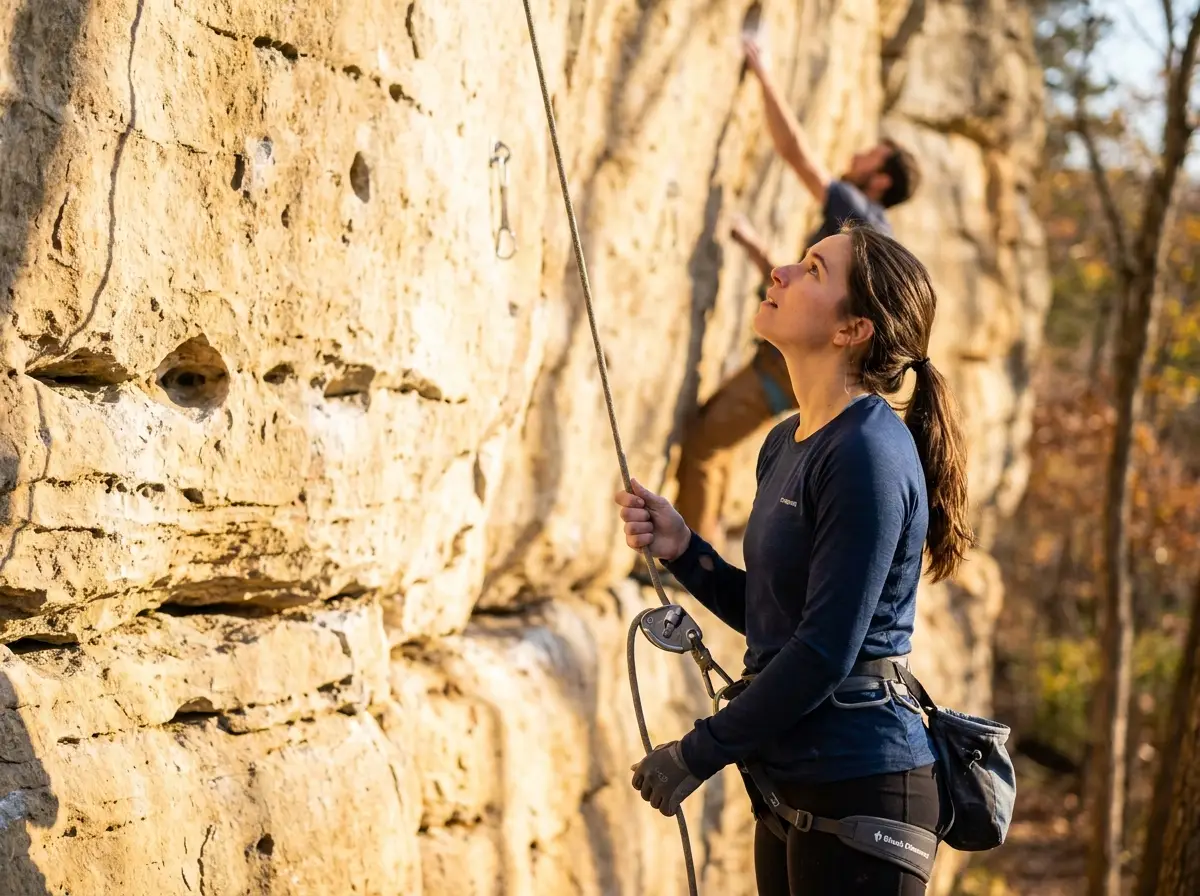
The lead belay cert test at most gyms takes about fifteen minutes. After passing, a new belayer goes to the wall, clips in their first leader, and begins a skill set that takes years to actually be good at. The gap between “passed the test” and “reliably good belayer” is where most lead climbing accidents happen, and where most climbers never think to look for improvement.
Good lead belaying isn’t just the brake hand rule and giving slack for clips. It’s a dynamic, contextual skill that requires reading your climber’s movement signals, predicting when they’ll fall, managing slack in real time, and maintaining focus through an entire route — not just the exciting parts. Most belayers are competent at some of this and quietly deficient at others. This guide covers the specific mistakes that show up most often and exactly how to correct each one.
Quick Answer: The most common lead belaying mistakes and their fixes:
- Brake hand leaves the rope — your brake hand never leaves the rope; practice the hand-over-hand feed until it’s automatic
- Too much slack for early clips — be tight and close to the wall until the third bolt; decking potential is highest here
- Drifting too far from the wall — stay within 1–1.5 meters of the wall to keep fall distances predictable
- Not watching your climber — eyes on the leader at all times; anticipate falls before they happen
- The Grigri panic grab — on an assisted device, letting your hand rise above the device during a fall locks the mechanism and can cause a hard stop; brake hand must stay low and away
- Static belay position — move with your climber; your position should shift as they climb higher
- Skipping the check — always verify the belay setup together before the leader leaves the ground
The Brake Hand: The Rule Everything Else Depends On
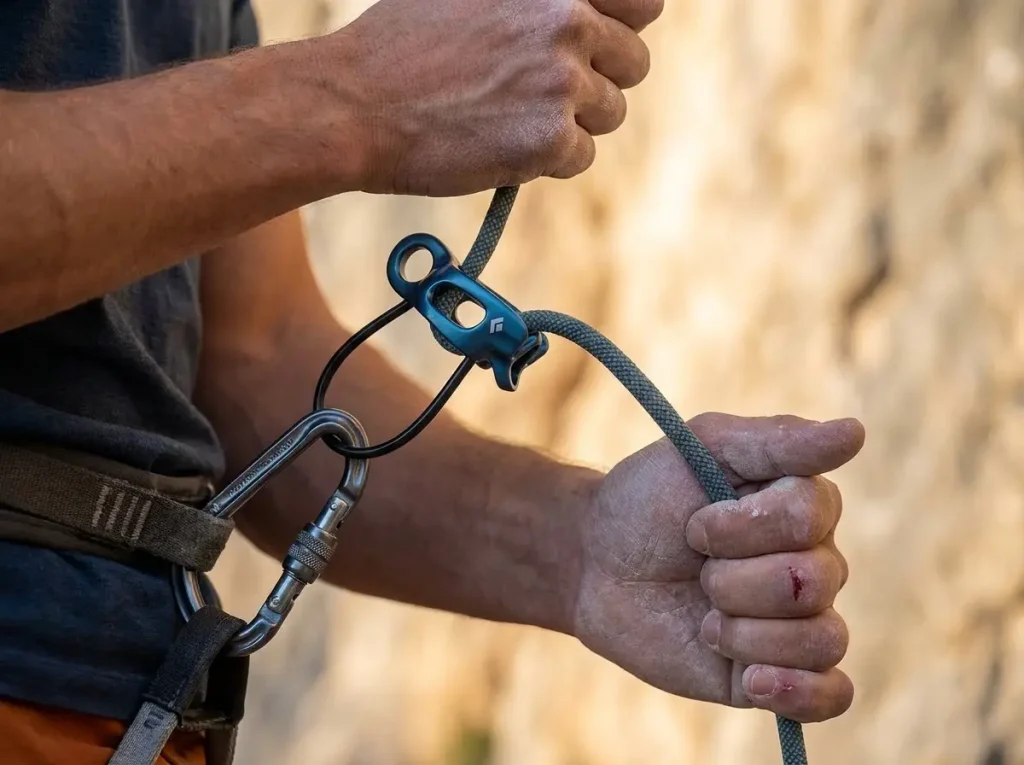
The most fundamental rule in belaying — both top rope and lead — is that the brake hand never leaves the rope. Not during feeding. Not during taking. Not to adjust your position, scratch your nose, or respond to someone calling your name. Never.
Why this is the one non-negotiable
A belay device creates friction on the rope through its geometry — rope bending around the device, under tension from the brake hand, generates enough force to hold a fall. Remove the brake hand and you remove the friction. The rope moves. The climber falls.
This is not a guideline about good practice. It’s a description of physics. Every year, the American Alpine Club’s accident reports include belay failures caused by a belayer momentarily releasing the brake hand — often during slack feeding, often thinking it was just for a second. When your climber falls in that second, the outcome is the same as if you weren’t holding the rope at all.
The most common moment the brake hand leaves
During slack feeding for a clip, especially on early clips, new belayers have a tendency to use both hands to feed rope upward, releasing the brake hand to grab higher on the rope. This is the wrong sequence. The correct sequence: pull rope through the device with the guide hand, slide the brake hand down (not off) the rope, repeat. At no point does the brake hand lose contact.
Practice this on the ground until it’s automatic. Have a partner pull on the brake strand while you run through the feed motion. If the rope moves when they pull, your brake hand came off. Do it again.
Pro tip: The AAC’s annual accident report, referenced in our belayer error prevention guide, identifies brake hand loss as one of the most preventable causes of belay failure. Reading those reports is useful for any serious belayer — not as fear, but as pattern recognition.
Slack Management: Too Much, Too Little, and the Early Clip
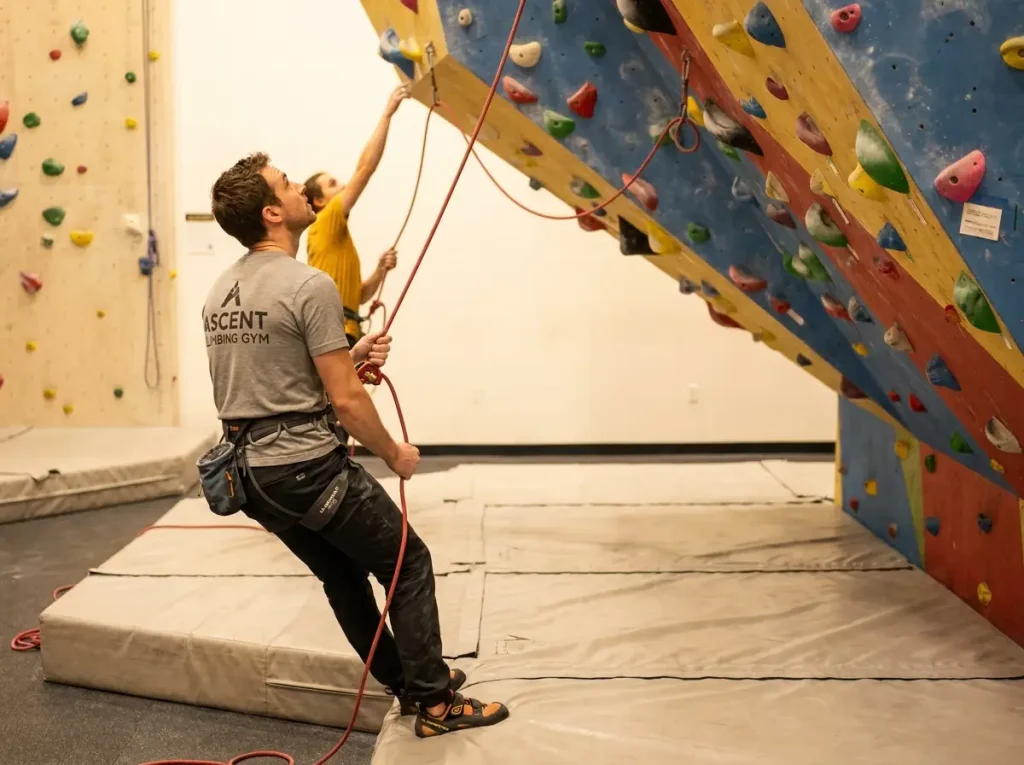
Slack management is the part of lead belaying with the most variables and the most context-dependence. There’s no single right amount of slack — it shifts based on where the leader is on the route, how fast they’re moving, and what they’re about to do.
The first three bolts: tightest belay of the route
Until the leader has clipped the third bolt, they’re at peak decking potential. A fall before the first clip sends them to the ground regardless of how tight you’re holding. A fall after the first clip but before the second can still result in a ground contact if you’re standing far from the wall or have too much slack. For the first three clips, stand close to the wall (within 1 meter), keep the slack minimal — just enough that the climber can move freely, not enough that rope hangs in a U below the last clip — and do not drift backward.
After the third bolt, you can begin to manage slack with more latitude. The leader is above the ground-fall zone and the rope angle changes such that a moderate fall has more rope to absorb into.
Giving slack for a clip
When the leader reaches for the rope to clip, they need a specific amount of slack: enough to complete the clip motion without you pulling them off balance, but not so much that it hangs loose below them and adds to fall distance. The practical guide: when your climber calls or reaches for their clip, feed until the rope forms a gentle upward arc from the device to the bolt — roughly arm-length twice — and then stop adding slack while they complete the clip.
Don’t wait for them to yell “clip” and then start feeding. Watch their hands. When you see the reach for the rope, start feeding proactively. The timing lag between the call and the feed is where climbers get held back mid-clip.
Too much slack: the soft catch problem in reverse
Soft catches — giving a little rope when the climber falls to reduce fall forces — are a legitimate advanced technique for experienced belayer-climber pairs. They’re not appropriate for new belayers, and they can be executed incorrectly in ways that increase, not decrease, fall severity. A belayer who gives slack during a fall to soften it but gives too much creates a longer fall than necessary, potentially into a ledge or the ground. Until you have significant experience reading fall trajectories with a specific climber on specific terrain, give a firm, controlled catch rather than attempting a dynamic one.
Belayer Position and Distance from the Wall
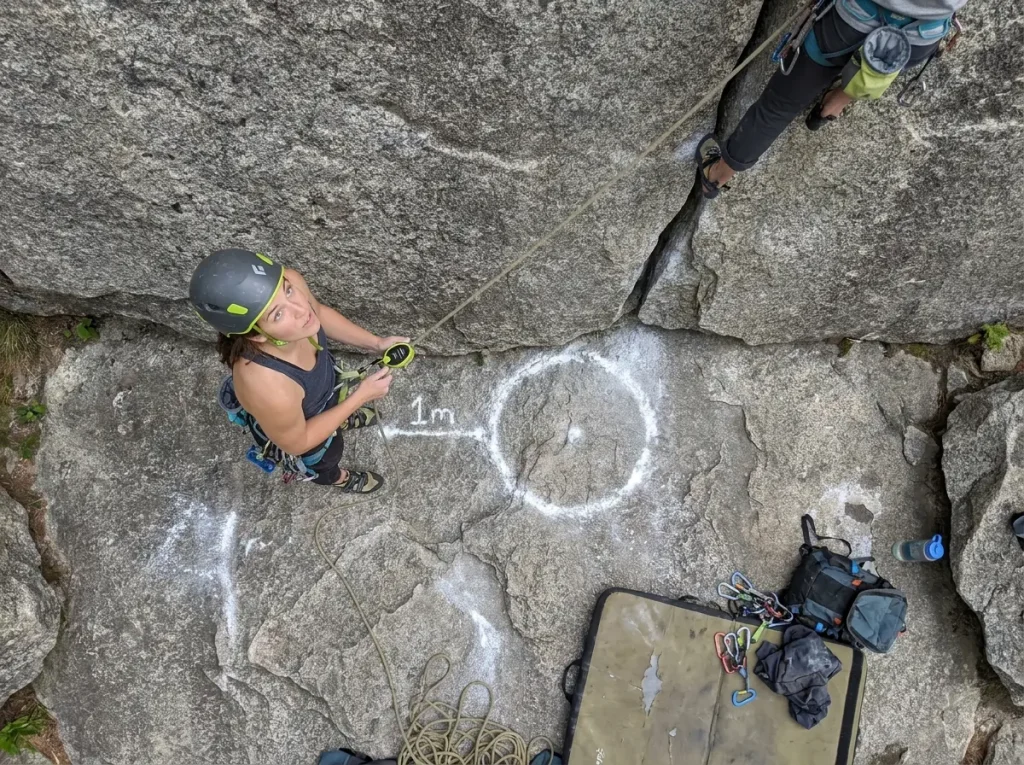
Where you stand as a belayer affects every other aspect of your belay — your fall catch mechanics, your slack management, and your visibility of the climber above.
The 1–1.5 meter zone
Stand 1 to 1.5 meters from the wall. Closer for the first few clips; you can step back slightly as the leader gets higher. Beyond 1.5–2 meters, several things go wrong: the rope angle through the first bolt creates additional slack that you can’t see from a distance, your reaction time to a fall increases because you’re moving through a larger arc before the rope comes taut, and lighter belayers risk being pulled forward violently into the wall by the force of catching a heavier climber.
Lighter belayers — especially those significantly lighter than their leader — should consider using a ground anchor on routes with significant fall loads. This is not a beginner problem; it’s a physics problem. A 120-pound belayer catching a 180-pound leader who falls above the third bolt can be lifted off the ground forcefully, which disrupts the catch and has caused injuries. A chest harness anchor to a bolt or fixed point solves this. Read more about anchor setups in our top rope anchor building guide.
Dynamic position: moving with your climber
Your position on the ground should not be static. As your climber moves right, step right to stay under them. As they move into an overhang and the fall line changes, adjust. As they enter a section where a fall might swing them into a feature, position yourself to give a catch that manages that swing.
Most new belayers find a spot, stand there, and watch the show. Effective belayers are in constant low-level motion, staying positioned for the next likely event rather than reacting to the current one.
The Grigri Panic Grab and Other Assisted Device Mistakes
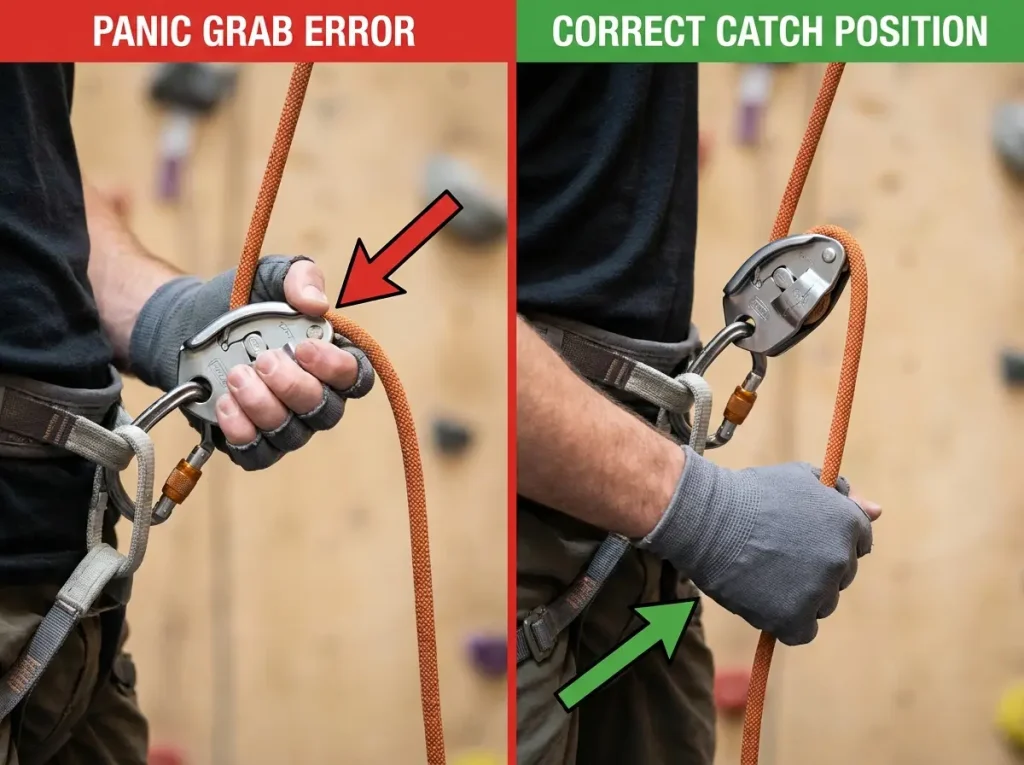
Assisted braking devices — the Petzl Grigri and its equivalents — are excellent tools for lead belaying. They are also tools with specific misuse patterns that are less common on tube devices and specific enough to warrant their own section.
The panic grab
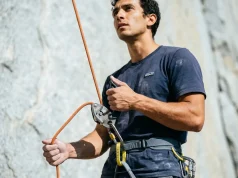
When a climber falls unexpectedly, the untrained instinct with a Grigri is to grab the device. This is the wrong response. Gripping the Grigri — specifically, letting the brake hand rise toward and onto the device — can cam the assisted braking mechanism open and prevent it from locking. The result is a rope that runs through the device instead of stopping.
The correct response to any fall on a Grigri is to keep the brake hand low and away from the device — at or below hip level, with the brake strand angled down and behind. The device locks automatically when the rope loads; your only job is to not interfere with that mechanism. If you feel the instinct to grab the device rising, train it out deliberately. Run controlled fall-catch drills with a trusted climbing partner and consciously practice brake hand position through each catch.
Feeding slack with an assisted device
Feeding slack with a Grigri requires a specific technique: press the lever with the thumb of the guide hand, feed rope through smoothly with both hands moving in coordination. Feeding too slowly creates a jerky, interrupted rope feed that riders climbers while clipping. Feeding too quickly with the lever held fully open removes the assisted braking margin during the feed. The goal is smooth, lever-controlled feeding that keeps the rope moving without fully bypassing the cam.
Tube devices like the Black Diamond ATC are more forgiving for slack feeding but require more active brake hand attention because there’s no backup mechanism. If you’re transitioning from a tube device to an assisted braking device, expect the feed technique to feel different and practice it on the ground before using it on a real lead.
Reading Your Climber Before They Fall
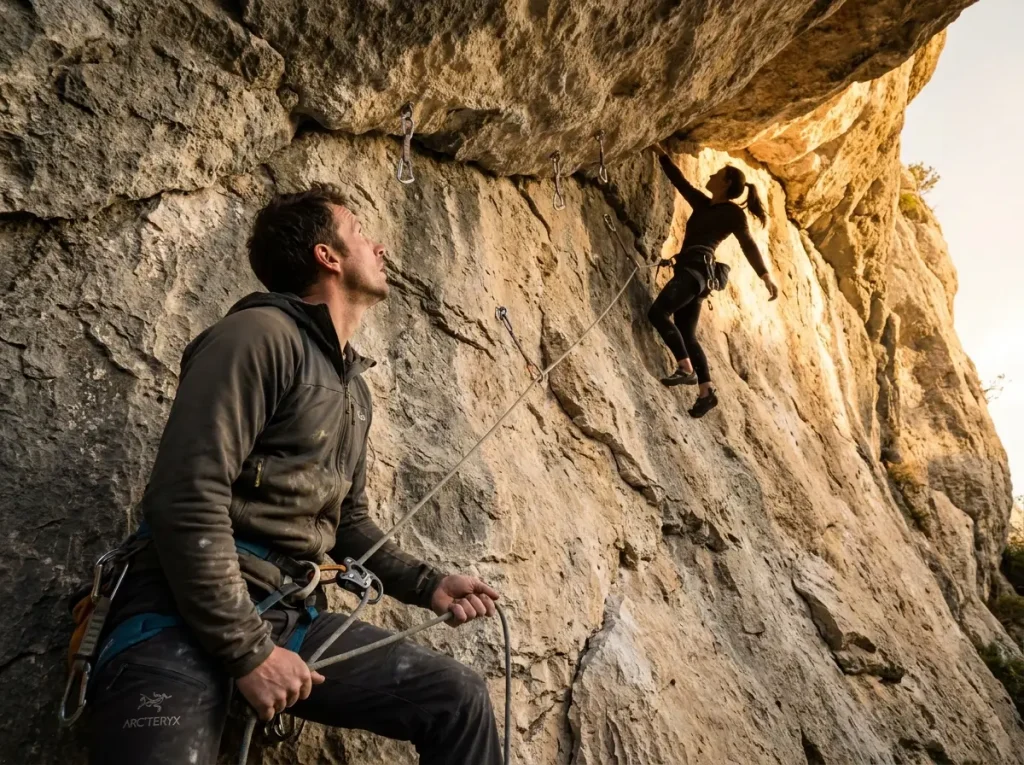
The best lead belayers anticipate falls before they happen. This isn’t a mysterious skill — it comes from watching your climber’s signals and knowing what they mean.
Physical signals of an impending fall
Shaking arms and pumped forearms that stop extending fully. Feet that start to cut or shift rapidly. Movement that slows or becomes fragmented where the climber was previously fluid. Reaching for holds multiple times without committing. Breathing that becomes audible from below. These are fall signals. When you see them, your hands should already be in a catch-ready position — brake hand gripping firmly, weight balanced and close to the wall.
Watching the route, not just the climber
Know where your climber is on the route. Look at the wall above them. Spot ledges, roof features, or traverse sections where a fall would create a swinging arc or a specific landing hazard. Position yourself now for what might happen there — before they reach it, while you still have time to think. Reactive belaying — responding only to what’s happening this moment — is slower and less accurate than anticipatory belaying.
For the falling side of the equation, our sport climbing falling practice guide covers drills that benefit belayers equally — understanding what the climber is experiencing during a fall makes you a better catcher.
Communication Failures That Create Confusion
Belay communication protocols exist because “take” and “on belay” are non-ambiguous — and because noise, wind, and vertical distance routinely destroy subtler communication. When communication breaks down, belayers and climbers make unfounded assumptions.
The standard calls and why they exist
“On belay” — belayer confirms the system is ready. “Climbing” — climber confirms they’re moving. “Clip” — climber signals they’re about to clip; some teams use it, some don’t, but it should be decided beforehand. “Take” — climber wants the rope tight immediately. “Falling” — a warning, though often involuntary. “Off belay” — climber is secure on an anchor and the belay can be released.
The mistake isn’t not knowing these. The mistake is using ad hoc variations without telling your partner. “Can you take a little?” is not “take.” “I’m going to clip” is not “clip.” When your communication is imprecise or improvised, your partner’s response may be imprecise or improvised. Set the protocol on the ground before climbing.
Confirming the setup together
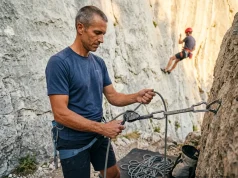
The pre-climb check is not an optional formality. Before the leader leaves the ground: does the harness fit buckle-doubled and snug? Is the figure-eight threaded correctly and tied back? Is the belay device loaded in the right orientation with the rope running through the correct strand? Is the locking carabiner locked? Check each element together, out loud, with both parties confirming. Our pre-climb safety checklist covers the full sequence; make it a habit you can run on a busy gym wall without breaking conversation.
Training Your Belay to Actually Be Good
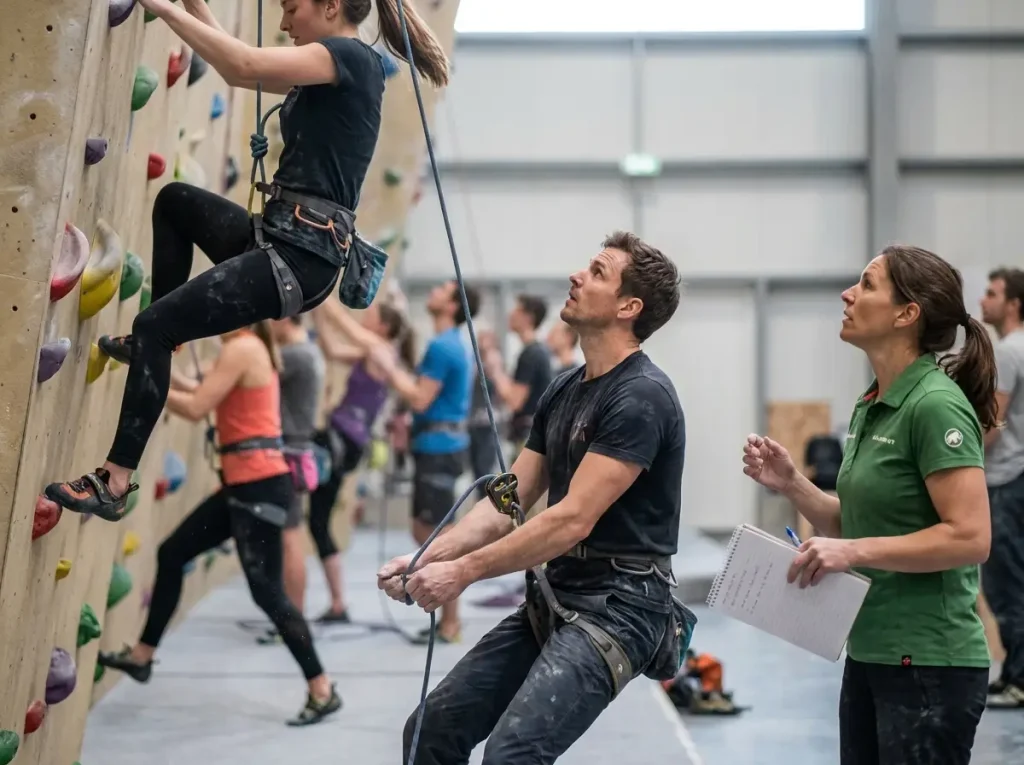
Passing a lead belay test tells a gym you won’t make an obviously catastrophic error. It doesn’t tell you — or anyone else — that you’re actually good at lead belaying. Getting good requires deliberate practice.
Catch drills with a trusted partner
Set up a fall practice session on a low route with a trusted partner who knows what you’re doing. Climber falls from specific planned positions; belayer practices the catch, brake hand position, stance position, and fall distance management. Do this on a top rope setup first so the consequences of an error are minimal, then graduate to low lead falls. The goal is catch mechanics that run automatically, not correctly-but-slowly.
Belay improvement through feedback
Ask experienced climbers to watch your belay and tell you specifically what they see. Most belayers can’t see their own technique in real time. A five-minute observation from someone who knows what good belaying looks like will tell you more than months of unobserved belaying. Be specific about what you want feedback on — brake hand position, slack management, stance — rather than “how was my belay?”
Conclusion
Lead belaying is a skill with a low entry bar and a high ceiling. Passing a gym test confirms the minimum; climbing safely for years with different partners at varied crags requires ongoing attention to the specific gaps that most belayers carry without knowing it.
Start with the brake hand. It’s the foundation everything else stands on. Then build slack management from there — early clip proximity, reading the fall line, watching your climber. The rest follows from those fundamentals.
Q1 What is the most common lead belaying mistake?
The brake hand leaving the rope during slack feeding — often done unconsciously during the hand-over-hand motion while giving slack for a clip. The fix is practicing the correct feeding sequence until it’s automatic: guide hand feeds, brake hand slides down (not off) the rope, repeat.
Q2 How close should a belayer stand to the wall?
One to 1.5 meters is the working range. Closer for the first three clips, where decking potential is highest. Standing too far back creates additional slack, changes the fall catch angle, and increases the risk of a lighter belayer being pulled violently forward into the wall on a hard catch.
Q3 Should I use a Grigri or an ATC for lead belaying?
Both work well. An ATC requires more active brake hand engagement at all times; a Grigri provides an assisted braking backup but has specific misuse patterns (the panic grab) that need to be trained against. New belayers often find ATCs more straightforward to learn proper technique on before transitioning to assisted devices.
Q4 What is the Grigri panic grab?
When a climber falls unexpectedly, an untrained instinct with a Grigri is to grip the device itself — including the lever that controls the cam. Pressing that lever open during a fall defeats the assisted braking mechanism and allows the rope to run. The correct response is brake hand low and away from the device, letting the cam engage automatically.
Q5 How do I give a soft catch in lead climbing?
A soft catch involves giving a small amount of rope at the moment of fall impact to extend the fall slightly and reduce the force transmitted to the climber. It requires accurate timing, understanding of the fall line, and a specific trust agreement with your climber. It’s an intermediate-to-advanced technique that should be practiced deliberately, not improvised. New belayers should give firm, controlled catches and build toward soft catches with experience.
Safety Notice: Rock climbing and mountaineering are inherently high-risk
activities that can involve physical trauma or fatal incidents. The information on Rock Climbing Realms is for
educational and informational purposes only. Techniques and advice presented here are not a substitute
for professional, hands-on instruction. Conditions and risks vary by location. Always seek guidance
from a qualified instructor before attempting new techniques. By using this website, you agree that you
are solely responsible for your own safety. Any reliance you place on this information is strictly
at your own risk, and you assume all liability for your actions. Rock Climbing Realms and its authors
will not be held liable for any harm, damage, or loss sustained in connection with the use of this information.
Affiliate Disclosure: We are a participant in the Amazon Services LLC Associates Program, an
affiliate advertising program designed to provide a means for us to earn advertising fees by advertising and linking
to Amazon.com. As an Amazon Associate, we earn from qualifying purchases. We are also an official affiliate partner
of Black Diamond Equipment via the AvantLink network. If you click on a Black Diamond affiliate link and make a
purchase, we may earn a commission at no additional cost to you. We also participate in other affiliate programs.
Additional terms are found in the terms of service.