
In this article
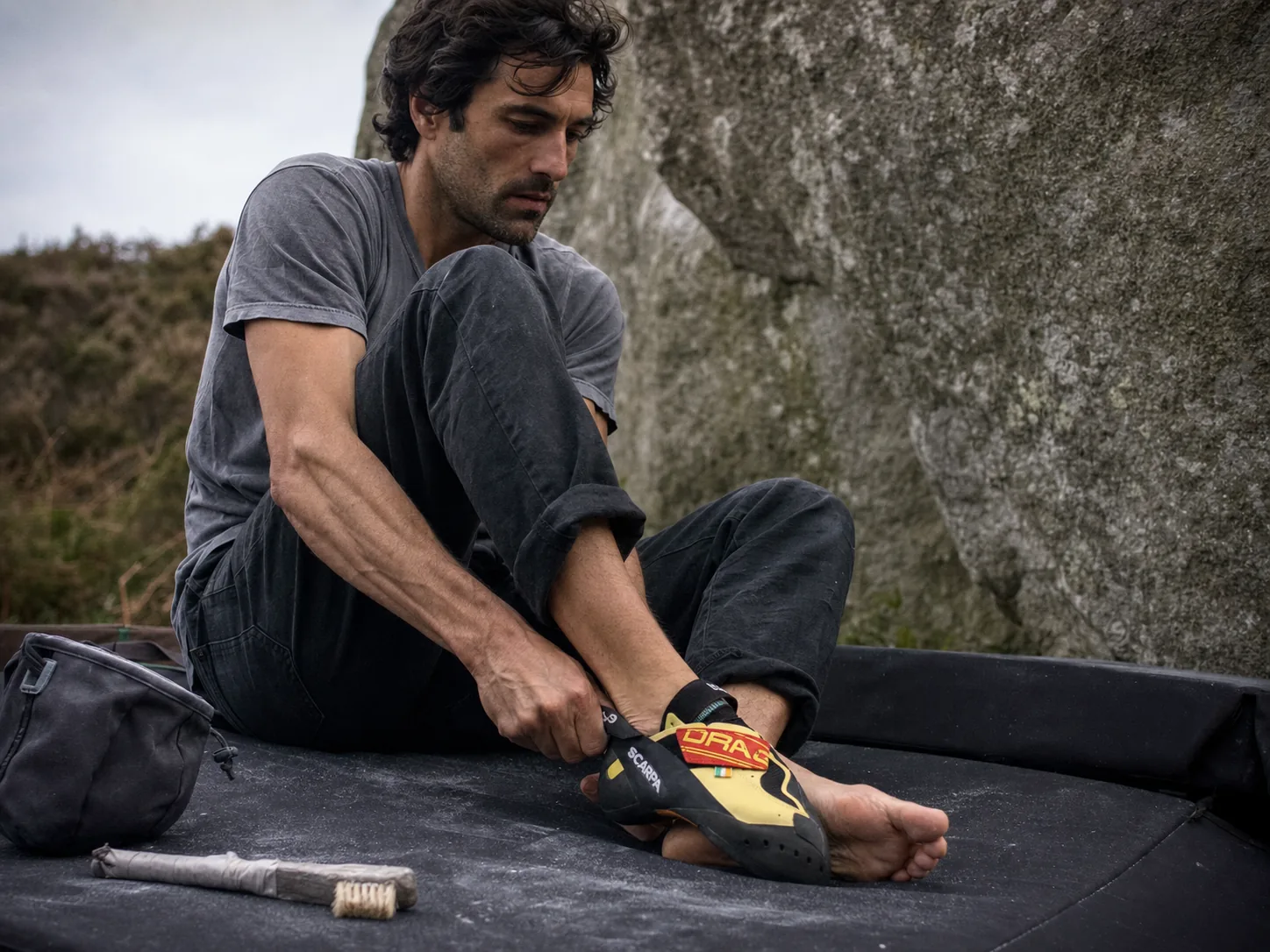
You’re standing at the shoe wall looking at four boxes that all say Instinct. Instinct, Instinct VS, Instinct VSR, Instinct VSR LV. The shop employee is helping someone else, and when he does get to you, there’s a decent chance he’ll guess too. That confusion isn’t your fault: Scarpa runs more than twenty current models across three internal categories, and most of the guides that rank for Scarpa climbing shoes either split the catalog across three separate pages or read like a 2023 snapshot that got recycled forward. Here are nine current models, what actually separates them, and which one matches your discipline, your foot, and how much shoe you’re willing to pay for.
Start here, then read the reasoning underneath.
| Model | Tier | Best For | Rubber | Closure | Foot Note |
|---|---|---|---|---|---|
| Drago | Specialized | Bouldering, steep sport | XS Grip2, soft | Single strap | Standard volume |
| Boostic R | Specialized | Micro-edging, vertical | XS Edge, hard | Straps | Standard volume |
| Furia Air | Specialized | Light sport, comp | XS Grip2, soft | Single strap | Breathable upper |
| Mago Lace | Specialized | Aggressive, long pitches | XS Grip2, soft | Laces | Adjustable fit |
| Instinct VS | Performance | Small holds, heavier climbers | XS Edge, 3mm | Straps | Standard volume |
| Instinct VSR LV | Performance | Sensitivity, lighter climbers | XS Grip2, soft | Straps | Low volume last |
| Vapor V | Performance | Everything, adequately | S-72, medium | Straps | Men’s and women’s |
| Helix | All-Day | Multi-pitch, long days | XS Edge, hard | Lace or strap | Near-symmetrical |
| Origin | All-Day | Gym, first pair | S-72, medium | Straps | Forgiving shape |
How Scarpa Sorts Its Own Lineup

The model names tell you nothing about where a shoe sits in the range. Scarpa’s own three buckets do, and almost nobody writing about this brand uses them.
Specialized Performance is the aggressive end: Drago, Boostic, Furia, Mago. Heavily downturned, soft or very hard rubber depending on the job, and built on the assumption you’ll take them off between attempts.
Performance is the middle: Instinct, Vapor. Still capable, still precise, but you can leave them on through a full pitch without your feet filing a complaint.
All-Day Performance is Origin, Helix, Veloce. Flatter, more symmetrical, designed around the idea that you’re going to wear them for six hours. The same logic that governs matching a shoe to your discipline, foot shape and the rock you actually climb applies inside a single brand, and Scarpa has already done the sorting for you.
Those three categories also happen to be the price ladder, which is the part no competitor points out. All-Day is where you start, Performance is the mid-range all-rounder, Specialized is the premium project shoe. If you know which bucket you belong in, you’ve already eliminated two-thirds of the catalog before reading a single review.
The Names Behind the Shoes
Heinz Mariacher has designed Scarpa’s climbing shoes since 2006, after years doing the same job at La Sportiva. That history is why the two brands’ geometry philosophies rhyme in places and split hard in others, and it’s worth reading the same breakdown for La Sportiva’s line if you’re cross-shopping. The company itself sits in Asolo, in northern Italy, and has been making mountain footwear there since 1938.
The Mistake Everyone Makes First
Here’s where people go wrong: they buy the most downturned shoe in the catalog because a strong climber on Instagram wears it. Twenty minutes into a gym session they’re sitting on the bench with their shoes off, wondering why climbing hurts. The downturn isn’t a quality rating. It’s a specialization, and specializing costs you comfort in exchange for performance on terrain you might not climb yet.

What the Model Names Actually Mean
This is the section you came for and didn’t know how to search. Those suffix letters look like marketing noise. They’re not. They encode rubber compound and last shape, which means once you can read them, the whole wall of boxes resolves in about ten seconds.
Instinct, Instinct VS, VSR, VSR LV
Same base shoe. Different decisions.
The Instinct VS runs 3mm of Vibram XS Edge, the harder compound. The Instinct VSR runs 3.5mm of Vibram XS Grip2, the softer one. That’s the difference. Not a tier, not a generation, not better versus worse: a rubber choice, wearing almost the same name.
And here’s the part that reframes the whole decision. It’s not a skill question, it’s a bodyweight question.
Heavier and stronger climbers, roughly 180 pounds and up, consistently do better in the stiff-rubber VS, because their mass is enough to make hard rubber deform and grip. Lighter climbers get more out of the soft-rubber VSR, because they don’t weigh enough to load XS Edge properly and end up skating on it. That pattern shows up across independent owner reports, not in one person’s opinion.
LV means low volume. It’s a last shape for narrower, lower-volume feet, and it is not a women’s-only badge despite how often it gets described that way. The VSR LV pairs the soft compound with the narrow last, which is why it ends up being the answer for a lot of people who’ve spent years assuming Scarpa “doesn’t fit” them.
Before you argue about which Instinct is better, weigh yourself. If you’re a light climber who bought the VS because someone told you it was the “serious” one, the rubber is never going to work the way it does for the 190-pound guy who recommended it. You’re not climbing badly. You’re standing on a compound you can’t load.
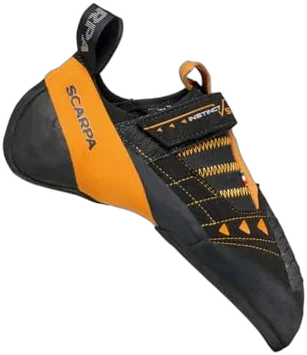
The Scarpa Instinct VS is also the model that tends to land well for sport climbers working vertical to slightly overhanging terrain. Climbers who’ve owned both versions report the same thing: the VS holds its downturn and its shape under heavy use, while some VSR owners watched the softer rubber flatten out quite a bit faster than they expected. That durability gap is the hidden second half of the rubber choice, and it’s the reason the “which one feels better in the shop” test misleads people.

If you’re a lighter climber with a narrow foot who’s been told Scarpa runs wide, the Scarpa Instinct VSR LV is the shoe that changes your mind about the brand. The tradeoff is honest: you get sensitivity and fit, and you give up some of the shape retention the VS is known for.
Vapor, Vapor V, Vapor S
Same decoder, different family. Vapor is the base. Vapor V carries the V for Velcro, and it runs dual straps, which is the version most people mean when they say Vapor.
Vapor S is the slipper-style one, but it isn’t strapless: it closes with a removable Nano Strap System, a detachable cord and velcro tab you can reconfigure or take off entirely. Three shoes, one name, one letter of difference, and a shop wall that explains none of it.
The 2026 Catalog Nobody Updated For
Here’s a freshness problem worth knowing about. The Scarpa Drago XT arrived as the 2026 update to the Drago, and it changed real things: a second opposed Velcro strap where the classic Drago has one, plus a slightly stiffer and less asymmetric last. Two straps instead of one is not a cosmetic change. It’s a different amount of fit adjustment across your forefoot.
So if the definitive Drago review you found doesn’t mention two straps, it’s describing the old shoe. That’s the state of most Scarpa content right now, and it’s worth checking the date on anything you read about this brand, including the model names in the paragraph you’re reading. The Drago XT is hard to get hold of at the moment, so the classic Drago below is where the family’s buying path actually starts today.
The Furia Air got an updated last in spring of 2026 as well. Same story: real change, almost no coverage.
Picking a Scarpa by What You Actually Climb
Discipline is the axis that narrows this catalog fastest, and it’s the one people skip. They shop by “how good is this shoe” instead of “what am I standing on,” which is how you end up with a project shoe and a season of foot pain.
Bouldering and Steep Sport
Overhanging rock wants downturn and soft sticky rubber. The downturn shifts your weight forward onto the big toe so you can pull with your foot instead of just standing on it, which is exactly what steep terrain demands and exactly what a flat shoe can’t do. Before you commit, it’s worth being honest about whether you’re actually ready for a downturned shoe, because the answer for most climbers is “not yet, and that’s fine.”
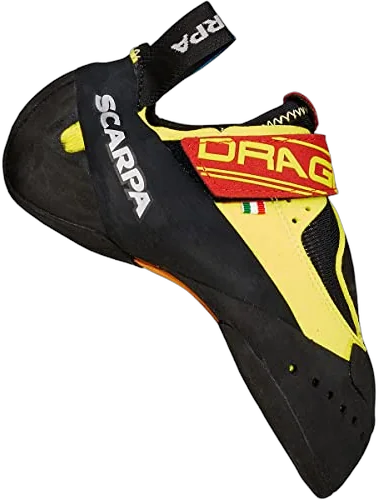
The Scarpa Drago is a specialist and behaves like one. On a steep boulder problem it’s superb. On a five-hour multi-pitch day it’s a punishment you chose. Buy it as a second pair, not a first.
Light Sport and Comp Days

The perforated upper on the Scarpa Furia Air is a real advantage in a hot gym and a genuine liability on abrasive outdoor rock. Know which one you’re buying it for.
The One That Does Everything Adequately
Now the unglamorous truth. Most readers of this article should buy the shoe in this section, and most won’t, because “adequate at everything” is a terrible sales pitch and an excellent shoe.

The Scarpa Vapor V comes in separate men’s and women’s lasts, so grab the one built for your foot rather than assuming the shape is identical. It isn’t.
Trad, Cracks and Long Days
Nobody talks about this one, and it’s where an aggressive shoe does the most damage to your actual climbing. A crack doesn’t want a downturned shoe. It wants a flat, stiff platform you can twist sideways and stand on inside a constriction, because that’s what a foot jam is: your shoe wedged in a slot, taking your weight through the edge of the sole rather than the tip of your toe.
Put a Drago in a hand crack and two things happen. The curve fights the slot instead of settling into it, and every jam concentrates load onto compressed toes that are already curled.
That’s toe-jamming pain, and it’s the reason people come back from their first crack day convinced they’re bad at it. They’re not. They brought a shoe designed to do the opposite of what the rock asked for.
The flatter, near-symmetrical All-Day lasts are the answer here: Helix and Origin shapes let your foot sit flat inside a jam and let you stand on it for a full pitch without the shoe punishing you between placements. If you’re heading into crack terrain specifically, it’s worth reading up on the shoes built for cracks rather than adapted to them before you commit, because the requirements diverge harder from sport climbing than most people expect.
Multi-pitch runs the same logic for a different reason: it isn’t jamming that gets you, it’s hours. Precision footwork on pitch one means nothing if you can’t feel your feet by pitch four.
Gym Shoes and First Pairs

Honest math before you spend anything: if you’re climbing twice a month, keep renting. The rentals are ugly and they smell, but they’re free with your entry and they fit fine for what you’re doing. Around two or three sessions a week the math flips and owning wins, which is roughly the same conclusion the honest first-pair guide lands on from the other direction.
Scarpa’s Rubber, Compound by Compound
Every shoe wall conversation eventually becomes an argument about which rubber is stickiest. The argument rests on a premise that doesn’t hold up.
Vibram XS Edge is the harder compound, built for standing on small edges on vertical terrain and for long multi-pitch days where your foot shouldn’t be doing the work. Vibram XS Grip2 is softer, roughly 30% more adhesive than the original XS Grip, and better at smearing and steep bouldering. Davos S-72 and M50 are Scarpa’s own compounds, sitting in the middle of the range on the Performance and All-Day shoes.
Now the part that upsets people: a 2024 University of Birmingham tribology study found that softer climbing shoe rubber doesn’t reliably out-grip harder compounds, because friction depends on hardness plus surface roughness plus interfacial adhesion, not on softness alone. Soft is not a synonym for grippy, and the Shore A hardness number on a spec sheet predicts far less about grip than the marketing around it suggests. If you want the full argument and what it means for your next resole, we’ve laid out why the stickiest rubber usually isn’t the smartest buy separately.
XS Edge, The Hard One

The Scarpa Boostic R is the answer to a specific question: what do I stand on when the holds are the size of a credit card edge and the wall is dead vertical for forty feet? It’s a poor smearing shoe and it doesn’t pretend otherwise.
XS Grip2 and the Davos Compounds
The soft compounds are where the Drago and Furia Air live, and where the shoe feels alive under your foot on a smear. They’re also where the compromise bites, and here’s the seasonal detail nobody writing about this brand seems to mention.
Scarpa’s softer compounds, S-72 and M50, have a reputation in the community for going greasy in summer heat and losing friction faster than the harder Vibram compounds do. If you climb somewhere genuinely hot, a harder-rubber pair can out-perform the “stickier” one in July. That’s an uncomfortable sentence for anyone who bought soft rubber specifically for grip, and it’s the kind of thing you only find out standing on a sun-baked slab wondering why your expensive shoes stopped working.
Tension Systems, Stiffness and Why Heel Hooks Blow Out
Scarpa’s acronym soup is where brand marketing gets loudest and reader comprehension gets thinnest. The way in isn’t the feature. It’s the failure.
A tension rand is the rubber band built into the shoe that holds the downturn and keeps the toe loaded. Without it, an aggressive shoe is just a tight flat shoe with delusions. Every system Scarpa names is a variation on how that band routes and how hard it pulls.
Bi-Tension is the classic two-way rand. DTS, the Differentiated Tension System, tensions asymmetrically and lives on the Furia Air. PCB, the Power Connection Band, is what the Drago runs. PAF, SRT and TPS are further variations on the same idea: get force from your heel into your toe without your foot doing the work.
Stiffness follows from that, and it comes from two places most shoppers never look at: the midsole and the upper. A Flexan midsole is what decides whether the shoe carries the load or your foot does, while the upper material (Scarpa’s Hyperskin on some models, microsuede on others) decides how much the fit drifts over a season.
Stiff means you can stand on edges all day and the shoe does the work. Soft means you feel the rock and can smear, which is what you want when you’re onsighting terrain you can’t preview. Neither is better. You’re picking a trade, and the only wrong answer is picking without knowing you were choosing.
Here’s what failure actually looks like, and it’s the part the rest of the internet skips. Get the rand tension wrong for your foot and the shoe won’t fail on a small hold. It’ll fail on a heel hook.
The heel cup rolls off the hold instead of locking, usually at the exact moment you’ve committed your weight to it, and you come off wondering what you did wrong technically. You didn’t. The rubber never engaged.
Test the heel before you buy, not on the wall. Standing in the shop, press your heel down and roll your ankle outward like you’re loading a hook. If you feel the cup shift or hear it suck air, the volume is wrong for your foot and no break-in period is going to fix it.
Rands also wear out, which is the part that catches people who’ve owned the same pair for two seasons. Heat, sweat and time flatten the tension, and a two-year-old aggressive shoe doesn’t hold its shape anywhere near the way it did new. It’s worth knowing what’s involved in keeping a rand alive as long as the rubber lasts, because most people replace a shoe that was only tired.

Laces, Straps and Which One You’ll Actually Use
The closure debate gets treated as pure preference, and mostly it is. There are two situations where it isn’t.
Laces adjust along the length of your foot, which matters on multi-pitch and long crag days when your feet swell and a shoe that fit at 9am becomes a problem at 3pm. Straps come on and off in ten seconds, which matters when the shoe is too aggressive to keep on between attempts. That’s the whole argument, and everything else is taste. If you want the general version rather than the Scarpa-specific one, there’s the full lace-versus-velcro breakdown.
The tell that you chose wrong is behavioral. Watch a boulderer with lace-ups: they leave them on between burns because re-tying is annoying, and by the third problem their feet are quietly paying for a decision they made in a shop.
When Laces Earn Their Keep

The Scarpa Mago Lace exists for climbers who want Drago-level shape but need to loosen the forefoot on pitch four. That’s a narrow use case, and if it’s yours, nothing else in the line does it.
The Budget Lace-Up

One thing worth flagging so you don’t order the wrong shoe: the Scarpa Helix pair splits by closure. The men’s version is the lace-up described above. The women’s model is the Helix V, which runs a strap instead. Same family, same rubber, same all-day intent, different way of getting it onto your foot.
Fit, Sizing and the Foot You Actually Have

“Size down and check for dead space” is the advice every guide gives, and it stops exactly where your real problem starts. You have a wide forefoot, or a high instep, or a bunion, and nobody maps that to an actual model. So let’s do that.
Start with the manufacturer’s own number. Scarpa’s own size conversion chart puts you roughly a half to a full size down from your street shoe, and as much as two full sizes on the most aggressive models.
Beginners stay near their real size. Experienced climbers can go tighter, and often should. What that chart won’t tell you is which last to put your foot in.
Mapping Your Foot to a Last
Narrow or low-volume foot: the LV lasts. Instinct VSR LV, Drago LV. This is the group that’s been told for years that Scarpa runs wide, and they were reading the wrong half of the catalog.
Wide forefoot: start with the flatter, more symmetrical All-Day lasts. Helix and Origin have room the aggressive shoes structurally cannot give you, because a downturned shoe achieves its shape partly by squeezing. Trying to force a wide foot into a Drago is how people conclude climbing shoes just aren’t for them.
High instep: your problem isn’t length, it’s volume over the top of your foot, and the fix is closure type rather than size. Laces distribute pressure across the whole instep. Straps concentrate it at two points. If your instep is high, a lace-up in your correct size will beat a strap shoe a half-size bigger every time.
The Dead Space Trap
The single most repeated fit mistake is leaving dead space at the toe. Empty room inside the shoe means your toe travels before the rubber does, which destroys sensitivity and precision even in an otherwise correct shoe. It’s the error that makes people blame a good shoe, return it, and buy a worse one. What a correct fit feels like is genuinely hard to describe in a shop, and it’s worth reading up on what a correct fit actually feels like before you’re standing there with a card in your hand.
There’s a related confusion worth clearing up: LV is a volume option, not a gender badge. Plenty of men need low-volume shoes and plenty of women don’t, which is why the anatomy-first take on women’s fit is a more useful frame than the label on the box.
The Part About Your Feet Lasting
Now the honest bit, said the way a friend would say it rather than a lecture. Nearly half of climbing-related injuries land in the feet and legs, and as the Appalachian Mountain Club notes, chronically tight, downturned shoes are linked to conditions like hallux valgus and Achilles tendinitis with prolonged over-tight use.
Read that carefully, because the nuance matters. An aggressive shoe crushing your toes for a one-hour redpoint burn is fine. That’s what the shoe is for.
Living in that fit every session, every day, for years is how climbers end up with permanent foot damage and a surgeon’s phone number. The problem was never the tight shoe. It was the tight shoe worn as a default.
Own two pairs before you own one perfect pair. A comfortable All-Day shoe for volume and warmups, an aggressive shoe for the four burns that matter. It costs more up front and less than a bunion surgery, and it’s what most climbers who’ve been at this twenty years quietly do.
The fit that’s actually right feels wrong on the shop carpet and correct on the wall. That’s the whole problem with buying shoes standing on flat ground, and there’s no trick that fixes it. If you’ve already sized wrong and you’re living with it, stretching a pair that’s genuinely too tight is a real option before you write the pair off.

Resoling, Wear and How Long a Pair Really Lasts

People resole too late. They wait until the sole looks bad, by which point the rand is gone and the repair costs more than it should have. The fix is knowing exactly where to look, and the spot is smaller than anyone expects.
Check the Big Toe, Not the Sole
Roughly 90% of your sole wear concentrates at the big toe, and a shoe starts life with about 4mm of rubber there. That’s the whole measurement. Not how the sole looks overall, not how worn the heel is: the thickness of rubber at your big toe, checked with a thumbnail.
When it’s gone thin enough that you can feel the layer beneath it, send the pair out. Wait longer and you’re paying for a rand rebuild instead of a resole, and the exact moment a pair should go out for resole is earlier than instinct says.
If you already see the rand peeling away from the upper, that’s a different repair with a shorter clock. If the rand is already peeling, deal with it before it spreads, because delamination doesn’t wait politely for your next rest day.
Ask Which Rubber Before You Ship
Here’s the thing nobody warns Scarpa owners about, and it’s the reason a resoled pair can come back feeling like a different shoe. Scarpa’s proprietary S-72 Davos compound often isn’t stocked by independent US resolers. So they substitute Vibram XS Grip2, which is a fine compound and a different one, and your shoe now behaves differently than it did.
That’s not a scam. It’s a supply reality, and it only becomes a problem when nobody tells you. Ask your resoler which rubber they’ll use before you put the pair in a box.
Write the rubber you want on a note and drop it in the box with the shoes. Resolers work through stacks of anonymous footwear and they’ll default to whatever’s on the bench. Thirty seconds of a pen saves you a season of wondering why your Vapors feel wrong.
Where to Send Them in the US
Three names worth knowing, because most resole guides written about Scarpa cite UK shops that do you no good in Colorado.
- Yosemite Bum (Tustin, California) turns work around in roughly three to four days. This is the fast option when you need the pair back before a trip.
- The Rubber Room (Bishop, California) is the Eastern Sierra standby, well known to anyone who’s spent a season in Bishop.
- Tahoe Gripworks / FA Resoles is Scarpa’s authorized resoler, running roughly four to five weeks. That’s the factory-faithful option, and the wait is the price of a rebuild that matches how the shoe left Italy.
Which Rubber Lasts Longer
This circles back to the Instinct decision from earlier, and it’s the half of the choice that doesn’t show up in the shop. Hard XS Edge holds an edge longer before it needs a resole. Soft XS Grip2 and S-72 feel better sooner and wear out faster. That’s your real cost per season, and it’s why owners who ran both an Instinct VS and a VSR report the same split: the VS held its shape, while the VSR flattened out quite a bit faster under the same use.
Pick soft rubber for how it climbs, not for how long it lasts. Just know which one you picked.
The Short Version
Three things worth carrying out of here.
The suffix letters aren’t marketing. VS versus VSR is a rubber call driven by your bodyweight, and LV is a last driven by your foot’s volume. Read them and the wall of boxes resolves.
Scarpa’s own three categories are the price ladder, and most climbers belong in the middle of it rather than the top. The Vapor V outperforms the Drago for the overwhelming majority of days most people actually climb.
Check the big toe, not the sole. That’s the resole clock, and it runs faster than you think.
Go back to the table at the top and narrow it with the only axis that really works: what you climbed last month, not what you want to climb next year. The shoe for the climber you are beats the shoe for the climber on your screen, every session.
Frequently Asked Questions
01Is Scarpa or La Sportiva better for climbing shoes?
Neither. They use different last philosophies, and the right brand is whichever fits your foot. Heinz Mariacher designed for both, so the geometry rhymes; the real split is heel volume and forefoot shape. Compare against La Sportiva’s line by discipline before deciding.
02Are Scarpa climbing shoes true to size?
No. Scarpa’s own chart puts you roughly a half to a full size down from your street shoe, and up to two full sizes on the most aggressive models. Size for zero dead space at the toe rather than for a number, since empty room kills sensitivity even in the right shoe.
03What is the best Scarpa shoe for beginners?
The Scarpa Origin for gym climbing and first pairs, or the Helix if your days run long. The real answer is the least aggressive shoe you’ll actually keep on your feet, because a downturned shoe you take off every ten minutes teaches you nothing.
04Do Scarpa climbing shoes stretch?
Leather uppers stretch meaningfully with use. Synthetic and microsuede uppers barely move. Size for the material rather than the model, and if a pair is already too tight, there are safe ways to stretch them before writing them off.
05What happened to the Scarpa Rockmaster?
It was discontinued. The Boostic, and now the Boostic R, are the practical heirs for pure edging: same stiff Vibram XS Edge formula and supportive platform that made the Rockmaster the standing-on-nothing specialist.
Safety Notice: Rock climbing and mountaineering are inherently high-risk
activities that can involve physical trauma or fatal incidents. The information on Rock Climbing Realms is for
educational and informational purposes only. Techniques and advice presented here are not a substitute
for professional, hands-on instruction. Conditions and risks vary by location. Always seek guidance
from a qualified instructor before attempting new techniques. By using this website, you agree that you
are solely responsible for your own safety. Any reliance you place on this information is strictly
at your own risk, and you assume all liability for your actions. Rock Climbing Realms and its authors
will not be held liable for any harm, damage, or loss sustained in connection with the use of this information.
Affiliate Disclosure: We are a participant in the Amazon Services LLC Associates Program, an
affiliate advertising program designed to provide a means for us to earn advertising fees by advertising and linking
to Amazon.com. As an Amazon Associate, we earn from qualifying purchases. We are also an official affiliate partner
of Black Diamond Equipment via the AvantLink network. If you click on a Black Diamond affiliate link and make a
purchase, we may earn a commission at no additional cost to you. We also participate in other affiliate programs.
Additional terms are found in the terms of service.