
In this article
Stand in front of a wall of La Sportiva boxes at the shop, or a browser tab stacked with them, and the honest reaction is the same: which one of these forty-something shoes is actually mine? Here’s the thing nobody at the counter says out loud. The most hyped model is usually the wrong first pick, and La Sportiva’s famous narrow last will punish some feet no matter what size you buy. These are the La Sportiva climbing shoes that climbers actually own and argue about at the crag, sorted by the job each one does, so you can skip the wall-of-boxes paralysis and figure out how to match a climbing shoe to your discipline and foot.
How La Sportiva Splits Its Lineup by Discipline
La Sportiva builds close to fifty climbing shoe models out of Ziano di Fiemme, a village in the Italian Dolomites, and that Italian craftsmanship is a big reason athletes like Adam Ondra and Alex Honnold compete in the brand. The catalog looks chaotic until you sort it by one thing: the shape of the shoe, which tracks the kind of climbing it’s built for.
Shoes with a neutral profile, flat and symmetrical, are for learning and all-day comfort. Moderate shoes with a little downturn handle everything from the gym to your first outdoor sport climbing lead. Aggressively downturned shoes, with more asymmetry curving the shoe toward the big toe for power, are for steep rock and hard bouldering. Stiff, flat trad climbing shoes are for jamming your feet into cracks for hours.
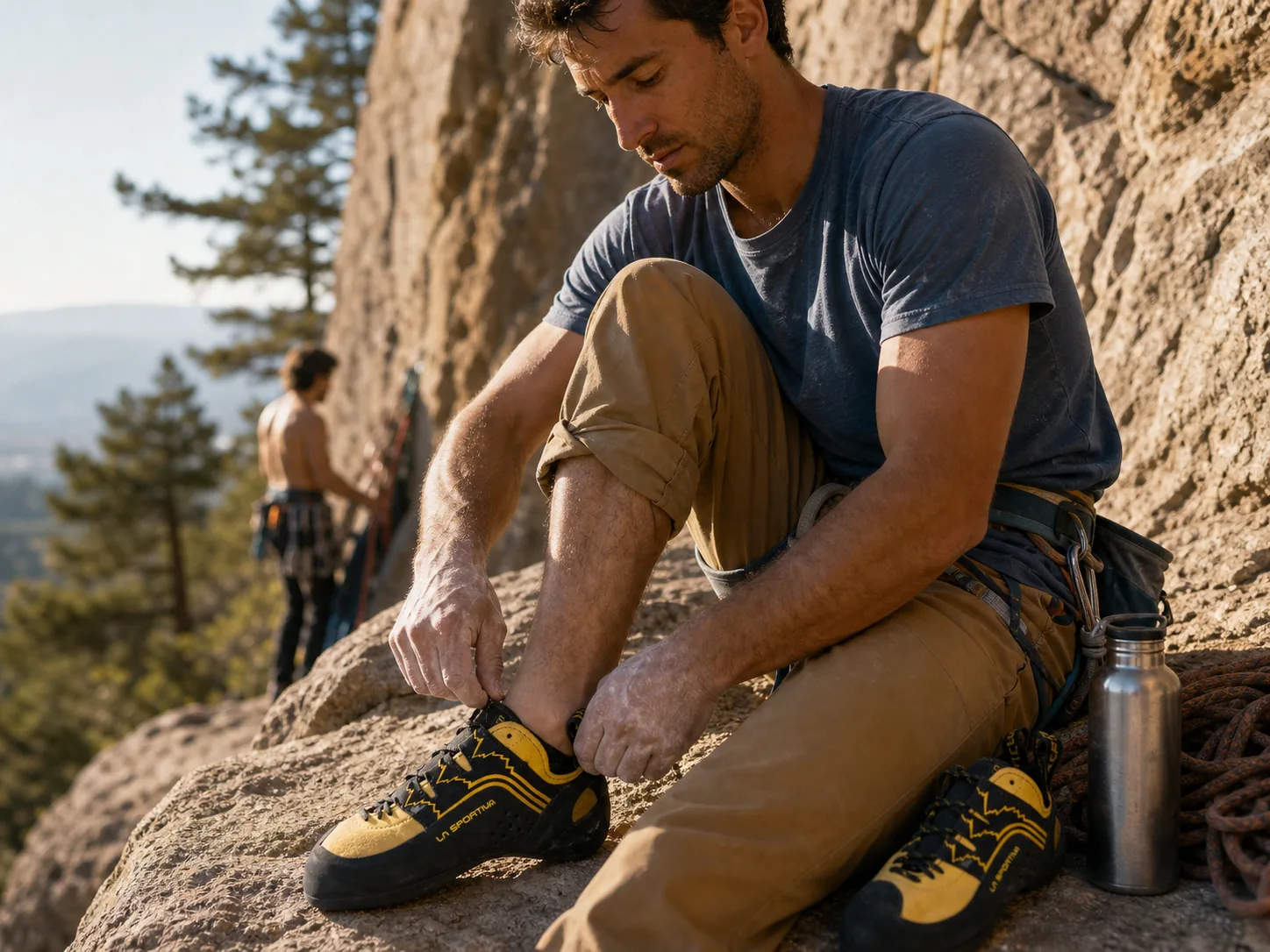
Get that framework and the wall of boxes stops being intimidating. One quick piece of crag slang first: climbers call the aggressive, downturned pair their sending shoes, kept in reserve for hard attempts and not worn all day. If you’re new, the biggest mistake is trying to climb everything in a sending shoe. You won’t enjoy it, and your footwork won’t improve any faster.

The Beginner and Gym Tier — Tarantulace

If you’re buying your first pair, this is the shoe. The Tarantulace runs on Vibram FriXion RS rubber, which trades a little outright stick for a lot of life, exactly the deal a beginner wants while learning where their feet go. Size it about one EU size down from your street shoe, snug but not painful. You want to climb in these for two hours, not survive them for twenty minutes.
The slip-on Tarantula is the same shoe with an elastic closure if you want faster on-and-off, and the Finale is another wallet-friendly entry option in the lineup, but the Tarantulace’s laces give a better fit across more foot shapes. Either way, resist the pull toward something more aggressive because a stronger climber told you to. A flat shoe that lets you feel the wall teaches footwork faster than a downturned one that hurts.
The All-Around Outdoor Shoe — Katana Lace
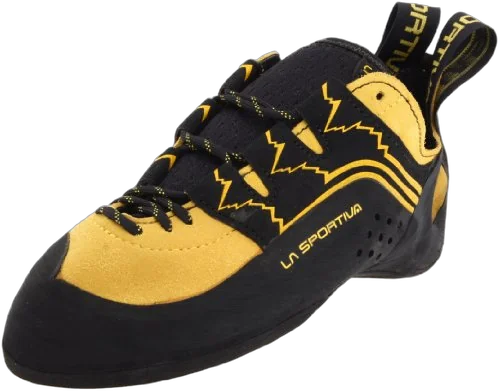
Once you’ve outgrown a beginner shoe, the Katana Lace is the one most climbers should reach for next. Its Vibram XS Edge rubber is stiff and holds its shape, so it edges cleanly on small holds, and the moderate profile keeps it comfortable enough for a full multi-pitch day. If your climbing is trending toward ropes and outdoor rock, this is the do-everything pick, and it pairs naturally with our sport-climbing shoe breakdown if you want to go deeper on that discipline.
The lace-up matters more here than people think. A wide lacing zone lets you snug the shoe over the whole foot, which is a real advantage if your foot isn’t a uniform width. Velcro is faster, but for all-day precision, laces win.
The Aggressive End — Bouldering and Steep Sport
When the rock kicks past vertical, you want a shoe that pulls your toes into a hooked, powerful position. The La Sportiva Skwama (men’s · women’s) is the model that fills this slot in almost every climber’s quiver. It runs soft, sensitive Vibram XS Grip2 rubber and a moderate-aggressive downturn, so it sticks to smears on steep boulders where a stiff edging shoe would skate off.
The Skwama isn’t a first shoe, and it isn’t an all-day shoe. It’s a sending shoe in the truest sense, one you pull on for hard attempts and peel off between burns. If you’re not sure you’re ready for an aggressive fit yet, start with something flatter, and our guide to beginner bouldering shoes will keep you from over-buying downturn you can’t use.
The Crack and Trad Specialist — TC Pro
Cracks are a different game entirely, and the La Sportiva TC Pro is the named standard for them. Designed with input from Tommy Caldwell, it’s a stiff, flat shoe on Vibram XS Edge with a padded mid-height cuff that protects your ankles when you’re jamming your feet sideways into granite. That stiffness lets you stand on tiny edges and inside cracks for hours without your feet folding up.
It’s a specialist, not an everyday shoe, and it’s a premium pick you buy when your climbing has a specific job for it. The classic leather Mythos is the softer, old-school crack alternative if the TC Pro’s stiffness is more than you want. If crack is where you’re headed, it’s worth reading our roundup of the best crack climbing shoes, where the TC Pro earns its spot. For finger-to-hand cracks, nothing else in the line comes close.
How La Sportiva Sizing and Downsizing Actually Works

Here’s the number that sends people into a spiral online: “size down 1.5 to 2.5 EU sizes.” Everyone quotes it like one rule, then buys a beginner shoe two sizes too small and can’t climb a full session. The real answer depends entirely on the shoe’s job.
La Sportiva uses EU sizing, and the baseline is that you go roughly 1.5 to 2.5 EU sizes down from your street shoe to engage the shoe’s tension system, according to La Sportiva’s own sizing and technology page. So a street 42 might have you trying a 39.5 to 40.5. But that baseline swings hard by model. Soft, aggressive shoes get sized down two to three; a beginner Tarantula or Tarantulace goes only about one EU size down; and a stiff trad shoe like the TC Pro sits closer to one to two down.
The logic underneath makes it click. You wear the TC Pro comfortably for hours in a crack, so it’s barely downsized. The Skwama is meant to hurt a little for one hard attempt, so it’s cranked down. Never apply aggressive-shoe downsizing logic to a beginner shoe. That’s the single most common online-buying mistake, and it leaves people in a shoe too small to actually climb in.
Try shoes on at the end of the day, or after a short warm-up, when your feet are slightly swollen. That’s much closer to how your feet feel mid-session at the crag than a first-thing-in-the-morning fit, and it stops you from buying a size that turns unbearable two hours in.
Your street shoe size is just the anchor point every La Sportiva chart measures from, so know your real EU street size before you start. Once you’ve got a size range, remember the number on the box is only half the decision, because how the shoe actually feels on your foot settles the rest.

Leather, Synthetic, and How Much Each One Stretches

This is the mistake that hits people six weeks after purchase, not on day one. Two shoes wear the same size number on the box and end up fitting completely differently after a month, because one is unlined leather and the other is synthetic.
Unlined leather uppers stretch the most, often close to a full size over the break-in period. Lined leather moves less. Synthetic uppers barely budge and hold their shape from day one. That single fact should change the size you buy. If you want an unlined leather Miura and a lined synthetic Katana Lace to fit the same six weeks from now, buy the leather one a half-size smaller.
The practical read is simple and a little counterintuitive. A synthetic shoe that fits perfectly in the store is done stretching, so what you feel is what you get. A leather shoe that fits perfectly in the store will feel sloppy in a month. Buy leather slightly tight and let it mold; buy synthetic to fit. If a pair comes out tighter than you’d like, our guide on how to stretch a tight pair safely beats forcing them the wrong way.
Vibram Rubber Compounds and What They Do on Rock

Rubber is the spec everyone reads and nobody understands. “XS Edge” versus “XS Grip2” means nothing until you’re skating off a smear you should have stuck, or watching soft rubber fold on a dime edge. Here’s the plain-language version.
Vibram XS Edge is the stiffer compound. It resists deforming, so it holds its shape on tiny holds and keeps supporting your weight edge after edge. It’s the big-wall and multi-pitch edging standard, and it’s what the TC Pro and Katana Lace run. Stand on dime-sized edges pitch after pitch and XS Edge doesn’t fold under you.
Vibram XS Grip2 is the sticky one, roughly thirty percent more adhesive than the original XS Grip, and it’s tuned for overhung, aggressive climbing. It’s what makes the Skwama stick to smearing moves on steep rock where stiff edging rubber would slide. And FriXion RS, the compound on the Tarantulace, is the durable, forgiving option that gives you life and value while you learn.
The tradeoff, stated flat: softer, stickier rubber gives more sensitivity and smearing but wears faster, while harder rubber gives more edging support and lasts longer. Neither is better until you name the rock and the angle. If you want the full science on compounds, our climbing shoe rubber guide goes deep, and none of it matters without precise footwork on small holds to put that rubber where it counts.
Rotate two pairs, one softer and one stiffer, instead of grinding a single pair into the ground. You match the shoe to the rock, the rubber lasts longer on both, and you stretch out how often each pair needs a resole. A quiver of two beats one worn-out do-everything shoe.

Laces, Velcro, or Slipper — Picking a Closure

Closure feels like a trivial choice until you’re forty feet up re-snugging a lace you can’t reach, or ripping Velcro off between boulder burns. It’s really a question of how often you take the shoe off and how precise the fit needs to be.
A lace closure, on shoes like the Tarantulace, Katana Lace, and TC Pro, is the most adjustable. You can dial tension across the whole foot, which is best for all-day trad and for feet that aren’t a uniform width. Velcro, or hook-and-loop, on shoes like the Skwama, comes on and off in seconds between attempts and is the boulderer’s and gym climber’s default, at the cost of a little micro-adjustability. A slipper closure has the least structure and the most sensitivity, quick to pull on and great for training volume, less supportive for hard edging.
The honest read: laces for precision and long days, Velcro for quick swaps and steep sessions, slipper for sensitivity and gym mileage. A Velcro shoe isn’t a less serious shoe than a lace-up, so don’t let closure alone drive your decision. If you’re torn between the two most common options, our breakdown of laces vs velcro settles it by use case.
Which La Sportiva Models Actually Fit Wide Feet

Here’s the reputation nobody at the shop will say out loud: La Sportiva built its name on a narrow, low-volume Italian last, and for years a wide-footed climber was mostly out of luck. Some current models genuinely fixed that. Some absolutely did not, and no amount of sizing up will change it.
Start with the truth. If every “narrow Italian last” shoe has mashed your forefoot, that’s the foot shape meeting the last, not your sizing. The current honest answer for a wide foot is the La Sportiva Kubo (men’s · women’s), which reviewers consistently describe as having a noticeably wider, squarer toe box than most performance La Sportiva shoes. An unlined, elastic suede and microfiber upper helps it give across the forefoot instead of pinching it.
La Sportiva has tried wider models before, like the harder-to-find Aragon, but the Kubo is the one you can reliably buy today. What does not fix a narrow foot problem is sizing up a narrow performance last. Buy a bigger Solution or Miura-family shoe and you just end up with a shoe that’s long and still narrow, sloppy at the heel and tight at the toes. Here’s the part the size charts never mention: a wide forefoot in a narrow last doesn’t improve with break-in the way length does. Leather gives a little in length as it stretches, but the fundamental shape of the last is the shape you’re stuck with.
Volume matters too, and it’s a big reason the men’s and women’s versions exist. The split is about heel volume and forefoot shape, not just a smaller number, which is why how heel volume and foot shape drive women’s fit is worth reading if you’re between shapes. Before you commit to any model, get clear on what proper fit feels like across the forefoot so you can tell “snug” from “wrong shape.”

Real Budget Tiers Across the La Sportiva Catalog

Most guides give you exactly one cheap beginner shoe and then act like the next step is a premium performance model, with nothing in between. Real shopping has a middle, and knowing the tiers stops you from over-buying a shoe you can’t climb in yet. Think in three honest bands: First-Pair, Everyday, and Specialist.
The First-Pair tier is the Tarantulace, the forgiving shoe you learn footwork in. Don’t skip it to “save money later” by jumping to an aggressive shoe, because a downturned shoe on a beginner foot slows your progress and eats cash you’ll wish you’d kept. If you’re still deciding between renting and buying, our first-pair guide covers when renting stops paying off and buying makes sense.
The Everyday tier is the Katana Lace, plus the comfort-leaning Kubo for wider feet. This is the shoe you keep after the first pair wears out, and it does roughly ninety percent of what most climbers actually need. The Specialist tier is where the Skwama and TC Pro live, and you buy those when your climbing has a specific job for them, not before.
The honest move for most climbers is one solid mid-range all-arounder, not a three-shoe quiver on day one. The quiver comes later, when you know what kind of climbing you actually do most. Buy for the climbing you do, not the climbing you watch on video.
What Downsizing Really Feels Like the First Week

Every source states the “size down” rule as a spec. None of them tell you what the first week in an aggressively downsized La Sportiva shoe actually feels like, and that gap is exactly where people panic and make bad decisions.
Here’s the reality. Week one in a downsized aggressive shoe means numb toes on the approach, cramping on longer sessions, and a nagging 2 a.m. temptation to size back up. For the first five to ten sessions, while leather molds to your foot, most of that is normal. The tingling isn’t a sign you failed. It’s the shoe doing what a performance shoe does before it settles.
The line between normal and wrong is worth memorizing. Snug pressure spread evenly across your toes is normal. A single hot pressure point, feet going completely numb every session with no adaptation over weeks, or pain that never eases after a genuine break-in means the size or the model is wrong, not that you’re weak. That distinction saves people from either quitting a good shoe too early or grinding through real injury.
And it is a real concern, not just discomfort. A 1998 study in the Journal of the American Podiatric Medical Association found 81% of climbers reported foot or ankle pain linked to undersized shoes, and a peer-reviewed review of climbing-footwear practices confirms just how aggressively climbers downsize in the field. Knowing your own limit matters more than matching whatever number a stronger climber quotes you.
Picture the first dawn approach in a freshly downsized pair, toes going numb before you even rope up. That’s the moment every climber second-guesses the size. The exit is simple: if it’s still wrong after a real break-in, it’s the shoe, not your willpower, and the fix is a different size or a different model. If the shoe feels too aggressive rather than too small, our guide on when you’re actually ready for an aggressive shoe is the honest gut-check.
Care, Resoling, and When to Retire a Pair

This is the knowledge that saves you real money. Most climbers resole too late, after the rand is already worn through, and end up paying double or losing the shoe entirely. Catching it at the right moment is the difference between a cheap fix and a dead pair.
The trigger is specific. La Sportiva recommends resoling once the sole rubber is worn to roughly eighty percent, or when there’s about a millimeter left near the big toe and a visible dip where the sole meets the rand, per La Sportiva’s own maintenance and resoling guide. Don’t wait for a hole to open in the toe. By then the rand is exposed, the resole costs more, and the repair can compromise the shoe’s structure. Our breakdown of the exact moment to resole walks through the visual cues in detail.
Lifespan is better than most people assume if you stay ahead of it. A shoe resoled early enough can typically take five or six resoles before the upper gives out, though performance softens noticeably after the second one. The cost math is straightforward: two resoles on one good pair still beats replacing the shoe twice, so budget resoles as part of owning nice shoes rather than a surprise. Keeping the uppers and rubber healthy along the way is its own skill, covered in our guide to keeping the rubber and uppers alive longer.
Watch the toe rubber and the rand line, not the overall look of the shoe. A pair can look beat-up and still have good rubber, or look fine and be one session from a blown rand. Check the toe against the eighty-percent mark every few weeks and you’ll never miss the resole window.
There’s always the pair someone pushes to a third resole past its prime, and knowing where the “keep fixing it” line sits is half the skill. If the toe is delaminating rather than just worn, learn how to fix a delaminating toe yourself before you write the shoe off. Sometimes retirement is right; often it isn’t.

What P3, No Edge, and Dynamic Tech Actually Change

These are the buzzwords on every La Sportiva product page, and they read like you should already know why you want them. Here’s what they actually do on the wall, and where each one is genuinely worth it versus where it’s a spec-sheet flex.
P3 technology, short for Permanent Power Platform, is a heat-reactive plastic strap around the midsole and heel that reshapes toward its downturned profile after it warms up and cools down. The real effect is that an aggressive shoe like the Skwama or Solution holds its downturn far longer instead of going flat after a season. On a downturned performance shoe, P3 genuinely earns its keep. On a flat beginner shoe, it would be mostly marketing.
The No Edge design and D-Tech construction remove the hard lateral edge and wrap the rubber around the toe for a rounded, sensitive profile, the approach behind sensitive performance shoes like the Futura and Genius. That comes alive smearing on gym volumes and rounded sandstone, and it feels vague on a hairline granite edge. It’s a tradeoff built for a specific kind of rock, not a straight upgrade. Dynamic Technology, along with the LaSpoFlex midsole and the S-Heel tension system, shapes how power transfers to your toe, and it matters most on steep terrain where you’re pulling in with your feet.
The honest, anti-sell version: buy the technology that matches how you climb, not the longest spec list. You don’t notice P3 on day one. You notice it at the end of a season, when your buddy’s non-P3 aggressive shoe has gone flat and yours still points. If you want to squeeze more life out of that downturn, our guide on how to preserve an aggressive shoe’s downturn covers the maintenance side.
The Bottom Line on La Sportiva Shoes
Match the shoe to your discipline first, not to the hype. Learn in a Tarantulace, grow into a Katana Lace, and add a Skwama or TC Pro only when your climbing has a real job for them. Downsizing is model-specific, and your foot shape decides more than the size number does, so wide feet should look at a Kubo rather than a smaller Solution. Resole at eighty percent, rotate two pairs, and buy the tech that fits how you climb instead of the longest spec list.
Next session, pull your current shoes and check the toe rubber against that eighty-percent line. You’ll know in ten seconds whether you’re shopping for the next pair or just booking a resole, and either way you’ll spend smarter than the climber who buys the shoe off the poster.
Frequently Asked Questions
01What is the best La Sportiva climbing shoe for beginners?
The Tarantulace is the best La Sportiva shoe for beginners, with a flat, forgiving last, durable FriXion RS rubber, and a lace-up fit. A flat shoe teaches footwork faster than an aggressive one, and it stays comfortable for a full session.
02How much should you size down La Sportiva climbing shoes?
Roughly 1.5 to 2.5 EU sizes down from your street shoe as a baseline, but it varies by model. Beginner shoes go about one size down, soft aggressive shoes two to three, and stiff trad shoes one to two. Material and stiffness shift the number, so dial in the fit by feel.
03What is the difference between La Sportiva and Scarpa climbing shoes?
Both are top Italian brands; the split most climbers notice is last shape. La Sportiva runs narrower and lower-volume across much of its line, while Scarpa often fits wider, higher-volume feet. If your foot is between shapes, try both, or read our Scarpa brand guide.
04Are La Sportiva climbing shoes true to size?
Not in the street-shoe sense. They are built to be downsized, so true to size doesn’t really apply. Go by the EU downsizing ranges and your foot width rather than your sneaker number, and if your feet are wide, prioritize the model and last over the size.
Safety Notice: Rock climbing and mountaineering are inherently high-risk
activities that can involve physical trauma or fatal incidents. The information on Rock Climbing Realms is for
educational and informational purposes only. Techniques and advice presented here are not a substitute
for professional, hands-on instruction. Conditions and risks vary by location. Always seek guidance
from a qualified instructor before attempting new techniques. By using this website, you agree that you
are solely responsible for your own safety. Any reliance you place on this information is strictly
at your own risk, and you assume all liability for your actions. Rock Climbing Realms and its authors
will not be held liable for any harm, damage, or loss sustained in connection with the use of this information.
Affiliate Disclosure: We are a participant in the Amazon Services LLC Associates Program, an
affiliate advertising program designed to provide a means for us to earn advertising fees by advertising and linking
to Amazon.com. As an Amazon Associate, we earn from qualifying purchases. We are also an official affiliate partner
of Black Diamond Equipment via the AvantLink network. If you click on a Black Diamond affiliate link and make a
purchase, we may earn a commission at no additional cost to you. We also participate in other affiliate programs.
Additional terms are found in the terms of service.