

In this article
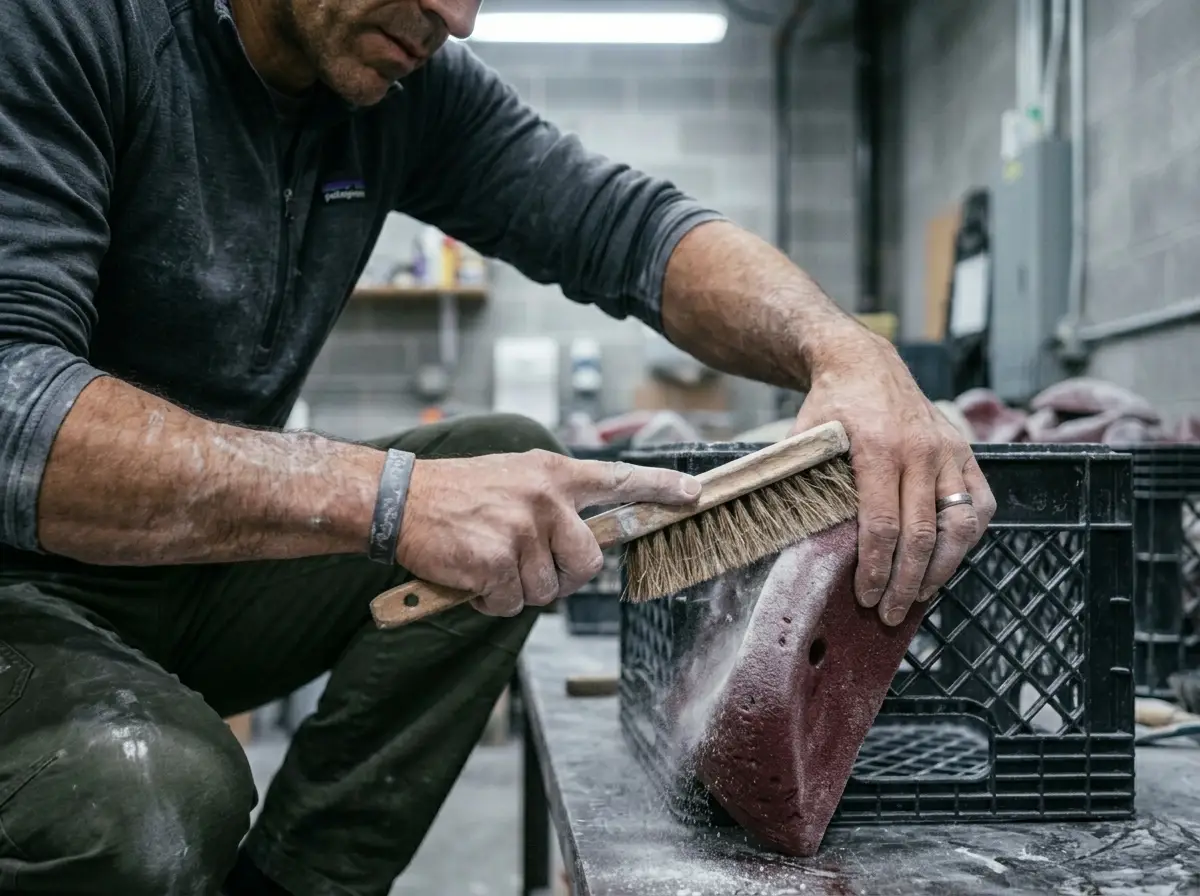
The hold had been on the wall for three months. You could see the grease. A layer of chalky film, brownish at the edges, that your skin just skated across. Then somebody hit it with vinegar from a spray bottle — “it cuts the buildup,” they said — and now the embedded washer is corroding under the resin where nobody will notice it for another six months. By then, the hold will be a structural liability disguised as a crimp.
I’ve pulled holds off walls that smelled like a biology experiment. Gym maintenance schedules that say “clean when slick” are fine until you realize “slick” has a silent second act: hardware failure. Cleaning climbing holds correctly means understanding what’s actually on them, what products will not wreck the hardware, and which method fits your material and scale.
Here’s exactly what you need to know — no shortcuts, no vinegar.
⚡ Quick Answer: The slick feel on used holds is caused by sebum (skin oils), crystallized sweat minerals, and saturated chalk — not just chalk alone. For polyurethane and polyester holds, pressure wash at 1,200–2,000 PSI with a fan nozzle. For wooden holds, use 99% isopropyl alcohol and a dry brush first — never water. Never use vinegar or any acid-based cleaner: it corrodes the zinc-plated steel washer inside the hold, setting off a failure mechanism called hydrogen embrittlement that can cause silent structural collapse 24–72 hours later.
What’s Actually On Your Holds (And Why Chalk Alone Isn’t the Problem)
Most guides tell you the problem is chalk. That’s the top layer. What’s underneath is why a freshly brushed hold can still feel like polished glass an hour later.
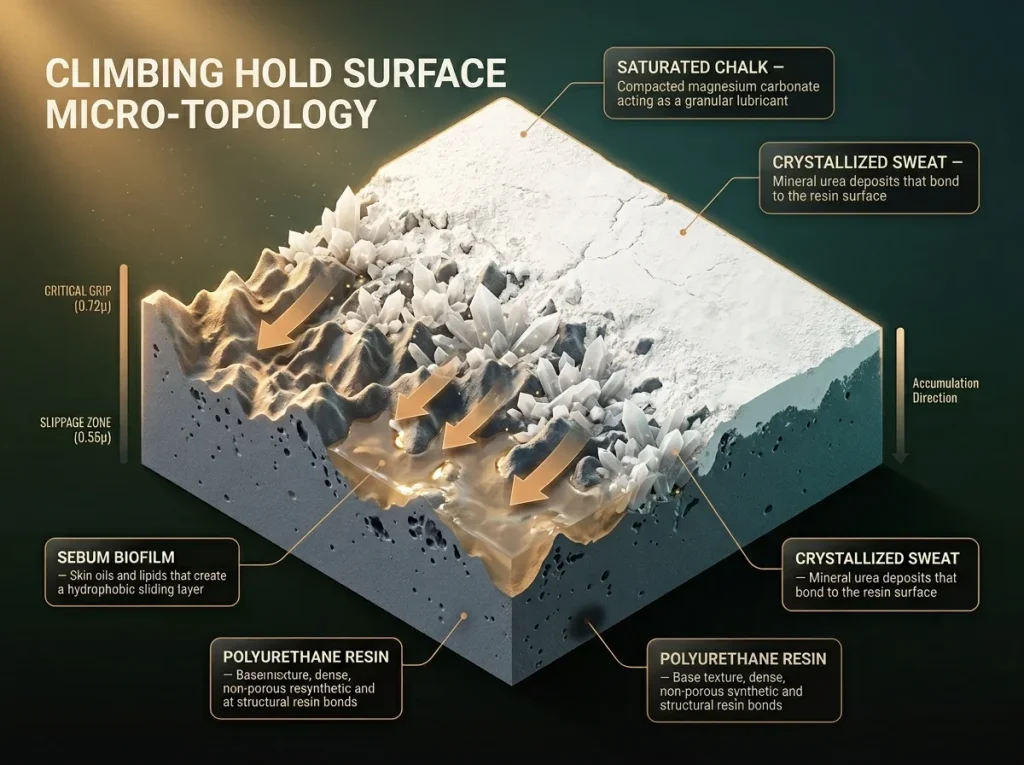
Climbing chalk — magnesium carbonate — absorbs moisture and improves grip. That part is true. The problem is what happens when it saturates. Packed into the micro-texture valleys of a polyurethane hold, excess chalk stops drying your hands and starts acting as a dry lubricant. A clean PU hold grips at around 0.72μ friction. Once that texture fills with caked chalk and oil, it drops to 0.55μ — below Teflon’s 0.53 reference level. According to peer-reviewed friction coefficient measurements across hold surface conditions, that’s a real, measurable performance loss, not a matter of perception.
Below the chalk layer is where it gets biological. Human skin produces sebum — triglycerides, wax esters, squalene — that forms a hydrophobic film over synthetic resins or absorbs straight into wooden holds through capillary action. It soaks in. Once enough accumulates, it supports biofilm growth: bacterial communities that require surfactants or chemical degreasers to disrupt, not just a stiff nylon brush.
The crystallization of sweat compounds the problem further. Sweat contains electrolytes and urea that, as it evaporates, leave crystalline mineral deposits packed into the same texture valleys the chalk filled. Three distinct contaminant layers — mineral, lipid, and biological — stacked on top of each other. Understanding how excess chalk transforms from grip aid to performance liability explains why some holds come back after cleaning and others don’t.
I’ve scrubbed holds for forty minutes and fully restored grip, then had them feel dead again in a week. Every time, the culprit was sebum, not chalk. Chalk is just the layer you can see.
The sebum is what you’re actually fighting. The chalk is just the top layer.
The Acid Warning: Why Vinegar Is Not a Cleaning Solution
Vinegar dissolves chalk. This is true. It also destroys the hold’s structural hardware in a way you won’t detect until something fails.
Most climbing holds contain an embedded zinc-plated washer — permanently encased in the resin — that distributes the compressive force of the mounting bolt. You can’t see it. You can’t inspect it. When you pour anything with a pH below 7.0 onto that hold, the zinc coating corrodes, releasing nascent hydrogen atoms that diffuse into the steel, migrating to micro-cracks and grain boundaries where they recombine into molecular hydrogen and create internal pressure. The steel goes brittle.
This is hydrogen embrittlement, and the washer’s structural role in the hold mounting system makes it the most critical point of failure. Internal HE failures typically occur 24 to 72 hours after acid exposure. Environmental HE can show up weeks or months later. High-strength steels over 39 HRC Rockwell — exactly what structural fasteners use — are most susceptible.
There is no field fix. The industry remedy is baking: 190°C–220°C for 24 hours. You cannot do that to an encased washer inside a resin hold. Once that washer absorbs hydrogen, there’s no reversal through rinsing or neutralization. Per OSHA standards for chemical handling in maintenance environments, any hold with confirmed acid exposure should be treated as a structural compromise and evaluated for retirement.
The risk extends beyond vinegar. Muriatic acid descalers, citric acid, lemon juice, and any “natural” cleaner you can’t verify as pH-neutral all qualify. The product doesn’t have to strip the hold’s surface to compromise the washer. The chemistry works below the surface, invisibly, and on a timer.

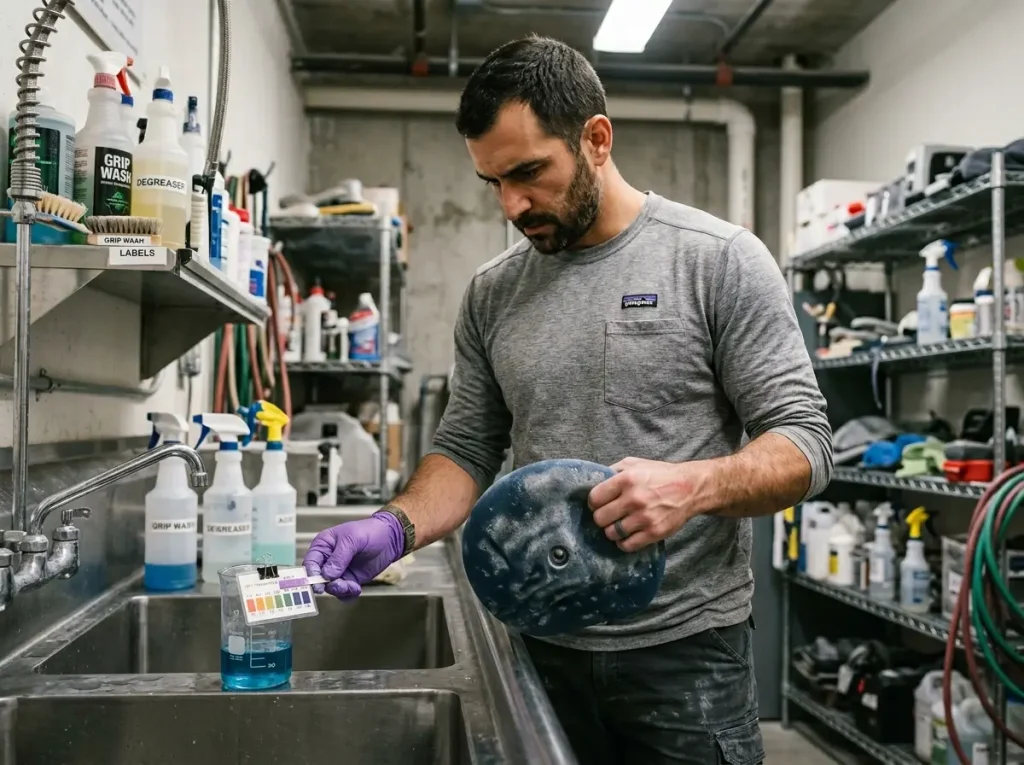
Pro tip: Label every cleaning product in your washing station with its pH. Not the brand name — the pH. The next routesetter in the rotation needs that information to not accidentally acid-treat twenty holds before the session.
Material-Specific Protocols: Cleaning by Hold Type
Polyurethane Holds: Pressure Washing Parameters
Polyurethane is the current industry standard for most commercial holds — best impact resistance, lightest weight, complex shapes. It’s also vulnerable to two things: heat and focused mechanical impact. Get either wrong in a cleaning cycle and you’ll wreck the texture you’re trying to restore.
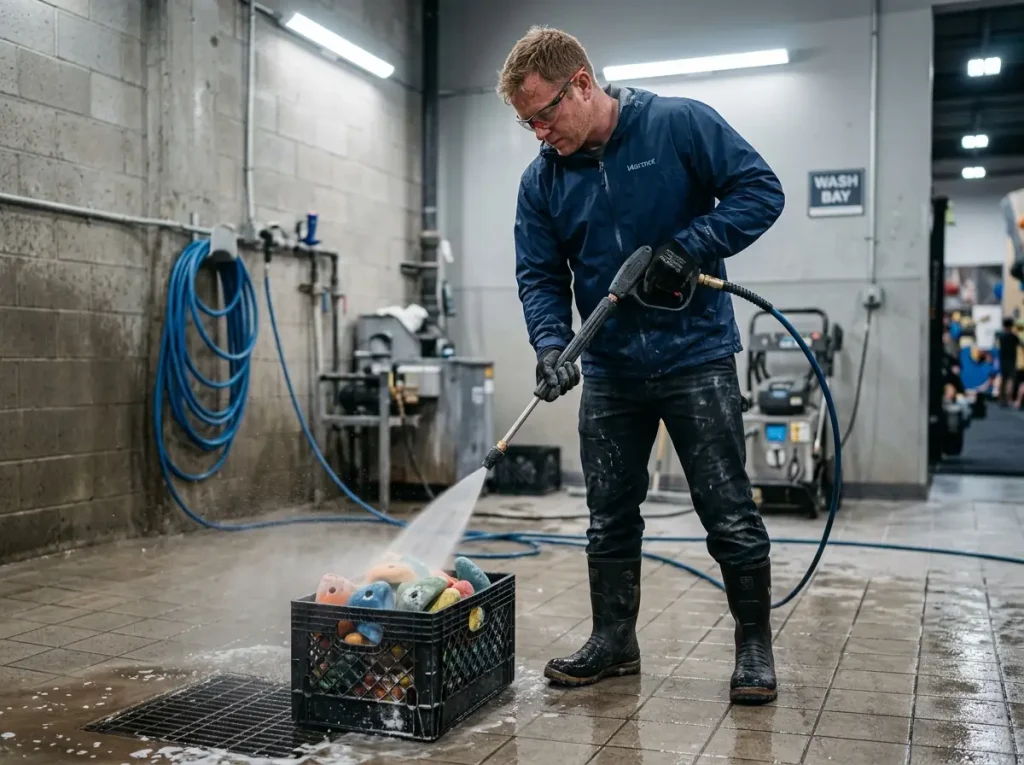
Recommended PSI for PU holds is 1,200 to 2,000. That range delivers the shear force needed to break chalk and sebum bonds without physically removing resin. Use a 25° or 40° fan nozzle — always. A 0° pencil tip focuses all that pressure on a single point and will gouge PU. The goal is broad cutting force across the surface, not impact drilling into it.
Temperature is the other variable nobody monitors carefully enough. Polyurethane texture begins to soften at 60°C (140°F) in some formulations and 93°C (200°F) in standard grades. If you’re running a hot water pressure wash or have holds sitting in a “Heat Dry” dishwasher cycle, you may be permanently deforming the hold’s shape and ruining the original texture. Cold or warm wash, air dry only.
Batch your holds in mesh crates. Crate-in, spray down, crate-out — handling time drops under a minute per hold and you stop dropping slippery resin on wet concrete. Water consumption runs about 5 liters per hold, so a gym cycling 1,000 holds weekly burns through 5,000 liters. Worth tracking.
Before adjusting your PSI for polyester, it helps to understand the material science differences between PU and PE that determine your cleaning window.
Polyester Holds: The Brittleness Variable
Polyester holds feel like real rock because they have silica or glass bead filler packed into the resin — that’s the authentic grit that makes them popular. That same composition makes them brittle. Not flexible-PU brittle. Thermosetting brittle, meaning no give, no impact absorption. Once cured, there’s no reshaping without fracture.
Use the low end of the pressure range: 1,200 PSI or below for PE. Fan nozzle only. Skip immersion baths with agitation. Skip metal-bristle brushes. The cleaning risk here isn’t chemical — it’s mechanical. I’ve cracked PE holds just pulling them out of a crate too fast. The brittleness isn’t obvious until it’s too late. Handle them like you’d handle ceramic, and you’ll stop replacing them before their time.
The difference in how PU and PE respond to cleaning stress is worth pausing on before moving to wood — because wood requires an entirely different approach, one that has nothing to do with water pressure at all.
Wood and Training Boards: The Non-Aqueous Protocol
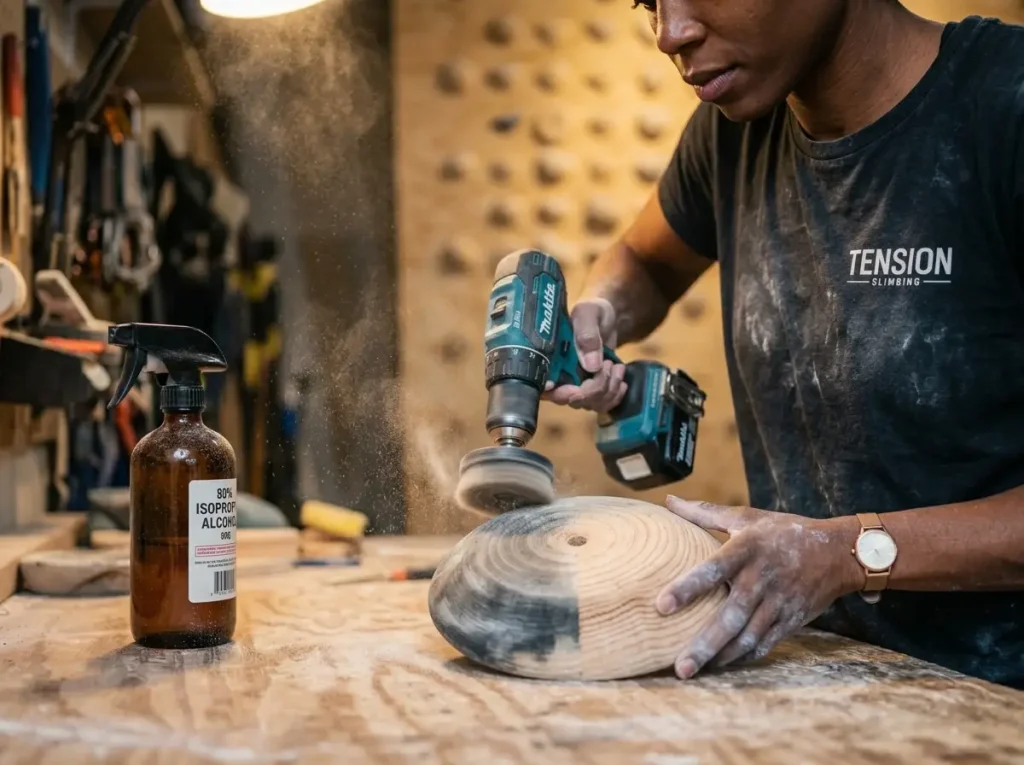
Wooden holds — Tension Board 2, MoonBoard, Kilter Board — are porous. Water swells the grain. Grain swells means the fibers raise and splinter. Long exposure causes delamination and rot. Pressure washing a wooden hold above 500 PSI damages it irreversibly, and even lower PSI degrades the grain over time.
The gold standard is 99% isopropyl alcohol. The concentration matters: lower concentrations (70% rubbing alcohol) carry too much water. At 99%, it evaporates in seconds, minimizing the time the wood contacts any moisture.
The standard protocol for wood-porosity management is a specific sequence: dry brush first, always. Apply the alcohol to chalk-caked wood and you create a slurry that pushes contamination deeper into the grain rather than lifting it. Brush off the loose chalk with a stiff nylon or boar’s hair brush, then spray the 99% IPA, then scrub with a drill-mounted or hand brush while the surface is still damp. If the hold still feels slick after drying, light sanding with 100–200 grit reopens the wood fibers and restores friction.
Wood polishes as sebum saturates it. The surface goes glassy. A sebum-saturated wood hold drops its friction to around 0.48μ — below Teflon. Quarterly cleaning at minimum prevents this, more frequently under heavy use volumes.
Per OSHA flammable liquid storage requirements for isopropyl alcohol, gyms using IPA at scale are subject to OSHA 1926.152: no more than 25 gallons outside approved storage cabinets, minimum 6 air changes per hour in storage rooms, fire extinguisher within 10–25 feet of the storage area.
Pro tip: For Tension Board or MoonBoard panels you can’t pull off the wall, a drill brush loaded with 99% IPA and a firm scrubbing pass every quarter is the only protocol that actually works. Don’t improvise with water-based cleaners just because it’s more convenient. You’ll spend more time sanding splinters than you saved.
Pressure Washing vs. Ultrasonic Cleaning: The Professional Debate
For a single problem hold mid-session, when brushing technique alone is enough and when it isn’t is the question worth asking first. But once holds are pulled and sent through the cleaning cycle at commercial scale, you’re choosing between two methods. They don’t do the same thing.
How Pressure Washing Works (and Where It Fails)
PSI delivers cutting force — the energy to break chalk and sebum bonds with the resin surface. GPM (gallons per minute) does the rinsing — flushing dislodged debris away. Both matter, and budget pressure washers often sacrifice GPM for PSI numbers that look good on a label.
Pressure washing excels at surface contamination: chalk layers, rubber scuffs, bio-residue you can see. It doesn’t penetrate deep pores. Sub-surface sebum loads and micro-particulate chalk caught in texture valleys can survive multiple pressure wash cycles without getting dislodged.
At gym scale it’s also physically brutal. Water consumption is 5L per hold. After washing 800 holds in a morning, you’ll know exactly how fast your wrists give out. The crate-batch method isn’t just efficient — past a certain volume, it’s the only sustainable way to get through the job.
Ultrasonic Cavitation: The Physics Explained
Ultrasonic cleaning uses 40 kHz transducers to generate alternating high- and low-pressure waves in a liquid bath. During low-pressure cycles, millions of microscopic vacuum bubbles form; during compression, they implode. That implosion — ultrasonic cavitation — releases micro-jets of cleaning solution capable of reaching pores that a pressure washer jet can’t touch. According to NASA technical documentation on ultrasonic cleaning physics, cavitation at 40 kHz produces bubbles small enough to penetrate complex textures while generating enough force to dislodge stubborn contamination.
Industrial parameters: 40 kHz frequency, 50°C bath (122°F — safely below PU’s glass transition threshold), 10–15 minute cycle, 4–10% soap-to-water concentration. Biodegradable concentrates like TICKOPUR R 27 handle rubber marks without damaging the resin. Do not exceed 60°C.
A 250-liter system (140L bath, 110L rinse) cleans approximately 2,500 holds before water renewal — 0.1 liters per hold versus 5 liters for pressure washing. A 50-fold reduction in water consumption. For gym managers making the capital investment case, that’s the ROI argument before you even count the labor savings.
Pro tip: Ultrasonic systems don’t replace brushing — they replace the deep cleaning cycle you were never actually doing. The combination is ultrasonic monthly for the depth, hand brushing between cycles to knock back surface chalk. Neither alone is the full protocol.
When Cleaning Fails: Friction Testing and Hold Retirement
Most guides end at “rinse and dry.” That’s incomplete. The objective of cleaning is friction restoration — restoring grip to functional levels. How do you know it worked?
Post-Cleaning Friction Verification
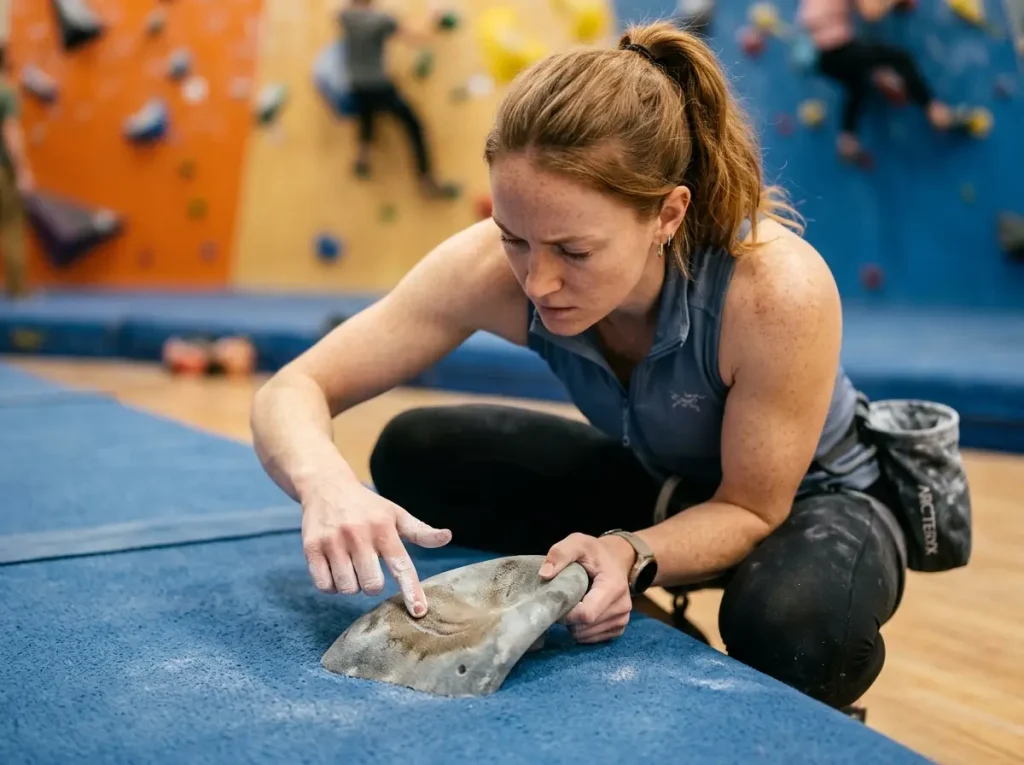
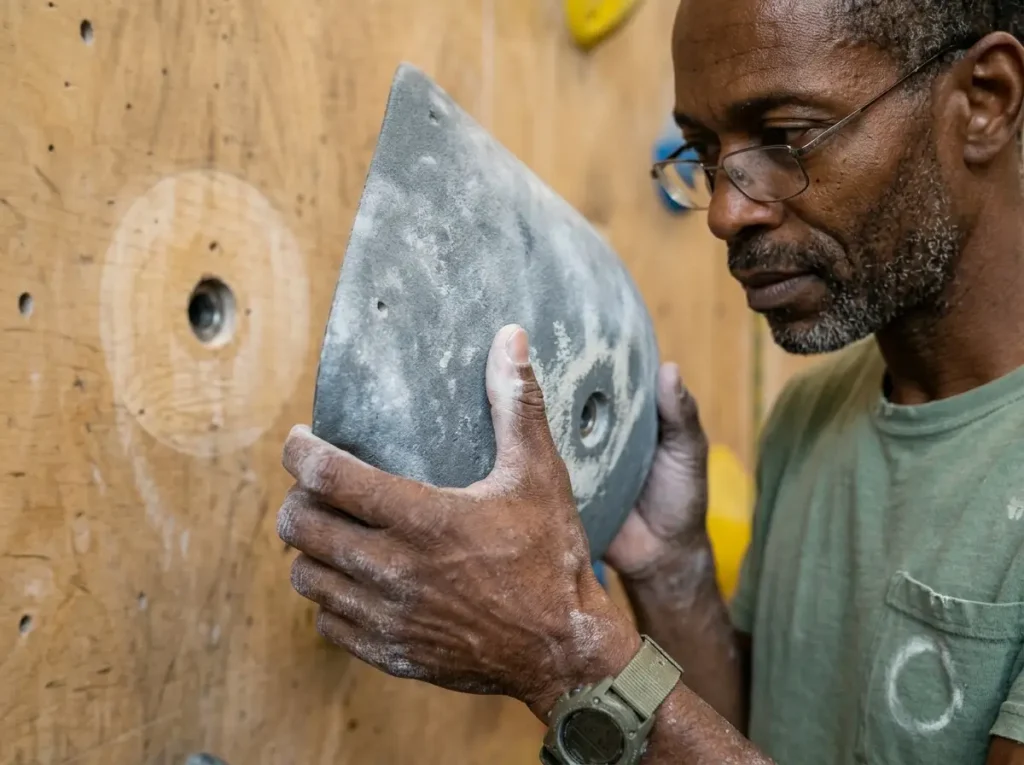
Basic field test: after drying completely, drag a clean dry finger across the hold. A genuinely clean hold has a distinct grippy resistance — almost a subtle stick. Slick feel post-cleaning means sebum contamination persists under the chalk layer you removed. A second cleaning cycle or an IPA degreasing pass is warranted before that hold goes back on the wall.
The post-cleaning friction testing step matters because of something counterintuitive about chalk: powdered chalk on a granular surface can decrease grip by acting as a granular lubricant. This is why some holds feel better early in a session and then get progressively worse — it’s not sweat, it’s over-chalking. Measured COF values across clean vs. contaminated hold surfaces confirm it. A hold that went through a full cleaning cycle and still feels wrong hasn’t been cleaned — it’s been rinsed.
Dishwasher use is viable for PU and PE holds with one restriction: no Heat Dry. The heated cycle can exceed PU’s minimum softening threshold. Cold or warm water wash, pull them before drying starts, air dry on a rack.
On home wall maintenance schedule: clean every 500 sends as a practical trigger. Commercial gyms with 200 or more daily climbers should pull and clean active holds monthly. Training boards like MoonBoard and Tension Board with fixed wooden holds need quarterly to bi-annual IPA cleaning depending on usage volume and humidity.
Retirement Criteria: When a Hold Is Done
Visible micro-fractures in PE holds — check at bolt holes and edges — indicate structural fatigue. Retire them. Don’t reinstall them in a low-traffic corner hoping for one more season. Cracked resin, stripped T-nut interfaces, and deformed bolt channels are also non-negotiable retirement triggers regardless of cleanliness.
Any hold with confirmed acetic acid or other acid exposure should be evaluated for retirement. There is no test for washer integrity in an encased hold. The only defensible posture is precautionary — if it went into a vinegar bath, you don’t know what you have anymore. The same principles that govern rope and cam retirement apply here — condition-based assessment, not calendar-based replacement, and the benefit of the doubt goes toward safety.
Re-texturing services exist for worn PU holds, but the bond strength of secondary texture layers isn’t well-documented — treat any re-textured hold as new and watch it through the first cleaning cycle.
Safety, PPE, and Compliance for Commercial Cleaning Operations
Respiratory and Dermal Hazards
Pressure washing creates backsplash that aerosolizes bacteria, chalk particulate, and cleaning solution. Your breathing zone is directly in the spray. Nobody budgets for PPE when they’re setting up a gym washing station. Then they spend a morning washing 400 holds in a poorly ventilated room and wonder why they have a headache and their hands look like cracked leather.
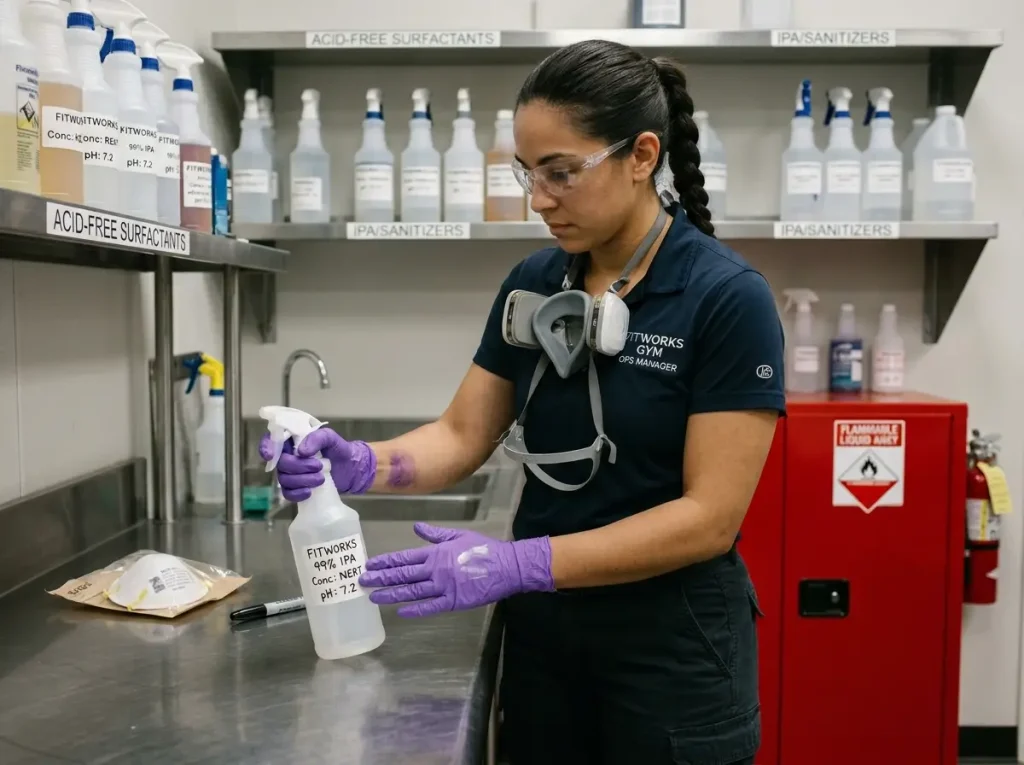
Minimum requirements: N-95 respirator for chalk dust and aerosolized chemicals — half-face respirator with appropriate cartridge for surfactant-heavy concentrates. Chemical-resistant nitrile gloves when handling detergents or concentrated IPA. Extended skin contact with 99% IPA causes rapid dermatitis. Safety glasses or face shields for high-pressure backsplash.
First time I ran a full hold wash without an N-95, I had a splitting headache by noon and hands raw by 2 PM. Chalk dust alone will do it — add surfactant aerosol from the pressure gun and you’ve turned maintenance into a respiratory hazard. Gear up before you start.
Per OSHA general requirements for personal protective equipment in maintenance operations, PPE selection for commercial gym washing operations is not optional. This connects directly to the same inspection-and-maintenance mindset that applies to harnesses and hardware — maintaining the systems that make climbing safe extends to how you maintain the holds themselves.
Building a Compliant Gym Washing Station
IPA at 99% is flammable. Vapor accumulation in an enclosed space is an explosion risk, not just a toxicity issue. OSHA 1926.152 governs it: no more than 25 gallons outside approved storage cabinets, mechanical exhaust with minimum 6 air changes per hour, fire extinguisher within 10–25 feet.
For pressure washing stations: contain the drainage. Rinse water carries chalk, surfactants, and biofilm — direct discharge to stormwater drains can violate local environmental ordinances.
Label all cleaning agents with concentration and pH. Not the brand name — the pH. Standardize your crate-based workflow from pull to reinstall, and make sure route setters and gym managers rotating through cleaning duty have enough info on every container to do the job right.
Conclusion
Three things that matter above everything else here.
First: the contaminant is biological, not just mineral. Chalk is what you see; sebum, crystallized sweat, and biofilm are the performance problem underneath. Your cleaning method needs to address all three layers, not just the visible one.
Second: acid has no place in hold maintenance. Vinegar, muriatic acid, citric acid — anything pH below 7.0 silently compromises the embedded washer through hydrogen embrittlement, a failure mode you won’t see coming and cannot reverse. pH-neutral surfactants only.
Third: match the method to the material. Pressure washing at 1,200–2,000 PSI for PU and PE with a fan nozzle, 99% IPA for wood using the dry-brush-first sequence, ultrasonic cavitation for deep commercial cleaning. These are not interchangeable protocols.
Pull the most-used hold on your wall right now and run the finger-drag friction check. If it grips, reinstall it with confidence. If it slides, now you know why — and exactly what to do about it.
FAQ
Can you put climbing holds in the dishwasher?
Yes — with one restriction: turn off Heat Dry. PU holds begin to soften at 60°C (140°F) and most dishwasher drying cycles exceed that threshold, deforming the hold permanently. Cold or warm water wash cycles are safe for PU and PE. Wooden holds should never go in a dishwasher — moisture exposure causes grain swelling, delamination, and rot.
Can I use vinegar to clean climbing holds?
No. Vinegar (acetic acid) dissolves chalk but corrodes the zinc-plated steel washers embedded in most holds through hydrogen embrittlement — a failure mechanism that triggers 24 to 72 hours after exposure, or weeks later with environmental HE. There is no reversal once the washer has absorbed hydrogen. Use pH-neutral detergents for synthetic holds, 99% isopropyl alcohol for wood.
How do you clean wooden climbing holds without damaging them?
Use 99% isopropyl alcohol — not water, not 70% rubbing alcohol. The 99% concentration evaporates in seconds, preventing moisture absorption into the grain. Always dry-brush first, then spray and scrub. If friction remains low, light sanding with 100–200 grit reopens the wood fibers and restores grip.
What PSI should I use to pressure wash climbing holds?
For polyurethane and polyester holds: 1,200–2,000 PSI with a 25° or 40° fan nozzle. Never use a 0° pencil tip — it will gouge the resin and destroy the texture you’re trying to restore. For wooden holds, pressure washing is not recommended. If unavoidable, stay below 500 PSI and accept you’re still degrading the grain over time.
How often should you clean climbing holds?
On a home wall, clean every 500 sends as a practical trigger. In a commercial gym with 200 or more daily climbers, active holds should come off the wall monthly. Training boards with fixed wooden holds — MoonBoard, Tension Board, Kilter Board — benefit from quarterly to bi-annual IPA cleaning depending on usage volume and humidity.
Safety Notice: Rock climbing and mountaineering are inherently high-risk
activities that can involve physical trauma or fatal incidents. The information on Rock Climbing Realms is for
educational and informational purposes only. Techniques and advice presented here are not a substitute
for professional, hands-on instruction. Conditions and risks vary by location. Always seek guidance
from a qualified instructor before attempting new techniques. By using this website, you agree that you
are solely responsible for your own safety. Any reliance you place on this information is strictly
at your own risk, and you assume all liability for your actions. Rock Climbing Realms and its authors
will not be held liable for any harm, damage, or loss sustained in connection with the use of this information.
Affiliate Disclosure: We are a participant in the Amazon Services LLC Associates Program, an
affiliate advertising program designed to provide a means for us to earn advertising fees by advertising and linking
to Amazon.com. As an Amazon Associate, we earn from qualifying purchases. We are also an official affiliate partner
of Black Diamond Equipment via the AvantLink network. If you click on a Black Diamond affiliate link and make a
purchase, we may earn a commission at no additional cost to you. We also participate in other affiliate programs.
Additional terms are found in the terms of service.