
In this article
The guide’s pack weighed 38 pounds. Rock, 5.9, maybe three pitches. He clipped the anchor at the top of pitch two, weighted the rope — and flipped. Upside down, backpack pulling his shoulders toward the earth, he couldn’t right himself. His partner lowered him to the ledge in a panicked hurry. No injury, but a close call that reshaped how he thought about a piece of gear he’d been using for fifteen years: his sit harness.
That story comes from Seth Hobby at the American Alpine Institute, and it’s not a freak accident. It’s physics. This guide breaks down the anatomy, the clinical reality, and the engineering behind full-body harness systems — when a sit harness becomes a liability, and what you need to know before making the switch.
⚡ Quick Answer: Most climbers — sport, gym, trad — do not need a full-body harness. A properly fitted sit harness with a solid iliac crest lock is the gold standard for performance climbing. You need a full-body or chest harness combination in four specific situations: you’re under 10 years old, you’re in your second or third trimester of pregnancy, you’re carrying a pack over 25 lbs on technical terrain, or your body morphology gives you no defined waist-to-hip ratio. If none of those apply, stick with your sit harness and master the fit.
The Anatomy of Pelvic Retention — Why Sit Harnesses Work (and When They Don’t)
The Iliac Crest Lock: Your Skeleton’s Harness Interface
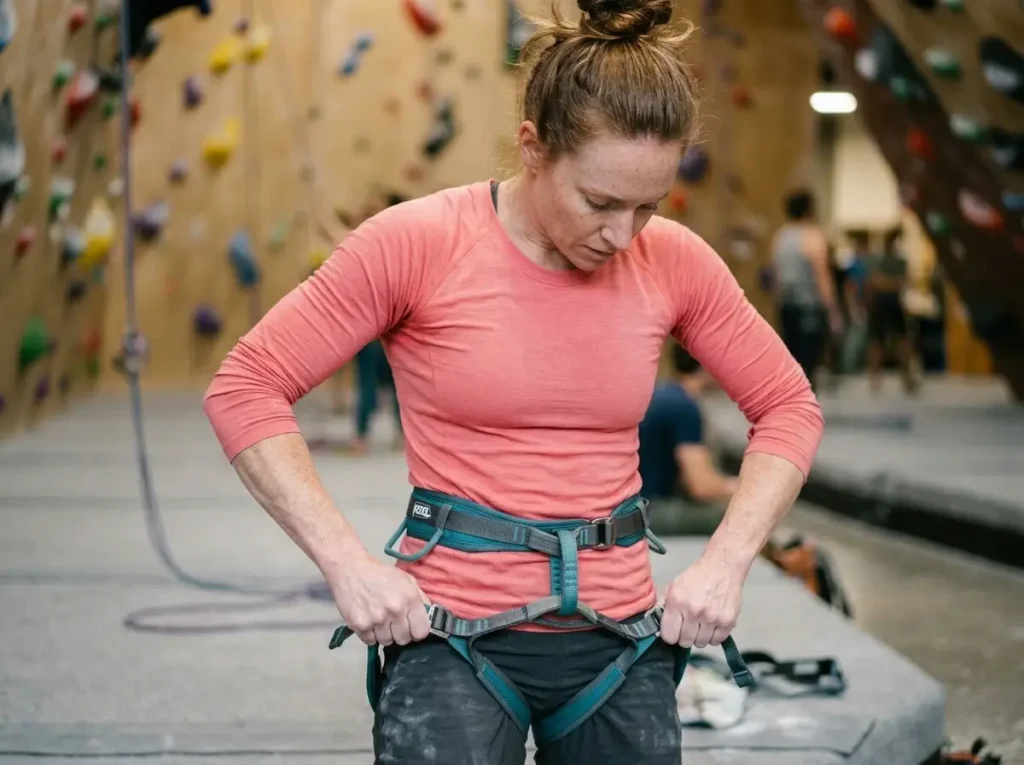
Run your fingers along your hip bones until you hit the top edge — that hard ridge is the iliac crest, and it’s the only reason a sit harness works. When your waist belt is cinched above the Anterior Superior Iliac Spine (ASIS), the harness can’t slide down over your hips even in a head-down fall. Your skeleton physically blocks it.
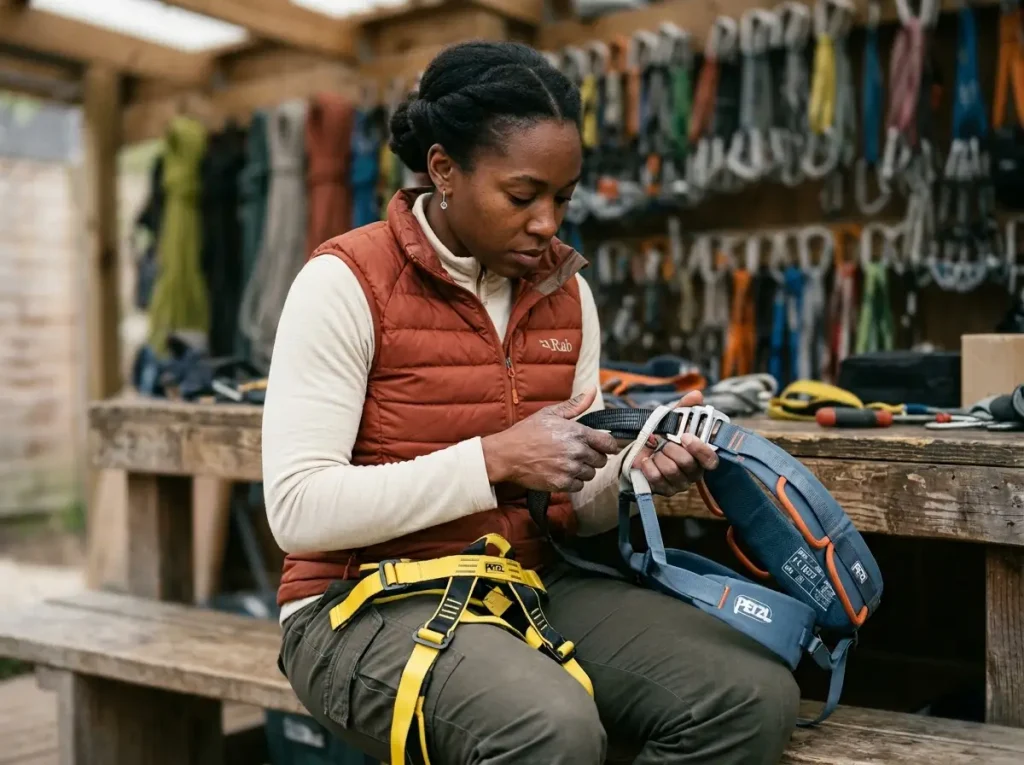
This is where most people get the terminology wrong. “Hips” is vague. The actual lock point is skeletal geometry — the harness grips the iliac crest shelf, not soft tissue. A properly seated waist belt should fail the pull-down test completely: if you yank downward hard with the harness fully tightened, it shouldn’t budge. Walk through the suspension audit for proper harness fit to nail this before every season.
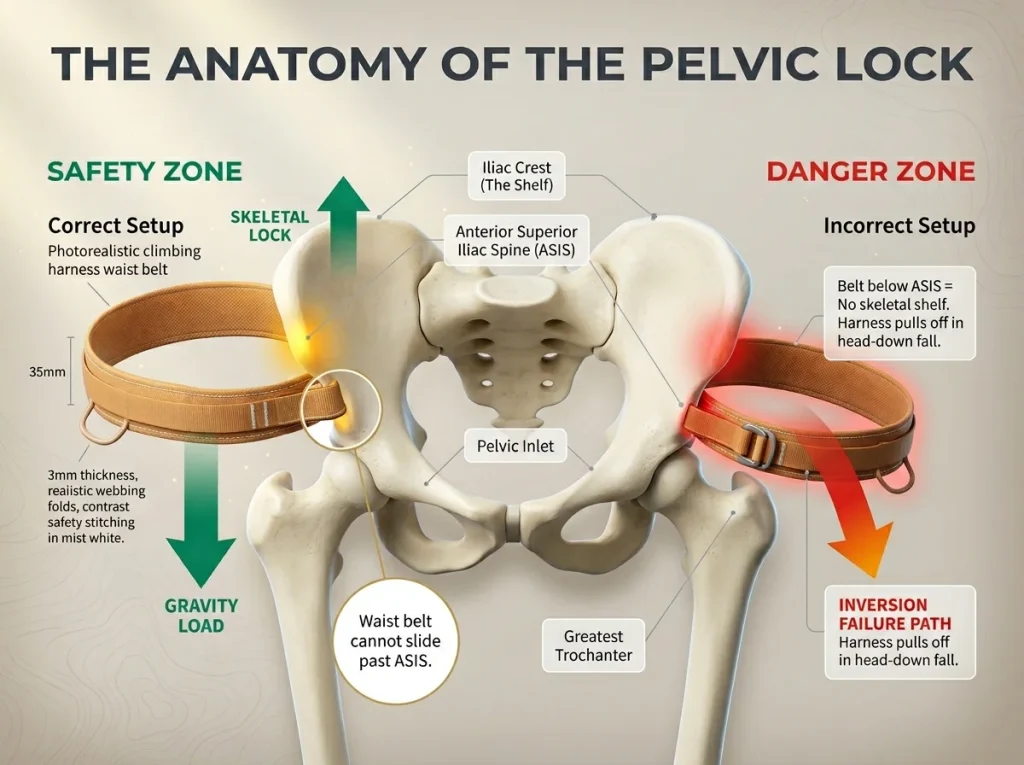
I’ve watched climbers at the gym set their waist belt right on the hip bones, not above them. They’re hanging from their pelvis, not locking against it. That’s a completely different load path, and it’s one where a head-down fall could strip the harness off entirely. According to UIAA Standard 105 harness fit requirements, the waist belt must be positioned above this anatomical landmark — not at it, not below it.
I spent three seasons fitting harnesses on gym members before I understood the difference between “at the hips” and “above the iliac crest.” Once I saw it on an anatomical model, I went home and pulled down my own harness to double-check. It passed — barely. That’s when I started doing the pull-down test every single time I rack up.
Pro tip: The real test isn’t finger-width at the waist — it’s the pull-down check with everything fully tightened. Grab the bottom of the waist belt and haul downward. Zero movement means you’re locked. Any give means you’re not.
Three Morphological Failure Conditions of the Pelvic Lock
The iliac lock fails under three specific conditions, and none of them are rare.
First: pediatric anatomy. Children under roughly age 7–10 haven’t fully ossified their iliac crests. The bony ridge hasn’t developed enough to function as a shelf. No amount of adjustment fixes an absent anatomical structure.
Second: morphological body type. Adults whose waist circumference equals or exceeds their hip circumference can’t create an iliac lock. The harness can be pulled over the hips when fully tightened. The two-finger rule is useless here — the pull-down test is the only honest arbiter. See adjusting leg loops and rise height for atypical body proportions for the practical setup guide.
Third: loss of core tension. An unconscious or severely exhausted climber can’t engage their core to stay upright. Even a correctly fitted harness can allow inversion when the body goes limp — which matters both for rescue scenarios and for anyone who’s taken a serious pump.
The Performance Penalty — Why Professionals Reject Full-Body Systems
No full-body harness appears in elite sport climbing. That absence is itself data.
Full-body systems (Type A under EN 12277) restrict trunk rotation, high reaches, and the body tension needed to keep feet on steep terrain. The shoulder and chest straps cut across exactly the muscle groups climbers use hardest. Add 200–400 grams of extra weight and you have a system that actively fights the climbing.
Put on a chest harness and try a high step. The restriction is immediate. That’s why professionals reject it — not because they’re reckless, but because they’ve already solved the inversion problem with proper fit.
The right harness for most people isn’t the “safest” harness — it’s the harness that fits correctly and stays out of the way. Understanding where that line sits is the difference between equipment that protects you and equipment that holds you back.
The Physics of Inversion — Center of Gravity and the Lever Arm Problem
Your Center of Gravity and the Tie-In Geometry
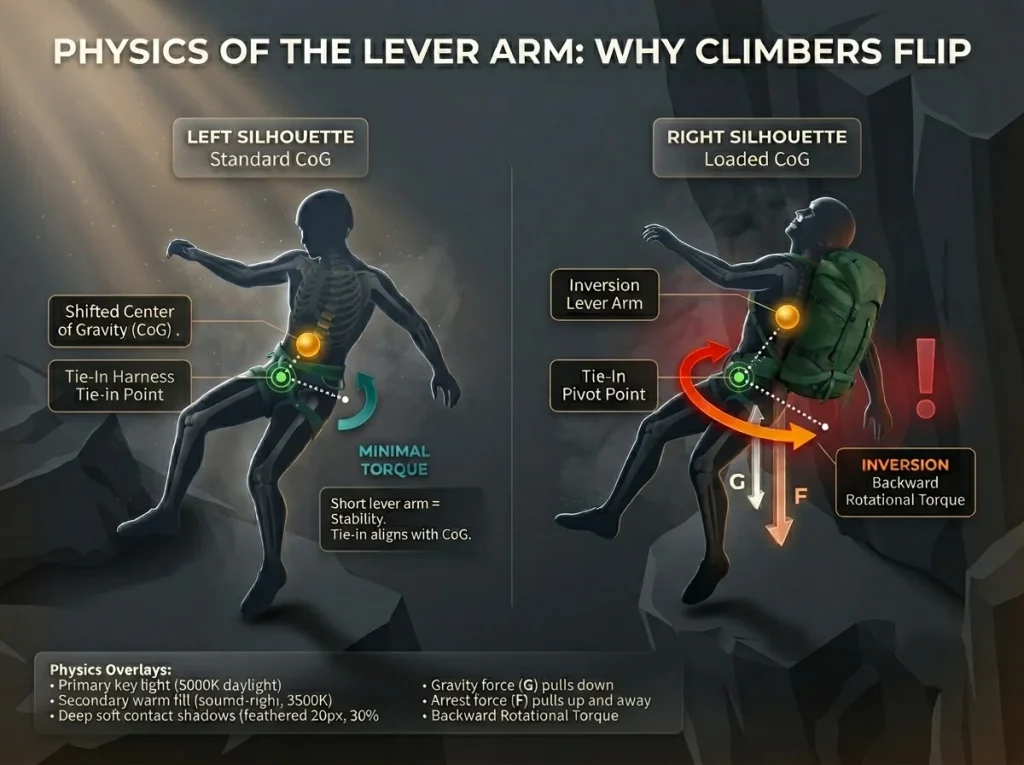
For most adults, the center of gravity sits near the L4/L5 vertebrae — roughly navel height. A sit harness tie-in point lives right there at the waist. That close alignment means fall arrest applies almost no rotational torque. You stay upright.
Shift that CoG upward and the gap between it and the tie-in point becomes a lever arm for inversion. Past a certain threshold, that torque flips a climber upside down. A full-body harness moves the tie-in to the sternum — above even an elevated CoG — converting the system from low-pivot to high-pivot and eliminating inversion torque. For the mechanical details, how tie-in point placement distributes load across the harness system covers it thoroughly.
The Backpack Problem — Calculating the CoG Shift
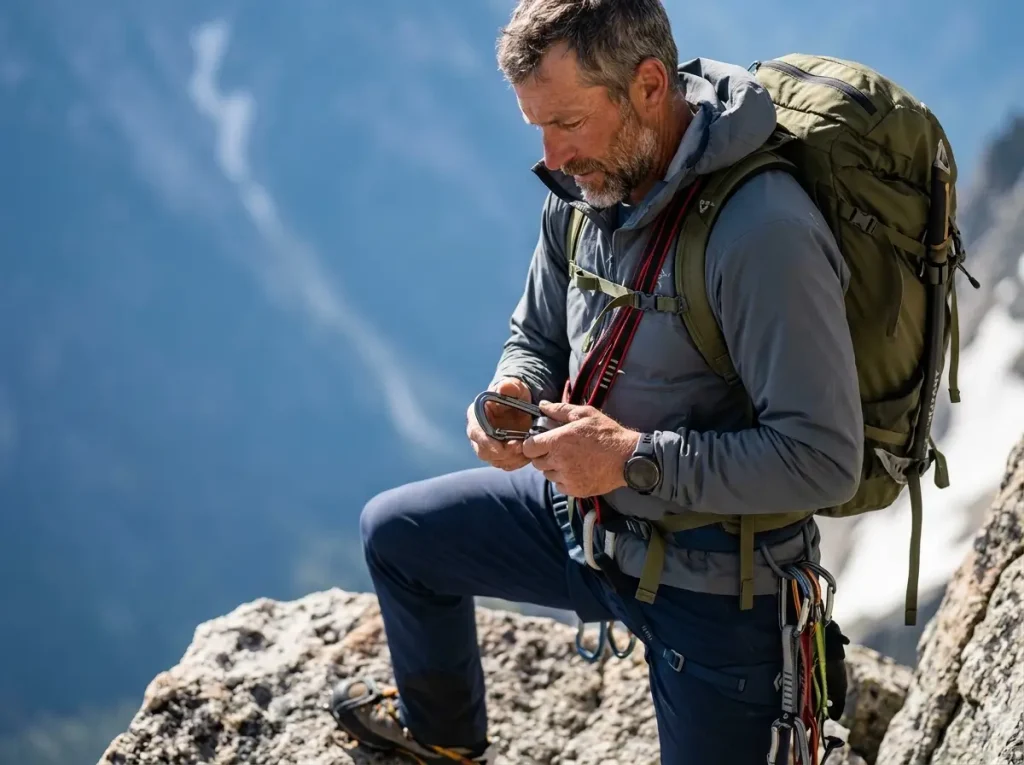
A 25-plus pound alpine pack worn at mid-back doesn’t just add weight — it shifts the combined climber-pack center of gravity upward and posteriorly. That posterior shift adds a second rotational force: the pack’s mass pulls the back down, rotating the climber backward (face-up) during a fall.
The result is turtle-ing. You’re suspended upside down, face up, legs in the air, unable to reach the wall, unable to unclip. If your partner can’t lower you quickly, you’re in a clock-running scenario.
A sit-chest harness combination — Type C plus Type D — addresses this specific scenario without the full mobility penalty of a Type A. The chest piece keeps your chest anchored to the rope when the pack wants to drag your shoulders down.
In the mountains, the rule I use is straightforward: if your pack is heavy enough that you can’t easily right yourself from a seated position on flat ground while wearing it, rig the chest harness. That’s the threshold. Not 25 lbs as a precise cutoff, but functional inability to self-correct.
Pro tip: Carry the chest harness racked on your pack straps. Rig it only when the grade or the pack weight demands it. It’s not insurance you wear every pitch — it’s the piece you reach for on the technical sections.
Pediatric CoG Dynamics — The Developmental Reality of Kids
Children have proportionally larger heads relative to their bodies. Their center of gravity sits higher in the torso than any adult’s — often near the chest. Combined with undeveloped iliac crests, they meet both failure conditions simultaneously: no bony shelf to lock against, and a high CoG generating significant inversion torque in a fall.
USA Climbing youth harness safety requirements mandate full-body harness use for youth competitors who cannot safely use a sit harness. Brands built for this specific morphology — Petzl Ouistiti (Type B) and Edelrid Fraggle (Type B) — are engineered for pediatric proportions, not just sized-down adult designs.
The transition age to a sit harness isn’t fixed. The pull-down test is the criterion, not a birthday. Some kids can make the switch at 7. Some need a full-body until 12. Run the test, don’t guess. For a full breakdown of selecting safe climbing gear for kids at every developmental stage, the dedicated guide covers each developmental window.
That same physics logic — CoG position relative to tie-in point — applies to every climber who walks into a harness decision. Understanding it for kids makes it clearer for everyone.
The Pathology of Suspension Syndrome — A Vertical Medical Emergency
The Physiology of Suspension — What Happens Inside Your Body
This is the part most guides skip. They mention blood pooling and move on. The clinical picture is worse than that.
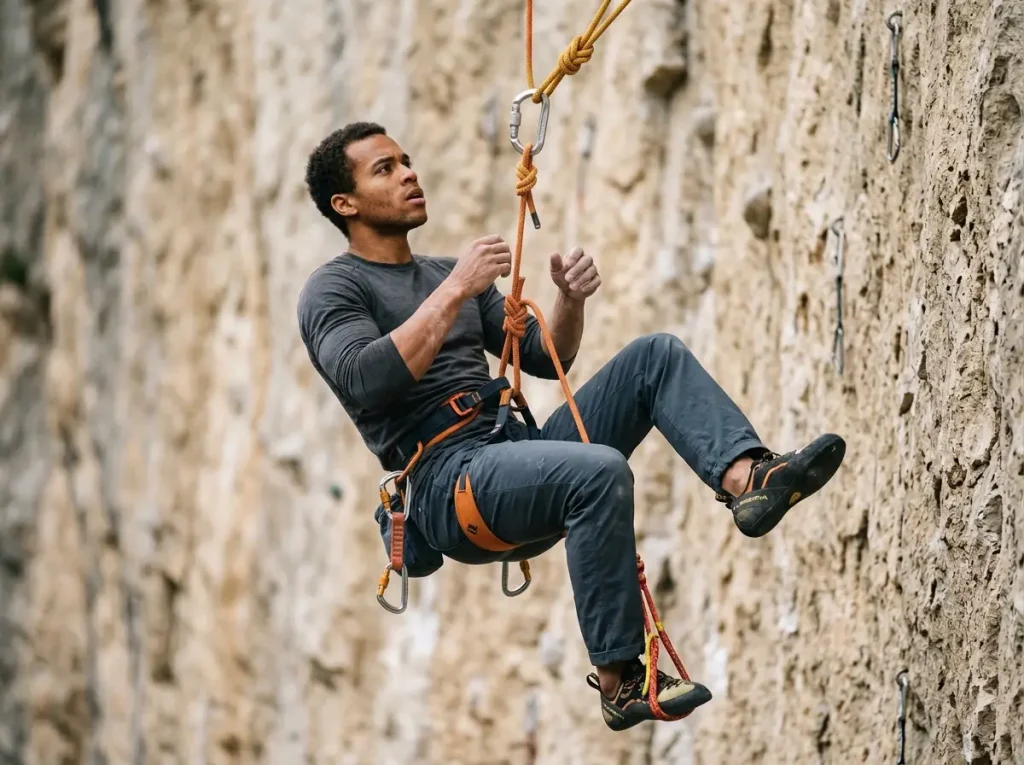
When you hang motionless vertically, gravity pulls blood into your legs faster than your muscular pump can return it. Up to 750ml — roughly 15% of total blood volume — pools in your lower extremities. Cardiac output drops. Cerebral perfusion drops with it. Presyncopal symptoms can start in as few as six minutes. Loss of consciousness in healthy subjects is documented within 15 minutes, per the ICAR MEDCOM scoping review on suspension syndrome management.
The part most guides skip: the Neurocardiogenic Reflex. As blood pressure falls, the brain paradoxically signals the heart to slow down. Bradycardia. The body accelerates its own collapse toward suspension syncope. This is documented in the clinical review of suspension trauma pathophysiology and applies to any harness type.
The first time I read about the Neurocardiogenic Reflex in a WFR manual, I went back through every session I’d done where a partner took a long hang and seemed “fine.” Six minutes is not a long time when you’re sorting a rack at the anchor. I now tell every partner before a multi-pitch: the foot loop goes in the pack, accessible, not buried.
Knowing the biology changes how you manage a suspended partner. The countermeasures below aren’t optional knowledge — they’re the ones that buy time.
How Harness Type Changes Suspension Risk
Sit harness geometry helps, counterintuitively. The “seated” position naturally elevates the knees, which partially engages the muscular venous pump and slows venous pooling onset. Your body is doing some work even while hanging.
A full-body harness (Type A) often holds the body in a more vertical configuration — legs pendant, not elevated. That position accelerates pooling. This is a counter-intuitive trade-off of full-body systems that almost no one mentions.
In a chest-only harness (Type D)? Never hang there alone. The femoral artery compression is immediate and adds mechanical circulatory obstruction on top of the pooling problem. The Edelrid technical team is blunt about it: hanging in a Type D alone, even briefly, can be fatal.
For field management of suspension trauma in vertical environments, the WFR protocol breakdown covers the rescue response.
The countermeasures are simple and non-negotiable:
- The bicycle pump — actively cycling your legs while suspended keeps the muscular venous pump running. This can extend consciousness by several minutes.
- Foot loop protocol — always carry a short sling you can clip into the rope to create a stirrup. Stepping into it elevates your legs and takes load off the harness suspension geometry.
For signaling for rescue while suspended on a vertical face, the communication guide covers GPS options when you’re in that position.
Pro tip: Every climbing pack should have a 60cm sling clipped to a gear loop, rigged and ready. Not buried. Not at the bottom. Clipped where you can reach it while hanging inverted and confused. You won’t improvise when your vision is greying.
The Pregnancy Exception — Shifting CoG and Abdominal Protection
Second and third trimester pregnancy triggers the lever arm inversion risk directly: the CoG shifts anteriorly and superiorly, increasing the distance between where the rope pulls and where the body’s mass sits.
The simultaneous problem is abdominal pressure. A sit harness waist belt exerts direct load across the abdomen during a fall. The fetal impact risk is documented, and it’s why choosing a pregnancy harness with clinical safety guidance is non-negotiable for climbing past the first trimester.
The Petzl 8003 and Ocun Bodyguard are the current community consensus — the Mad Rock Mountain Mama has been discontinued. These systems redistribute load to the chest and thighs, away from the abdomen. ACOG (American College of Obstetricians and Gynecologists) doesn’t specifically address harness type, which means physician consultation isn’t optional — it’s the baseline.
This is one scenario where the full-body question has a clear answer: yes. By the second trimester, a full-body or dedicated maternity system is the correct call.
Engineering Standards — What the EN 12277 Classification Actually Means
The Four Harness Types Decoded (Type A, B, C, D)
The EN 12277 and UIAA 105 classification system isn’t bureaucratic paperwork. It tells you exactly what force tests each harness has passed and in which orientation — which directly maps to when each type is safe.
Type A (Full-Body, Adult): Passes static force tests both head-up and head-down. The only adult harness tested for inversion prevention. Heaviest and most restrictive — built for scenarios where pelvic retention fails.
Type B (Full-Body, Child): Same inversion prevention requirements as Type A, scaled for pediatric proportions. The Petzl Ouistiti and Edelrid Fraggle live here.
Type C (Sit Harness): The universal standard. Tested only in head-up orientation. No inversion prevention requirement — safe because pelvic retention works.
Type D (Chest Harness): Supplemental only. No head-down static force requirement. It will fail catastrophically as a standalone load-bearing system. Belay loop minimum is 15kN; many modern loops hit 22kN or higher. Real lead fall forces peak at 6–12kN — the margin exists, but only when the harness is used as designed.
For the full breakdown of UIAA 105 harness pictorial standard and force requirements, the primary source is worth reading directly. And for decoding UIAA impact force ratings and fall factor math, the standards explainer connects the classification to real fall scenarios.
The Chest Harness Combination — Type C + Type D vs. Type A
Many experienced alpinists use a sit harness plus chest harness combination instead of a Type A for heavy-pack alpine climbing. Each piece is lighter than a Type A alone. The sit harness handles normal hanging comfort; the chest piece gets added only when terrain or pack weight demands it.
The critical warning: the chest harness must connect to the sit harness belay loop, never as an independent attachment to the rope. The Type D has no standalone load capacity. Clip them together properly and you have a working system. Clip the Type D directly to the rope and you’re building a fatal compression scenario.
For alpine-optimized harness systems tested across 200 pitches, the field-tested review walks through the real-world trade-offs.
The combo approach is the alpinist’s compromise: lightweight enough to move fast, safe enough to fall on. When you sort out the rigging once at home, it adds maybe 90 seconds at a belay station.
Harness Selection by Scenario — The Decision Framework
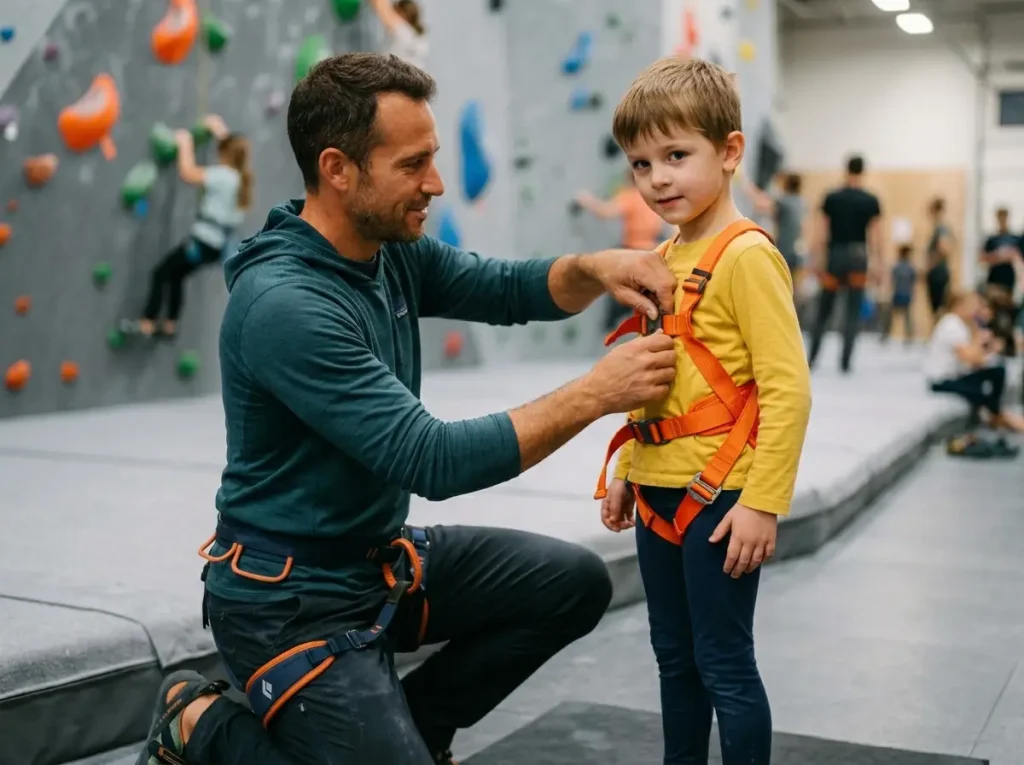
The Four Non-Negotiable Full-Body Scenarios
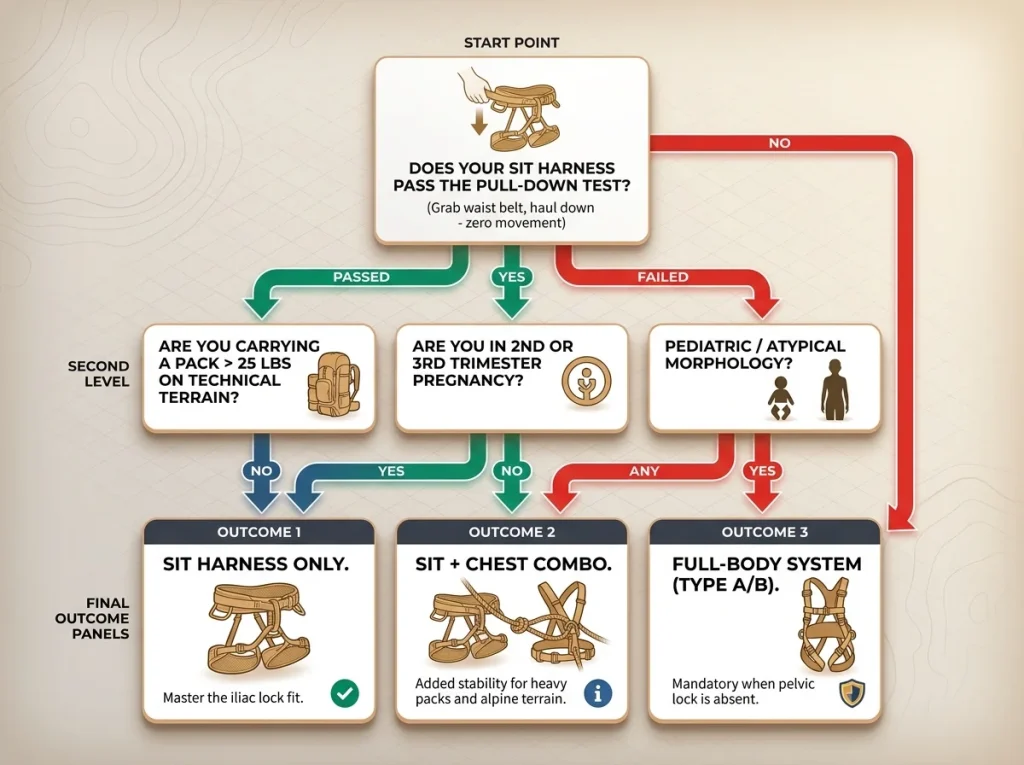
There are four situations where a full-body harness (or chest harness combination) isn’t a preference — it’s a minimum.
Child under 10: Iliac crests aren’t developed. The pull-down test confirms this faster than any age chart. Type B is mandatory.
Second or third trimester pregnancy: Shifted CoG plus abdominal pressure risk. Type A or a dedicated maternity alternative. Physician sign-off required.
Pack over 25 lbs in technical terrain: CoG shift creates real inversion torque. A chest harness combination is the minimum.
Morphology with no iliac definition: If the harness slides over the hips when fully tightened, the lock mechanism doesn’t exist for you. A sit harness alone is unsafe.
A fifth scenario: rescue. An unconscious climber can’t control body position — full-body systems are standard when the subject is passive. Run the pre-climb harness audit every partner should do before technical objectives.
The Sit Harness Is Still King — Understanding the Default
A properly fitted sit harness with a working iliac lock is not just adequate for recreational sport climbing, indoor gym climbing, and trad climbing — it’s the correct system. Not a compromise. Not a risk you’re accepting. The correct tool for the job.
Sit harness geometry provides superior hanging comfort for long belays, multi-pitch hanging, and rappelling. The legs-elevated suspension position is better for your circulation. The system is simpler, lighter, and faster to manage at anchors. When you need chest support for real alpine objectives, add a Type D to your existing sit harness — don’t replace the sit harness.
Harness fit mastery matters more than harness type in most real-world climbing scenarios. The honest question isn’t “is a full-body harness safer?” It’s “safer for whom, doing what?” For a properly built adult sport climbing on a single-pitch route, a full-body harness is a performance penalty, not a safety upgrade.
For the best field-tested sit harnesses for every discipline, the comprehensive review covers sit harnesses across sport, trad, and alpine objectives.
The Takeaways
Three things worth carrying off this page:
A sit harness is only safe if the pelvic retention mechanism works. It fails under three conditions: pediatric anatomy, certain body morphologies, and heavy pack weight that shifts your CoG above the tie-in point.
The physics of inversion are unambiguous. When your center of gravity rises above your tie-in point, rotational torque is created. A chest-high tie-in is the only fix.
Suspension syndrome has a clinical timeline. Motionless suspension is a medical emergency that begins in minutes. The bicycle pump technique and a foot-loop sling are not optional knowledge. Carry the sling.
Next session, do the pull-down test on your current harness. Fully tightened, correctly positioned — can you pull it over your hips? If yes, or if you’re not sure, you have a knowledge gap that needs to close before your next lead.
FAQ
What is the main advantage of a full-body harness over a sit harness?
A full-body harness places the tie-in point at the sternum, above the body’s center of gravity. This eliminates the rotational lever arm that causes inversion during a fall. For climbers whose sit harness pelvic lock mechanism cannot work — children, pregnant climbers, or those carrying heavy packs — this sternum tie-in is the critical functional difference.
Are full-body harnesses safer than sit harnesses for general climbing?
Not for most climbers. A properly fitted sit harness with a working iliac lock is the gold standard for sport, gym, and trad climbing. Full-body systems add weight, restrict mobility, and complicate multi-pitch anchor setups. Safer is context-dependent: a full-body harness is safer only when the pelvic lock mechanism fails or doesn’t exist.
Can adults use a full-body climbing harness?
Yes, and sometimes it’s the correct choice. Adults with certain body morphologies — no defined waist-to-hip ratio — those carrying heavy alpine packs, or pregnant climbers in the second and third trimester should use a full-body or chest-harness combination. For all other adults, a correctly fitted sit harness is the appropriate system.
At what age should a child switch from a full-body to a sit harness?
Age is not the criterion — iliac crest development is. Most children can transition between ages 7–12, but the correct test is the pull-down check: if the sit harness cannot be pulled down over the hips when fully tightened, the switch is physically appropriate. USA Climbing recommends individual assessment over a fixed age threshold.
What happens if you hang motionless in a harness for too long?
Suspension syndrome begins with blood pooling in the lower legs, dropping blood pressure and cerebral perfusion. Presyncopal symptoms — dizziness, nausea — can start in as few as six minutes. Loss of consciousness is documented within 15 minutes in healthy subjects. Active leg cycling or a foot stirrup keeps the muscular pump working. This risk exists with any harness type.
Safety Notice: Rock climbing and mountaineering are inherently high-risk
activities that can involve physical trauma or fatal incidents. The information on Rock Climbing Realms is for
educational and informational purposes only. Techniques and advice presented here are not a substitute
for professional, hands-on instruction. Conditions and risks vary by location. Always seek guidance
from a qualified instructor before attempting new techniques. By using this website, you agree that you
are solely responsible for your own safety. Any reliance you place on this information is strictly
at your own risk, and you assume all liability for your actions. Rock Climbing Realms and its authors
will not be held liable for any harm, damage, or loss sustained in connection with the use of this information.
Affiliate Disclosure: We are a participant in the Amazon Services LLC Associates Program, an
affiliate advertising program designed to provide a means for us to earn advertising fees by advertising and linking
to Amazon.com. As an Amazon Associate, we earn from qualifying purchases. We are also an official affiliate partner
of Black Diamond Equipment via the AvantLink network. If you click on a Black Diamond affiliate link and make a
purchase, we may earn a commission at no additional cost to you. We also participate in other affiliate programs.
Additional terms are found in the terms of service.