

In this article
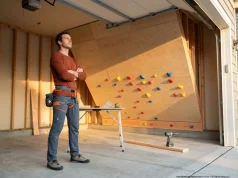
You’re thirty feet up your home wall, cranking on an impact driver to set the crux crimp, when a loud crack echoes through the garage as a fifty-dollar polyester hold shatters into three razor-sharp pieces.
This is what happens when you ignore material science. Setting routes is about more than angles and grip types; it is about anticipating failure. I’ve stripped thousands of spinning holds off commercial walls, and the difference is obvious once you look at the back. The choice of climbing hold materials for your training set dictates whether you build a reliable board or a hazard. We provide a technical breakdown of the polymer chemistry, the mechanical failure modes, and the surface friction that separates a professional-grade training tool from cheap plastic. By understanding polyurethane vs polyester, you ensure you never waste money on the wrong resin for your wall.
⚡ Quick Answer: Polyurethane (PU) holds are elastomeric, lightweight, and highly impact-resistant, making them the standard for large shapes and commercial gyms. Polyester (PE) holds are dense, heavy, and extremely rigid, providing authentic silica-based friction at a lower price point. Choose PU for durability against impact, and PE for raw grip and UV resistance.
| Climbing Hold Material Comparison | ||
|---|---|---|
| Feature | Polyester (PE) | Polyurethane (PU) |
| Primary Strength | Raw, mineral-based friction | Impact resistance and low weight |
| Failure Mode | Catastrophic shattering | Bending and elastic stretch |
| Common Use | Small crimps and outdoor walls | Large volumes and commercial gyms |
| Cost Profile | budget-friendly pe | premium pu |
The Chemical Architecture of Climbing Polymers
Polyester Resin Systems and Mineral Loading
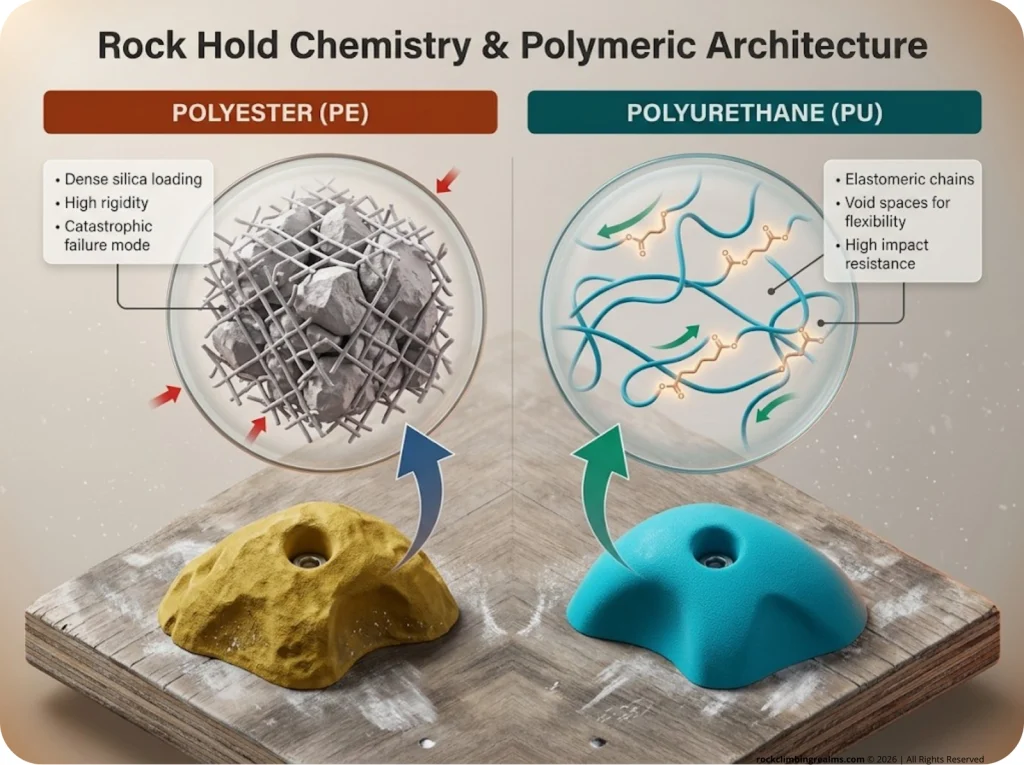
Look at the back of an old-school climbing hold in a dusty gym corner. You are looking at resin formulas based on thermosetting polyester. The manufacturing process relies entirely on mineral fillers to create bulk. Brands load the chemical mix with sand, crushed silica, or fiberglass beads to add volume to the shape.
This creates extreme density. The structure becomes rock-hard during the curing phase. You get massive compressive strength, which means the hold will easily support your weight on a tiny edge without crushing. The trade-off is severe stiffness. The heavy silica inclusions give you the abrasive friction traditionalists prefer, but they eliminate the plastic’s ability to stretch.
Polyurethane and the Elastomeric Advantage
Polyurethane is a completely different chemical beast. It relies on a two-part system that forms urethane linkages. High-end modern manufacturers like Agripp and 360 Holds cast these shapes with minimal mineral fillers.
Without the dense sand dragging it down, the urethane provides a massive weight reduction. The real benefit is the polymer chain flexibility. You can quite literally feel the difference in your hands. When you haul a massive PU macro up a ladder, it feels like a hollow plastic shell compared to the anvil-like density of a similarly sized PE hold.
This flexible nature allows the material to bend before it breaks. It accommodates complex, ergonomic hold shapes that would simply fracture under their own mass if poured in rigid polyester.
Mechanical Performance and the Physics of Torque

Shore Hardness and Flexural Resistance
Gym owners and setters live and die by shore d hardness ratings. Holds typically sit between 45D and 90D. Polyester sits at the extreme high end, often exceeding 80D. It feels exactly like rock, but it is incredibly stiff. It absolutely refuses to yield.
If you bolt a rigid 80D shape onto an uneven section of plywood, it cannot conform to the wall. The tightening force creates concentrated stress right at the bolt hole. You apply the mechanical advantage of the bolt for one quarter-turn too many, and you initiate micro-cracks that ruin the hold.
Polyurethane typically lands between 55D and 75D. It has enough give to contour against slight wall imperfections. As you drive the screw, the PU undergoes minor elastic bending. This distributes the load evenly across the back of the plastic, massively reducing the risk of breakage during tightening.
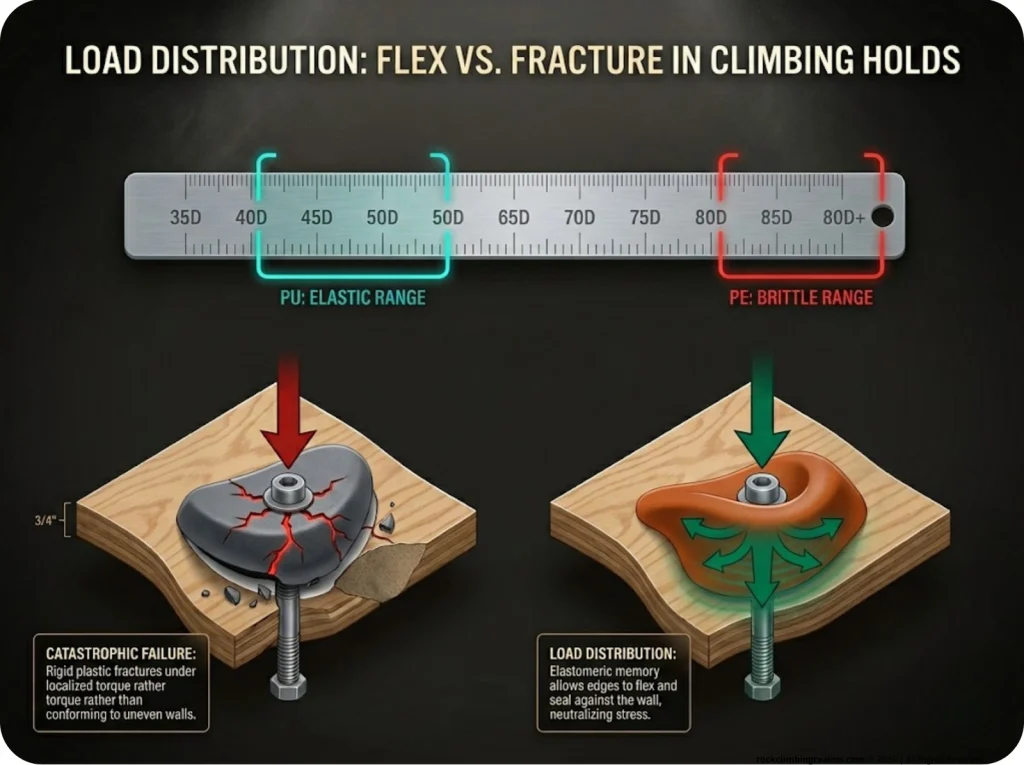
Pro-Tip: Never use an impact driver on rigid PE shapes when bolting holds to your plywood wall. The sudden high-torque impulse easily exceeds the material’s failure limit, instantly shattering your investment. Always hand-tighten your polyester.
Tensile Strength and Failure Loads
Let’s look at the numbers behind the tensile strength—how hard you can pull before it snaps. Manufacturer test data shows a clear advantage for PU in high-stress applications. Premium commercial PU can sustain up to 2,300 pounds of load before reaching its bending point. Even at failure, the material stretches rather than separating completely.
Polyester maxes out much lower, around 1,200 to 1,500 pounds. The failure mode is sudden and violent. It shatters under stress, sending plastic shards across the mats according to fracture mechanics research. The internal stress fractures on PE happen fast. You rarely get a warning creak.
Creep and Temporal Deformation
A quiet killer of route integrity is creep. This is the tendency of a plastic to deform permanently under persistent load. Think of a hold that starts spinning three weeks after you set it, even though the bolt has not moved.
High-end urethane formulas, like Dannomond, are engineered specifically to resist this deformation. You torque them down once, and they stay put for the duration of the set. Polyester, due to its rigid internal structure, exhibits almost zero creep anyway. It trades stability for brittleness.
Surface Morphology and the Science of Friction
Grain Structure and Texture Longevity
The true grip of a hold comes down to its microscopic grain. These two plastics generate friction in fundamentally different ways.
Polyester features an additive surface. The texture comes from the actual silica particles suspended inside the resin. The surrounding binder wears down, but the hard mineral grains stay exposed. This means the aggressive mechanical grip persists for years.
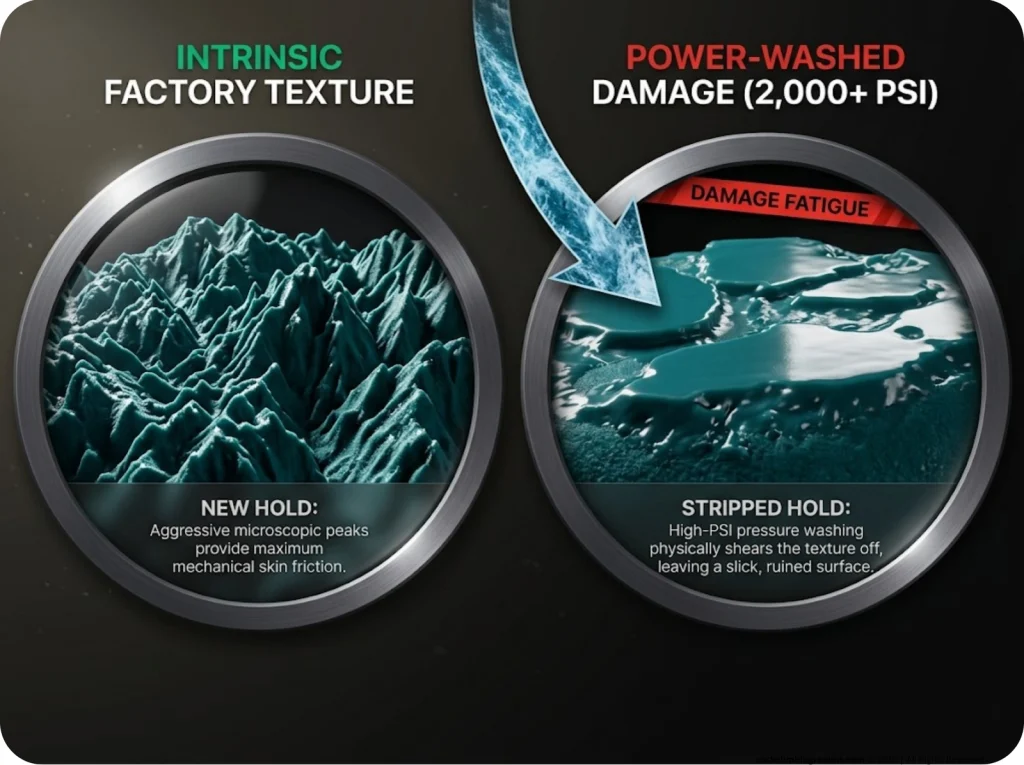
Polyurethane has an intrinsic surface. The friction is molded straight into the plastic without coarse fillers. This comes with a penalty over time. Heavy climbing traffic polishes the microscopic peaks of the PU. The hold loses its bite and starts to feel slick, requiring more finger strength to secure the exact same move.
The Role of Chalk and Rubber Accumulation
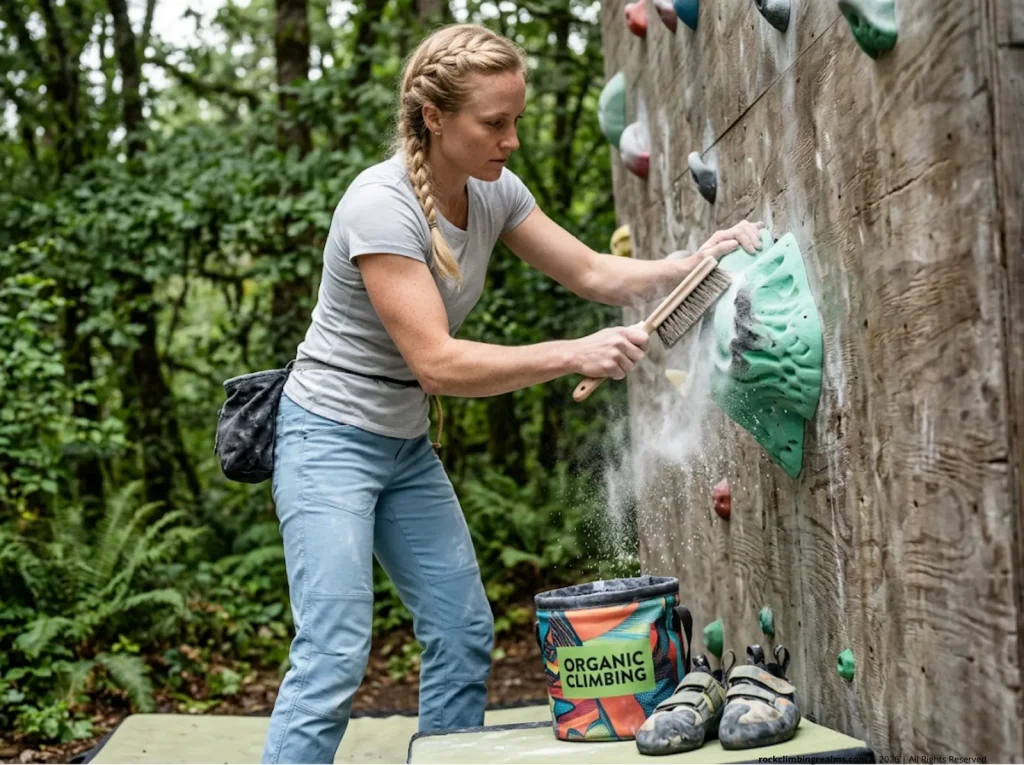
Friction is ruined by what you leave behind. Every time you project a boulder problem, you cram magnesium carbonate and vulcanized shoe rubber into the microscopic pores of the holds.
This dense layer of grime drastically changes how climbers actually perceive hold friction, masking the true grain completely. We watch the longevity of friction drop sharply as chalk fills the intended texture.
Pro-Tip: Experienced climbers often perceive PE as “stickier” because the rigid mineral fillers create a sharp mechanical interlock with your fingerprints, whereas PU relies more on general surface contact.
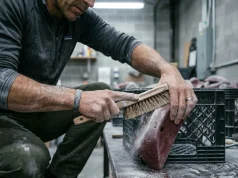
You need a systematic approach for clearing out chalk and rubber buildup with a boar’s hair brush to restore that baseline grip, regardless of which plastic you bought.
Maintenance Science: Cleaning and Restoration
The Chemistry of the Acid Bath
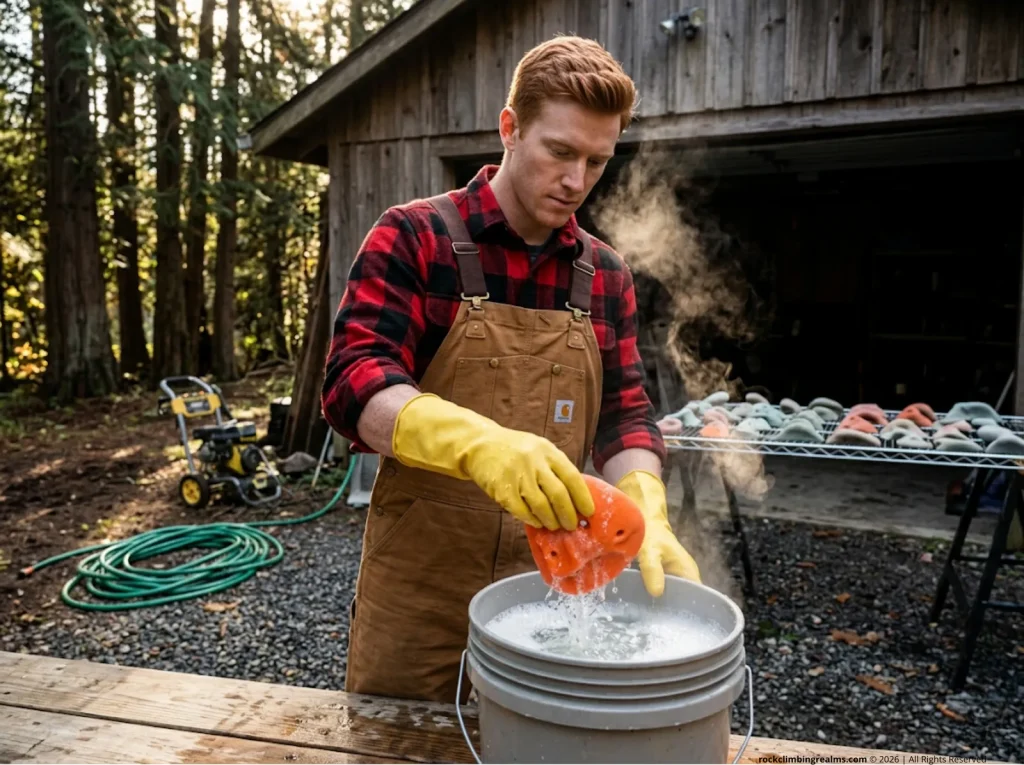
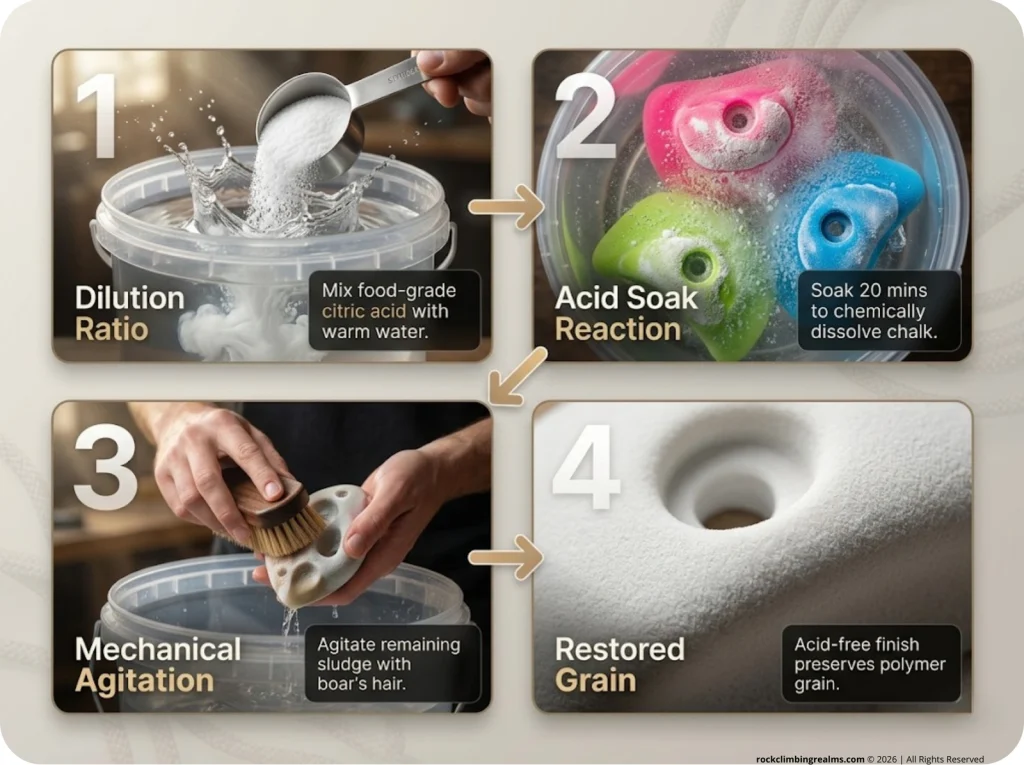
The fastest way to ruin a thousand-dollar hold order is bad maintenance. cleaning holds requires controlled chemistry. Gyms frequently dump shapes into muriatic acid baths to dissolve caked-on chalk aggressively.
Muriatic acid works rapidly, but it is highly corrosive. Leave a PE crimp in the tank too long, and the acid will eat the resin binder right out from between the sand grains.
The smarter approach uses food-grade citric acid. It triggers the necessary reaction with magnesium carbonate without causing polymer degradation. Your skin and your equipment both survive the wash cycle without inhaling caustic fumes.
Power Washing and Mechanical Degradation
Power washing is the undisputed standard for resetting a gym, but the mechanical force acts like a sandblaster. Blasting PU shapes at 2,000 PSI rips the microscopic grain right off the surface. You strip the peaks completely, leaving the setup permanently polished.
Back off the nozzle distance. Dropping the pressure preserves the delicate intrinsic grain and prevents chipping vs smoothing damage on your expensive sets.
UV Stability and Outdoor Exposure
Outdoor training introduces a brutal new variable: uv stability.
If you launch fluorescent PU jugs on a wall in direct sunlight, solar radiation will destroy them. The UV rays sever the polymer chains, fading the bright colors entirely within a single summer. They also face severe thermal expansion issues, leading to cracking around the embedded washers.
Polyester shuts down solar damage. The dense structure resists UV breakdown and handles temperature swings perfectly. Keep this in mind when selecting holds for a backyard setup exposed directly to extreme weather.
Operational Economics and Gym Management

Weight, Logistics, and Route Setting
Setting efficiency depends heavily on mass. A solid PE sloper can weigh twenty pounds. Lugging that dead weight up a static line while hanging awkwardly from a harness will smoke a setter’s core in a single afternoon.
Polyurethane dominates the commercial sector exclusively because it supports hollow-back technology. Manufacturers eliminate the solid interior, cutting the bulk by up to 70 percent. A setter manipulates a gigantic volume one-handed while drilling the screws confidently. This logistical edge redefines the price you pay in sheer labor.
Durability and Breakage Rates
Look objectively at the total cost of ownership. PU holds run around 50 percent higher on the invoice sheet. But you have to calculate the price-per-send and the inevitable replacement rate.
PE shapes suffer terrible attrition. Dropping a bucket of PE crimps carelessly onto a concrete floor causes immediate permanent chipping. The over-torque risk is a constant threat when setters work fast with drills. You replace PE holds constantly.
Premium PU is practically immune to clink damage in the wash buckets. The steep impact resistance means they bounce rather than shatter when dropped. The initial investment stings the wallet, but the decade of survival justifies that premium.
Pro-Tip: If you are building a strict training board and hunting purely for tiny crimps and foot edges, the weight advantage of PU vanishes. Budget-friendly PE remains the smartest financial move when creating routes on your home wall.
The Internal Safety Coil and Fire Ratings
Safety regulations entirely dictate commercial viability. To comply with the uiaa and European safety standards and testing protocols, brittle PE shapes cast an internal “safety coil” directly into the resin. It is a stainless steel spring. If the plastic snaps, the coil traps the sharp fragments against the wood, preventing lacerations on the belayer below.
Commercial gyms also adhere to strict municipal building codes. Premier brands like Nicros engineer proprietary blends to lock in a class d fire-rating or better, avoiding the toxic off-gassing properties of cheaper plastics. Modern thermoplastic alternatives are steadily emerging alongside these safety specs, offering total recyclability across ten distinct lifespans without losing strength. Sustainable manufacturers like Volx Holds and HRT are already leaning into eco-friendly pours to offset the waste of the old synthetic era.
Final Thoughts
- Polyurethane’s flexible makeup provides massive weight savings and impact resistance. It remains the undisputed choice for massive commercial operations that reset weekly.
- Polyester rules the outdoor environment. It survives UV saturation effortlessly and provides authentic, additive silica friction at a fraction of the cost.
- Knowing the limits of your plastics prevents dangerous shattering. Treat your brittle PE grabs with respect and put away the impact driver.
Take a hard look at your home wall and audit the hardware setup. Factor in the physics of torque and confirm your drill is not actively destroying your holds.
FAQ
Are polyurethane climbing holds better?
Polyurethane holds are significantly lighter and inherently shatter-resistant, making them superior for commercial gyms and large shapes. However, for raw friction and budget constraints, polyester is often favored by home wall builders and backyard outdoor setups.
What are the best materials for climbing holds?
The most practical materials are high-grade Polyurethane (PU) for durability against impact, and Polyester (PE) for cheap, high-friction crimping. Modern manufacturers also test 100% recyclable thermoplastics to minimize environmental waste while retaining structural integrity.
How long do climbing holds last?
A high-quality PU hold can survive over a decade if cleaned gently without corrosive acids or excessive pressure washing. PE holds keep their abrasive grip friction far longer due to embedded silica, but generally suffer early breakages from accidental chipping or localized torque stress at the bolt.
Can you use polyester resin for climbing holds?
Yes, unsaturated polyester resin loaded heavily with sand formed the primary foundation of the indoor climbing boom. It yields excellent mechanical grip but requires extreme precision when bolting to avoid shattering its dense structure completely.
Safety Notice: Rock climbing and mountaineering are inherently high-risk
activities that can involve physical trauma or fatal incidents. The information on Rock Climbing Realms is for
educational and informational purposes only. Techniques and advice presented here are not a substitute
for professional, hands-on instruction. Conditions and risks vary by location. Always seek guidance
from a qualified instructor before attempting new techniques. By using this website, you agree that you
are solely responsible for your own safety. Any reliance you place on this information is strictly
at your own risk, and you assume all liability for your actions. Rock Climbing Realms and its authors
will not be held liable for any harm, damage, or loss sustained in connection with the use of this information.
Affiliate Disclosure: We are a participant in the Amazon Services LLC Associates Program, an
affiliate advertising program designed to provide a means for us to earn advertising fees by advertising and linking
to Amazon.com. As an Amazon Associate, we earn from qualifying purchases. We are also an official affiliate partner
of Black Diamond Equipment via the AvantLink network. If you click on a Black Diamond affiliate link and make a
purchase, we may earn a commission at no additional cost to you. We also participate in other affiliate programs.
Additional terms are found in the terms of service.