

In this article
You walk into your first gym with a brand-new loose-chalk bucket under your arm, and the front desk tells you the gym is chalk-ball-or-liquid only. That conversation happens constantly, and it happens for one reason: almost everybody buys the bag first and treats the chalk inside it as an afterthought.
This guide runs on the Climbing Wall Association’s own dust research and on what gyms actually have posted on their rules pages right now, not on brand marketing copy. By the end you’ll know which of the four chalk formats fits how you climb, which bag that format demands, and what your gym will let through the door. Chalk bag and chalk is one purchase, not two, and the order you make the decision in changes what you end up with.
Why Chalk And The Bag Are One Buying Decision

Watch a beginner shop and the order is always the same. Bag first, because the bag is the visible part, the piece with a color and a pattern that says something about you at the wall. Then whatever chalk sits on the shelf next to it goes in the cart, and three sessions later the whole setup feels off without them being able to say why.
Veterans buy in the opposite order, and the reason is chemistry. Magnesium carbonate is hygroscopic: it binds sweat molecules into its own salt lattice instead of resting on your skin like a dusting of powder. That distinction matters more than it sounds. A powder that sat on top would wipe off; chalk actually pulls moisture in and holds it, which is why a proper coat on sweaty hands feels different from a dry hand.
If you want the deeper version, the science behind why chalk grips at all covers the friction side in full. Chalk also behaves as a fine airborne particulate rather than a surface film, which is measured science and not gear-shop folklore, a University of Wisconsin study measuring airborne chalk particulate in gyms put numbers on exactly that.
Here’s the part that turns chemistry into a shopping decision. Because chalk absorbs until it’s saturated, re-chalking mid-route buys you a few minutes and then stops working. Once the coat is loaded with moisture it does nothing until you wipe it and reapply. Every format pays that tax at a different rate, and how often you pay it decides how you’ll physically get chalk onto your hands, which decides the container.
Follow that thread and it goes somewhere counterintuitive. A climber whose primary format is liquid chalk barely needs a chalk bag at all. A small bottle in the pack covers the entire session, plus maybe a token bag for top-ups. Nobody selling you a bag will mention this.
Meanwhile a boulderer running loose chalk needs a wide-mouth pot they can plant on the mat and dunk both hands into between attempts. A narrow drawstring closure bag on a hip belt is genuinely the wrong tool for that motion.
The setup gear reviewers keep landing on isn’t one format, it’s two: liquid chalk as a base layer before you tie in, then loose chalk or a ball for quick top-ups between attempts. You get the long-hold benefit of liquid without paying the dry-time tax on every single re-chalk.
So the frame for everything below: you are not buying two products. You are buying a system where the consumable dictates the container, and the container is the cheap part of the decision to get wrong only if you buy it last.
The Four Chalk Formats, Plainly Explained

The shelf at any gym shop has four things claiming to be climbing chalk, sold at wildly different amounts per gram. Nobody tells you they’re the same compound in four delivery systems, each with a different tax attached. Here’s the whole map before the detail.
| Format | Dry Time | Dust Output | Cost Per Gram | Best For |
|---|---|---|---|---|
| Loose chalk | None | High | Low | Fast full-hand coverage, outdoor days |
| Block chalk | None | High | Lowest | Controlling your own grind, bulk buying |
| Ball or sock | None | High | Low to mid | Spill control and strict gym policies |
| Liquid chalk | 20-30 sec | Near baseline | Highest | Humid sessions, dusty gyms, base layers |
Loose Chalk
Loose chalk is 100% magnesium carbonate in powder form, and it’s the texture every other format gets judged against. Dip, clap, climb. There’s no waiting and no technique to learn, which is exactly why it’s the default at most crags and why beginners reach for it first.
The Black Diamond White Gold Loose Chalk 300g (check it here) is the honest reference point for what standard loose chalk feels like, and it sits at the budget end of the shelf. If you want to see the format’s ceiling, the Friction Labs Unicorn Dust Fine Loose Chalk 200g (available here) runs a finer micronized texture at a premium-tier price. The gap between them is real but small, and it’s a texture preference more than a performance jump. Buy the cheap one first, and only chase the fine grind if the standard stuff genuinely doesn’t stick to your skin.
One thing worth knowing before you buy in bulk: commercial chalk is rarely pure magnesium carbonate, and what it’s cut with varies by brand. That’s a whole conversation on its own, and the honest breakdown of what’s actually in your chalk goes through it properly. The dust cost is the other half of the story, and it’s the reason loose chalk is the format most likely to be banned indoors.
Block Chalk
Block chalk is a pressed brick you crush yourself, and it’s the cheapest per gram of anything on the shelf. People treat the crushing as a chore. It isn’t. It’s the actual feature.
Crush it coarse and you get chunks that break down slowly on your hands for a longer burn between dips. Crush it fine and you get full even coverage immediately. Nobody sells you that control in a pre-ground bag, and once you’ve dialed the grind you like, going back to whatever texture a brand decided on feels like a downgrade. The Endo Block Chalk 1 lb from Frank Endo (grab it here) is the classic version of this, and one block lasts long enough that most climbers forget when they bought it.
Quick vocabulary warning, because it trips people up later. Climbers also say “brick” to mean loose chalk that has clumped solid from humidity, which is a completely different thing from a pressed block you bought on purpose. Same word, opposite situations. That second meaning comes back in the humidity section.
Chalk Balls And Refillable Socks
A chalk ball is a mesh sock that meters powder out through the fabric as you squeeze it. It doesn’t spill when it tips over, it doesn’t dump half a bag when someone kicks your pack, and it gets you into gyms where loose chalk is a non-starter.
Here’s the correction that matters, though, because it contradicts what most climbers believe. According to the Climbing Wall Association’s own dust-mitigation research, a 2012 study comparing loose chalk, pressed block chalk, and chalk balls found all three produced airborne particle levels proportional to gym traffic. Chalk balls did not significantly cut airborne dust versus block chalk.
So the “ball is the clean option” belief is only half-true. It solves the floor. It does not solve the air.
Buy refillable, not pre-filled. A refillable sock like the Metolius Super Chalk Sock (see it here) lets you put whatever loose chalk you like inside it, which means you buy bulk once and refill indefinitely instead of being locked into one brand’s fill at one brand’s markup. A pre-filled ball is a consumable pretending to be a product.
Liquid Chalk
Liquid chalk is magnesium carbonate suspended in an ethanol carrier. You squeeze a small amount into your palm, rub it in, and the alcohol flashes off leaving a bonded base layer instead of a coating that sits on top. That bonding is why it lasts through moves that would have stripped loose chalk off entirely.
The alcohol does something else that matters in summer: it actively evaporates moisture on application, pulling water off your skin as it dries rather than just absorbing what’s already there. One application in a humid session can outlast several loose dips.
The catch is timing. Liquid chalk needs roughly 20 to 30 seconds to fully set, and this is where nearly everyone gets burned once. Slap it on and pull onto a dyno at ten seconds and it’s still tacky, which gives you worse friction at that exact moment than loose chalk would have.
Apply it before you start climbing or during a genuine rest. Never in the seconds before the crux.
Liquid is also the only format shown to bring airborne particle levels down near a no-chalk baseline, which is the whole reason it exists in gym policy conversations at all.
A few things hold across all four. They’re the same compound, and the differences are delivery, dust, dry time, and money. The per-gram cost order runs block, then loose, then sock and ball fill, then liquid at the top. And you can hear the difference in a busy gym without looking: the clap of a loose-chalk dip and the poof that follows it, versus the near-silence of someone squeezing and rubbing liquid chalk into their palms.
Which Chalk Format Your Gym Will Actually Allow

Nothing above matters if your gym bans the format you picked. This is the check nobody tells beginners to run, and it’s the single most common reason a chalk purchase turns into a return.
The examples aren’t hypothetical. UCSB’s Adventure Climbing Center, River Rock Climbing Gym, and University of Kansas Recreation all restrict loose or block chalk and require balls, socks, or liquid instead. The rule is usually written as some version of “chalk must be contained,” which in practice reads as ball-or-liquid. Not every gym does this, but enough do that assuming yours doesn’t is a coin flip with your money on it.
Gyms write these rules because dust control is an industry-wide operational problem, not a house quirk, and the strategies gyms use to control chalk dust are documented across the industry. Filtration is expensive. Chalk restriction is free. You can guess which one gets adopted first.
Now the tension nobody at the front desk wants to have. CWA’s own research shows chalk balls barely beat block chalk on airborne particulate, so a ball-only policy is partly theater. It cleans the floor and the visible haze around the mats, and it makes almost no measurable difference to what’s in the air an hour later. Liquid chalk is the format that actually moves that number.
Say it out loud, know it’s true, and then follow the posted rule anyway. You don’t win that argument standing at a desk with a membership card in your hand, and a gym enforcing a slightly-wrong gym chalk ban is still a gym enforcing a rule.
Your gym’s rules page takes ninety seconds to read and it’s the cheapest step in this entire process. The story that comes up constantly in beginner threads is the same one every time: a big loose-chalk bucket bought with enthusiasm, banned at the door, and then sitting in a closet at home for a year.
Outdoor climbing has no front desk, but it has its own version of the same conversation. Heavy tick marks and chalk residue build up on popular lines, and at some crags that buildup is a genuine access problem rather than an aesthetic complaint. There are areas where chalk residue is an access issue at some crags with real consequences for whether climbing stays permitted at all.
Brush your tick marks off when you finish a project. It costs you nothing.
Matching Your Chalk To The Right Bag
Watch what people actually do at the wall instead of what they say they need. Boulderers drop a pot on the mat and dunk both hands into it between burns. Sport climbers reach behind one-handed, mid-route, without looking, and come back out chalked. Those are two different motions, and the chalk format you chose already decided which one you’ll be doing all day.
Loose Chalk And The Two-Hand Dip
If loose chalk is your primary format and you boulder, you want a wide-mouth pot with a stable base that sits on the ground. The rhythm is down off the wall, both hands in, shake off, back on. A narrow bag makes you do that one hand at a time, which sounds trivial until you’re doing it forty times a session.
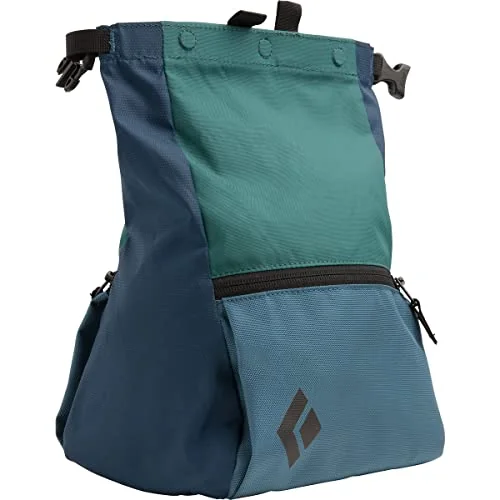
A pot is a bouldering and cragging tool, and it makes no sense on a harness. It’s also the format that gets shared, which is worth knowing if you climb with a regular crew. One person brings the pot, everyone dips, and nobody’s carrying four half-empty bags. The tradeoff is bulk in the pack and the fact that a wide open mouth is the single dustiest way to apply chalk, so a pot is the first thing a strict gym will object to.
Roped Climbing And The One-Hand Dip
For sport and trad, you want a standard drawstring bag on a belt or a harness loop, fleece-lined, and reachable without looking. Everything about that bag is designed around one motion: hand goes back, finds the opening, comes out chalked, all while your other hand is holding you on the wall.
Size is the part people get wrong. A standard bag runs roughly 7 inches tall by 5 inches wide, a wide mouth opening sized so a full hand fits inside, which means hand size is a real variable and not a detail to skip. Too small and you’re doing awkward partial fingertip dips exactly when you’re pumped and need a real coat. Too big and it swings on your hip, catches on the rock at chimneys, and wastes chalk every time you sit into the harness.
Most bags ship with a webbing belt, but plenty of climbers clip theirs to a rear gear loop instead with a small non-locking biner. That’s where the chalk bag quietly joins the rest of your carabiners, quickdraws and belay hardware as one connected system on the harness, which matters more on multi-pitch and trad climbing days when everything on your waist has to coexist for hours.
The Chalk Bag for Rock Climbing (2 Zip Pockets, Azure Blue) (check it out) is a straightforward budget-friendly entry into that standard-size category, fleece lined with a belt loop and zip storage for a phone and keys at the crag. It does the job a first bag needs to do without asking you to have opinions yet.
You know a bag is right when you stop noticing it. Hand goes back, finds the mouth, comes out chalked, and you never once thought about it. That takes a couple of sessions to develop, and a wrong-size bag never gets there. You keep glancing down, and glancing down mid-route costs you more than the bag did.
When You Barely Need A Bag At All
If liquid chalk is your primary format, the honest advice is to not buy the bag first. A bottle in the pack covers your whole session. Add a small bag only if you top up with powder between attempts, and if you don’t, you’ve saved yourself a purchase entirely.
This is the anti-sell, and it’s real. Plenty of gym climbers running liquid-only have a chalk bag they bought on day one that has never held chalk.
The One-Click Starter Setup
For the reader who wants zero decisions on day one, bundles exist. The Petzl SAKAB Chalk Bag with Power Crunch chalk included (see the bundle) ships as bag plus loose chalk, which means one order and nothing to match up. The tradeoff is obvious: you’re accepting somebody else’s answer to the format question. If your gym allows loose chalk, that’s a fine trade for a first setup.
Two notes to close the pairing conversation. Capacity translates simply: a pot holds a session’s worth for a group, a hip bag holds a session for one person. And brush holders, belt-loop styles, and closure hardware matter far less to this decision than the width of the mouth, so if you want that depth we’ve got closure type, lining and capacity broken down bag by bag in its own article. Pick your format here, then go pick your hardware there.
How Humidity And Heat Change The Answer

Chalk that worked fine all winter suddenly feels useless in July. It isn’t the brand, and it isn’t you getting weaker. It’s the water in the air and the water on your hands, and the format you picked decides how hard it hits you. Cold, dry conditions run the opposite way, which is why alpine climbing rarely produces the chalk complaints a humid summer crag does.
Loose chalk left open in a humid environment clumps and cakes, and once it does, it stops transferring to skin properly. You dip, you come out with a thin uneven film and a few chunks, and the coat you needed isn’t there. This is the “brick” climbers complain about, the second meaning of the word from the block chalk section. A half-open bag riding in a hot car trunk or living in a humid gym bag can go from powder to solid in days, not months.
Go back to the hygroscopic mechanism and the timeline makes sense. Chalk saturates faster when the air is already loaded with moisture, so on a humid day your effective re-chalk interval shortens. You’re not imagining that you’re dipping twice as often. You are, and no brand of powder fixes it, because the powder isn’t the variable.
This is also where liquid chalk earns its price. The alcohol carrier actively evaporates moisture on application rather than passively absorbing it, so one liquid application can outlast several loose dips in a sweaty summer session. That’s the whole argument for carrying it in July even if you’re a loose-chalk climber the rest of the year.
Worth remembering that friction is never a chalk-alone problem. It’s chalk plus surface plus moisture, and the surface half of that equation changes everything, how chalk behaves against different rock types is a real variable on the same humid day that’s ruining your powder. Humid limestone and humid granite are not the same problem.
Caked chalk isn’t ruined, it’s just compressed. The move climbers describe at humid summer crags is crushing the clump back to powder with a knuckle between routes, right there in the bag. It works fine. The actual fix is upstream: store the bulk supply sealed, keep it out of the car, and refill your bag from it in small amounts.
Practical summer kit, then. Crush and sieve the clumped stuff back to usable, keep the bulk supply in something that seals, and carry liquid chalk as the base layer for humid days even if you use powder everywhere else. That’s a two-format setup, and humidity is the reason most climbers end up with one whether they planned it or not.
What Is Actually In Your Chalk
Somebody at every gym has a confident opinion about chalk dust and lungs. Most of those opinions are unsourced. Here’s what’s actually established, what isn’t, and where the honest line between them sits.
Start with the compound itself. Pure magnesium carbonate is classified by the CDC as posing no substantial health hazard. That’s the good news and it’s genuinely good news, because it means the base ingredient isn’t the question.
The question is what commercial chalk gets cut with. Chalk sold to climbers is rarely pure, and depending on the source it can carry crystalline silica and trace heavy-metal dust as impurities. Cheap bulk chalk is the bigger unknown here, not magnesium carbonate. That’s an argument for buying from brands that state their purity rather than for avoiding chalk.
Particle size explains why the air in a busy gym looks the way it does at 8pm. Roughly 90% of chalk dust particles measure 5 microns or smaller, and particles under 1 micron effectively never settle, because gravity has negligible effect on something that small. The haze isn’t waiting to fall. It’s staying up until the ventilation moves it.
The same source, the Climbing Wall Association’s summary of the particle-size and exposure data, also carries the only exposure benchmarks anyone has to work with: OSHA’s permissible limit of 15 mg/m³ for total nuisance dust over an 8-hour shift, and NIOSH’s recommended 10 mg/m³ total with 5 mg/m³ respirable. Those are workplace numbers written for factories, not gyms. They’re the closest thing to a legal yardstick that exists.
And here’s the part most articles skip. Dr. Cheryl Pirozzi, a pulmonary physician at the University of Utah, states plainly that there is no published research on the long-term effects of humans breathing chalk dust.
Nobody knows. Not the doctors, not the gyms, not the person with the confident opinion by the mats.
The caution climbers practice around chalk dust is precautionary, not proven, and that’s worth saying honestly instead of implying either safety or harm that the evidence doesn’t support.
What you do with that is a judgment call, not a directive. If the air quality at your gym genuinely bothers you, liquid chalk is the format that measurably changes it, not a chalk ball. That’s the one practical lever the research actually supports.

The other habit that cuts dust costs nothing at all. Most of the chalk you add mid-session is compensating for holds that are already caked with everyone else’s, and brushing holds instead of adding more chalk fixes the actual problem. Less chalk in the air, better friction on the hold, and you use less of the stuff you paid for.
Keeping The System Working

A chalk bag is a fleece-lined container of damp hand sweat and powder that lives in the bottom of a gym bag. Nobody washes it. Then they wonder about the smell.
The fleece is the culprit, and it’s doing exactly what fleece does. Skin oil, sweat, and dead skin go in with every dip and the pile holds all of it, packed in with the chalk. Over a season that mixture compresses into the fabric and stops behaving like fleece at all.
The routine is short. Empty it, turn it out, shake it hard outside rather than over the gym floor, and hand-wash the shell periodically. The one step people skip is the important one: let it air dry completely before you refill it. Put fresh chalk into a damp bag and you’ve manufactured a chalk brick on purpose.
This is the same maintenance thinking that keeps the rest of your kit working, and the same routine that keeps carabiners running clean applies here, chalk gear is just the piece everyone forgets exists.
Refillable socks make the long game cheaper. One bag, one sock, and you rotate what’s inside based on what you’re doing and what your gym allows, instead of buying a new sealed product every few months.
Storage is the other half. Keep bulk chalk sealed and out of the car, because heat plus humidity together is what actually ruins it. A sealed container on a shelf indoors will hold fine for a year.
Here’s the tell most climbers miss. The smell isn’t the signal, because you get used to the smell. The signal is the fleece: when a bag has been in service a season, the lining goes stiff and slick where the chalk has packed into it, and slick fleece stops holding chalk the way it should.
Run a finger inside. If it feels more like a plastic bag than a sweater, it’s overdue.
Building Your First Chalk Setup

You’ve got the model now. Here’s the buying order, which is deliberately not the order the shop displays them in.
- Check your gym’s rules page. Ninety seconds, and it eliminates whole categories before you spend anything. If it says contained chalk only, loose and block are off the table for indoor use no matter what anyone recommends.
- Pick the chalk format that survives that filter and fits your discipline and your climate. Boulderer in a dry climate at a permissive gym? Loose or block. Sport climber in a humid summer? Liquid as your base, powder for top-ups. If bouldering is where you’re starting, the rest of the beginner bouldering kit walks through what sits alongside the chalk.
- Buy the bag that format demands, and only now. Wide-mouth pot for two-hand dips, standard 7×5-class drawstring for one-hand reaches mid-route, or nothing at all if you’re liquid-primary.
The two-format hybrid is where most experienced climbers land eventually, and there’s no rule saying you have to arrive there the slow way. Liquid base layer, loose or ball for top-ups. Starting there on day one is completely legitimate and saves you a season of trial and error.
Where the money should go is straightforward. Chalk is a consumable and it’s cheap per session in every format including the premium ones. The bag is a one-time buy that lasts years if you don’t destroy it. Spend accordingly: don’t agonize over chalk brands while buying the cheapest possible bag, because you’ll replace the bag and you won’t remember the chalk.
One last thing about brands, since it’ll come up. Climbers talk about send chalk, meaning the particular brand they credit part of their performance to. It’s mostly superstition and everyone knows it’s mostly superstition.
But texture preference is real even when the magic isn’t, and if a specific grind genuinely feels better when you chalk up on a redpoint attempt, that’s a legitimate reason to buy it. Just don’t expect it to add a grade.
Conclusion
The chalk format decides the bag, not the other way around, so make the decision in that order and the bag question mostly answers itself.
Chalk balls stop spills, not dust. Liquid chalk is the only format that measurably changes what you’re breathing, and that’s worth knowing whether or not it changes what you buy.
Check your gym’s chalk policy before you buy anything, because a banned format is a return no matter how good it is.
Next step is the free one: pull up your gym’s rules page before your next session and see which formats it allows. Then match the bag to whatever survives that filter, and you’re done thinking about this.
Frequently Asked Questions
01What kind of chalk do you put in a chalk bag?
Any of the three dry formats: loose chalk, crushed block chalk, or a chalk ball or refillable sock. Liquid chalk is the exception, since it goes on your hands directly from the bottle. If your gym restricts loose chalk, a refillable sock is usually the accepted middle ground.
02Is loose chalk or liquid chalk better for climbing?
Neither wins outright, because they solve different problems. Loose chalk applies instantly and costs less per session, while liquid chalk lasts longer in humid conditions and is the only format shown to bring airborne dust near a no-chalk baseline. Most experienced climbers use both.
03How long does liquid chalk take to dry?
Roughly 20 to 30 seconds to fully set as a base layer. Mistiming that is the most common liquid chalk mistake: apply it before you start or during a real rest, never in the seconds before a hard move, because tacky half-set liquid chalk grips worse than loose chalk would have.
04Why did my chalk turn into a hard clump?
Humidity. Magnesium carbonate absorbs moisture from the air, so loose chalk stored half-open in a humid gym bag or a hot car cakes into what climbers call a brick within days. You can crush it back into usable powder, but the real fix is sealed storage out of the heat.
05Do chalk balls actually reduce chalk dust?
Less than most climbers assume. A study cited by the Climbing Wall Association found chalk balls produced airborne particle levels comparable to block chalk, so they stop floor spills without meaningfully changing the air. Liquid chalk was the only format that dropped concentrations near no-chalk levels.
Safety Notice: Rock climbing and mountaineering are inherently high-risk
activities that can involve physical trauma or fatal incidents. The information on Rock Climbing Realms is for
educational and informational purposes only. Techniques and advice presented here are not a substitute
for professional, hands-on instruction. Conditions and risks vary by location. Always seek guidance
from a qualified instructor before attempting new techniques. By using this website, you agree that you
are solely responsible for your own safety. Any reliance you place on this information is strictly
at your own risk, and you assume all liability for your actions. Rock Climbing Realms and its authors
will not be held liable for any harm, damage, or loss sustained in connection with the use of this information.
Affiliate Disclosure: We are a participant in the Amazon Services LLC Associates Program, an
affiliate advertising program designed to provide a means for us to earn advertising fees by advertising and linking
to Amazon.com. As an Amazon Associate, we earn from qualifying purchases. We are also an official affiliate partner
of Black Diamond Equipment via the AvantLink network. If you click on a Black Diamond affiliate link and make a
purchase, we may earn a commission at no additional cost to you. We also participate in other affiliate programs.
Additional terms are found in the terms of service.