
In this article
I was fifty feet up a classic 5.9 when my partner yelled “ROCK!” from the belay ledge. I hugged the wall, heard a horrifying whirr past my ear, and watched a microwave-sized granite block shatter at the base. That sound changes how you look at the wall. After a decade of dodging sketchy flakes across the country, I learned that rocks rarely cut loose without leaving clues. Here is the exact 5-step rockfall hazard assessment you need to spot bad stone and dodge debris before you even tie in.
⚡ Quick Answer: You navigate loose rock by checking recent weather, scanning for fresh scars at the base, and testing suspect holds with a firm palm strike. Throwing on a helmet is just your last line of defense. The real trick to alpine risk mitigation is learning to read the wall, but most climbers skip step one and pay the price for it.
Step 1: Macro-Trigger Analysis (What the Weather Is Doing)

Most climbers think clear skies mean stable routes. That assumption gets people hurt. The mountain does not care if you have a bluebird Saturday. Before you even pack the car, you have to run a recreational crag assessment based on what the weather did yesterday. Civil engineers use a massive matrix called the Rockfall Hazard Rating System (or RHRS) to figure out where to build highway catch fences. You can skip the math, but you need to pay attention to the same variables to understand what the wall is feeling.
The “Hydraulic Jack” Effect of Freeze-Thaw
Water destroys rock. It is that simple. When rain or snowmelt seeps into tiny cracks in a granite face, it waits for the temperature to drop. When water freezes, it expands in volume by exactly nine percent. This creates a literal hydraulic jack inside the mountain. The ice pries the crack wider, millimeter by millimeter, separating the outer block from the main wall.
If you had a cold night and you are now watching the morning sun hit the route, that ice is melting. The jack is releasing. The glue holding those loose flakes together turns to water, and gravity takes over. This is why you hear unexpected crashes first thing in the morning. Freeze-thaw cycles are the most common mechanical trigger for falling debris, especially in alpine zones like the Cascades or the Dolomites.
Pro-Tip: Treat morning sun on a frozen wall as an active hazard, not just a chance to warm up your hands. Give the route a few hours to shed the loose stuff before you rack up.
Seasonal Probabilities: When Is It Most Dangerous?
Timing matters more than the specific route. You dial in your seasonal timing by understanding how weather shifts weaken the stone. Spring melt happens to be the sketchiest time to climb. The ice that kept everything glued together all winter turns to slush, causing massive, unpredictable shedding.
Autumn brings heavy rainstorms. Intense rain washes out the packed dirt and sediment that holds precarious blocks in place. If a route just took three days of torrential downpour, the dirt matrix is gone. Winter climbing often feels solid because the ice locks everything in place, but you are always one warm afternoon away from a surprise. Understanding these patterns is a core part of reading mountain meteorology before you commit to an approach.
Even if you memorize the seasonal cycles and wait for the perfect weather window, the rock is actively changing. The environment at the crag operates independently of the forecast you read that morning.
The Sneaky Summer Threat: Thermal Expansion
Summer throws a curveball that catches veterans off guard. You are roped up on a dead-calm Tuesday in July, zero wind, zero rain, and a slab of granite suddenly peels off the wall. This happens due to the micro-climate effect of direct sunlight baking the rock face.
Dark rock absorbs heat fast. The outer layer of the wall literally expands faster than the cool rock underneath it. This thermal expansion causes the outer layer to buckle and snap. Geologists studying the thermal expansion of granite on calm days note that south-facing walls endure the most stress. The harsh contrast of sun vs shade creates daily movement. If a route sits in the baking hot sun all afternoon, approach the loose sections with serious suspicion, as the wall is actively peeling itself apart.

Step 2: The Sector Scan and Bio-Indicators

The second phase of your 5-point crag check starts when you drop your pack at the base. Forget the guidebook for a minute. Look at the ground. The history of the cliff is written in the dirt and the trees. If you know what to look for, the environment gives you a map of every active fall zone.
Spotting Fresh Scars and Vulnerable Gullies
Your first visual check covers the wall itself. You are hunting for fresh scars. Old rock turns gray, gathers dust, and oxidizes. When a chunk of rock falls off, it leaves behind a bright, clean patch that looks like a freshly pulled tooth. If you see bright white or distinct orange patches on a dark gray limestone wall, a block dropped recently. Never set up your belay directly under those bright spots.
Gullies act as natural funnels. The classic alpine V-notch couloir collects every piece of debris that drops from the upper face. If the base of a gully looks like a gravel quarry full of sharp, unweathered scree, you are staring at a bowling alley. These are the red flags of loose rock that tell you to pick a different line or move fast.
Tree Kinks: The Crag’s Hidden History Book
You do not need an advanced geology degree to track falling rocks. The trees tell the story. This involves checking bio-indicators right at the base. Trees growing near a cliff act as living witnesses to every major impact.
Look for sudden kinks or ‘S’ curves in the tree trunks. When a bowling-ball-sized rock smashes into a young sapling, it bends the tree over. The tree survives, but it has to grow a hard right angle to reach the sun again. If you notice every tree in a thirty-foot radius has a massive scar at chest height, you are standing in a historic strike zone. Use that information for identifying historical rockfall paths and stash your gear somewhere else.
Once you check the trees, you still have to verify the timeline of when those rocks fell. The ground tells you what happened, but the vegetation covering the boulders tells you exactly when it happened.
Lichen Rules: New Rock vs. Old Rock
Lichen patterns offer the most honest timetable at the crag. Lichen grows at a painfully slow rate—sometimes just a millimeter a year. If you spot a massive, dinner-plate-sized patch of crusty yellow lichen on a block, that block has not moved in a century. It is solid.
On the flip side, if an entire section of the wall features bare, clean rock while the surrounding face is covered in green and black fuzz, that section sheds routinely. If a loose block has lichen growing sideways or underneath it, the rock flipped recently. Combine these clues to build a mental picture of understanding crag rock geology before you tie your figure-eight. Once you understand the history written in the dirt, it is time to start physically testing the rock on the route.
Step 3: Acoustic Testing – Listening for the “Drum”

Visual checks only get you so far. Once you pull off the ground, you have to gather physical data. The look listen test framework keeps you attached to the wall when the holds look suspect. Do not pull blindly on a flake that looks solid. You have to interview the rock first.
Palm Strikes vs. Gentle Tugs
A gentle tug tells you nothing. You can pull lightly on a hundred-pound block, feel it hold your weight, and assume it is safe. Then you stand on it, shift your hips, apply outward leverage, and the whole thing rips loose.
Instead of pulling, use a firm palm strike. Hit the suspect hold with the heel of your hand. You want to send blunt force straight into the stone. If it is a foothold down by your knees, give it a solid kick with the toe of your climbing shoe. A secure connection to the main wall transfers that energy away, giving you a sharp, painful thwack. A loose block absorbs the hit and vibrates. You will literally feel the stone shudder under your hand.
Pro-Tip: Do not test a hold by pulling outward if you are directly underneath it. Hit it with your palm first. If it moves, find a different sequence.
Acoustic Physics: Why Unstable Rock Sounds Hollow
That vibration produces a specific noise. When you strike a solid wall, the sound waves absorb deep into the mountain. If the flake is partially detached, an air gap exists behind it. The sound waves hit that air gap and bounce right back at you.
This creates a terrifying, low-pitched hollow boom. We call this the drummy sound. It means the only thing keeping that television-sized block on the wall is gravity and friction. The acoustic signature of detached rock is unmistakable once you hear it. Relying on hollow sound testing turns an assumption into an educated fact. If it sounds like a drum, treat it like a loaded trap. Do not pull out on it, and definitely do not place a cam behind it. If you fall on that cam, the outward force will pry the block off the wall, cutting your rope in the process.
While doing the palm strike yourself is mandatory, sometimes you get lucky and someone else already did the dirty work. Pay close attention to anything drawn on the wall that looks unnatural.
Respect the Chalked ‘X’
Climbers have a universal visual warning system. If you reach for a jug and see a massive ‘X’ drawn in climbing chalk, do not use the hold. Chalk-marked x’s mean someone else already did the palm strike, heard the drum, and almost took a trip to the hospital finding out.
Do not be the hero who tests it again. The chalk mark is a gift from a previous party. Bypass the hold entirely. Recognizing these community warnings is a mandatory part of updating your daily risk assessment as you move up the pitch, keeping you alert for the next trap.
Step 4: The Human Factor – Escaping Autopilot

The mountain drops the rocks, but human error determines who gets hit. The American Alpine Club (or AAC) publishes accident reports every year. A staggering percentage of injuries happen to veterans, not beginners. Climbing requires intense focus, but experience breeds complacency. Escaping the cognitive traps keeps you off the rescue stretcher.
The Familiarity Trap on Classic Routes
You hike up to a classic moderate route you have climbed fifty times. You know every handhold, every rest stance, and every gear placement. Because the route feels familiar, you turn off your hazard assessment brain. This is the familiarity trap.
Mountains erode every single day. A block that felt solid last October might have shifted over the winter. When you climb on autopilot, you stop knocking on flakes. You stop looking for fresh scars. You just blindly grab the holds based on muscle memory. Treat your local crag with the same suspicion you apply to an unclimbed alpine ridge. The rock does not know you climb there every weekend.
The “Expert Halo” and Speaking Up
Beginners face a different psychological trap. When you rope up with someone who has ten years of experience, you naturally assume they know what they are doing. If they stand directly under a loose gully, you assume it is safe. This is the “expert halo” effect.
Read any breakdown of human factors in climbing accidents and you notice a pattern. The novice saw the danger but stayed quiet because they did not want to sound stupid. If you hear the crack-boom sound of falling rock two routes over, say something. If your veteran partner sets up a belay in a stupid spot, speak up.
Your own ego and assumptions are dangerous, but external pressure makes it even worse. Climbing around other people changes how you behave, often causing you to shortcut your own safety rules.
Why Rushing Gets Climbers Hurt
Crowded crags create artificial pressure. Another party waits at the base, staring at your back. You want to move fast to clear the pitch. Rushing makes you sloppy.
When you rush, you grab the closest hold instead of the solid one. You throw your rope blindly instead of coiling it. You skip the palm strikes. The pressure to perform forces you into bad decisions. Managing belayer error and risk normalization means accepting that a slow, deliberate send beats a trip in a helicopter. Ignore the party behind you, test the rock, and prepare for the worst.
Step 5: Tactical Positioning and The Belayer’s Escape

You checked the weather, you scanned the scars, and you tested the holds. A rock falls anyway. Now you depend entirely on your crag base positioning. The belayer takes the brunt of the danger because they are anchored to the ground. Surviving a direct hit comes down to geometry and reflex.
Finding the True “Fall Shadow”
When a rock drops from two hundred feet up, it rarely falls straight down. It hits the lower angle slabs, shatters, and ricochets outwards like shrapnel. Most belayers naturally want to back away from the wall to get a better view of their climber. This puts them exactly where the bouncing rocks land.
You want to find the true fall shadow. Stand tight against the base of the cliff. By hugging the vertical wall, the debris bounces out and over your head. Find an overhang, a small roof, or a solid tree, and anchor there. Check resources on managing rockfall hazards at the belay to master the geometry of the belayer’s safe zone. Always position yourself opposite your climber’s first piece of gear. If they rip a rock loose, you want to be out of the direct plumb line. Establishing a smart belay stance is non-negotiable.
The “Pack Shrug” Defensive Posture
When you hear your partner scream “ROCK!”, you have less than two seconds to react. Your instinct tells you to look up and spot the danger. If you look up, you expose your face, your neck, and your throat to high-velocity stone.
Instead, execute the pack shrug. Stare straight down at the dirt. This points the reinforced crown of your helmet directly at the sky. Next, pull your shoulders aggressively up to your ears. This wedges your heavy climbing backpack against the base of your helmet, creating a makeshift neck guard. A defensive posture feels counterintuitive, but taking a glancing blow off your pack hurts a lot less than taking a rock to the jaw. Plan your belayer’s escape route before the climber leaves the ground, but if you cannot move, turtle up and brace for impact.
Protecting yourself on the ground is only half the battle. When you finish the route and start your descent, your own gear becomes the biggest threat to the parties underneath you.
Saddlebagging the Rope in Chossy Terrain
Many rockfalls are human-triggered. Dragging a rope over loose terrain pulls small stones down onto the parties below. Rappelling creates the absolute worst scenario. Tossing a sixty-meter rope blindly down a dark gully guarantees that you will dislodge loose scree.
Instead of throwing the rope, use a rope management tactic called saddlebagging. You butterfly coil both ends of the rope into even loops, and clip those loops directly to the gear loops on your harness. As you rappel down the wall, you feed the rope out of the bags one arm-length at a time. Saddlebagging ropes prevents the cord from snagging on sketchy flakes fifty feet below you. Efficient strategic alpine rope management minimizes your footprint on shattered alpine routes. Even with perfect rope management and positioning, you still need a final layer of physical armor.
Your Gear’s Last Stand: Helmet Reality Check

The final barrier between a falling rock and a traumatic brain injury sits on your head. Climbing helmets are mandatory, but you need to understand what they can actually stop. A foam dome does not make you invincible. Treating a helmet like a magic forcefield breeds bad habits.
Linear Hits vs. Rotational Forces
Standard climbing helmets excel at taking a direct, straight-down hit. Testing facilities drop heavy weights squarely onto the crown of the helmet to measure linear impact. If a golf-ball-sized rock drops straight out of the sky onto the top of your head, the EPS foam crushes, absorbs the force, and gives you another day at the crag.
Real life lacks pristine testing conditions. Rocks hit the side of your head. They glance off the back. You take a weird fall and swing sideways into a dihedral. These angled impacts create rotational forces. The helmet suddenly twists, causing your brain to slosh and rotate inside your skull. This twisting motion tears tissue and causes severe concussions. The effect of helmet design on impact performance proves that standard foam struggles with oblique, off-axis strikes.
Does MIPS Actually Matter for Rockfall?
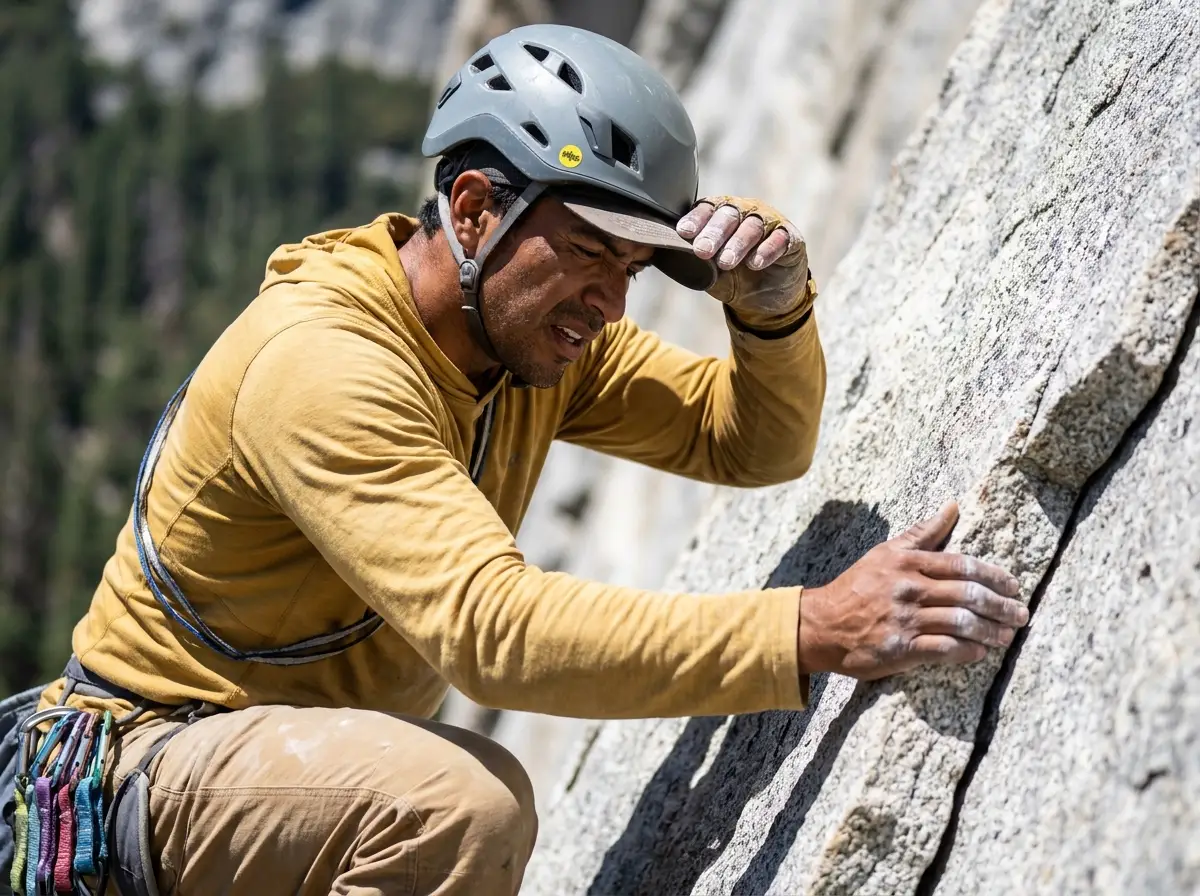
You see the yellow logo on high-end helmets, but what does it actually do? MIPS stands for Multi-directional Impact Protection System. It is a thin, low-friction plastic layer inside the foam shell.
When a rock hits you at an angle, the MIPS layer allows the helmet shell to slide roughly ten to fifteen millimeters independently of your head. That tiny slip redirects the violent spinning energy away from your brain. It sounds like a gimmick until you slam the side of your head into a limestone roof. The weight penalty sits at around forty grams, roughly the weight of an energy bar. It is absolutely worth the investment. Use that context when selecting the best rock climbing helmet for an upgrade, knowing that a few extra dollars could save you from a major concussion.
Pro-Tip: Helmets are single-use items. If you take a serious rock strike, the internal foam crushes permanently. The helmet might look fine on the outside, but it will not protect you twice. Retire it and buy a new one.

Conclusion
Rocks fall for a reason. Taking the mystery out of the process allows you to approach the wall with confidence. Monitor the temperature swings before you drive to the cliff. Scan the dirt and the tree lines to locate the active fall zones. Knock on the holds with a firm palm to find the hollow patches, and actively fight the urge to rush.
Your local crag requires the same disciplined checklist you would bring to a massive alpine wall. Find the fall shadow, buy a helmet that mitigates rotational shear, and stop letting the “expert halo” dictate safety. Next time you rack up at the base, turn off the autopilot and read the rock.
FAQ
What are the signs of potential rockfall on a climbing route?
Fresh, bright-colored rock scars, a hollow drummy sound when struck, and disoriented lichen heavily suggest loose rock. Chalked ‘X’ marks are universal warnings left by climbers to mark suspect flakes on a route.
What time of day is rockfall most common?
Mid-to-late afternoon on south-facing walls sees the highest danger. The sun triggers thermal expansion, causing granite flakes to heat up, buckle, and peel away from the cooler rock underneath, even on completely windless days.
What should you do if someone yells ROCK! while climbing?
Do not look up. Shrug your shoulders tight to your ears to protect your neck with your backpack, press yourself hard against the wall in the fall shadow, and angle the top of your helmet straight up.
Are climbing helmets effective against large rockfall?
A helmet effectively deflects golf-ball and baseball-sized rocks, but it will never save you from a direct hit by a microwave-sized block. Helmets offer a final, flawed line of defense; your hazard assessment matters much more.
Safety Notice: Rock climbing and mountaineering are inherently high-risk
activities that can involve physical trauma or fatal incidents. The information on Rock Climbing Realms is for
educational and informational purposes only. Techniques and advice presented here are not a substitute
for professional, hands-on instruction. Conditions and risks vary by location. Always seek guidance
from a qualified instructor before attempting new techniques. By using this website, you agree that you
are solely responsible for your own safety. Any reliance you place on this information is strictly
at your own risk, and you assume all liability for your actions. Rock Climbing Realms and its authors
will not be held liable for any harm, damage, or loss sustained in connection with the use of this information.
Affiliate Disclosure: We are a participant in the Amazon Services LLC Associates Program, an
affiliate advertising program designed to provide a means for us to earn advertising fees by advertising and linking
to Amazon.com. As an Amazon Associate, we earn from qualifying purchases. We are also an official affiliate partner
of Black Diamond Equipment via the AvantLink network. If you click on a Black Diamond affiliate link and make a
purchase, we may earn a commission at no additional cost to you. We also participate in other affiliate programs.
Additional terms are found in the terms of service.