
In this article
Three hours into a Red River Gorge mega-day, you grab a hold you’ve stuck a hundred times and your hand opens like it belongs to someone else. You’re not scared. You’re not overtrained. You’re empty. That mid-session power crash had nothing to do with your fitness and everything to do with the clock on your last meal.
After fifteen years of climbing through bonks, mystery pumps, and “why am I so weak today” sessions, I’ve learned that nutrient timing is the single highest-leverage thing most climbers ignore. Not supplements. Not macros. Just when you eat.
This article breaks down the exact pre-climbing timing windows, during-climb fueling, and post-climbing recovery window protocols backed by climbing-specific energy data, so you can stop guessing and start fueling around your actual physiology.
⚡ Quick Answer: Eat complex carbs 2–4 hours before climbing, simple carbs 30–60 minutes before, 30–60 g carbs per hour during sessions over 60 minutes, and 20–40 g protein plus carbs within 30–60 minutes after. Spread 20 g+ protein across meals every 3–4 hours throughout the day. For finger health, add 15 g collagen with vitamin C 45 minutes before your session.
Why Timing Beats Total Calories for Climbing Performance
Your Muscles Run on a Timer, Not a Calorie Counter
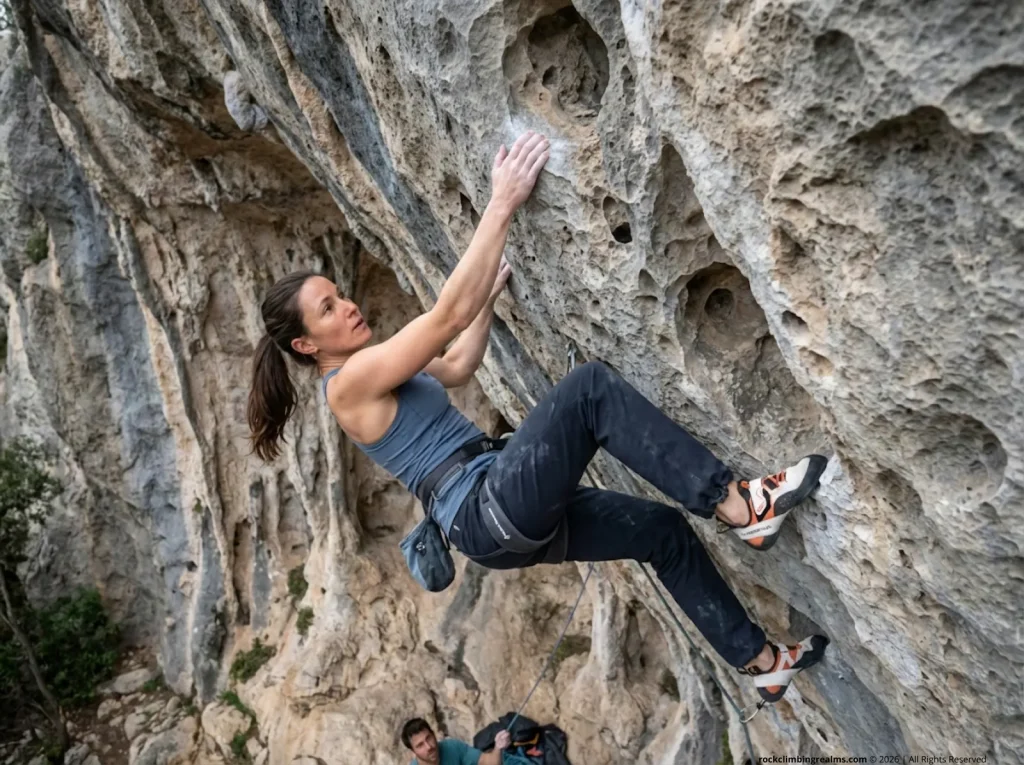
Active climbing burns between 10 and 13 kcal per minute on the wall. Factor in rest between burns and you’re looking at roughly 300 kcal/h of climbing energy expenditure for a full session. That rate means your muscle glycogen is on a ticking clock whether you feel it or not.
Climbing relies heavily on Type II muscle fibers for explosive moves—crimp locks, dynos, powerful heel hooks. These fibers burn glycogen faster than the slow-twitch fibers you’d use jogging to the crag. And unlike running, climbing is intermittent high-intensity work: 30 to 90 seconds of near-maximal effort, then a rest on a ledge or at the belay.
Your body stores roughly 400 g of glycogen in muscle and 100 g in the liver. A hard two-hour bouldering session can drain 30 to 50 percent of glycogen stores post-climbing in your forearms and pulling chain. Once it’s gone, no amount of willpower will make that crimp feel solid. Your send potential drops whether you realize it or not.
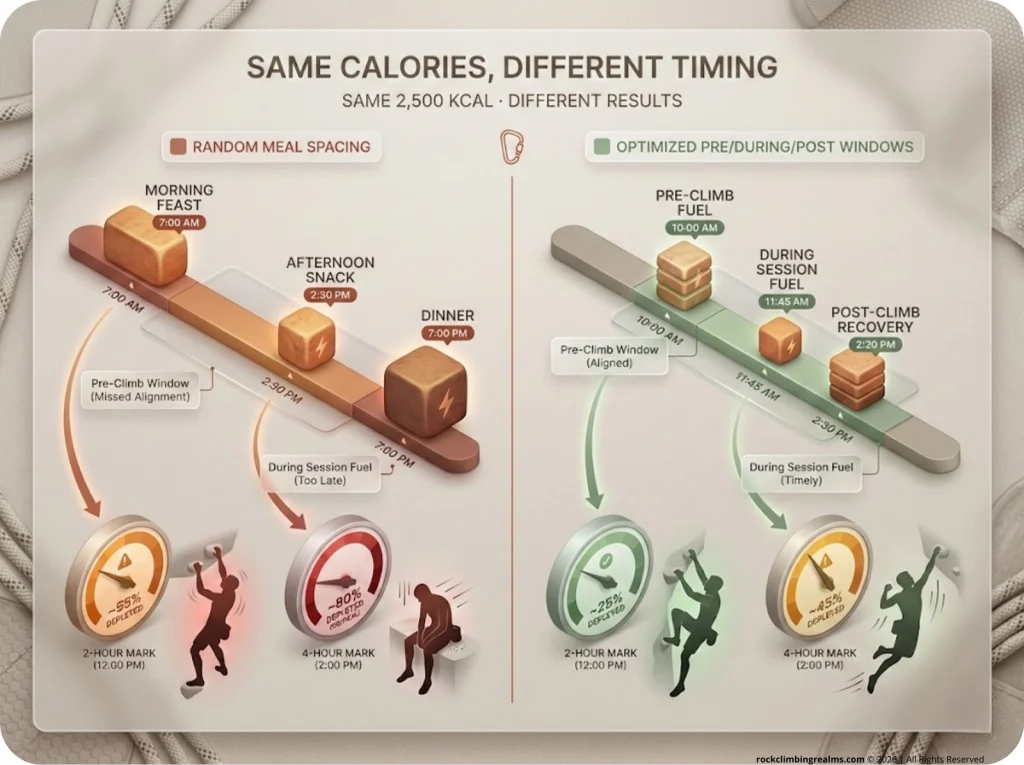
Pro tip: If you track total calories but still bonk on the wall, the problem is almost certainly timing rather than quantity. Shift your focus from daily totals to when those calories land relative to your session.
Bouldering vs. Multi-Pitch: Two Completely Different Fuel Demands
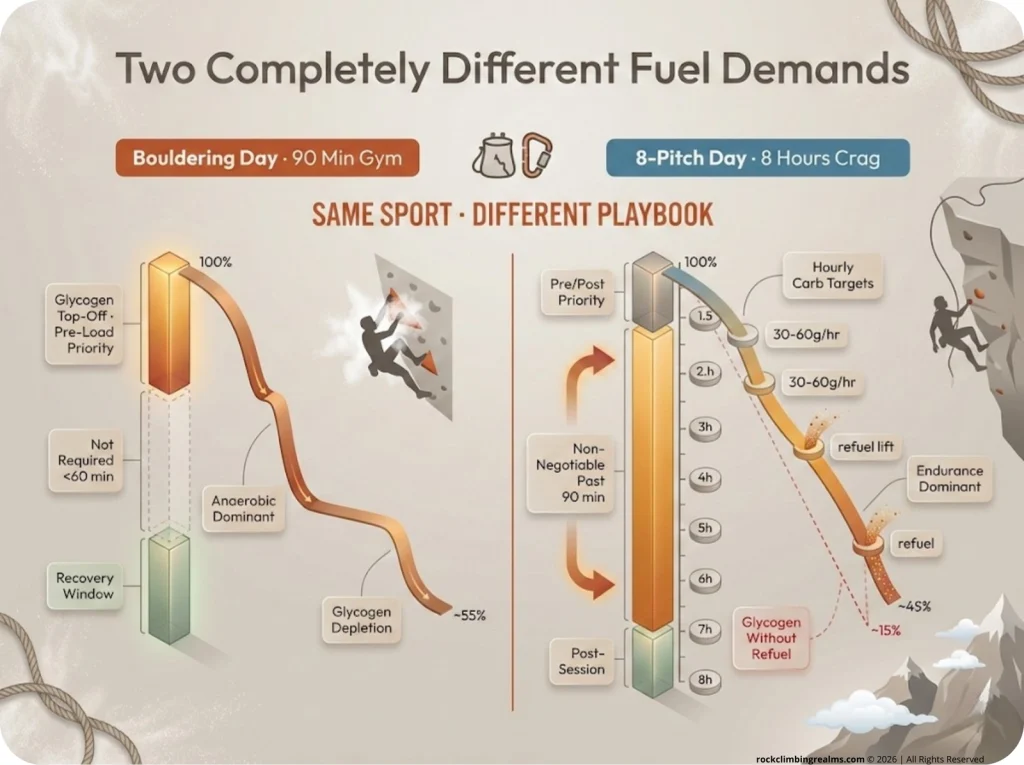
This is the gap nobody talks about. A 90-minute gym bouldering session and an 8-pitch day at the crag have almost nothing in common nutritionally, but every nutrition article treats them the same.
Bouldering sessions (5 to 10 minute efforts with long rests) are dominated by anaerobic power. The anaerobic demands mean your pre-session and post-session windows matter most. During-climbing fueling is unnecessary if you’re done within 60 minutes. Think of it as a glycogen “top-off”—a quick preload, not a full marathon carb-load.
Multi-pitch climbing and long sport days (3 to 10 hours) flip the equation. Endurance climbing dominates, and during-session fueling becomes non-negotiable past 60 to 90 minutes. Skip it and you’ll feel strong on pitch 3 and hollow by pitch 7. If you’re building bouldering-specific power, make sure your fueling strategy matches the session type, not just the sport.
Competition climbing is the hybrid case—4 to 5 hours of high-intensity bursts with rest between rounds. Treat during-fueling like a multi-pitch day and intensity like a bouldering session.
The Pre-Climb Window: Loading Glycogen Without the Crash
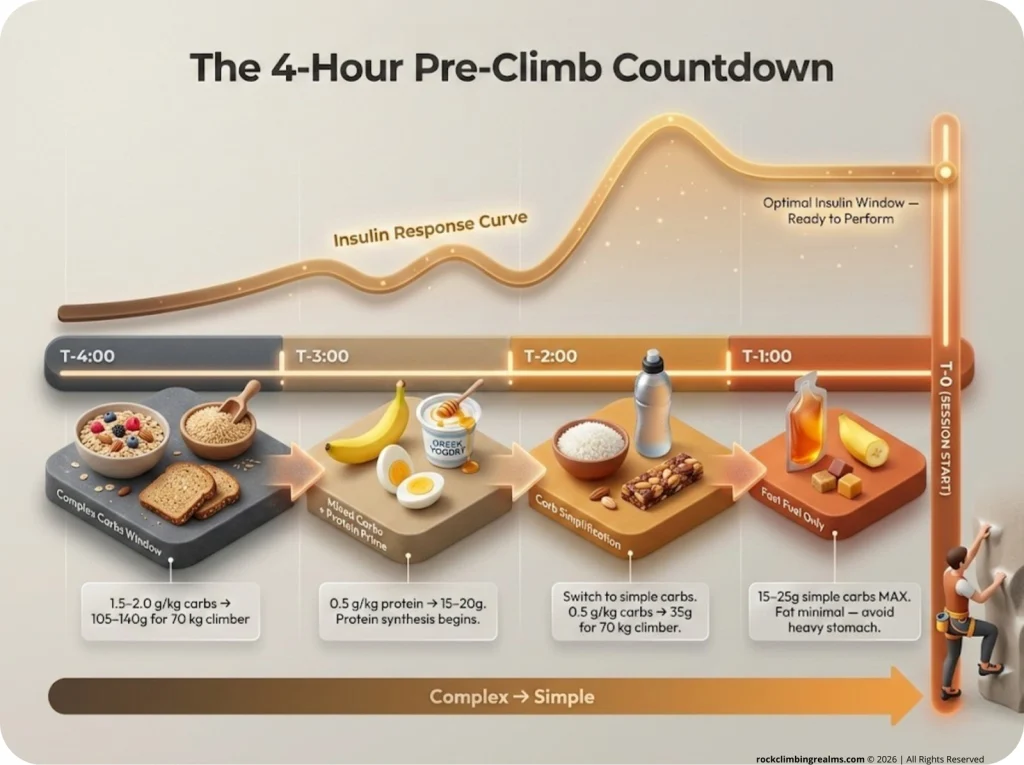
The 1-to-4-Hour Countdown
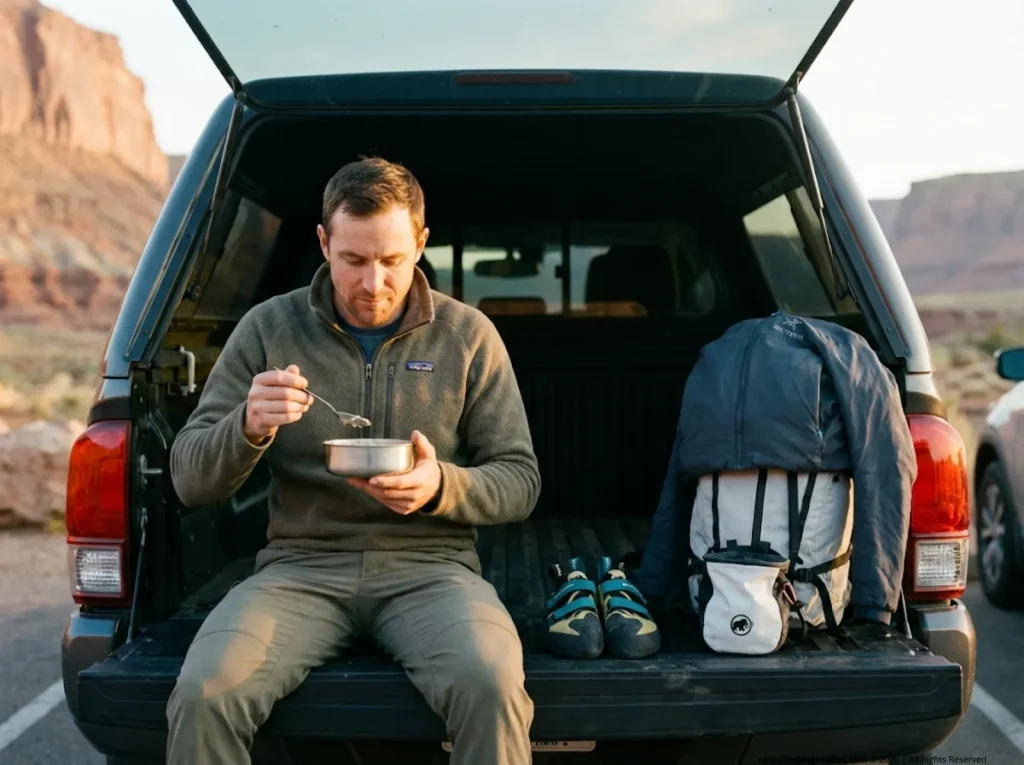
Two to four hours before your session, eat complex carbohydrates—oatmeal, whole grain toast, sweet potato, rice. These break down slowly and stockpile glycogen without flooding your bloodstream. The target is 1 to 4 g/kg body weight, according to the International Society of Sports Nutrition position stand on nutrient timing. For a 70 kg climber, that’s 70 to 280 g carbs. Start at the lower end for a gym session and go higher for an all-day crag outing.
Thirty to sixty minutes before, switch to simple carbohydrates—a banana, an energy bar, a handful of dried fruit. This tops off liver glycogen without triggering a heavy insulin release that leaves you feeling flat right as you pull on.
The trap nobody warns you about: eating a large carbohydrate-rich meal 60 to 90 minutes before your climbing session can spike insulin, crash your blood glucose, and leave you weaker than if you’d eaten nothing. The two-stage approach—big meal early, small snack late—solves this.
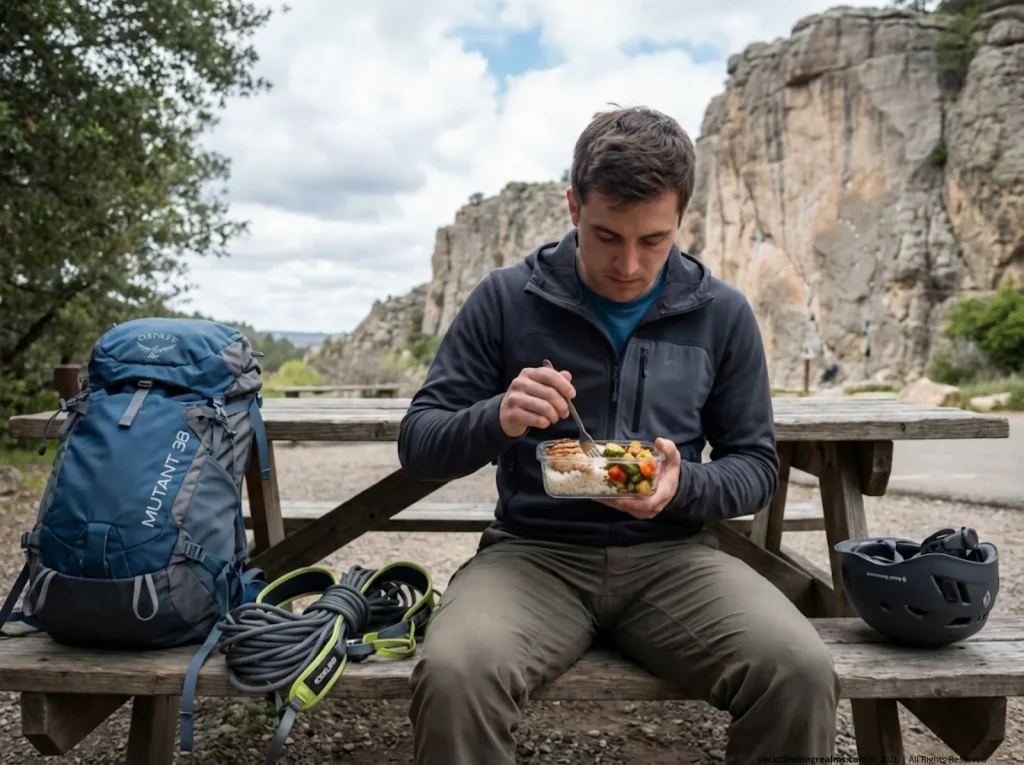
Pro tip: Eat your biggest pre-workout meal 3 hours out. Think rice bowl and chicken, not a Clif Bar 20 minutes before your warm-up. The bar is a top-off, not a meal.
What About Pre-Climb Protein?
Adding 15 to 20 g dietary protein to your pre-climb meal primes muscle protein synthesis before you even start climbing. This matters more than most people realize.
It matters even more for women. Dr. Stacy Sims recommends 15g pre-protein alongside carbs for female athletes because gender hormonal differences affect how nutrients get partitioned. That pre-workout protein snack can be the difference between feeling flat and feeling ready.
Fat in the pre-workout meal is fine in small amounts but should not be the focus. Dietary fat slows digestion speed, and the last thing you want is a heavy stomach on steep terrain. Keep it moderate.
Fueling During the Session: When and How Much
The 60-Minute Rule
Under 60 minutes, water and maybe a few sips of electrolyte drink are enough. Your pre-session fueling handles this window.
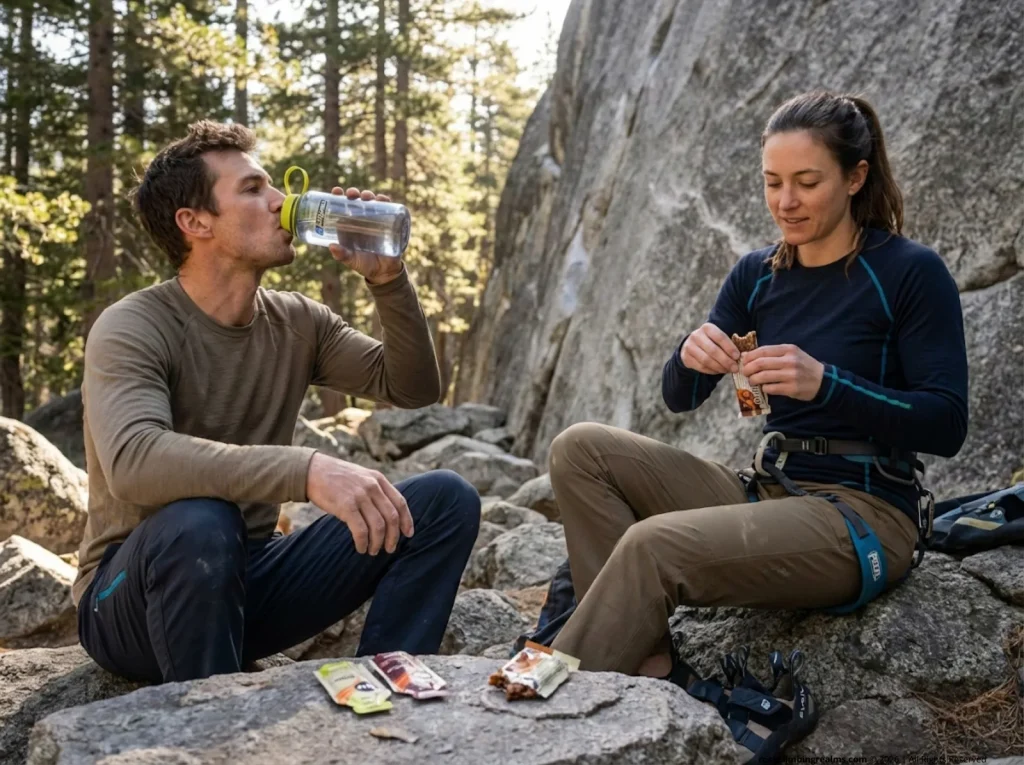
Past 60 minutes, you need 30 to 60 g carbs per hour. This isn’t arbitrary—your body can absorb carbohydrates from a single source at a maximum rate of roughly 60 g/h based on absorption curves for single-source carbs. Climbing burns about 300 kcal per hour overall, and during-exercise carbs are what prevent the blood glucose crash that turns crux moves into survival climbing.
Practical translation: one banana (27 g carbs) plus a few swigs of sports drink (15 to 20 g) gets you roughly 45 g per hour. The trick is starting early enough. If you wait until you feel sluggish, you’re already 30 minutes behind the curve.
Pro tip: Set a timer on your watch for every 45 minutes at the crag. Eat a snack whether you feel hungry or not. Hunger is a lagging indicator—by the time your brain tells you to eat, your muscles are already running on fumes.
What to Eat While Climbing
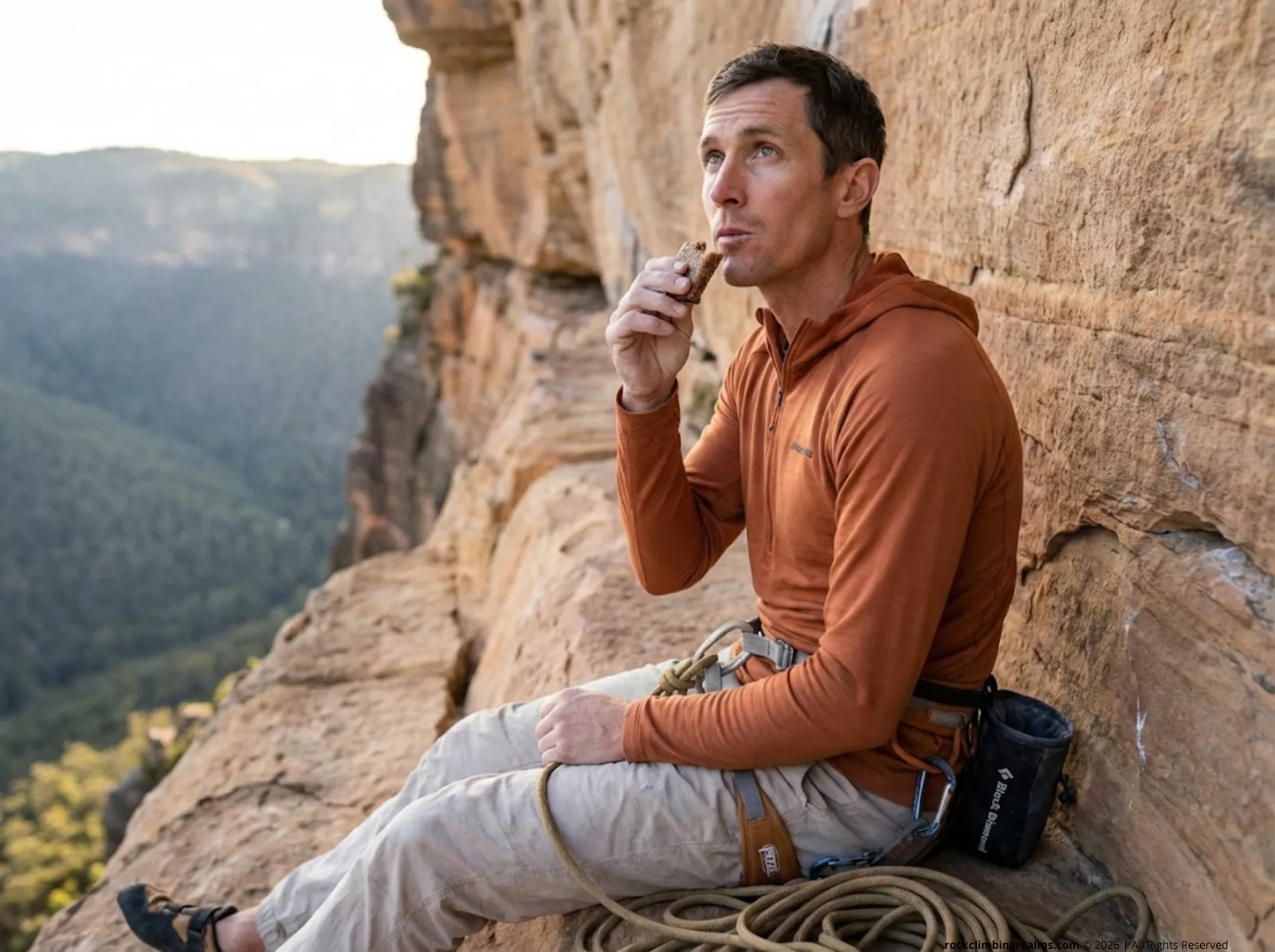
Quick options that work at the crag: dates, dried mango, fig bars, rice cakes with honey, diluted juice. These are fast-digesting carbs that hit the bloodstream quickly without sitting heavy in your gut. Consider ready-to-go products like a GU Energy Gel or Larabar for convenience.
Avoid anything high in fat or fiber during the session. Trail mix with chocolate and nuts might feel like crag food, but it slows absorption and risks GI distress prevention problems when you’re pumping hard on a steep wall. Save the nuts for the drive home.
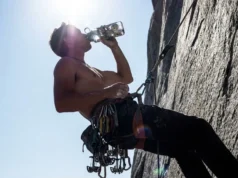
Hydration runs parallel to fueling: aim for roughly 250 mL per hour and add sodium for sweat replacement if you’re climbing in heat. Losing more than 2 percent of your body weight in fluid tanks both power output and grip. If you’re serious about dialing in your sweat rate and electrolyte balance, treat hydration priority with the same precision you give your carbs.
Post-Climb Recovery: The Window That Actually Matters
Protein + Carbs Within 60 Minutes
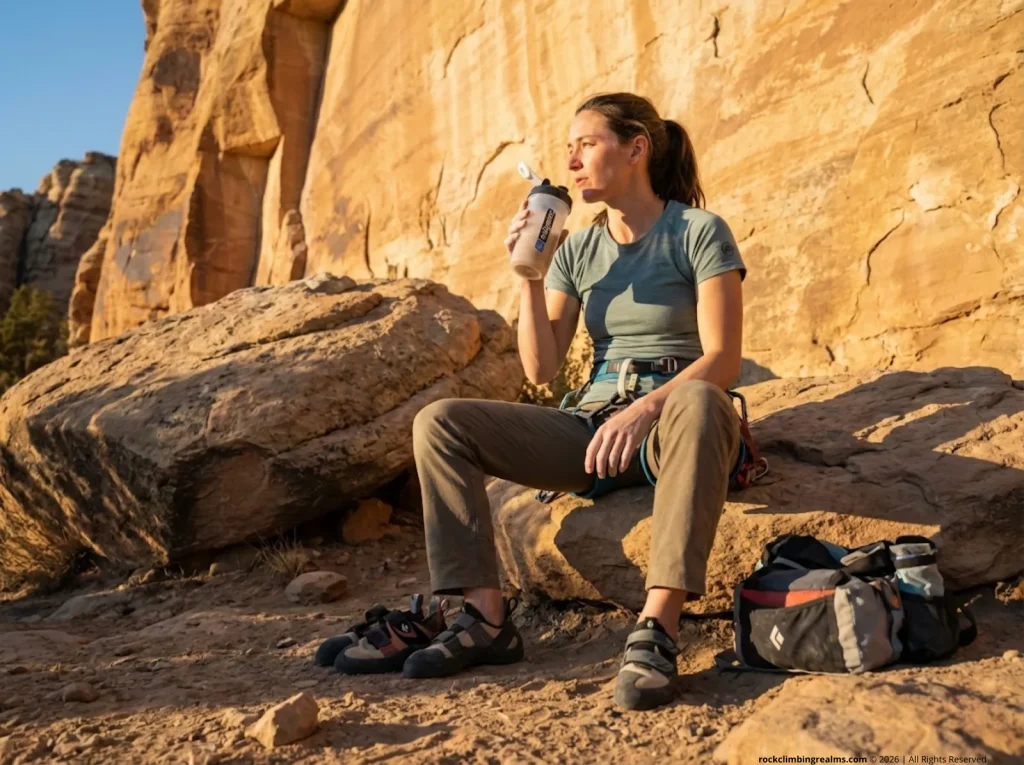
Within 30 to 60 minutes after your last pitch, get 20 to 40 g high-quality protein into your system. This triggers muscle protein synthesis for repair. Pair it with carbs: 1.2 g/kg per hour for the first 4 to 6 hours if you need rapid glycogen resynthesis—like if you’re climbing again tomorrow. That rate lets you accelerate recovery and come back strong for back-to-back days.
The classic “anabolic window” is less rigid than gym culture taught you. If you ate a solid pre-climb meal, the window extends to 3 to 5 hours, per the 2013 meta-analysis on post-exercise nutrient timing. But if you climbed fasted or on minimal food, that 30 to 60 minute post-climbing recovery window becomes genuinely critical.
The simplest system that works: protein shake plus a banana at the car. Real recovery meal within two hours. Done.
Gender Differences in Post-Climb Recovery
Dr. Stacy Sims‘ research shows female athletes have a shorter effective post-exercise window—roughly 45 minutes compared to 60-plus for men. Gender hormonal differences in nutrient partitioning drive this gap, and it’s practical, not theoretical.
Women should add 15 g protein to their pre-workout snack AND prioritize 25 to 30 g protein within 30 minutes post-session. During the high-hormone phase (luteal phase), your ability to access glycogen shifts, making pre-session and during-session fueling even more important.
This isn’t hype. It’s how sex-based climbing physiology works, and most nutrition strategies ignore it completely. If you’re interested in structuring your recovery days for supercompensation, factor these timing adjustments into the equation.
Protein Spacing: The Rule Most Climbers Ignore
20 Grams Every 3–4 Hours Beats One Giant Post-Climb Shake
Here’s where most climbers get it backwards. They obsess over the post-session shake and forget about the other 22 hours.
The ISSN position stand puts it clearly: meeting total daily protein (1.4 to 2.0 g/kg for active athletes) with evenly spaced feedings, approximately every 3 hours, should be the primary emphasis. Each feeding needs a minimum of roughly 20 g protein with 2 to 3 g leucine to hit the amino acid pool threshold for muscle protein synthesis. Below that, you’re wasting the opportunity. Above 40 g per meal, the extra amino acids mostly get burned for energy rather than used for repair.
Brian Rigby (MS, CISSN) puts it bluntly: “Carbohydrates offer the greatest benefit for timing as they increase exercise performance in-the-moment. Neither protein nor fat has this capability.” Translation: time your carbs tightly around sessions. Spread your meals out by around 3 hours and protein across the day.
Practical version for a 75 kg climber: breakfast (25 g), mid-morning snack (20 g), lunch (30 g), pre-climb snack (15 g), post-climb shake (30 g), dinner (30 g). That’s about 150 g total, hitting 2.0 g/kg without ever needing to choke down a 60 g mega-shake. Protein spacing every 3 hours is the system. It works.
Fat Timing: It Doesn’t Matter (and That’s Good News)
Dietary fat has no acute timing relevance for climbing performance. There is no “fat window.” This simplifies your planning enormously—focus carbs around sessions, distribute protein across the day, and eat fat whenever it fits your balanced meals.
The one exception: avoid high-fat meals in the 60 minutes before and during climbing. Not because of a timing effect, but because fat slows digestion and increases the odds of stomach trouble on steep terrain. If you’re curious about how low-carb diets interact with climbing performance, the short answer is that carbohydrate timing strategically works better for most climbers than removing carbs entirely.
The Collagen Timing Hack for Finger Health
30–60 Minutes Pre-Session: Gelatin + Vitamin C
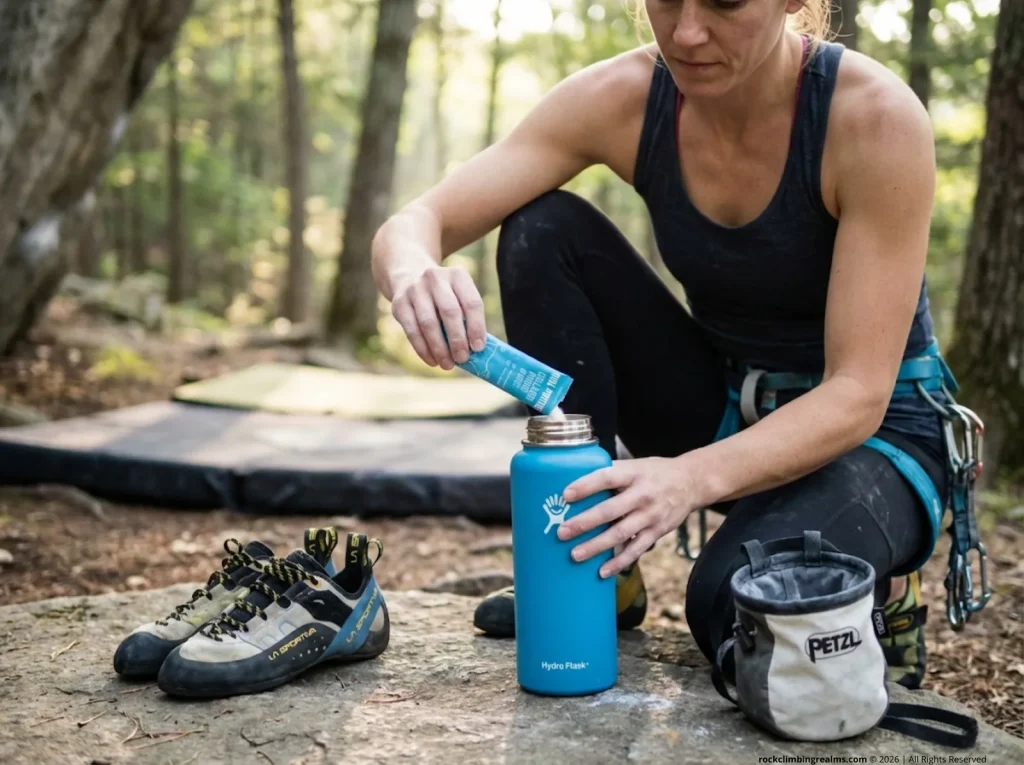
This one flies under the radar. Research by Dr. Keith Baar at UC Davis shows that consuming 15 g of gelatin or hydrolyzed collagen with 50 mg vitamin C, 30 to 60 minutes before exercise, increases collagen synthesis rates in tendons and ligaments. It’s one of those findings from exercise physiology that hasn’t crossed over into most climbing circles yet.
Climbing loads finger pulleys and forearm tendons intensely. This is the one area where a separate timing window—outside the carb and protein framework—targets finger tendon collagen timing directly. Mix collagen powder with orange juice 45 minutes before your session. It’s tasteless, cheap, and has published data behind it.
This is not magic. It’s a supportive protocol that adds to proper progressive loading and tendon conditioning over weeks and months. But for climbers who have a history of A2 pulley tweaks, it’s worth adding to your routine. Vitamin C is non-negotiable—it’s required for collagen cross-linking. Without it, the gelatin just digests as regular protein. If you’ve ever dealt with a pulley injury, you know how slow recovery can be. Check the full finger pulley recovery protocol for the complete picture.
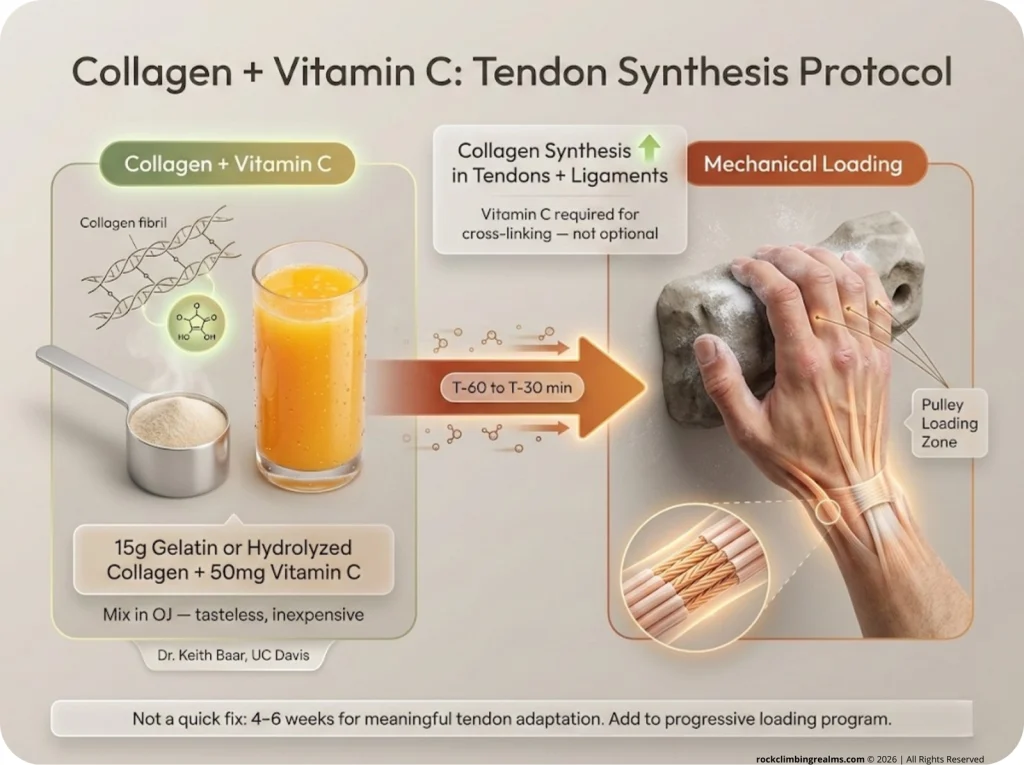
Pro tip: Start the collagen protocol 4 to 6 weeks before a project trip, not the day before. Tendon adaptation is slow. You won’t feel anything dramatic, but your fingers will hold up better through back-to-back heavy days during your training blocks.
Your Timing Playbook: Sample Schedules by Session Type
Gym Bouldering Session (90 Minutes)
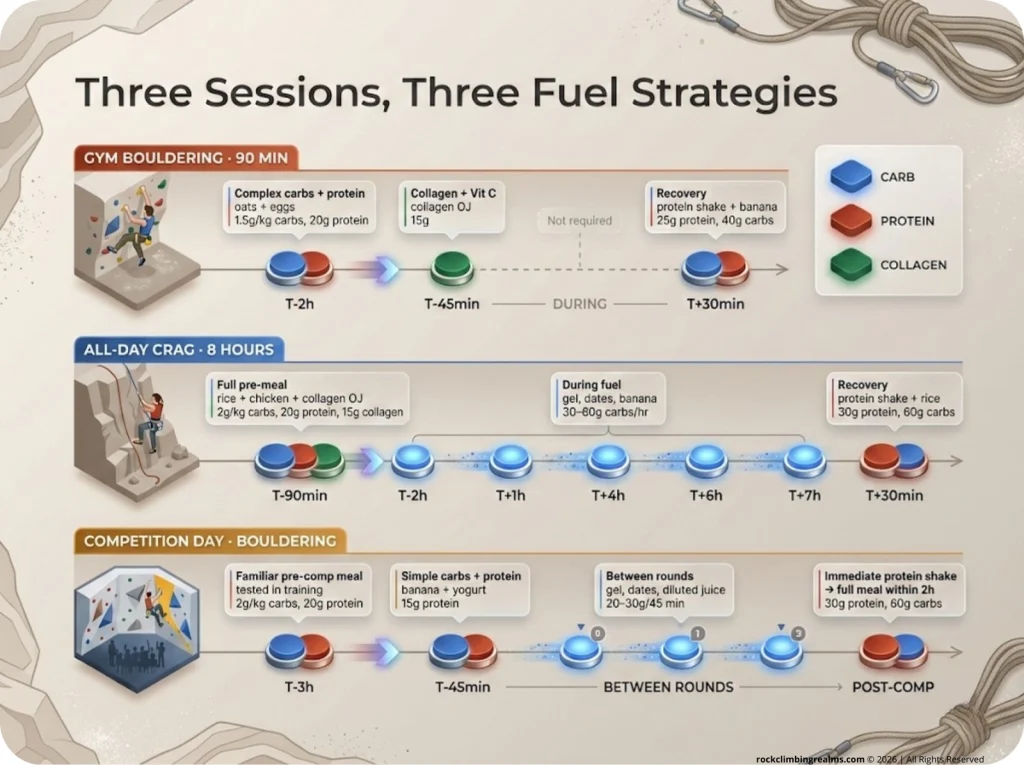
Three hours before: oatmeal, banana, peanut butter—roughly 60 g carbs, 15 g protein, 12 g fat. Forty-five minutes before: collagen plus OJ. Thirty minutes before: handful of dried fruit (20 g carbs). During: water and electrolyte sips only since the session is under 90 minutes. Within 30 minutes after: protein shake plus banana (30 g protein, 30 g carbs). Two hours after: full meal with rice, chicken, and vegetables.
All-Day Crag Session (6–8 Hours)
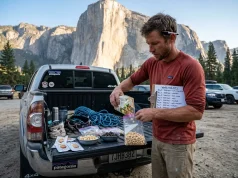
Three hours before: large breakfast—oatmeal, eggs, toast—roughly 80 g carbs and 25 g protein. This is where you top off the tank for the day. Forty-five minutes before: collagen plus OJ. Every 45 to 60 minutes during: 30 to 45 g carbs from fig bars, Skratch Labs drink mix, or rice cakes with honey. Midday: a real-food recovery lunch at the car—sandwich, fruit, electrolyte refill. Within 30 minutes after your last pitch: recovery shake or chocolate milk with 30 g protein and 40 g carbs. Evening: substantial dinner with a carb reload for the next day.
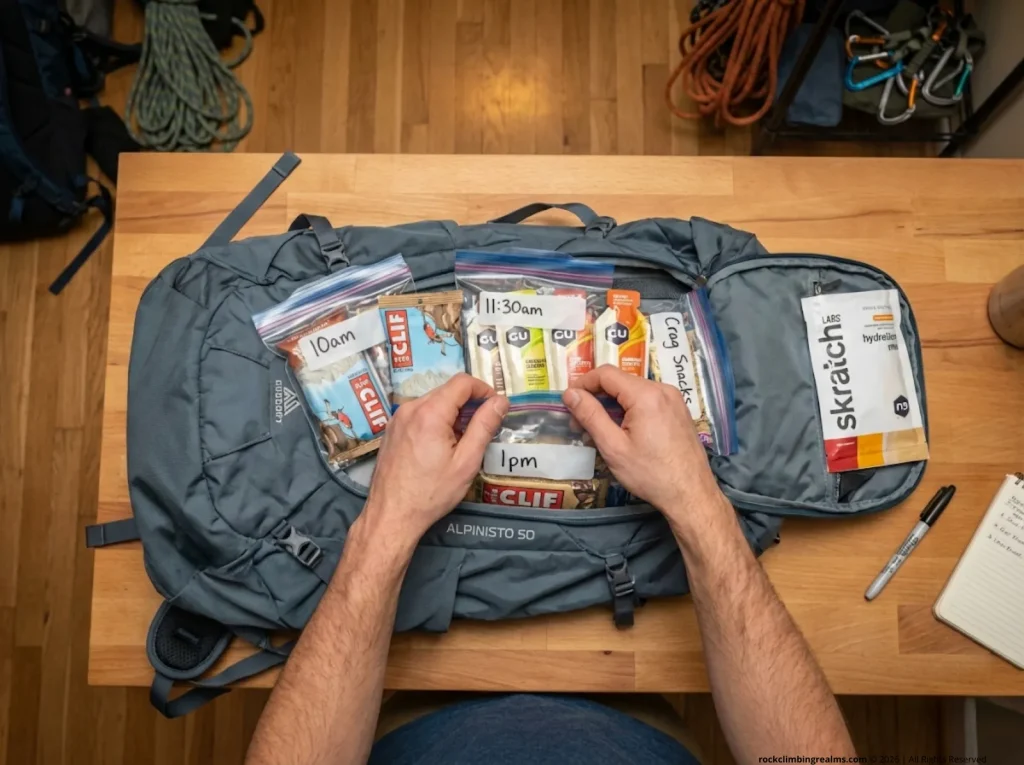
Pack everything the night before and label snacks by time. Ziploc bags marked “10am,” “11:30am,” “1pm.” Sounds obsessive. Works every time. Understanding the physiology of the pump and how fueling delays it will convince you that this kind of planning is worth the 15 minutes the night before.
Competition Day (Bouldering)
Three hours before: your familiar pre-competition meal, tested in training—nothing new on comp day. Forty-five minutes before: simple carbohydrates plus 15 g protein (especially important for women). Between rounds: 20 to 30 g carbs every 45 minutes from gels, dates, or diluted juice. Post-comp: protein shake immediately, full meal within two hours. Hydrate constantly between rounds. Your overall climbing performance during the later rounds depends on what you did in the first hour, not the last ten minutes.
Conclusion
Three things to walk away with. First, timing your carbs around climbing sessions—not just eating more food—is the single highest-leverage nutrition change for sending harder and recovering faster. Second, spread protein across 4 to 5 daily feedings of 20-plus grams each; the post-workout shake matters, but way less than your total daily distribution. Third, the collagen plus vitamin C pre-session protocol is the one move worth adding for finger tendon health that almost nobody in the climbing world talks about.
Pick one session type from the playbook above. Run it for two weeks straight. Track how you feel at the two-hour mark compared to how you used to feel. That data will tell you more than any article can.
Now go send something.
FAQ
When should I eat before a climbing session?
Eat a complex carbohydrate meal 2 to 4 hours before and a simple carb snack 30 to 60 minutes before. The two-stage approach stockpiles glycogen without triggering an insulin crash right as you start climbing.
How many carbs do I need per hour while climbing?
Aim for 30 to 60 g carbs per hour for sessions longer than 60 minutes. Climbing burns roughly 300 kcal per hour overall, and your body absorbs carbs at a maximum rate of about 60 g/h from a single source. Start at 30 g/h and adjust based on exercise intensity.
Does protein timing really matter for climbers?
Total daily protein distributed across 4 to 5 meals matters more than the exact post-workout window. That said, if you climb fasted or with minimal pre-session food, getting 20 to 40 g protein within 60 minutes post-climb becomes important for triggering muscle protein synthesis.
What should I drink during a long climbing day?
Water plus electrolytes—target roughly 250 mL per hour and add sodium if you’re sweating heavily. Losing more than 2 percent of your body weight in fluid intake drops your power output and grip strength noticeably.
Is there a nutrition difference between men and women climbers?
Yes. Dr. Stacy Sims’ research shows female athletes have a shorter post-exercise recovery window (about 45 minutes versus 60-plus for men) and benefit from adding 15 g protein to their pre-workout snack. Hormonal fluctuations during the menstrual cycle also affect glycogen access, making pre-session and during-session fueling even more important for women.
Safety Notice: Rock climbing and mountaineering are inherently high-risk
activities that can involve physical trauma or fatal incidents. The information on Rock Climbing Realms is for
educational and informational purposes only. Techniques and advice presented here are not a substitute
for professional, hands-on instruction. Conditions and risks vary by location. Always seek guidance
from a qualified instructor before attempting new techniques. By using this website, you agree that you
are solely responsible for your own safety. Any reliance you place on this information is strictly
at your own risk, and you assume all liability for your actions. Rock Climbing Realms and its authors
will not be held liable for any harm, damage, or loss sustained in connection with the use of this information.
Affiliate Disclosure: We are a participant in the Amazon Services LLC Associates Program, an
affiliate advertising program designed to provide a means for us to earn advertising fees by advertising and linking
to Amazon.com. As an Amazon Associate, we earn from qualifying purchases. We are also an official affiliate partner
of Black Diamond Equipment via the AvantLink network. If you click on a Black Diamond affiliate link and make a
purchase, we may earn a commission at no additional cost to you. We also participate in other affiliate programs.
Additional terms are found in the terms of service.