
In this article
You’re on a 5.11 that should be in your wheelhouse. There’s a tiny edge two moves in and every time you step on it, your foot slides off, you grab harder, and your arms start screaming before the crux. The hold isn’t too small. Your placement is wrong.
I’ve watched this exact pattern repeat at the crag for fifteen years — intermediate climbers pulling hard because their feet won’t stick, getting pumped on routes that climbers at the same grade sail through. The difference isn’t finger strength. It’s where the rubber lands and what the eyes do three seconds before.
This guide breaks down precise foot placement on small holds from contact mechanics to rock-specific adaptations, including the part most technique articles skip entirely: how to actually build the proprioceptive sense that makes small holds feel solid.
Quick Answer: Here’s how to place your feet precisely on small holds:
- Identify the exact contact point on the hold before your foot moves
- Keep your eyes on the foothold the entire time your foot travels to it
- Use the front 8–10mm of your toe box — not the arch, not the mid-foot
- Match your foot angle to the hold geometry (inside edge for vertical, heel-drop for slopers)
- Place with control and commit — no adjustment once rubber contacts rock
- Weight the hold deliberately before transferring your full load
Why Legs Do the Work Your Arms Are Begging to Quit
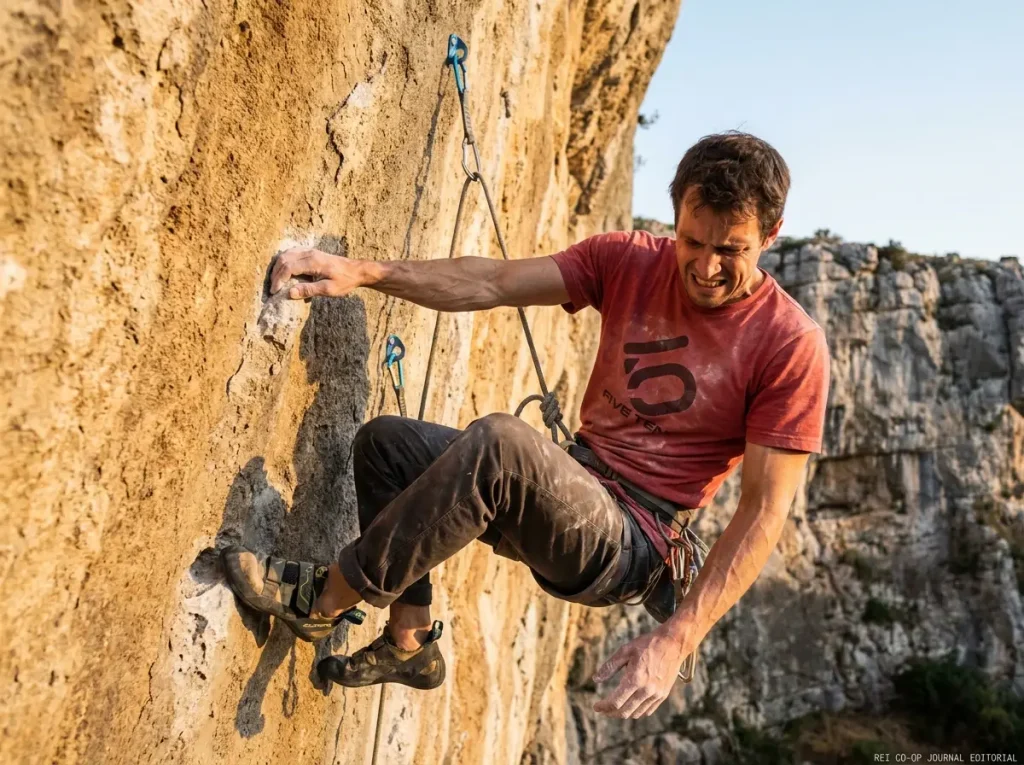
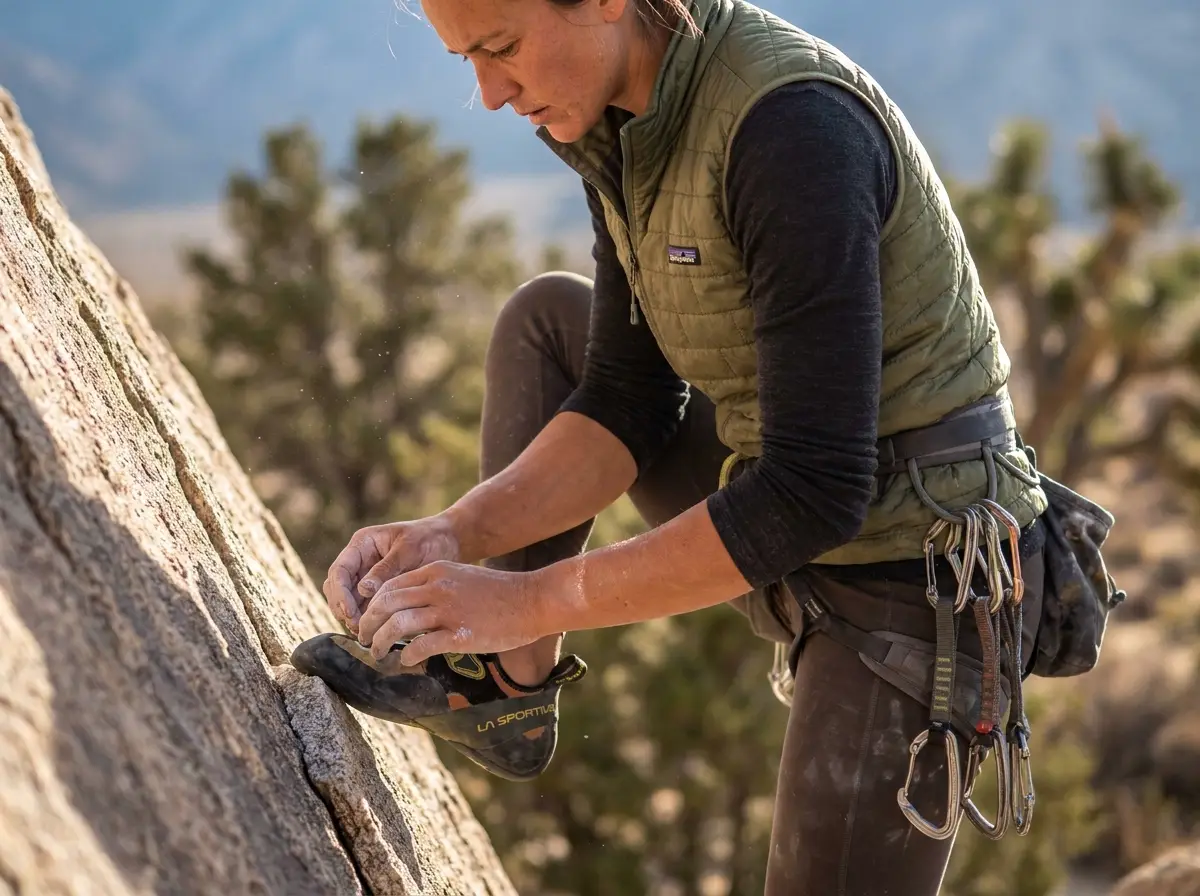
Most climbers treat their feet as an afterthought. The hands find holds, the feet follow. By the time the feet have landed somewhere approximate, the hands are already pulling for the next hold. This is exactly backwards, and it explains most of the pump people feel on routes below their technical ceiling.
The math your muscles already know
Your legs can generate roughly three to four times the sustained force of your arms before fatiguing. Every pound of load you carry on your feet instead of your hands extends your time on the route and delays the burn. When your foot placement is sloppy — landing on the back edge of a hold, or on the wrong face of a sloper — your foot contribution drops toward zero and your arms compensate.
A single missed foothold on a crux sequence doesn’t just cost you that move. It costs you grip endurance for the next four moves, because your hands spent extra force correcting what your feet should have held.
What “pushing off your feet” actually means
The goal isn’t to stand on your feet — it’s to push through them. When you’re on a small edge, the force vector should run through your skeleton: hip over knee, knee over ankle, ankle over toe. If your heel is floating or your hip is too far from the wall, the force disperses sideways and your foot pops.
Learning to load your legs properly starts with finding your balance point over each foot before you move. It’s slower. It pays. Climbers who look methodical below their redpoint grade move that way intentionally — they’re building positions, not just grabbing moves.
Pro tip: If you find yourself grabbing holds more than three times as hard as you need to just to stand on the move, your feet aren’t working. Step back one grade and spend a session focused entirely on foot loading. Count to two on every foothold before your hands move. Boring as watching paint dry, and it will change your climbing.
What Part of Your Shoe Actually Goes on the Hold
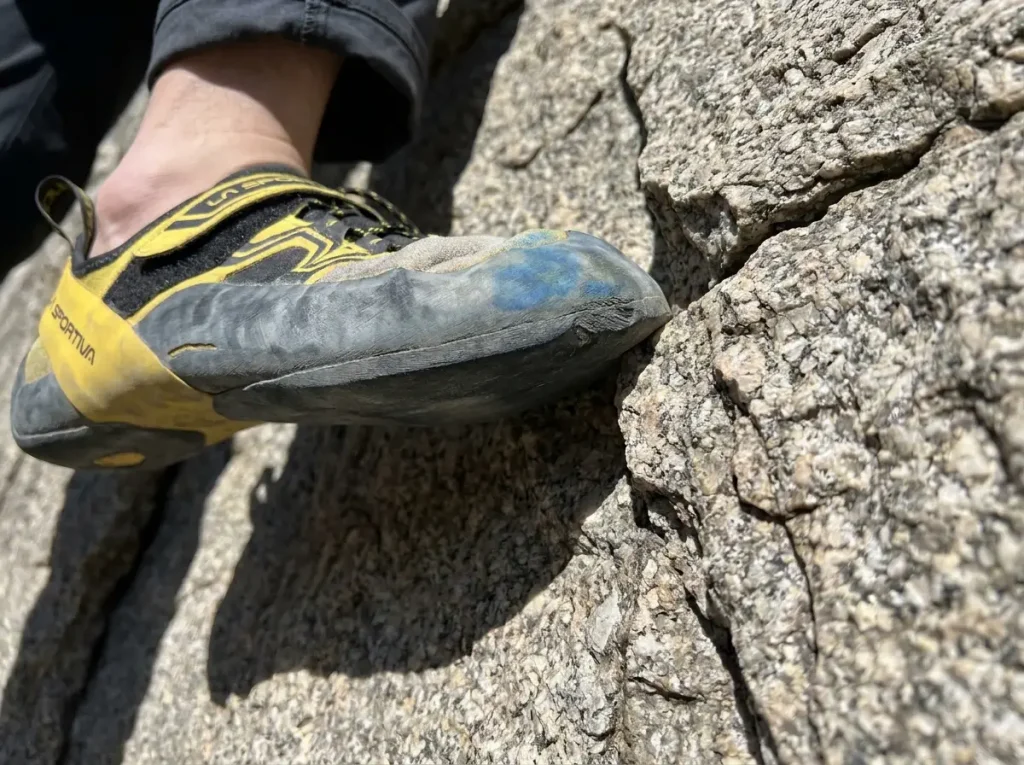
This is where most footwork advice stops at “use the inside edge of your shoe” and calls it done. That’s correct and wildly incomplete.
The toe tip and why it’s your default
For edges, pockets, and crimps — anything with a defined contact surface — the front 8–10mm of your toe box is the placement zone. Not the middle of your foot, not the bottom of your toe, not the pad of your big toe through the shoe rubber. The absolute front point.
Here’s why: climbing shoes are designed with their stiffest, most precise rubber concentration at the toe tip. The sole taper directs tension toward that point, and the last of most performance shoes is downtured specifically to position your big toe as the primary load point. When you land with your mid-foot on a small edge, you’re using the shoe’s weakest, most flexy zone. The hold feels like nothing because structurally, it almost is.
Stand on the tip. Drive through the big toe. Let the shoe do what it was built to do.
Inside edge: the workhorse placement
Inside edging uses the line from your big toe down the inside wall of your shoe. It’s the strongest placement on most holds because your big toe is the most powerful digit and provides the most neural control. For standing edges on vertical or slightly overhung terrain, this is your default.
Keep your knee slightly inward to load the inside edge cleanly. A knee that drifts outward — common when you’re rushing — shifts weight to the center of the shoe and kills precision.
When outside edge and heel-drop change everything
Outside edging — using the pinky-toe side — comes into play during backstepping and drop-knee moves where your hip needs to be close to the wall on one side. It’s less powerful but often necessary for positioning. The technique is identical: commit the toe tip, keep weight through the shoe and into the hold.
For sloping holds and smeary terrain, drop your heel. A heel that rides high on a sloper concentrates load on a tiny area of rubber and pops. Drop the heel below the toe and you recruit the full ball-of-foot surface, dragging friction across more rubber. This is the single most common fix for climbers who can’t trust sloping footholds — and nearly every article about footwork forgets to mention it in context.
Look at Your Foot the Entire Way There
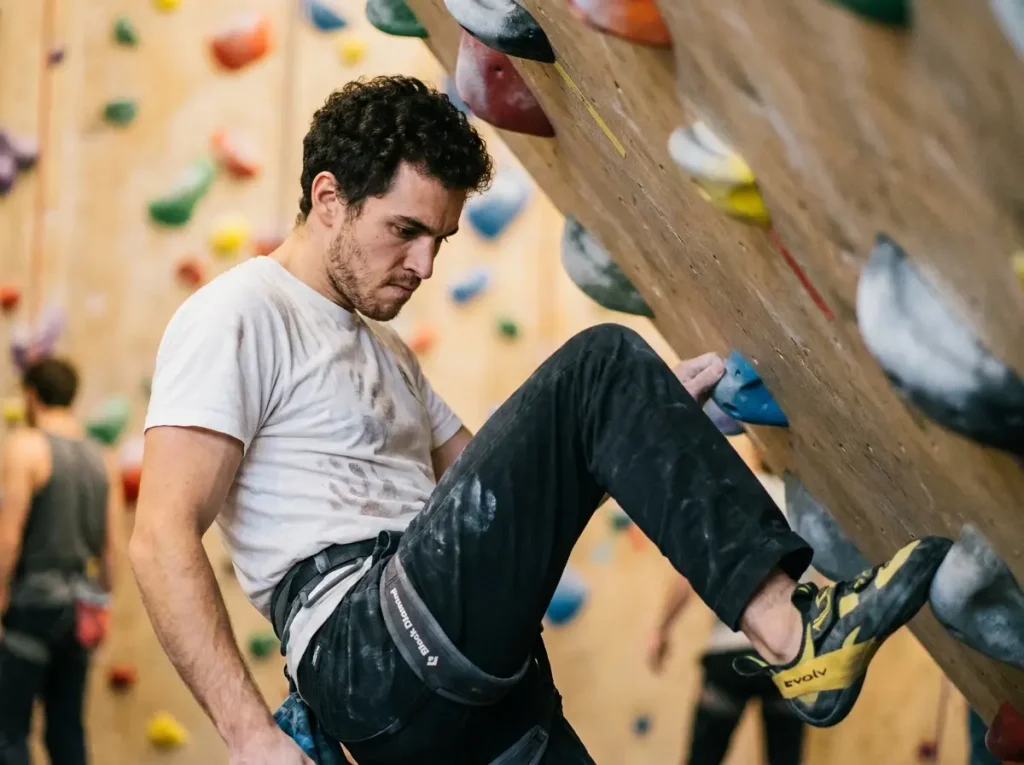
Ask ten intermediate climbers where they look when they step onto a foothold. Seven will say “at the foothold.” Ask them to climb while you watch their eyes. They look at the hold, start their foot moving, then look up to find the next handhold before their foot has actually landed.
That two-second eyes-up window is where the imprecise placement happens.
Visual discipline as a trainable skill
The rule is simple and non-negotiable: watch the foothold from the moment you decide to use it until the moment your rubber contacts rock. Not most of the way. The whole way. Eyes come up only after your foot is committed.
This feels awkward because the instinct is to find your hands before your feet land. The climbers who move cleanly have wired the reverse: feet first, eyes up after. The reason is mechanical — a foot you’re not watching travels approximately to the hold. A foot you’re watching tracks exactly to the hold.
The 3-second pause
Before any critical foot placement, pause with your foot hovering over the intended contact point and take one breath. This is the field version of the hover drill: it forces your brain to commit to the exact placement zone before the rubber touches rock. It also gives you a reset if your position isn’t right.
One breath. Then place. No adjustment after contact.
Pro tip: Try this on a route you know cold: climb it with the rule that you cannot move your hands until your feet are set. Not ready — set. Foot contacted, weighted, stable. You’ll feel how often you’ve been moving your hands before your feet have finished their job.
How Rock Type Changes Everything Under Your Foot
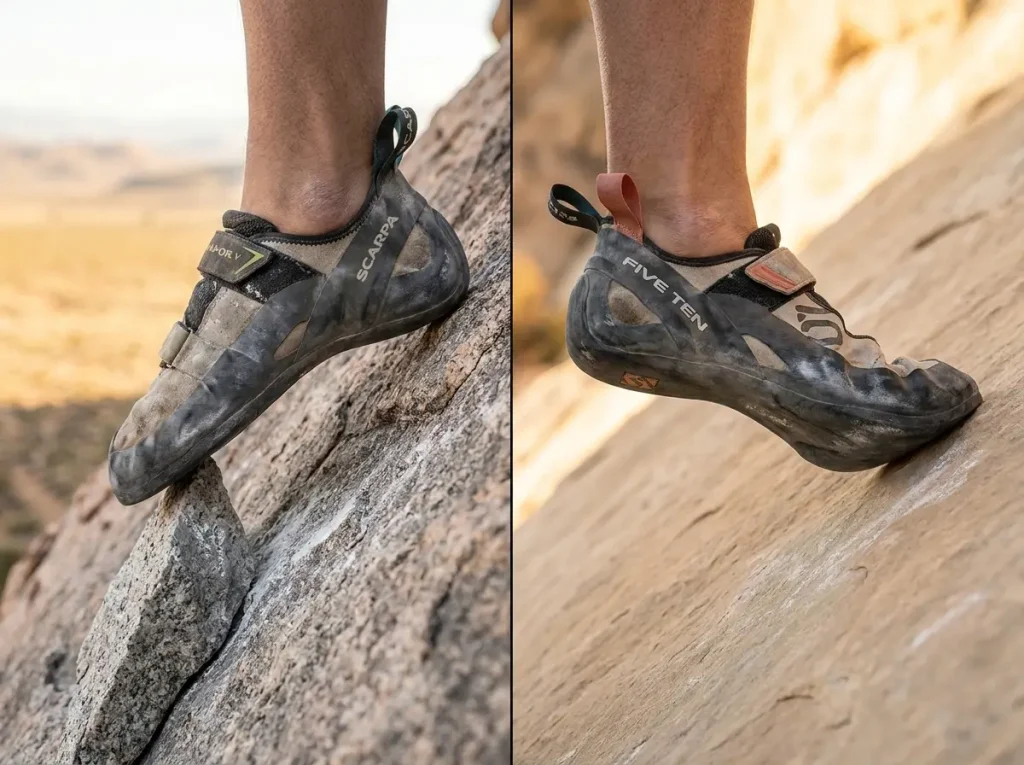
This is the section nobody writes because it’s easier to talk about footwork in the abstract. But your foot placement on a sharp granite edge is not the same technique as your placement on a polished limestone pocket, and treating them the same is why climbers who climb well indoors can feel completely lost on certain rock.
Granite: trust the crystal, commit the angle
Granite friction climbs well even on small edges because of the crystalline surface texture. The key is committing your angle early — granite crystals are unforgiving of micro-adjustments after contact. Place your toe precisely and then stiffen: the rubber grabs the crystal immediately, and any movement after contact scrapes against grip rather than building it.
On granite slabs, smearing works exceptionally well because the texture creates meaningful friction across a large rubber surface. Keep weight forward over your feet, heels low, and trust the shoe.
Limestone: polish changes the game
Limestone sport crags often have polished, near-frictionless surfaces on popular routes. Here, a tiny defined edge is more reliable than smearing because edge friction on limestone is contact-point specific. Drop your heel dramatically on slopers — the rubber needs to load against whatever micro-texture exists on the slope face.
Our guide on climbing rock types and grip adaptation covers this in detail, but for foot placement specifically: on polished limestone, any foot movement after contact cleans off the micro-texture that’s providing your grip. Commit instantly. Do not adjust.
Sandstone: the fragile hold problem
Sandstone crimps are hollow underfoot in a way granite isn’t. The rock compresses slightly under load, and overhanging sandstone can fracture outward if you stab your foot at a hold rather than placing it. This is crag ethics as much as technique: a sharp stab at a sandstone foothold can chip it permanently.
Place slow, load smoothly, and avoid edging on sandstone holds that haven’t been reinforced with moisture or flagged by the local crag community. For indoor and gym holds — which are typically polyurethane — the same smooth placement principle applies even though you’re not going to chip anything. The habit of controlled placement transfers everywhere.
Drills That Actually Build Precision on Small Holds
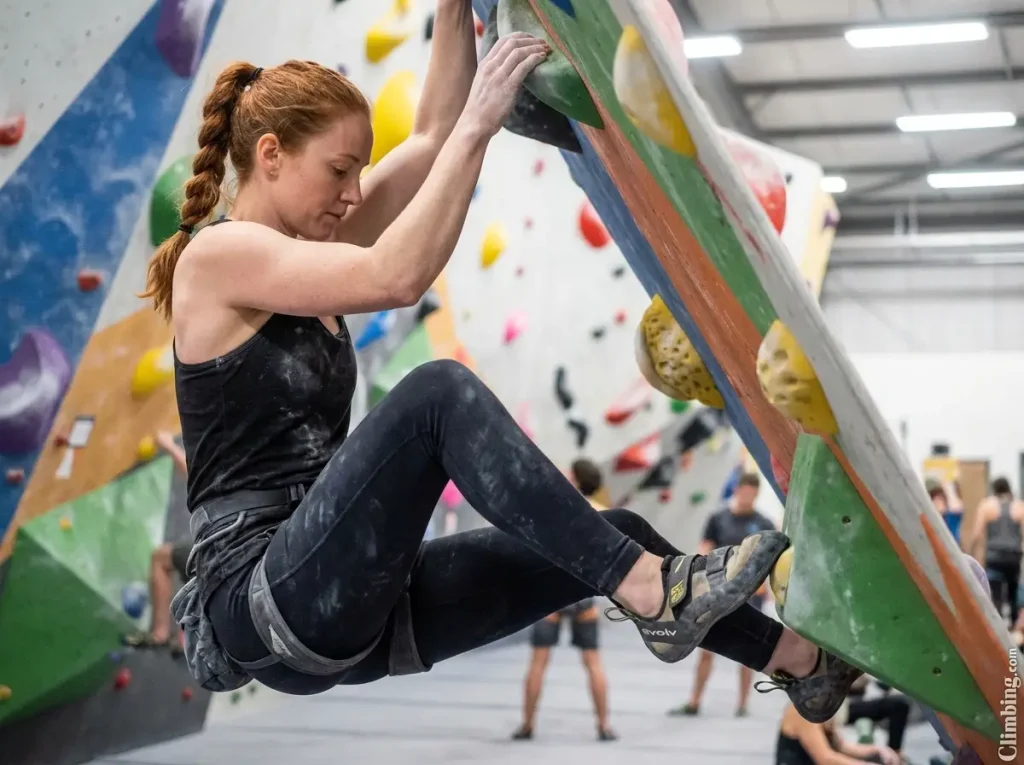
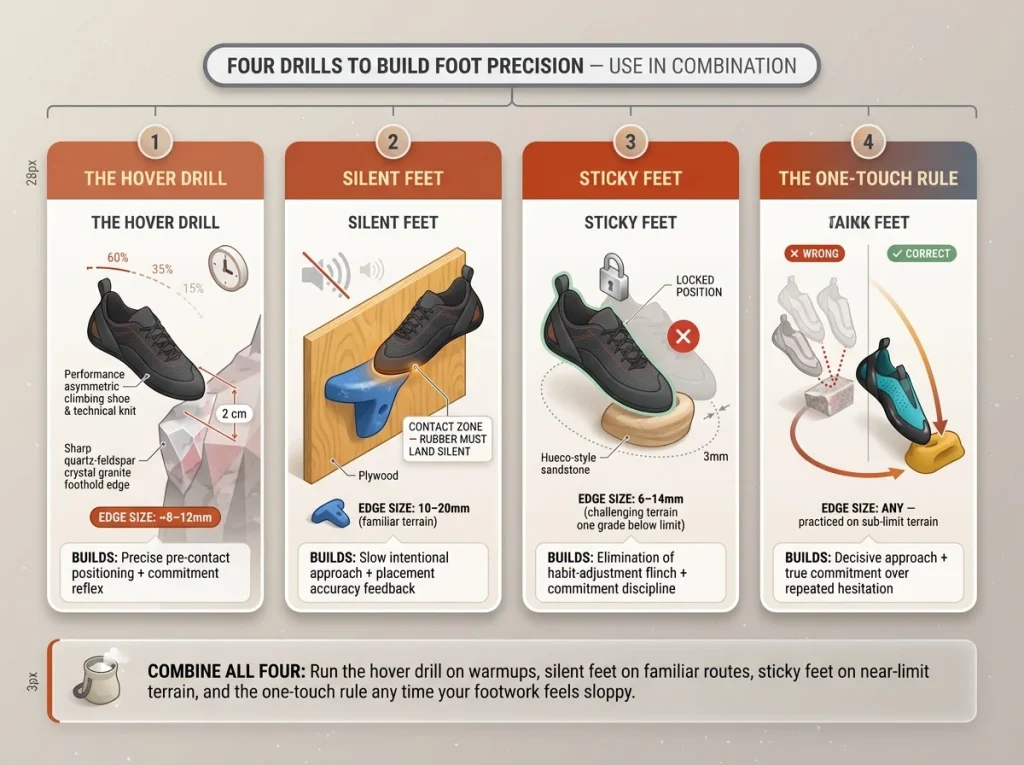
Practice without structure just cements bad habits. These four drills build specific skills and are all worth doing in a regular gym session.
The hover drill
Before each foot placement, hold your foot 2cm above the target hold for three seconds. Do not move until three seconds are up. This breaks the rush-to-place reflex and forces your nervous system to compute the exact placement before contact. Start on easy terrain where balance is not a limiting factor. After three weeks, the pause becomes internal — you’ll hover mentally even when your foot moves quickly.
Silent feet
Climb an entire route or boulder problem with the rule that your feet must make no sound on the holds. Slapping, scraping, clicking — all disqualify. Silent placement requires that your foot approach the hold slowly and stop precisely on contact. It’s also immediate feedback: if you hear something, you know you missed.
This drill works best on slab and vertical terrain where you have enough balance to actually focus on foot sound rather than survival.
Sticky feet
Once your foot touches a hold, it stays exactly where it landed. No repositioning, no micro-corrections. If you placed it wrong, that’s the placement you climb on. This drill reveals immediately where your visual discipline is failing — every time you want to adjust but can’t, note where your eyes were when you placed.
The one-touch rule
On every foothold, watch your foot all the way to contact, touch the hold once, and commit. If you find yourself making multiple contact attempts — tap, retract, re-approach — you’re revealing that your commitment phase is broken. The one-touch rule forces a decision: either your foot goes there and stays, or you choose a different hold entirely.
Use this on routes one full grade below your limit so the footwork is the only challenge.
Building the Feel: Proprioception and Trust on Small Holds
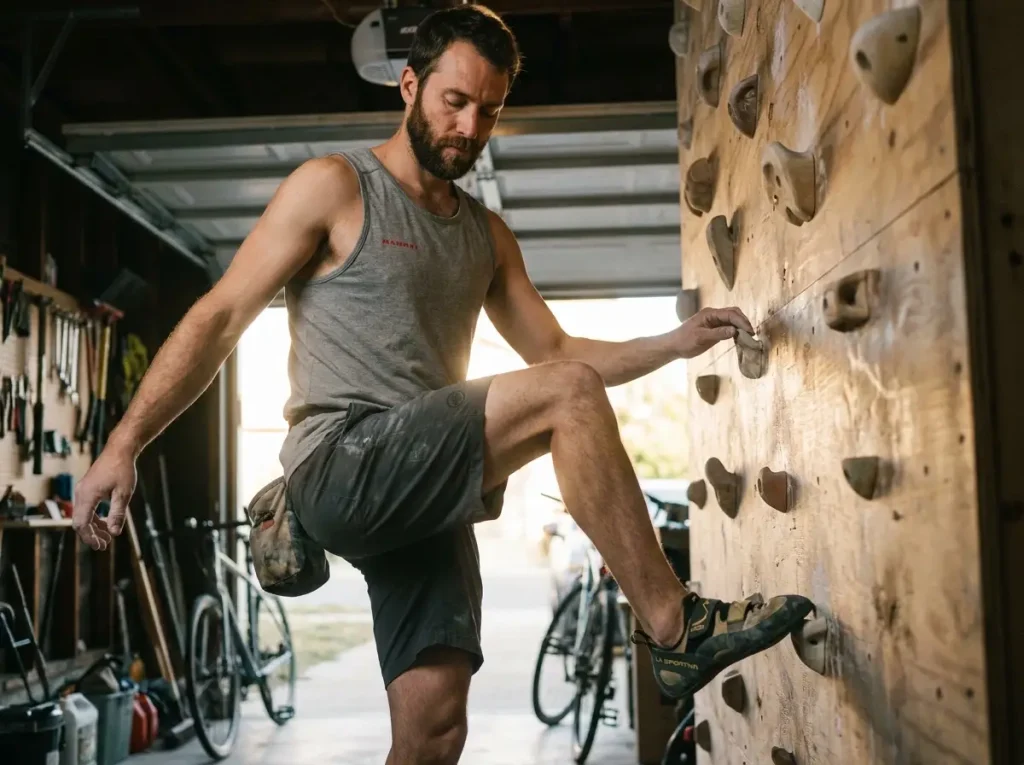
Every climber talks about “trusting your feet.” Nobody explains what that actually means at the neural level, or how to build it faster than just climbing more.
What proprioception is doing under your shoe
Proprioception — your nervous system’s ability to sense position, load, and movement without looking — is one of the primary differentiators between intermediate and advanced climbers, a finding supported by USA Climbing’s coaching and training frameworks. Every foothold placement gives your nervous system feedback — how much the rubber is deforming, how much friction is engaged, whether the contact is stable or shifting. Climbers who “trust their feet” have trained their sensory loop to process this feedback quickly and accurately. Beginners have the same loop; it just hasn’t learned what the signals mean yet.
The key insight is that shoe rubber contact feedback is trainable the same way balance is trainable. You build it by making precise placements repeatedly, paying attention to what the contact feels like when it’s right versus when it’s borderline. Over time, your nervous system starts predicting stability before it happens.
Training your feel on a woody or training board
The fastest way to develop foot proprioception is a woody or hangboard board session with your eyes closed on foot placements. Set up on a simple training wall with defined footholds. Place your foot on a hold you know well. Close your eyes. Feel the rubber engagement across the hold. Shift weight and notice where the stability boundary is — the point where the hold stops feeling solid.
This is uncomfortable at first. It becomes extremely useful. After twenty sessions, your feet start reading holds the way experienced climbers describe: you know when you’re on and when you’re not before your full weight has transferred.
The connection to shoe fit
None of this works if your shoes are too big. Climbing shoes should fit close enough that you can feel the rubber’s response through the shoe structure without major empty space. Shoes that are too loose mask the proprioceptive signal — you feel the shoe flexing more than you feel the hold. Shoes that are precisely fitted transmit hold texture and load accurately through the toe.
This is the functional reason why performance climbers wear shoes that feel uncomfortable to beginners. It’s not just downturn and stiffness — it’s signal quality. If your shoes have more than a centimeter of empty space at the toe, you’re getting noisy proprioceptive data. For guidance on fit and when to get new rubber, see our guide on when to resole climbing shoes.
Pro tip: After a climbing session, sit quietly for two minutes and think through one specific foot placement that felt uncertain. Replay it: where were your eyes, where did the rubber land, what did the hold tell you? This deliberate review is the learning loop that separates climbers who plateau from climbers who keep improving.
Conclusion
Precise foot placement on small holds is three separate skills operating together: the mechanics of where your rubber contacts rock, the visual discipline of watching it all the way there, and the proprioceptive sense that tells you whether the contact is solid before you commit your weight. Most technique advice covers the first and stops.
Start with the one-touch rule on terrain you find easy. Add the hover drill to anything challenging. Build the rest — rock-type adaptation, tactile feedback, the feel that makes small holds seem larger — through intentional repetition rather than just climbing more. The climbers who develop footwork fast are the ones who think about it between moves, not just during them.
Better feet don’t just make you safer on small holds. They cut your pump in half on routes you already project. That alone is worth two months of slow, boring, deliberate practice.
Q1 Why do I keep slipping off small footholds even when I place carefully?
Most slipping on small holds comes from heel elevation rather than bad placement. If your heel rides high on an edge, your weight concentrates on the back of your toe instead of the tip, and the shoe pops. Drop your heel below the toe and feel the rubber seat into the hold before weighting. Also check that you’re using the toe tip, not the mid-shoe.
Q2 What part of the climbing shoe should touch a small edge?
The front 8–10mm of the toe box — essentially the toe tip. This is the stiffest, most precise zone of the shoe and where the sole design concentrates tension toward your big toe. Placing mid-foot on a small edge uses the flexible arch zone and provides dramatically less support and friction.
Q3 How do you practice precise foot placement in a climbing gym?
Run the silent feet drill on routes one grade below your limit: every foot placement must be made without any sound. Slapping, scraping, or clicking means you missed. Supplement with the hover drill — hover the foot 2cm above the hold for three seconds before contact. Both drills build the slow, intentional placement habit that transfers to harder terrain.
Q4 Does rock type actually change how you place your feet?
Significantly. Granite allows committed edging and smearing because the crystalline texture provides friction across a range of placements. Polished limestone requires instant commitment — any post-contact adjustment wipes the micro-texture that’s providing grip. Sandstone requires smooth loading rather than sharp placement to avoid chipping the rock. Adjust your approach to match what’s underfoot.
Q5 How long does it take to build reliable precision on small holds?
With deliberate practice — drills two or three sessions per week — most climbers notice a qualitative improvement in three to four weeks. Full automaticity, where foot precision no longer requires active attention on familiar terrain, typically takes three to six months of consistent work. The fastest path is to combine the drills above with the bouldering plateau approach of working problems specifically chosen to expose footwork weaknesses.
Safety Notice: Rock climbing and mountaineering are inherently high-risk
activities that can involve physical trauma or fatal incidents. The information on Rock Climbing Realms is for
educational and informational purposes only. Techniques and advice presented here are not a substitute
for professional, hands-on instruction. Conditions and risks vary by location. Always seek guidance
from a qualified instructor before attempting new techniques. By using this website, you agree that you
are solely responsible for your own safety. Any reliance you place on this information is strictly
at your own risk, and you assume all liability for your actions. Rock Climbing Realms and its authors
will not be held liable for any harm, damage, or loss sustained in connection with the use of this information.
Affiliate Disclosure: We are a participant in the Amazon Services LLC Associates Program, an
affiliate advertising program designed to provide a means for us to earn advertising fees by advertising and linking
to Amazon.com. As an Amazon Associate, we earn from qualifying purchases. We are also an official affiliate partner
of Black Diamond Equipment via the AvantLink network. If you click on a Black Diamond affiliate link and make a
purchase, we may earn a commission at no additional cost to you. We also participate in other affiliate programs.
Additional terms are found in the terms of service.