
In this article
Most climbers put on their helmet, tighten the chin strap, and start climbing. That’s the extent of the inspection. And for a piece of gear that’s specifically designed to absorb force on your behalf — and then stop working — that’s not enough.
The uncomfortable reality is that a climbing helmet can fail without showing obvious signs. EPS foam compresses permanently on a single hard impact and looks completely normal afterward. UV exposure degrades the shell gradually over years, invisible until you squeeze it. The retention system loosens incrementally until the helmet shifts at exactly the wrong moment. None of these failures announce themselves. That’s the point of this guide.
This isn’t a scare piece. Helmets work extraordinarily well when they’re in good shape. The inspection process is fast once you know what you’re looking for, and it genuinely tells you something meaningful about whether the thing on your head is going to do its job.
Quick Answer: Here’s how to inspect a climbing helmet:
- Check the outer shell for cracks, dents, deep scratches, and deformation under gentle hand pressure
- Examine the foam interior for compression, hardening, crumbling, or any visible impact zone
- Test all straps for fraying, cuts, stiffness, and whether they hold adjustment under tension
- Verify the buckle clicks closed, holds under pull, and releases cleanly
- Test the retention system — it should hold snug without wobble, and return to adjustment when released
- Check for UV damage on the shell by looking for color fade, chalky surface texture, or surface micro-cracking
- If the helmet has taken any impact to the head — retire it regardless of visible condition
Why Helmet Inspections Actually Matter
The data from the American Alpine Club’s annual accident reports consistently shows that head injuries in climbing are survivable when a helmet is worn correctly and in good condition — and significantly more severe when the helmet is absent, worn incorrectly, or compromised. The problem with compromised helmets is that they’re often still in circulation.
The invisible failure problem
EPS (expanded polystyrene) foam — the white beaded material in most helmets — is designed to absorb impact energy by crushing. That crushing is a one-time event. The foam doesn’t recover. When you look inside a helmet after an EPS crush failure, you often see nothing unusual. The outer shell absorbed the visual damage, or didn’t deform at all. The foam below did its job and used up its capacity. That helmet is now a hard hat with some padding.
The reason this matters is that most climbers have a gut sense that if the helmet looks okay, it is okay. For EPS helmets specifically, that sense is wrong. The only reliable signal is that the helmet was in a hard impact — and the only appropriate response to that is retirement.
EPP foam is different — but not exempt
EPP (expanded polypropylene) foam, used in some helmet designs including most Petzl models, is more resilient. It can absorb multiple moderate impacts and partially recover. It’s not indestructible. Extended UV exposure, chemical contact, or one significant impact can compromise EPP foam the same way EPS fails. EPP helmets typically show more visible deformation when damaged, which makes inspection slightly more reliable — but you still need to check.
The Outer Shell: What You’re Actually Looking For
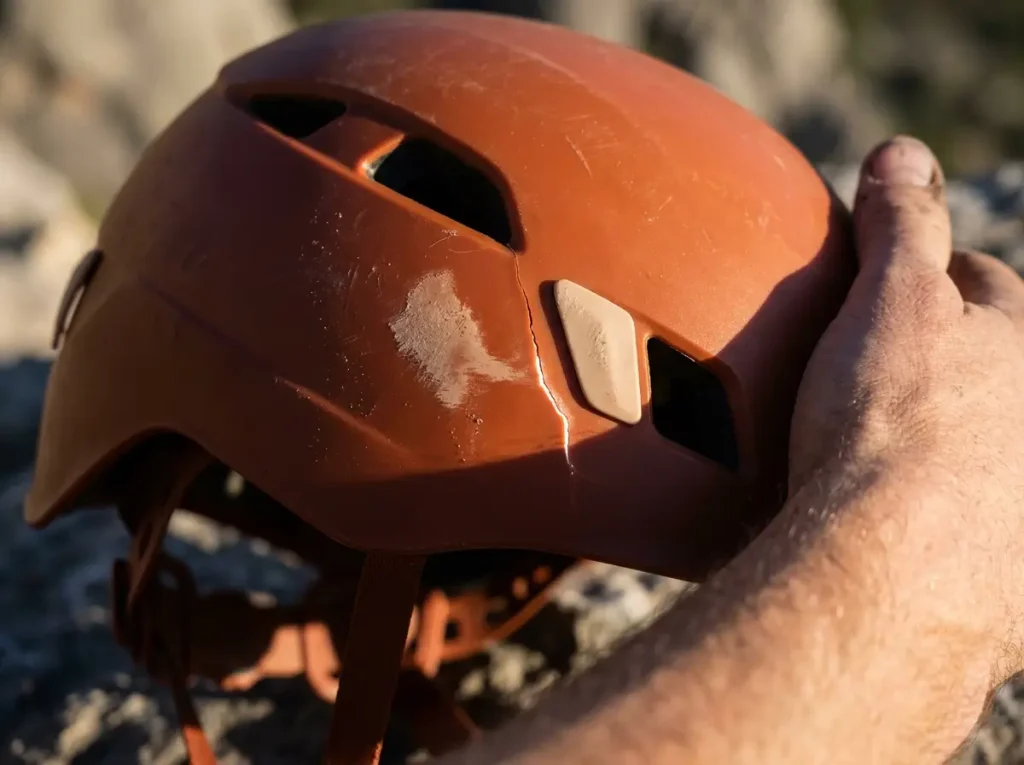
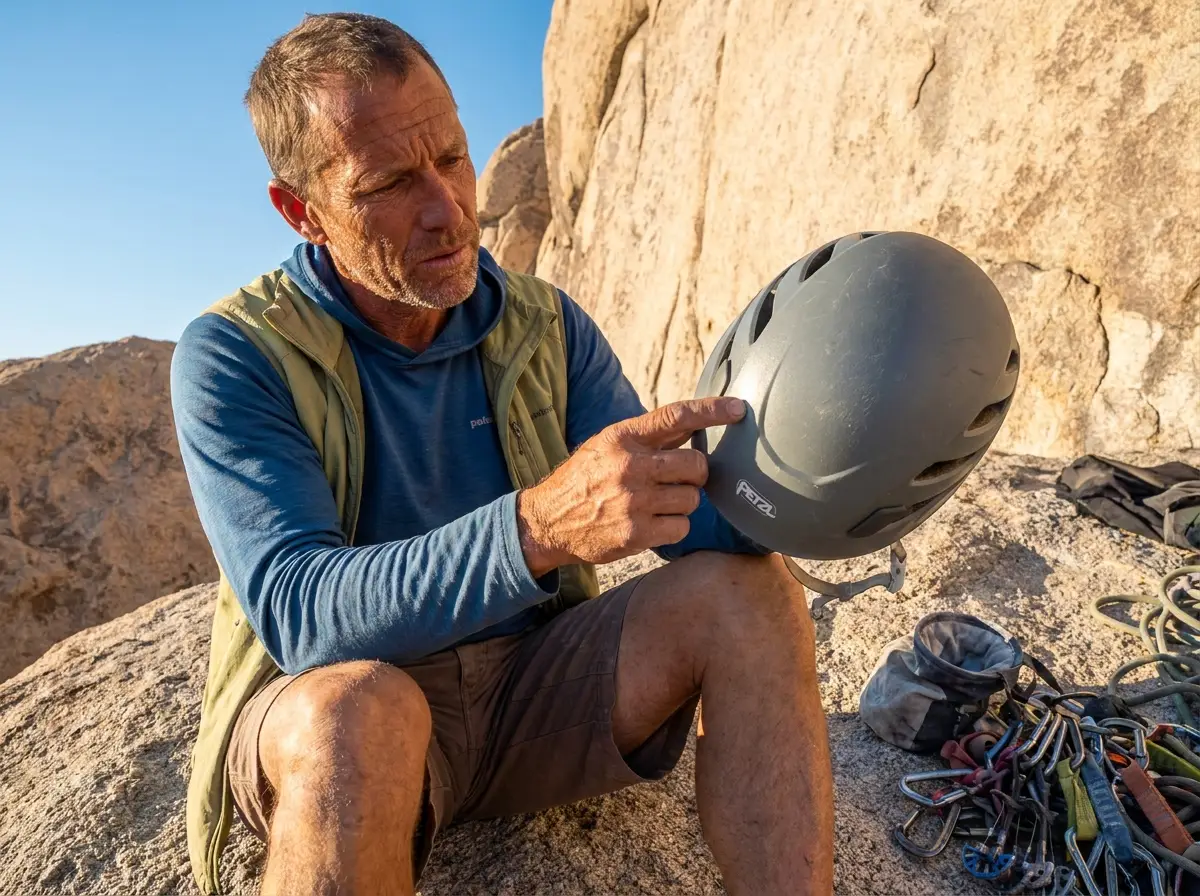
Run your hands over the entire outer surface while looking for these specific conditions.
Cracks and fracture lines
In ABS plastic shells, look for any crack, fracture line, or surface split — even small ones. ABS is tough but brittle under point loads, and a fracture that looks superficial often extends into the shell at depth. Press gently around any fracture line; if you feel flex where there should be rigidity, the shell structure is compromised.
In polycarbonate shells, cracks are rarer but more serious when they appear. Polycarbonate can develop hairline fractures from flex fatigue over years of storage, temperature cycling, and use. These show up as faint white stress lines, usually around high-stress areas like vent holes or the brim edge.
Dents and deformation
A dent in the outer shell means the shell absorbed energy. For EPS helmets, any shell dent that corresponds to a foam compression zone is an immediate retirement signal. For EPP helmets, check whether the dent is accompanied by any foam deformation inside. Light cosmetic surface scuffs from rockfall are normal and acceptable; actual geometric deformation of the shell is not.
Deep scratches
Surface scratches from general use are fine. A scratch deep enough to expose the substrate material — the pale inner layer of plastic under the outer color — means the shell has lost structural integrity at that point. Multiple deep scratches in the same zone indicate cumulative damage even if no single scratch appears critical.
The Foam Interior: EPS and EPP and How Each Fails
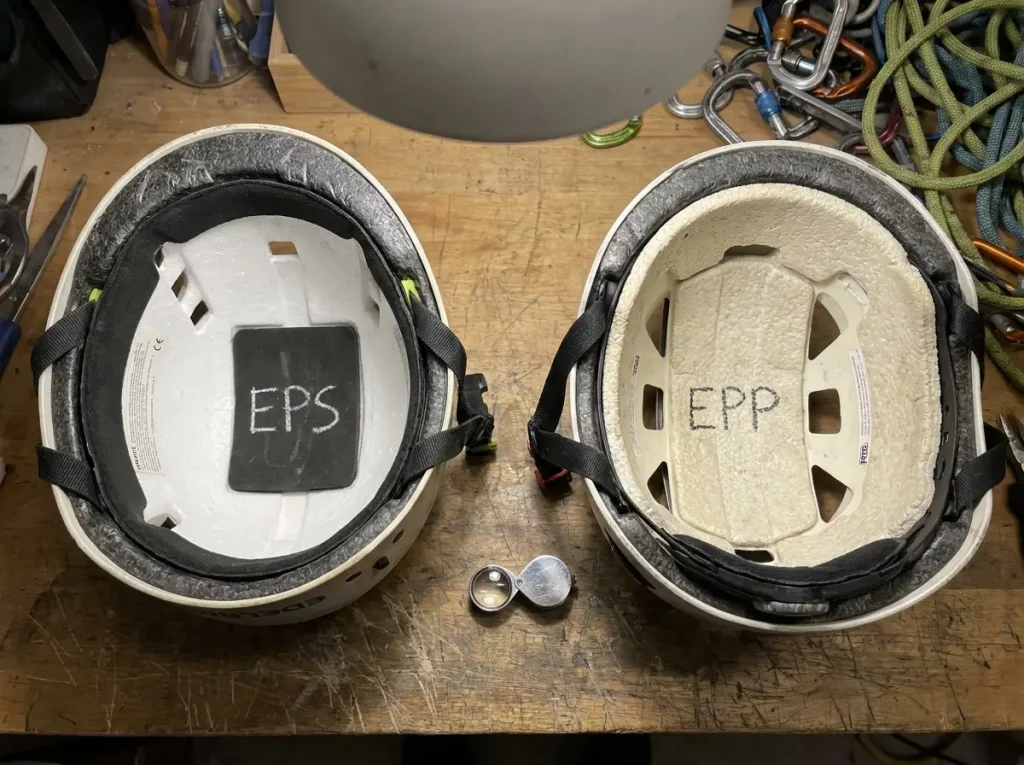
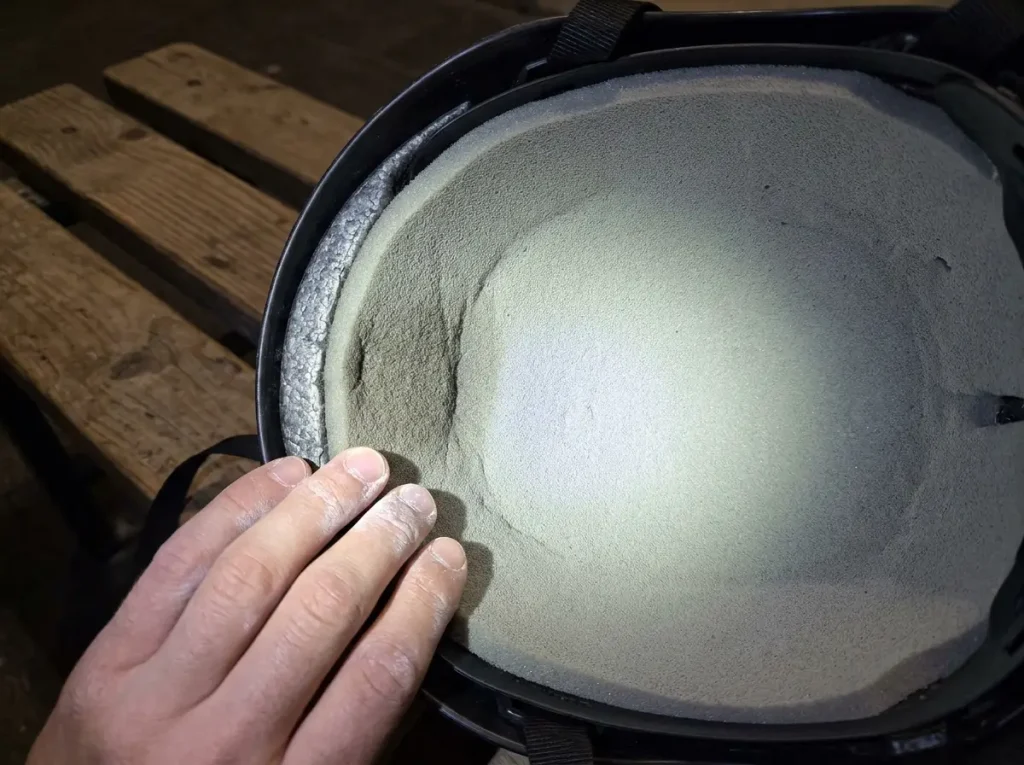
Pull the fit pads out if your helmet has removable ones, and inspect the foam directly.
What healthy foam feels like
Healthy EPS foam is uniformly firm, slightly resilient under fingertip pressure, and returns to shape immediately. It has a consistent texture throughout. Healthy EPP foam has a more rubbery feel, compresses slightly more under pressure, and springs back. Both types should have no visible compression zones, crumbling edges, or areas of dramatically different texture.
Signs of degraded foam
EPS foam that has experienced significant impact often shows a subtle — sometimes invisible — compression zone when you look at the inner surface at a raking angle in good light. Feel for areas that are harder or denser than surrounding foam; these are compressed zones that no longer provide meaningful protection. EPS foam that has deteriorated from age or UV exposure feels friable — it crumbles or flakes slightly at edges. That foam is done.
EPP foam shows degradation differently: look for a rough, pitted surface texture that wasn’t there when the helmet was new, or areas where the foam has a permanently dented appearance even without a clear impact history. If the foam feels mushy rather than rubbery when you press it, the cellular structure has broken down.
Pro tip: Take a photo of the interior foam when your helmet is new. The visual reference makes future comparisons much more reliable than memory alone.
Straps, Buckles, and the Retention System

This is the part of helmet inspection that gets least attention and fails most often in the field.
Strap condition
Inspect every strap — chin strap, rear adjustment straps, and any cross straps — for fraying at edges, cuts through the webbing weave, stiffness from UV or chemical exposure, and color bleaching that indicates significant UV damage. Straps that are stiff don’t absorb load uniformly and are more likely to snap under sudden tension. Any cut that penetrates more than 10% of the strap width is a retirement signal for that strap; most manufacturers don’t sell individual replacement straps, so that usually means a new helmet.
Buckle function
The chin buckle should click positively closed, hold under a firm pull without slipping, and release cleanly with the designed action. Buckles that are gritty, stiff, or that release unexpectedly under tension are failing. Most modern climbing helmets use side-release buckles that should require deliberate two-handed action to open under load. Test yours: buckle up, pull the chin strap firmly downward, and verify it holds. A buckle that gives under that test is not reliable.
The retention system — the overlooked failure point
The foam fit dial or webbing cradle that holds the helmet centered on your head is the component that most climbers never check and that most commonly causes problems in the field. Test it by putting the helmet on, tightening the retention system to your preferred fit, and then trying to rock the helmet forward, backward, and side to side without holding it. If the helmet moves more than about 1.5 centimeters in any direction without the retention system loosening, either the system is out of adjustment or the mechanism has worn beyond reliable function.
A helmet that shifts on your head in a fall is a helmet that may not protect the impact zone. The retention system also takes indirect abuse — sweat, sunscreen, and chalk dust accumulate in the ratchet mechanism and degrade its friction surfaces. Rinse the system with clean water periodically, and rotate the dial through its full range to clear debris before inspecting whether it holds its position.
Pair helmet inspections with harness retirement checks — the guidance in our climbing harness inspection and retirement guide covers the same UV and strap degradation patterns you’re watching for here.
After Any Impact: The Rule That Isn’t Optional
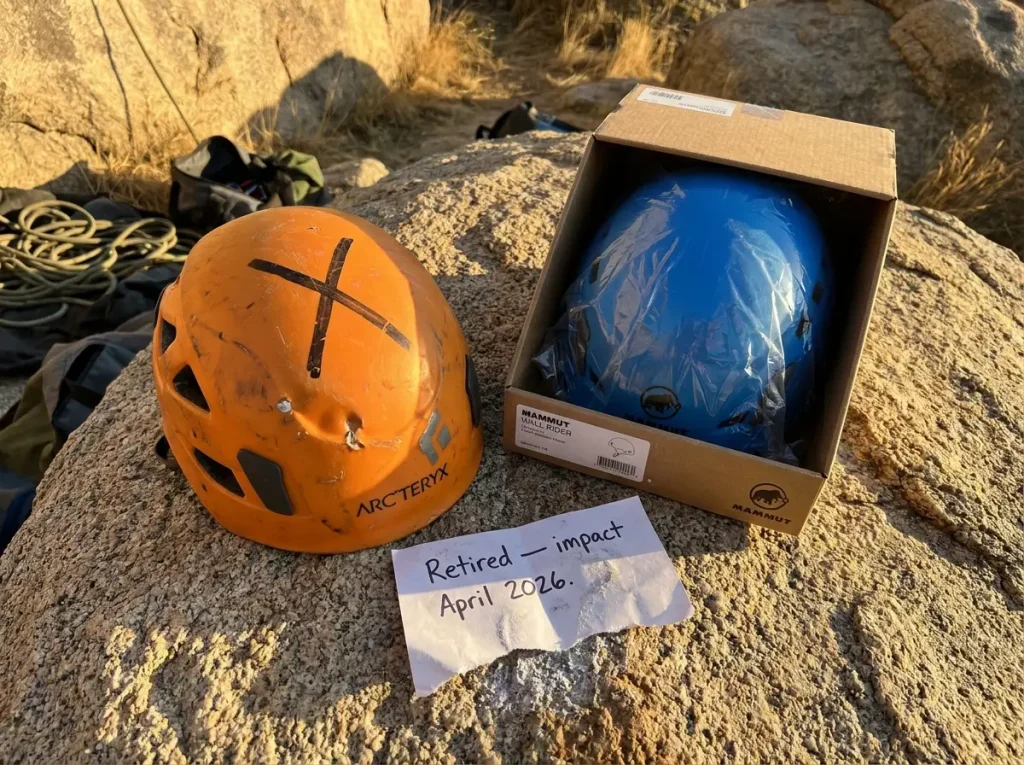
Every climbing helmet manufacturer and the UIAA are unambiguous about this: if a helmet absorbs a significant impact — meaning a fall where it contacted rock or ground with meaningful force — it should be retired regardless of visible condition.
Why “it looks fine” is not enough
The energy absorption system in a helmet is mostly invisible. EPS foam that crushed internally looks the same as intact foam. A polycarbonate shell that cracked at depth and healed its surface crack under compression looks intact. An EPP foam layer that has permanently deformed in a zone 5mm below the surface is undetectable by visual inspection without sectioning the helmet.
The practical rule is simple: helmet took a significant hit to the head zone, helmet comes off the rack and goes in the bin. “Significant” means you were falling and the helmet contacted rock with enough force that you felt it through the helmet — not a bump against the wall while climbing, but an actual impact event.
Some helmets come with impact indicators — small inserts that change color on significant impact — but these are not universal and they detect threshold events, not cumulative fatigue.
Rockfall is not the same as a climbing fall
A helmet that stopped a piece of loose rock from the team above takes a point load to a localized area rather than the distributed load of a ground fall. These impacts can be hard to evaluate. If the rock was significant — fist-sized or larger, and falling more than a few meters — treat it as a retirement event. Smaller rockfall on a non-critical zone (top of the helmet rather than the side or back) warrants close inspection of that zone, with retirement if you see any deformation.
Pro tip: Write the date of manufacture on a piece of tape inside your helmet when you buy it. The manufacturer’s date stamp is usually on a sticker inside that fades over time. Knowing the actual age of the helmet is the single most useful piece of information you have about its service life.
How Long Does a Climbing Helmet Actually Last
Two numbers matter here: manufacturing date and first use date. They’re different because gear sits in warehouses and closets.
The UIAA and EN 12492 guidance
The UIAA standard (UIAA 106) and the European EN 12492 standard that most modern climbing helmets are certified to don’t specify a hard retirement date. Manufacturers do. Typical manufacturer guidance is 10 years from manufacture date or 5–7 years from first regular use — whichever comes first. These aren’t conservative estimates designed to sell more helmets; they reflect real material degradation curves for ABS, polycarbonate, and EPS foam under normal use and storage conditions.
What accelerates aging
UV exposure is the primary accelerant — helmets stored in vehicles, on crag walls, or in sunny garages age faster than helmets stored in bags in cool, dark spaces. Chemical exposure matters too: sunscreen, insect repellent, and strong cleaning products attack the shell surface and strap webbing. Frequency of use matters less than exposure conditions for shell and strap degradation, but more for foam fatigue.
A helmet used twice a year and stored in a car every summer may be in worse condition at year eight than a helmet used fifty days a year and stored correctly. Inspect both carefully. Neither gets a pass because of a low day count.
Before every day out, the check from our pre-climb safety checklist includes a helmet pass-over that takes thirty seconds and catches the most obvious issues. Build that into your routine.
What to Look for in Your Next Helmet
When an inspection tells you it’s time, here’s what guides the replacement decision.
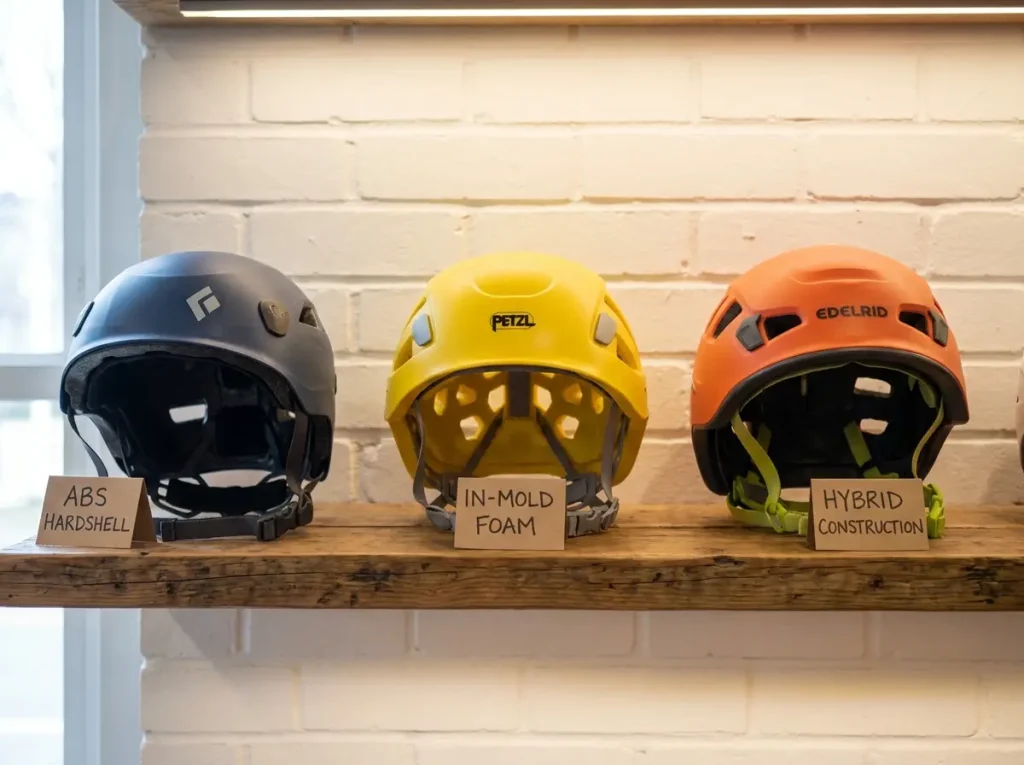
Construction type: hardshell vs. in-mold
Hardshell helmets (ABS shell with EPS liner) are more resistant to rockfall point loads because the shell distributes force before it reaches the foam. They’re heavier and run warm but hold up to abrasion and repeated minor impacts better. In-mold helmets bond the shell and foam in a single process; they’re lighter and better ventilated but more vulnerable to point loads from small rocks. For alpine and trad climbing with rockfall exposure, hardshell has a real advantage. For sport climbing and gym use where the primary hazard is a fall-and-contact, in-mold is typically fine.
Fit first, everything else second
A helmet that fits well and stays in place protects you. A helmet with superior impact ratings that shifts on your head does not. Try the helmet on, tighten the retention system, and shake your head firmly. It should not move. Adjust the chin strap so you can fit two fingers under it comfortably but cannot slide the helmet backward off your head.
For gear inspection methodology that applies to everything on your rack, the principles in our carabiner inspection and wear guide translate directly — look for mechanical function, not just cosmetic condition.
Conclusion
A climbing helmet inspection takes four minutes when you know what you’re looking for. Shell, foam, straps, buckle, retention — check each component against the conditions that indicate failure, not just the conditions that indicate obvious damage. Retire without hesitation after any significant impact.
The climbers who skip inspections aren’t reckless — they just haven’t been shown what to look for. Now you have. Check the helmet, trust the gear, climb with confidence.
Q1 How often should I inspect my climbing helmet?
Do a quick pass-over before every climbing day — shell, straps, buckle, retention system. Do a full detailed inspection including foam examination every three to six months if you climb regularly, and always after any impact event. A pre-use check catches obvious problems; the detailed inspection catches the slower-developing failures.
Q2 Can I use a cycling or skiing helmet for climbing?
No. Cycling and skiing helmets are designed for different impact types and energy magnitudes than climbing helmets, and are not certified to EN 12492 or UIAA 106 standards. The impact geometry of a climbing fall is fundamentally different from a cycling crash. Use a helmet built and certified for climbing.
Q3 What should I do with a retired climbing helmet?
Mark it permanently — spray paint, a big X with a marker — so it can’t be mistaken for a usable helmet, then throw it away. Don’t donate it, sell it, or give it away. A retired helmet is not a helmet. It’s a liability wearing the shape of one.
Q4 Does dropping a helmet on the ground retire it?
Dropping it from your hands to the ground — yes, inspect it carefully but probably not retired. Dropping it from height, with the interior facing a hard surface, or after any fall where it was on your head — those warrant careful inspection and probably retirement. The test is whether the foam could have experienced meaningful compression during the drop. A one-meter accidental drop onto carpet isn’t the same as a two-meter drop onto granite.
Q5 Do climbing helmets expire if I never use them?
Yes. Material degradation happens through time and UV exposure regardless of use. A helmet stored in a garage for ten years has aged. Check the manufacture date on the sticker inside and apply the manufacturer’s recommended service life — most recommend retirement at ten years from manufacture even for helmets with low use hours.
Safety Notice: Rock climbing and mountaineering are inherently high-risk
activities that can involve physical trauma or fatal incidents. The information on Rock Climbing Realms is for
educational and informational purposes only. Techniques and advice presented here are not a substitute
for professional, hands-on instruction. Conditions and risks vary by location. Always seek guidance
from a qualified instructor before attempting new techniques. By using this website, you agree that you
are solely responsible for your own safety. Any reliance you place on this information is strictly
at your own risk, and you assume all liability for your actions. Rock Climbing Realms and its authors
will not be held liable for any harm, damage, or loss sustained in connection with the use of this information.
Affiliate Disclosure: We are a participant in the Amazon Services LLC Associates Program, an
affiliate advertising program designed to provide a means for us to earn advertising fees by advertising and linking
to Amazon.com. As an Amazon Associate, we earn from qualifying purchases. We are also an official affiliate partner
of Black Diamond Equipment via the AvantLink network. If you click on a Black Diamond affiliate link and make a
purchase, we may earn a commission at no additional cost to you. We also participate in other affiliate programs.
Additional terms are found in the terms of service.