
In this article
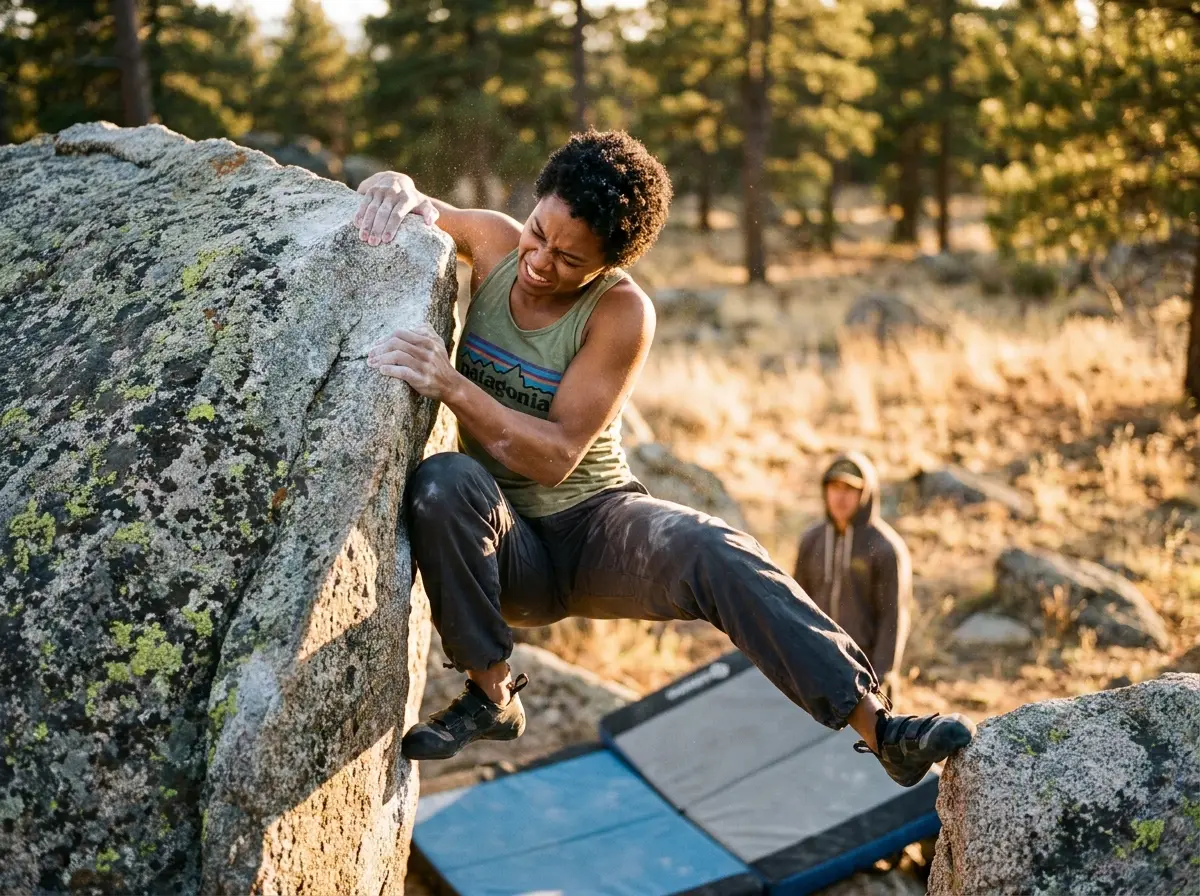
The first time I got shut down by a compression problem, I couldn’t figure out what I was doing wrong. Good fingers, decent footwork, solid endurance — and I kept peeling off a V4 arete like I was trying to hug a greased basketball. Turns out my back and biceps, the muscles I’d spent two years overdeveloping on steep gym walls, were exactly the wrong tools for the job.
Compression climbing is a fundamentally different game. It uses push muscles instead of pull muscles, inward force instead of downward grip, and a type of full-body coordination that most climbing training never touches. Once you understand how it works, those slopey aretes and featureless prows stop feeling impossible and start feeling like puzzles with solutions.
This guide breaks down what compression climbing actually is, how it differs from opposition, the specific body mechanics that make it work, and how to train the muscles and movement patterns you’re probably missing.
Quick Answer: Compression climbing is a technique where you squeeze inward on opposing holds or features using your chest, shoulders, and core rather than pulling down with your fingers. It’s used on aretes, slopers, volumes, and roofs where positive handholds are scarce. The key is generating inward force with push muscles while maintaining full-body tension — a skill set most climbers never train because standard climbing rewards pull strength.
What Compression Climbing Actually Is
The Inward Force Principle
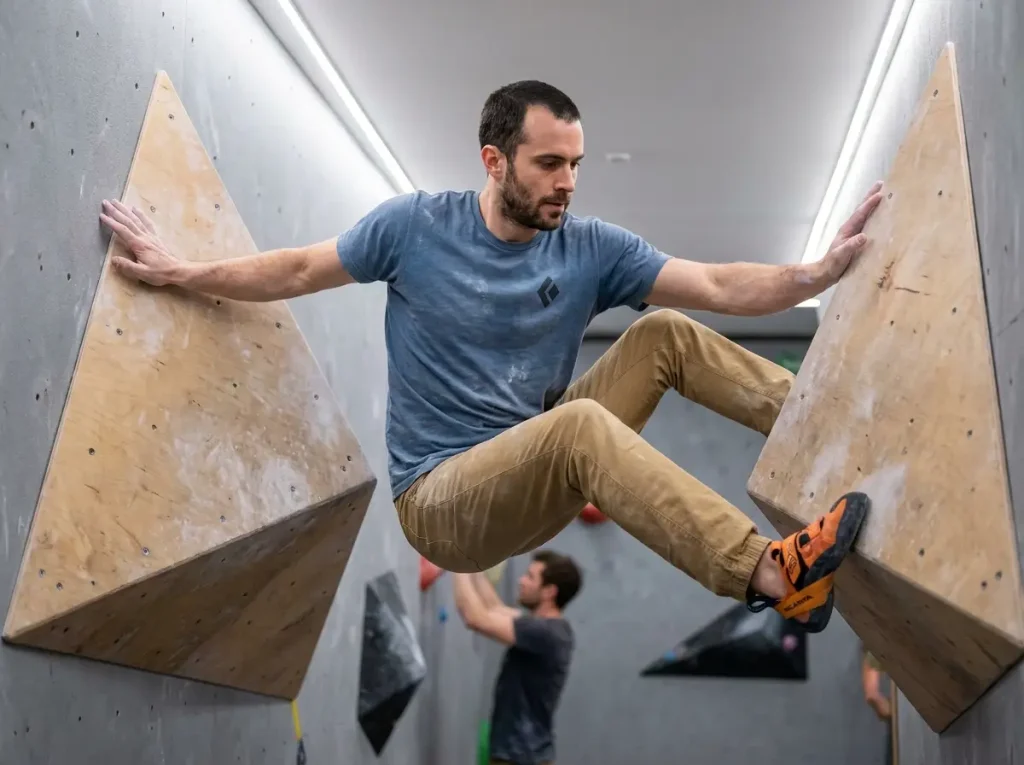
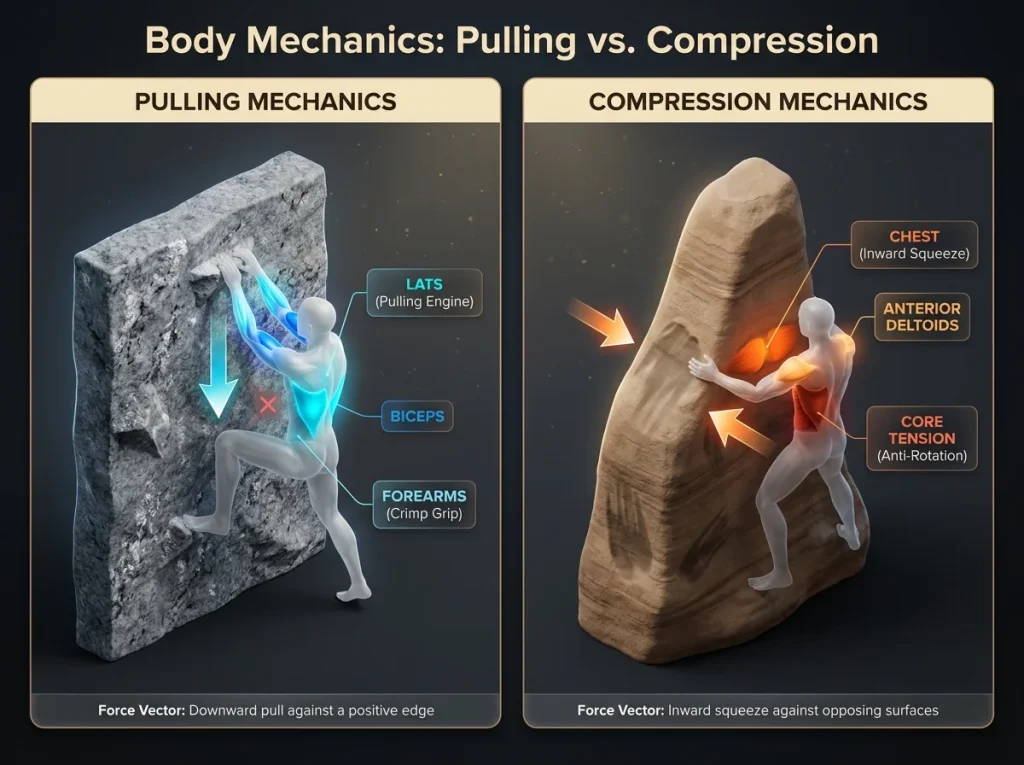
Most climbing techniques rely on pulling down. Crimps, jugs, pockets — you grip and pull toward the wall. Compression flips that entirely. Instead of pulling down, you’re pushing inward from both sides, squeezing the rock or feature between your hands, arms, and sometimes your entire torso.
Think of it like trying to carry a large box with no handles. You don’t grip the top — you press your palms into the sides and squeeze. The friction between your hands and the box is what keeps it from sliding out. That’s compression. The force vector points inward, not downward.
This is why climbers with massive finger strength can get shut down on compression problems. Finger strength pulls down. Compression needs your chest, shoulders, and core generating force in a completely different direction.
Where You’ll Find Compression on the Wall
Compression shows up in specific terrain features:
- Aretes — the outside edges of boulders and walls, where you wrap around both sides and squeeze
- Volumes — those large geometric shapes bolted to gym walls that have no edges to grip
- Slopers — rounded, featureless holds where friction is your only friend
- Roof transitions — where the wall kicks from vertical to horizontal and there’s nothing to grab but the lip itself
- Prows — the blunt nose of a boulder, essentially a wide arete
If you notice a problem where the holds all face sideways or away from you rather than providing an edge to pull on, you’re looking at compression.
How Compression Differs From Other Techniques
The confusion usually comes from mixing up compression with opposition. They sound similar but the force directions are opposite:
- Compression = inward force, squeezing the feature between your contact points
- Opposition = outward force, pushing away from the feature (like stemming in a corner)
A stemming corner is opposition — you’re pressing your feet and hands outward against two walls. An arete is compression — you’re pressing inward against two faces of the same feature. The muscles, the body position, and the mental approach are different for each.
Pro tip: If you can’t tell whether a problem requires compression or opposition, look at where the holds face. Holds facing toward each other (like the inside of a corner) = opposition. Holds facing away from each other (like two sides of a prow) = compression.
The Body Mechanics of Compression
Why Push Muscles Matter More Than Pull
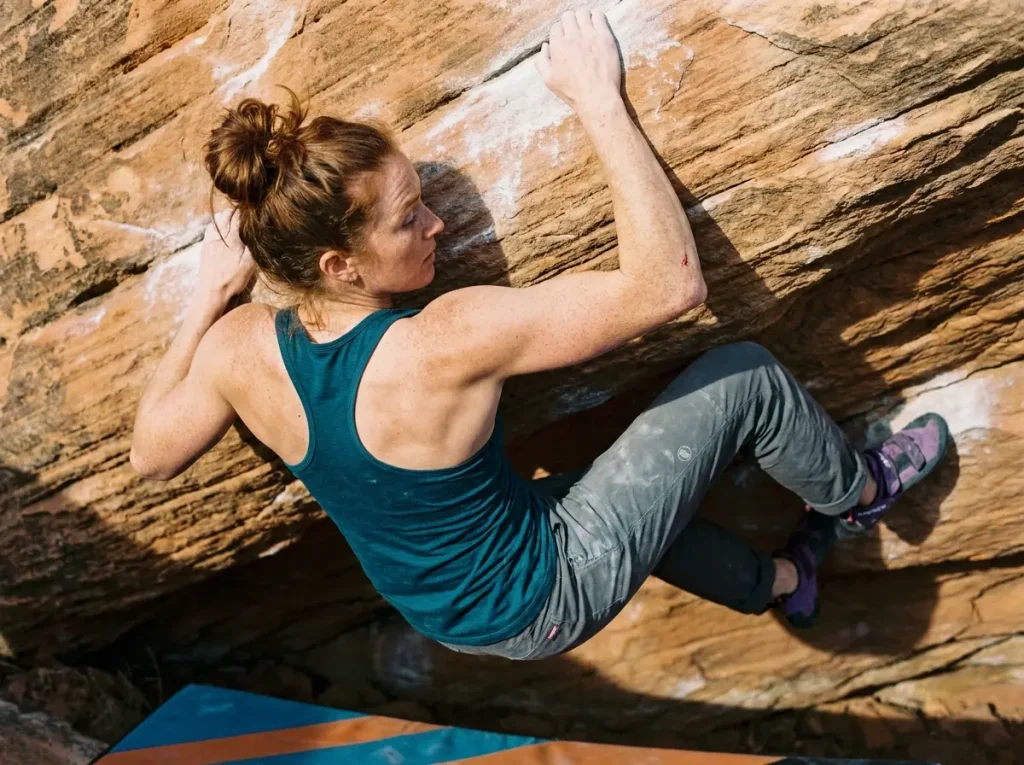
Here’s the part that trips up strong climbers: compression uses the muscle groups that climbing undertrained. Your pectorals, anterior deltoids, and triceps — the push muscles — do the work of generating inward force. Your lats and biceps, the pull muscles you’ve built up from thousands of routes, contribute almost nothing.
This is why a boulderer who can campus a V8 overhang might fall off a V4 compression arete. They have a massive pulling engine and a scooter-sized pushing engine. The technique works fine on holds you grip downward. The moment the holds face sideways and the only option is to squeeze, that imbalance shows up immediately.
The fix isn’t complicated, but it requires admitting that climbing alone won’t build the muscles compression demands. You need supplemental push training — and we’ll cover exactly what in the training section below.
Core Tension as the Foundation
Even with strong push muscles, compression falls apart without body tension. Your core connects the force your arms generate to the force your feet create. Without that rigid chain linking upper and lower body, the squeeze dissipates and you peel off.
One microsecond of relaxation in your core during a compression move and you’re on the mat. It’s that binary. This isn’t the gradual pump-out you feel on a long sport route — it’s an instant on/off switch. You’re squeezing or you’re falling.
The specific type of core tension compression requires is anti-rotation and anti-extension — resisting the forces that want to twist your torso or arch your back away from the wall. Standard crunches don’t train this. Planks, hollow body holds, and hanging L-sits do.
Three Points of Contact — The Compression Rule
On face climbing and crack climbing, you routinely break the three-point-contact rule. Dynamic moves, campus reaches, paddle-style dynos — they all leave you with fewer than three points on the wall.
Compression doesn’t tolerate that. Because the holds themselves are usually poor — slopers, round edges, friction-dependent smears — every contact point carries a disproportionate amount of the total force equation. Lose one point and the remaining two can’t compensate.
This means your feet stay on until your next hand is placed. Every move is deliberate. No throwing, no campus-style lunging, no rushing through sequences. The coordination required to move one limb while maintaining maximum tension through the other three is what makes compression technically demanding at any grade.
Pro tip: When you’re stuck on a compression sequence, try moving slower, not faster. The instinct on slopey holds is to move quickly before you slide off. In compression, speed kills tension. Slow, pressurized movements where your squeeze never drops below 80% is what keeps you on.
How to Read a Compression Problem
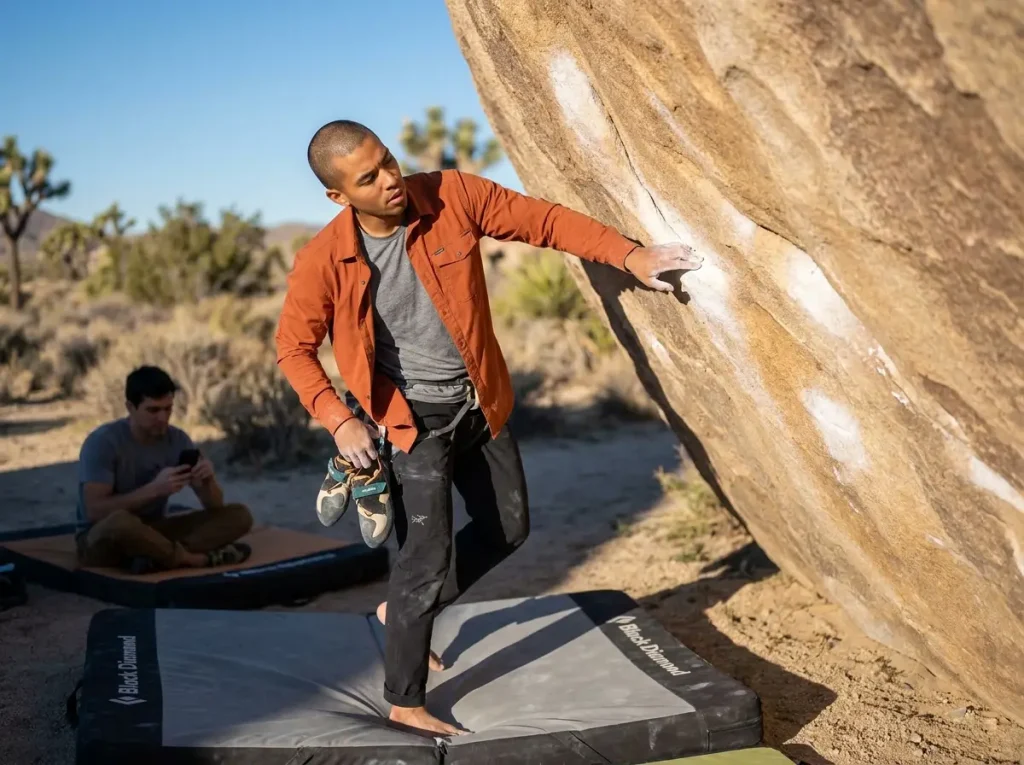
Identifying the Squeeze Before You Pull On
The skill nobody teaches — and the one that separates boulderers who flash compression from boulderers who flail on it — is reading the problem before you leave the ground.
Stand at the base and look at the holds. Ask yourself three questions:
Where do the holds face? If they face sideways or away from center, it’s compression terrain. Which features create opposing surfaces? Look for aretes, prows, volume edges, and natural pinch features on the rock. Where will my feet generate the most inward force? Footholds that let you smear into the feature or hook around it are your compression anchors.
Most people pull on and try to figure it out mid-climb. On compression problems, that’s how you burn through three attempts before you even understand the sequence. Understanding the physics behind different climbing styles helps you recognize which technique a problem demands before you touch the wall.
The Centerline Shift — Reading the Sequence
Compression moves almost never happen straight up the center of a feature. The sequence moves side to side, shifting your weight across the centerline of the prow or arete with each move.
Picture climbing an arete. Your right hand is on the right face, your left hand on the left face. To move your right hand up, you need to shift your weight onto the left side — pressing harder with your left hand and left foot — so the right hand can release without the whole system collapsing.
Then you move it up, replant it, and shift weight back to the right side so the left hand can advance. It’s a lateral pendulum, not a vertical ladder. The climbers who look smooth on compression aretes are managing this weight transfer seamlessly. The ones who look like they’re fighting the rock haven’t figured out the rhythm yet.
Matching Foot Technique to Compression Terrain
Your feet do different things in compression than in standard face climbing:
- Smearing — pressing the rubber flat against the rock surface for maximum friction, no edges required
- Heel hooks — wrapping your heel over a feature to create an inward pulling force from below
- Toe hooks — curling your toes over or around a feature, especially useful on volumes and rounded aretes
- Backstepping — turning your hip into the wall so your toe pushes against the opposite face
The foot technique must match the feature geometry. On a sharp arete, you might edge one foot and smear the other. On a round prow, it’s all smears and hooks. On a gym volume, toe hooks on top and smears on the sides.
If you’re struggling with feet cutting on steep terrain, fixing body position problems on roofs and overhangs covers the overlapping footwork techniques that apply directly to compression roof sections.
Training Compression Strength Off the Wall
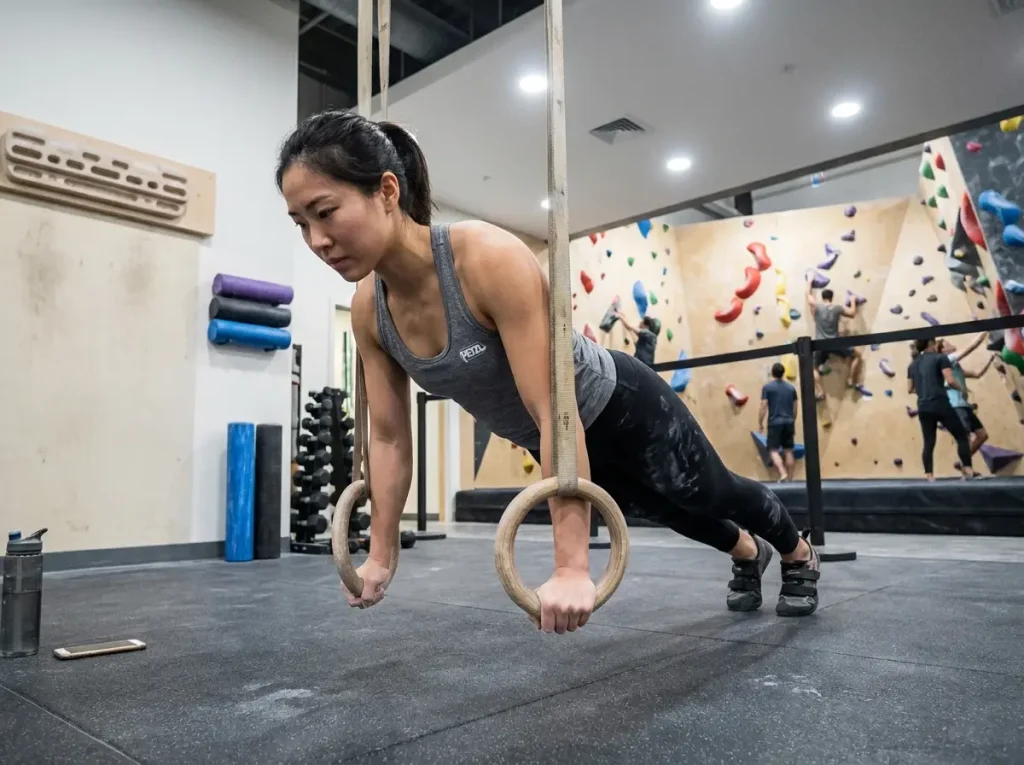
The Push Exercises Climbers Skip
Climbers are notorious for skipping push training. It feels counterintuitive — why would you train muscles that push away from the wall when climbing is about pulling toward it? Because compression exists, and it punishes that imbalance ruthlessly.
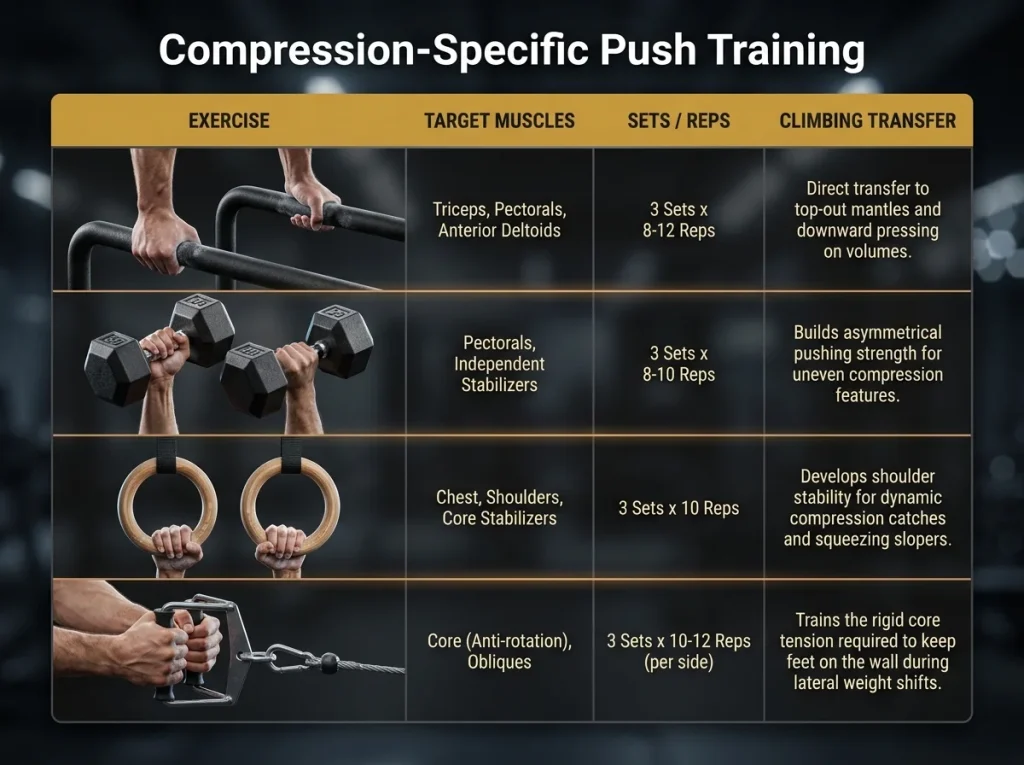
Here are the exercises that build compression-specific push strength:
Dips — target your triceps, pectorals, and anterior deltoids. Three sets of 8-12 reps, twice per week. If bodyweight dips are easy, add weight. Dips directly transfer to mantling and compression pressing.
Dumbbell bench press — not barbell. Dumbbells force each arm to stabilize independently, which mirrors the asymmetric loading of compression climbing. Three sets of 8-10 at moderate weight.
Ring push-ups — the instability of rings recruits stabilizer muscles in your shoulders and core that fixed surfaces miss. These build the kind of coordinated pushing strength that compression demands.
Pallof press — an anti-rotation core exercise that directly trains the type of core stability compression requires. Cable or band, three sets of 10-12 each side.
Invest 15-20 minutes into these exercises two or three days per week. That’s it. You’re not training to be a powerlifter — you’re filling the gap that standard climbing leaves open.
On-the-Wall Compression Drills
The best compression training happens on real compression terrain. Here’s how to structure it:
Arete laps — find a gym arete at two grades below your max. Climb it five times in a row, focusing on keeping tension through every move. No resting between laps. This builds compression-specific endurance.
Volume traverses — most gyms have volumes scattered across their bouldering walls. Create a traverse that touches only volumes — no bolt-on holds. This forces pure smearing and squeezing.
Sloper circuits — set up or find a circuit of 8-10 sloper moves at moderate difficulty. The goal isn’t to complete the circuit at max effort — it’s to learn how your hands stay on rounded features when your squeeze is consistent.
Three-point pause drill — on any compression problem, pause for two seconds every time you move a hand. This trains you to maintain full-body tension through the transition moments where most people fall off.
Pro tip: The single best way to improve at compression is to go outside and climb on real rock aretes and prows. Gym volumes approximate it, but nothing replicates the friction, texture variation, and subtle geometry of natural compression features. Hueco Tanks’ syenite boulders are some of the best compression training ground in the country.
Building Open-Hand Strength for Slopers
Compression problems are full of slopers — holds where your fingers can’t curl over an edge. Your grip becomes an open-hand press against a rounded surface, and the only thing keeping your hand on is friction and squeeze force.
Open-hand grip strength is different from crimp strength. Training one doesn’t automatically build the other. Hang from slopers on a hangboard or system board with an open-hand position. Start with large slopers and progress to smaller ones. Do repeaters: 7 seconds on, 3 seconds off, 6 reps, 3 sets.
The payoff shows up immediately on compression terrain. When your open-hand strength matches your crimp strength, slopers stop feeling impossible and start feeling like just another hold type.
If you’ve hit a ceiling on compression grades and can’t figure out why, diagnosing what’s actually stalling your bouldering progress often reveals the push/grip imbalance that compression exposes.
Compression vs Opposition — The Full Breakdown
Force Direction Is Everything
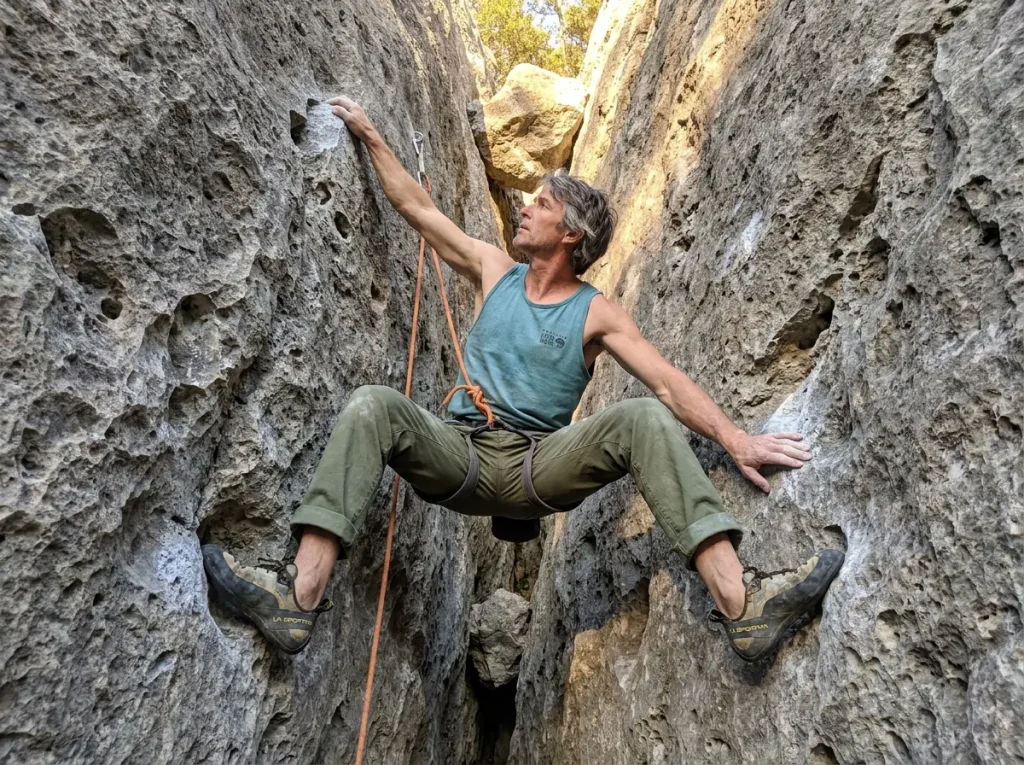
The difference between compression and opposition comes down to one thing: which way the force points.
Compression = you push inward. Both sides of your body are squeezing toward the center. The feature is between you and you’re holding it by pressing in from both sides.
Opposition = you push outward. Both sides of your body are pressing away from center. You’re between the feature and you’re staying in place by pressing out against both sides.
The classic opposition example is stemming in a dihedral corner. Your left foot presses left, your right foot presses right, and the outward forces hold you in place. The classic compression example is climbing an arete — your left hand presses right, your right hand presses left, and the inward forces keep you stuck to the feature.
When Compression and Opposition Overlap
Real climbing isn’t textbook clean. Plenty of sequences blend both techniques within the same problem. An arete that turns into a corner might require compression on the prow and opposition in the dihedral three moves later. A roof problem might need compression to hug the lip and opposition to stem between features once you’ve topped out.
The ability to switch between the two mid-sequence — recognizing when the force direction needs to change — is what separates intermediate boulderers from advanced ones. You stop thinking “this is a compression problem” and start thinking “this move is compression, the next one is opposition, and the mantle is pure push.”
Common Confusion Points
A few moves that people misidentify:
Laybacking is not compression — it’s opposition. You’re pulling with your hands and pressing with your feet in opposite directions along the same plane.
Palming is compression when you’re pressing inward against a feature. It’s just friction when you’re pressing down on a flat surface.
Heel hooks can be part of both. A heel hook on the opposite side of a feature that creates inward squeeze = compression. A heel hook that pulls you into the wall while your hands push away = opposition.
Pro tip: Next time you watch a strong boulderer work a compression problem, ignore their hands. Watch their hips. The hips tell you where the center of force is and which direction the squeeze is pointing. That’s the real beta.
Classic Compression Problems and Where to Find Them
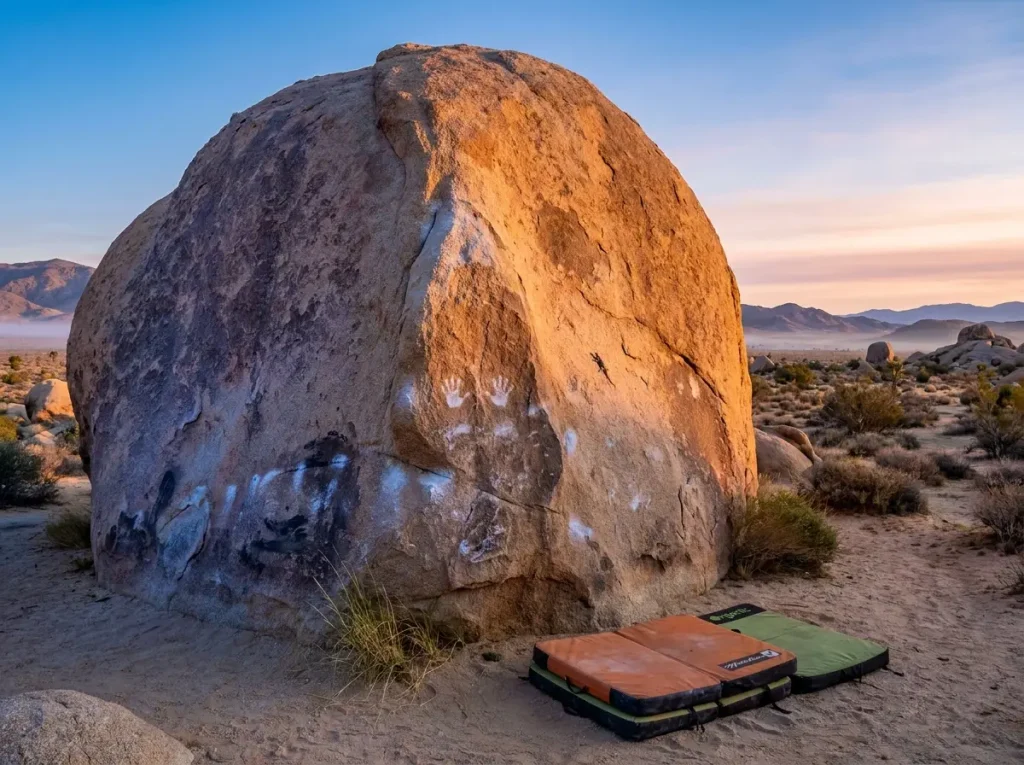
Outdoor Compression Destinations
If you want to learn compression on real rock, these areas are famous for it:
Fontainebleau, France — the sandstone boulders are loaded with rounded aretes, slopey prows, and featureless compression problems across every grade range. The friction on Font sandstone rewards good technique.
Hueco Tanks, Texas — the syenite rock creates natural compression features: smooth prows, rounded aretes, and slopey top-outs that demand full-body squeeze. The classic problems here built compression climbing’s reputation.
Bishop, California — the Buttermilks and Happy Boulders have iconic compression lines on volcanic rock. The holds face every direction except the one you want, and the solutions are always about squeeze. Check the Access Fund’s climbing area conservation resources before visiting any outdoor area — many compression-heavy bouldering destinations have specific access and stewardship requirements.
Colorado Front Range — the granite and sandstone boulders across the Front Range’s best bouldering areas offer compression in every flavor from gentle V2 aretes to desperate V10 prows.
Gym Compression Features to Seek Out
Not everyone can fly to Font. In the gym, look for:
- Large volumes — especially the ones with no bolt-on holds attached. Pure volume climbing is pure compression.
- Set arete features — wall sections that create an outside edge you can wrap around both sides of.
- Comp-style boulders — competition setting increasingly features compression-heavy sequences because they test body awareness and coordination, not just finger strength.
- Sloper-heavy problems — any problem that forces open-hand grip and body tension is building your compression skill set whether it’s labeled “compression” or not.
Reading Beta for Compression Problems
When you look at beta videos or route descriptions for compression problems, the language is different from standard climbing beta:
“Wrap the arete” means compress both sides. “Match the sloper” means both hands generating inward force on the same feature. “Squeeze and step through” means maintain compression while moving your feet — the hardest part. “Bear hug” is exactly what it sounds like — full torso compression against a wide feature.
Learning this vocabulary helps you decode beta and apply it on the wall. Watching technique-focused climbing channels is one of the best ways to see compression in action before you try it yourself.
Conclusion
Compression is a push technique, not a pull technique. Your chest, shoulders, and core generate the inward force that holds you on aretes, slopers, and prows — muscles that standard climbing barely touches. If you’re strong on steep walls and weak on compression problems, the imbalance is the answer.
Learn to read compression before you climb it. Look at where holds face, identify the opposing surfaces, and plan your weight shifts side-to-side before you leave the ground. The sequence moves laterally across the centerline, not straight up.
Train what climbing doesn’t build. Add dips, ring push-ups, and open-hand sloper hangs to your routine two days a week. Then get on real rock aretes and prows whenever you can — gym volumes help, but nothing teaches compression like natural stone under your palms.
Q1 What is compression in climbing?
Compression is a technique where you squeeze inward on opposing holds or features using your chest, shoulders, and core. Instead of pulling down on edges, you press both sides of a feature inward to create friction and stability. It’s common on aretes, volumes, and slopey prows.
Q2 How do you train compression for climbing?
Train push muscles with dips, ring push-ups, and dumbbell bench press two to three days per week. On the wall, practice arete laps, volume traverses, and sloper circuits at moderate grades. Open-hand hangboard repeaters build the grip strength slopers demand.
Q3 What is the difference between compression and opposition in climbing?
Compression pushes inward — you squeeze a feature between opposing contact points. Opposition pushes outward — you press away from both sides, like stemming in a corner. The force directions are opposite, and they use different muscle groups and body positions.
Q4 What muscles does compression climbing use?
Compression relies on your pectorals, anterior deltoids, triceps, and core — the push muscles that standard climbing undertrains. Your forearms contribute through open-hand grip strength rather than crimp strength. Core tension connects upper and lower body forces into a rigid chain.
Q5 How do you climb slopers better?
Keep your wrist neutral and your hand as flat as possible against the hold surface. Maximize skin contact for friction. Engage your core and shoulders rather than relying on finger strength. Move slowly and deliberately — speed breaks the tension that keeps your hands on rounded holds.
Safety Notice: Rock climbing and mountaineering are inherently high-risk
activities that can involve physical trauma or fatal incidents. The information on Rock Climbing Realms is for
educational and informational purposes only. Techniques and advice presented here are not a substitute
for professional, hands-on instruction. Conditions and risks vary by location. Always seek guidance
from a qualified instructor before attempting new techniques. By using this website, you agree that you
are solely responsible for your own safety. Any reliance you place on this information is strictly
at your own risk, and you assume all liability for your actions. Rock Climbing Realms and its authors
will not be held liable for any harm, damage, or loss sustained in connection with the use of this information.
Affiliate Disclosure: We are a participant in the Amazon Services LLC Associates Program, an
affiliate advertising program designed to provide a means for us to earn advertising fees by advertising and linking
to Amazon.com. As an Amazon Associate, we earn from qualifying purchases. We are also an official affiliate partner
of Black Diamond Equipment via the AvantLink network. If you click on a Black Diamond affiliate link and make a
purchase, we may earn a commission at no additional cost to you. We also participate in other affiliate programs.
Additional terms are found in the terms of service.