
In this article
Gravity is the only non-negotiable partner in climbing; it does not care about your stoke, your project, or your ankles. When you peel off a boulder problem, you cease to be an athlete and become a projectile governed strictly by the laws of physics. In bouldering, every fall is a ground fall. In my two decades of guiding and technical instruction, I have seen too many strong climbers sidelined not by a lack of strength, but by a failure of geometry. The difference between a “good burn” and a career-altering injury often lies not in luck, but in the deliberate engineering of your landing zone.
This guide moves beyond the basic heuristic of “throwing a pad down” to establish a deterministic, safety-first technical blueprint for managing kinetic energy. We will analyze how to predict your trajectory map, layer foam densities correctly, and construct a landing system that keeps you climbing while respecting the biotic integrity of the cliff base.
The Physics of Falling: Why Do We Miss the Pad?

What is the “Fall Shadow” and how does it shift?
The “Fall Shadow” is the dynamic surface area where a climber is likely to impact, calculated by combining the vertical drop with horizontal velocity and rotational torque. It is almost never directly below the hold you fall from.
When you are hanging statically on a vertical wall, a plumb line drop is an accurate predictor of your landing. However, bouldering is rarely static. Once you introduce dynamic movement, you must account for the principles of projectile motion and falling objects.
The math is simple: how far you travel sideways depends on how fast you are moving and how long you are in the air. When you are climbing a steep overhang or making a big jump, you don’t fall straight down—you swing outward. If you put your safety pads directly under the edge of the rock, you are protecting a patch of dirt you will never actually hit. You have to account for that outward momentum and place your pads where your body is actually going to land.

Things get even trickier because of the “Barndoor” effect. If a hand or foot pops while you are leaning, your body will swing away from the rock like a door on a hinge. That spin throws you off balance and means you won’t just fall straight down; you’ll likely fly out to the side. Because of this, you need a much wider landing area covered with pads to make sure you don’t hit the ground outside the safety zone.
You aren’t just falling backward; you are corkscrewing. This necessitates placing bouldering pads wider than you think necessary, specifically to the side of the fall line. This becomes critical when mastering the takeoff, flight, and latch of dynamic moves, where high horizontal velocity creates a “Hazard Zone” that can shift the safe drop spot 2 to 3 meters back from the wall base.
Material Science: What Makes a Crash Pad Safe?

How do open-cell and closed-cell foams interact?
A crash pad utilizes a “sandwich” architecture wrapped in durable ballistic nylon, typically consisting of a thin, rigid top layer (Closed-Cell Polyethylene) bonded to a thick, soft core (Open-Cell Polyurethane), designed to manage specific energy phases for optimal impact absorption.
The top layer is the distribution plate. Its function is to take the point-load of a heel strike—which generates massive pressure per square inch—and spread it across a wider surface area. Without this rigid layer of stiff foam, your heel would punch through the soft foam, leading to tissue damage.
Beneath this, the open-cell foam core acts as a pneumatic shock absorber. It relies on air resistance (drag) within the foam matrix to dissipate kinetic energy as heat. The epidemiology of lower extremity injuries in climbing suggests that insufficient deceleration time ($Delta t$) is a primary cause of trauma, validating the need for this specific dual-density arrangement found in modern pads.

However, foam is not magic. Repeated impacts cause “hysteresis,” or foam fatigue, where the polymer struts inside the foam compartments break down, creating soft spots. This increases the risk of “bottoming out,” where the foam fully compresses and the climber strikes the ground through the pad.
While stiff closed-cell foam may feel harsh on impact, it is essential for higher falls to prevent this catastrophe. When you select the perfect crash pad for your climbing style—whether it’s a Metolius Session, a Kinetik Climbing Newton, or an Organic Climbing Simple Pad—prioritizing high-density foam stability over plush comfort is usually the safer bet for longevity and protection.
The Geometry of Placement: How Do We Build the Landing Zone?
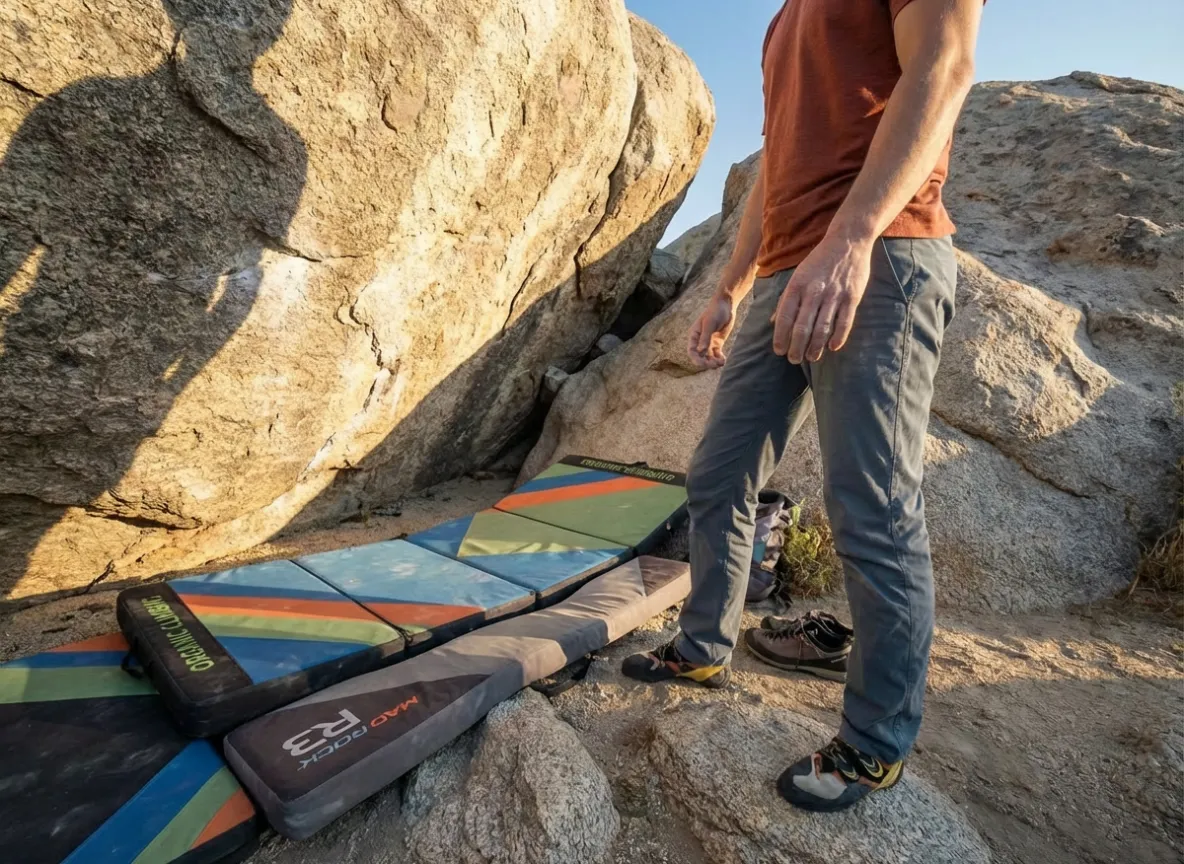
 Mad Rock R3 pad and covering seams with an Organic Climbing Blubber pad.” class=”wp-image-12422″/>
What is the “Pad Tetris” strategy for uneven terrain?
“Pad Tetris” is the operational protocol of leveling, platforming, and sealing to neutralize uneven landing surfaces and prevent mechanical injuries like inversion sprains. This is critical when dealing with protruding rocks, roots, and slopes.
The process begins with the “Leveling” phase. Use flexible pads (like the Mad Rock R3), satellite pads, or a frank slider pad to fill voids between talus and roots. Once you have a roughly flat surface, move to the “Platform” phase by placing your largest, stiffest pads—such as an Organic Big Pad, Black Diamond Mondo, or Flashed sector pad—on top to create a uniform landing surface.

You must avoid the “Bridge Hazard” at all costs. Never bridge a soft pad over a gap; if you land in the center, the pad will collapse into the void, trapping your ankle in a mechanism that almost guarantees a fracture.
Pro-Tip: If you are climbing alone or with limited pads, prioritize covering the rock or root that sticks up rather than the hole that dips down. You can survive landing in a depression; landing spine-first on a sharp rock is a different story.
The most common failure point in a pad-stacking scenario is the seam. These “gutters” are responsible for a high percentage of ankle sprains. “Seam sealing” is a medical necessity. Use a blubber pad, a Flashed Drifter pad, or a slider to cover the junctions, locking the system together into one continuous surface for gap avoidance.
Furthermore, you must account for the “Paratrooper Roll” (often called aikido rolls or judo rolls in climbing). Extend the landing zone in the direction of your momentum. If you stick the landing but stumble backward off the pad edge onto talus, the system has failed. This aligns with the proactive prevention framework for climbing injuries, which emphasizes that safety extends until the climber is stable on the ground.
Advanced Protocols: How Do We Manage Highballs and Spotting?

Why must the stiffer pad always go on top?
In high-consequence scenarios involving stacked pads, such as a highball or a roadside highball, the rule is non-negotiable: Hard on Soft.
The stiff top pad acts as a distribution plate, spreading the high-velocity impact force across the entire surface area of the soft bottom pad. This maximizes the impact absorption capabilities of the bottom layer while providing a surface stability that prevents tripping hazards.
If you reverse this (Soft on Hard), the falling climber’s foot accelerates through the soft top foam and strikes the hard underlying layer with a concentrated point load. This often results in a rolled ankle or heel bruise, defeating the purpose of the stack.
Pro-Tip: When stacking pads on a slope, strap them together if possible. A loose stack can “shear” or slide apart upon impact, sending the climber sliding downhill with the top pad while their foot stays trapped in the bottom one.
Spotting in this context shifts from “catching” to flight control. Active spotting and crash pad placement work in tandem; the spotter’s job is to redirect the climber toward the center of this engineered stack and protect the head, avoiding lobitomizing impacts or back-slapping low falls. Use the spoons position (fingers together, thumbs in) to avoid finger injuries.
For traversing lines or a long circuit pad problem, use the “Train Method,” where spotters shuffle pads in a coordinated line to track the climber, ensuring the safe drop zone moves with the fall shadow. This often involves moving a pad mid-climb to clear the landing for the next section.
Environmental Ethics: Where Should We Not Place Pads?

How does soil compaction destroy cliff ecology?
Our gear deployment can easily become an instrument of environmental degradation if we ignore the “Biotic Cost” of the landing zone.
Crash pads are heavy, and when combined with the impact of a falling climber, they crush vascular plants, mosses, and lichen that may be decades old. This mechanical force causes ground erosion and destroys soil pore space, preventing water infiltration.
We must identify “No-Go Zones.” Avoid placing pads directly on Umbilicaria lichens, alpine moss, or fragile vegetation. Instead, seek durable surfaces like rock, sand, or established bare soil. Studies on the impact of bouldering on rock-associated vegetation highlight that the footprint of a boulder problem extends well into the surrounding flora.
We must also adhere to the “No Drag” rule. Dragging a pad acts like a plow, disturbing topsoil and widening social trails. Always carry your pads between boulders using the straps or handles.
Furthermore, “gardening”—moving rocks or logs to create a flat landing—is effectively vandalism. Terraforming alters the micro-habitat for local fauna and violates the core tenets of the climber’s guide to leave no trace ethics. If a landing cannot be made safe without destroying vegetation or moving geological features, the problem should not be climbed. We must commit to the climber’s pact and practice sustainable pad placement to ensure access for future generations.
Summary of Protocols
Placing a crash pad is an act of prediction. It requires you to calculate the “Fall Shadow” based on your horizontal velocity, respect the material limits of your foam through “Hard-on-Soft” stacking, and meticulously seal the seams that lie in wait for your ankles.
Yet, operational safety must never compromise the ecological integrity of the cliff base. By utilizing durable surfaces and refusing to terraform the terrain, we ensure that our pursuit of the ascent leaves no scar on the ground below.
Visit our complete library of technical climbing guides to further refine your risk mitigation strategies and become a more self-reliant alpinist.
FAQ – Frequently Asked Questions
How many crash pads do I need for bouldering outdoors?
For most moderate problems up to 10-12 feet, two standard-sized pads (like a Metolius Session or Organic Simple Pad) are the recommended minimum. This allows you to cover the primary landing zone and the secondary swing zone where your body might roll (often called the boulder roll). Highballs or complex traverses often require 4+ pads, potentially including a big pad or The Brickyard, and a coordinated team of spotters.
Is a hinge-style or taco-style crash pad better for safety?
Taco-style pads offer a continuous landing surface with no gaps, making them superior for preventing ankle twists during awkward falls. However, hinge-style pads (often a briefcase pad design) lie flat more easily and are easier to store in a trunk. If you use a hinge pad, you must be vigilant about covering the gutter with a slider or accessory pads.
What is a slider pad and do I really need one?
A slider (or blubber pad) is a thin sheet of high-density foam designed to cover the seams between multiple crash pads. It is essential equipment for creating a unified, trip-free landing zone. On uneven terrain, it prevents your foot from slipping between pads, which is a leading cause of ankle sprains.
How do I spot a climber safely?
Spotting is about redirecting momentum and spinal protection, not catching weight. Stand with spoons position hands (fingers together, thumbs in), knees bent, and focus on guiding the climber’s center of gravity toward the middle of the pad stack. Your primary goal is to keep their head and neck from striking the ground or rocks.
Safety Notice: Rock climbing and mountaineering are inherently high-risk
activities that can involve physical trauma or fatal incidents. The information on Rock Climbing Realms is for
educational and informational purposes only. Techniques and advice presented here are not a substitute
for professional, hands-on instruction. Conditions and risks vary by location. Always seek guidance
from a qualified instructor before attempting new techniques. By using this website, you agree that you
are solely responsible for your own safety. Any reliance you place on this information is strictly
at your own risk, and you assume all liability for your actions. Rock Climbing Realms and its authors
will not be held liable for any harm, damage, or loss sustained in connection with the use of this information.
Affiliate Disclosure: We are a participant in the Amazon Services LLC Associates Program, an
affiliate advertising program designed to provide a means for us to earn advertising fees by advertising and linking
to Amazon.com. As an Amazon Associate, we earn from qualifying purchases. We are also an official affiliate partner
of Black Diamond Equipment via the AvantLink network. If you click on a Black Diamond affiliate link and make a
purchase, we may earn a commission at no additional cost to you. We also participate in other affiliate programs.
Additional terms are found in the terms of service.