
In this article
In 1808, Marie Paradis reached the summit of Mont Blanc. Her guides had carried her through the final snowfields, and she descended with frostbite so severe she lost fingernails. History recorded her as the “first woman to climb Mont Blanc.” The reality of that ascent — a passive passenger on a static hemp rope under 7 kg of wool — had almost nothing in common with the act of climbing.
Being transported uphill is not the same as climbing. That conflation, between passenger and practitioner, is the central error in how climbing history has been written.
Women were never latecomers catching up. They were climbers working against mechanical and systemic disadvantage, building their own movement and autonomy from scratch. Understanding what historic routes teach climbers about the sport’s evolution means looking past the famous names and examining what those climbers were actually working with.
Quick Answer: Women were never “latecomers” to climbing — they were systemically excluded from the technical infrastructure (guide networks, rope technology, training data) that made progression possible. From the Parminter sisters’ 1786 ascent of Mont Buet to Angela Eiter’s 2017 5.15b redpoint, women have consistently matched or redefined the standard once given access to the same equipment and autonomy as men.
The Guided Era: Wool, Hemp, and the Physics of Being Carried (1786–1900)
The Parminter Sisters: The First Recorded Female Ascent History Forgot
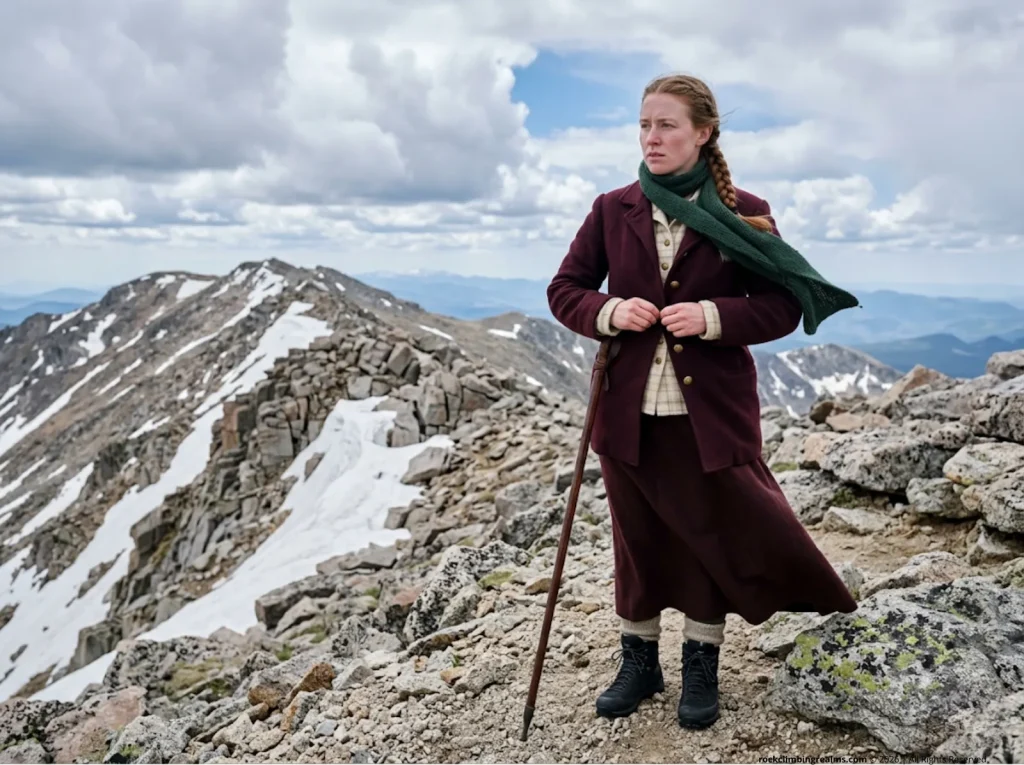
Elizabeth and Jane Parminter, along with their cousin Mary, summited Mont Buet (3,096m) in June 1786. Over two decades before Marie Paradis touched Mont Blanc. Their achievement stayed buried in archives for 171 years while Paradis got the “first” label — not because she was first, but because Mont Blanc carried more prestige.
This pattern repeats throughout climbing history: real technical ascents by women get erased in favor of famous peaks climbed under guided conditions. The Parminters climbed. Paradis was carried. History chose the more dramatic mountain.
The Gear Penalty: What Victorian Women Actually Climbed In
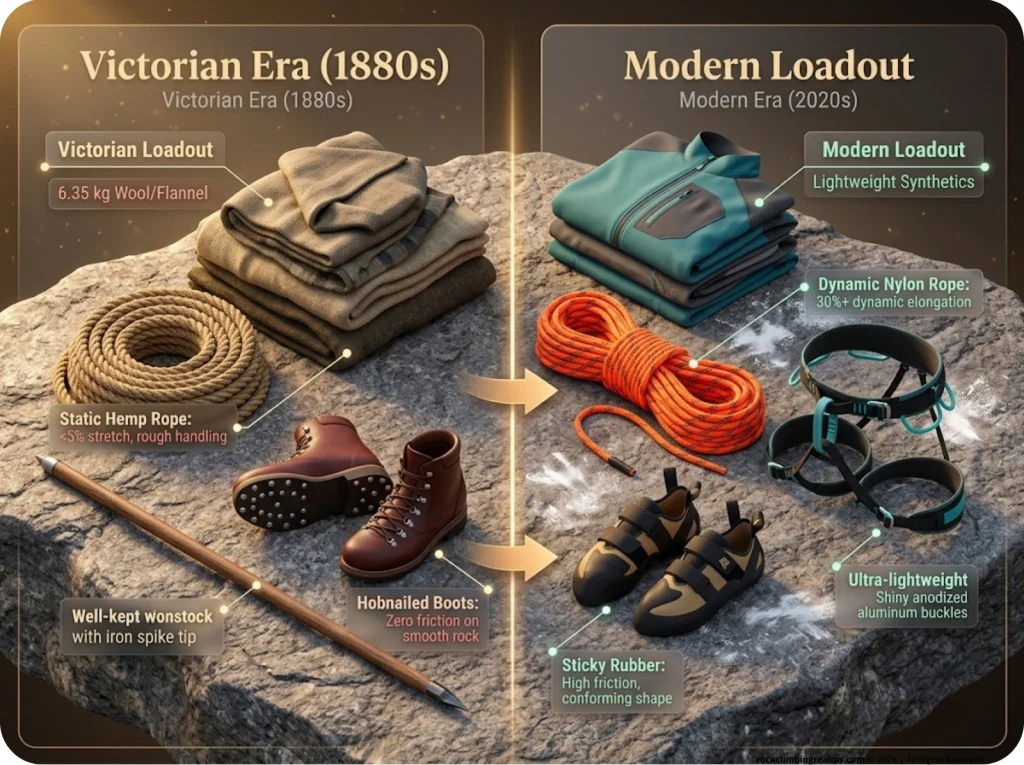
Henriette d’Angeville’s 1838 Mont Blanc outfit weighed about 14 pounds of flannel, wool, and fur — 6.35 kg of non-breathable fabric restricting every joint. A 7 kg non-breathable load on a Victorian woman pushes the effort up 10–15% before you even factor in the restricted range of motion in her hips and shoulders.
The rope was worse. Hemp rope, 10–12mm twisted, stretched less than 5% before breaking, with a minimum breaking strength around 2,000 lbs. No shock absorption. A fall transferred force straight into the climber and the anchor. Hobnailed leather boots gave zero friction on smooth slabs — smearing was a guaranteed hospital visit.
Three points of contact was not a preference. It was survival.
From Passenger to Practitioner: Henriette d’Angeville’s Refusal to Be Carried
D’Angeville explicitly refused the physical assistance that defined Paradis’s ascent. She walked every step herself — the first documented push for female climbing autonomy. The male alpine community celebrated her precisely because she demonstrated competence, not participation.
The distinction between guided and autonomous ascent is the fault line running through every evaluation of early female climbing achievements. These women were testing themselves against the alpine hubs where women first tested their autonomy against the world’s most iconic peaks, laying groundwork that would take another century to bear fruit.
Pro tip: If you want to understand what early alpine climbing actually felt like, try hiking a steep approach in a wool sweater with a 15 lb pack. Now imagine doing that for 12 hours at 4,000 meters with no breathable fabric, no shock-absorbing rope, and boots that slide off any surface smoother than sandpaper.
The “Leader Must Not Fall” Era: Static Ropes and Technical Autonomy (1880–1930)
Hemp Rope and Why Every Fall Was System-Ending
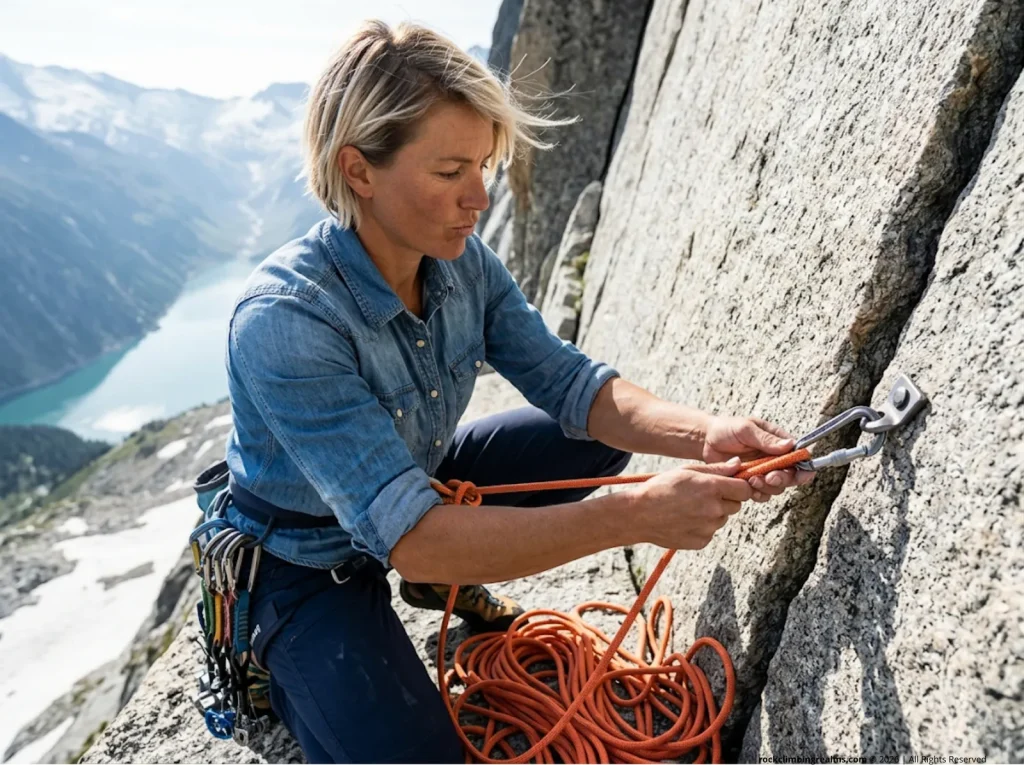
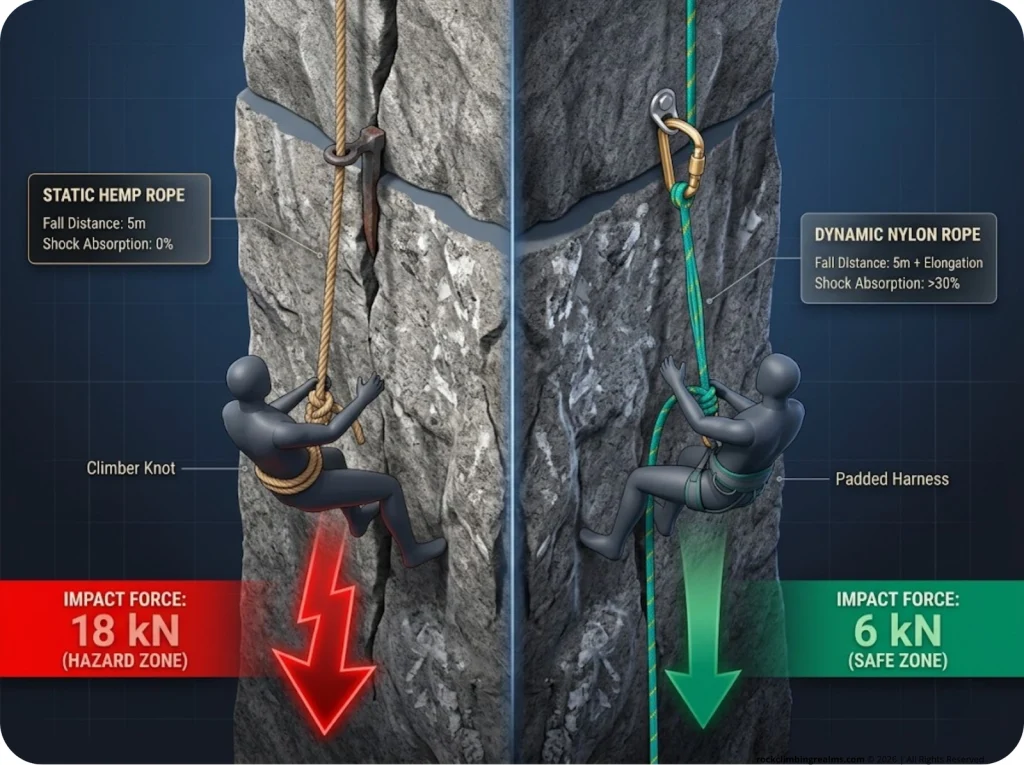
Hemp rope does not stretch. In a 5-meter fall with 1 meter of slack, the impact force can exceed 15–20 kN — enough to cause severe internal injury or snap the rope. The rope was a psychological tether, not a safety system.
Understanding how modern dynamic ropes fundamentally changed the physics of falling explains why climbing grades stayed so low for so long — and why women, operating with the same inadequate equipment, were not “behind” but working under identical, brutal constraints.
Elizabeth Le Blond: Skirts, Knickerbockers, and the First Winter Traverse
Le Blond completed the first attempted winter traverse of the Jungfrau in the 1880s and 90s, navigating terrain with zero modern safety net. She shucked her skirt once out of sight of villages and climbed in knickerbockers — a critical technical adaptation, not a fashion statement.
Removing the skirt barrier restored proper hip abduction and foot placement on technical rock. In a static rope system where every fall was potentially career-ending, that range of motion was the difference between climbing and getting seriously hurt. Le Blond also bypassed the social requirement for a male “protector” by hiring guides professionally, exploiting a social loophole to gain access to terrain she could not reach alone.
The Ladies’ Alpine Club and The Pinnacle Club: The First Technical Incubators
The Ladies’ Alpine Club (founded 1907) and The Pinnacle Club (founded 1921) were data-sharing networks where women recorded first ascents, shared route beta, and iterated on technical systems — the same process that drives modern projecting. These organizations let women bypass the gatekeeping of male guides and develop independent climbing skills.
Miriam Underhill and the Engineering of “Manless Climbing” (1929–1950)
The Dependency Loop: Why Following a Male Leader Prevented Skill Acquisition
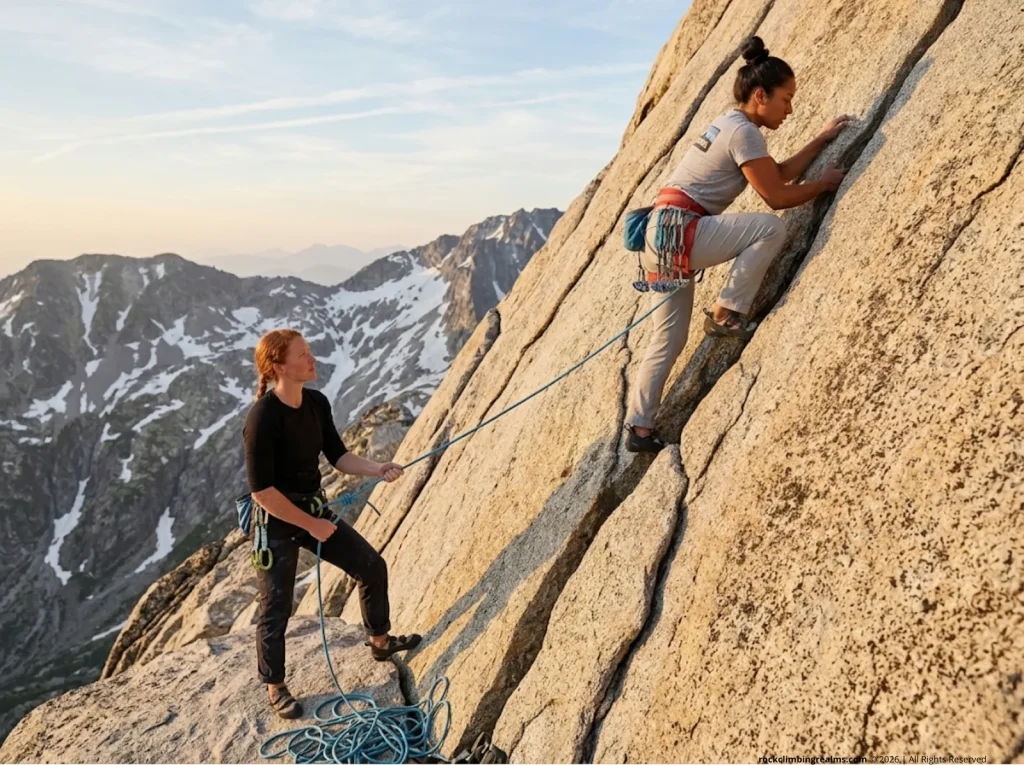
Miriam Underhill was a mathematician and physicist. She identified something most climbers still miss: following a male leader prevents you from mastering risk assessment, route finding, and anchor management. In her 1934 National Geographic essay, she wrote that “the person who invariably climbs behind a good leader may never really learn mountaineering at all.”
Without responsibility for anchor forces and safety logistics, you cannot develop the judgment required for independent climbing. Removing men from the party forced women to manage their own safety systems — converting theoretical knowledge into practical competence. Understanding the ethics and craft of the modern first ascent means recognizing that autonomy, not just strength, is what makes a first ascent meaningful.
The Grépon (1929): First Manless Ascent and Its Technical Significance
Underhill and Alice Damesme completed the first manless ascent of the Aiguille du Grépon in 1929, including the Mummery Crack — now rated 5.8–5.9. Leading it with a hemp rope and primitive protection, where pitons were rare and often untrusted, showed proficiency equal to the leading male climbers of the era.
The male climbing community’s reaction was telling — they complained the Grépon was “ruined,” revealing how technical difficulty was weaponized as a proxy for masculine identity. The route had not changed. The climbers had.
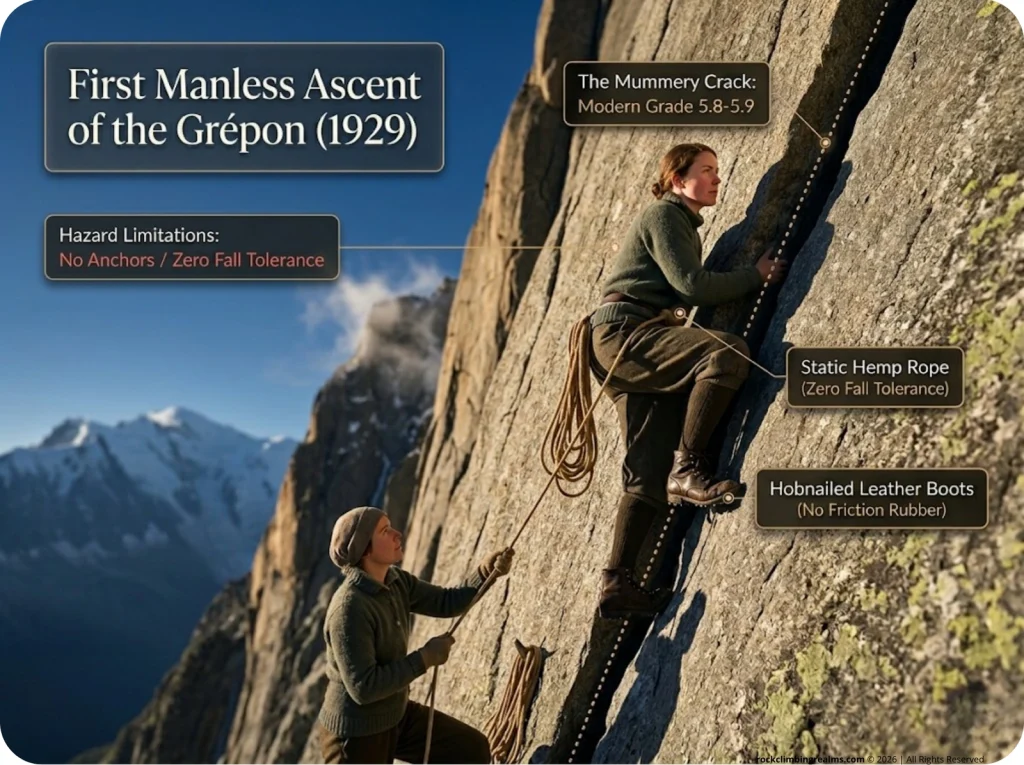
Pro tip: Next time someone tells you a route “used to be harder” or “lost its prestige,” check what equipment the original ascent used. Most “sandbagged” historic grades become reasonable once you account for hemp ropes, hobnailed boots, and the absence of belay devices.
By the 1940s, multiple female-led teams had validated the manless concept across rock types and terrain, shifting the argument from “can women climb alone?” to “why were they prevented from doing so?”
How Female Climbers Move Differently: Center of Gravity, Flexibility, and Grip
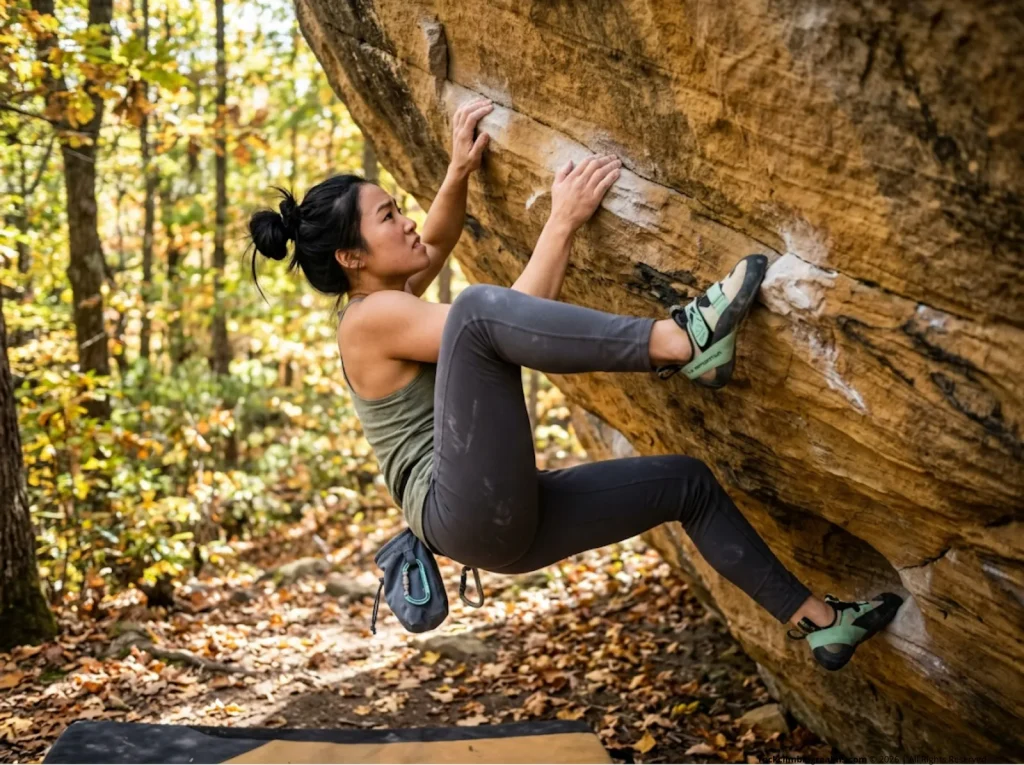
Lower Center of Gravity and the Flexibility Edge
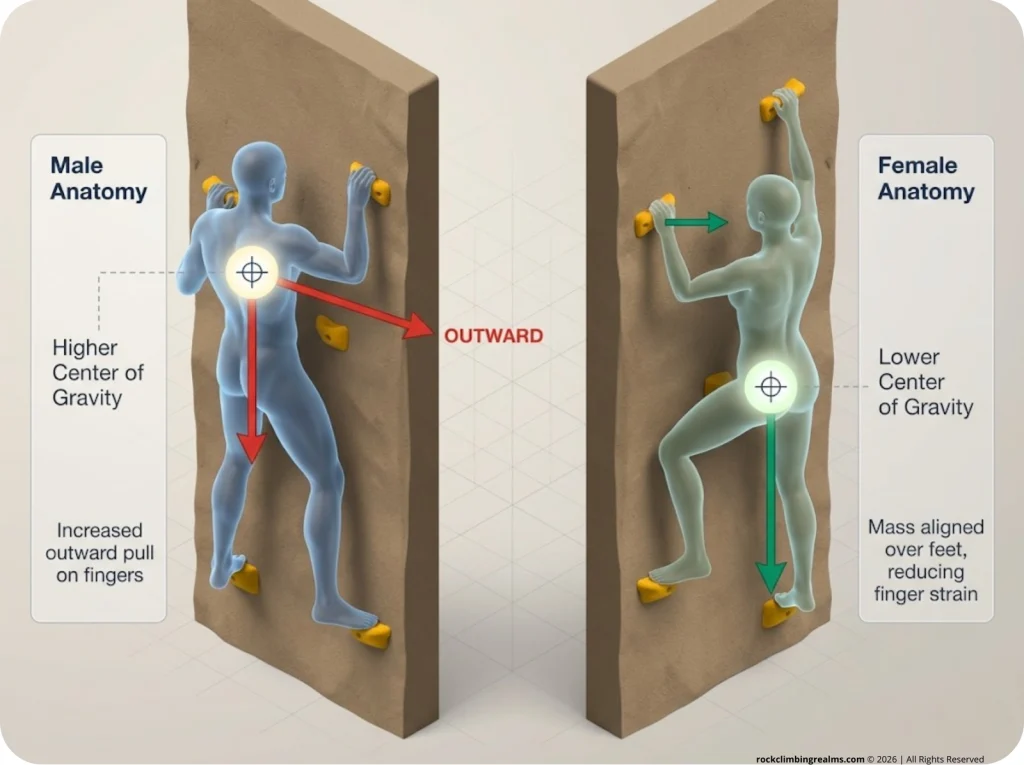
Women typically carry their center of gravity lower relative to total height. On vertical and slab terrain, that allows more efficient weight distribution over the feet, reducing the outward pull on finger holds. The farther your center of gravity hangs from the wall, the harder your fingers have to pull. Women start closer.
Elite female climbers also demonstrate superior hip flexibility, especially the ability to rotate and open their hips wide. This allows high-stepping and frog positions that place body mass directly over a foothold — converting a vertical pull into a balance-based push. Less strain on the upper body means preserved finger endurance on long routes. Understanding how finger strength determines climbing performance across grade scales clarifies why relative finger strength — not absolute — is the main predictor of performance for both sexes.
The Finger Strength Paradox: Why Smaller Hands Can Be an Advantage
The gap between tendon and bone is larger in men (0.24 cm vs. 0.20 cm in women), putting more stress on the finger pulleys when crimping hard — a morphological difference documented in ultrasound-based research published by the National Institutes of Health (PMC12138156). Women’s thinner tendons and lower absolute grip strength push them toward open-hand or half-crimp grips instead of the full crimp. This adaptation reduces injury risk and opens up intermediate holds — tiny ripples in the rock that larger male fingers cannot effectively grip. What looks like a “weakness” in the gym is an advantage on real rock.
Pro tip: If you are a female climber working a project that feels strength-dependent, check whether switching from a full crimp to an open-hand grip opens up intermediate holds you were ignoring. Smaller fingers can use edges that larger hands slide right off.
The Redpoint Revolution: Nylon, Sticky Rubber, and Closing the Grade Gap (1950–2010)
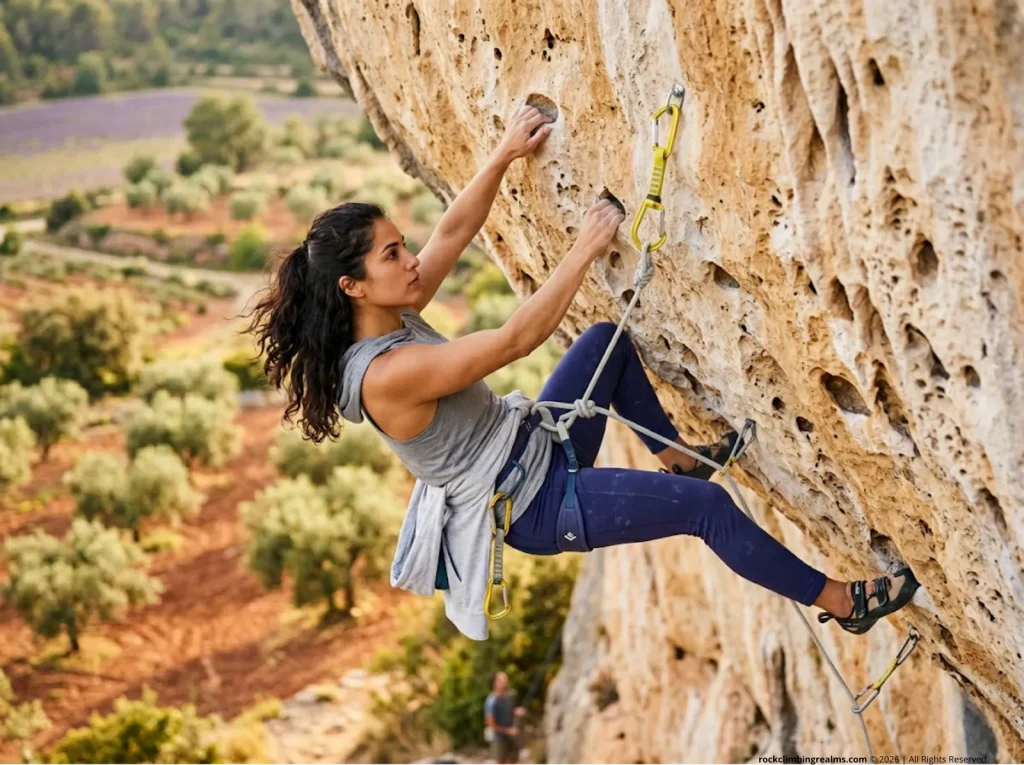
Dynamic Ropes: Why Lighter Climbers Gained the Most
Modern dynamic ropes stretch under load, absorbing fall energy and reducing impact force. This mattered more for lighter female climbers — a lighter body experiencing the same impact force decelerates harder. When the UIAA standardized dynamic ropes in the post-1950s era, lighter climbers gained proportionally more safety margin, directly enabling the push into 5.12+ grades by women in the 1970s and 80s.
Lynn Hill on The Nose: Deconstructing the Power Beta
Her 1993 free ascent of The Nose on El Capitan (5.14a) remains the technical case study. On the Great Roof and Changing Corners pitches, male climbers relied on reach. Hill used intermediate holds so small they were invisible to her partners — a higher frequency of smaller, controlled movements between holds. How The Nose embodies climbing’s stylistic evolution from aid to free becomes clear when you look at Hill’s beta: she found sequences the route’s original aid climbers and subsequent free aspirants had never considered, because their hands could not use the holds she was using.
Josune Bereziartu and the One-Notch Gap
By 2005, Bereziartu had redpointed Bimbaluna (5.14d/15a). At the time, the world’s hardest route was 5.15a — placing her one grade notch from the absolute standard for either sex. The limitation was not physical — it was a lack of data-driven training methodology, the same methodology male climbers had developed for decades with a research base built on male physiology.
High-Altitude Autonomy: Expedition-Grade Self-Sufficiency (1970–2000)
The Denali Damsels (1970): 70-Pound Packs and Z-Pulley Systems
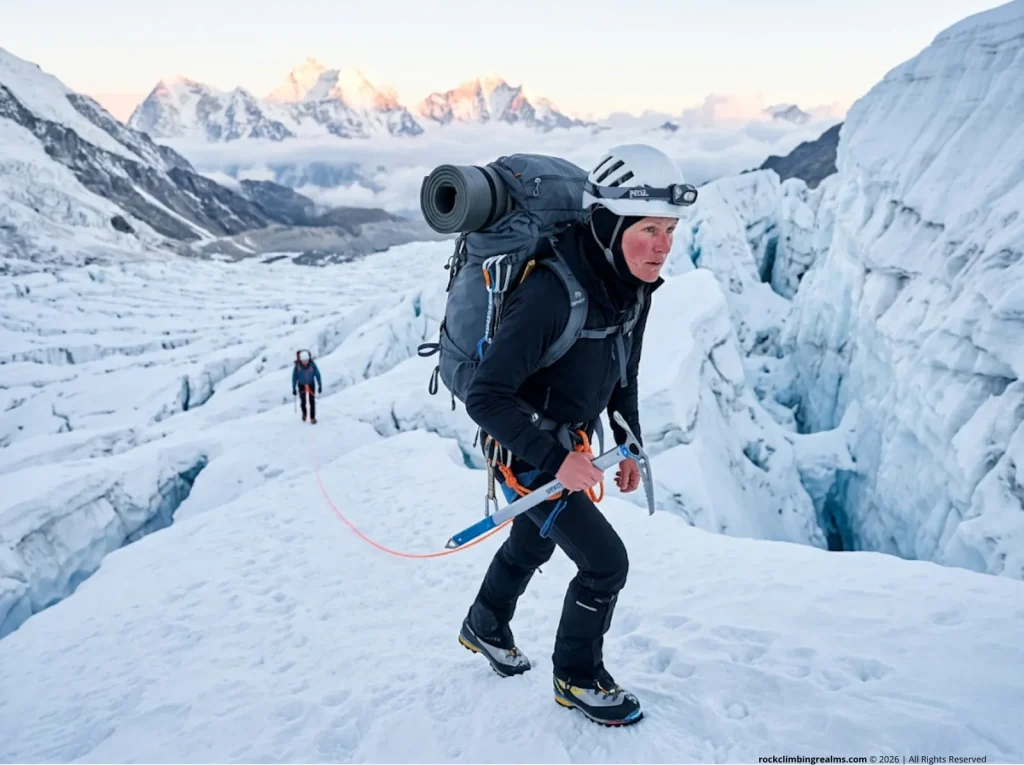
In 1970, Grace Hoeman led the first all-female Denali summit without male guides. Each woman carried roughly 70 pounds of gear — often 50–60% of body weight — using the leapfrog method: haul, cache, return. The team mastered crevasse rescue using Z-pulley systems, where a 120-pound woman can theoretically lift a 360-pound load. Self-sufficiency on glaciers is not optional — it is the only way to survive a crevasse fall when there is no one else to pull you out.
Annapurna (1978) and Everest (1975): The High-Altitude Zone as Engineering Problem
Arlene Blum’s 1978 American Women’s Himalayan Expedition achieved the first female ascent of an 8,000m peak, using custom-fitted down suits to address the fit issues of male-sized gear. Junko Tabei’s 1975 Everest summit made her the first woman on the world’s highest peak, leading an all-female Japanese team. Lydia Bradey’s 1988 solo Everest summit without supplemental oxygen completed the autonomy progression: guided, then team, then solo.
The iconic climbers who have summited Mount Everest — including the women who redefined what was possible tell a story less about individual achievement and more about systems. Managing supplemental oxygen flow rates, compensating for caloric deficit and iron depletion, engineering custom gear — these were the problems women solved to prove they belonged at 8,000 meters. Female-specific nutritional needs at altitude — caloric deficit, iron depletion, and RED-S risk — directly affect endurance and decision-making.
Pro tip: If you are a female climber shopping for expedition gear, ignore the “women’s” label and check the actual fit specs. Rise length, hip belt angle, and shoulder strap width matter more than the color. A harness that does not fit your Q-angle will hurt you under load.
The Modern Era and the Gender Data Gap: 5.15, RED-S, and Equipment That Doesn’t Fit (2010–Present)
Margo Hayes, Angela Eiter, and the End of the Grade Gap Narrative
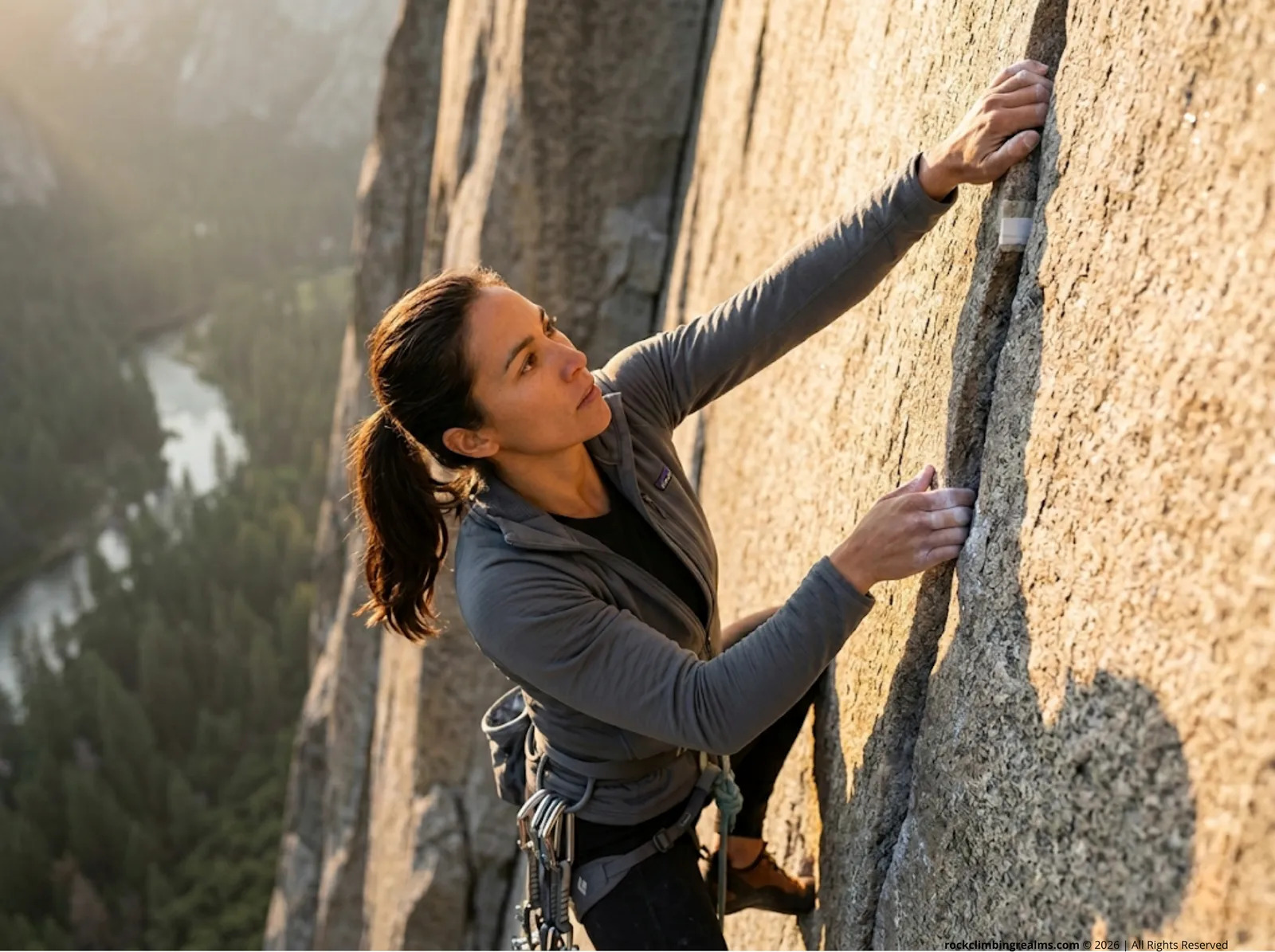
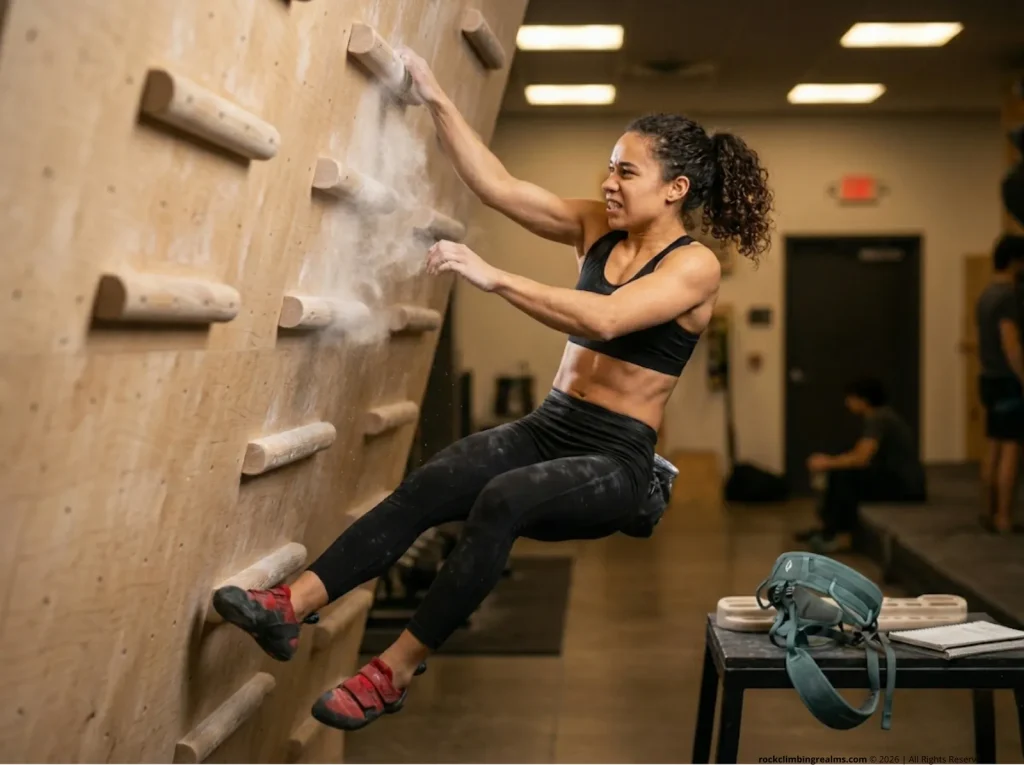
Margo Hayes’ 2017 ascent of La Rambla and Biographie (both 5.15a) was the result of a “tactile map” strategy — internalizing every micro-adjustment of thumb and toe. Eight months later, Angela Eiter skipped 5.15a entirely to redpoint La Planta de Shiva (5.15b). The time from first male 5.15a (2001) to first female 5.15a (2017) was 16 years. The leap from 5.15a to 5.15b took women only 8 months. The power gap was a product of sample size, not biology.
RED-S and the Strength-to-Weight Trade-Off
Only 34 studies in climbing research specifically analyze sex-based differences — the entire data foundation for half the climbing population. A comprehensive review published by the National Institutes of Health (PMC12827595) confirms that the evidence base remains dangerously thin for informing female-specific training and recovery protocols. Relative Energy Deficiency in Sport (RED-S) is a critical issue: operating at a caloric deficit to maintain a high strength-to-weight ratio leads to bone density loss, hormonal disruption, and shorter time maintaining finger force on a route.
Training for female climbers should prioritize endurance over maximum hang protocols, building route-length capacity without sacrificing overall health. Dropping body mass increases your strength-to-weight ratio but decreases the durability of the entire system.
The Q-Angle Problem and the “Shrink-It-and-Pink-It” Equipment Myth
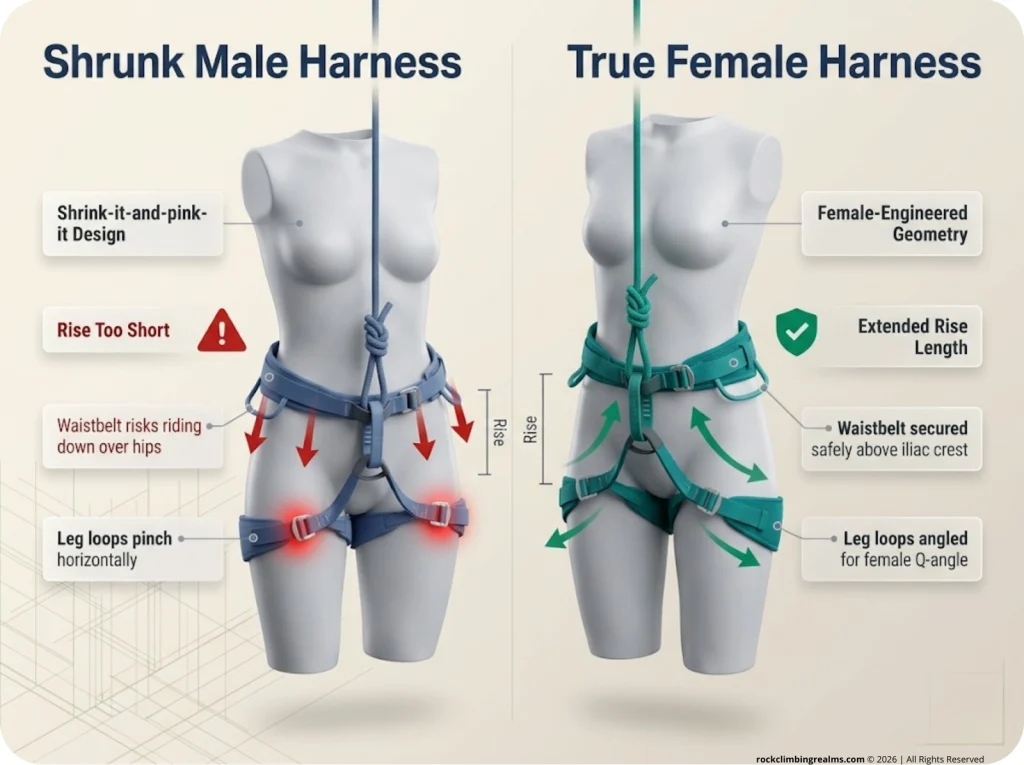
The wider female pelvis creates a larger Q-angle — where the femur meets the tibia — affecting force distribution through knees and ankles during drop-knee moves and bouldering landings. A proper female-specific harness requires adjusting the rise and accounting for femoral angles — not just sizing down a male design and painting it purple.
Why proper harness fit is a safety-critical system, not just a sizing exercise is something every female climber needs to understand before buying gear based on marketing categories. The “shrink-it-and-pink-it” approach ignores the underlying mechanics and can create unsafe fit issues under load. Evaluate gear on force distribution and suspension geometry, not color.
Conclusion
Women were not latecomers to climbing. The Parminter sisters predated Marie Paradis by two decades, and the erasure of their achievement reveals the bias that shaped the narrative. The manless climbing movement forced women to master anchor management, risk assessment, and route-finding — the same skills that define modern independent climbing. The grade gap was never biological — it was a product of sample size, equipment access, and a research base built on male physiology. The 8-month jump from 5.15a to 5.15b is the proof.
The next time you read a climbing history timeline, ask not “who was first?” but “what system were they climbing in?” The answer changes everything — and reveals the systemic barriers that still shape who gets to climb and whose stories get told. Now go send something.
FAQ
Who is the most famous female rock climber?
Lynn Hill. Her 1993 free ascent of The Nose on El Capitan (5.14a) redefined what was possible on big walls and remains one of the most significant ascents in climbing regardless of gender.
When was the first all-female climbing club founded?
The Ladies’ Alpine Club was founded in 1907 in London, followed by The Pinnacle Club in 1921. Both functioned as technical networks where women recorded first ascents and developed independent climbing systems outside the male-dominated guide structure.
Has a woman ever free-climbed The Nose on El Capitan?
Yes. Lynn Hill achieved the first free ascent of The Nose in 1993, grading it at 5.14a. She repeated it in under 24 hours the following year — a feat not duplicated by anyone, male or female, for over a decade.
Who was the first woman to summit Mount Everest?
Junko Tabei reached the summit on May 16, 1975, leading an all-female Japanese expedition without male guides. She managed her own logistics and safety systems — a direct extension of the manless climbing philosophy pioneered by Miriam Underhill decades earlier.
Why is there a grade gap between male and female climbers?
The perceived gap was never primarily biological — it was a product of sample size, equipment access, and a sports science research base built almost entirely on male physiology. Only 34 sex-specific climbing studies exist as of 2026. Once women gained access to modern training methodology and dynamic equipment, the gap collapsed: Angela Eiter jumped from 5.14d to 5.15b in eight months after Margo Hayes first cracked 5.15a.
Safety Notice: Rock climbing and mountaineering are inherently high-risk
activities that can involve physical trauma or fatal incidents. The information on Rock Climbing Realms is for
educational and informational purposes only. Techniques and advice presented here are not a substitute
for professional, hands-on instruction. Conditions and risks vary by location. Always seek guidance
from a qualified instructor before attempting new techniques. By using this website, you agree that you
are solely responsible for your own safety. Any reliance you place on this information is strictly
at your own risk, and you assume all liability for your actions. Rock Climbing Realms and its authors
will not be held liable for any harm, damage, or loss sustained in connection with the use of this information.
Affiliate Disclosure: We are a participant in the Amazon Services LLC Associates Program, an
affiliate advertising program designed to provide a means for us to earn advertising fees by advertising and linking
to Amazon.com. As an Amazon Associate, we earn from qualifying purchases. We are also an official affiliate partner
of Black Diamond Equipment via the AvantLink network. If you click on a Black Diamond affiliate link and make a
purchase, we may earn a commission at no additional cost to you. We also participate in other affiliate programs.
Additional terms are found in the terms of service.