
In this article
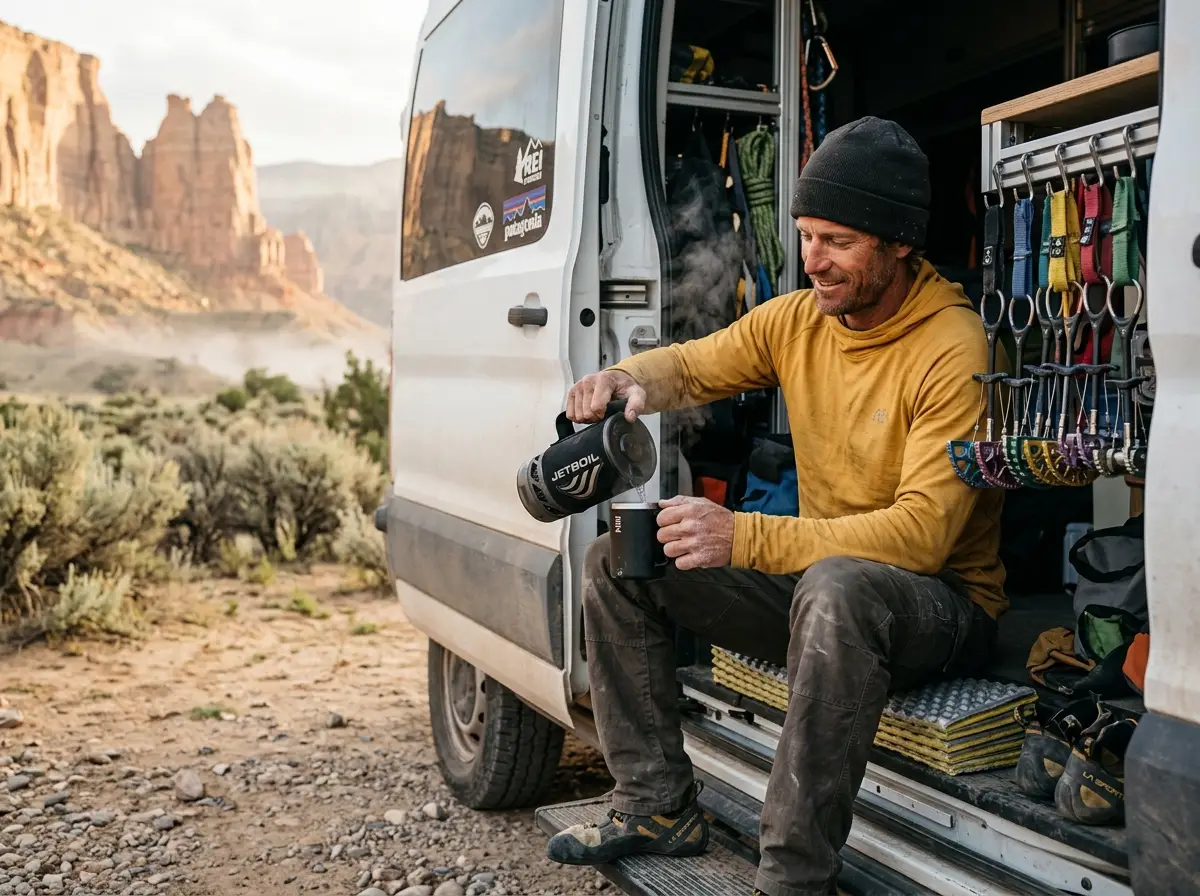
The ranger’s rig rolls past at 6:43 a.m. You’ve been awake since 5:30, watching the dust trail through your van’s windshield, one ear tuned to the gravel crunch. Your rack hangs off a hook you welded from a coat hanger. Your rope is coiled on the passenger seat because there’s nowhere else to put it. Fifteen cents of instant coffee. Day 48 in the Southwest. You’ve never felt richer.
That’s the image. And here’s what most articles about dirtbagging miss — the image is accurate, but it’s not why it works. People think this lifestyle runs on rebellion. It doesn’t. It runs on systems. The climbers who last more than two seasons aren’t the ones with the best van aesthetics or the most followers — they’re the ones who figured out the physics of the road. Budget architecture. Gear maintenance calendars. Federal land-use law. If you treat the dirtbag climbing lifestyle like a vibe, you’ll be home by October. If you treat it like an engineering problem, you can run it for decades.
This article covers how the real ones actually do it — origins, economics, vehicle build, gear longevity, performance, and stewardship.
⚡ Quick Answer: The dirtbag climbing lifestyle is a deliberate system built around one goal: maximum time on rock. The math is simple — eliminate rent ($0 lodging on BLM lands), compress food to caloric-density staples, minimize movement to cut fuel spend, and work seasonally to replenish. A solo climber can sustain it on roughly $1,160/month. The hard part isn’t the money — it’s the discipline to maintain gear, protect land access, and manage recovery in a way that keeps you climbing for years, not months.
The Origins of the Dirtbag — More Than a Myth
Fred Beckey didn’t set out to build a counter-culture. He just refused a career. After graduating in 1949, he looked at the corporate trajectory in front of him and said no — not loudly, just quietly, by loading gear into a beat-up sedan and driving toward the next objective. His informal economy was summed up in a phrase that became dirtbag legend: “Will belay for food.” That wasn’t a joke. That was a functional system.
What Beckey actually built was a time-wealth model. His primary asset wasn’t money — it was months. Every dollar he didn’t spend on rent was a week of gas money. Every salary he rejected was a season he kept. The output was a volume of first ascents across North America that nobody has matched since, not because he was the best climber alive, but because he was on rock while everyone else was in an office. The calculus hasn’t changed. You can read more about Fred Beckey’s documented climbing career and biographical timeline — the math tracks the same way today.
If Beckey built the model, Yosemite’s Camp 4 in the 1960s and 70s industrialized it. Yvon Chouinard and Royal Robbins lived on tourist scraps — dumpster pizza, booty-food hauled out of trash cans near the valley’s visitor center. The practice had a name: dumpster diving. But what they were doing wasn’t random poverty — it was the deliberate elimination of every cost that wasn’t directly related to climbing. Chouinard built his own gear because the stuff available was either inadequate or too expensive. That impulse — the “Anti-Sell” — eventually became Patagonia and Black Diamond. The birth of those companies came from someone who was just trying to climb cheaper. You can explore Yosemite’s Camp 4 and the permit systems that govern access today — the culture that started there still defines the norms every dirtbag inherits.
The 1970s Stonemasters pushed the technical limits further in Yosemite and Joshua Tree, dodging park rangers who enforced stay limits through evasion tactics that became part of the lifestyle’s oral lore. By 2010, the culture had split. Traditional dirtbagging — low vehicle investment, brutal frugality, subsistence-level spending — ran alongside the rise of “Van Life”: high-end Sprinter builds, remote work income, Instagram galleries. Alex Honnold’s van has 900 watts of solar and pull-out drawers rated for 300 lbs. It’s technically a dirtbag van only in cultural lineage. The lifestyle didn’t die, though — it stratified. Understanding how women shaped the counter-culture movements of climbing’s Golden Age reveals how layered this history actually is, and who gets left out of the canonical story.
The Math of the Road — Dirtbag Economics Decoded
Here’s where most people get it wrong. They think the lifestyle is about spending as little as possible. It’s not. It’s about spending strategically on exactly the right things, and spending nothing on everything else.
The Traditional Budget Breakdown
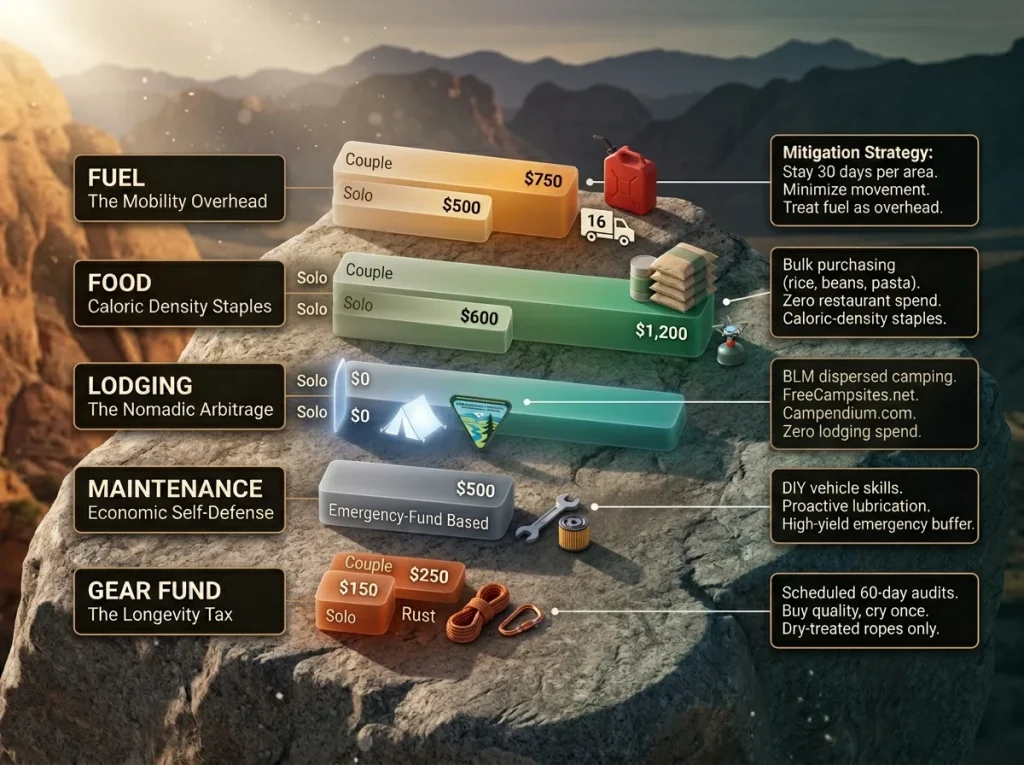
A solo climbing road trip runs on roughly $1,160/month — the equivalent of 40 hours a week at federal minimum wage. That number comes from real practitioners, not guesswork. Fuel is your biggest variable. A truck getting 16 MPG burns around $500/month to cover 1,600 miles. The mitigation strategy isn’t complicated: stay 30 days in one area. Every day you don’t move, you’re saving gas. Stop treating travel as part of the experience and start treating it as overhead to minimize.
Food runs $600/month solo, $1,200 for a couple. The solution is bulk staples — rice, beans, pasta, lentils — chosen purely for caloric density per dollar. Lodging is $0. Dispersed camping on BLM lands, FreeCampsites.net, and Campendium. Nomadic living with a $0 lodging line item is the primary financial arbitrage of this lifestyle. The full tactical execution of that strategy lives in finding free and cheap camping near climbing areas. Read the BLM dispersed camping regulations for public lands so you know the rules before you need them.
Vehicle maintenance is the wildcard that ends seasons. DIY skills are not optional — they’re economic self-defense. Proactive chassis lubrication, filter rotations, tire pressure checks. And a high-yield savings account set to auto-transfer after each seasonal work stint creates a travel fund that absorbs mechanical emergencies without ending your season.
Pro tip: A $500 emergency buffer is the real minimum viable dirtbag budget, not the monthly number. The van will break. Budget for it before the season starts, not during.
The “Dirtbag Rich” Phenomenon
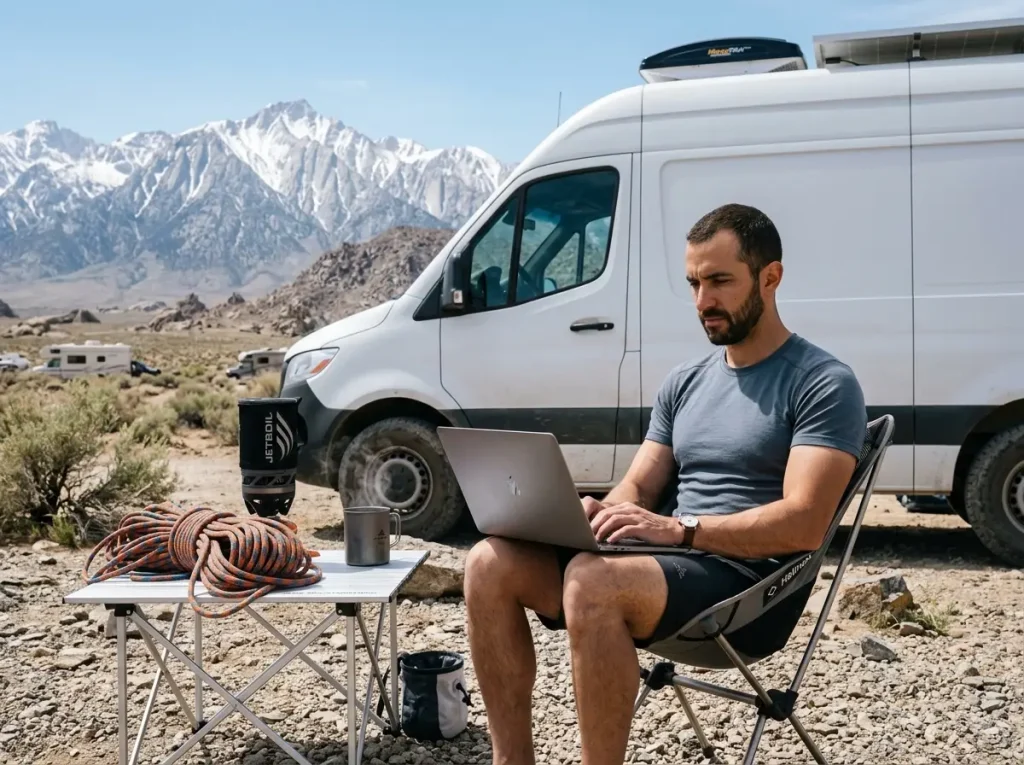
After 2020, something shifted at the meccas. Red Rock started filling with people who worked five-hour laptop days and then went projecting V10 boulders in the afternoon. Remote work didn’t end the dirtbag lifestyle — it created a sub-class. The “Dirtbag Rich” run $15,000–$40,000 per year through remote freelancing or seasonal work. They have $1,000+ trad racks. They have medical insurance. And their primary metric is still climbing days per year, not net worth.
The difference between Dirtbag Rich and Van Life is philosophical, not economic. Dirtbag Rich people optimize for time on rock. Van lifers frequently optimize for the van life experience itself. Both might drive a Sprinter. One of them is measuring success in climbing days. The other is measuring it in content. You can feel the difference at the crag inside about 20 minutes. Check the best climbing destinations near major US cities for remote workers if you’re plotting the logistics of this transition.
The risk of Dirtbag Rich status is a spending ratchet: nicer van, better gear, more paid experiences. The time-wealth advantage erodes quietly. Watch the lifestyle inflation before it watches you.
Seasonal Work Strategies and Income Architecture
The most resilient income structures in this world combine three to four months of hard work with eight to nine months of travel. You don’t stumble into that schedule — you engineer it backwards. First, identify your peak climbing seasons. Then find work that ends before them.
The platforms worth knowing: WorkamperNews for campground hosting gigs, CoolWorks for resort and national park jobs, wildland firefighting for the highest pay-density work available. A three-month trail crew stint in Glacier can net $6,800 — enough to fund Yosemite, Red River Gorge, and Joshua Tree over the next seven months, if you stop eating at anything with a cash register.
Tax strategy is real here too. Climbers earning below the standard deduction threshold often owe near-zero federal income tax. That’s not a loophole. That’s the system working as designed for low earners. American Alpine Club membership benefits for traveling climbers include rescue insurance and gear discounts that directly cut the financial risk of going nomadic — worth factoring into the income architecture before you leave.
Engineering the Mobile Basecamp
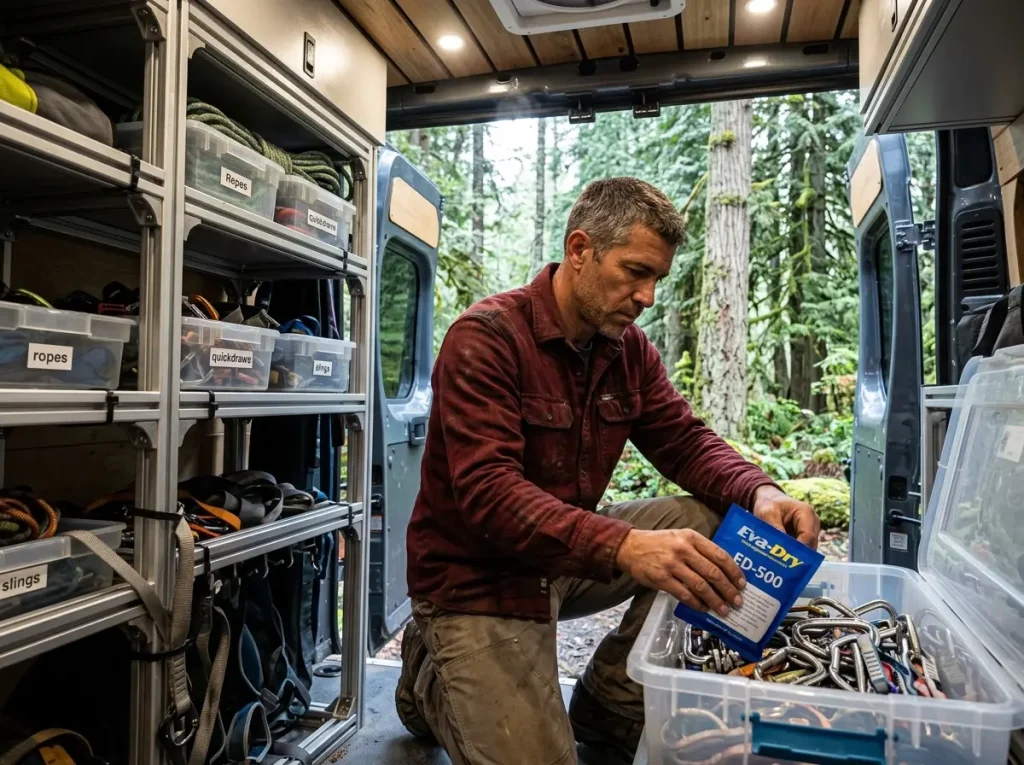
Most people approach the van build aesthetically. That’s how you get a pretty van that handles badly on switchbacks and smells like wet nylon by March. Approach it as a structural engineering problem and you get something that actually works.
Payload Physics and Material Selection
Standard cargo vans carry 3,300–4,400 lbs total — that’s passengers, build materials, gear, food, water, and you. Traditional steel shelving burns 15–20% of that capacity (450–700 lbs) before you load a single cam. Aluminum modular systems like Packd consume 5–8% (about 150 lbs) while rating to 1,200 lbs — same load capacity, 70% less weight. The fuel math isn’t abstract: every 100 lbs added costs roughly 1% fuel economy. A 700-lb steel build wastes $35–$50/month in extra fuel at current prices. That’s real money on a $1,160/month budget.
Prioritize modular systems over fixed builds. A Sprinter build that breaks down partially lets you haul big wall gear or ski equipment without wrecking your payload budget. The full engineering protocol lives at engineering a full mobile basecamp for climbing season.
Pro tip: Honeycomb composite at 300 lbs adds sound dampening that matters when you’re sleeping 30 feet from a paved pullout. Worth the extra 150 lbs if your crags have road noise.
Weight Distribution and Center of Gravity
AGM battery banks run 60–100 lbs each. A 20-gallon water tank is 167 lbs (water weighs 8.34 lbs per gallon). Those are your heaviest items, and most first-time builders stack them on the same side of the van. Don’t.
Place heavy items on opposite sides of the chassis, as low as possible. Think in quadrants: front-left, front-right, rear-left, rear-right. Total weight in each should balance within 10–15% of the others. A poorly distributed van overloads one rear axle — you’ll see it in tire wear first, handling on loose gravel second, and rollover risk on off-camber pullouts third. The fix during a rebuild takes an afternoon. The consequences of skipping it accumulate over months.
Moisture Management and Stress Corrosion Cracking
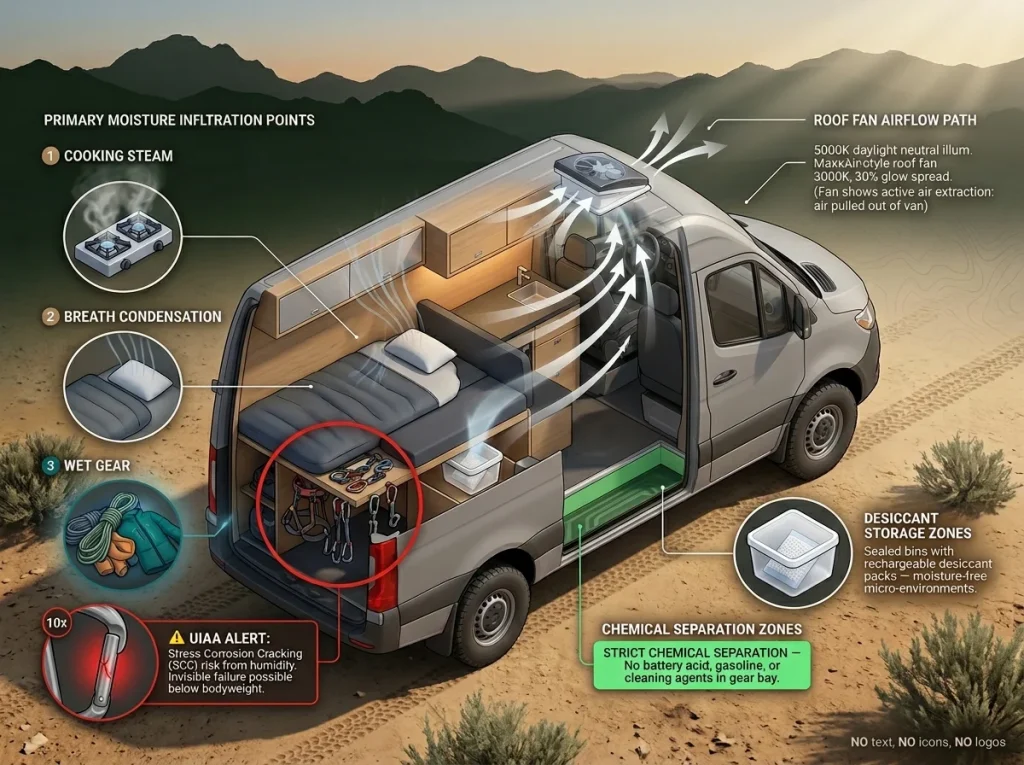
Here’s the connection nobody in the van build community talks about. Your van traps moisture — from cooking, breathing, wet gear after rain sessions. High relative humidity inside a sealed space promotes bacterial growth and metal corrosion. Standard nuisance. But in a climber’s van, that moisture is living with thousands of dollars of life-safety equipment.
The UIAA — the governing body for climbing equipment standards — has issued formal warnings about stress corrosion cracking in climbing anchors. Stress Corrosion Cracking (SCC) in stainless steel hardware can cause failure under loads less than a climber’s bodyweight, often with nothing visible to the naked eye. In a damp van storing your gear for months at a time, SCC risk is not theoretical.
The protocol: sealed bins with rechargeable desiccant packs (Eva-Dry ED-500 type) for hard goods, a MaxxAir or similar roof fan running after every wet session, and strict chemical separation — gear never shares space with battery acid, gasoline, or cleaning agents. For context on actual failure chains, read real-world anchor failure case studies and how corrosion plays a role. That makes the moisture management protocol feel urgent rather than optional.
Cedar Wright has been through every version of this — cave dwelling, vehicle-based, modern builds — and what he thinks it actually means to be a dirtbag is worth 20 minutes of your time:
Gear Longevity — The Nomadic Maintenance Protocol
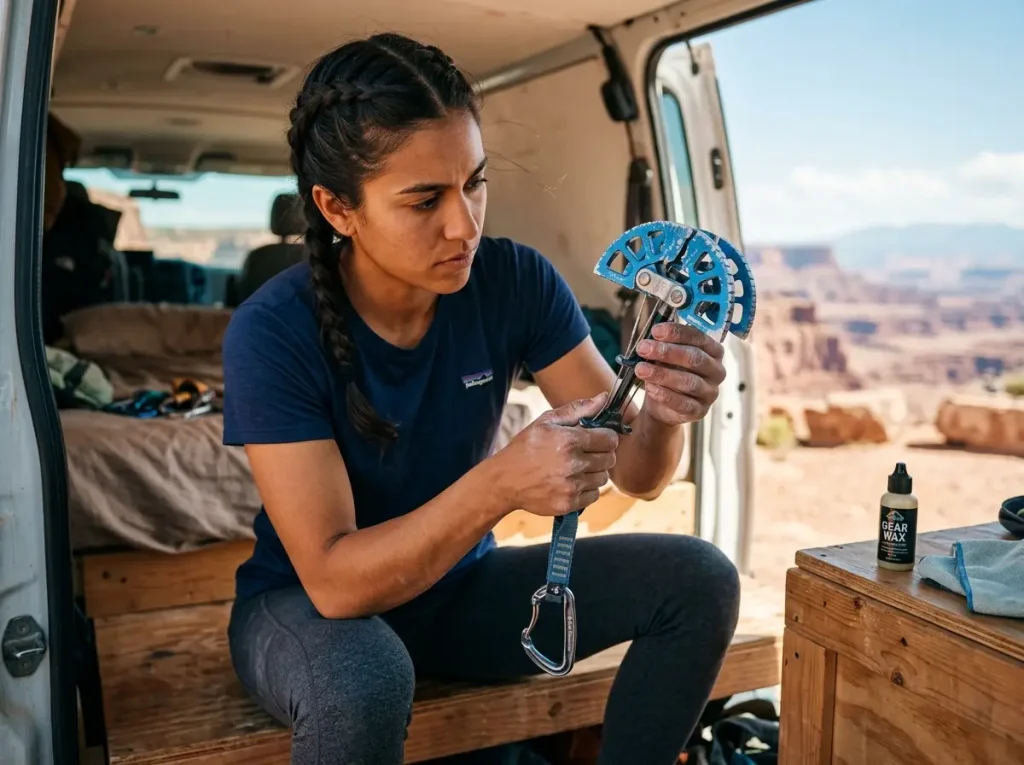
The mistake is using gym-climber retirement timelines when you’re living nomadically. In a gym, your rope goes home after a session and hangs in a climate-controlled hallway. On the road, it lives coiled in a van that cycles between humid evenings and baking afternoons. Those are not equivalent environments.
Rope Science — Polyamide 6 and the Moisture Problem
Climbing ropes are Polyamide 6 (nylon), and nylon is hygroscopic — it pulls moisture out of the air. A rope with internal humidity above 25% can lose more than 50% of its UIAA-rated fall capacity. A wet rope also increases impact force on anchors and your body by 11–12% during fall arrest. That’s not a small margin when you’re already operating near design limits.
Peer-reviewed research on moisture effects on climbing rope dynamic properties documents exactly this failure mechanism. For a nomadic climber whose rope lives in a perpetually damp van, the one-year heavy-use retirement threshold isn’t conservative — it’s accurate. Core shots, flat spots, and significant fuzzing warrant immediate retirement regardless of age. And dry-treated ropes (UIAA certified dry) aren’t a luxury for van dwellers — they’re a maintenance cost that extends functional life. The full comparison is in dry vs. non-dry rope performance data for wet and humid storage conditions.
Hardware Inspection Under Nomadic Conditions
Metal hardware — carabiners, cams — has no set shelf life, but it retires immediately after a factor-two fall or when you find a crack. That’s the standard rule. For cams, lubricate springs and trigger wires with dry, wax-based lubricants regularly. The WD-40 debate: it’s a water displacer, not a lubricant. It may strip factory oils if you don’t follow it with a dedicated climbing-specific oil. Don’t use it and call it done.
The harder problem on the road is contamination. Gear sharing space with gasoline, battery acid, or cleaning agents puts nylon and metal surface coatings at risk in ways that don’t show up until you’re checking a harness under a headlamp and wondering why the webbing feels different. Inspect cams every 30 climbing days or after any significant fall — more often than the annual check most guides recommend for people who go to the gym twice a week. The full trad gear cleaning and inspection protocol for cam maintenance covers the hands-on process.
Pro tip: Inspect gear in good light. Hairline cracks in a carabiner are invisible under a parking lot lamp at dusk. Do your audits at noon, with the doors open and natural light on everything.
Harness and Sling Retirement Under Accelerated UV and Humidity
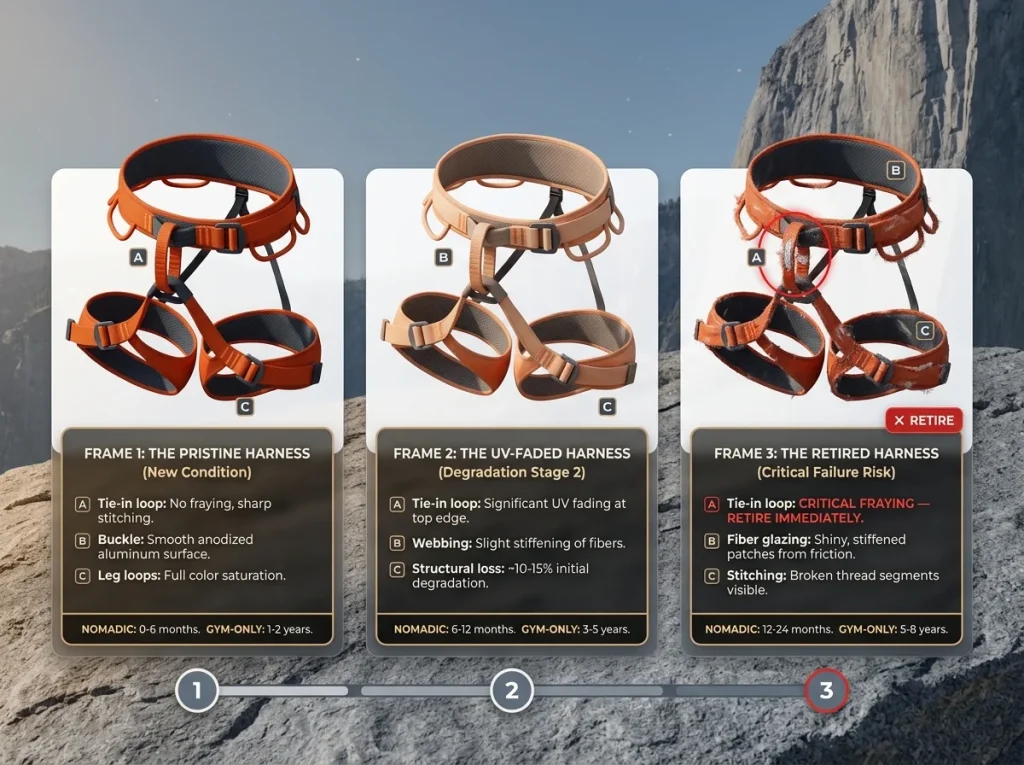
A harness has a 10-year shelf life unused, and 1–2 years of frequent nomadic use before it needs to go. UV exposure drives that curve hard. A van with roof windows and crag-adjacent parking accumulates UV load daily — fading is the first visible sign, but fading means degradation, not just aesthetics. When the color goes, structural integrity is already compromised.
Slings and webbing: retire at first sign of fraying stitching, glazing (that shiny surface means compromised fibers), or stiffening. Six-month retirement cycles for heavily used slings are appropriate when you’re climbing 150+ days a year. Helmets with surface cracks in the foam or deep shell scratches retire immediately. A helmet rolling free in a van is taking exactly the kind of low-speed impacts that don’t leave dramatic marks but do matter structurally.
Build a gear audit day every 60 climbing days. It’s not optional maintenance — it’s risk management. The complete climbing gear lifespan and retirement tracking system gives you the framework.
Performance on the Road — Training and Physiology Without a Home Gym
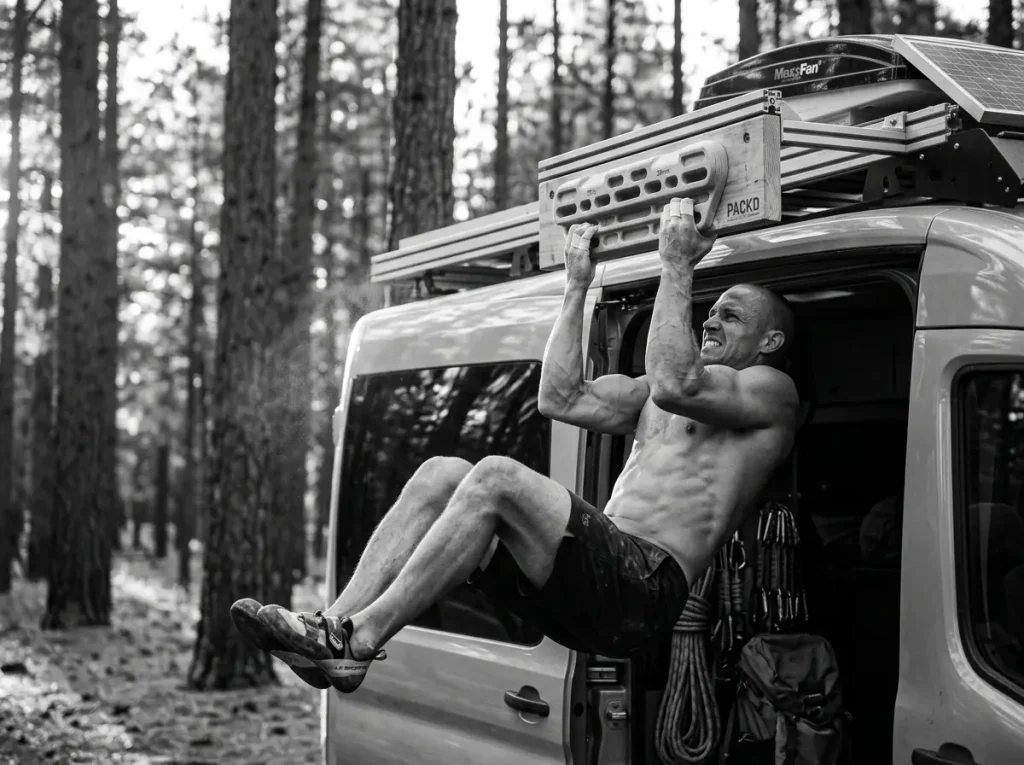
High-volume climbing with poor recovery doesn’t produce a better climber — it produces an injured one. The nomadic lifestyle makes this easy to get wrong because the volume is always there and the structure isn’t.
The Cortisol Problem — Nomadic Stress Physiology
Climbing difficult routes significantly increases salivary cortisol — that’s well-documented in peer-reviewed research on cortisol and stress responses in rock climbers. Nomadic climbers pile additional stressors on top: inconsistent sleep, financial uncertainty, social isolation, and the physiological load of moving through unfamiliar environments. Climbing to height produces higher heart rate and metabolic stress than equivalent bouldering, even at the same technical grade.
Advanced climbers show lower baseline anxiety and better sympathetic modulation — but that adaptation breaks down under chronic sleep deprivation. Six hours of sleep in a van isn’t a lifestyle choice. It’s the primary mechanism by which training converts to adaptation. Without it, five consecutive high-output days will reduce grip strength, increase perceived exertion on sub-maximal routes, and increase injury risk. The practical protocol for managing this is in the science of climbing rest days and supercompensation for nomadic athletes.
Road Training Protocols — Force Sensors and Portable Systems
The dirtbags who actually progress on the road use data before they climb, not just after. Portable force sensors on 20mm edges assess forearm fatigue and grip strength before you decide whether to get on a project or take the day. Psychophysiological research on advanced climber fatigue management and grip strength documents this methodology — the MVC-7 protocol (Maximum Voluntary Contraction on 7-second holds) on a portable hangboard mounted to a van door frame or tree limb gives you quantifiable strength data regardless of where you are.
Movement creativity — the ability to vary movement patterns under pressure — degrades under chronic fatigue faster than raw strength. This matters more on novel terrain than at a home crag you’ve memorized. Finger strength scales with training frequency, not just intensity. High climbing volume is an advantage if recovery is managed. It’s a liability if it isn’t. Portable hangboard training protocols for climbers without a home gym gives the structural framework for building this on the road.
Nutrition Thermodynamics — The Dirtbag Diet Deconstructed
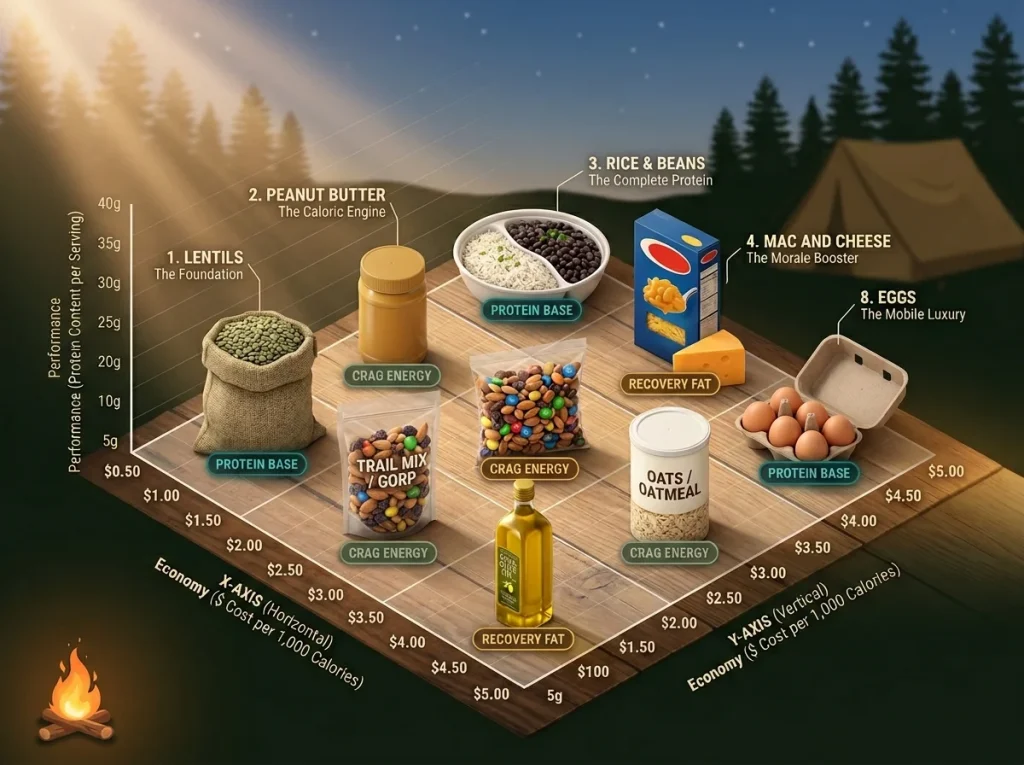
The Dirtbag Diet is not starvation. It’s caloric density optimization on a tight budget. A climber needs roughly 1.25–1.75 lbs of food per day to fuel serious output.
The complete protein matrix for nomads: rice and beans (grains + legumes), peanut butter on whole wheat (grains + nuts), mac and cheese (grains + dairy). These combinations provide full amino acid profiles without requiring refrigerated meat. Monthly staples for a solo climber run about 43 lbs of cheese and butter (recovery fat), 63 lbs of gorp and nuts (crag energy and trace minerals), 17 lbs of lentils and rice (protein-carb foundation). A $3 bag of lentils clears more protein per gram than a $15 rotisserie chicken. The constraint is knowledge, not scarcity.
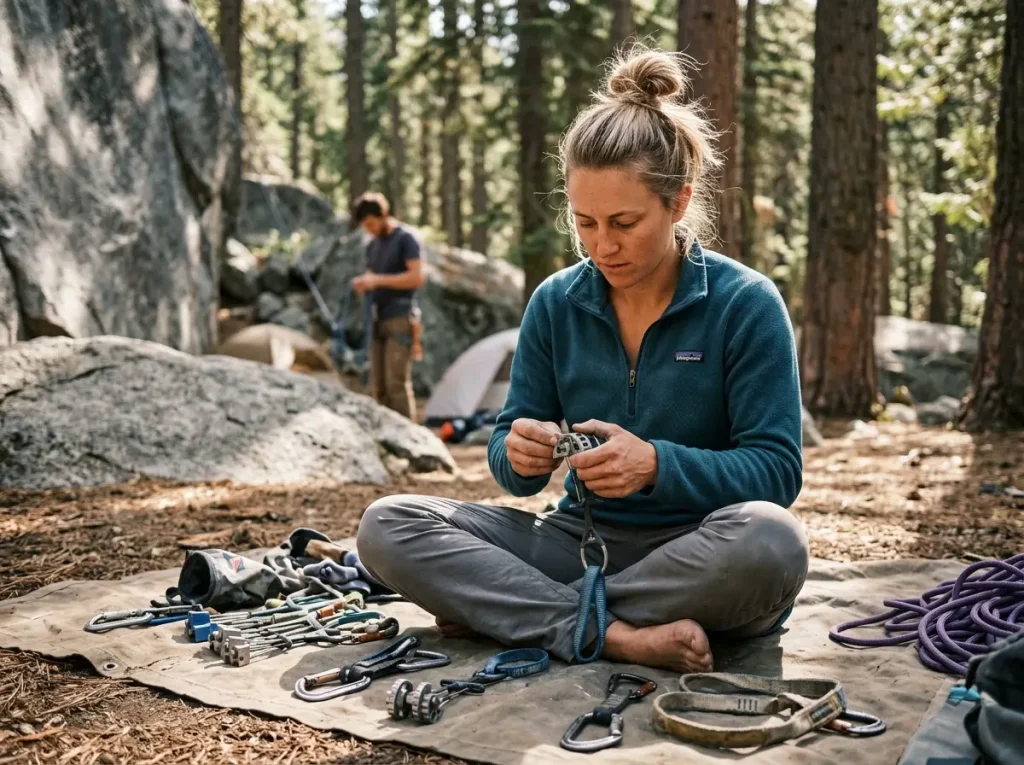
Cooking in a van is a thermodynamic problem. Jetboil systems use heat-exchange rings to boil water in under two minutes — maximum fuel efficiency for the most common task. Advanced builds run two-burner propane stoves connected to external tanks, which opens up backcountry baking: bread and brownies during rain delays. Morale matters on a nine-month season. Nutrient timing windows for climbing performance and post-route recovery covers the performance layer on top of this foundation.
Stewardship — The New Dirtbag Rebellion
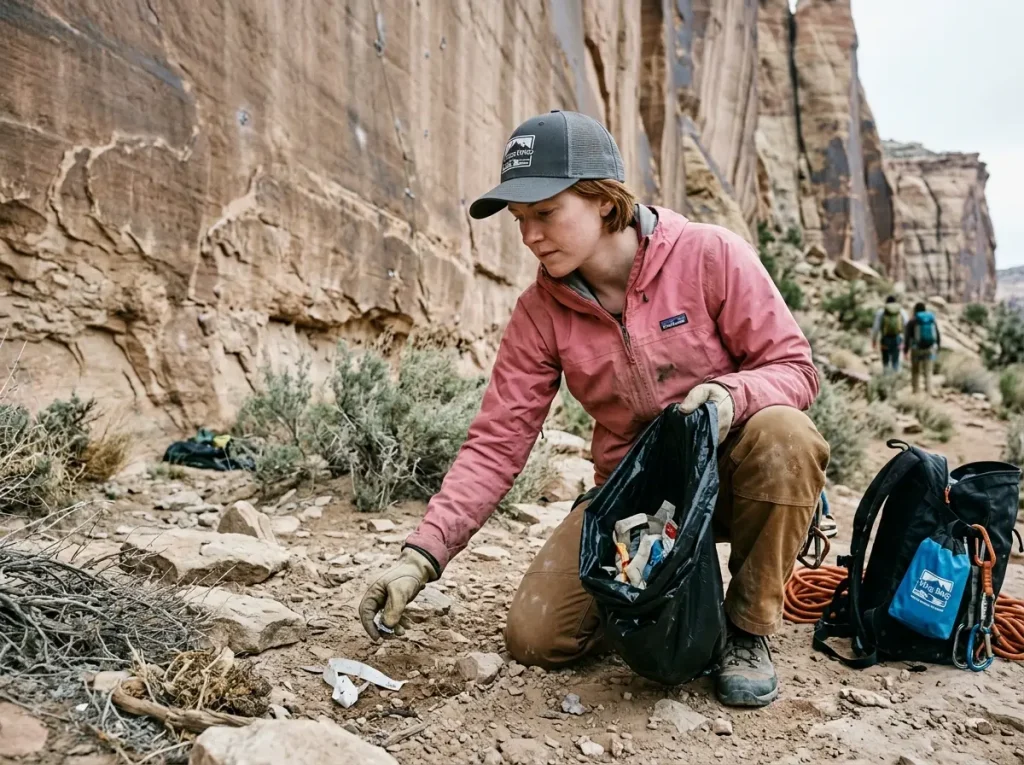
Cedar Wright put it directly: dirtbagging may be economically gone in its original form, but its spirit survives as stewardship. The modern dirtbag’s rebellion isn’t dodging rangers — it’s becoming the person the ranger calls when there’s a problem.
BLM Stay Limits and the Campsite Shuffle
Most BLM dispersed camping: 14 days within a 28-day period. After that, your vehicle moves at least 25–30 miles to let the land recover. That’s the rule from official BLM stay limits and dispersed camping regulations. Non-compliance has two outcomes: an immediate citation, and long-term ranger attention that can close entire areas. The Indian Creek precedent is real — overcrowding and waste issues drove seasonal restrictions that affected an entire generation of crack climbers.
The campsite shuffle is not inconvenience management. It’s the legal and ethical foundation of the entire lifestyle. Keep a simple log: area, arrival date, departure date. Track your 28-day windows. One individual’s chronic overstay creates ranger pressure on a community. The Access Fund’s role in protecting climbing areas and stewardship programs shows what organized advocacy looks like at the institutional level — the systemic counterpart to individual compliance.
Waste Protocols — Technical Clean Climbing
Human waste is the single largest environmental impact in high-visitation climbing areas. Cat holes are inappropriate at Red River Gorge or Indian Creek — soil density and user volume make them functionally useless. The technical protocol: CMCs (Clean Mountain Cans) for specific alpine routes like Denali’s West Buttress, Wag Bags with chemical gelling agents for high-use areas. Wag bags render waste inert and transportable; dispose at designated solid waste facilities per National Park Service best practices for remote human waste management.
Build a dedicated waste station into your van build — a waterproof bin near the door, separate from food and gear. This removes the behavioral friction that leads to shortcuts in the dark at 5 a.m. The full tactical guide to WAG bags, catholes, and waste management for climbers covers the product specifics.
Pro tip: The van waste station isn’t just organization — it’s about removing the moment when it feels easier to do the wrong thing. Design the system so the right behavior is automatic.
Stewardship as Counter-Culture Identity
The climbers who show up for trail days, crag cleanups, and public comment periods are the ones who keep areas open for everyone who comes after. That’s not idealism — it’s political reality. Private landowner liability laws and public land management policies face constant pressure. The climbers who engage through the Access Fund’s Climber Steward program expanding to protect crag access — now operating in Washington state and beyond — build land manager relationships and cultural influence that purely extractive visitors don’t.
The reciprocity model reframes stewardship as mastery, not obligation. You’re not giving back because you feel guilty. You’re giving back because you understand that access is a privilege earned through demonstrated care, and the dirtbag who doesn’t understand that is an anachronism who’ll eventually cost everyone. The advanced stewardship framework lives at mastering the art of climbing stewardship beyond Leave No Trace principles.
Conclusion
Three things separate the people who sustain this lifestyle from the ones who go home early.
First: treat the whole system like an engineering problem. Budget architecture, van build physics, gear retirement calendars — none of this is optional. The dirtbags who make it decades treat every decision as load-bearing. The ones who treat it as a personality trait are home by October.
Second: your gear degrades faster on the road, and your inspection environment is worse. Moisture, UV, vibration, and chemical exposure accelerate every retirement curve. Build a 60-day audit day into your calendar and make it non-negotiable. One overlooked hairline crack in the right piece of hardware ends your season in a different, worse way.
Third: stewardship is the only thing that preserves the future of the lifestyle. The dirtbag who dodges rangers belongs to a different era. The one who shows up to the public comment meeting and leads the volunteer trail crew day is the one who keeps the crags open for the next generation.
Your vehicle is a recovery center, a gear room, and a legal residence for most of the year. Treat its engineering with the same precision you’d bring to anchor building. Pick one section of this article and implement it before your next trip.
Now go send something.
FAQ
Is dirtbag climbing still possible with student loans or a mortgage?
It depends on your burn rate more than your balance sheet. Climbers with student loan payments have sustained the lifestyle by structuring loan deferment periods around seasonal work stints, then climbing during those windows. A mortgage makes it harder — long-term house-sitting gigs or renting the property during your season can offset costs. The math works when fixed costs are managed aggressively. The lifestyle is an optimization problem, and the inputs are different for everyone.
What’s the real difference between dirtbagging and van life?
Dirtbagging optimizes for time on rock — every decision flows from that objective. Van life often optimizes for the experience of living in a van: the build aesthetics, the content, the community. A dirtbag with a $1,200 beater truck and a sleeping bag is closer to the archetype than someone in a $90,000 Sprinter who climbs twice a week. The $90,000 Sprinter is not wrong — it’s just a different thing.
How do dirtbag climbers handle healthcare and medical emergencies?
Most Dirtbag Rich climbers carry minimum-coverage ACA marketplace plans, often subsidized to near-zero premium at their income level. AAC membership includes rescue insurance for technical terrain evacuations. The more important protocol is wilderness first aid training — WFR or WAFA. In remote environments, you are always the first responder. Medical emergencies are the single largest financial risk to this lifestyle, and skill cuts that risk more effectively than insurance alone.
Can you maintain serious training progression while living nomadically?
Advanced climbers who route their travel through premier training destinations — Bishop, Red Rock, Yosemite, Red River Gorge — often report higher progression rates than gym-based climbers. The volume is there. The challenge is recovery. Portable force sensors, disciplined rest days, and sleep quality management all depend on how well your van build supports them. Get those variables right and high climbing volume produces adaptation. Get them wrong and it produces overuse injuries.
What’s the minimum realistic budget to start a dirtbag climbing season?
$3,000–$5,000 in liquid savings for a three-month stretch in the Western US. That covers roughly $1,000/month in expenses plus a $500–$2,000 mechanical emergency buffer. A beater-class van under $8,000 with a simple plywood sleeping platform is the minimum functional setup. Do not start with less cushion than this. Vehicle repairs will exceed your optimistic projections every single time.
Safety Notice: Rock climbing and mountaineering are inherently high-risk
activities that can involve physical trauma or fatal incidents. The information on Rock Climbing Realms is for
educational and informational purposes only. Techniques and advice presented here are not a substitute
for professional, hands-on instruction. Conditions and risks vary by location. Always seek guidance
from a qualified instructor before attempting new techniques. By using this website, you agree that you
are solely responsible for your own safety. Any reliance you place on this information is strictly
at your own risk, and you assume all liability for your actions. Rock Climbing Realms and its authors
will not be held liable for any harm, damage, or loss sustained in connection with the use of this information.
Affiliate Disclosure: We are a participant in the Amazon Services LLC Associates Program, an
affiliate advertising program designed to provide a means for us to earn advertising fees by advertising and linking
to Amazon.com. As an Amazon Associate, we earn from qualifying purchases. We are also an official affiliate partner
of Black Diamond Equipment via the AvantLink network. If you click on a Black Diamond affiliate link and make a
purchase, we may earn a commission at no additional cost to you. We also participate in other affiliate programs.
Additional terms are found in the terms of service.