

In this article
The gate at Maple Canyon doesn’t care about your redpoint grade. It closes when the soil toxicity levels spike. Across the American West, from the granite spires of the Enchantments and Yosemite National Park to the sandstone splitters of Indian Creek, access committees are drawing a direct line between unmanaged human poop and restricted permits.
“Pack it in, pack it out” is no longer just a slogan for hikers. It is the primary defense mechanism for keeping our crags open.
As a guide who has spent decades hauling clients up walls and navigating strict permit systems, I can tell you this is not a conversation about etiquette. It is a technical how-to guide on the most critical access issue of the decade. Just as you learned to anchor building or flake a rope, you must master the technical climbing logistics of waste management.
In this guide, we will break down the decision matrix for every environment, from forest zones to alpine zones. We will cover the physics of using a drop-seat harness on a hanging belay and the chemical engineering required to keep a poop tube from becoming a hazard. This is your technical beta for the unglamorous but essential side of the vertical life.
Why Is Waste Management Now a Technical Climbing Skill?
Unburied poop directly threatens climbing access preservation because visitor volume has surpassed the soil’s biological capacity to process it. Land managers now use sanitation hazards as a primary metric for closing areas.
Ten years ago, a trowel was a “nice-to-have.” Today, outdoor recreation areas are experiencing exponential increases in traffic. The soil at the base of popular crags simply cannot process the volume of biological input it receives. Agencies like the Bureau of Land Management (BLM) and the National Park Service (NPS) measure coliform bacteria blooms in local water sources and camp soil.
When those levels hit a tipping point, the regulatory response is swift and often non-negotiable: emergency closures.
We are seeing this play out in real-time. The strict permit lottery in the Enchantments and the intense regulations in Zion National Park are direct responses to this crisis. The challenges facing America’s climbing areas have shifted from parking disputes to biological hazards. The Access Fund and American Alpine Club (AAC) have made it clear: carrying a waste kit is now as mandatory as carrying a helmet.
Technical competency includes the ability to manage biological necessity without leaving a trace. We have to stop viewing this as a camping chore and start seeing it as decoding climbing access threats. If we fail to manage our poop needs, we lose the resource.
How Do I Determine Which Method to Use? (The Decision Matrix)
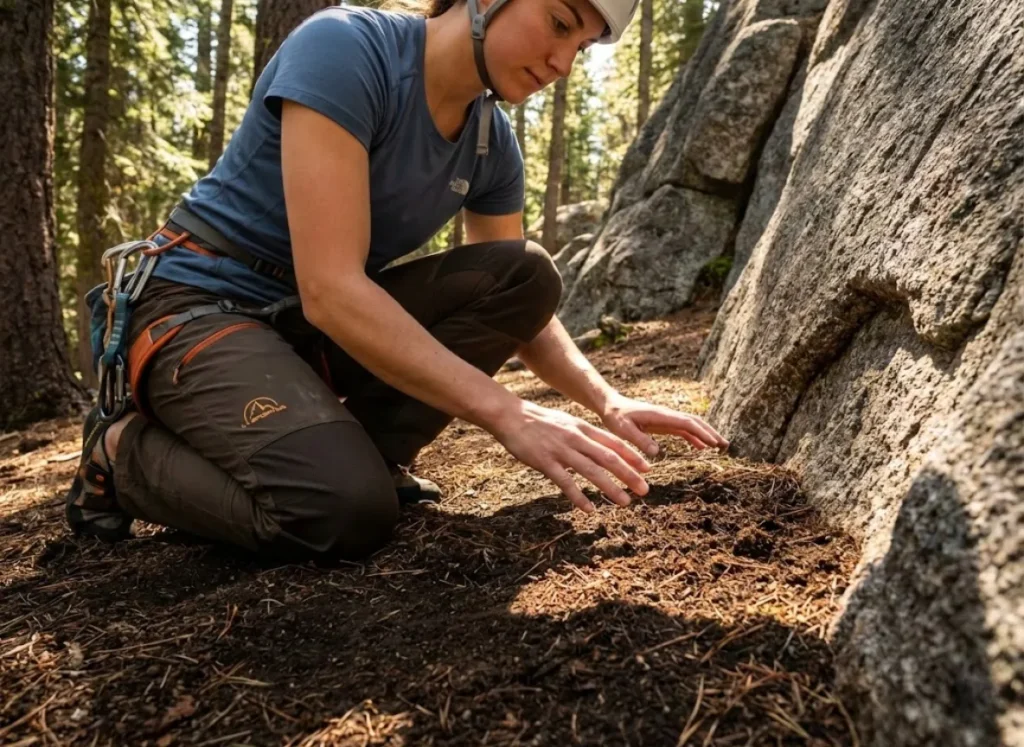
The correct technical execution of waste management is determined by soil composition and climate. Organic soil permits catholes, while mineral soil in deserts and vertical walls mandate a mandatory pack-out.
You need to assess the ground beneath your feet before you act. I teach my students to categorize their environment into three zones.
Zone A (Temperate Forest): This applies to places like the White Mountains NH or the base of Mt. Tecumseh, featuring rich, dark humus. Here, the traditional cathole method works, provided you adhere to strict depth and distance parameters.
Zone B (Desert/Alpine): This covers desert zones and high-altitude rock. These soils lack the microbial activity necessary for decomposition, making a WAG bag (Waste Alleviation and Gelling) the only viable option.
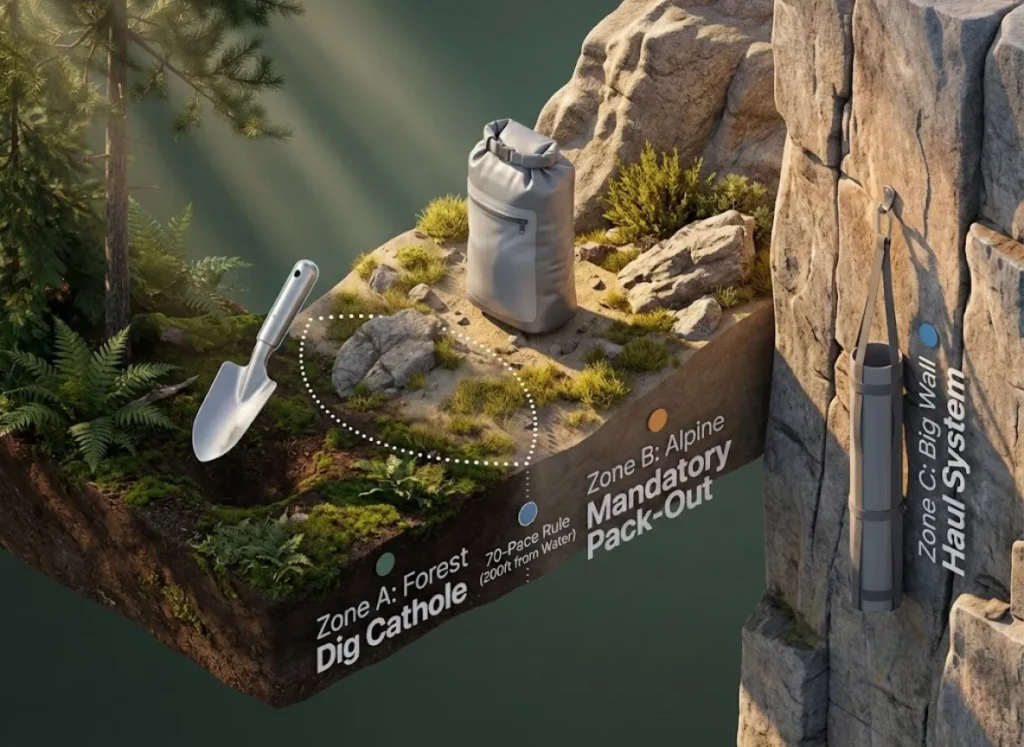
Zone C (Vertical/Big Wall): This is simple: if you can’t walk away, you have to pack it out. This requires a dedicated tethered waste system integrated into your haul gear.
Regardless of the zone, the “70-Pace Rule” applies. You must be at least 200 feet from water, trails, and campsites. This aligns with the Leave No Trace Center for Outdoor Ethics guidelines and Leave No Trace Principle 3: Dispose of Waste Properly (link).
Pro-Tip: If you can’t identify the soil type, assume it’s Zone B. It is always better to pack out waste unnecessarily than to bury it in soil that cannot break it down.
Failing to identify the zone correctly can lead to fines, especially in National Parks. More importantly, it violates the standard ethic outlined in the Climber’s Guide to Leave No Trace Ethics, endangering the experience for everyone who follows.
How Do I Manage Waste in the Forest and Alpine? (The Cathole Method)

A scientifically effective cathole must be excavated 6–8 inches deep into organic soil, located 200 feet from water, and disguised to prevent social trails or animal disturbance.
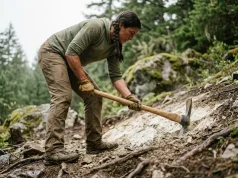
Precision is key here. “Digging a hole” isn’t enough; you need to reach the biologically active layer of the soil. This is typically 6–8 inches down, where microorganisms are most dense.
To achieve this in root-heavy forest floors, you need a purpose-built trowel like the Deuce of Spades. Boot heels simply cannot generate the required cathole depth.
Location strategy is just as important as depth. Move at least 70 paces (approx. 200 feet) away from the base of the crag, the trail, and any small pond or stream. This prevents pathogen migration during rain events. Standard protocols for outdoor hygiene emphasize that distance from water is your primary filter against contamination.
Once the deed is done, use a stick to mix some soil into the waste—the “smear” technique. This increases the surface area for bacteria to do their work. Cover the site with the original plug of sod and scatter leaves or twigs over top. The goal is to make the site invisible.
For hygiene, minimize paper use by utilizing natural wiping elements like smooth stones, snow, or mullein leaves (nature’s toilet paper) if available. Follow up with hand sanitizer or Dr. Bronner’s soap (used 200 feet from water) to ensure cleanliness.
Pro-Tip: Even in cathole zones, pack out your toilet paper. Animals often dig up catholes attracted by the salts in urine or waste, and the first thing they scatter is the paper. A bloom of “tp flowers” is a failure of mastering the art of climbing stewardship.
What Is the Protocol for Desert and High-Traffic Crags? (The WAG Bag Mandate)
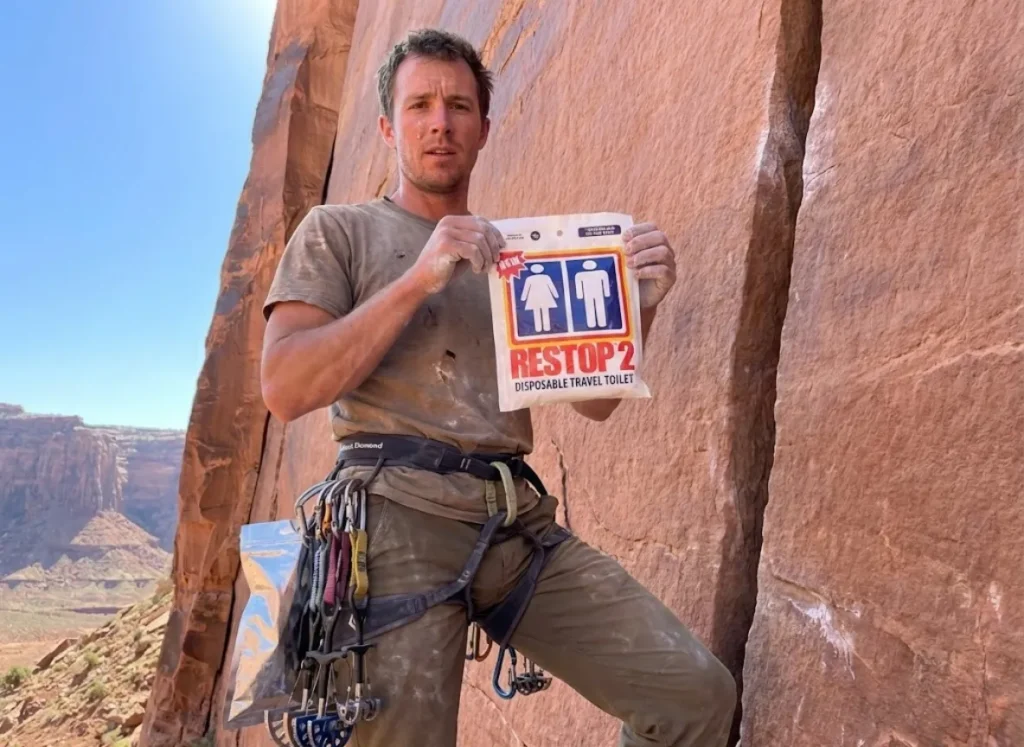
Catholes are prohibited in desert zones because arid mineral soil lacks the moisture and bacteria for decomposition, and digging destroys fragile cryptobiotic soil crusts.
In the desert, the ground preserves waste rather than processing it. I’ve seen catholes in the high desert that looked fresh years after they were dug. The environment lacks the moisture and microbial density to break down pathogens.
Furthermore, the soil itself is often alive. Cryptobiotic soil crusts (cyanobacteria) take decades to regenerate and are vital for preventing erosion. Digging a hole here is an act of long-term destruction on public lands.
Land managers are aware of this. BLM regulations for human waste in Utah explicitly forbid catholes in high-traffic areas like Moab. The logic is simple: in these fragile zones, the only way to follow the Desert Climber’s Ethics Codex is to remove solid waste entirely using a WAG bag.
How does WAG bag chemistry actually work?
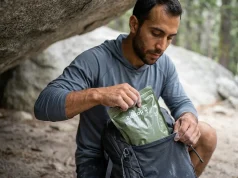
WAG bag (Waste Alleviation and Gelling) chemistry utilizes sodium polyacrylate, a super-absorbent polymer gel that encapsulates solids, combined with decay catalysts to neutralize odors and enable landfill disposal.
The “magic” powder in a bag (often referred to as Poo Powder) is actually NASA-grade chemistry. Sodium polyacrylate is capable of absorbing hundreds of times its weight in water. When it contacts waste, it instantly utilizes gelling agents to trap the liquids and encapsulate the solids. This prevents spills and begins the breakdown process immediately.
Because the waste is gelled and treated with enzymatic decay catalysts, sanitary waste disposal systems like Cleanwaste, Restop, or Biffy Bag are EPA-approved for disposal in standard trash receptacles. They are not considered biohazards.
Portable Waste Disposal Systems
Comparison of top-tier gelling solutions and containment systems for field use.
Gelling Agent
Yes. Uses Sodium Polyacrylate “Poo Powder” for rapid solidification.
Odor Control
Chemical encapsulation with decay catalysts and enzymes.
Gelling Agent
Yes. High-performance polymers for complete containment.
Odor Control
Mylar gas-impervious outer shell; superior for long-term containment.
Gelling Agent
No. Relies purely on desiccation/drying; prone to leakage.
Landfill Safety
No. Lacks EPA-approved treatment enzymes. High risk of odor escape.
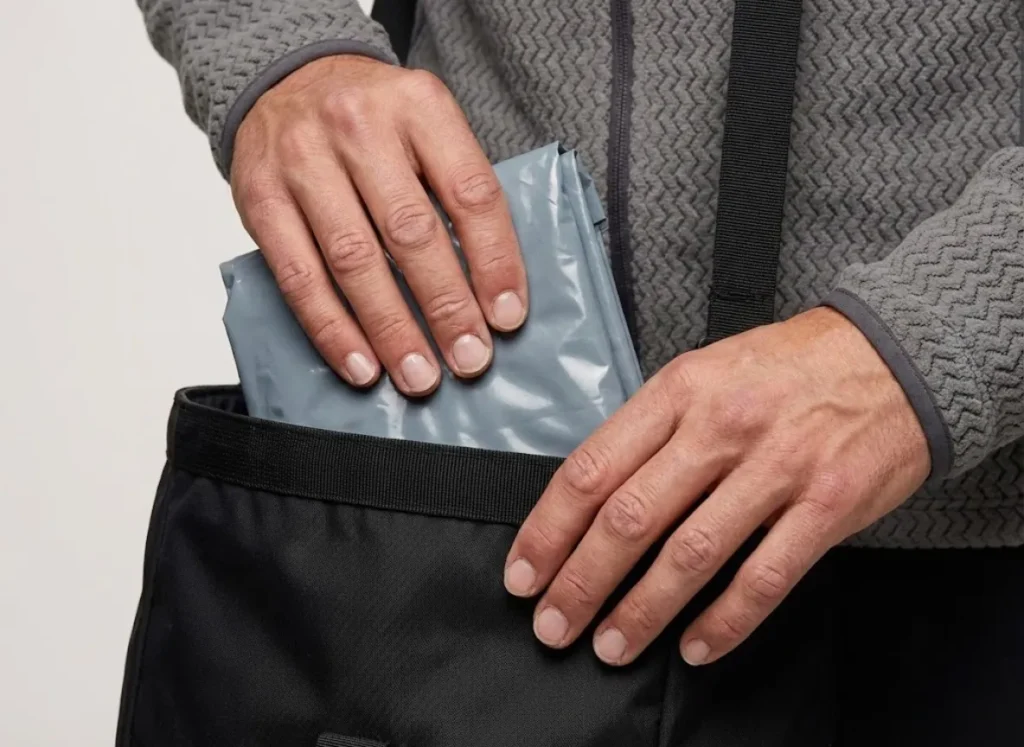
Most systems use a double-bag system with a heavy-duty, puncture-resistant outer layer. They are shelf-stable effectively forever, meaning there is no excuse not to have one in your pack. For a detailed breakdown of gear options, check out our guide on WAG Bags, Catholes & More.
How Do I Poop on a Big Wall or Hanging Belay? (Vertical Logistics)
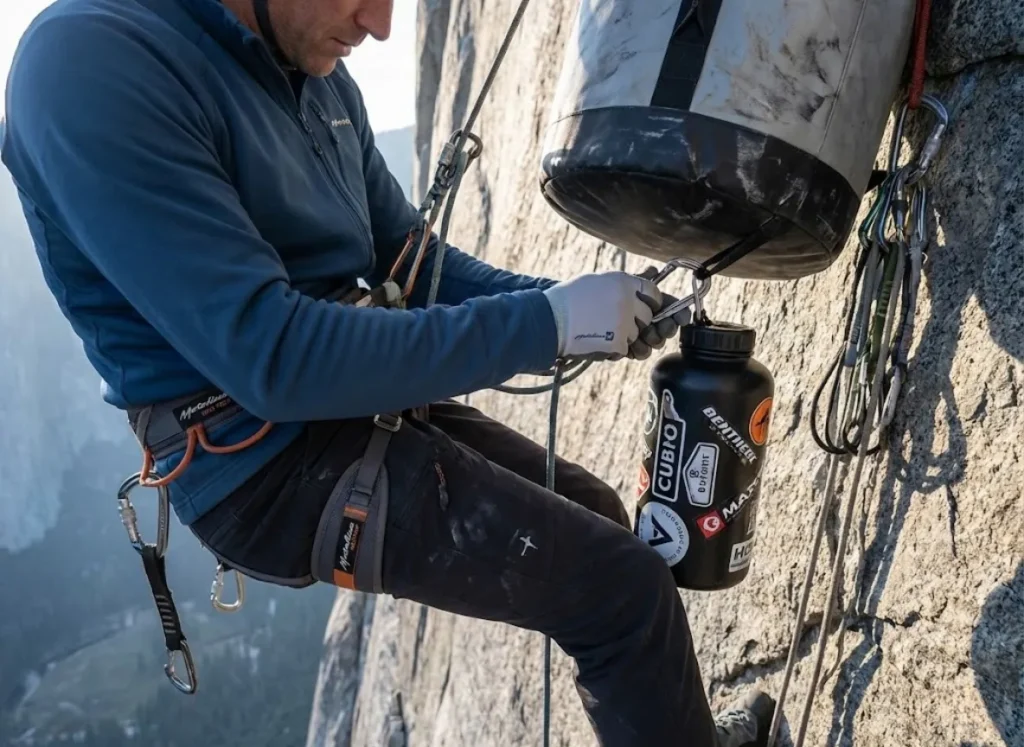
To poop on a big wall, you must build a PVC poop tube or use a commercial haul system like the Metolius Waste Case, utilizing chemical inhibitors to prevent gas buildup.
When you are three days up a route like Conquer Freerider El Capitan or tackling El Capitan via the Nose, you can’t walk 200 feet away. You need a poop tube. The standard DIY version is built from 4-inch Schedule 40 PVC pipe. You’ll need about 10-12 inches of length per person for every 4 days (calculating based on roughly 0.5L per person/day of volume capacity).
Glue a cap on the bottom and install a threaded screw-top plug on the top. Critically, you must rig a tethered waste system. Sling the tube with 3mm accessory cord and clip it to the haul bag or your belay loop. Dropping a full poop tube is a catastrophic safety hazard for parties below.
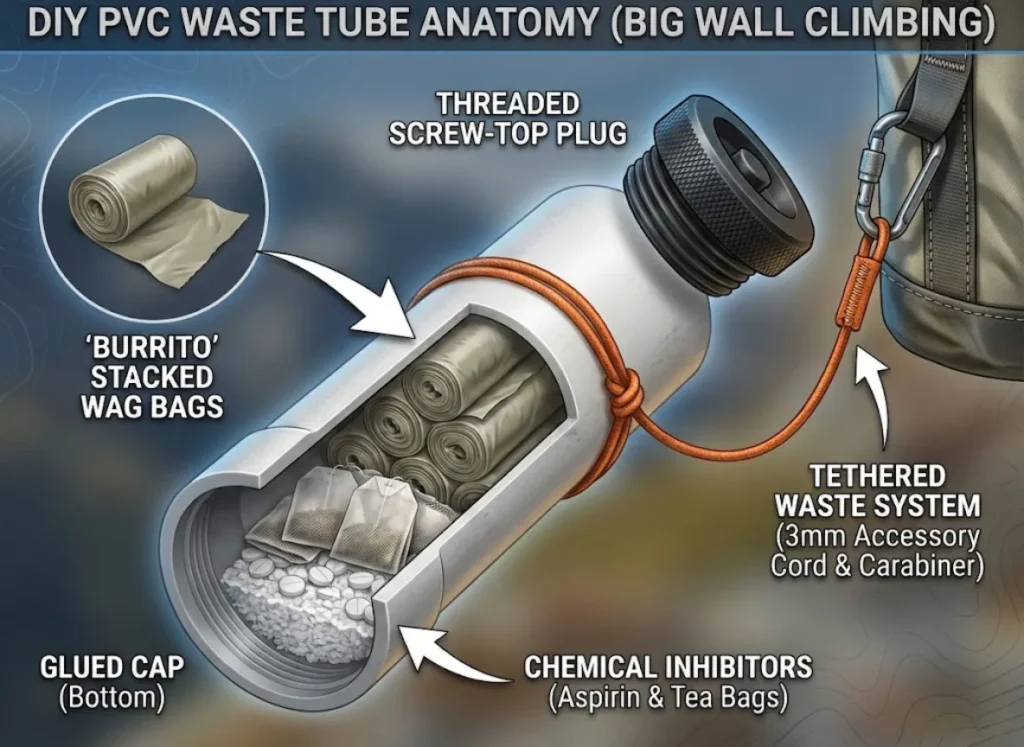
To maximize space and assist with volume compression, roll your used WAG bags tightly—the “Burrito Method”—before sliding them in. On peaks like Denali, you might use a Clean Mountain Can (CMC), but for walls, the tube rules.
Here is the secret to not dreading the tube: odor-science. Add crushed aspirin and dry tea bags (wrapped in coffee filters if loose) to the bottom of the tube before you start the climb. The salicylic acid and tannins are scientifically proven to reduction of gas emissions from manure. They inhibit the bacterial processes that generate methane and hydrogen sulfide, preventing the dreaded tube expansion or “bomb” effect when you open it in the heat.
How do I physically poop while hanging in a harness?
Physically pooping while hanging requires using a drop-seat harness to lower leg loops without untying, utilizing technical stances to maintain safety.
This is the crux of harness logistics. First, never untie. You must remain clipped to the anchor via a Personal Anchor System (PAS) or the rope. Modern big wall harnesses feature releasable leg-loop risers. Unclip these plastic buckles behind your thighs.
This allows you to lower the leg loops and your trousers while the waist belt stays structural and secure. Mastering Peak Safety: Rock Climbing Harness Know-How covers these features in detail.
Adopt the tree-hug method, holding the anchor or rope for stability, or the squat method (suspended squat) by leaning back against the waist belt. Some prefer a seated hang. In windy conditions, you must use a “thigh-lock” technique, holding the WAG bag firmly against your body to prevent the wind from scattering the contents.
Be hyper-aware of micro-trash. Dropping a small wrapper or a wipe corner is littering on a massive scale when it falls 1,000 feet. The NPS takes this seriously; human waste management on Denali and Glacier National Park is strictly monitored. Privacy is secondary to safety. Communicate clearly with your partner and other parties. It’s a professional maneuver, not a source of shame.
The Bottom Line
Waste management is a technical discipline, not a chore. The environment dictates your protocol: catholes for forest zones, WAG bags for desert zones, and rigid tubes for the vertical world. We must understand that biology is access. The link between sanitation failure and crag closure is undeniable.
By using science-backed beta—like sodium polyacrylate for containment and aspirin for gas inhibition—we turn a poop problem into a managed process. Maintaining your anchor connection via drop-seat mechanics ensures you stay safe while doing your part. Next time you rack up, check your kit. Do you have the tools to protect the access you enjoy?
FAQ – Frequently Asked Questions
Can I use kitty litter instead of WAG bag powder?
While kitty litter dries waste and masks odor, it does not encapsulate it or eliminate bacteria like the specialized enzymes in Poo Powder. For short trips, it is a budget option, but for big walls, the gas-inhibiting properties of gelling agents are much safer.
Is it illegal to throw a Mud Falcon (bag of poop) off a cliff?
Yes, throwing mud falcons off a wall is illegal, unethical, and one of the most damaging actions a climber can take. It creates a biohazard at the base and drives strict regulations in places like Yosemite.
How many WAG bags do I need for a 3-day climb?
Plan for one bag per person per day as a baseline. Carrying 1-2 extra emergency bags is best practice. Reusing a bag on a hanging belay is logistically risky and difficult.
Does the aspirin trick for poop tubes actually work?
Yes. The salicylic acid in aspirin and tannins in tea bags help inhibit the bacterial processes that generate methane gas. This significantly reduces pressure buildup inside a sealed PVC poop tube.
Safety Notice: Rock climbing and mountaineering are inherently high-risk
activities that can involve physical trauma or fatal incidents. The information on Rock Climbing Realms is for
educational and informational purposes only. Techniques and advice presented here are not a substitute
for professional, hands-on instruction. Conditions and risks vary by location. Always seek guidance
from a qualified instructor before attempting new techniques. By using this website, you agree that you
are solely responsible for your own safety. Any reliance you place on this information is strictly
at your own risk, and you assume all liability for your actions. Rock Climbing Realms and its authors
will not be held liable for any harm, damage, or loss sustained in connection with the use of this information.
Affiliate Disclosure: We are a participant in the Amazon Services LLC Associates Program, an
affiliate advertising program designed to provide a means for us to earn advertising fees by advertising and linking
to Amazon.com. As an Amazon Associate, we earn from qualifying purchases. We are also an official affiliate partner
of Black Diamond Equipment via the AvantLink network. If you click on a Black Diamond affiliate link and make a
purchase, we may earn a commission at no additional cost to you. We also participate in other affiliate programs.
Additional terms are found in the terms of service.