
In this article
If you’ve ever felt the sudden urge to go mid-pitch, or wandered away from the base only to realize every rock and tree is already surrounded by used toilet paper, you know the reality. After a decade of climbing—and watching more crag closures due to human waste than I care to count—I’ve learned that standard hiking advice absolutely fails at high-traffic crags. This guide breaks down exactly how to handle waste, manage chalk runoff, and protect local water quality without needing a biology degree.
⚡ Quick Answer: You must bury your waste in a 6-to-8-inch cathole at least 200 feet from water. If the ground is too hard to dig, you pack it out in a WAG bag. Most climbers misjudge distance and bury everything too shallow. Here is the exact framework to protect your crag.
Riparian Protection Quick Reference:
- Distance from water: 200 feet (one 60-meter rope length)
- Cathole depth: 6 to 8 inches (the aerobic humus layer)
- Pack-out rule: If you use toilet paper, take it home. Mandatory WAG bag on big walls.
- Chalk cleanup: Brush holds to break the hydromagnesite crust before it rains.
The Access Threat: Why Your Waste Closes Crags
Let me tell you about the fastest way to get a climbing area shut down. It isn’t bad parking or loud music. It’s water contamination. The old idea of the “invisible user” wandering through the woods no longer applies to our community. We show up in massive numbers, and when local land managers look at the environmental impact, our waste is the absolute first thing they scrutinize.
I’ll never forget the time a classic climbing area locked its gates because coliform levels in the local swimming hole spiked after a busy holiday weekend. A heavy rain turns a hidden pile in the woods into a direct creek contaminant. The vegetation near the creek acts as a natural filter, but high-density climbing overloads it completely. When you truly grasp the major threats to climbing access, you quickly realize human waste is the one variable we completely control.
If we don’t police ourselves, the USFS and the BLM step in, and their favorite solution is a locked gate. Every single time you step off the trail, you make a choice about the future of that crag.
Why “Just Burying It” Isn’t Enough Anymore
We used to just walk off the trail and dig a quick hole. That logic worked when crags only saw ten people a weekend. Now they see hundreds. The dirt simply cannot process that massive volume of waste.
Plus, look at where we actually climb. Alpine ridges and desert canyons lack decent soil and moisture. If you bury waste out in the desert, it doesn’t break down—it just turns into a petrified rock waiting for a flash flood. The old-school burial rules just do not apply to modern crag-specific waste management.
The “Pulse Effect” When It Rains
Here is the really ugly reality. You hide your business under a rock up the hill and think the problem is solved. Then a thunderstorm hits. That rain grabs everything on the surface and washes it downhill in one massive wave called the “pulse effect.”
If you leave waste above ground or bury it too shallow, the very next storm flushes it straight into the watershed, bypassing the dirt’s natural filter entirely. The numbers back this up: data collected by the NIH shows sewage levels spike wildly near recreational areas right after it rains. That hidden pile in the woods creates a direct crag-to-creek flow of contaminants that ruins the swimming hole downstream.
These storms don’t just wash away fresh waste; they dig up the old stuff too. The dirt itself doesn’t magically neutralize the threat overnight like most people assume.
Survival Rates of Pathogens in Dirt
Throwing a handful of dirt on your waste doesn’t make the bacteria disappear. Nasty pathogens like Giardia and E. coli can survive well over a year in the soil through deep freezes and brutal droughts.
Unmanaged waste at the crag poses a direct sickness hazard to whoever climbs after you. Getting violently ill on a trip usually traces back back to someone filtering contaminated water downstream. I’ve had friends sidelined with brutal stomach cramps from this stuff. Limiting the impact of recreation on water quality isn’t just about appeasing park rangers—it’s about keeping you and your belay partner healthy on the approach hike.
So, if shallow burying ruins the water, what’s the actual procedure we should follow? That brings us to the 200-foot buffer.
The 200-Foot Rule Explained for Climbers
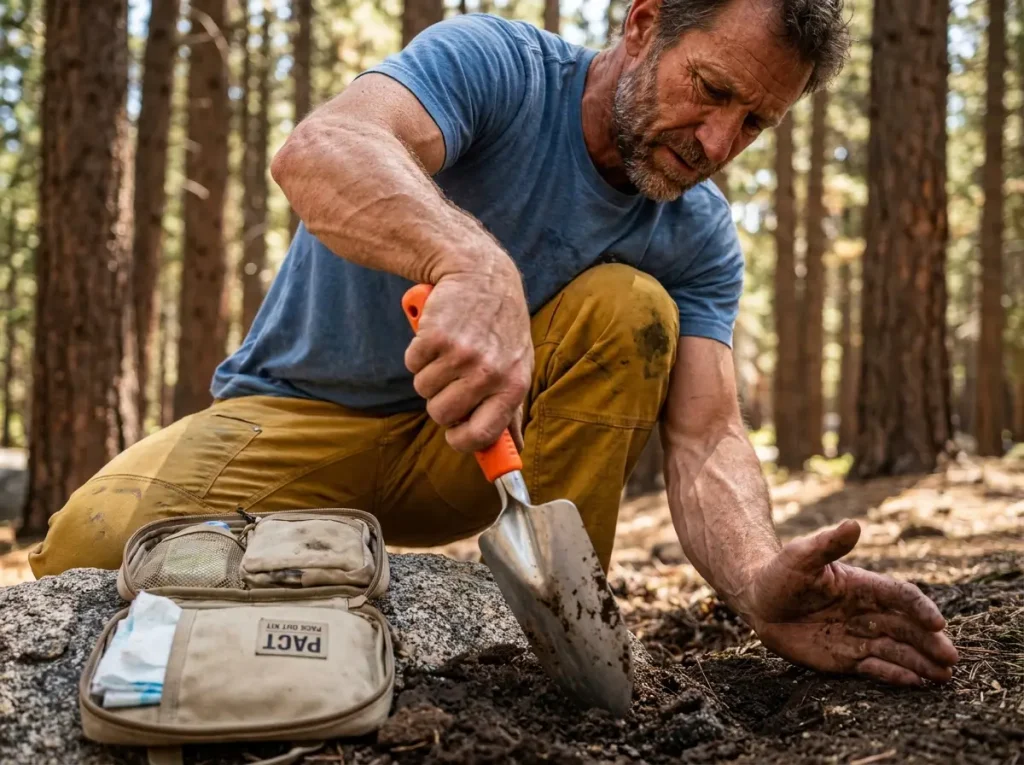
Everyone knows you’re supposed to walk away from the water. The problem is execution. Humans are terrible at judging distance in the woods. You think you’ve hiked 200 feet, but you’ve actually only gone 50 feet before finding a quiet bush.
But established Leave No Trace principles treat that 200-foot rule as a hard, scientific fact. That specific distance gives the dirt enough time to filter out the bad stuff before it reaches the groundwater. When you’re mastering how to poop outdoors, that buffer distance is strictly non-negotiable.
Translating 200 Feet into Rope Lengths
Stop trying to count your paces. You are a climber, so use a measurement you already know intuitively. One full length of a standard 60-meter dynamic climbing rope is exactly how far you need to get from the water. Eyeball the distance from where you dropped your rope bag to the base of the climb. That translates perfectly.
This 200-foot distance also applies to proximity from trails and the cliff base. You don’t want to dig a cathole right where the belayer is going to sit tomorrow. If you ever ask yourself how far from water should you poop, picture your rope stretched tight.
Pro tip: Never dig a cathole straight uphill from a water source where runoff forms naturally. Always look for a flat area or a localized depression so rainwater doesn’t rush straight over your spot.
The “Goldilocks Zone” for Cathole Depth
Digging the hole is an art form. The depth matters just as much as the distance. The cathole needs to sit exactly 6 to 8 inches deep. This puts the waste in the aerobic humus layer—the dark, rich topsoil packed with oxygen-breathing bugs that eat the mess.
If you just scrape the surface, wild animals dig it up instantly. But if you dig aggressively deep—say, a full foot down—you hit the anaerobic zone. There is almost zero oxygen down there. Bury it that deep, and the waste basically sits preserved like a time capsule. Hit the 6-to-8-inch Goldilocks zone, handle your business, and cover it back up with the original dirt.
Digging the right hole handles the solid waste. But you still have to manage how you clean up your gear and your hands afterwards.
Why Biodegradable Soap is a Trap
I see climbers washing their pans right in the stream with “green” soap constantly. To the fish, soap is soap. People think biodegradable means harmless, but that is a dangerous myth.
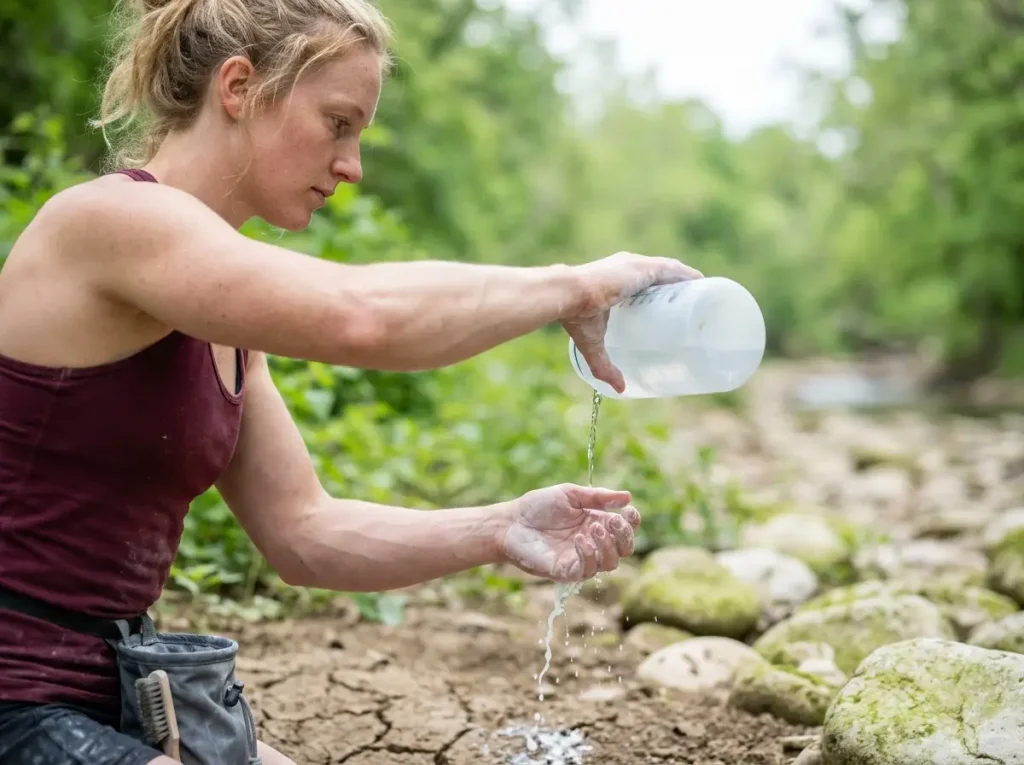
Biodegradable soap lowers surface tension, causing aquatic insects to sink and perish instantly. Your soap also requires strong soil bacteria to break down properly; it doesn’t just safely dissolve in a moving creek. If you insist on using it, haul your water 200 feet back up the hill. Wash your dishes there, then widely scatter the greywater across dry land so the dirt can act as the filter.
Code Brown on Big Walls: Managing Waste Mid-Pitch
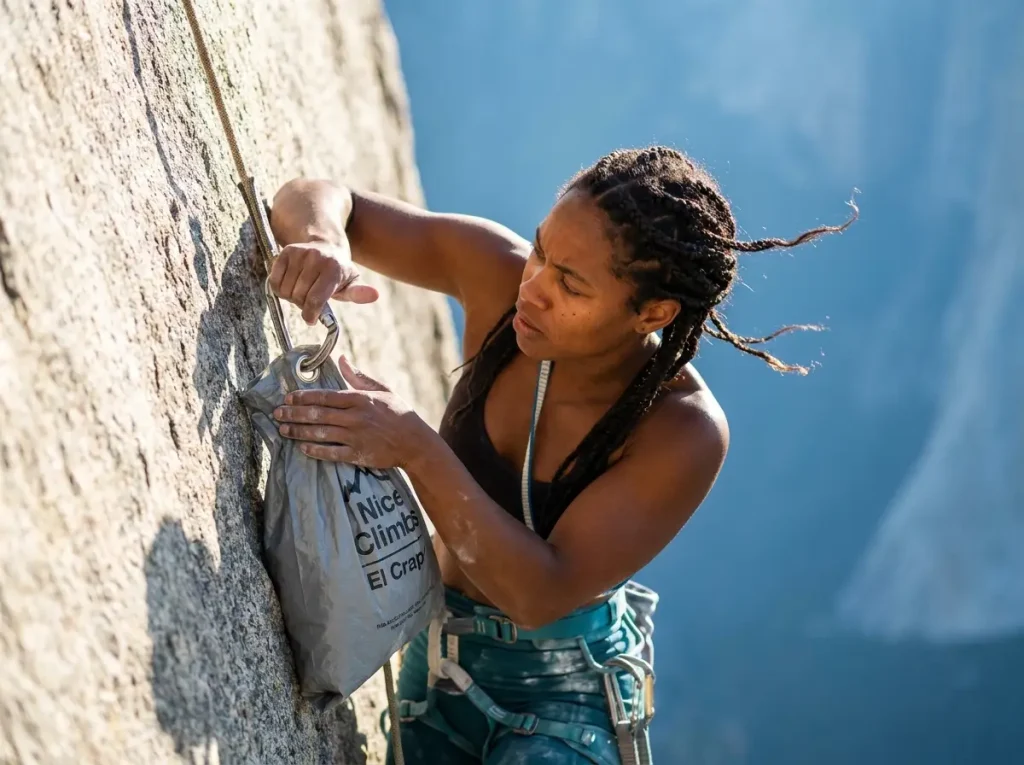
We need to address the elephant in the room. Going to the bathroom while hanging hundreds of feet off the deck is absolutely terrifying the first time you do it. Traditional catholes obviously don’t apply here. You are stuck in a harness, clipped to an anchor, fighting a brisk crosswind with nowhere to hide.
On my first big wall, I nervously tried to handle a bag while balancing precariously on a tiny ledge. It was a complete disaster waiting to happen. The old ethic was simply throwing waste off the wall (the “drop method”). That is totally forbidden now. Today, using WAG bags effectively mid-pitch separates the real veterans from the liabilities. You have to handle this without dropping anything, including your pride.
The Mid-Pitch Squat: Adjusting Your Harness
The sheer mechanics of going to the bathroom in a harness confuse almost everyone. But it’s perfectly safe if you trust the system. You never, ever unbuckle your waist belt. That belt is your primary life support and stays fully secured the entire time.
Instead, detach the rear elastic risers of your leg loops. Once those snap free, pull the leg loops down the back of your thighs. Use a clove hitch on your personal tether to dial in the perfect length from the anchor. Set it just short enough so you can lean back into a comfortable “hanging squat” without completely unweighting your feet. Practice this motion exactly once from a pull-up bar before you test it a thousand feet up a wall.
Anchoring Your Bag Against the Wind
A sudden gust of wind is your absolute worst enemy when handling a code brown mid-pitch. A loose bag turns into a kite instantly. The second you pull out the plastic bag, you must secure it.
Put a heavy carabiner or a rock in the bottom of the bag, or clip the very edge of the plastic to a small biner attached to a piece of gear. Do this before you start doing your business. The bag must remain open and anchored below you, leaving your hands totally free for balance and cleanup.
Once the bag is securely anchored and sealed, you face the next major logistical nightmare. You have to store that bag safely for the rest of the multi-day climb.
The Anatomy of a Poop Tube
When you spend multiple days on a big wall, you crank out far too much waste to just shove in the bottom of your backpack. The standard piece of engineering for this scenario is the Poop Tube.
This is essentially a sealed PVC pipe. You seal your used bags, drop them into the tube, and crank the threaded cap shut. Here’s the key detail: you haul the tube hanging completely outside the main haul bag. If a catastrophic leak ever happens, it coats the outside of the bag instead of soaking your sleeping bag and food supply. It is heavy and awkward, but it remains the required price of admission for big vertical terrain.
The WAG Bag Revolution: NASA Tech in Your Pack
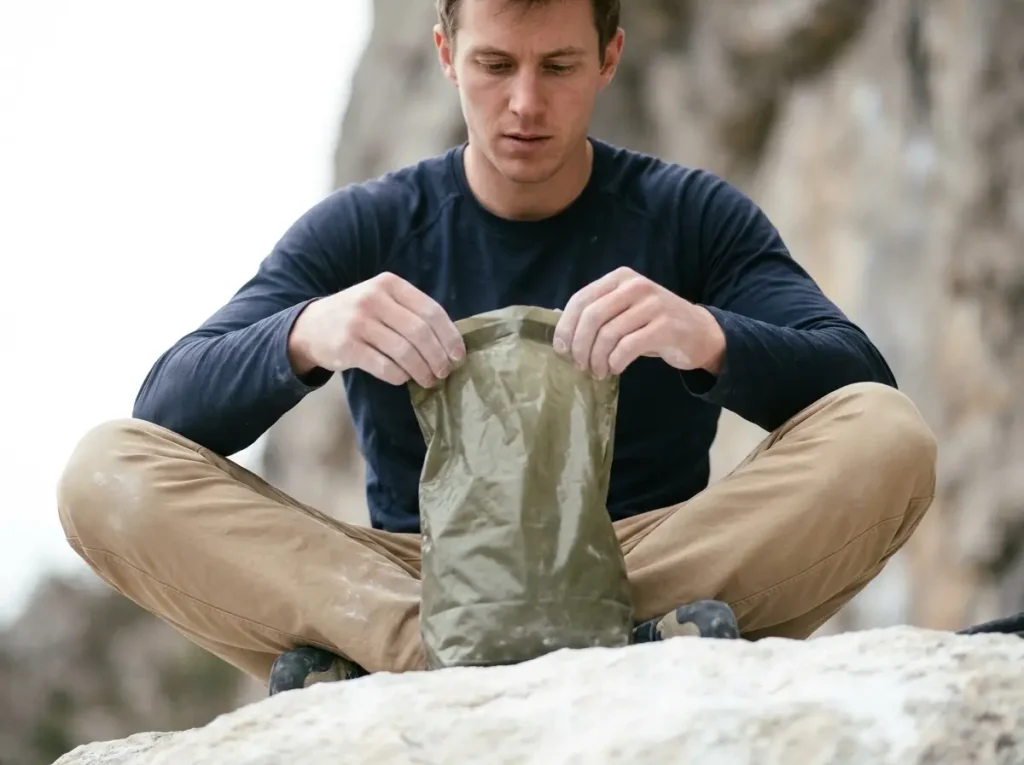
Sometimes, digging a hole simply isn’t an option. Maybe the rock is solid granite, the dirt is frozen solid, or the crag sees ridiculous amounts of weekend traffic. This is where the Waste Aggregation and Gelling bag—the WAG bag—saves the day. Stop thinking that packing out waste makes you weird. It’s the cleanest, most definitive form of Leave No Trace available out there.
I used to hate the idea of packing it out. It sounded gross. But once you realize how the technology actually works, slipping a bag into your pack isn’t a big deal at all. It isolates the mess completely and remains the ultimate tool to reduce your impact while climbing.
How “Poo Powder” Actually Works
The magic inside these bags goes by the name poo powder. It actually utilizes brilliant NASA engineering. When liquid hits the powder, it activates a mix of super-absorbent polymers and specialized enzymes.
The gelling technology instantly solidifies the liquid, putting an end to any sloshing or leaks inside your climbing pack. Better yet, it encapsulates the odor molecules and begins neutralizing the bacteria immediately. It turns a nasty biological hazard into an inert, jelly-like substance. Because the reaction neutralizes the pathogens, the resulting mixture sits completely safe for normal municipal trash cans. You just toss it in the dumpster at the gas station on the hike out.
Comparing the Best Waste Kits for Climbers
Not all bags are built the same, and a blowout inside your climbing pack will absolutely ruin your entire month. If you want the best gear, you buy based on durability.
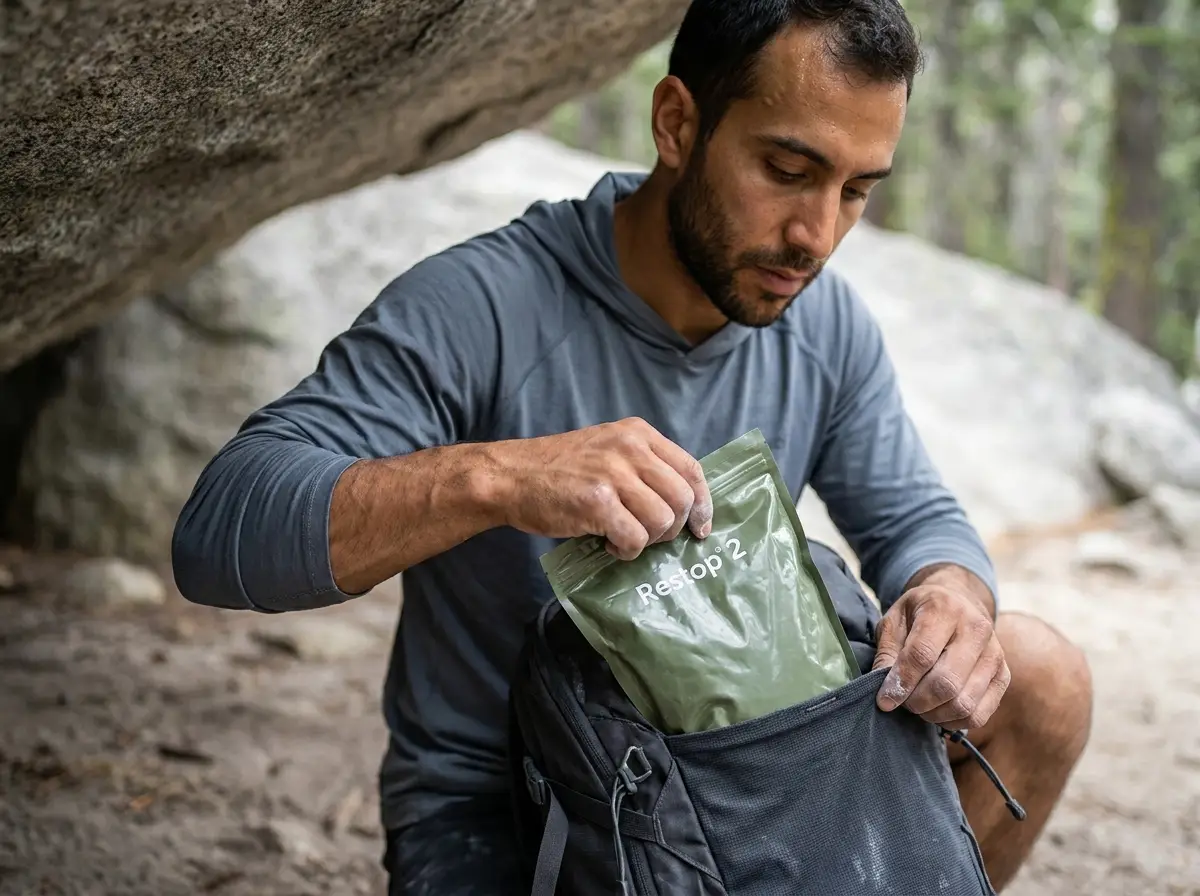
The Cleanwaste Original stands as the standard-issue bag used by the military. It feels rugged but packs a bit bulky. The Restop 2 usually wins out as the climber favorite because it features a super-secure drawstring closure on the inner bag and rolls up tight. On the ultralight end, the PACT Lite Kit uses compressed wipes that expand with water, saving critical space in your crag bag.
Pro tip: Always pre-open the bag at the base of the crag before you put your harness on. Fumbling with static-cling plastic seals while desperately holding it in is a miserable experience.
Choosing the right bag is only the first step. You also have to commit entirely to the pack-out ethic, and that means completely rethinking how you view toilet paper at the crag.
The Golden Rule of Toilet Paper
This applies everywhere, on every crag: if you wipe, you pack it out. Toilet paper creates massive social impact complaints. It looks terrible at the boulders, it takes months to disintegrate, and wild animals dig it up constantly for the salt content.
Even in areas where land managers completely allow you to dig a cathole, you still pack out your TP. Shove it in a small ziplock bag wrapped entirely in duct tape so you don’t have to look at it, and toss it in your pack. The toilet paper blooms decorating the bases of popular climbs are the fastest way to convince a park ranger that climbers lack basic respect.
The White Crust: How Climbing Chalk Rewires Ecology
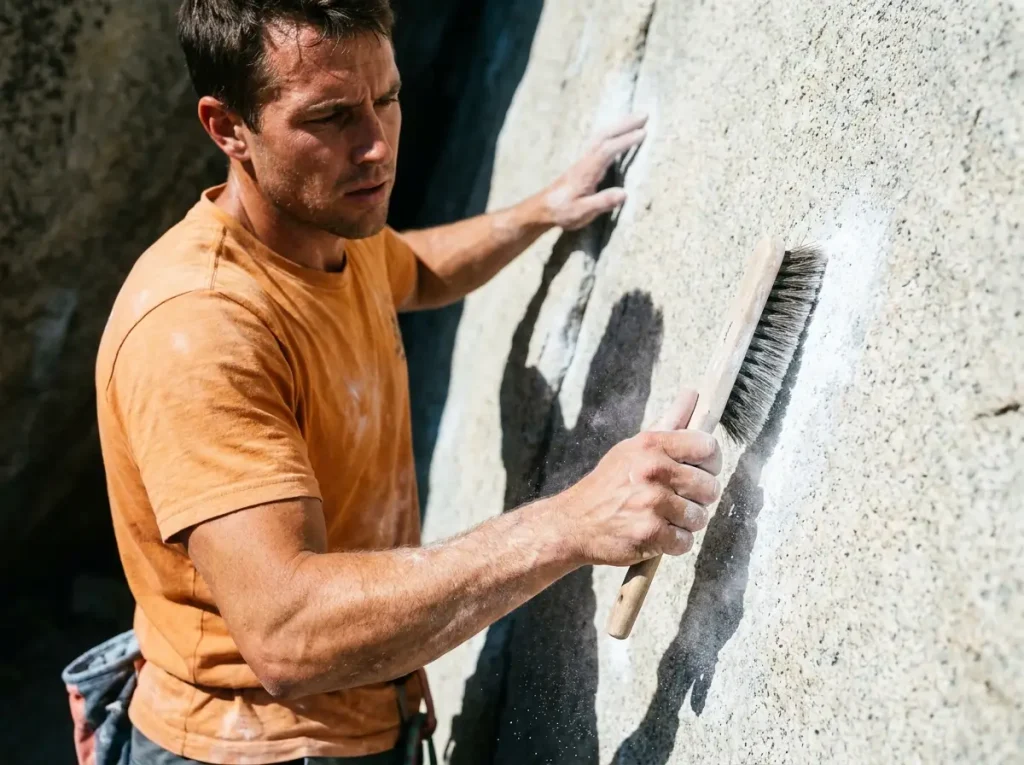
Most of us treat climbing chalk like mere visual pollution. We complain about the white tick marks left on classic boulder problems, but we generally assume the next rainstorm just washes the dust away. I didn’t realize until a botanist friend slapped some sense into me that our chalk literally shifts the chemistry of the rain runoff.
Chalk isn’t an inert substance. We carry pounds of chemicals into the woods and aggressively dust the rock with it. Over time, this creates a massive chalk wash impact that alters the soil directly beneath the cliff line. Brushing the holds after you send isn’t just polite for the next climber’s friction; it is a required environmental duty to protect the native rock ecology.
The pH Problem of Magnesium Carbonate
Climbing chalk boils down to magnesium carbonate. This chemical acts extremely alkaline, boasting a pH of around 10.5. Compare that to the natural pH of standard rainwater, which sits slightly acidic at around 5.6.
When you coat a granite cliff with chalk, you bombard a naturally acidic environment with heavy alkalinity. Ferns and mosses are especially vulnerable because they absorb water directly through their cell walls. A heavy dusting of chalk basically scorches the microscopic flora that holds the cliff’s micro-ecosystem together.
The Hydromagnesite Crust: Why Rain Doesn’t Work
The biggest lie we tell ourselves is that the next big storm washes the rock clean. Magnesium carbonate is actually incredibly resistant to dissolving in water. When rain hits loose chalk, it reacts to form a hard, caked-up layer called a hydromagnesite crust.
This permanent crust clogs the natural pores of the rock, ruining the friction for years. As it slowly flakes off, it creates a magnesium overload inside the soil at the base of the crag. This alkaline dirt washes down the hillside, causing chemical chalk runoff that pollutes the nearest stream. The rain doesn’t solve the problem—it bakes the problem directly onto the wall.
Understanding the gross chemistry of this crust is the first step. The second step is actually changing the tools you use the next time you hit the wall.
Simple Mitigations: Chalk Balls and Soft Brushes
You don’t need to quit chalk cold turkey, but you absolutely must change how you deploy it. First, run chalk balls inside your bag. Dipping your hands into a loose pile creates a massive dust cloud that coats a ten-foot radius. A chalk ball keeps the product exactly where you need it—on your skin.
Second, commit to safe climbing chalk removal at the end of every single session. Use soft nylon or boar’s hair brushes to break down the chalk lines. Never use a wire brush. Brush aggressively while the chalk remains dry. If you smash up the powder before the rain hits it, you prevent that permanent hydromagnesite crust from ever forming.
Pro tip: Dedicate a specific brush to chalk cleanup that is softer than your climbing brush. A cheap boar’s hair brush works perfectly to clear the holds without polishing the native rock.
Trail Erosion: The Unseen Threat to Streams
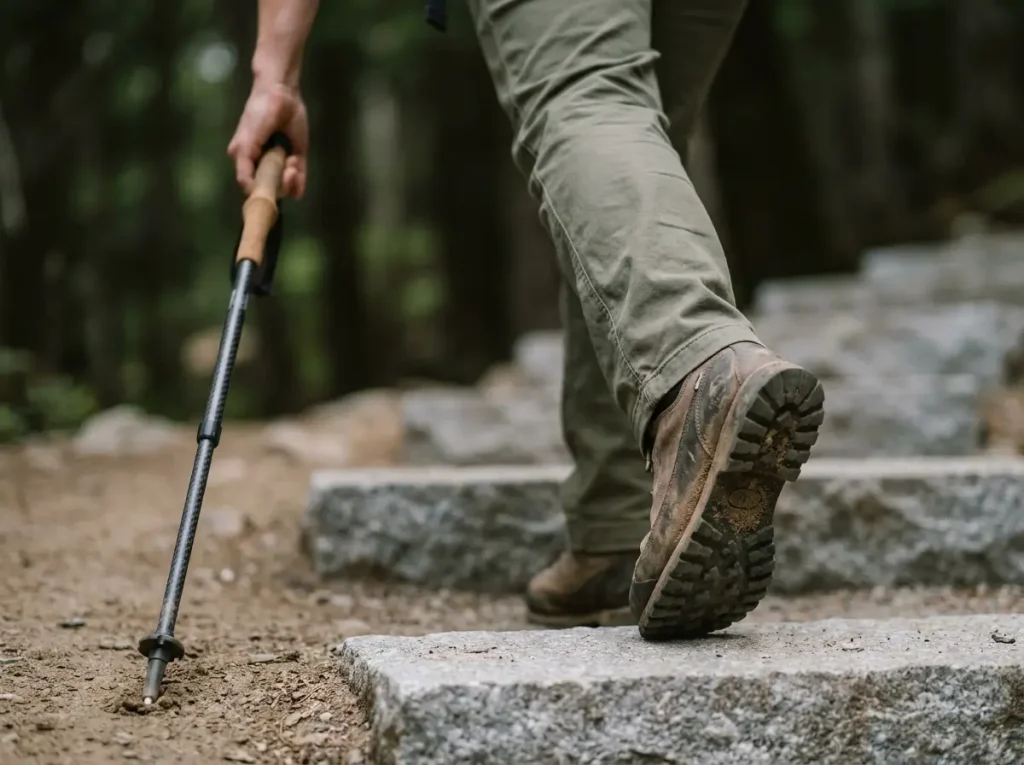
While human waste looks like the grossest problem, physical trail erosion hits the water footprint of a climbing area the hardest. Climbing often takes place on ridiculously steep slopes, requiring rough, unmaintained approach trails.
You know that steep, washed-out sandy gully you slid down on the approach last weekend? That dirt doesn’t just vanish. It flows entirely downhill. I learned the hard way that walking single file on the slow, boring switchbacks is what actually saves the creek below. The Access fund spends thousands of dollars fixing trails near streams, but a few impatient climbers cutting corners ruins a whole season’s worth of work in a single afternoon.
Sedimentation: Smothering the Stream
Erosion kicks off a devastating process called sedimentation. When loose dirt from the climber trail washes into a stream, it aggressively clouds the water.
Eventually, all that silt settles right onto the bottom of the riverbed. It blankets the rocks, completely suffocating the macroinvertebrates—the water bugs sitting at the very bottom of the food chain. No bugs means absolutely no fish. That sediment also suffocates fish eggs buried in the gravel. A poorly managed approach trail actively destroys the river below it.
Why “Hardened” Belay Spaces Matter
Take a close look at the base of popular crags. You will often notice beautifully constructed stone retaining walls. These “hardened” spaces aren’t just there to give your belayer a flat, lazy place to stand.
Builders use these stone walls to concentrate the human impact into one tight zone. If everyone drops their bags and paces around on one specific stone platform, the surrounding vegetation gets a real chance to heal. Plants take root outside the hardened zone, locking the hillside together. Those roots act like a natural net that catches loose dirt before it washes down into the watershed.
Hardened surfaces protect the immediate belay zone perfectly. But all that protection is totally wasted if climbers destroy the hillside just trying to get there.
The Danger of Short-Cutting the Approach
The approach hike serves as the warm-up for the climb. When you skip a switchback and plunge straight up a steep hillside, you murder the vital root systems holding that hill together.
The very next time it rains, that shortcut turns into a frictionless waterslide for mud. You essentially dig a fast-pass erosion trench directly to the water. Stay on the designated trail, even when it feels laughably tedious. Walk on exposed rock whenever possible rather than soft dirt. Keeping your boots exactly where they belong is how you start mastering the art of climbing stewardship and ensuring the ecosystem survives the busy season.
Pro tip: If you must pee in a river while climbing, don’t. The “dilution is the solution” myth only applies to massive rivers like the Colorado. At small local crags, haul your liquid waste out 200 feet to let the soil filter the heavy nitrogen and salts.
The Final Takeaway
We hold absolute control over how we treat the crags. That 200-foot rule stands non-negotiable for water quality; just picture a standard climbing rope stretched tight across the dirt as your visual guide. When you head out, make sure a loaded WAG bag hits your crag pack before your lunch does, and stop pretending packing your waste out is shameful. Finally, spend two extra minutes brushing your chalk residues off your project to stop the chemical degradation of the rock.
Next time you load up, throw that extra WAG bag in the lid and double-check your brush. Your local access depends on the habits you decide to build right now.
FAQ
How far from water should you poop when climbing?
You must walk at least 200 feet away from any water source. That breaks down to about the length of a standard 60-meter climbing rope. This buffer gives the dirt the exact time it needs to filter out pathogens before the groundwater hits the stream.
Is biodegradable soap safe to use in lakes or rivers?
No. Biodegradable soap actively hurts fish and aquatic insects if used directly in water. It drastically lowers the water’s surface tension, causing bugs to sink, and it absolutely requires robust soil bacteria to properly break down its chemicals.
What exactly is a WAG bag and how does it work?
A WAG bag is a complete double-sealed portable toilet setup built around a NASA-developed mix of polymers and enzymes. When liquid hits the active powder, it gels instantly, neutralizes odors, and renders the waste totally safe for a regular municipal trash can.
Can climbing chalk really harm plants and water?
Yes. Standard climbing chalk acts as a harsh alkaline agent with a high pH of 10.5. Rain turns it into a permanent hard crust that damages the natural rock chemistry, making the surface heavily toxic for sensitive mosses, ferns, and native plant life.
Safety Notice: Rock climbing and mountaineering are inherently high-risk
activities that can involve physical trauma or fatal incidents. The information on Rock Climbing Realms is for
educational and informational purposes only. Techniques and advice presented here are not a substitute
for professional, hands-on instruction. Conditions and risks vary by location. Always seek guidance
from a qualified instructor before attempting new techniques. By using this website, you agree that you
are solely responsible for your own safety. Any reliance you place on this information is strictly
at your own risk, and you assume all liability for your actions. Rock Climbing Realms and its authors
will not be held liable for any harm, damage, or loss sustained in connection with the use of this information.
Affiliate Disclosure: We are a participant in the Amazon Services LLC Associates Program, an
affiliate advertising program designed to provide a means for us to earn advertising fees by advertising and linking
to Amazon.com. As an Amazon Associate, we earn from qualifying purchases. We are also an official affiliate partner
of Black Diamond Equipment via the AvantLink network. If you click on a Black Diamond affiliate link and make a
purchase, we may earn a commission at no additional cost to you. We also participate in other affiliate programs.
Additional terms are found in the terms of service.