
In this article
The rain the night before wasn’t bad, but hiking up the steep gully toward the crag, our approach looked like a ruined riverbed of mud and exposed roots. You spend years hauling gear up washed-out nightmares before finally doing the sweat equity on a cleanup day. I learned trail preservation from the guys swinging pickaxes. This is the field guide to climbing approach trail erosion prevention that actually holds up.
⚡ Quick Answer: You stop trail erosion by kicking water off the path early and often using grade reversals and rock armoring. When water crosses a trail instead of flowing straight down it, the dirt stays put—but most climbers unknowingly wreck these drainage systems on their hike in.
The Biology of Trail Failure: Why Approaches Wash Away
We’ve all taken that hidden shortcut up to the wall to shave five minutes off the approach. It feels smart in the moment. That same shortcut turns a solid dirt path into a muddy water slide for the next crew. Real trail engineering means reading the hydrology of the hillside before picking up a shovel. Master builders study exactly how water moves across the mountain. A proper path handles rain. A lazy shortcut destroys the slope in one wet season. Gravity and friction run this show. If you fight gravity, it wins. Water grabs the path of least resistance. When frustrated climbers ignore the physical rules, they wreck the local crag.
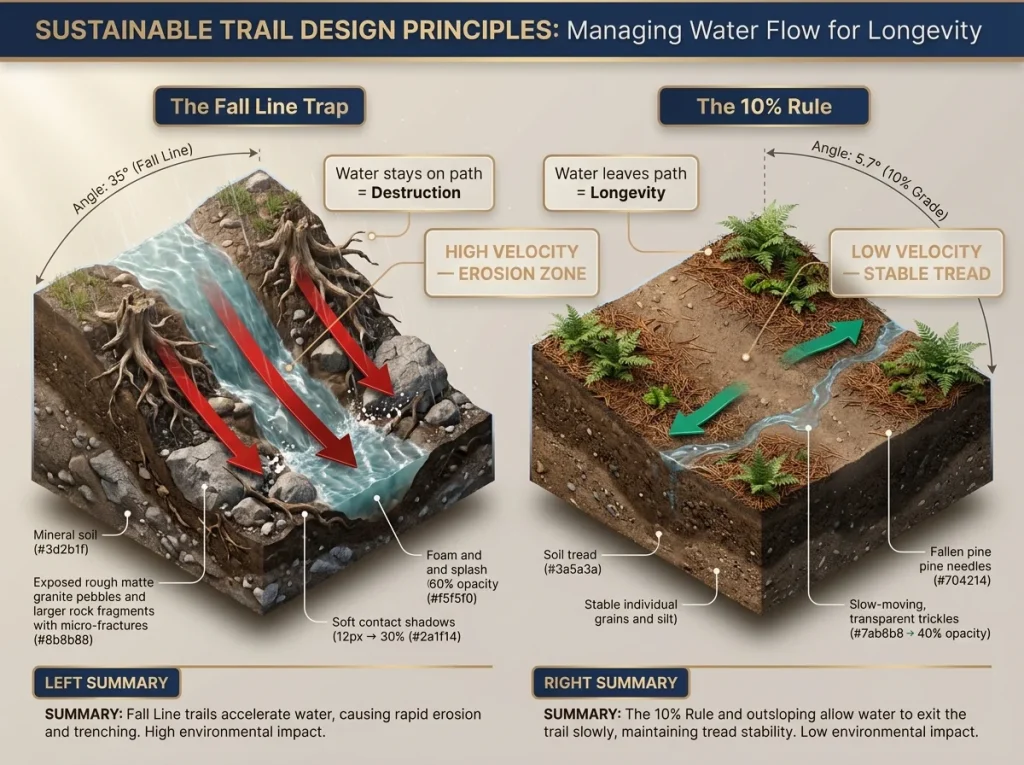
The Fall Line Trap
You spot this error at every new crag. First ascensionists locate the wall and bushwhack straight up. We call this the fall line—the steepest pitch on the slope. It’s the fastest route to the rock face, and it guarantees a blowout because it acts as a perfect downhill funnel for rain.
When you pack loose dirt down hard with approach shoes on a steep angle, you make a smooth channel. Water blindly follows gravity, picking up velocity and carving a ditch deep into the mountain. Soon, your brilliant shortcut is a knee-deep trench full of wobbly rocks that roll ankles on the hike out. Once a fall-line nightmare forms, it takes heavy equipment to fix.
The Mud-Moving Power of Sheet Flow
To understand why steep approaches fail, watch how water steals dirt. It comes down to holding power. Slow water drops the sediment it carries. Fast water grabs everything it touches and throws it downhill.
On a healthy mountainside, water moves as sheet flow. It spreads out across the forest floor in a thin, uniform layer. The thick roots, dead leaves, and fallen branches act like a gentle showerhead, slowing it down. This water creeps across the ground, soaking in without stripping topsoil.
A bad trail ruins that system by concentrating sheet flow into a single focused stream. Fast surface water works like a thief. It steals dirt right off the path and carries it away. A slow puddle drops its mud exactly where it sits. A screaming river washes your favorite approach right off the map.
This leads us to the next critical consideration for protecting the crag when you are making your approach. It’s not just about how water flows over the dirt; it’s about what happens when climbers make their own decisions in the woods.
Social Trails and the “Highway Effect”
Impatient climbers deciding the main switchback takes too long start cutting through the woods, forming social trails. These unofficial zig-zags pop up wherever impatience beats common sense. You think walking over those ferns once won’t hurt. Then ten people spot your crushed footprints and follow.
This leads to trail braiding and soil erosion. When a social trail gets muddy, the next hiker steps right to keep their canvas shoes dry. The trail widens. The new edge gets muddy, and people step wider. A narrow footpath stretches into a ten-foot-wide mud pit. To stop it, you need to understand climbing ethics and access. Walk straight through the miserable mud instead of stepping around it. Accept that your outdoor shoes will get dirty. Protecting the woods requires staying on the established path. This mindset shift is the only thing that keeps fragile crags open.
Crag-Side Manners: The Highest Impact Zone
Think about the hours you spend pacing at the base of a route swapping belays. It feels harmless. You tie a knot, toss the rope in a pile, and shift your weight left and right. But pivoting on your heels in the exact same spot for hours acts like taking a power sander to the delicate forest floor.
Most trail manuals focus heavily on hiking safety and completely ignore the climbing-specific reality of the staging area. The crag base represents the highest impact footprint in the entire outdoor rock climbing experience. When fifty people hang out holding ropes every weekend, the ground radically changes structurally. The small plants wipe out completely. Real crag-side manners mean recognizing your belay stance is a constant environmental issue. You leave a compact crater behind.
The Belay Impact on Mineral Soil
The dirt beneath your approach shoes has a microscopic structure containing millions of tiny air pockets that let rain soak through. When you stand in a tight three-by-three square for five hours belaying a partner hangdogging a project, your heavy weight crushes those air pockets.
This repetitive pressure causes severe soil compaction. Porous dirt turns into concrete. When a thunderstorm hits, the rain cannot soak into the crushed ground and pools uncontrollably. This is the base area impact nobody mentions in the gym.
You have to build belay platforms deep on the firm clay under the topsoil. Tamping down soft leaves just creates sliding muck that cannot support heavy haul bags. If the base turns to concrete, fast runoff scours the hillside.
Pad Dragging vs. Root Systems
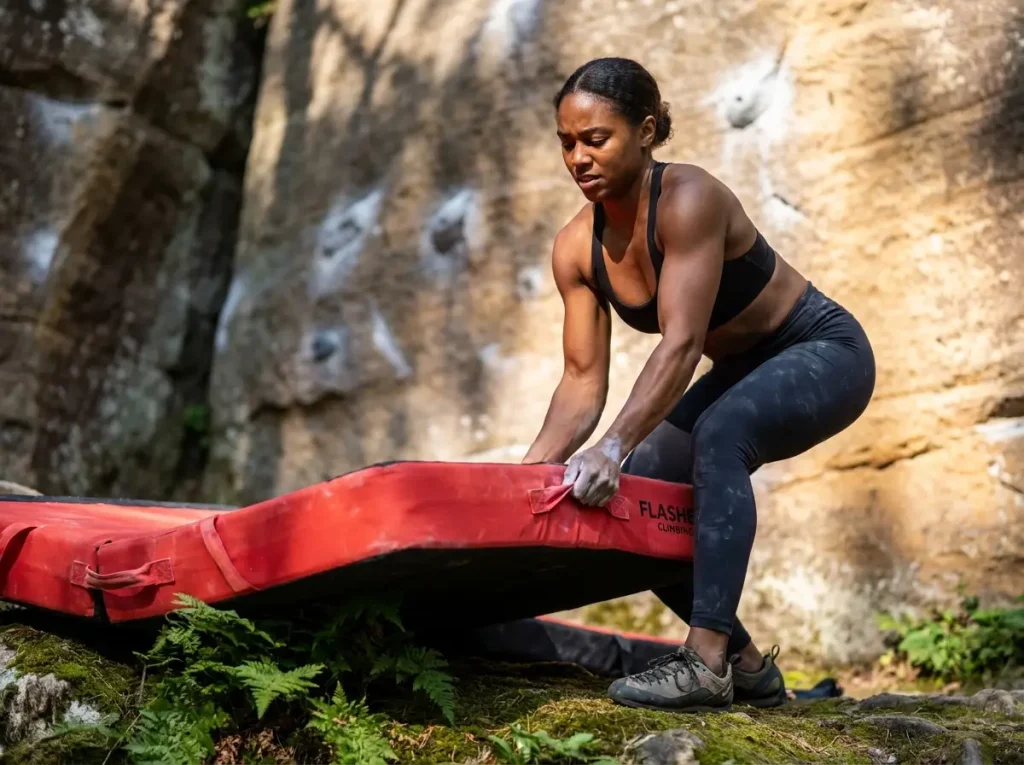
Boulderers create a completely different type of destruction. A large pad covers a ton of surface area. When moving ten feet left to try a new line, the laziest move is grabbing a handle and letting the pad drag across the smooth dirt.
Stop doing this. Dragging massive foam over soft ground acts like coarse sandpaper. It rips up fragile mosses and destroys the microscopic root systems holding the soil securely. These tiny roots act as the structural anchor lines of the hillside.
Sand those roots away, and the dirt loses its grip. The next heavy rain washes pulverized soil right off the cliff base. Lift your crash pads completely off the ground when pivoting to a new spot. Taking the extra physical effort saves the structural roots that keep the bouldering area from sliding into the valley. If you need to know exactly where dropping your pad matters most, focus on preserving those micro-habitats.
And what you leave behind on the rock eventually ends up in the dirt right where you stand, creating a whole new set of ecological problems.
The Invisible Damage of Climbing Chalk
We coat our hands in magnesium carbonate to block sweat. We tick marks on holds. We spill it ripping bags open. It seems like sterile white dust that washes off in the rain. Chemically, it’s not.
Climbing chalk alters the fragile pH balance of the soil sitting directly below the route, driving up alkalinity. This chemical shift causes cliff plant abundance decreases that researchers track decades later. It systematically poisons native plants trying to survive harsh vertical environments.
For those looking at how climbing impacts rock erosion, understand that keeping loose chalk inside your bag matters. Brush your tick marks off when you lower. We are introducing foreign minerals into a closed loop. The rain washes it off the rock straight into the dirt at the belay. Every piece of chalk you spill changes the soil chemistry forever.
Pro tip: Switch immediately to using a chalk ball instead of a bucket of loose powder. It cuts accidental spillage down by eighty percent, limits the massive dust cloud when you chalk up, and keeps your chemical footprint at the belay base to an absolute minimum.
The Golden Rules of Dirt: Grading and Angles
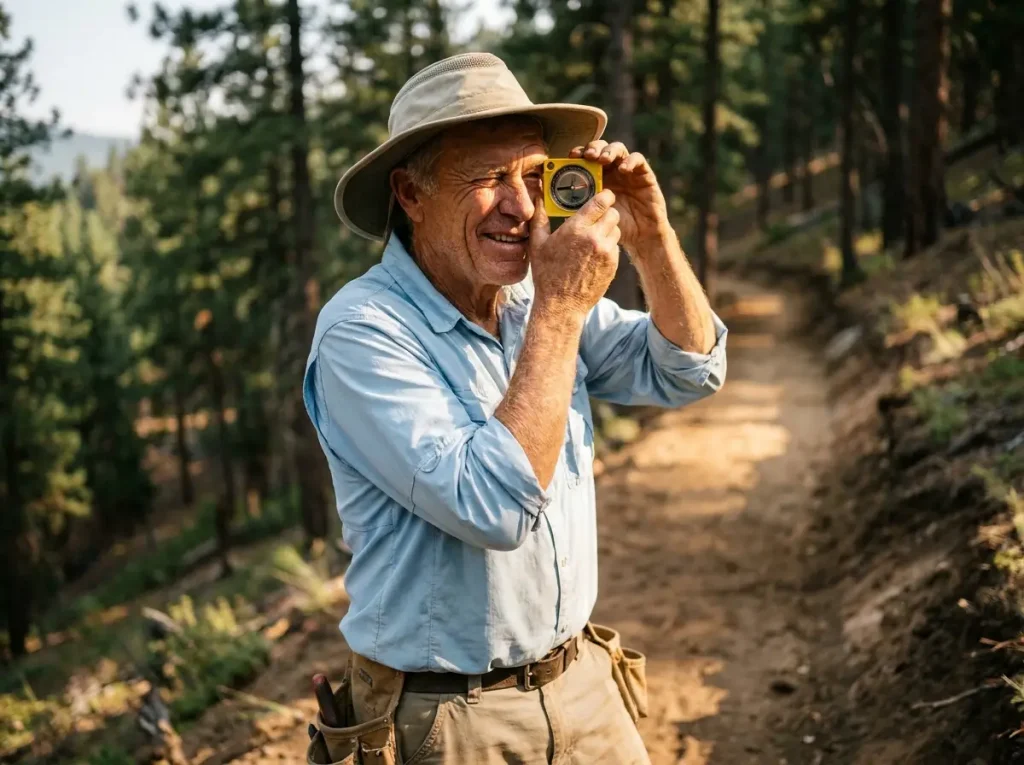
You wouldn’t guess a route’s grade without checking the guidebook. You know a mellow 5.9 feels different than a steep 5.11b. Do not guess the specific angle of a rocky hill when doing trail work either. Your tired eyes will lie to you.
Professional trail crews rely completely on hard numbers to beat falling water. They carry pocket-sized clinometers to measure exact steepness. Swinging a shovel at dirt based on what looks flat builds a weak path that fails in a month.
There are strict rules for shifting dirt. These dictate precisely how water interacts with the trail tread. Follow them, and the trail survives decades. Ignore them, and you just dig a trench. A beautifully flat walkway means nothing if the angles sit wrong; the first solid spring rain will erase it permanently.
The 10% Rule for Mellow Angles
Water attacks steep ground with terrifying speed. The golden rule in backwoods building is simple: trail crews call it the 10% rule. Your main trail grade should never exceed ten percent.
In practical terms, for every one hundred feet you casually walk forward, the path should only gain ten feet of vertical elevation. Push steeper, and gravity takes control. Erosion rates jump exponentially once you cross eleven percent.
Short, punchy step-up sections can run steeper, but they must be anchored on solid stone. Plain dirt cannot handle steep holding grades. Loose dirt needs shaping into a mellow ramp. Maintain a low baseline angle and the ground holds its shape.
The Half Rule: Beating the Hillside Grade
Another crucial requirement governs the relationship between the path and the mountain sitting under it. You must follow the half rule for trail grades. This mathematical test limits your path steepness based on the surrounding natural terrain.
When side-hilling across a slope, the path grade must always measure less than half the total hillside grade. Because surface water wants to flow straight down the mountain, if your trail sits steeper than half the hill’s steepness, water stops crossing the path and starts flowing down it instead.
Imagine traversing a heavy slope at a twenty percent angle. Your new trail cannot top ten percent. Cutting a fifteen percent trail there turns your path into a raging creek. The half rule ensures the path offers enough resistance to force water across it smoothly.
Even on trails built with perfect grades, surface water still needs to be micromanaged actively to avoid pooling and eventual collapse.
The 50-Foot Flush for Water Removal
You cannot stop falling water from directly hitting the trail surface. You only control how long it stays there. The secret to longevity is kicking water completely off the path before it gains enough speed to rip the dirt loose.
Master builders rely on the fifty-foot flush. You engineer a smart way to get water off the trail every twenty to fifty linear feet. If water runs cleanly down an open path for sixty feet, it digs huge holes and carries tons of gravel away forever.
You must interrupt the flow constantly. Small dips, sharp outsloping grades, and subtle kick-banks act as fast exit ramps for moving water. The moment the water thinks it has a clean runway, you tip the floor away safely. Frequent drainage solutions are the only working armor soft dirt has against a thunderstorm. This active drainage strategy will buy your home crag decades of access.
The 5-Minute Fixes: Low-Impact Maintenance

You do not need a twenty-person crew and a dozen shovels to make a lasting difference at the crag. Some of the most effective trail work happens in exactly five minutes on your casual hike up to the wall. You just need to know what subtle clues to look for.
These are the small things you can fix with the toe of your climbing shoe. It’s the difference between doing nothing and saving hours of sweaty dig-time later in the season. Leaving no trace means minimizing your destructive footprint while maximizing your helpful one.
Spot a heavy drainage problem early, and you solve it without heavy tools. Puddling water hands you obvious clues. Thick mud tells you exactly where the invisible drainage system is failing. A quick kick with a heavy boot can drain a puddle before it turns into a huge sinkhole.
Consolidating Your Staging Area
When your tired crew stumbles up to the crag, your first action sets the tone. Most groups drop a heavy backpack here, toss a rope bag there, and throw their food bag by a random shade tree. You just thoughtlessly covered an eighty-square-foot radius with gear.
Keep all your assorted gear firmly stacked on a single tarp. Consolidating your main staging footprint easily reduces the overall impact area by massive visible margins. Piling everything tightly in one cluster means you aren’t trampling a dozen struggling ferns every time you grab an energy bar.
This directly connects to applying the climber’s pact. Explicitly stack giant crash pads high when not actively climbing on them. Do not create a comfortable wall-to-wall foam floor just for lounging around between attempts. Use the bare minimum footprint required for the landing safely.
Berm Removal and Staying on the Tread
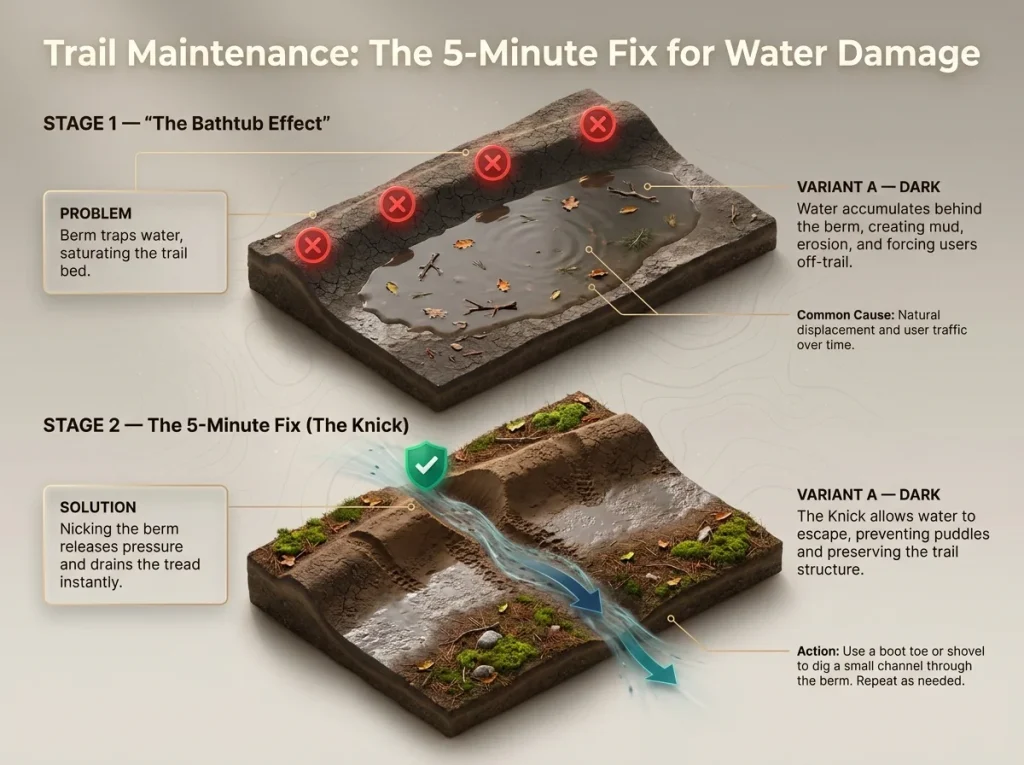
Over time, thousands of heavy footsteps push loose dirt to the outer downhill edge of the footpath. This forms a raised, hard ridge of packed dirt called a berm, acting exactly like a cement curb on a city street. It traps falling water right on the path, turning the trail into a messy bathtub.
If you see a nasty berm holding a pool of water, use your boot to kick it out of the way. Break the hard curb and kick loose dirt straight off the downhill side. This simple action lets the trapped water quickly escape and lets the trail breathe again.
When you encounter a giant mud puddle dead in the path, absolutely do not step softly around it. Walk deeply through the center. Walking along the dry outer edge wipes out bordering plants and violently widens the trail footprint. You prevent puddling from spreading by keeping the impact tight. Embrace getting your approach shoes dirty.
But sometimes stepping through the mud is not enough. You actually have to build a quick escape route for the trapped water before it destroys the track.
Nicking the Tread for Emergency Drains
If you find a long trail section actively holding a deep pool of standing water, build an emergency pressure-release valve. Trail builders call this nicking the tread. You create a temporary drain to immediately send standing water away.
Scan the puddle for the absolute lowest point sitting on the downhill edge. Grab a strong stick, sharp rock, or the heavy toe of your shoe to scrape a clean channel through the dirt lip. You do not need a huge trench. Just a subtle sloping groove about a foot wide that tips downhill.
The trapped water will immediately follow the new exit ramp, draining the entire puddle completely empty in minutes. This tiny fix, called a knick, totally stops the water from soaking deep into the trail bed and melting the hard ground from the inside out. Fixing these minor issues on your way to the wall keeps the approach solid for everyone else.
Pro tip: Always roll an orange or pour your water bottle straight down your newly dug drain to fully test it. If the rushing water flows right off the trail cleanly without stopping, you nailed it. If it jumps the edge or confusingly pools up, you need to dig deeper.
Site Hardening: When Dirt Needs Permanent Armor
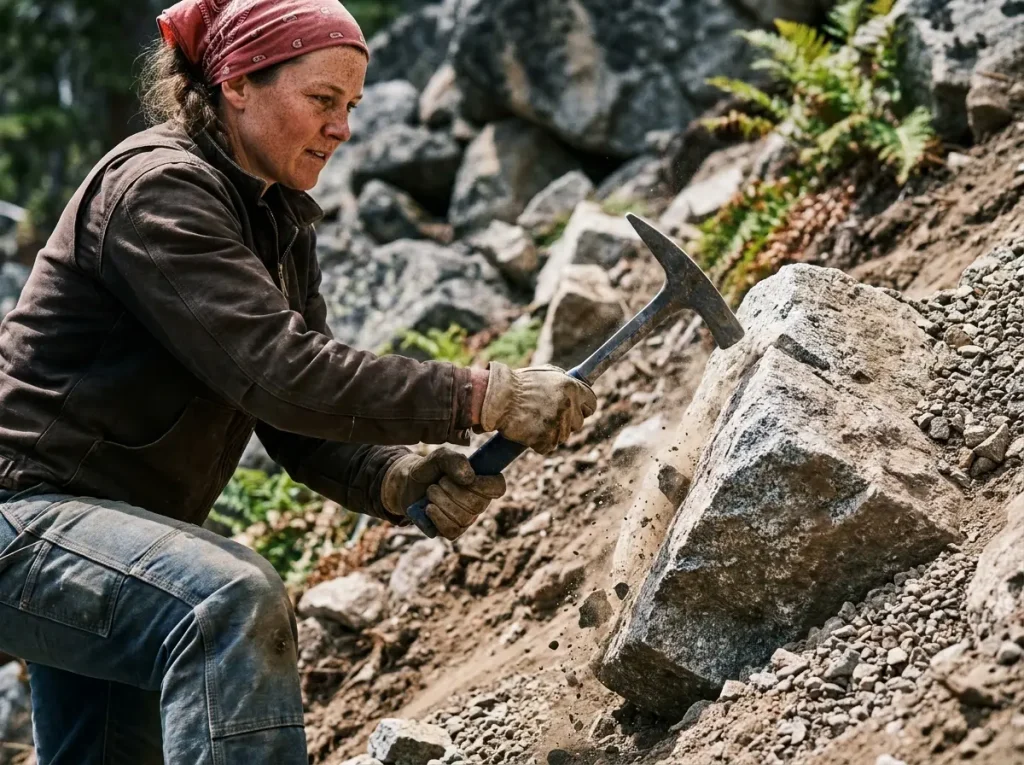
Sometimes local dirt lacks the required strength. In rough, steep sections, or directly at the base of the main climbing wall where traffic runs heaviest, plain soil will utterly fail regardless of careful drainage. This is exactly where you have to bring in heavy rock.
Expert trail builders call this grueling process site hardening. You pave the absolute worst sections with heavy, jagged stone to stabilize steep sections and create an indestructible surface that boots cannot crush and strong rain cannot wash away. Doing rock armoring best practices changes everything. But a poorly built rock staircase is just a dangerous trap waiting to collapse.
If a freshly set stone wiggles under your approach shoes today, it will slide all the way down the mountain in a month. Working effectively with stone requires insane, frustrating patience. It works just like a giant heavy puzzle. Lock stones in tightly like solid gear placements on a trad pitch.
The Tombstone Method for Rock Placement
The single biggest mistake amateur builders make is laying perfectly flat rocks right on bare ground exactly like garden pavers. Flat rocks sitting happily on a slick surface possess zero deep anchors. When an exhausted climber carrying a heavy sixty-pound haul pack steps down hard on a flat paver, the loose rock violently shoots out from under their foot like a wet skateboard.
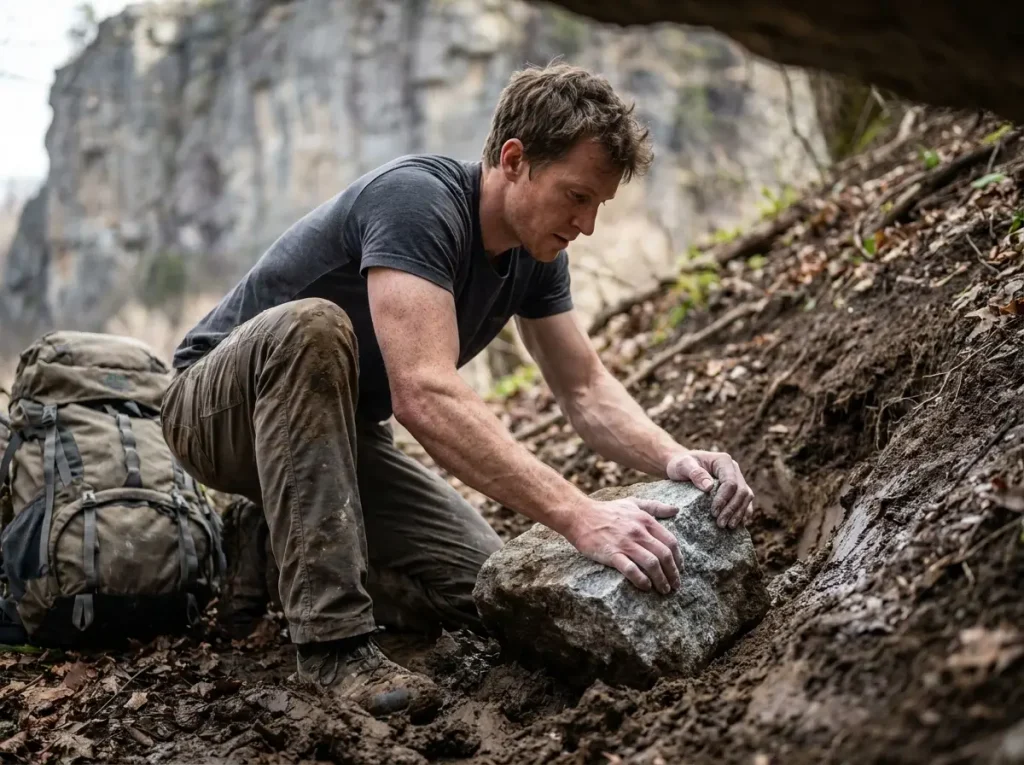
Embrace the tombstone method. Take a large, flat-ish rock and aggressively bury it vertically, tightly on its side, deep down into the firm earth. Forcibly bury at least two-thirds of the heavy rock in the ground, leaving only the very top edge safely exposed to act as the step.
Think about it exactly like a tooth sitting in a jawbone. The huge deep root prevents it from moving forward smoothly when violently kicked. Setting rock this way demands grueling, blister-inducing work. You are essentially doing full bench construction on a micro scale, requiring deep, precise holes for every heavy stone. The result creates a permanent, solid staircase.
Angular Rock Interlock vs. River Stones
Not all rocks mysteriously pull off the hard job for proper trail building. If you lazily gather smooth, round river stones from a local creek bed to build a retaining wall, it fails dramatically. Round rocks explicitly act like slippery ball bearings under heavy pressure. They relentlessly spin around and slide out when brutal weight hits them hard.
You desperately need angular, jagged, chunky rock. Seasoned trail crews call this riprap. The sharp edges and flat broken planes of angular rock create massive amounts of friction. When systematically stacked tight, rough edges aggressively bite into each other. They lock together tight, forming a single, unified, unbreakable mass.
Fully embrace “Tetris thinking.” Spend way more time pacing around searching for the rock with the absolute perfect shape than you do straining your back moving it around the hill. Rough stone should naturally slide into its tight slot like a key turning into a lock well before you grab a heavy sledgehammer to pack soft dirt tightly around it.
After moving these massive stones into position, you still have to verify the structural integrity of the ground holding them together.
The Wiggle Test and Ditch Memory
The final brutal step of any fresh rock armoring firmly involves the wiggle test. Once heavy stone sits deep in the ground, stand directly on top of it. Jump on it hard. Shift your body weight side to side. If the rock wiggles even a fraction of a millimeter, you officially fail. Pull the rock fully out, re-dig the muddy hole, and stubbornly start over.
You also have to relentlessly fight a sneaky concept named ditch memory. When you fill in an old washout trench, falling water remembers the exact route where it used to flow. It quietly moves beneath the dirt surface running as a sneaky ghost river. Shoveling loose dirt softly into a deep hole lets underground water slowly wash it all away from the bottom up.
Aggressively tamp soil with a heavy steel tool until it feels exactly as hard as a shiny gym floor. This obviously requires packing wet dirt in incredibly thin layers, crushing every microscopic air pocket fully out flat. This unyielding packing process acts as your final seal of approval.
Pro tip: When filling heavily washed-out sections, use burlap sandbags as a heavy base layer beneath the dirt. Even when the ugly fabric eventually tears slowly over time, those buried sacks firmly hold the loose soil in place long enough for deep root systems to establish permanently.
Organizing Your Crew: The Right Way to Dig
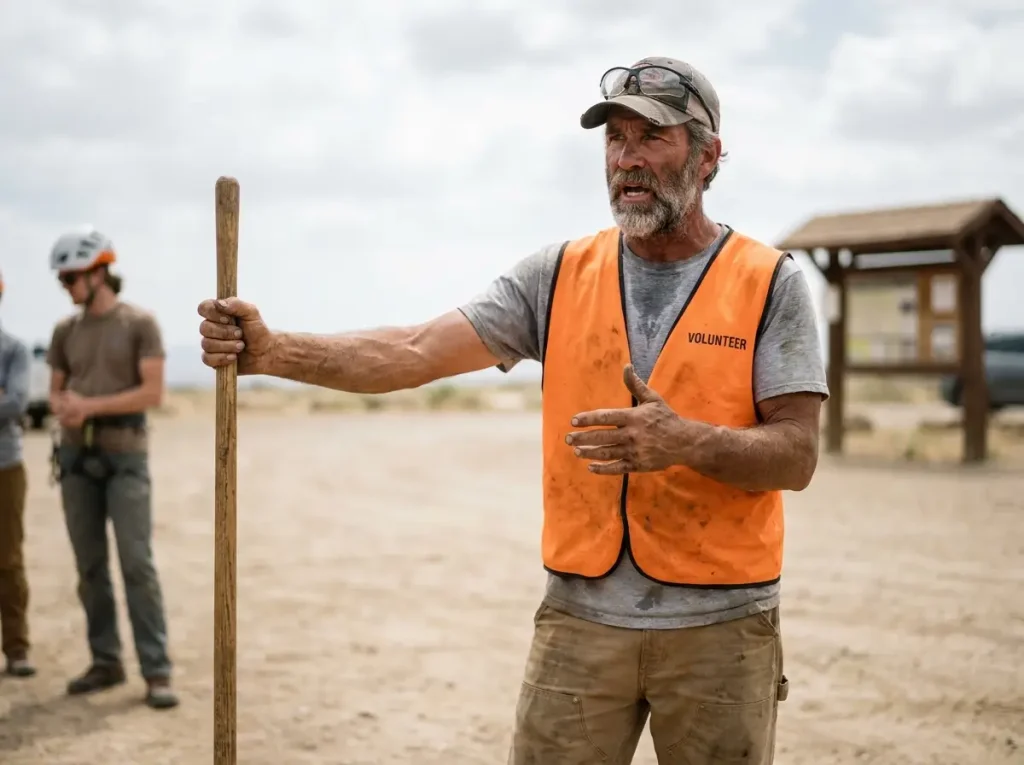
Just because you brought a heavy shovel into the woods does not magically mean you are helping. You obviously would not arbitrarily bolt a new sport route on a popular wall without politely asking the local consensus first. You should not build rogue trails completely on your own, either.
The busy outdoors requires management. Specialized park rangers and overwhelmed local forest managers oversee these precious lands. They have specific master plans. When eager climbers casually bypass the established system, the entire community pays a steep price.
Official trail maintenance volunteer groups require rigid structure, signed permits, and serious safety protocols. You cannot treat a trail day like a casual hangout where everyone hacks randomly at dirt. Proper organization makes work totally legitimate. Doing it the approved way ensures your favorite crag stays open for generations.
Why “Asking Forgiveness” Closes Crags
Many passionate climbers spot a terrible approach path, grab a heavy pickaxe on a Tuesday, and start fixing it right away. They follow the old saying: it is better to ask forgiveness than permission. In the highly political climbing access world, this stands as a totally fatal error.
Unauthorized rogue trail building completely angers stressed land managers instantly. To the law, it creates wanton destruction of public property. The absolute fastest way to get a local crag permanently shut right down is for an angry head ranger to suddenly find a renegade trail crew cutting down trees and moving huge boulders without any proper authorization.
If you stumble onto bad erosion issues, do not impulsively grab a shovel yourself. You must calmly learn how to report climbing access issues directly to the stewardship group first. Proper social trail mitigation absolutely requires extensive environmental review. Work politely within the bureaucratic system, or you massively risk losing climbing access entirely.
Partnering with Local Climbing Organizations
The correct long-term path cleanly involves working shoulder to shoulder with actual professionals. Reach out aggressively to your local climbing organization or advocacy groups to help decoding climbing access and threats. These big groups already securely hold critical relationships with the USDA Forest Service and touchy local land managers.
Established organizations regularly host official permitted Adopt-a-Crag days. They systematically secure hard permits, provide proper cutting tools, and bring in master trail builders to safely direct heavy labor. You simply provide willing muscle; they provide strict legal cover and brilliant engineering expertise.
Working patiently through these official channels virtually guarantees your incredibly hard work will actually last. It strongly builds much-needed trust with chronically nervous, over-worked land managers. It solidly shows them dedicated climbers function reliably as responsible stewards practicing real volunteer ethics, not as chaotic rogue operators. Deep official partnerships keep entry gates unlocked.
Once you hit the organized trail day, the focus shifts entirely from local politics to raw physical safety on the hilside.
The Safety Circle for Tool Handling
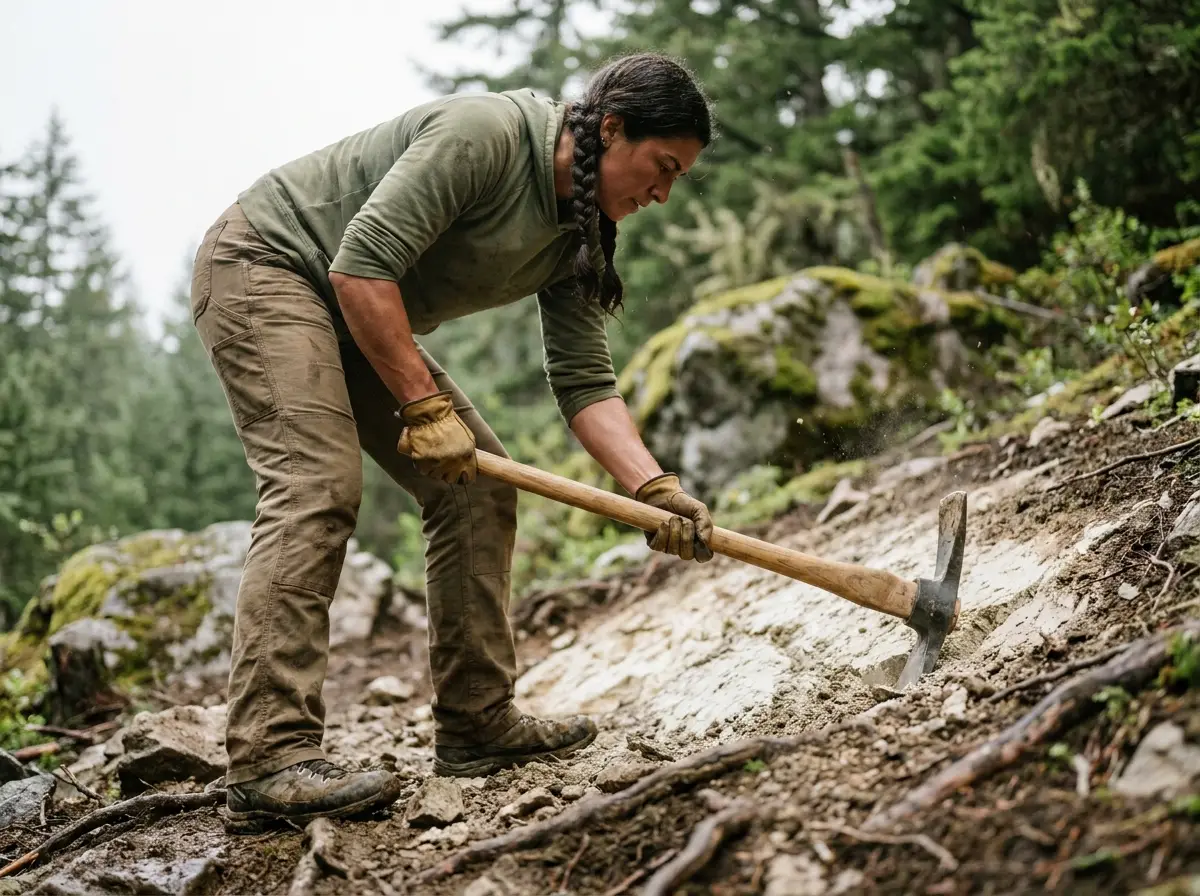
When you finally land on a legitimate official trail crew, you handle incredibly heavy, dangerous tools all day. A heavy Pulaski or sharply honed McLeod axe swings downward with actual force that can snap a leg. You must heavily respect the safety circle.
This refers specifically to the ten-foot safety perimeter strictly drawn around you whenever you swing a heavy tool. Right before swinging a rusty pickaxe, look completely around yourself. If another person, a loose dog, or a tired fellow volunteer stands closely inside your safety circle, you abruptly stop working completely immediately. Yell “Clear!” loudly and wait for them to shuffle away.
Also, fiercely protect your cracking joints to gracefully avoid pulling a tendon doing trail work. Trail work destroys tired elbows and bad shoulders. Do not swing a heavy mattock straight using strictly just your tired arms. Cleverly use your wide hips and thick legs to smoothly generate lifting power, letting heavy gravity drop the nasty tool blade straight down into firm earth.
Conclusion
Water always wins the long fight against dirt, but understanding the tricky fall line and utilizing incredibly smart site hardening puts the odds firmly back squarely in our favor. Carry your bouldering pads instead of dragging them, use the ten percent grading rule to keep sharp angles safely in check, and permanently armor the busy staging zones heavily. We actively save the precious structural integrity of the crag when we work wisely. Above all, tightly coordinating with your local organization firmly keeps everything totally protected, officially permitted, and totally legitimate. Let’s make sure trad ethics and crag care goes beyond just leaving no trace.
Check the busy schedule for the next official stewardship day happening at your home crag, pack some tough leather work gloves, and go move some dirty rock. You’ll never look at a steep approach trail exactly the same way ever again.
FAQ
How do you stop trail erosion?
Getting water off the path frequently stops trail erosion. Grade reversals, outsloping, and rock armoring ensure that rushing rainwater crosses the winding trail rather than destructively flowing straight down the middle of it.
What is the best material for a walking trail?
Angular, irregular heavy stone ranks lightyears ahead of any slick wood or soft soil. Huge, angular rocks bite into one another, creating massive friction that easily locks the path together tightly.
What are the 5 Ds of heavy trail maintenance?
The crucial 5 Ds instruct dedicated trail builders to Divert, Disrupt, Disperse, Dissipate, and Drain surface water. Every single piece of complex rock work aims deliberately at accomplishing one of these vital actions.
Should I step over mud puddles on an approach trail?
No, always firmly choose to walk straight through the mud to protect the established trail footprint. When climbers step around a puddle, they trample delicate green plants, instantly causing trail braiding that permanently widens the path.
Safety Notice: Rock climbing and mountaineering are inherently high-risk
activities that can involve physical trauma or fatal incidents. The information on Rock Climbing Realms is for
educational and informational purposes only. Techniques and advice presented here are not a substitute
for professional, hands-on instruction. Conditions and risks vary by location. Always seek guidance
from a qualified instructor before attempting new techniques. By using this website, you agree that you
are solely responsible for your own safety. Any reliance you place on this information is strictly
at your own risk, and you assume all liability for your actions. Rock Climbing Realms and its authors
will not be held liable for any harm, damage, or loss sustained in connection with the use of this information.
Affiliate Disclosure: We are a participant in the Amazon Services LLC Associates Program, an
affiliate advertising program designed to provide a means for us to earn advertising fees by advertising and linking
to Amazon.com. As an Amazon Associate, we earn from qualifying purchases. We are also an official affiliate partner
of Black Diamond Equipment via the AvantLink network. If you click on a Black Diamond affiliate link and make a
purchase, we may earn a commission at no additional cost to you. We also participate in other affiliate programs.
Additional terms are found in the terms of service.