
In this article
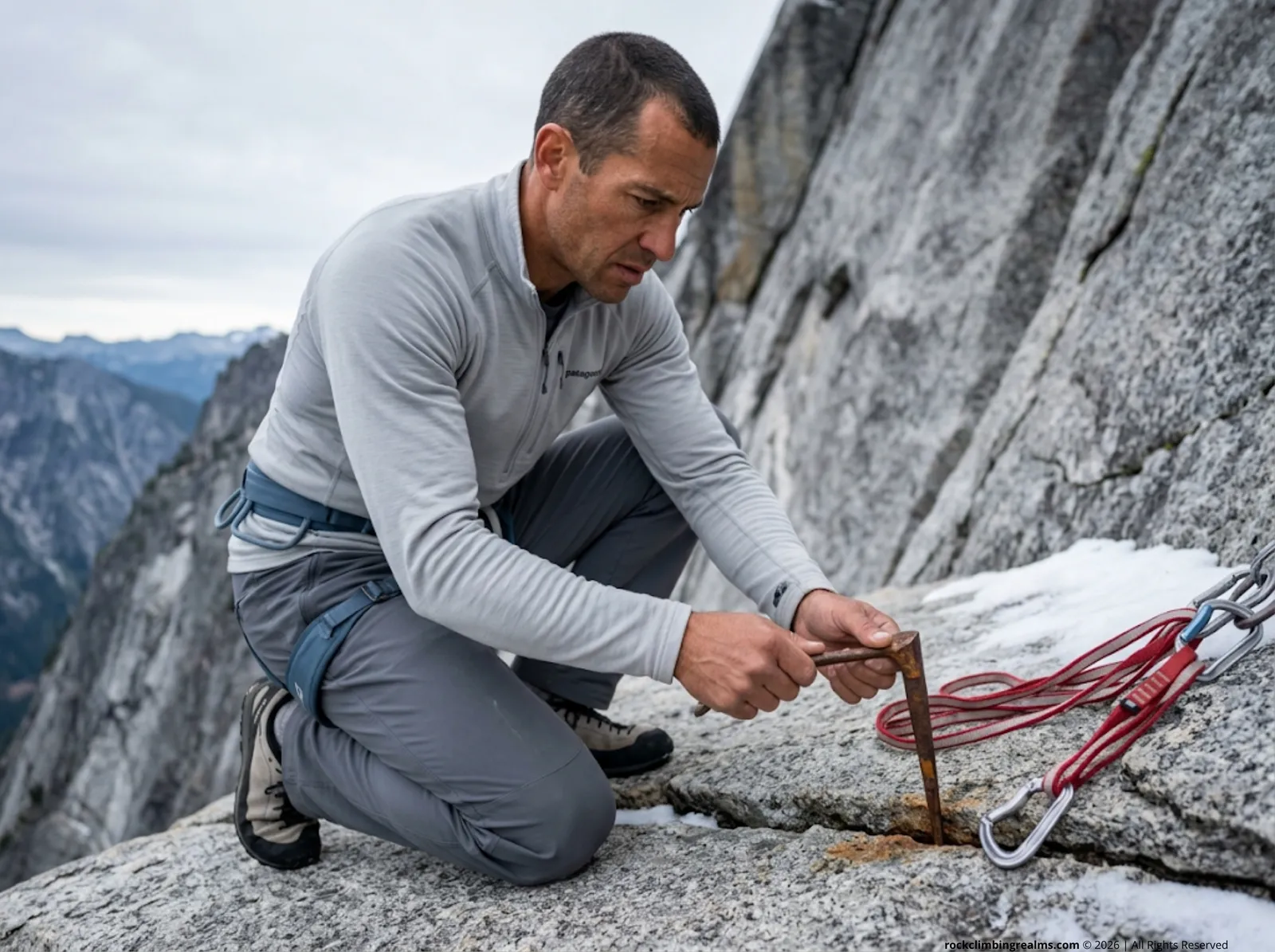
The piton was in the rock. A little rust, sure — pitons always look that way after a season in the Cascades. Four climbers clipped in. The first one weighted the system, and in less time than it takes to exhale, all four were gone. Four hundred feet of granite, one corroded angle iron, and the North Early Winters Spire claimed three lives in May 2025. I’ve been rigging anchors for over two decades. That report still made me sit down.
The worst part? Every failure pattern in that accident had been documented before. The single point of attachment. The deference to the most experienced person in the group. The twelve-hour day grinding down decision-making. None of it was new. The physics never are.
What follows is the course curriculum I wish existed before that day.
⚡ Quick Answer: Climbing anchor failures almost never come from a single cause. They follow a chain of error — bad geometry multiplies forces, material degradation reduces rated strength, weak substrate turns hardware into a lever, and human factors let it all slide past unchallenged. Keep anchor angles under 60° (hard limit at 120°), treat coastal and tropical stainless bolts as suspects regardless of age, build redundancy into the rock mass not just your placements, and slow down at every belay-to-rappel transition. That’s the short version. The long version is below.
The Physics of Force: Why Geometry Fails Before Hardware Does
Most climbers know angles matter. Few actually know by how much.
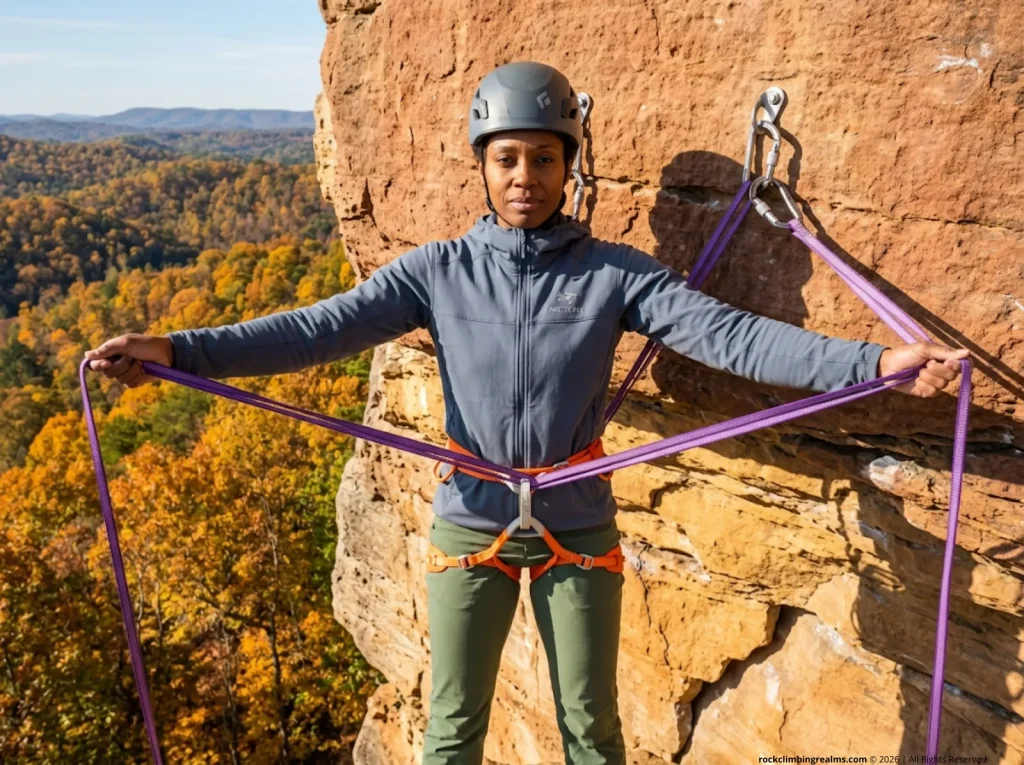
Anchor point force scales with the internal angle at the masterpoint in a way that feels almost unfair. At 0° — legs perfectly parallel — each point takes exactly 50% of the load. At 60°, you’re at 58%. Still reasonable. At 90°, each point holds 71% of the total load, which is why guides treat this as the practical upper limit for comfortable rigging.
Then it gets ugly fast.
At 120°, the critical angle, redundancy is mathematically dead. Each point is holding 100% of the load — the same as if the other piece wasn’t there. At 150°, each point takes 193%. At 170°, a 70kg climber generates forces on each bolt that exceed 5 kN from geometry alone, before you’ve added fall factor or system dynamics. The physics don’t care that your bolts are rated 25 kN.
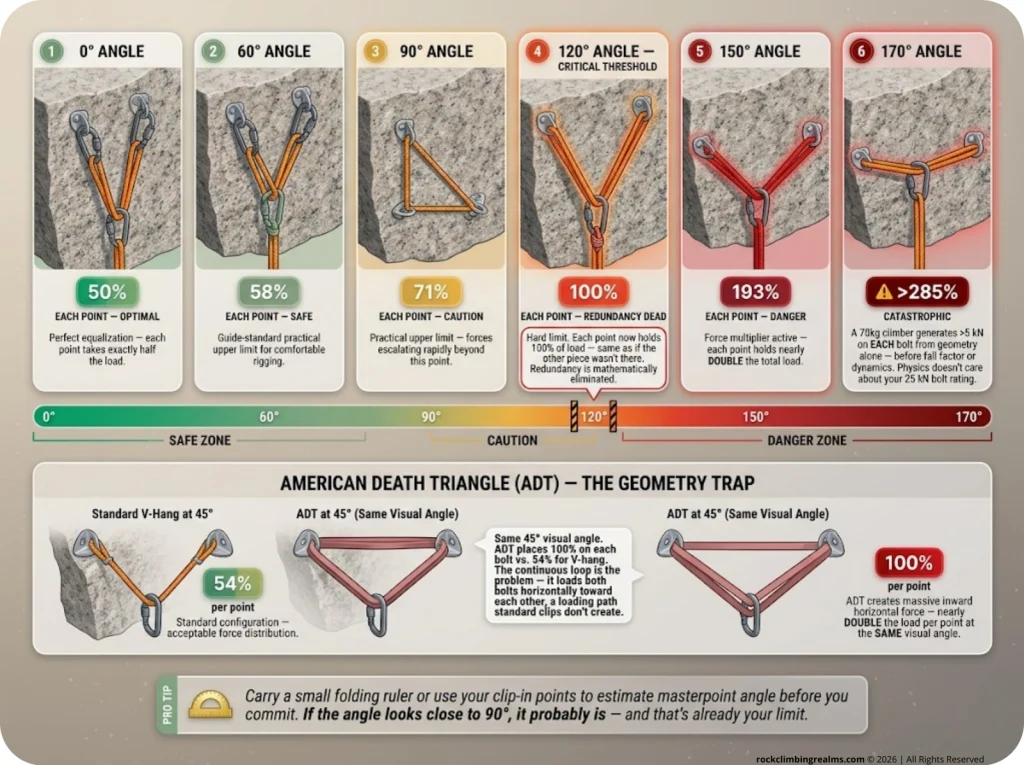
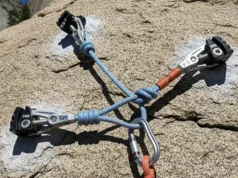
This is where building a SERENE/ERNEST trad anchor stops being academic and starts being a matter of survival. The “E” in SERENE — equalization — is the geometry problem. If you’re not actively measuring or estimating your masterpoint angle, you may be building a force multiplier disguised as a safety system. According to the UIAA’s anchor failure warning documentation, rigging angles above 90° represent a significant reduction in real-world system safety margin — a threshold most climbers routinely exceed without realizing it.
The American Death Triangle is the most well-documented example of this. At a visual angle of only 45°, the ADT places roughly 100% of the load on each bolt. A standard V-hang at 45° places 54%. That gap doesn’t come from poor materials or bad rock. It’s pure geometry — the continuous loop creates massive inward horizontal force on both anchor points simultaneously, a loading path that standard clip-in anchors don’t create.
The first time I actually ran these numbers on a route with a protractor, I stopped trusting anchors that “looked fine.” Eyeballing angle at the masterpoint is a confidence game, not a safety system.
Pro tip: Carry a small folding ruler or use your clip-in points to estimate masterpoint angle before you commit. If the angle looks close to 90°, it probably is — and that’s already your limit.
The detached block problem cuts even deeper. In “The Bulge” accident, three cams placed in a single basalt crack achieved piece redundancy on paper. The climbers had three pieces of gear. What they didn’t have was feature redundancy — the entire pillar was a detached block, and each cam acted as a lever prying the crack wider under load. The whole thing shifted. Three points of gear, one catastrophic failure. Tap the rock. Listen for hollow. If you can’t trust the rock mass, you don’t have an anchor.
Metallurgical Failure: The SCC Pandemic Climbers Ignore
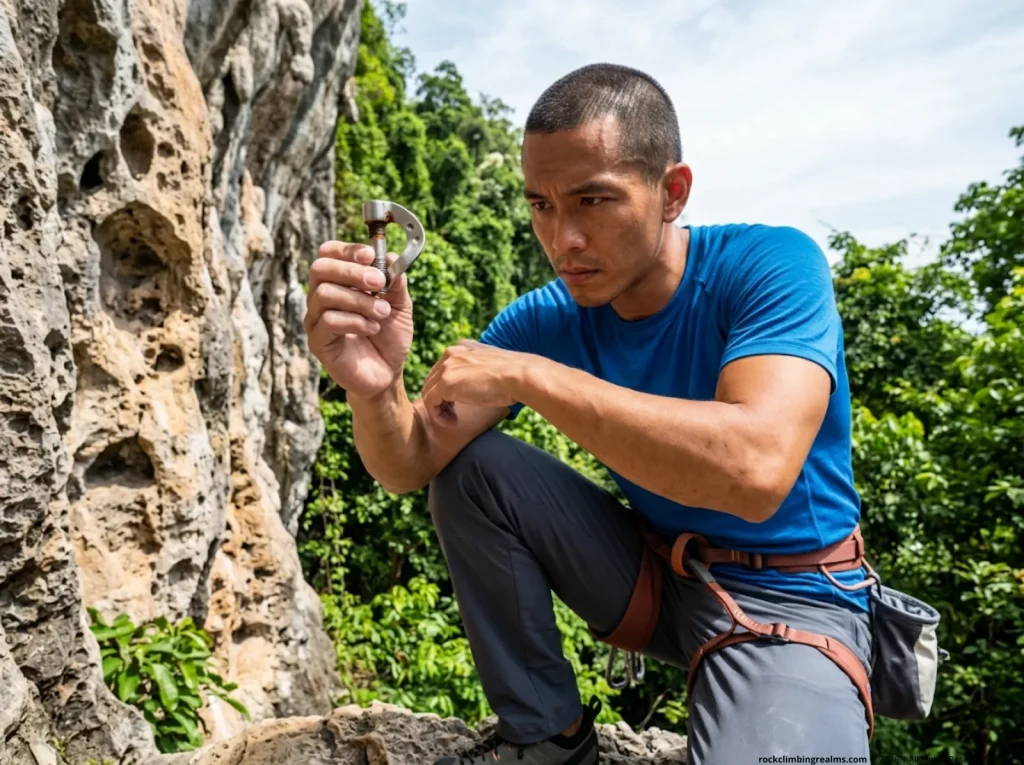
I once pulled a bolt hanger off a Thai limestone face with my fingers. The bolt was rated 25 kN. It had been in the wall for 14 months.
Stress Corrosion Cracking is a brittle failure mode in metals that are otherwise ductile under normal conditions. It requires three things happening simultaneously: tensile stress (provided by bolt expansion or static load), a corrosive environment (chloride ions from sea air), and a susceptible alloy (standard 304 stainless steel or 316 stainless steel). Take away one factor and SCC stops. In coastal and tropical climbing areas, all three are present year-round.
The UIAA Safety Commission has documented that up to 20% of anchors in tropical marine environments can fail under loads of 1–5 kN — barely the weight of a climber stepping onto a ledge. The 9-month failure window is the number that rewrote everything. Documented cases of 316L bolts in tropical areas fracturing under sub-rated loads within less than a year of installation. That destroyed the “stainless is permanent” story that generations of climbers grew up with.
The worst part of SCC is what it doesn’t look like. No visible corrosion. No cracking you can see. No hanger movement under lateral pressure. The bolt passes a visual inspection hours before it fails. The UIAA SafeCom report on marine anchor failure documents this with data from the Dominican Republic: bolts rated 22 kN failing at under 3 kN after 11 months. Eleven months. One season.
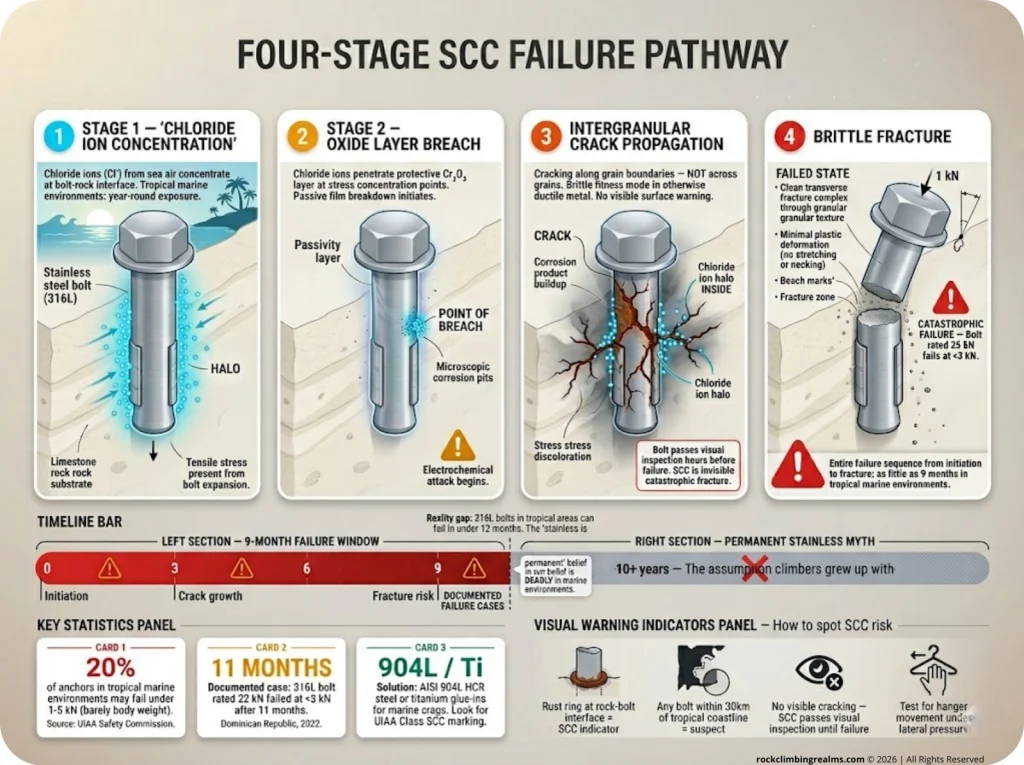
If you climb Railay Beach, Ton Sai, Koh Yao Noi, the Dominican Republic, or any marine limestone crag within 30 km of coastline, you need to understand what UIAA safety standards and corrosion classifications actually require. Under UIAA Standard 123 (V5.0, 2025), stating “316L” on a hanger is no longer sufficient for safety labeling. Anchors must be tested as full assemblies — hanger, bolt, nut, and washer — because installation torque itself can damage the protective oxide layer and initiate SCC at the bolt-rock interface.
The current solution for high-risk areas is AISI 904L HCR steel or titanium glue-in anchors. Standard 316L is not sufficient for marine crags. Look for the UIAA Class SCC marking. No marking in a tropical environment is a rejection criterion.
Bring your own draws to sport crags in marine areas. Do not clip the fixed anchor directly. Back it up with your gear until you’ve assessed the bolt age and installation context. Your climbing gear lifespan and inspection criteria framework should account for environmental exposure, not just years of use.
Pro tip: When checking bolts abroad, look for ring-shaped corrosion at the rock surface around the bolt shaft. That pattern — a rust ring where the bolt exits the rock — is the telltale surface indicator of SCC initiation, even if the hanger looks fine.
Geological Substrate Failure: When the Rock Itself Is the Anchor
The hardware rating on your bolt means nothing if the rock can’t support the failure cone.
When a bolt is loaded axially beyond what the surrounding rock can handle, it doesn’t pull the bolt out — it pulls a cone of rock out with it. Standard civil engineering assumes a 90° apex angle of failure cone. Field testing in limestone and weak sandstone has consistently found actual apex angles of 125–142°. Shallower, wider craters. Which means adjacent placements can share the same failure cone, effectively creating a single point of failure from two pieces of gear.
The embedment depth relationship is punishing: reducing from 100mm to 50mm doesn’t halve the pull-out resistance. It reduces it by roughly 75%. A bolt that holds 55 kN at full depth holds around 13.7 kN at half depth in certain sandstone samples. In granite, compressive strength runs 150–250 MPa and failure is almost always hardware-limited. In weathered limestone, and in desert sandstone like Wingate or Navajo formation, the rock is the weak link.
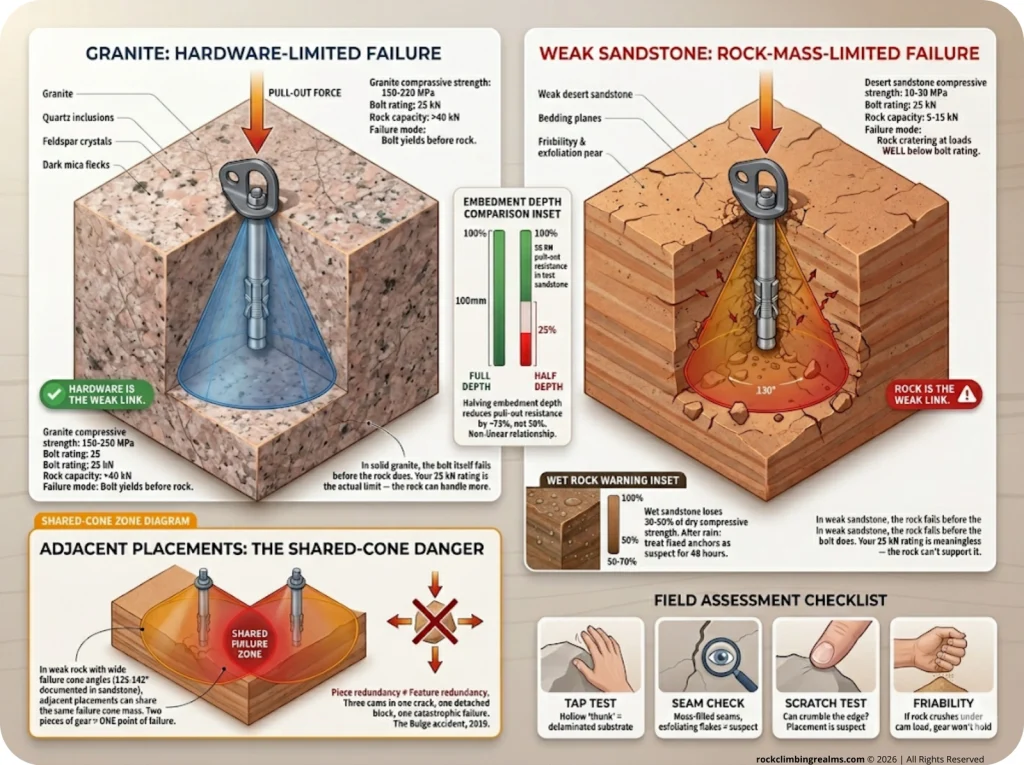
Desert sandstone has compressive strengths as low as 10–30 MPa. Under radial load, the hole edge crushes first, increasing the moment arm on the bolt shaft and accelerating crater formation at loads well below the bolt’s tensile rating. The ResearchGate study on anchor pullout strength in sandstone documents this prying failure mode in detail.
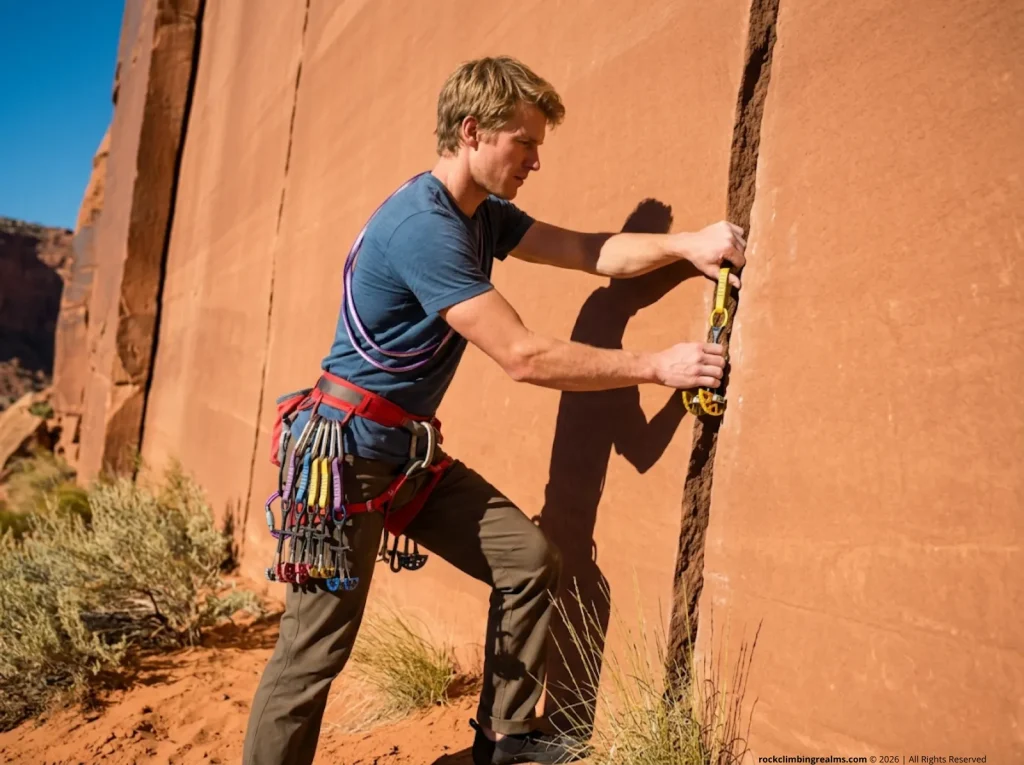
I once placed a bomber-feeling .75 cam in Indian Creek sandstone that I could extract by hand after a single fall. The rock crushed at the lip of the placement. The cam was fine. The rock wasn’t.
The wet rock rule makes this worse: saturated sandstone loses 30–50% of its dry compressive strength. After rain at desert crags, treat fixed anchors as suspect for 48 hours. Even on sport routes.
The field assessment is low-tech. Tap the rock near the bolt. A hollow “thunk” means delaminated or jointed substrate. Look for moss-filled seams, exfoliating flakes, crystals you can scratch with a fingernail. In trad placements, assess crack walls for friability. If you can crumble the edge, that placement is suspect. Understand how rock type determines protection choice before you build anything you’d trust with your life.
Case Studies in the Chain of Error: When Human Factors Complete the Failure
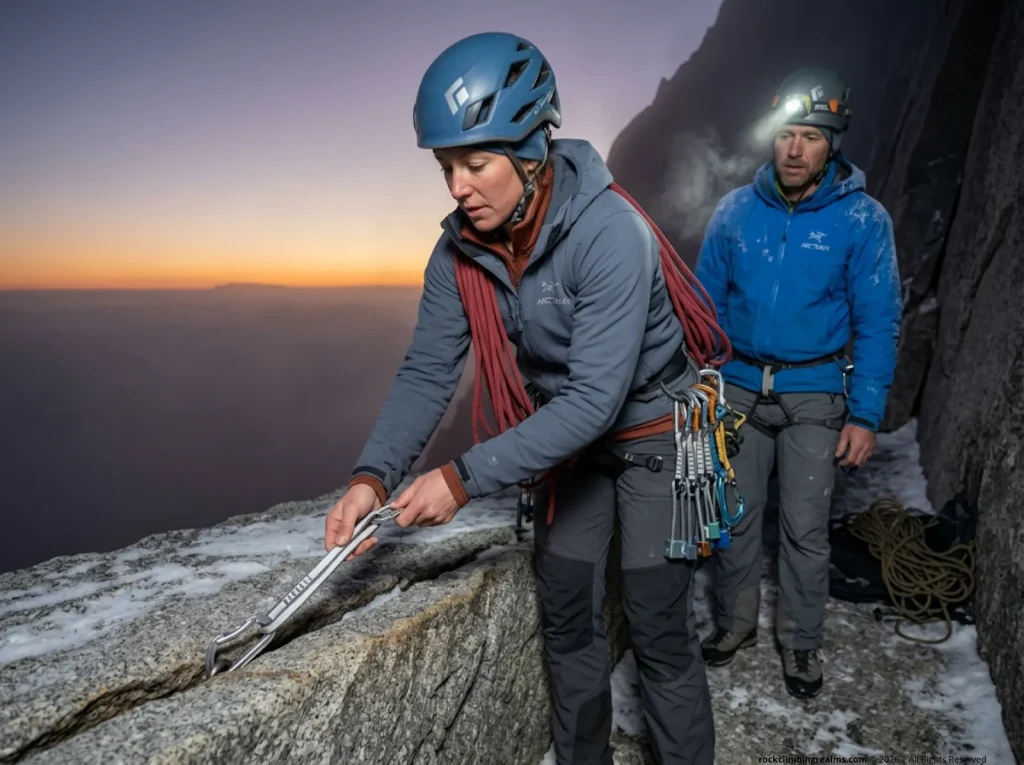
Technical knowledge does not confer safety. The American Alpine Club’s data from 1948 to 2024 shows that 43% of climbing accidents involve experienced climbers. Read that again. Nearly half the people getting hurt had the skills. What they ran out of was the discipline to use them under pressure.
The North Early Winters Spire accident in May 2025 is the clearest recent example. Party of four, fourth rappel, deteriorating weather, twelve hours on the mountain. The anchor: a single angle piton, moderate rust, all four climbers clipped in via two slings. Every textbook error stacked in one decision. The piton pulled cleanly from the rock. Three people did not make it down.
The USFS report noted that a 120-meter single-strand rappel using both ropes could have bypassed that station entirely — but it would have meant leaving the ropes on the mountain. The group had the option. They chose speed. The AAC analysis of human factors in climbing accidents documents the exact psychological sequence: decision fatigue from the long day, expert halo (the group deferred to the most experienced member without questioning the lack of redundancy), and environmental pressure from the incoming weather.
The scariest anchor I ever built was the one I was most confident in. Fourteen hours into a route, I set up what felt like a bomber three-cam system — and then caught myself before clipping in. Two of three cams were in the same crack feature. Piece redundancy, zero feature redundancy.
The 2019 Chimney Canyon accident adds a different layer — the physics of shock loading a static system. The Grigri was positioned 4–8 feet from the anchor pieces at the ground level. Slack accumulated. A fall of only a few feet in a static rope system with Dyneema slings generates a fall factor approaching 1.0 and impact forces of 10–12 kN. The Link Cams were damaged beyond their mechanical limits before the rock failed. A 60-liter backpack placed under the anchor to protect the rope inadvertently shifted the vector of pull on the cams — the backpack factor as it’s now known in forensic climbing analysis.
The zipper effect is what follows: the first piece shock-loads beyond capacity, the entire load transfers instantly to the remaining pieces, and they fail sequentially. The system was never rated for that load path.
Pro tip: When setting up a ground anchor for top-rope, the belay device must be positioned to absorb shock — not to create slack. Grigri placement 4–8 feet below the masterpoint creates an invisible fall factor problem that most climbers don’t calculate until it’s over.
Risk normalization is the cognitive foundation of most anchor fatalities. “We’ve done it this way ten times and it worked” is how experienced climbers end up trusting single-point anchors. The physics of a fall are not counting your past successes. A system that holds body weight is not a system that will handle a dynamic fall. Feed the Swiss Cheese Model of climbing accident causation into your pre-climb thinking — every hole in your system lines up with a hole in someone else’s, and you get the accident corridor. And anyone in the party — at any experience level — should have a standing invitation to call a stop and demand a system review. The most common rappelling accidents and how complacency drives them follow this pattern without exception.
Ice Anchors and Thermal Forensics: The 90-Minute Warning
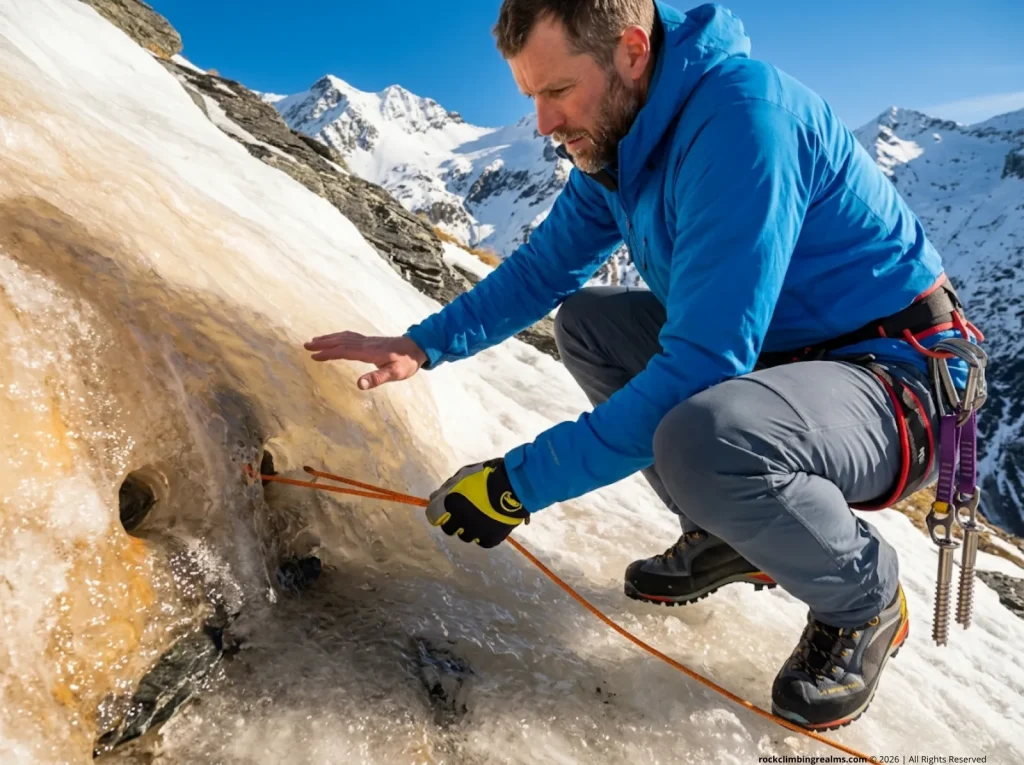
“The Canadian standard” of leaving V-threads for weeks is physically impossible at mid-latitude ice climbing venues. I’ve pulled V-threads at the end of a pitch and had the cord come free before I even pulled it — the ice tunnel had melted around it.
The Alta Ice Anchor Failure at the Remarkables Ice and Mixed Festival in New Zealand (2022) is the forensic baseline. An equalized double V-thread in thin waterfall ice over dark bedrock. Ambient temperature: -2 to 0°C. The anchor failed under static loading 1.5 hours after installation.
The mechanism is counterintuitive. Solar radiation delivers energy in the infrared spectrum. Dark volcanic bedrock has albedo values of 0.05–0.15 — it absorbs 85–95% of incoming solar radiation. When ice is less than 1 meter thick, that absorbed heat conducts through to the ice anchor interface in 30–60 minutes of direct sun exposure. The air stays cold. The ice melts from the inside. The RIMF 2022 Alta ice anchor failure accident report documents the complete failure sequence.
Mid-latitude climbing areas — New Zealand, Patagonia, continental USA — receive more intense solar radiation per unit than high-latitude venues like Alaska or Norway. This counterintuitively makes them more hazardous for ice anchors, not less.
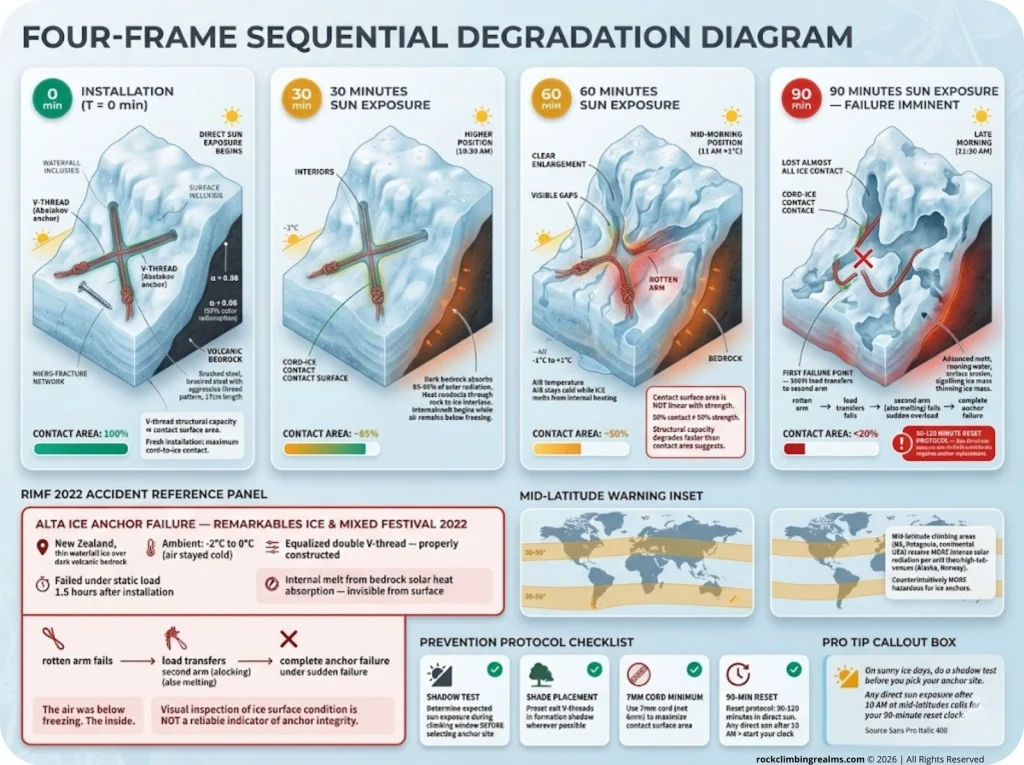
The V-thread’s structural capacity is proportional to the contact surface area of the cord against the ice tunnel walls. Any melt reduces that area — and the relationship is not linear. In the RIMF accident, the “rotten” arm of the V-thread failed first, shifting 100% of the load to the second arm, which was also actively melting. Sequential failure from a single thermal source.
The reset protocol is 90–120 minutes in direct sun. Use 7mm cord (not 6mm) to maximize contact surface area. Preset exit V-threads in the shade of the formation wherever you can. For building snow and ice anchors that won’t rip out, shade placement is the most undervalued variable in the entire protocol.
Pro tip: On sunny ice days, do a shadow test before you pick your anchor site. Determine expected sun exposure during your climbing window. Any direct sun exposure after 10 AM at mid-latitudes calls for your 90-minute reset clock.
Soft System Failures: Slings, Cords, and the Hidden Aging Crisis
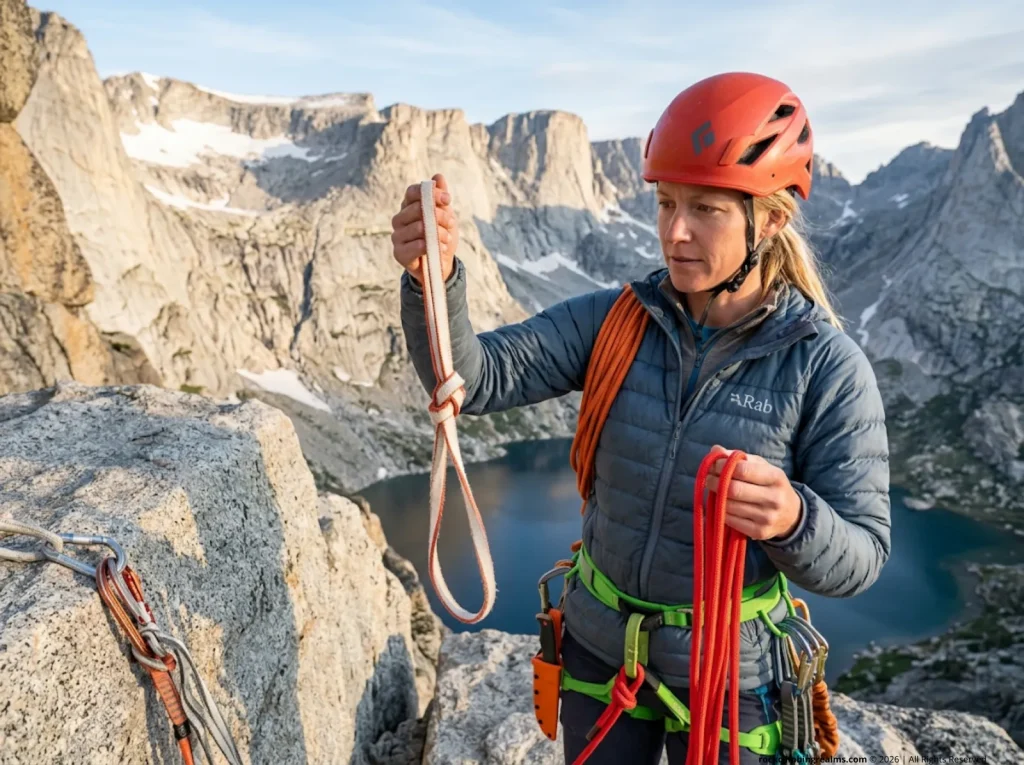
I’ve seen slings at the top of popular sport routes that were bleached white from their original red. That’s not sun fading — that’s catastrophic UV exposure. We replaced them with a cordelette from the rack before we rapped.
UV radiation breaks down polyamide and polyester fibers by cleaving polymer chains. A nylon sling rated at 22 kN new can degrade to 11 kN or below after a single season of UV exposure at altitude above 3,000 meters. No visible surface damage. No tactile change. The AAC rappel anchor failure report: aging slings and cords documents three rappel fatalities in 2022 alone attributed to failed aging slings or cords.
The Wolfs Head accident (Cirque of the Towers) is the definition of hidden failure. The cordelette “looked good.” It was the section wrapped around the back of the sandstone block — invisible, UV-degraded, thermally cycled to brittleness — that failed on first loading.
Fixed rappel tat has an unknown history in every dimension: age, previous loading, UV exposure, abrasion cycles. The UIAA recommendation treats any anchor tat of unknown age as structurally compromised. Carry 30–40 feet of 7mm cord and a knife. Leave your own material.
The auto-locking carabiner guillotine effect is less understood. Auto-lockers have sharper interior gate edge profiles than non-lockers — a design tradeoff for gate security. On unattended top-rope anchors where the rope runs over the masterpoint, axial twisting forces the rope against this interior edge. Under load, it becomes a shearing interface. The Devils Lake case documented an auto-locker at the masterpoint cutting completely through a rope sheath during a top-rope session. The physics of shock loading in dynamic vs. static anchor systems apply directly: when the system loads, rope-against-edge geometry becomes a blade.
Don’t use an auto-locker as the sole masterpoint on an unattended top-rope anchor. Use a large smooth-gate non-locker with a separate locking backup, or a dedicated chain system. Check how to audit and build a safe rappel anchor for the full protocol — every step of which applies to fixed tat assessment.
Conclusion
Three things. That’s what this dossier comes down to.
First: geometry is the primary load multiplier. Every anchor you build has an angle. That angle determines whether you have a safety system or a force amplifier. Keep it under 60°. Treat 120° as a hard failure limit. Don’t estimate it — verify it.
Second: your hardware is degrading right now. UV exposure, stress corrosion cracking, metal fatigue, thermal cycling, and abrasion work continuously and invisibly. The rating stamped on your gear reflects factory-fresh performance. Not what it delivers after a season on a coastal crag. Apply systematic gear audit and retirement criteria to everything that loads your system.
Third: human factors are the final link in the chain. No anchor fails in a vacuum. Every catastrophic failure in the forensic record involves at least one human decision made under fatigue, time pressure, or deference to authority. Complacency is the most hazardous thing you carry on your harness. Slow down at transitions, question everything, and speak up — regardless of seniority.
Before your next multipitch, run the angle test on your anchor stations. Physically verify the masterpoint angle. If it’s over 90°, rebuild it. Do it once per anchor, for every anchor, for the rest of your climbing career. That single habit is the most actionable thing this article can produce.
Now go send something.
FAQ
How often do climbing anchors actually fail?
Hard failure rates are difficult to aggregate globally, but UIAA data shows up to 20% of fixed anchors in tropical marine environments may be compromised enough to fail under 1–5 kN — barely body weight. Across all environments, the AAC’s annual accident database consistently shows anchors as a contributing factor in 15–25% of serious climbing accidents, with most failures combining material degradation and at least one human error.
Can a single bolt hold a fall?
Yes — under ideal conditions. A new UIAA or EN 959-rated bolt in solid rock is rated for a minimum 25 kN axial pull-out force, and most quality placements exceed that. The problem is compounding variables: SCC, improper anchor geometry, or weak substrate integrity can reduce real-world holding power to 2–5 kN. A single bolt with no backup is a bet that every variable is simultaneously ideal. It never all is.
What is the American Death Triangle and why is it hazardous?
The ADT is a configuration where a loop of cord or webbing is threaded through two anchor points with the masterpoint clipped to the bottom strand — a continuous loop. It lacks true redundancy and creates massive inward horizontal force on both anchor points simultaneously. At a visual angle of only 45°, the vector force profile mimics a standard V-hang at 120°, placing nearly 100% of the load on each bolt. Its problem isn’t just how it looks — it’s what happens under load.
How do I identify a bolt I shouldn’t trust?
Four red flags: ring-shaped corrosion around the bolt shaft at the rock surface (SCC indicator); any hanger movement under manual lateral pressure; hollow-sounding rock when you tap around the bolt base; and geographic context — any bolt within 30 km of coastline in a tropical or subtropical region should be treated as suspect regardless of visual condition. Bad bolt identification starts with these four checks before you clip anything.
Why do most anchor failures happen during descent, not the climb?
Because descent is when every compounding failure factor converges: maximum physical fatigue, maximum cognitive load, active system transition — you’re dismantling a safe belay to rig a rappel — and the psychological relief of almost done. Your risk-assessment capability is lowest exactly when you need it most. A mandatory pre-rappel checklist, run cold and out loud, regardless of how tired or rushed you feel, is the single most effective behavioral change you can make.
Safety Notice: Rock climbing and mountaineering are inherently high-risk
activities that can involve physical trauma or fatal incidents. The information on Rock Climbing Realms is for
educational and informational purposes only. Techniques and advice presented here are not a substitute
for professional, hands-on instruction. Conditions and risks vary by location. Always seek guidance
from a qualified instructor before attempting new techniques. By using this website, you agree that you
are solely responsible for your own safety. Any reliance you place on this information is strictly
at your own risk, and you assume all liability for your actions. Rock Climbing Realms and its authors
will not be held liable for any harm, damage, or loss sustained in connection with the use of this information.
Affiliate Disclosure: We are a participant in the Amazon Services LLC Associates Program, an
affiliate advertising program designed to provide a means for us to earn advertising fees by advertising and linking
to Amazon.com. As an Amazon Associate, we earn from qualifying purchases. We are also an official affiliate partner
of Black Diamond Equipment via the AvantLink network. If you click on a Black Diamond affiliate link and make a
purchase, we may earn a commission at no additional cost to you. We also participate in other affiliate programs.
Additional terms are found in the terms of service.