
In this article
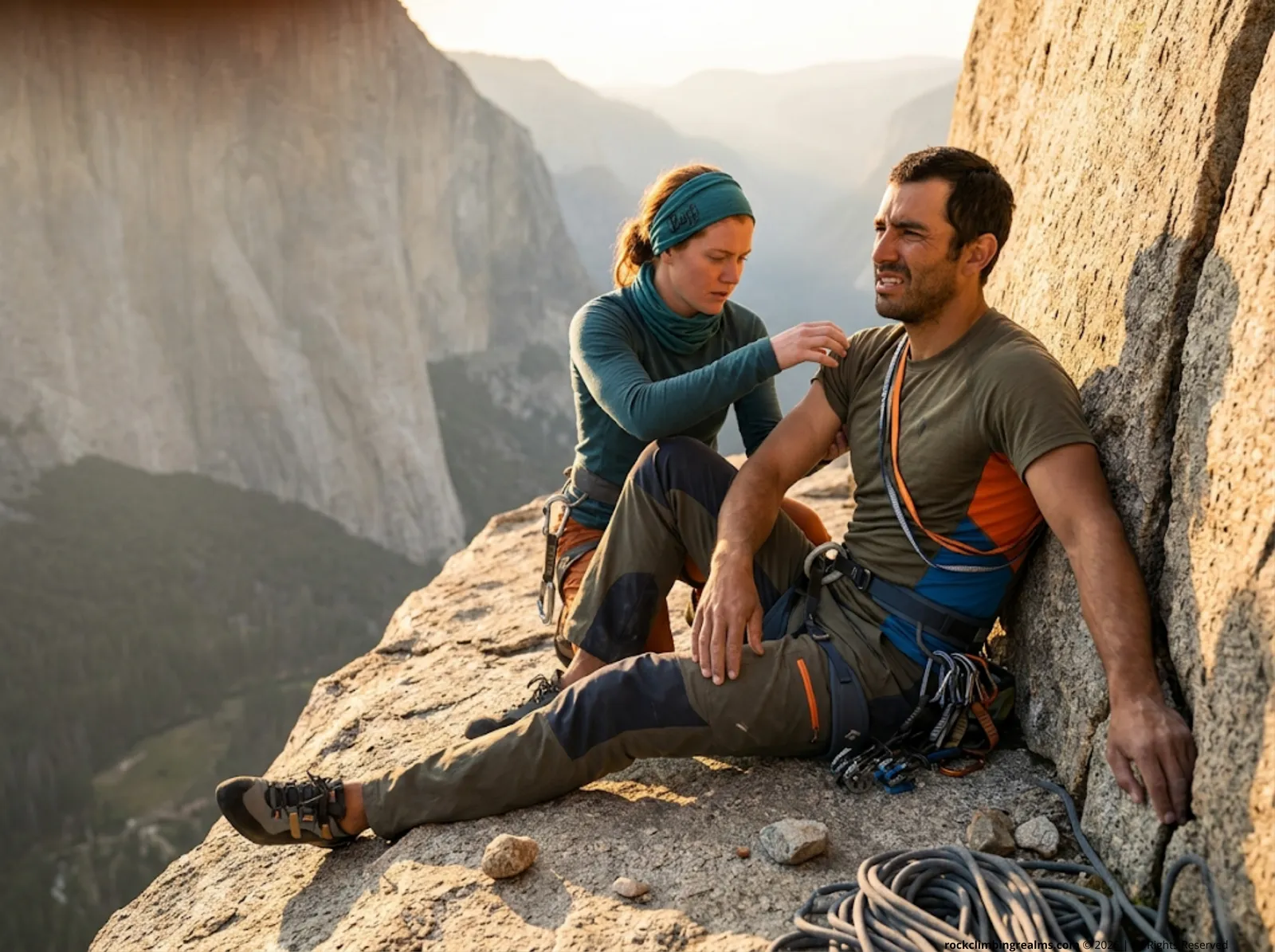
You’re 200 feet up a Grade IV splitter in the High Sierra — left hand clipped to a cam, right arm cranked into a gaston — and there’s a wet pop, a sickening shift, and then pain that empties your lungs. The arm hangs wrong. The shoulder is out. Your partner is below you, the nearest trail is three miles away, and you have a rack, two slings, and what you know. What happens next will determine whether you walk out or get carried out.
I’ve managed dislocations on multi-pitch routes, on boulder problems, on hanging belays. The thing that separates a clean outcome from a permanent nerve injury is protocol. Not strength. Not luck. Protocol. Here’s exactly what that protocol looks like.
⚡ Quick Answer: A backcountry shoulder dislocation requires three things before you touch it: fracture exclusion (run fingers along the shaft — any grating means abort), a CSM assessment (check radial pulse, sensation at the “sergeant’s patch,” and hand motor function), and confirmation of the mechanism (indirect levering force, not a direct impact). Once cleared, try the Cunningham technique first (seated, massage-based, no equipment), then the Davos technique for self-reduction (60% success rate). Immobilize post-reduction in 10–30° of external rotation using the backpack bolster method — NOT a standard sling. Every reduced shoulder needs a formal orthopedic evaluation within 72 hours.
The Anatomy of a Climbing Dislocation (Why the Shoulder Fails)
The Golf Ball on a Tee Problem
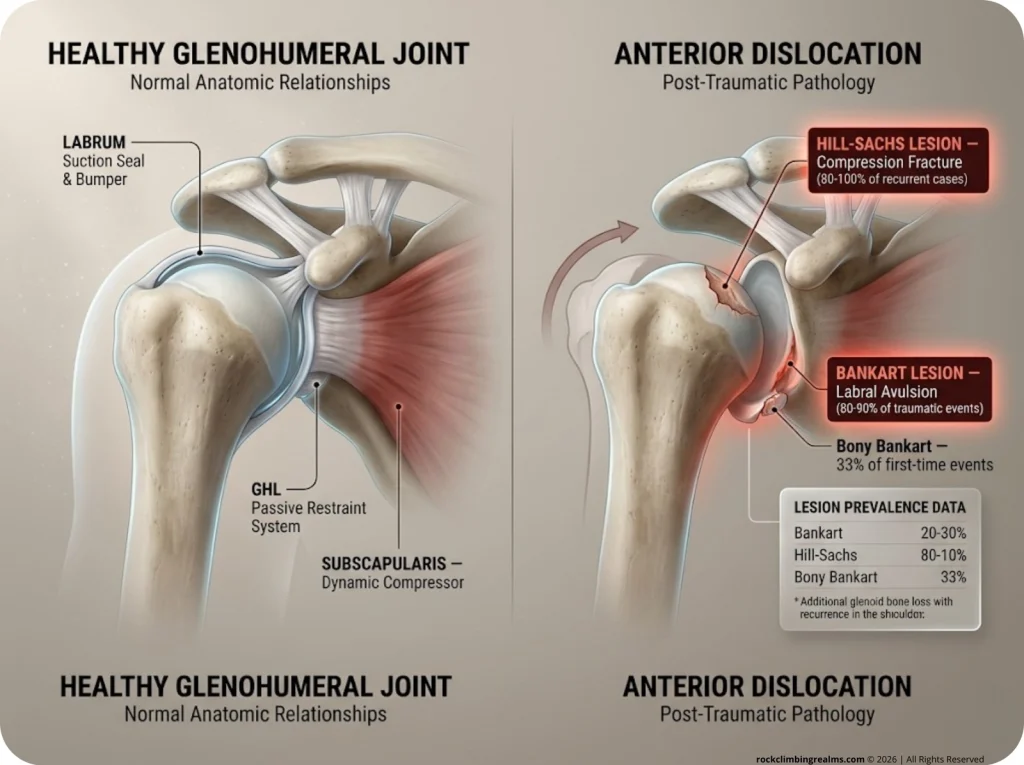
The glenohumeral joint is built for range of motion, not for stability. The humeral head has roughly three times the surface area of the shallow glenoid cavity. What keeps the joint together is a tension network: the labrum acting as a suction-cup seal and bumper, the glenohumeral ligaments providing passive restraint, and the rotator cuff force couple compressing the head against the socket dynamically.
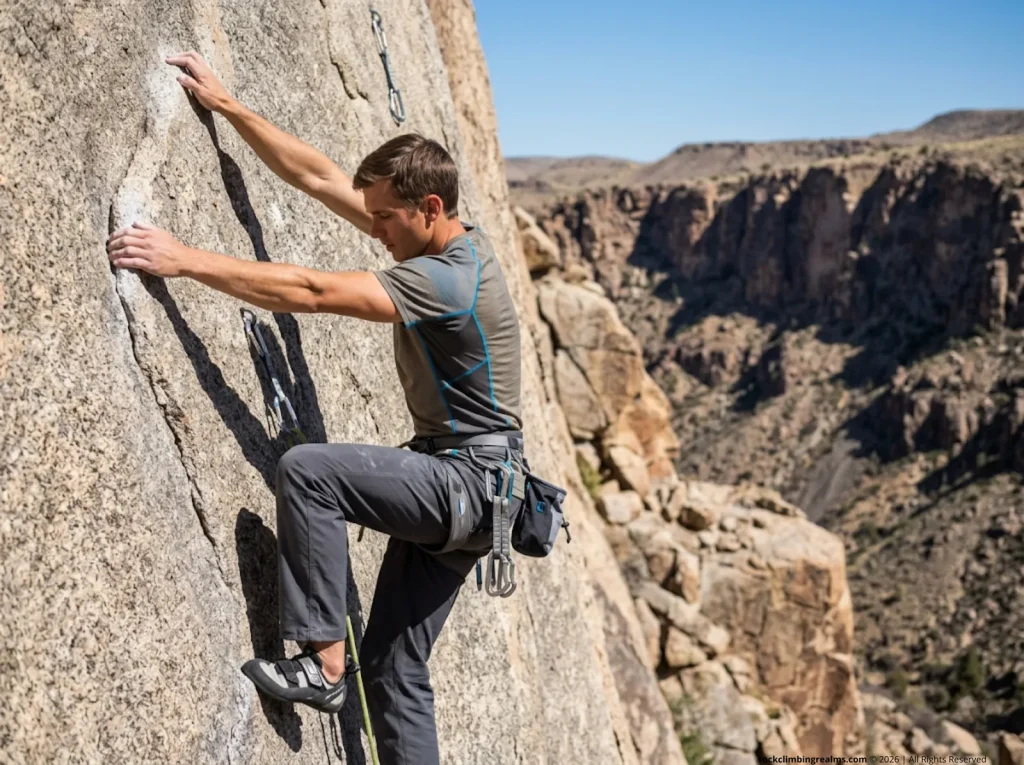
For climbers specifically, this system accumulates fatigue before the acute failure. Repetitive high-force eccentric loading — gastons, dynamic catches, desperate high-steps — progressively degrades ligament integrity. The first dislocation is usually not a surprise to the shoulder. It’s just the first time the system said “enough” out loud.
The gaston and the high-clip move are the two highest-risk positions for a first-time dislocation. If you’re working a redpoint with hard clips or wide pulls, that’s where to be careful. A stick clip there isn’t being soft — it’s being smart.
The Bankart and Hill-Sachs Lesion — The Internal Damage Report
When the humeral head levers out of the socket during an anterior dislocation, it produces two predictable internal injuries. The Bankart lesion — avulsion of the anteroinferior labrum from the glenoid rim — occurs in 80–90% of traumatic events. This tears out the suction seal. The joint now has dramatically reduced passive restraint.
Simultaneously, the posterosuperior humeral head slams into the glenoid rim, creating a compression fracture called a Hill-Sachs lesion. Present in 80–100% of recurrent cases, a large Hill-Sachs can lock the shoulder out again during normal overhead movement — what surgeons call an “off-track” lesion. You can’t determine this in the field, but it’s exactly why high-force folkloric reduction techniques (the Hippocratic foot-in-axilla method) can convert a manageable dislocation into a complex fracture-dislocation. Leave those in the history books.
A third scenario worth knowing: the Bony Bankart, an actual fracture of the anterior-inferior glenoid rim, occurs in roughly 33% of first-time events. When bone loss exceeds 20%, standard soft-tissue repairs fail at 89%. Every re-dislocation event costs an average of 6.8% glenoid bone loss. The way you manage the first dislocation shapes whether surgery is eventually necessary.
The Physics of Muscle Spasm — The Real Obstacle to Reduction
Here’s the thing guides explain wrong, or skip entirely: the obstacle to reducing a dislocated shoulder is not the bone. It’s the physiology.
Upon luxation, the brain triggers reflexive tetany in the subscapularis, pectoralis major, and deltoid — a survival mechanism that effectively pins the humeral head against the glenoid rim. The subscapularis, normally a stabilizing compressive force, flips its vector when the arm is dislocated and now actively resists reduction. You are fighting a physiological lock-out of the large muscle groups. More force is not the answer.
Field reduction without anesthesia must address this via one of two mechanisms: neuro-relaxation (Cunningham) or sustained muscle fatigue (Stimson, Davos). The 10–15 lb weight in Stimson’s maneuver works not by dragging the bone — it works by fatiguing the subscapularis and pectoralis until they can no longer resist. Time is the mechanism, not force. This is covered in the systematic guide on glenohumeral reduction techniques from PMC/NCBI, and it’s the part most backcountry content gets completely wrong.
This is also why climbers with undertrained push muscles and weak external rotators are statistically more vulnerable to the first dislocation. The rotator cuff antagonist imbalances that create dislocation vulnerability build quietly over thousands of training hours. The joint doesn’t warn you.
Pro tip: The “subscapularis flip” is real. When someone is dislocated and you try to force the arm, you’re pulling against a muscle that can generate enormous force. Slow down. Your job is to get the muscle to quit, not to beat it.
The Go/No-Go Decision — Diagnosis Before You Touch It
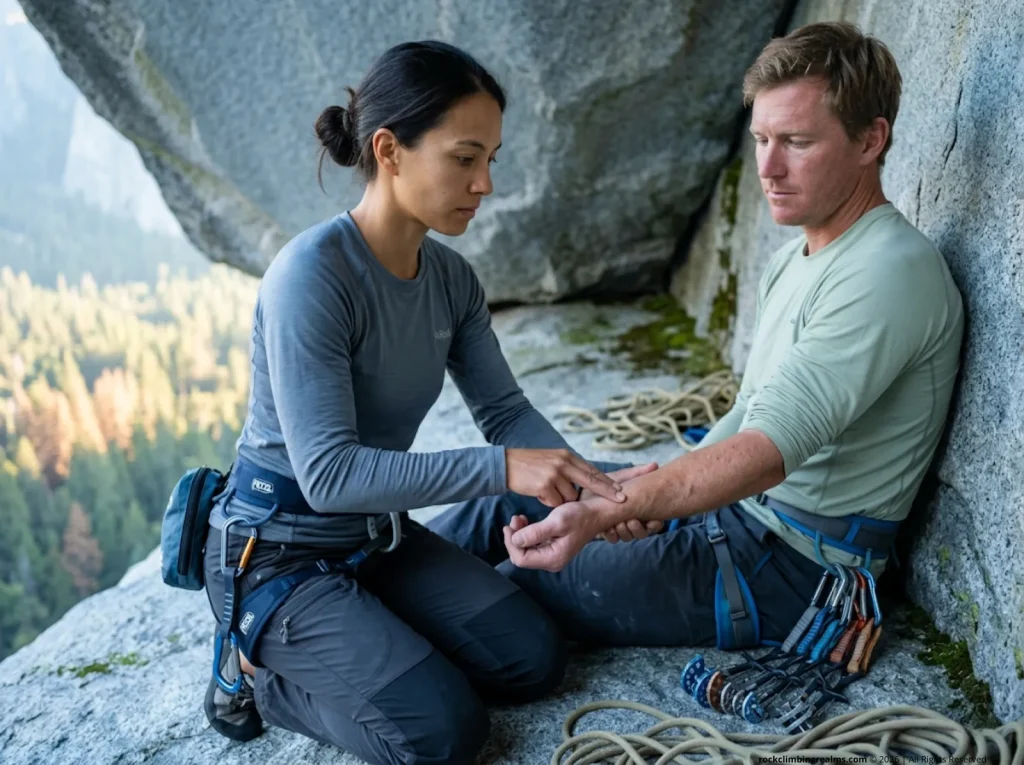
Clinical Recognition — What a Dislocation Actually Looks Like
The mechanism of injury is your first diagnostic clue. A sudden “pop” or “clunk” during a high-reach move or a fall, followed by immediate incapacitating pain. Visually: the shoulder loses its rounded deltoid contour and appears “squared-off” from the prominent acromion. There’s a palpable void where the humeral head should be, while the head itself often presents as a firm bulge in the axilla or subcoracoid region.
The Wilderness Medical Society’s four confirmation features: restriction of normal ROM, obvious deformity versus the unaffected side, absence of crepitus (grating = fracture flag), and the characteristic guarded posture — arm held away from the body, elbow slightly flexed, like they’re cradling something invisible.
One distinction worth making: a first-time dislocation in a 22-year-old granite climber carries a very different prognosis than a recurrent event in a known instability patient. The recurrent dislocation often reduces faster and with less pain. The first-timer is a full crisis.
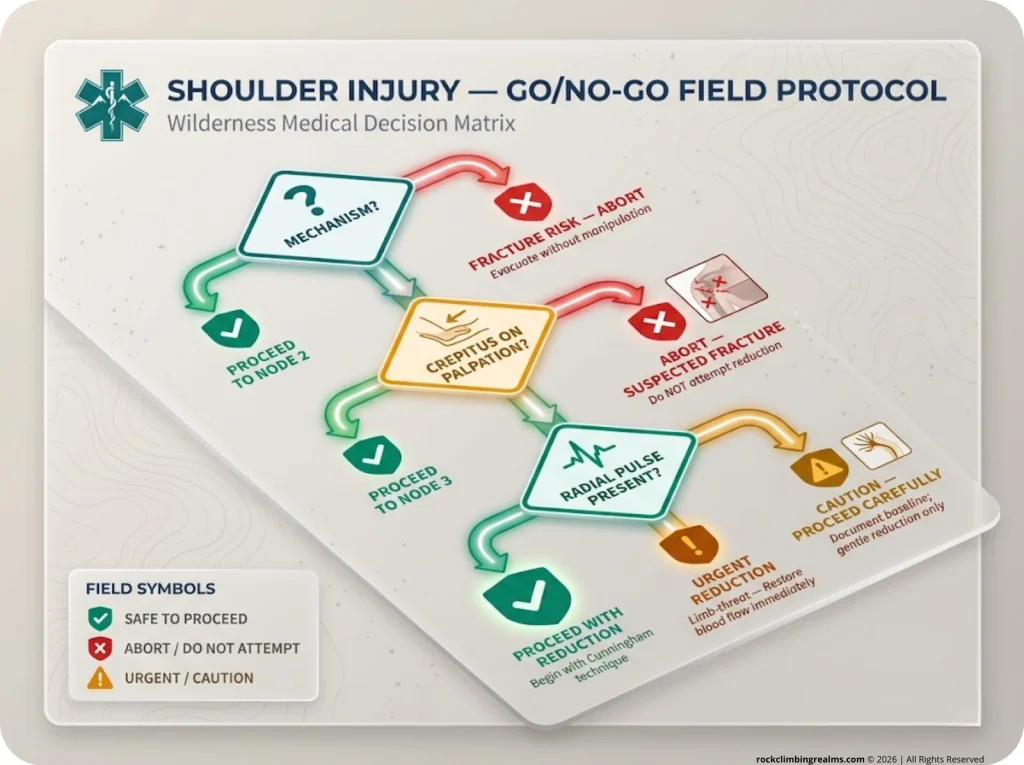
Fracture Exclusion — The Abort Criteria
A high-force direct impact — a 10-meter ledge fall onto the shoulder — significantly elevates the risk of humeral neck or greater tuberosity fracture. Do not reduce. Evacuate. The Crepitus Test is your fastest check: run two fingers along the humeral shaft from elbow to shoulder. Any grating or grinding is a fracture flag. Stop.
Age changes the risk profile dramatically. Patients over 40 have a 30% incidence of concomitant rotator cuff tear with dislocation. Over 60, that rises to 80%. You are not just reducing a joint in those cases — you may be manipulating a shoulder with a full-thickness cuff rupture. The fracture exclusion and age consideration should shape your confidence level before you proceed.
| Diagnostic Assessment: Dislocation vs. Fracture | ||
|---|---|---|
| Diagnostic Feature | Dislocation: Proceed | Fracture: ABORT |
| Mechanism | Indirect force (levering/reaching) | Direct blunt force impact |
| Palpation | Hollow subacromial space | Crepitus (grating/grinding) |
| Deformity | Squared deltoid contour | Gross swelling / bony step-off on shaft |
| CSM | Pulse present; minor numbness | Absent radial pulse; profound motor loss |
The CSM Exam — Neurovascular Baseline
Baseline CSM is mandatory before any manipulation. You’re establishing your comparison point. If neurological status changes after a reduction attempt, you need to know what you started with.
Circulation: Two fingers on the radial artery at the wrist. Note rate and strength. Absent pulse is a limb-threat emergency — immediate, gentle reduction to restore blood flow, regardless of other factors.
Sensation: Test light touch at the “sergeant’s patch” — the lateral deltoid skin, innervated by the axillary nerve. Numbness here is present in up to 25% of acute dislocations. Also test ulnar and median distributions in the hand (fourth/fifth digit for ulnar; thenar eminence for median).
Motor: “Wiggle your fingers” and grip test. A floppy or profoundly weakened hand suggests wider brachial plexus involvement — proceed with caution, but don’t automatically abort reduction if CSM is otherwise acceptable.
Repeat the CSM immediately after any reduction attempt. Mental note for evacuation handoff to EMS. In technical terrain, your hands are your diagnostic tools — use them before you touch the joint. Every time. The wilderness protocol for dislocation reduction decision-making from the Center for Wilderness Safety lays out the full Go/No-Go framework in protocol-card format. For a decision matrix covering all major climbing trauma scenarios, the full vertical medicine framework for backcountry climbing injuries is worth studying before you leave the trailhead.
Pro tip: In technical terrain, your rack is your medical kit. But your hands are your diagnostic tools. Do the CSM before you touch the joint — every time.
Evidence-Based Field Reduction — Four Techniques, Ranked
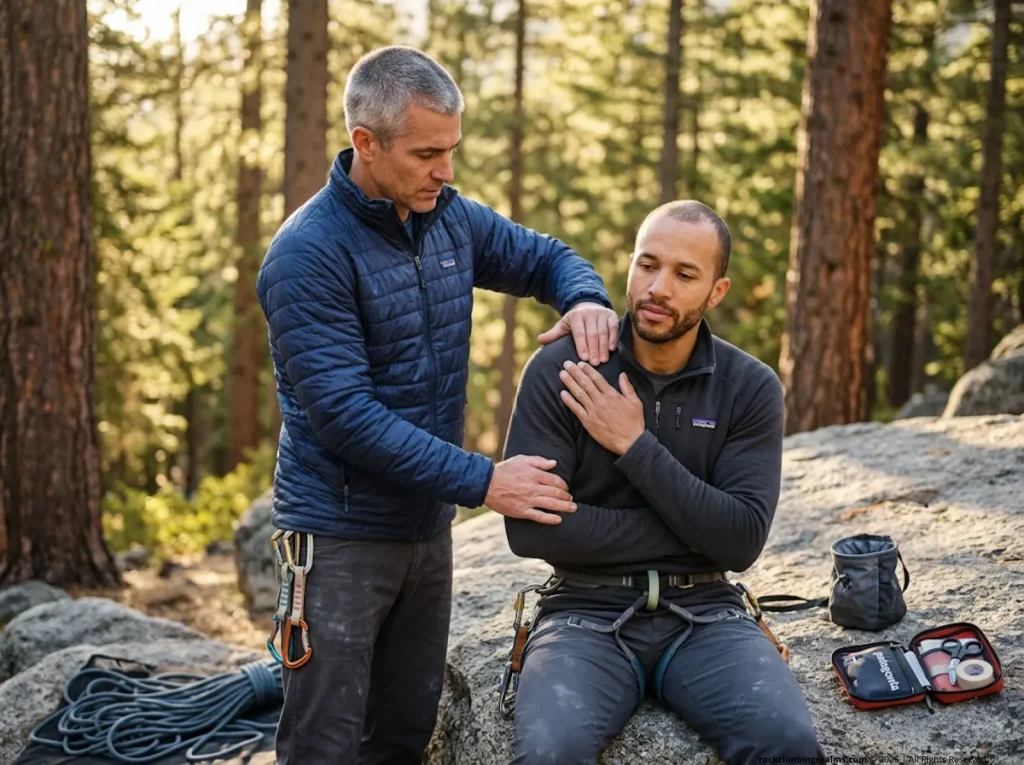
Cunningham Technique — First Line, No Equipment Required
Preferred first-line method for a cooperative, seated patient. No equipment. Minimum pain. The Cunningham technique works via neuro-inhibition of the spasm cycle — the massage sequence interrupts the feedback loop that maintains tetany.
Protocol: patient sits upright, chest out, straight back. Patient places hand on your shoulder. You rest your forearm in their elbow crease, providing gentle adduction. Massage sequence: trapezius first, then deltoid, then biceps — systematic, sustained, unhurried. Coach the patient to shrug shoulders up and back while breathing slowly.
Success marker: the absence of a “clunk.” The shoulder often reduces almost silently. The subscapularis relaxes, and the head finds the socket without any mechanical forcing. The scapular shrug is mechanically critical — it repositions the glenoid to better receive the returning humeral head as the subscapularis lets go.
Contraindications: uncooperative patient (extreme pain, anxiety), inability to sit upright during a hanging belay.
Davos (Boss-Holzach-Matter) Method — Solo Self-Reduction
The Davos technique was designed specifically for the solo climber or the hanging belay situation where no second practitioner is available. It has a 60% field success rate — the highest documented rate for any self-reduction technique.
Protocol: sit on a flat surface, flex the knee on the injured side as far as possible, interlace fingers around the shin. The critical field modification — tie your wrists together with a 60cm sling or 6mm cord before you start. The unmodified Davos fails most often because grip fatigue terminates the attempt before the subscapularis fatigues. The sling-wrist modification fixes this. Then lean your head back, tilt your torso posteriorly, breathe, and relax. Your own body weight provides the linear traction force.
If you’re on a wall and have no flat surface: place a nut in a crack at waist height, clip a sling, and lean away from it. The nut provides the counterforce. The same passive protection that doubles as a medical anchor for self-reduction also builds your lead anchors. Carry a dedicated 60cm sling in your kit labeled for this.
Success is confirmed by a palpable “clunk” and immediate, dramatic pain relief.
Pro tip: In the field, your wrists are the weak link in the Davos. I carry a dedicated 60cm sling in my first aid kit not for anchor building — it’s for this exact scenario.
Stimson Maneuver — Gravitational Traction for Uncooperative or Larger Patients
Find a boulder, a ledge, or a large log. That’s your operating table. The Stimson maneuver is the most mechanically reliable method for remote use when an elevated platform is available.
Patient lies prone on the platform edge, injured arm hanging vertically. Secure 10–15 lbs (5–7 kg) to the wrist — a gear bag, water bottles in a stuff sack, rocks in a pack lid. One 2L water bottle is approximately 4.4 lbs. Three bottles = 13.2 lbs. Don’t exceed 15 lbs; excess force risks nerve traction injury.
The time target is 20–30 minutes. This is not negotiable. Premature abort is the most common failure mode. You are fatiguing the pectoralis major and subscapularis, not dragging the bone. The platform is the counterforce. If spontaneous reduction hasn’t occurred by 25 minutes, add scapular manipulation — gently rotate the inferior tip of the scapula medially toward the spine while traction continues. This repositions the glenoid cavity to better receive the returning humeral head.
Useful specifically for larger, more muscular patients where Cunningham massage can’t overcome the spasm force.
Milch Technique — Abduction/External Rotation for Prone Patients
The Milch technique is your option when the patient cannot sit upright — unconscious, extreme pain, or a supine rescue position on a ledge.
Patient lies supine. Slowly abduct the arm toward overhead (180°) while gently externally rotating. Once overhead, apply thumb pressure to the humeral head in the axilla, pushing it toward the acromion. The abduction path realigns the humeral head vector with the glenoid cavity. The external rotation “turns” the head away from the engaged glenoid rim.
Pace is everything. Slow equals success. Fast equals guarding equals failure. Allow 3–5 minutes for the full abduction arc. The Garnavos modification: one hand on the mid-humerus to monitor for muscle relaxation — when you feel the arm “give” slightly, that’s your window for gentle traction while continuing abduction. Warn the patient: this one has a higher pain profile than Cunningham or Stimson.
The Hippocratic method — foot in the axilla — is contraindicated. Axillary nerve avulsion risk is unacceptable. The peer-reviewed analysis of shoulder dislocation management evolution is clear: high-force techniques are outdated. The difference between a clean reduction and a permanent nerve injury is often just the amount of force applied. The first aid kit components that make field reduction safer — SAM splints, cordage, stuff sacks for weight — often make the difference between a clean setup and an improvised mess.
Tactical Rigging — Using Your Rack as a Medical Kit
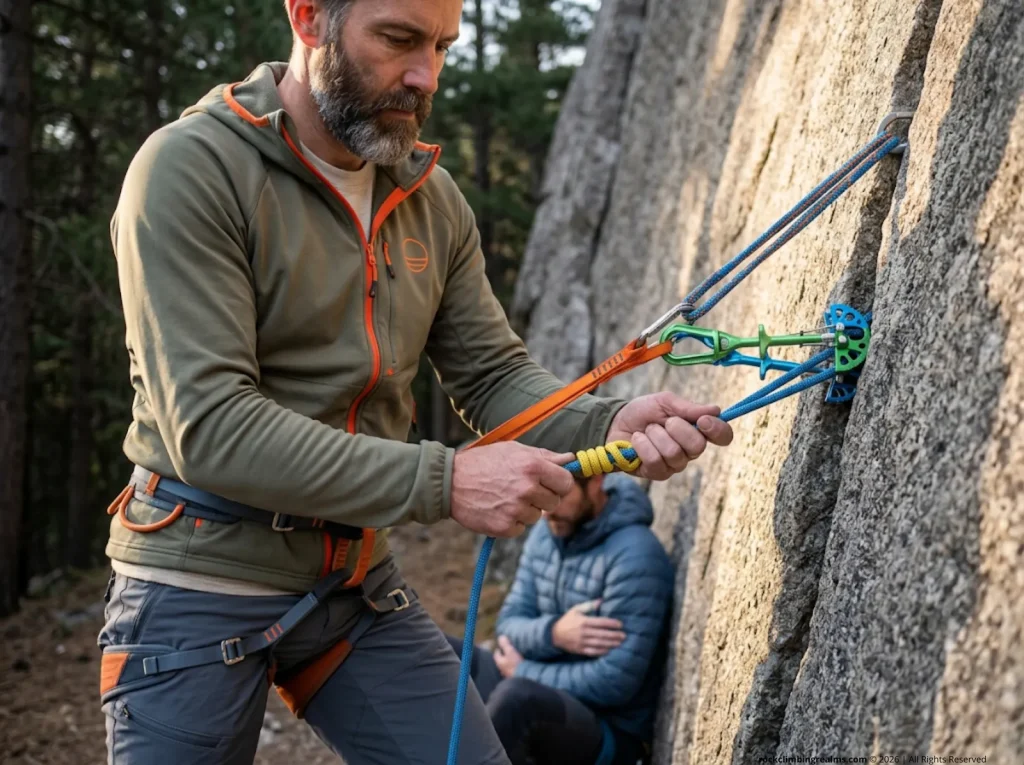
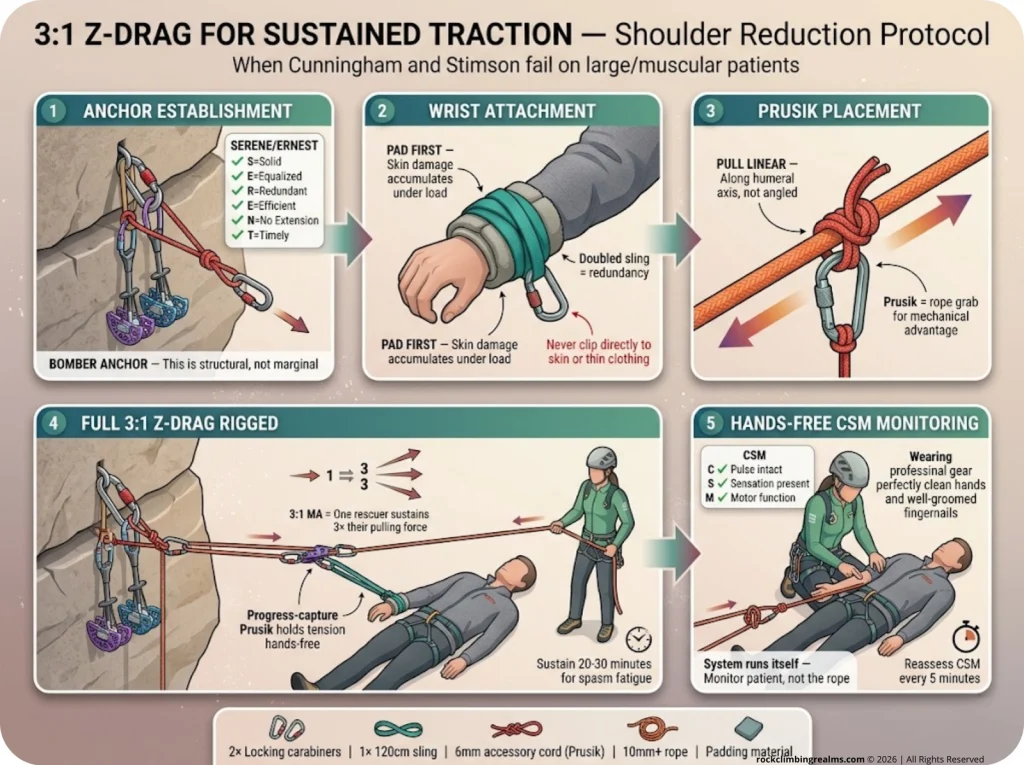
The 3:1 Z-Drag for Sustained Traction
When Cunningham and 20 minutes of Stimson have both failed on a large or highly muscular patient, you need a different tool. The same 3:1 mechanical advantage system used in standard rope rescue translates directly into a medical traction tool.
Anchor establishment first: SERENE/ERNEST bombproof placement using cams or nuts. This is structural — not a marginal piece. A Prusik hitch or Petzl Tibloc on the hauling line is your rope grab; a second Prusik at the anchor holds tension as the progress capture.
Pad the patient’s wrist before anything else. Jacket, fleece, foam pad — whatever you have. Skin under nylon under load accumulates damage fast. A single 120cm sling doubled creates the wrist attachment point. Clip with a locking carabiner. The 3:1 system lets one rescuer exert three times their input force, sustained over the 20–30+ minute spasm fatigue window. The progress-capture Prusik at the anchor means you can step away, check CSM, and let the traction run hands-free.
The force vector matters: pull linear along the long axis of the humerus. Any angle alters the direction and may worsen pain without advancing the reduction. The immobilization in neutral rotation for glenohumeral dislocation research also validates why the post-traction stabilization position is as important as the reduction itself.
Passive Protection as Self-Reduction Anchors
In alpine environments without natural features, climbing nuts — not hexes, not cams — create the anchor point for a Davos-style self-reduction. Place a nut in a solid horizontal crack at waist height, clip a 120cm sling, and lean away from the anchor. The nut provides the counterforce. No grip-fatigue variable. The patient can focus entirely on breathing and neuro-relaxation.
Wire nut selection: choose large enough to be bomber. This is medical use, not running protection. Seat it with authority. Nothing smaller than a #7 equivalent for lateral loading — double-nut with a locking carabiner if you’re not confident in the piece. The same placement principles from selecting the right protection size for a bomber medical anchor apply here with zero tolerance for doubt.
Post-Reduction Stabilization — The Anti-Sling Strategy
Why the Traditional Sling Fails — The Itoi Research
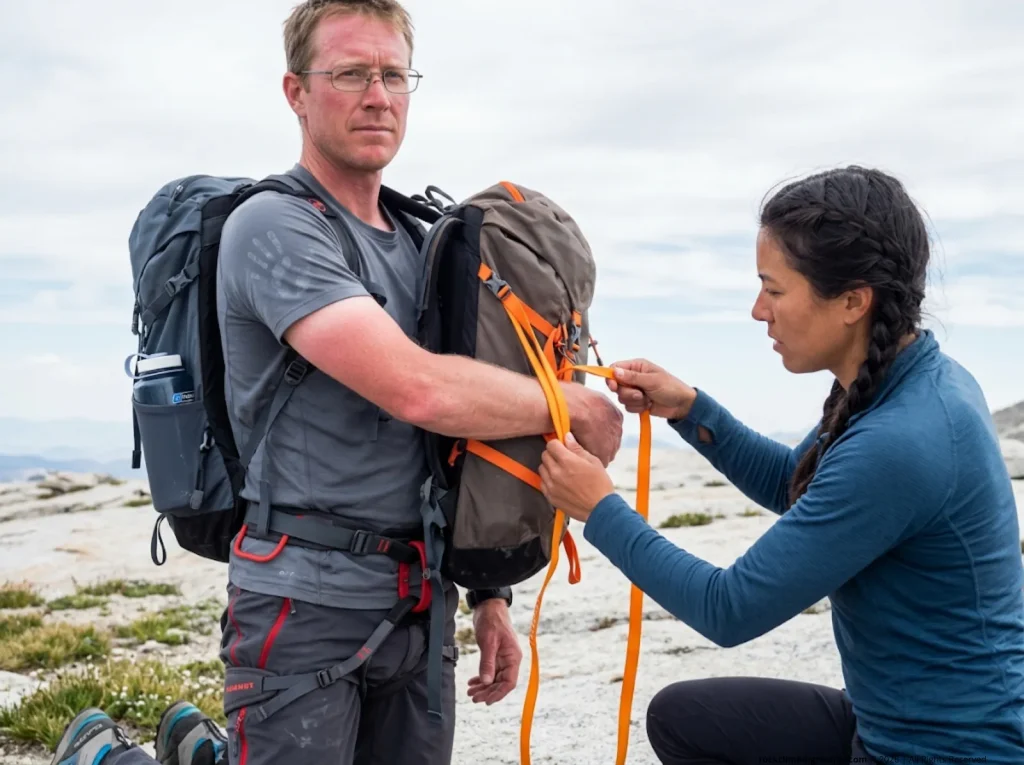
The standard triangular bandage sling in your climbing first aid kit places the arm in internal rotation and adduction. That’s the wrong immobilization position. Itoi et al. MRI studies demonstrated that internal rotation causes the avulsed Bankart labrum to fold further into the joint or remain medially displaced in the ALPSA position — preventing anatomic healing and locking in chronic instability.
External rotation (10–30 degrees) pulls the subscapularis tendon taut, which creates a biological “buttress” that physically presses the labrum back against the glenoid rim and promotes anatomic reapposition. Recurrence rates are substantially higher in patients immobilized in internal rotation — especially athletes under 30, which describes most climbers in their prime sending years. The Medical Journal of Australia review on sling immobilization for shoulder dislocation covers the Itoi research directly.
The sling is better than nothing. External rotation is better than the sling. Know which you’re doing and why.
Building an External Rotation Splint in the Backcountry
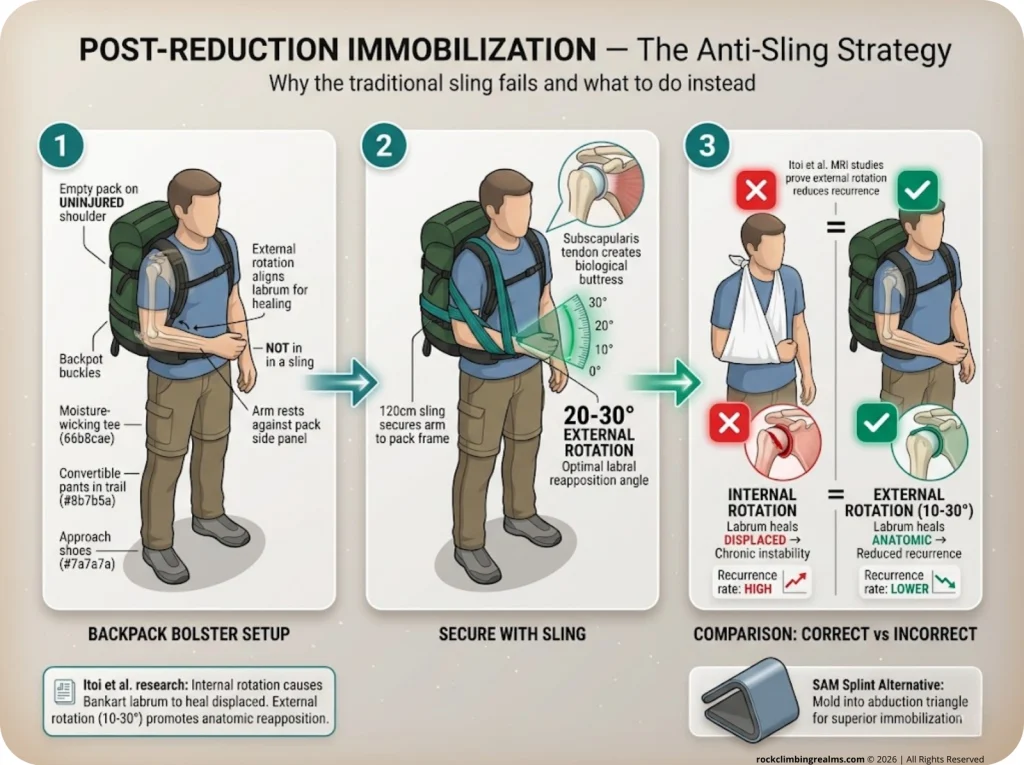
The Backpack Bolster Method is the highest-yield improvised technique in your standard climbing kit. Empty one backpack of heavy items. Patient wears it normally on the uninjured shoulder. The injured arm rests against the side panel of the pack with the forearm pointing naturally away from the body — that’s your 20–30° external rotation. Secure the arm to the pack frame with a 120cm sling or climbing tape.
If you carry a SAM splint, this is its use. Fold it into a C-curve for rigidity and mold it into an abduction triangle. Far superior to any sling for holding the joint in external rotation during a technical descent.
Evacuation Tactics — Getting Off the Wall with One Arm
The Tandem Rappel Protocol
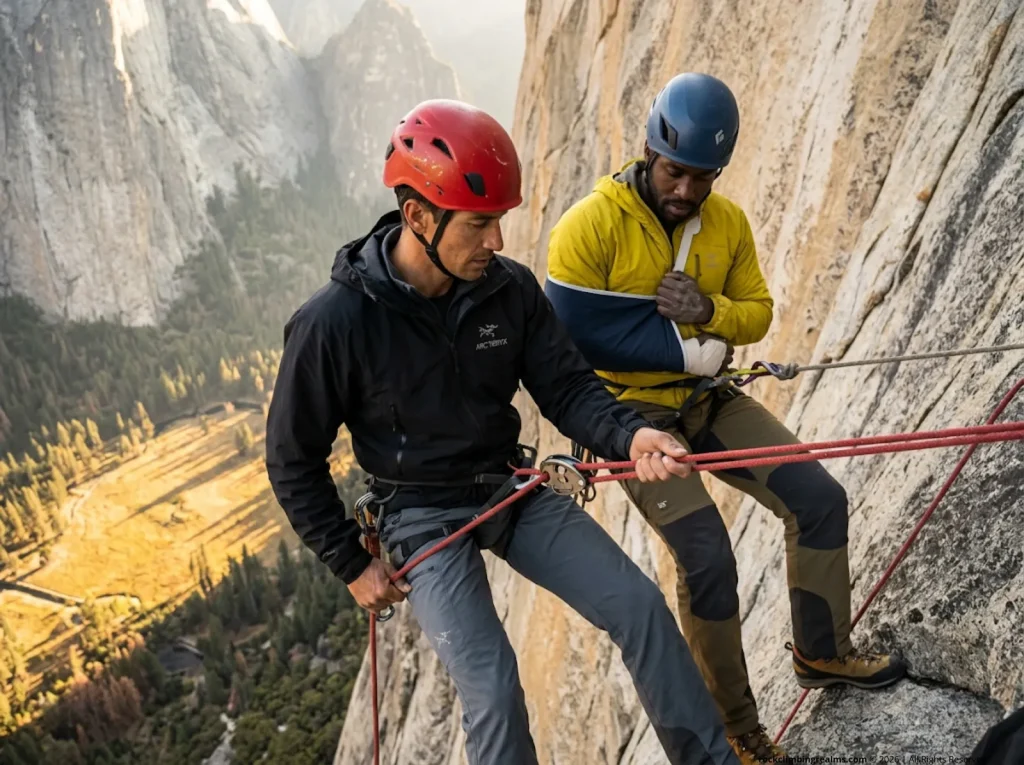
Never let a one-armed climber rappel alone after a dislocation. A re-dislocation mid-rappel means loss of brake control. The tandem rappel is the standard of care.
Master point setup: both rescuer and patient attached to the same belay device — an ATC or Grigri — using an extended rappel configuration. Patient connects to the rescuer’s harness via a 60cm sling tether from belay loop to rear gear loop, positioned slightly above the rescuer. The Safety Hand: instruct the patient explicitly to hold the rescuer’s harness or the tether — and NOT to grab the rope above the device or the brake strand. That’s an instinctive grab that can cause serious harm to both of you.
Shock mitigation is critical. Rappel in smooth, controlled increments. A jerky rappel generates significant force; any sudden loading on the injured shoulder from an instinctive grab can immediately re-dislocate it. The rescuer’s legs handle obstacles. Keep the patient off any protruding rock features.
Re-assess CSM at every anchor on multi-pitch routes. Any neurological deterioration — new numbness, increasing motor weakness — escalates evacuation priority. For scenarios where the injured climber cannot assist at all, the counterbalance rescue system for incapacitated climbers on multi-pitch provides a fully passive evacuation option.
Walk-Out Stabilization for Non-Technical Descents
Once off the technical terrain, the threat shifts from re-dislocation on a rope system to a trip on the trail where the patient instinctively reaches out with the injured arm. That instinctive reach is the problem.
A short 60cm sling tether from patient harness to rescuer harness keeps both parties in proximity without restricting gait. If trekking poles are available, put one in the uninjured hand — a third contact point to trust reduces the probability of a reflexive reach-out during a stumble. Transfer all heavy gear to the rescuer’s pack. Even a light haul bag on the injured shoulder risks re-dislocation on uneven trail.
If the injury occurred late in the day, evaluate bivy options seriously. A tired rescuer on technical terrain at night is a liability. The simple partner rescue framework for lowering and assisting injured climbers covers the ground-based stabilization principles once you’re off the ropes.
Pro tip: Transfer every piece of gear off the injured climber’s body. Even a light chalk bag clip on a hip belt can apply pressure to the shoulder harness and shift the joint during descent. Strip them down.
Return to the Rock — Prognosis, Timelines, and the Rehab Pyramid
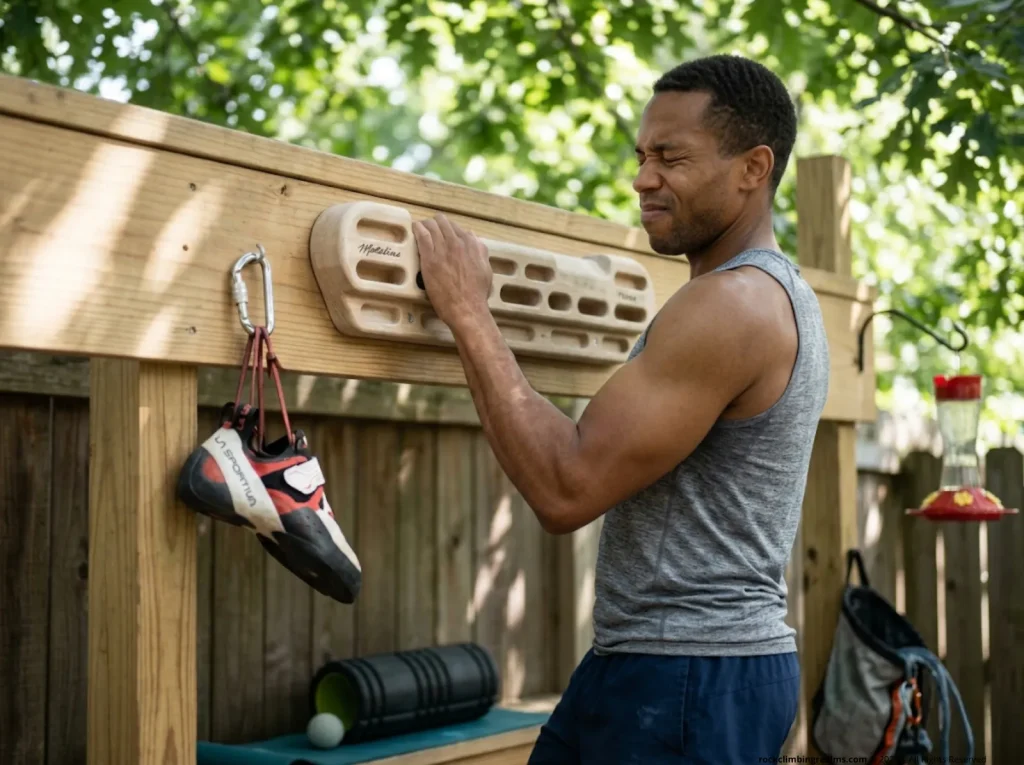
The Statistical Reality of Recurrence
Here’s the number most climbers don’t want to hear: if you’re under 20 when you pop your shoulder for the first time, your non-surgical recurrence rate is 80–90%. Ages 20–30: 50–60%. Ages 30–40: 25–35%. Over 40: 10–15%, but that group carries a dramatically higher likelihood of concomitant rotator cuff tears. The peer-reviewed meta-analysis on recurrence rates after traumatic anterior shoulder dislocation validates these numbers.
Every subsequent event costs an average of 6.8% glenoid bone loss. Once you cross 20% bone loss, the “inverted pear” glenoid morphology makes all soft-tissue Bankart repairs fail at 89%. At that threshold, the Latarjet-Bristow procedure — a bony augmentation — becomes the only reliable surgical option. This is why the field reduction methodology matters for the long game.
A field reduction is first aid, not treatment. Every shoulder reduced in the backcountry needs formal orthopedic evaluation within 72 hours.
The Rock Rehab Pyramid — The 4-Stage Return Protocol
The Rock Rehab Pyramid from the Climbing Doctor gives you the framework. Four stages, no shortcuts.
Stage 1 — Unload (0–3 weeks): External rotation immobilization. Kinesiotape to enforce better resting scapular posture and fight the climber’s default “forward rounded” shoulder. Zero climbing. Zero.
Stage 2 — Mobility (3–6 weeks): Pain-free ROM restoration. Priority: posterior capsule flexibility through the Sleeper stretch. Avoid end-range “high-five” abduction. FRC training for active shoulder range of motion in the rehabilitation window is specifically designed to reclaim the active range lost after capsular injury — a direct tool for this phase. Target full shoulder circles without the apprehension sign firing.
Stage 3 — Strength (6–12 weeks): Scapular stabilizers are the priority — serratus anterior and lower trapezius — not biceps, not pecs. These muscles ensure the glenoid “tracks” the humerus during overhead movement. Side-lying external rotation isolation until you hit 90% symmetry with the uninjured side. That number is not arbitrary. It’s the green light criterion.
Stage 4 — Movement (12+ weeks): Static hangboard lock-offs first. Then controlled deadpoints. Then moderate-angle bouldering. Then overhang work. Campusing and wide gastons are the last activities permitted — they’re the highest re-dislocation risk positions. You don’t get there until everything else is dialed.
Conclusion
Three things to carry off this page.
First: diagnose before you touch it. The CSM exam and fracture exclusion protocol are not optional. Absent radial pulse? Reduce immediately. Crepitus? Evacuate without manipulation. The 45 seconds you spend on that assessment determines everything downstream.
Second: low force, long time. Cunningham works through neuro-relaxation. Stimson works through subscapularis fatigue. The 10–15 lb weight is physiology, not mechanics. Patience is the technique. Fighting the spasm with more force is how people end up with permanently numb hands.
Third: the traditional sling is the wrong call. Immobilize in 10–30° external rotation using the backpack bolster or a SAM splint. Internal rotation causes the Bankart labrum to heal displaced — that’s a straight line to recurrence and eventual surgery.
Before your next expedition, build a shoulder dislocation protocol card, throw a dedicated 60cm sling in your first aid kit labeled for Davos self-reduction, and walk through the CSM exam with your climbing partner at the trailhead. It takes 45 seconds. It may save a limb. Now go send something.
FAQ
Can you pop a dislocated shoulder back in yourself?
Yes — the Davos (Boss-Holzach-Matter) method achieves solo self-reduction in approximately 60% of cases. The technique uses your own body weight as a traction force by interlacing fingers around your flexed knee and leaning back. Tie your wrists together with a 60cm sling or 6mm cord before starting — grip fatigue is the most common reason the unmodified technique fails before reduction occurs.
How do you tell if a shoulder is dislocated or fractured in the field?
Run two fingers along the humeral shaft from elbow to shoulder. Grating or grinding — crepitus — signals a fracture. Abort all reduction attempts and evacuate. A pure anterior dislocation presents with a squared-off deltoid contour, a palpable void below the acromion, and no crepitus. The mechanism also matters: indirect levering force during a move equals dislocation; direct high-impact blow to the shoulder equals suspect fracture.
What happens if a shoulder stays dislocated for more than 24 hours?
Progressive neurovascular compromise and irreversible muscle tetany. The axillary nerve is at highest risk — prolonged compression converts a temporary conduction block into permanent axonal damage. The longer the labrum remains displaced, the higher the probability it heals in the ALPSA position — medially displaced — which locks in chronic instability even after anatomic reduction later.
Is it hazardous to reset a shoulder in the field?
Modern low-force techniques — Cunningham, Davos, Stimson — carry substantially lower risk than historical high-force methods when fracture exclusion and CSM protocols have been properly applied. The risk of NOT reducing a dislocated shoulder in a truly remote field setting — nerve compression, vascular compromise, inability to self-evacuate — typically exceeds the risk of a properly executed field reduction. The hazard is high-force manipulation without diagnosis. That’s the thing that causes permanent damage.
How long until a climber can return to climbing after a shoulder dislocation?
The Rock Rehab Pyramid sets the minimum at 3 months before returning to moderate climbing. The green light criteria: 90% external rotation strength symmetry with the uninjured side, full ROM without the apprehension sign, no pain during the ABER position. High-risk positions — gastons, campusing, wide dynos — are deferred until those criteria are met. Returning early dramatically increases re-dislocation probability, which carries an average 6.8% additional glenoid bone loss per event.
Safety Notice: Rock climbing and mountaineering are inherently high-risk
activities that can involve physical trauma or fatal incidents. The information on Rock Climbing Realms is for
educational and informational purposes only. Techniques and advice presented here are not a substitute
for professional, hands-on instruction. Conditions and risks vary by location. Always seek guidance
from a qualified instructor before attempting new techniques. By using this website, you agree that you
are solely responsible for your own safety. Any reliance you place on this information is strictly
at your own risk, and you assume all liability for your actions. Rock Climbing Realms and its authors
will not be held liable for any harm, damage, or loss sustained in connection with the use of this information.
Affiliate Disclosure: We are a participant in the Amazon Services LLC Associates Program, an
affiliate advertising program designed to provide a means for us to earn advertising fees by advertising and linking
to Amazon.com. As an Amazon Associate, we earn from qualifying purchases. We are also an official affiliate partner
of Black Diamond Equipment via the AvantLink network. If you click on a Black Diamond affiliate link and make a
purchase, we may earn a commission at no additional cost to you. We also participate in other affiliate programs.
Additional terms are found in the terms of service.