
In this article
The highball looked clean. Four moves to a jug, maybe five. Then my heel hook blew off damp rock, my left foot inverted hard on the crash pad edge, and I heard a pop that turned my stomach before any pain arrived. Within thirty seconds the ankle was ballooning inside a shoe that suddenly felt two sizes too small. The trailhead was forty minutes away on loose talus. Everything I did in the next five minutes decided whether I walked out or got carried.
After fifteen years of rock climbing and more rolled ankles than I’d like to admit, I’ve learned that what you do at the crag matters more than what happens at the ER. This is the exact field first aid protocol that gets you from the moment of impact to taping yourself out, making an honest evacuation decision, and rebuilding enough strength to project again without your ankle giving out when it counts.
⚡ Quick Answer: Remove your climbing shoes immediately before swelling traps them. Run a CSM check (circulation, sensation, movement), then apply the Ottawa Ankle Rules to rule out a fracture. If you can take four weight-bearing steps without severe pain, your ankle injury is field-treatable with RICE protocol and a figure-8 taping job. If you can’t bear weight or have bony tenderness at the malleolus, immobilize with a SAM Splint or improvised U-splint and evacuate.
Why Climbing Ankle Sprains Hit Different
The Inversion Mechanism on Pads, Rock, and Talus
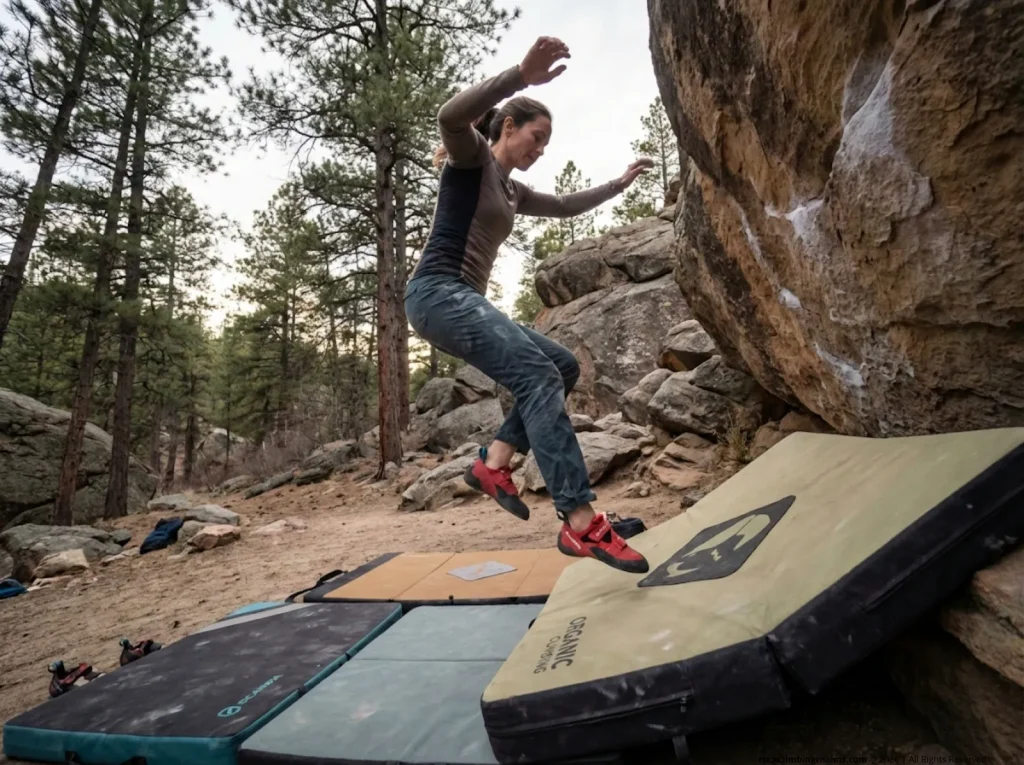
A rolled ankle on a hiking trail is bad enough. A rolled ankle at a bouldering crag is a different animal. When you peel off a highball and land on an uneven pad edge or loose talus, the downward force on an inverted foot shreds the outer ankle ligaments in milliseconds. The ATFL ligament takes the hit first because it’s the weakest link in the chain, and most inversion sprains at the crag damage it before anything else.
The numbers back this up. Between 2014 and 2023, emergency departments logged over 47,000 rock climbing injuries in the US, with lower extremities accounting for more than half. Ankle fractures represented nearly 31% of all fracture cases. And those are just the injuries that made it to an ER. Climbers underreport leg injuries at a staggering rate. Roughly half never seek professional care at all.
The problem with bouldering falls specifically is the landing surface. Pads shift, rocks hide under foam, and a tired climber doesn’t always rehearse the landing before committing to the crux. Poor landing mechanics account for most rolled ankles at the crag. Feet hip-width, knees tracking over ankles, weight centered. That’s the drill. Skip it and your ankle joint pays the price.
Why Your Climbing Shoe Makes Everything Worse
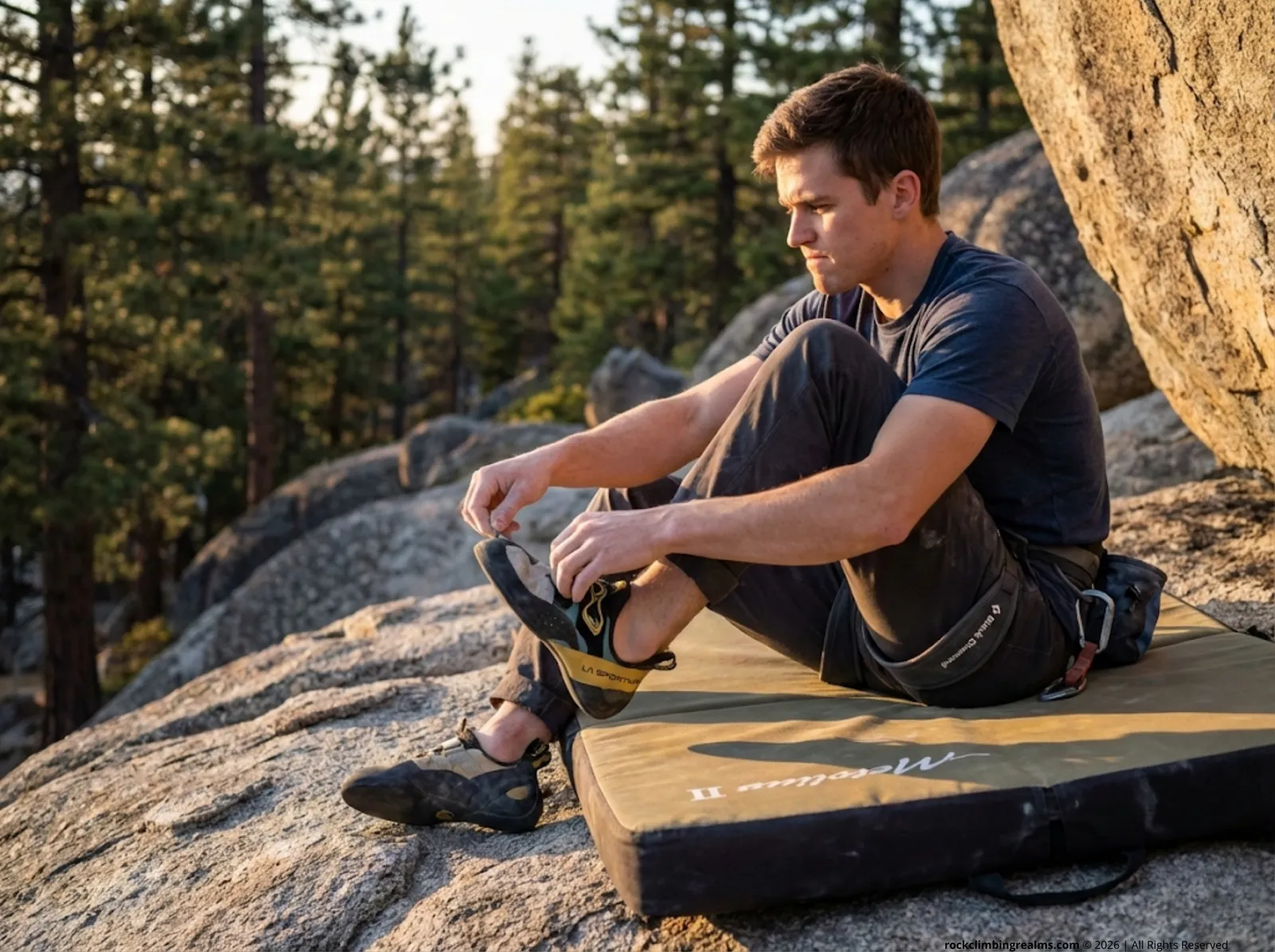
Here’s the part nobody thinks about until it’s too late. Your climbing shoes have zero ankle support. The tight fit and thin rubber that make them brilliant on a foothold turn them into a swelling trap the second you roll an ankle. Within ten to fifteen minutes, the inflammation can make removal painful or flat-out impossible.
Take them off immediately. Wiggle them off despite the pain. Your approach shoes or hiking boots will do a better job stabilizing the joint for the walk out, and you’ll thank yourself when the real swelling hits an hour later. This is the single most important step in climbing shoe removal after an ankle injury.
Grading Severity in the Field
Not every sprained ankle is the same, and the grade determines your next move. A Grade 1 sprain (mild stretch, some swelling, can still bear weight) is field-manageable. Grade 2 (partial tear, moderate swelling, difficulty bearing weight) is borderline. Grade 3 (complete ruptured ligament, severe extreme swelling, gross instability) means you’re not walking out on it. Period.
The tricky part is that field grading is imperfect. Adrenaline masks pain. Swelling hasn’t peaked yet. When in doubt, treat it as worse than it looks. A Grade 1 or 2 ankle sprain still needs six to nine weeks of proper exercise rehabilitation to prevent chronic ankle instability, which is just a clinical way of saying your ankle gives out every time you look at it wrong.
Pro tip: If you’re sketched about a landing, rehearse the downclimb option before committing to the crux. Most bouldering ankle injuries happen because climbers never considered the backup plan.
The 4-Step Crag Assessment Protocol
Step 1 — CSM Check (Circulation, Sensation, Movement)
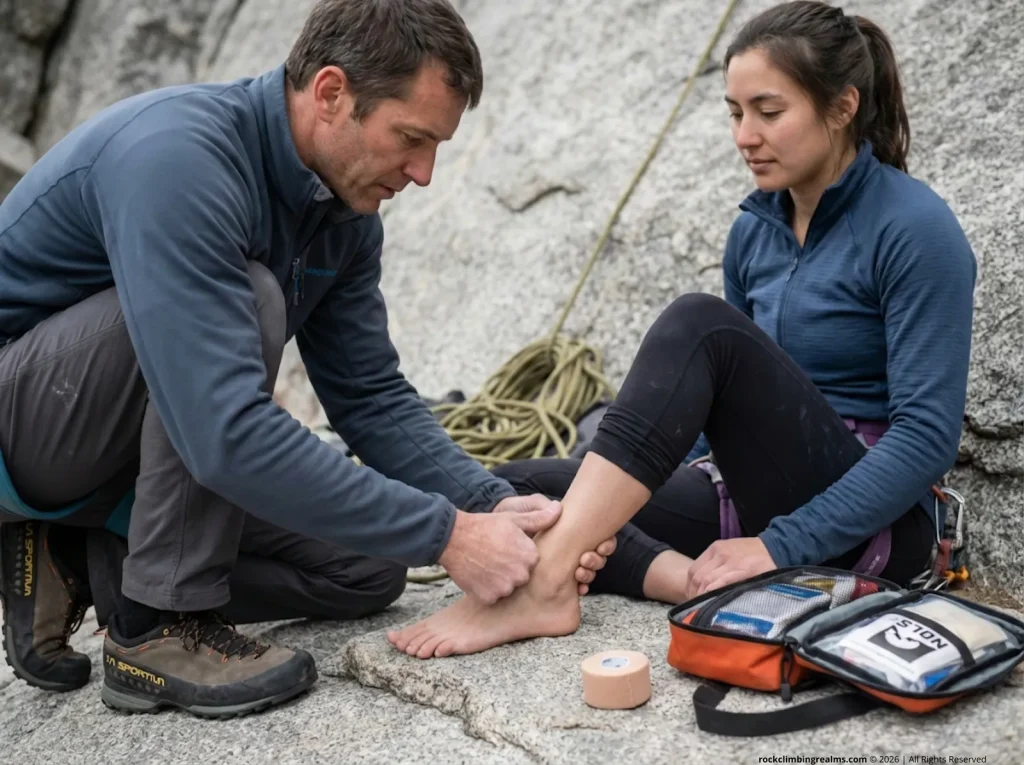
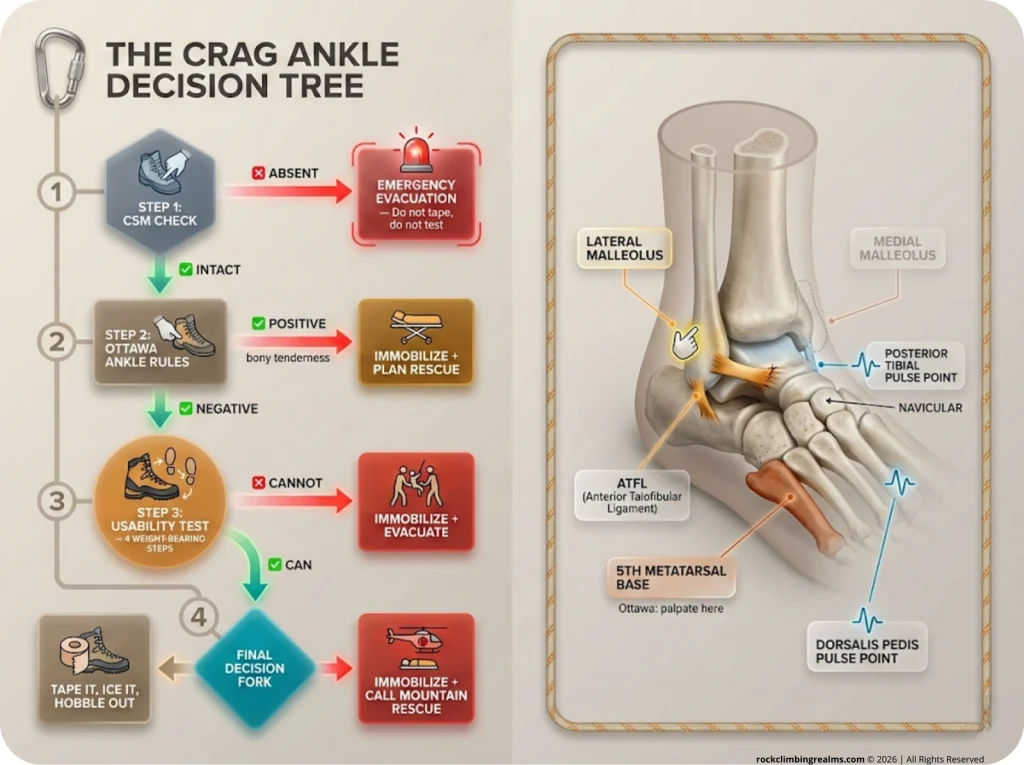
Before you do anything else, run a CSM check. Feel for pulses at the dorsalis pedis (top of the foot) and posterior tibial (behind the inside ankle bone). Test sensation by pressing a carabiner gate tip on both sides of the foot and toes. Ask the injured person to wiggle their toes and watch for asymmetry compared to the uninjured side.
If any of those checks come back absent, you have a vascular or nerve compromise. That’s an emergency evacuation, full stop. No taping, no testing, no debate.
Step 2 — Ottawa Ankle Rules (Field Version)
The Ottawa Ankle Rules are your best friend at the crag. Developed for emergency rooms, they have a sensitivity of 97.6 to 100 percent for ruling out clinically significant fractures. That means if the test comes back negative, a broken ankle bone is almost certainly off the table.
Here’s the field version. Palpate the bony landmarks with firm thumb pressure. The back edge and tip of the lateral malleolus (outside ankle bone). The back edge and tip of the medial malleolus (inside ankle bone). The base of the fifth metatarsal and the navicular on the foot. No bony tenderness at those exact spots and the person can bear weight for four steps? Fracture is highly unlikely.
Step 3 — The Usability Test
The NOLS Wilderness Medicine standard is straightforward. Can the injured person take four full weight-bearing steps without severe pain? If yes, the injured ankle is “usable” and field-treatable. If no, it’s “non-usable” and needs immobilization and evacuation.
This test is pass or fail. If there’s any doubt, treat it as non-usable. Nobody ever regretted being too cautious with a wilderness first aid situation.
Step 4 — The Decision Fork
CSM intact, Ottawa negative, usable? Tape it, ice it, hobble out. Any red flag — absent pulse, bony tenderness, inability to bear weight — immobilize and plan for rescue. Never let a climbing partner pressure you into walking on a non-usable injury to save the hassle of a mountain rescue call.
Pro tip: Practice the Ottawa Ankle Rules on a healthy partner before you need them. Learning the palpation landmarks for the first time while staring at a swollen ankle on wet talus is a bad plan.
Field Treatment That Actually Works at the Crag
RICE With What You’ve Got
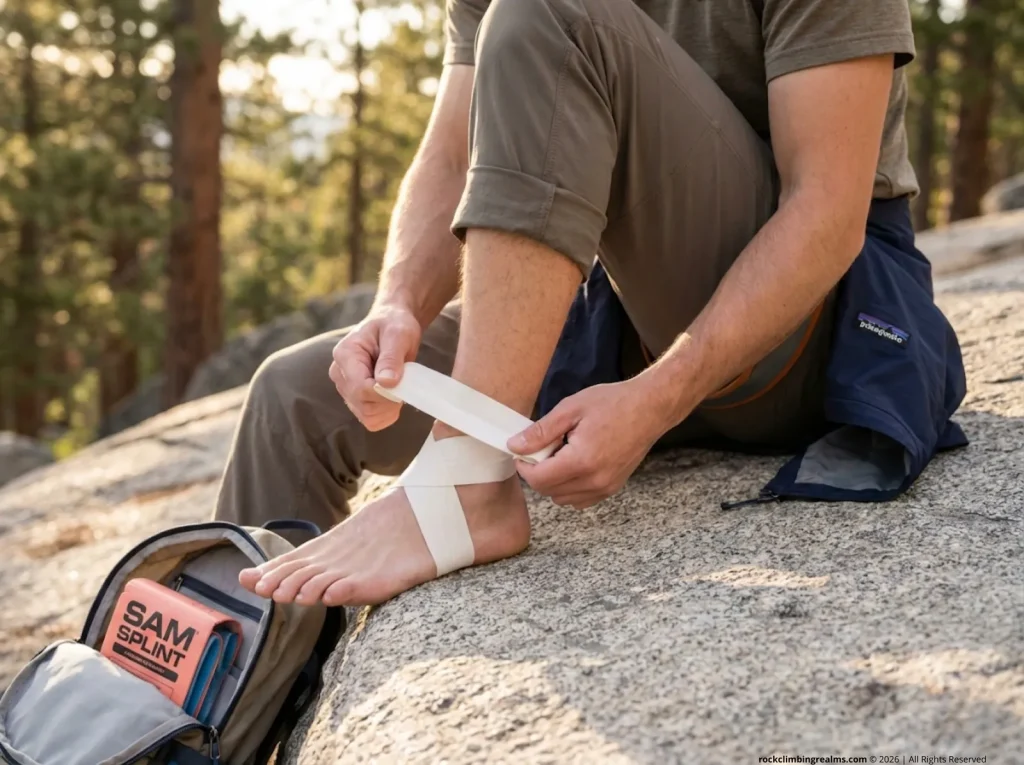
The RICE protocol — rest, ice, compression, elevation — remains the field stabilization standard recommended by NOLS Wilderness Medicine. Stop climbing immediately. No “testing it on one more problem.” If there’s snow nearby, pack the ankle in it for twenty minutes on, twenty off. A cold stream works almost as well. Wrap with athletic tape or a compression bandage before the swelling peaks, and sit on the crash pad with your ankle above heart level for fifteen minutes minimum.
One thing worth knowing. Modern evidence suggests early protected loading may outperform prolonged rest for recovery speed, according to a 2012 systematic review on RICE for ankle sprains. At the crag, use RICE for immediate management. Once you’re home, start gentle movement as pain allows rather than spending weeks immobilized on the couch.
The Figure-8 Tape Job
Two-inch athletic tape or climber’s tape is what you want. Start with two anchor strips just below the calf. Build stirrups from one side of the ankle to the other, locking the heel in place. Then wrap a figure-8 pattern crossing the front of the ankle with the foot held at ninety degrees. Finish with heel-lock wraps on both sides. You’ll use roughly three to four feet of tape per ankle.
After taping, re-check CSM. A wrap that’s too tight can cause compartment problems that are worse than the original sprain. If toes go numb or turn blue, loosen immediately.
Improvised U-Splint When Tape Isn’t Enough
For a non-usable or borderline injury, a SAM Splint bent into a U-stirrup is ideal. No SAM Splint in your pack? Roll a jacket or puffy into a tube, place it under the foot and up both sides of the lower leg, and tape it secure. The goal is to lock the ankle in a neutral position and prevent any further inversion during the hobble out or carry.
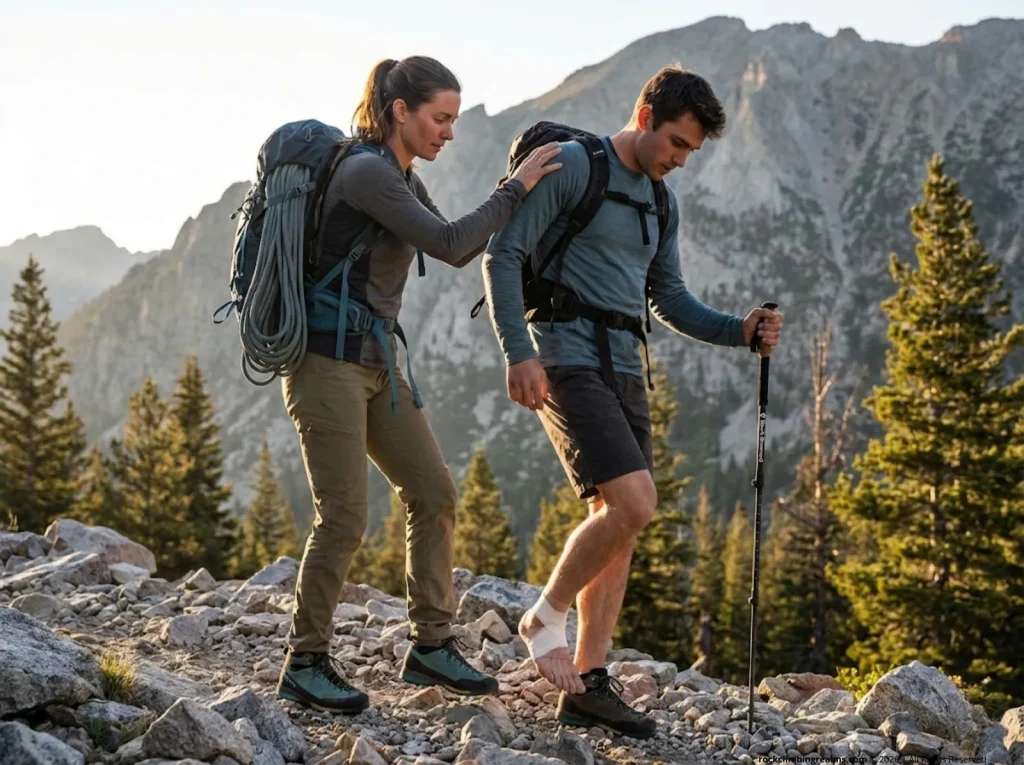
If you have a partner, use their shoulder for support. A trekking pole on the opposite side helps distribute weight away from the injured ankle.
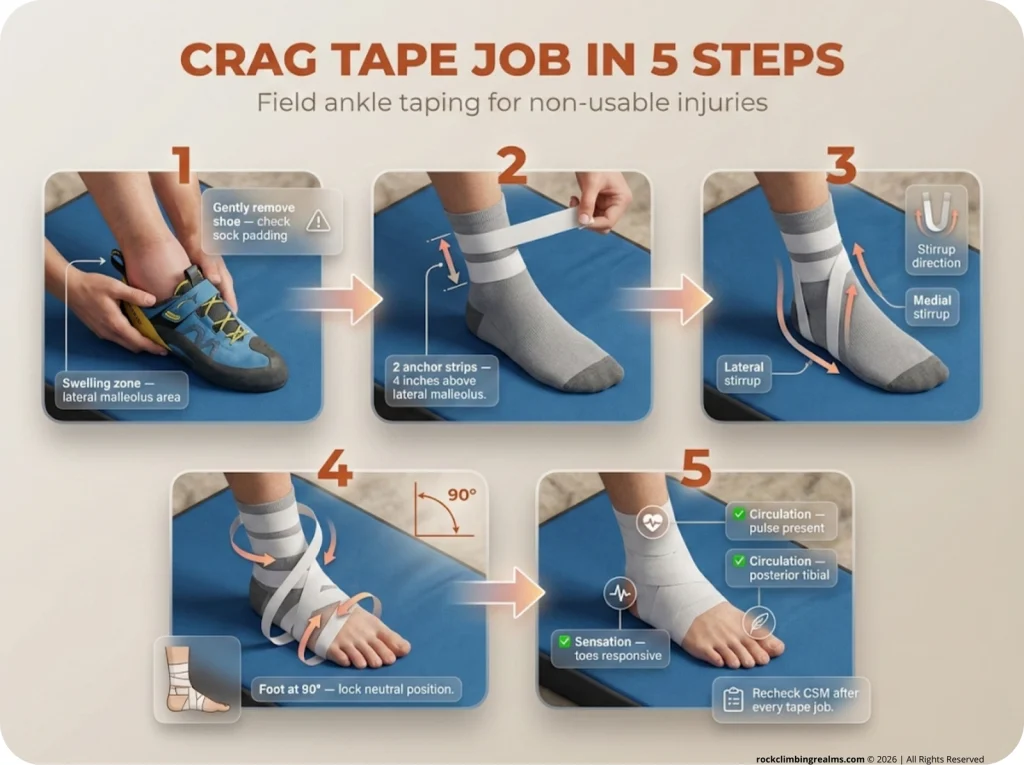
When packing your essential climbing trip gear, toss in a SAM Splint (four ounces, folds flat) and two rolls of two-inch athletic tape. They weigh nothing and handle everything from a simple field tape job to a full splinting situation.
Pro tip: If you’re bouldering in winter, pack the ankle in snow immediately after the injury. Twenty minutes buried in a snowbank beats any chemical ice pack you could carry.
Walk Off or Call for Help? The Evacuation Decision
When You Can Hobble Out
A usable injury that’s been taped or splinted, combined with a partner on your shoulder, makes self-evacuation viable on most crag approaches. Switch to high-top hiking boots or approach shoes if you have them. The external ankle cup adds meaningful stabilization that climbing shoes and trail runners can’t match.
Move slowly on descents. Talus and scree are re-injury traps. Plan rest stops every fifteen to twenty minutes to re-elevate the ankle and re-check CSM. Understanding proper crash pad placement and fall vectors can prevent most of these situations in the first place.
When You Need SAR
If the ankle is non-usable — can’t take four steps, Ottawa positive, absent CSM, obvious deformity, crepitus, or rapidly expanding bruising — do not walk on it. Call 911 or local mountain rescue. Provide GPS coordinates, injury description, and number of people in the party.
Immobilize with a U-splint, elevate, and keep the injured person warm. Hypothermia risk compounds any musculoskeletal injury at altitude, and a lot of climbing crags have limited cell service. Know your emergency plan before you leave the car. Run through the pre-climb safety checks every climber skips, including the one about how you’ll communicate if something goes wrong.
Nobody will judge you for calling rescue on a bad ankle. Plenty of people will judge you for making your partners carry you three miles and reinjuring both of you.
The Return-to-Projecting Rehab Pipeline
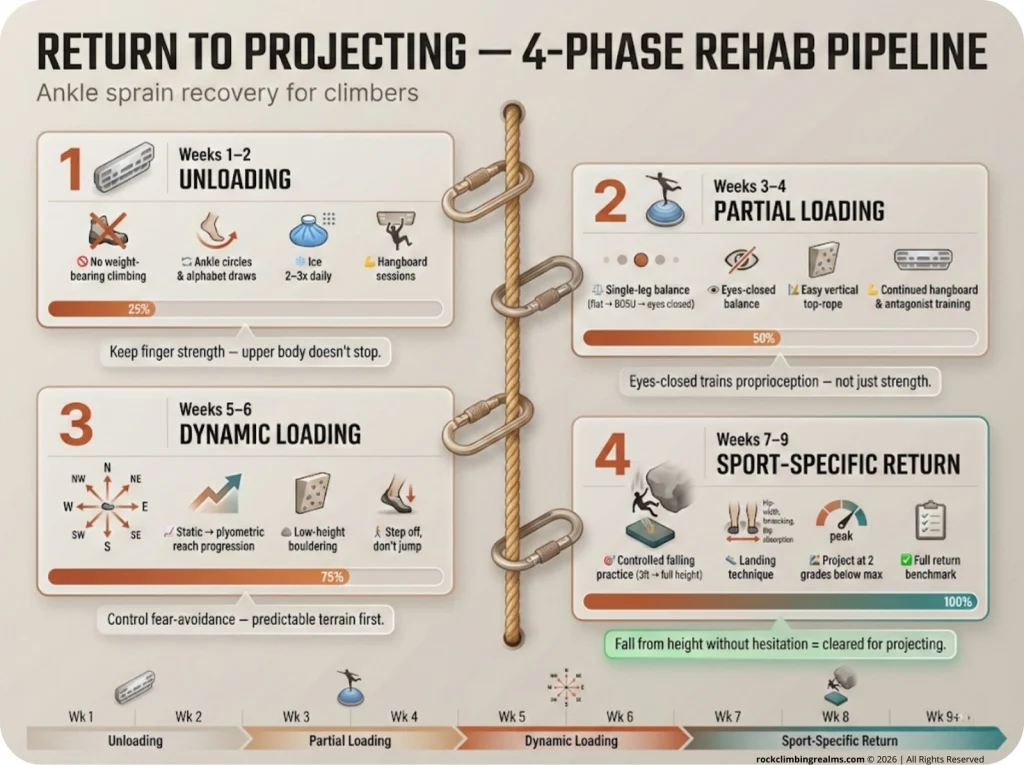
This is where every competitor article stops — basic RICE, a few sentences about rest, and a generic “see your doctor.” That approach leaves dedicated climbers with half a plan and a high risk of recurrent ankle sprains. Here’s the full pipeline, broken into four rehab stages that take you from the couch back to sending.
Phase 1 — Unloading (Weeks 1–2)
No weight-bearing climbing. The ankle needs controlled rest while the ligament starts healing. Gentle ankle circles, alphabet draws with the big toe, and ice two to three times daily.
Start short foot exercises as soon as pain allows. Scrunch your arch by pulling the ball of the foot toward the heel without curling the toes. This activates the intrinsic foot muscles that stabilize the ankle from the ground up.
And here’s the move that keeps serious climbers sane during unloading — hangboard sessions. Your fingers don’t care that your ankle is busted. Maintain finger strength so you don’t lose two months of upper-body work while the lower half heals.
Phase 2 — Partial Loading (Weeks 3–4)
Progress to single-leg balance on a flat surface, then on an unstable surface like a BOSU ball or folded crash pad. Eyes open first, then eyes closed. The eyes-closed version forces your ankle to rely on its position sense instead of visual cues, and that’s the whole point of effective balance training.
Start easy top-rope climbing on vertical walls with careful footwork emphasis. No dynamic moves, no heel hooks, no aggressive toe hooks yet. Keep the hangboard and antagonist training going so upper-body climbing readiness stays intact.
Phase 3 — Dynamic Loading (Weeks 5–6)
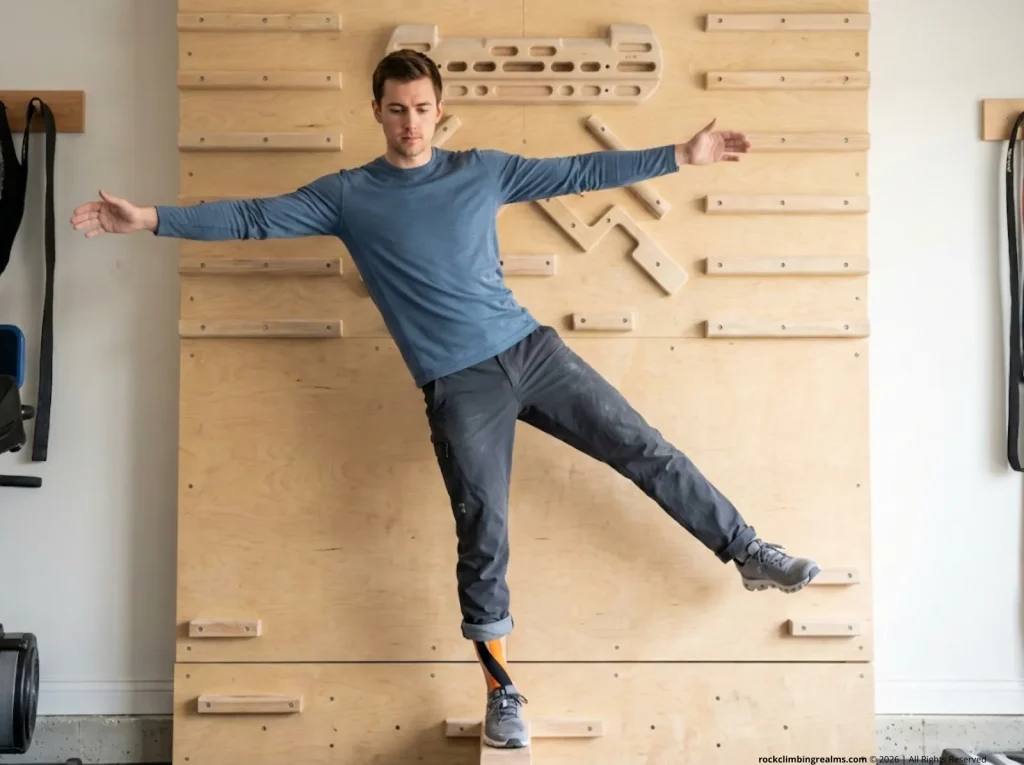
Time for the systems board. The star drill is the gold standard here. Stand on the injured leg on a low foothold and reach your opposite foot to eight compass points while maintaining balance. Progress from controlled static reaches to dynamic plyometrics that mimic real foot placements on varied terrain.
Begin low-height bouldering (easy grades) with controlled descents. Step off holds. Don’t jump. And start addressing kinesiophobia directly. Fear-avoidance after a bad sprain is real, and ignoring it doesn’t make it go away. Controlled exposure on predictable terrain is how you rebuild confidence before touching real rock.
Phase 4 — Sport-Specific Return (Weeks 7–9)
Controlled falling practice on the bouldering wall. Start at three feet, progress to normal height. Rehearse landing technique every single time — feet hip-width, knees tracking over ankles, absorb with hip flexion.
Return to projecting at reduced intensity, two grades below your max, before pushing limits again. Grade 2 sprains may need eight or more weeks. Don’t skip phases because the ankle “feels fine.” The full return benchmark is simple — can you fall from project height and land without hesitation or guarding?
Pro tip: Start your rehab on the systems board where you control the angle and hold size. The heights are low, the moves are simple, and you rebuild ankle confidence without the pressure of a real send attempt.
Bulletproof Your Ankles Before the Next Session
Landing Mechanics That Prevent the Next Roll
Rehearse bouldering landings before every session. Feet hip-width, knees soft, weight centered over your base. Assess pad placement relative to the fall zone arcs on every problem. On highball landings, rehearse the downclimb option before committing.
Trail runners and approach shoes with ankle cups reduce sprain risk on approach trails and descent trails significantly. If you’re hiking into a talus-heavy crag, leave the sandals in the car and wear appropriate footwear with real support.
The 5-Minute Pre-Session Ankle Protocol
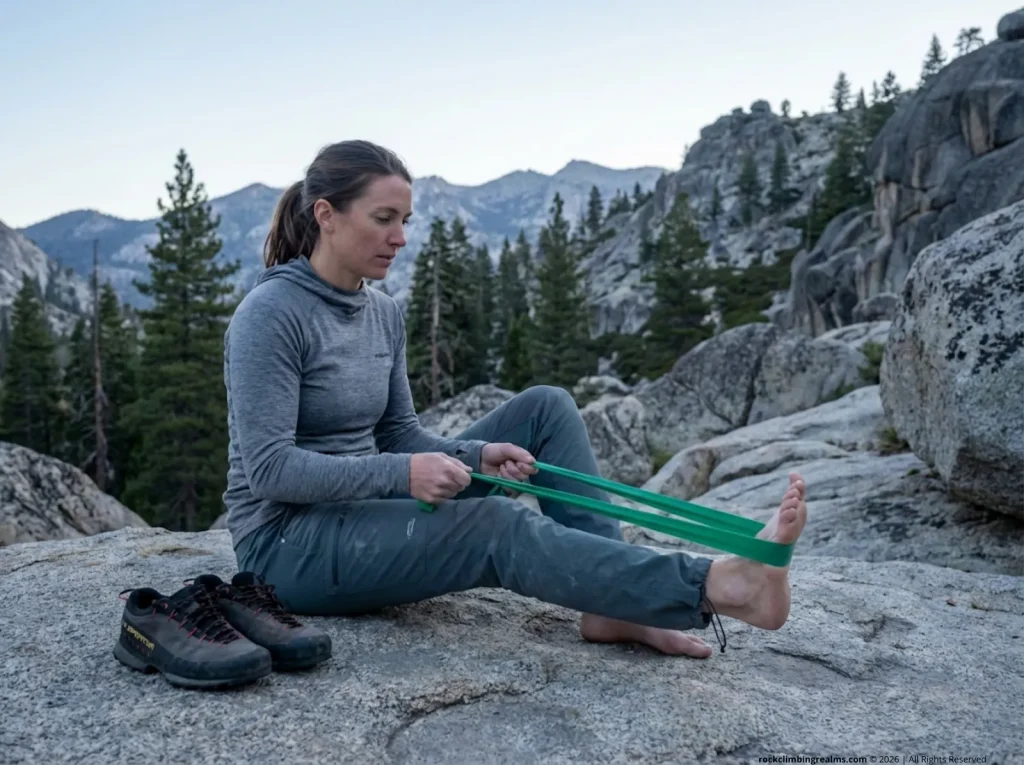
Five minutes of ankle work before every session cuts re-injury risk dramatically. Elastic band resistance exercises — eversion and inversion against a resistance band, twenty reps each direction. Single-leg balance holds, thirty seconds each side with eyes closed. Range of motion ankle circles, fifteen each direction per ankle. Calf raises, fifteen reps bilateral then single-leg. Neuromuscular training is the single best defense against recurrent sprains, and this takes less time than chalking up.
Gear That Earns Its Place in Your Pack
A SAM Splint, two rolls of two-inch athletic tape, a cohesive bandage, and a light resistance band. That’s the first aid ankle kit. The SAM Splint weighs four ounces and folds flat. The tape doubles as finger tape. The cohesive bandage stays put without scissors. The band fits in a chalk bag pocket and enables the pre-session protocol anywhere. Add high-top hiking boots for talus-heavy approaches, and you’ve covered every angle.
Conclusion
Three things decide whether a rolled ankle at the crag becomes a minor setback or a season-ender. Get those climbing shoes off and run the assessment protocol — CSM, Ottawa, usability test — before doing anything else. Tape or splint with what you’ve got and make an honest evacuation decision. And commit to the full rehab pipeline, because the star drill and controlled falling practice aren’t optional if you want to project again without your ankle failing at the worst possible moment.
Pack a SAM Splint and three rolls of tape on your next crag day. Run through the assessment sequence with your climbing partner while you’re both healthy. The time to learn this stuff is before you need it, not after.
Now go send something.
FAQ
How long does a sprained ankle take to heal before I can climb again?
Grade 1 ankle sprains allow easy top-rope climbing within two to three weeks with proper rehab. Grade 2 sprains typically need six to nine weeks of phased rehabilitation before returning to projecting grades. Skipping phases is the fastest path to chronic ankle instability and repeat injuries.
Can I tell the difference between a sprain and a broken ankle at the crag?
The Ottawa Ankle Rules are 97.6 to 100 percent sensitive for ruling out significant fractures. Palpate the bony landmarks — posterior malleolus tips, fifth metatarsal base, navicular. No bony tenderness at those points and you can take four weight-bearing steps? A fracture is highly unlikely. Any doubt, immobilize and evacuate.
Should I keep my climbing shoes on to support a rolled ankle?
No. Remove climbing shoes immediately. They have zero ankle support and their tight fit traps swelling, making removal painful or impossible later. Switch to approach shoes or high-top hiking boots if available for the walk out.
What should I carry in my climbing first-aid kit for ankle injuries?
At minimum, one 36-inch SAM Splint (four ounces, folds flat), two to three rolls of two-inch athletic tape, and a cohesive bandage. This handles everything from a simple tape job to a full U-splint for non-usable injuries. A light resistance band for pre-session ankle work is a smart addition to your first aid kit.
Is RICE still the best treatment for a climbing ankle sprain?
RICE protocol remains the wilderness first aid standard recommended by NOLS Wilderness Medicine, but modern evidence suggests early protected loading may improve recovery speed compared to prolonged rest. At the crag, use RICE for immediate management. Once home, start gentle movement as pain allows rather than weeks of total immobilization. Elevating the ankle and taking pain medication is fine for the first couple of days, but movement is medicine after that.
Safety Notice: Rock climbing and mountaineering are inherently high-risk
activities that can involve physical trauma or fatal incidents. The information on Rock Climbing Realms is for
educational and informational purposes only. Techniques and advice presented here are not a substitute
for professional, hands-on instruction. Conditions and risks vary by location. Always seek guidance
from a qualified instructor before attempting new techniques. By using this website, you agree that you
are solely responsible for your own safety. Any reliance you place on this information is strictly
at your own risk, and you assume all liability for your actions. Rock Climbing Realms and its authors
will not be held liable for any harm, damage, or loss sustained in connection with the use of this information.
Affiliate Disclosure: We are a participant in the Amazon Services LLC Associates Program, an
affiliate advertising program designed to provide a means for us to earn advertising fees by advertising and linking
to Amazon.com. As an Amazon Associate, we earn from qualifying purchases. We are also an official affiliate partner
of Black Diamond Equipment via the AvantLink network. If you click on a Black Diamond affiliate link and make a
purchase, we may earn a commission at no additional cost to you. We also participate in other affiliate programs.
Additional terms are found in the terms of service.