
In this article
The gate at the trailhead is locked. A “No Trespassing” sign hangs where the approach trail used to be, and the bolts on your project have been chopped by a land manager enforcing a sixty-year-old wilderness interpretation.
This scenario is not a dystopian fiction; it is the default state of American climbing without intervention. I have spent decades guiding clients from the granite of Yosemite to the sandstone of the Southeast, and I have seen firsthand how quickly access can vanish when no one is watching the shop.
While we obsess over the weight of our carabiners and the friction of our rubber, we often ignore the “Invisible Infrastructure”—the easements, liability policies, and federal legislation—that allows us to step onto the rock in the first place.
The Access Fund acts as the architect of this infrastructure. Founded by visionaries like Armando Menocal, it functions as more than a charity, operating as a sophisticated triad: a Banker for private land acquisition, a Lawyer for fighting land management policy battles, and a Builder for restoring the physical environment. This guide explores the machinery behind that logo on your bumper, breaking down the financial engines, legal shields, and stewardship realities that keep our crags open.
What is the Access Fund’s Role in Modern Climbing?
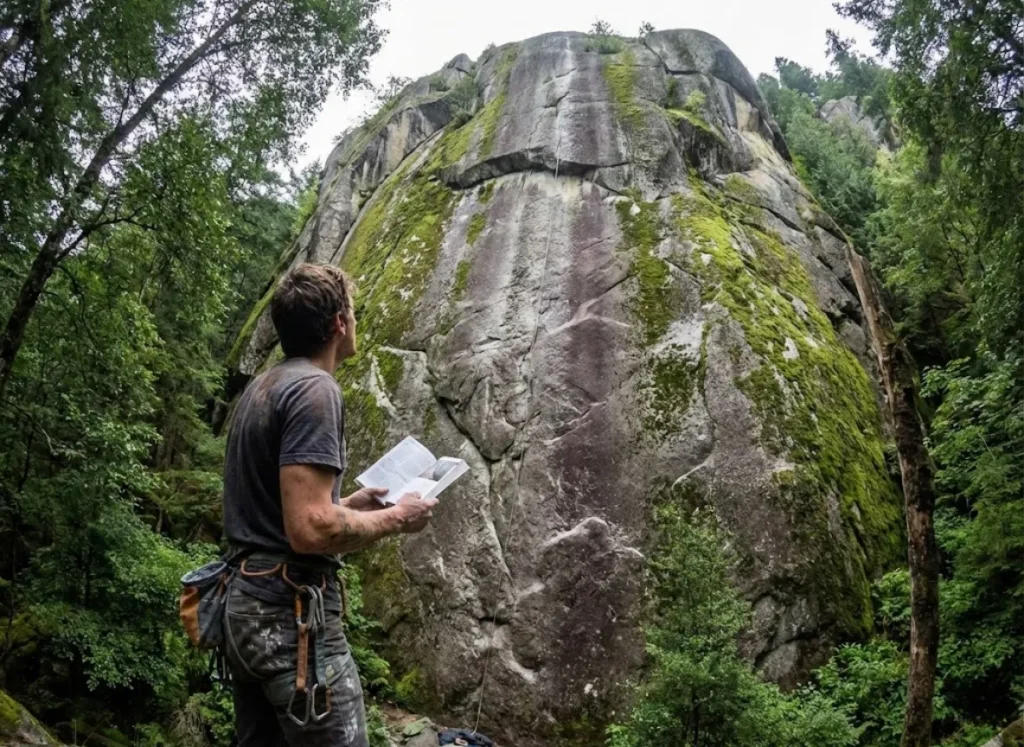
The Access Fund is the only national rock climbing advocacy organization in the United States dedicated exclusively to protecting climbing access and conserving the climbing environment.
How Does the “Invisible Gear” Concept Protect Your Crag?
Climbing access is maintained through a complex web of “Invisible Gear”—legal agreements and policy frameworks—rather than physical hardware. Think of the Access Fund not as a club, but as a specialized protective system for the sport itself. Established in 1991 following the fractious “Bolt Wars” of the 1980s, the organization shifted the focus from internal ethical squabbles to external environmental conservation.
Today, it operates as an accredited Land Trust. This allows it to secure permanent sustainable access through fee-simple acquisition (buying land outright) and conservation easements. Simultaneously, it functions as a lobbying firm in Washington D.C., drafting legislation like the Dingell Act to protect recreation on public lands.
The organization bridges the gap between climbers and federal agencies like the NPS, USFS, and BLM. It translates our needs into policy language that land managers understand, providing a critical legitimacy layer to our sport. This work requires institutional trust, evidenced by financial accountability and transparency ratings that allow the Access Fund to negotiate with private landowners and government bodies effectively.
However, this institutional power relies on individual behavior. The legal framework only holds if climbers uphold their commitment to the Climber’s Pact, ensuring that our actions on the rock do not undermine the negotiations happening in the boardroom.
Why Is a National “Federated Network” Essential for Local Access?
The Access Fund operates as the central node for over 130 Local Climbing Orgs (LCOs), such as the Red River Gorge Climbers’ Coalition (RRGCC), the Washington Climbers Coalition, and the Southeastern Climbers Coalition (SCC).
The national entity provides the “heavy artillery” resources that small local groups cannot afford. This includes high-level legal counsel, bridge loans for land purchases, and complex insurance policies. While the national office handles federal policy (The Lawyer), the LCOs manage the specific landowner relationships, trail days, and community relations needed for site-specific stewardship.
Pro-Tip: If you are visiting a new crag, always check if there is an active LCO. Their website will often have up-to-date beta on parking restrictions and closure notices that haven’t made it to Mountain Project yet.
This federated model allows for a specialized division of labor. It ensures that when a crisis occurs—like a sudden sale of private land—there is a pre-existing infrastructure ready to deploy capital and legal expertise immediately. This structure is built on coalition partnerships and land trust accreditation standards, ensuring stability across the network. By partnering with the Outdoor Alliance, they amplify this voice further.
By understanding the threats to climbing access, ranging from liability concerns to private land development, you can see why this symbiotic relationship between the national “Banker” and the local “Ground Crew” is the only way to keep the gates open.
How Does the “Banker” Model Buy Threatened Land?
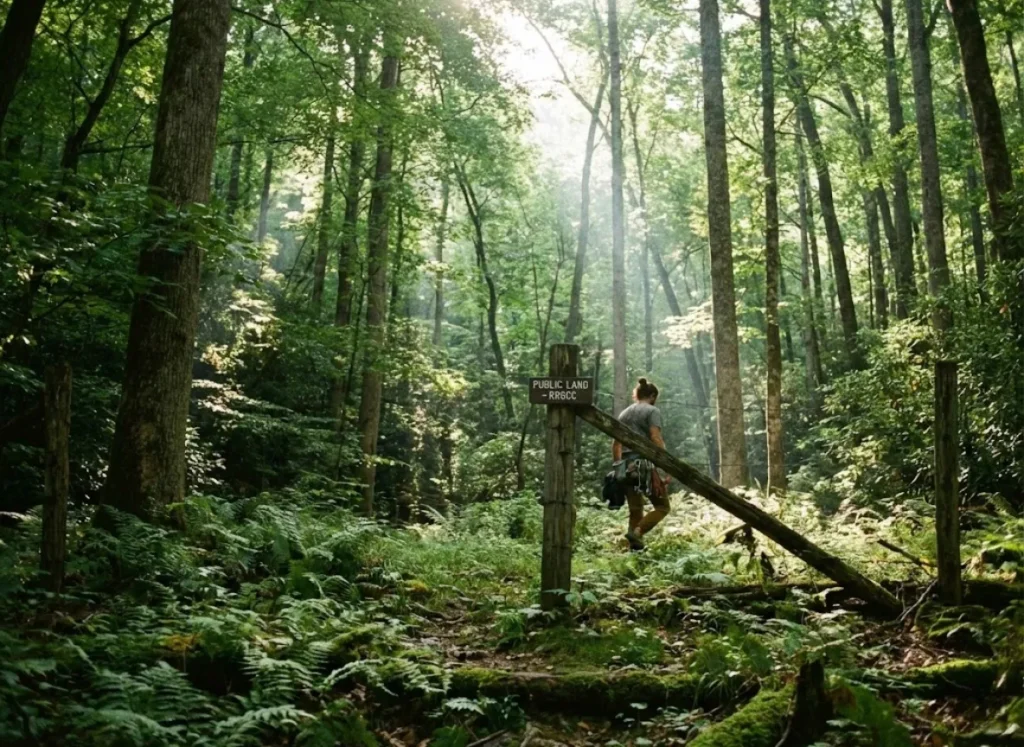
The “Banker” model utilizes a revolving loan fund to provide immediate liquidity to local organizations, creating a robust acquisition layer that allows them to purchase private land before developers can acquire it for trophy homes.
What Is the Climbing Conservation Loan Program (CCLP)?
The Climbing Conservation Loan Program (CCLP) is a revolving loan fund that functions as a renewable source of capital for land acquisition. It provides “bridge financing” to LCOs, allowing them to purchase threatened private land quickly. Speed is often the deciding factor in real estate; developers have cash on hand, and without the CCLP, climber coalitions would lose out while trying to fundraise.
Once the land is secured, the local community repays the loan through fundraising over time. This returns the capital to the fund to be reused for the next crisis. This creates a powerful “multiplier effect” where a single donated dollar is used repeatedly to purchase multiple climbing areas.
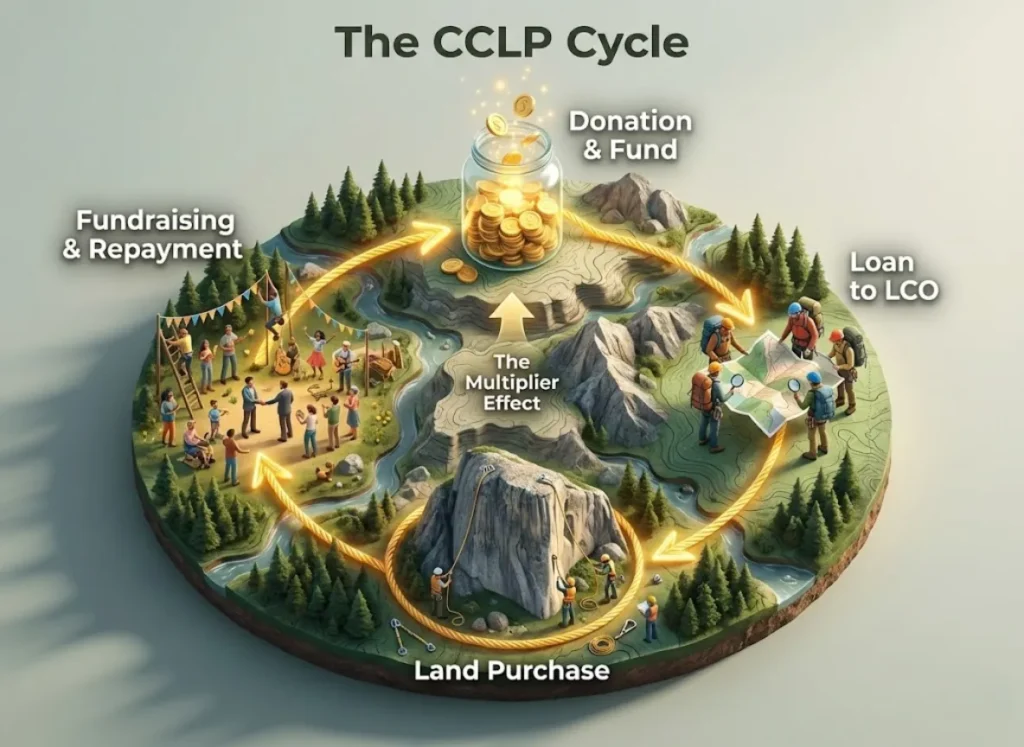
Since its inception, the CCLP has deployed millions in capital to secure iconic areas like Donner Summit (CA), Rumney (NH), and the Index Field of Dreams (WA). You can review the financials and loan program allocation details to see exactly how this liquidity removes the primary barrier to saving private crags. It serves as a financial belay for climbing in the Red River Gorge and beyond.
How Did Bridge Financing Save the Red River Gorge and Holy Boulders?
In 2013, the RRGCC utilized a $200,000 CCLP loan to acquire the 309-acre Miller Fork Preserve. This move prevented the land from being subdivided for oil exploration or private cabins. Similarly, the Access Fund purchased the Holy Boulders in Illinois directly for $300,000 in 2012, holding the title as a temporary land trust until the local community could take ownership.
More recently, the acquisition of The Citadel in Alabama (2023) and Woodcock Cove in Tennessee utilized CCLP gap financing to finalize deals that had been in negotiation for years. The Holy Boulders deal involved subdividing agricultural land to pay down debt, demonstrating sophisticated real estate management.
The economic impact of rock climbing in the Red River Gorge proves that Miller Fork now contributes significantly to the local economy. These cases illustrate the “Banker” role: providing the capital and technical real estate expertise (surveys, title work) that local climbers rarely possess. This strategy mirrors the success seen at the Boat Rock bouldering area, where rapid acquisition saved a historic urban crag from becoming a subdivision.
When Is a Conservation Easement Used Instead of a Purchase?
At Jailhouse Rock (CA), the Access Fund utilized a Conservation Easement and Access Easement rather than a fee-simple purchase. This legal tool permanently restricts development on a specific strip of land (the cliff and trail) while allowing the private landowner to retain ownership of the ranch.
It effectively separates the “right to develop” from the land title, extinguishing it to ensure the crag remains in its natural state. Easements are critical when landowners are willing to allow climbing but unwilling to sell the entire property. The arrangement often includes liability protections for the landowner under state Recreational Use Statutes. Similar strategies have been crucial in areas near The Gunks (Shawangunks) to buffer protected lands.
This strategy requires less capital upfront but demands perpetual legal monitoring. Understanding the definition and legal framework of conservation easements highlights why this is a preferred tool for working ranches and farms. Because easements rely on good relations with the landowner, strict adherence to trad ethics and LNT is mandatory; one open gate or piece of litter can jeopardize the agreement.
Why Is the “Lawyer” Function Critical in Washington D.C.?
The “Lawyer” function, led by experts like VP of Policy Erik Murdock, provides the legislative defense necessary to ensure that federal policies recognize climbing as a legitimate and protected use of public lands. This constitutes the vital policy layer of the organization.
How Did the PARC Act Resolve the “Bolt Ban” Threat?
In 2023, federal agencies proposed classifying fixed anchors (bolts, pitons) as prohibited “installations” under the Wilderness Act of 1964. This interpretation threatened to ban new routes and complicate the maintenance of existing anchors in iconic areas like Yosemite, Black Canyon of the Gunnison, and Rocky Mountain National Park.
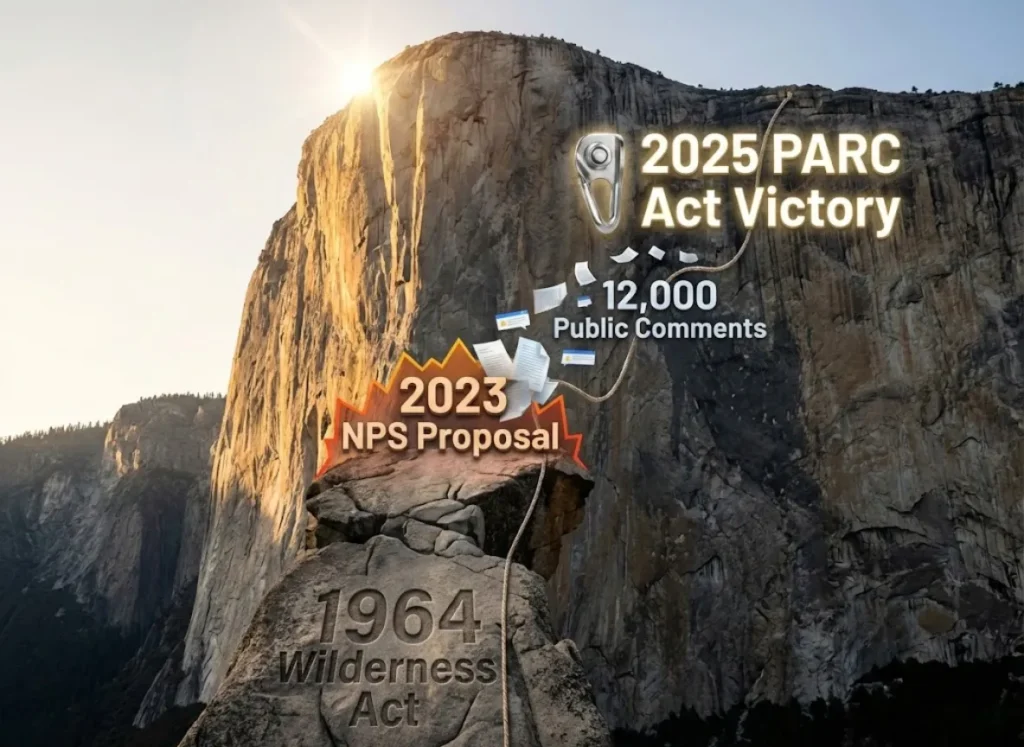
The Access Fund lobbied for the Protecting America’s Rock Climbing (PARC) Act, which was signed into law in January 2025 as part of the EXPLORE Act. The PARC Act codified “recreational climbing” and the use of fixed anchors as an “appropriate use” of Wilderness, overriding the agency proposal.
This victory prevents a blanket ban, requiring a public notice and comment process for any future restrictions. The details of this fight are outlined in the congressional report on the EXPLORE Act. It was a massive effort in decoding climbing access threats, protecting fixed anchor legislation through unified political pressure.
What Role Did the Dingell Act Play in Wilderness Protection?
The Dingell Act (2019) was a massive omnibus public lands bill that designated 1.3 million acres of new Wilderness, including the San Rafael Swell in Utah. The Access Fund successfully inserted specific language into the bill that explicitly protected climbing access within these new wilderness designations.
This set a critical legislative precedent that climbing is compatible with wilderness values (“Wilderness Character”). Prior to this, wilderness designations often inadvertently closed climbing areas due to strict interpretations of the 1964 Wilderness Act. They work similarly to secure funding through the Great American Outdoors Act (GAOA) and the Land and Water Conservation Fund (LWCF) to maintain these lands. You can read the specific protections in the text of the John D. Dingell, Jr. Conservation, Management, and Recreation Act.
The Dingell Act served as the blueprint for the broader national protections secured in the PARC Act. It highlighted the organization’s ability to operate at the highest levels of government to secure “Regulatory Insurance” for the sport, a necessity when dealing with complex management plans like those affecting Indian Creek, Bears Ears, and Ten Sleep rock climbing.
How Does the “Builder” Function Maintain Physical Access?
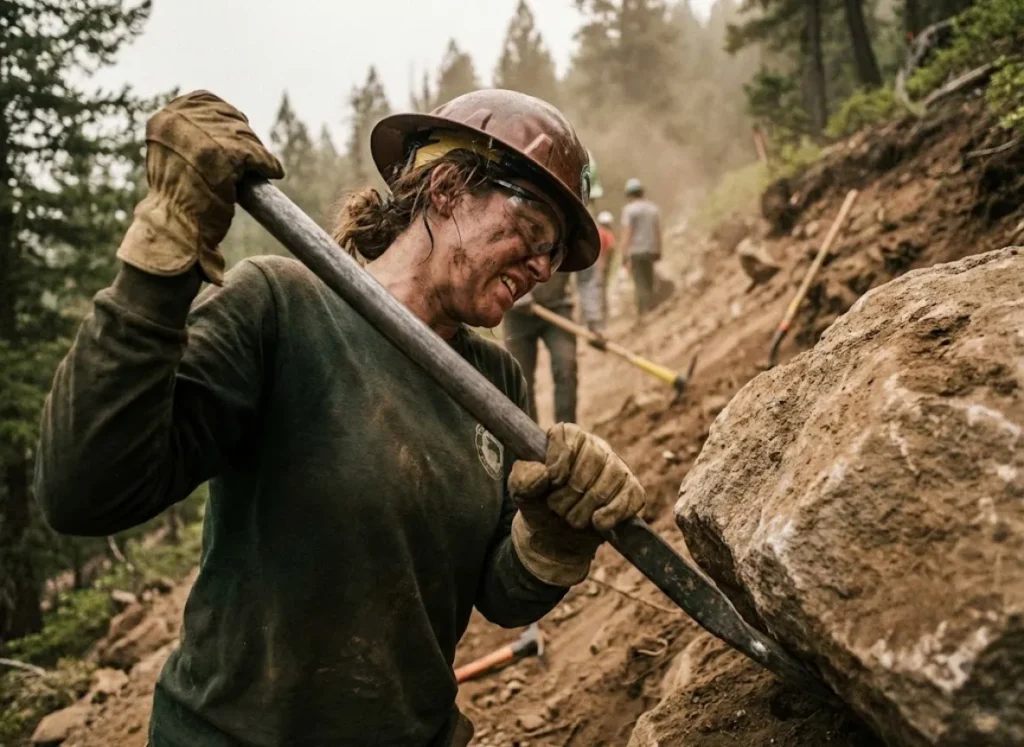
The “Builder” function creates a tangible stewardship layer, involving professional teams that physically restore climbing areas, stabilizing soils and constructing sustainable infrastructure to mitigate human impact.
What Do Conservation Teams Do to Fix “Loved to Exhaustion” Crags?
Conservation Teams are professional, mobile trail-building crews that travel the country to restore degraded climbing areas. They utilize heavy equipment (griphoists, highlines) and technical stonework to build sustainable approach trails, retaining walls, and belay platforms.
Since their inception, they have constructed or restored over 65,000 feet of trail and launched the Climber Stewards Program to address overcrowding and erosion at hot spots like Joshua Tree. This work transforms stewardship from a vague concept into engineering; they stabilize slopes that would otherwise erode into the watershed. The teams also lead Adopt a Crag events, training local volunteers in sustainable trail-building techniques to multiply their impact.
By professionalizing trail work, they ensure that climbing infrastructure meets the durability standards required by land managers, facilitating National Park Service partnerships for trail maintenance. This hands-on work is the physical manifestation of climbing stewardship beyond LNT, moving from “leave no trace” to “leave it better.”
How Does the Anchor Replacement Fund Keep Legacy Routes Safe?
The Anchor Replacement Fund, a partnership with the American Alpine Club (AAC), provides grants to replace aging, corrosion-prone “legacy bolts” from the 80s and 90s. It funds the purchase of modern, stainless steel or titanium hardware (often glue-in bolts) for local rebolting initiatives.
Pro-Tip: Inspect your bolts. If you see rust running down the rock face from behind the hanger, or if the hanger spins freely, the anchor is compromised. Back it up with natural gear if possible and report it to the local LCO.
Recent grants have supported safety updates at major destinations like The Endless Wall (WV), Foster Falls (TN), and Skinner Butte (OR). This program addresses a critical safety gap; there is no “maintenance staff” at outdoor crags. It supports the volunteer developers who do the dangerous work of removing old hardware.
By funding materials that meet UIAA standards for rock climbing anchors, the program ensures that replaced anchors will last for generations. Of course, the best hardware in the world is useless if you don’t know the basics of cleaning a sport anchor safely to prevent unnecessary wear.
How Can Individual Climbers Invest in the Future of Access?
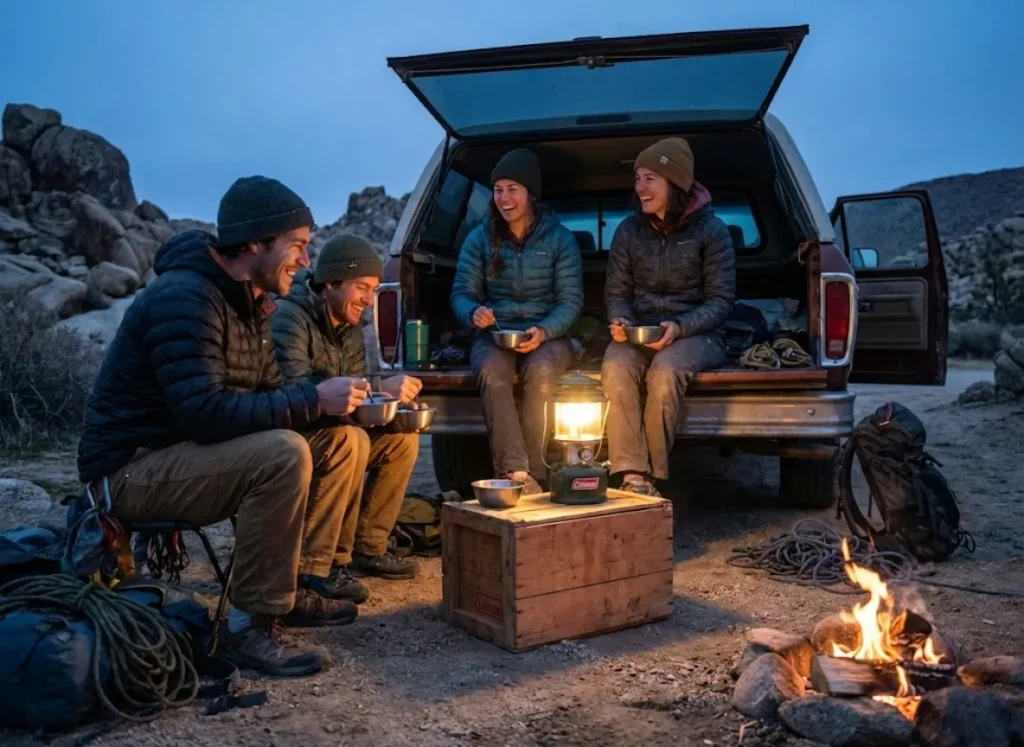
Individual climbers can invest in the future of access by maintaining membership in advocacy groups, which provides the funding and political leverage necessary to protect America’s climbing.
What Is the Economic Argument for Climbing in Rural Areas?
Economic impact studies prove that protected climbing areas are powerful economic engines for rural communities. Research shows climbers contribute $12.1 million annually to the New River Gorge (WV) region and $8.7 million to the Red River Gorge (KY).
This spending supports hundreds of local jobs in counties that have historically struggled with the decline of extractive industries like coal. The Access Fund funds this research to arm local advocates with data; “climbing pays the bills” is often a more persuasive argument to town councils than “climbing is fun.”

You can see the details in the New River Gorge economic impact study data. This data helps secure local political support for acquisitions and favorable access policies for rock climbing in the New River Gorge.
How Does the Joint Membership Model Support Local and National Goals?
The Joint Membership model allows a user to join both the national Access Fund and their specific LCO (e.g., Denny Cove stewards or the SCC) in a single transaction. A portion of the dues is routed directly to the local group, providing them with essential operating revenue without administrative overhead.
Membership is effectively “access insurance”—an investment that ensures the crags remain open, the bolts remain legal, and the trails remain usable. With high programmatic efficiency, verified by their GuideStar profile and Charity Navigator score, the contributions are deployed effectively into the “Invisible Infrastructure.”
It transforms the climber from a passive user into an informed steward. Many climbers choose to hold this alongside an American Alpine Club membership, covering both climbing conservation (AF) and rescue insurance (AAC). Through the mission & membership portal, you can see exactly where your money goes—towards expenses that keep the crags open, not administrative bloat.
Conclusion
The work of the Access Fund is the difference between a closed gate and a clipped anchor. By functioning as a Banker, the organization recycles capital through the CCLP to buy crags like the Holy Boulders. As a Lawyer, it secures legislative victories like the PARC Act, ensuring the legality of fixed anchors in the backcountry. And as a Builder, its Conservation Teams physically restore the ground beneath our feet.
This sophisticated triad protects the sport we love, but it relies on us. Verify legitimacy of your local LCO, check their 501(c)(3) status for tax deductibility, and consider a Joint Membership. It is the best protection policy for your climbing lifestyle.
FAQ – Frequently Asked Questions
Is the Access Fund a charity?
Yes, the Access Fund is a 501(c)(3) status non-profit organization. It holds a 4-Star rating from Charity Navigator, indicating high levels of financial transparency and accountability.
What is the difference between the Access Fund and the American Alpine Club?
The Access Fund focuses primarily on access, policy, and climbing conservation (land acquisition or stewardship). The American Alpine Club (AAC) focuses more on expedition grants, rescue insurance, and library or historical preservation, though they partner closely on policy issues like the GAOA.
Does the Access Fund build trails?
Yes, through its Conservation Teams. These professional crews travel the country to build sustainable approach trails and restoration projects, often training local volunteers via Adopt a Crag events.
How does the Access Fund save climbing areas?
They use a three-pronged approach: purchasing private land acquisition via the Climbing Conservation Loan Program, lobbying for favorable land management policy (like the PARC Act), and providing legal or technical support to local climbing organizations.
Safety Notice: Rock climbing and mountaineering are inherently high-risk
activities that can involve physical trauma or fatal incidents. The information on Rock Climbing Realms is for
educational and informational purposes only. Techniques and advice presented here are not a substitute
for professional, hands-on instruction. Conditions and risks vary by location. Always seek guidance
from a qualified instructor before attempting new techniques. By using this website, you agree that you
are solely responsible for your own safety. Any reliance you place on this information is strictly
at your own risk, and you assume all liability for your actions. Rock Climbing Realms and its authors
will not be held liable for any harm, damage, or loss sustained in connection with the use of this information.
Affiliate Disclosure: We are a participant in the Amazon Services LLC Associates Program, an
affiliate advertising program designed to provide a means for us to earn advertising fees by advertising and linking
to Amazon.com. As an Amazon Associate, we earn from qualifying purchases. We are also an official affiliate partner
of Black Diamond Equipment via the AvantLink network. If you click on a Black Diamond affiliate link and make a
purchase, we may earn a commission at no additional cost to you. We also participate in other affiliate programs.
Additional terms are found in the terms of service.