
In this article
The ranger’s citation was already written before the climber even touched the rock. A 1986 machine-drilled bolt — placed legally under a looser interpretation, decades before the agency memo that would reclassify it — had just become a federal liability. The climber wasn’t there to add hardware. She was there to replace a corroded anchor that hadn’t held body weight in fifteen years. That moment — confused law, decaying hardware, and a ranger trained on the old policy — is exactly how the Bolt Wars were born. And it took forty years, two legislative sessions, and one presidential signature to officially end them.
By January 2026, the PARC Act (embedded within the EXPLORE Act, Public Law 118-234) had codified fixed anchors as legal and appropriate in the National Wilderness Preservation System. But legal and safe are two different things. This guide decodes the policy, the agency directives, the metallurgy, and the ethics so you can operate at the professional standard the law now demands.
⚡ Quick Answer: As of January 4, 2025, the PARC Act makes fixed anchor placement, use, and maintenance explicitly legal in National Wilderness areas. Most designations require hand drilling only — no power tools. Parks like Joshua Tree require a Special Use Permit that can take up to six months. The law protects the activity; agency directives and professional metallurgy standards govern the hardware. Know both before you touch a drill.
Quick Reference
PARC Act Signed: January 4, 2025 (Public Law 118-234)
Tool Requirement in Wilderness: Hand drill only — power tools strictly prohibited
Minimum Hardware Standard: 3/8″ × 2.5″ 316 stainless steel (1/2″ preferred)
NPS Permit Processing Time: Up to 6 months (Joshua Tree, Yosemite, Black Canyon)
SCC Failure Threshold: As low as 1–5 kN on a 25 kN-rated bolt under corrosion
From Controversy to Codification — The Legislative Arc
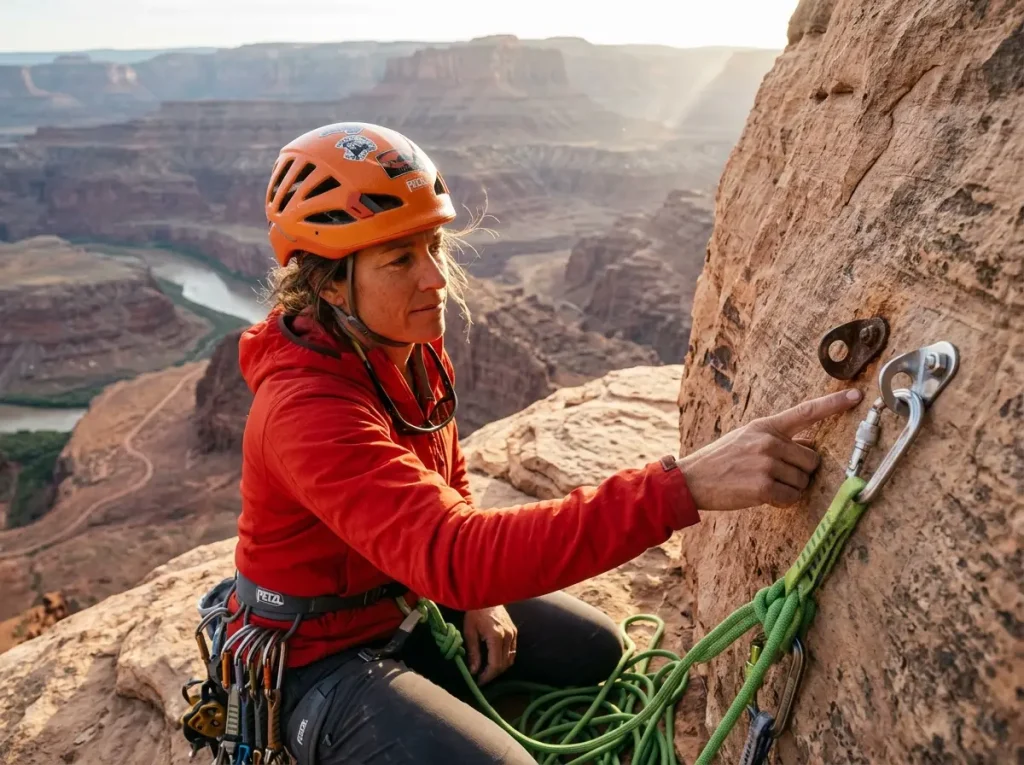
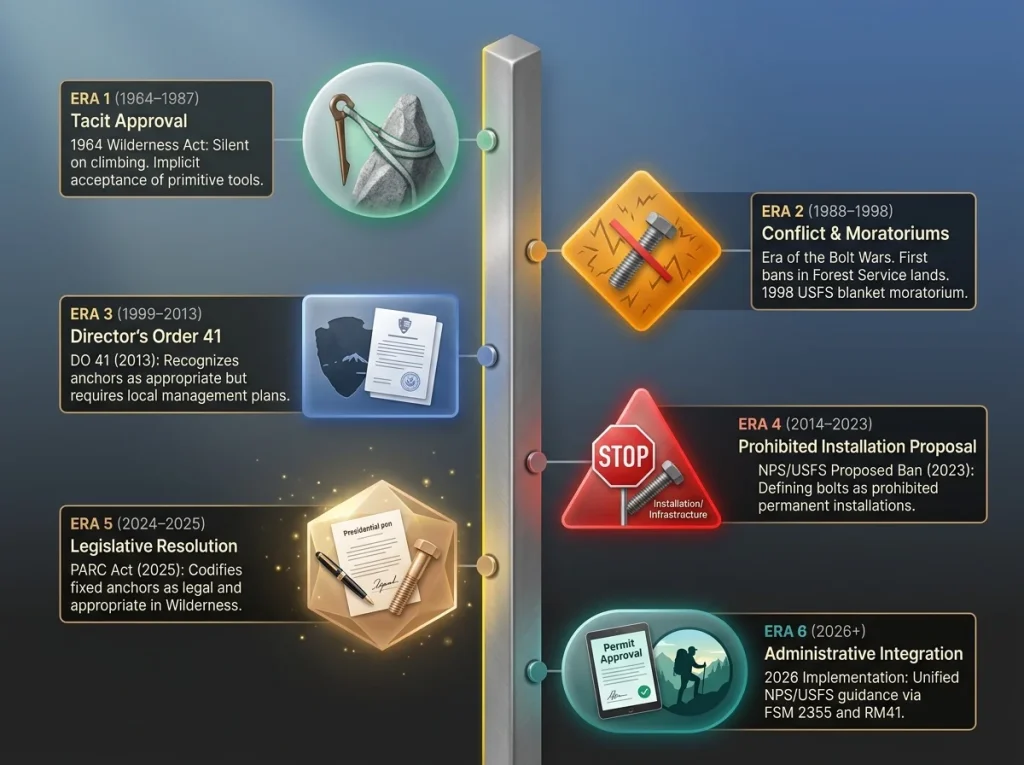
The 1964 Wilderness Act said exactly nothing about climbing hardware. Agencies operated in a vacuum, and for two decades that vacuum worked fine — trad climbers using removable gear, wilderness areas staying quiet. Then sport climbing arrived. Rappel-bolting — fixing protection while descending on a rope — spread from Yosemite walls to canyon sport crags and into wilderness zones. At places like Smith Rock and North Cascades, what had been the near-total ban on fixed anchors that almost erased decades of American climbing became a slow collision course with the “untrammeled wilderness” standard.
Alan Watts-era Yosemite culture called rappel-bolting an “unpardonable sin.” The argument wasn’t frivolous — if a stainless steel bolt counted as a “permanent improvement” under Section 4(c) of the Wilderness Act, it sat in the same legal category as a trail bridge or a dam. That definitional fight is what this was really about. Not ethics, not aesthetics: the agencies lacked a framework for distinguishing permanent infrastructure from safety hardware. Competitors cover the Bolt Wars as a culture clash. They miss that the two camps were literally arguing about different definitions of the same word.
The 2023 NPS/USFS proposal to classify fixed anchors as “prohibited installations” — requiring a Minimum Requirements Analysis for every individual bolt — nearly ended the debate by legislative surgery. A bolt-by-bolt MRA process would have made route maintenance impossible in practice, regardless of legal intent. The PARC Act’s impact on wilderness climbing access is measured precisely against that near-miss.
On January 4, 2025, the EXPLORE Act flipped the burden of proof. Before 2025, climbers justified anchors. After 2025, agencies must justify prohibition. The 2026 implementation phase completed the work: USFS FSM 2355 and NPS RM41 were updated, and final rules appeared in the Federal Register in spring 2026. Forty years compressed into one sentence: you are now a recognized stakeholder, not an illegal interloper.
What the Agency Directives Actually Require in 2026
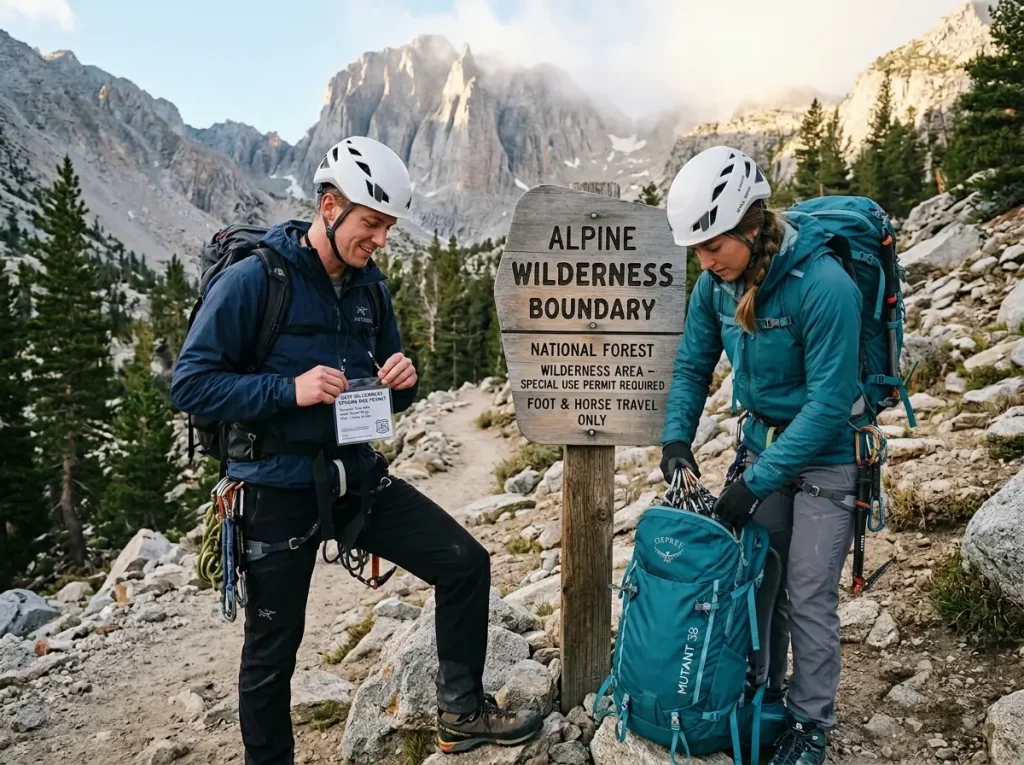
The law is federal. The rules are park-specific. Know the difference before you load the car.
USFS FSM 2355 governs about 30% of America’s climbing areas. Its defining feature is the “primitive tool requirement” — hand drills and hammers only, full stop. Individual anchors are generally exempt from Minimum Requirements Analysis. But local Forest Supervisors retain authority to limit bolting based on cumulative impact at specific crags. “Generally exempt” is not the same as “always exempt.” Call your local ranger district before committing to a new route development project.
NPS Director’s Order 41 / RM41 operates differently. Every park manages independently, all within PARC Act protections, but the ground-level rules vary hard. Here’s the park-by-park reality:
| Wilderness Bolting Regulations & Permit Requirements (2026) | ||
|---|---|---|
| Park / Area | Bolting Rule (2026) | Permit Required? |
| Joshua Tree Wilderness | Hand drill only; 3/8″ × 2.5″ SS minimum | Yes, all anchor work — GPS coordinates + photos required |
| Yosemite Wilderness | Hand drill only; power drills strictly prohibited | Yes, new routes; replacement varies by CMP |
| Black Canyon of the Gunnison | Hand drill only; visual impact minimization required | Yes, administrative review required |
| North Cascades | PARC Act lifted the moratorium; anchors now legal | Yes, follow new CMP guidelines |
Joshua Tree’s permit process is the benchmark everyone should study. You submit UTM coordinates, route photographs, and a formal justification that the fixed anchor is “the last resort” — the only means of safe ascent or descent. Review the permit process at Joshua Tree before you touch a single piece of hardware. That process can run six months. Start it before climbing season, not during.
The practical upshot: the law protects the activity. Agency directives govern the hardware. Operating under “allowed” without understanding the permit layer is how good climbers end up in bad situations with rangers who are still learning the new rules themselves.
Pro tip: Submit your NPS permit application in October for spring routes. The six-month clock is real, and permit staff at major parks are understaffed heading into 2026. Early submission isn’t courtesy — it’s logistics.
The Chemistry of Failure — What “Stainless” Actually Means
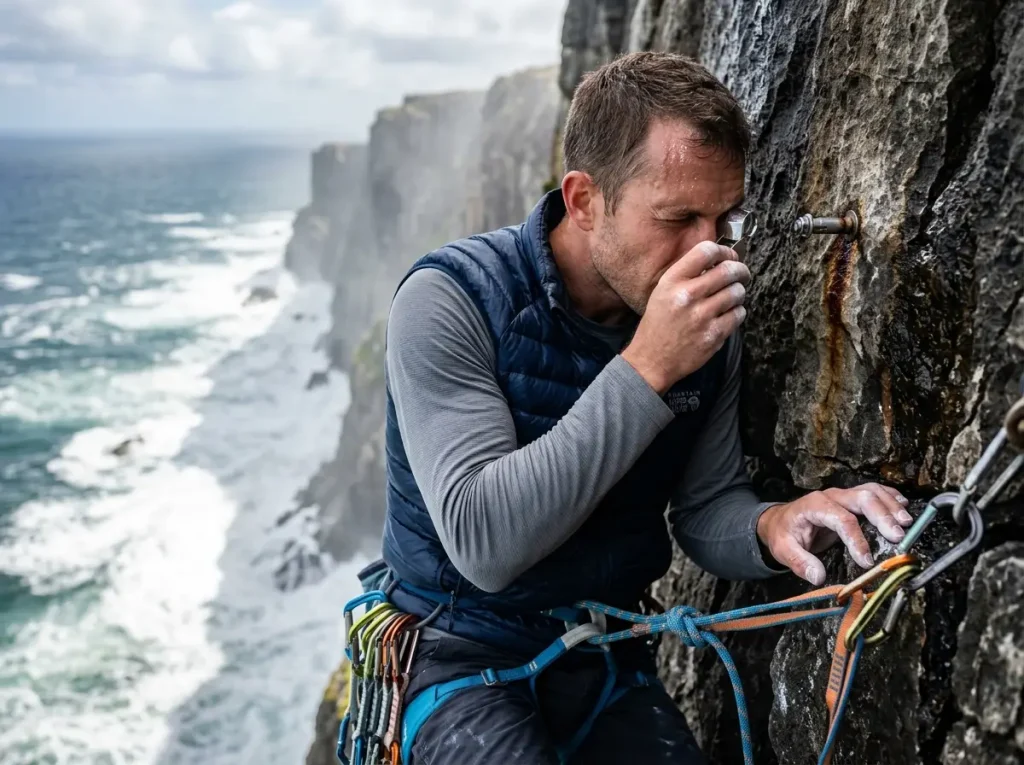
Here’s where people get hurt. Not because of a fall. Because of a bolt that tests fine visually and fails under body weight on a rappel.
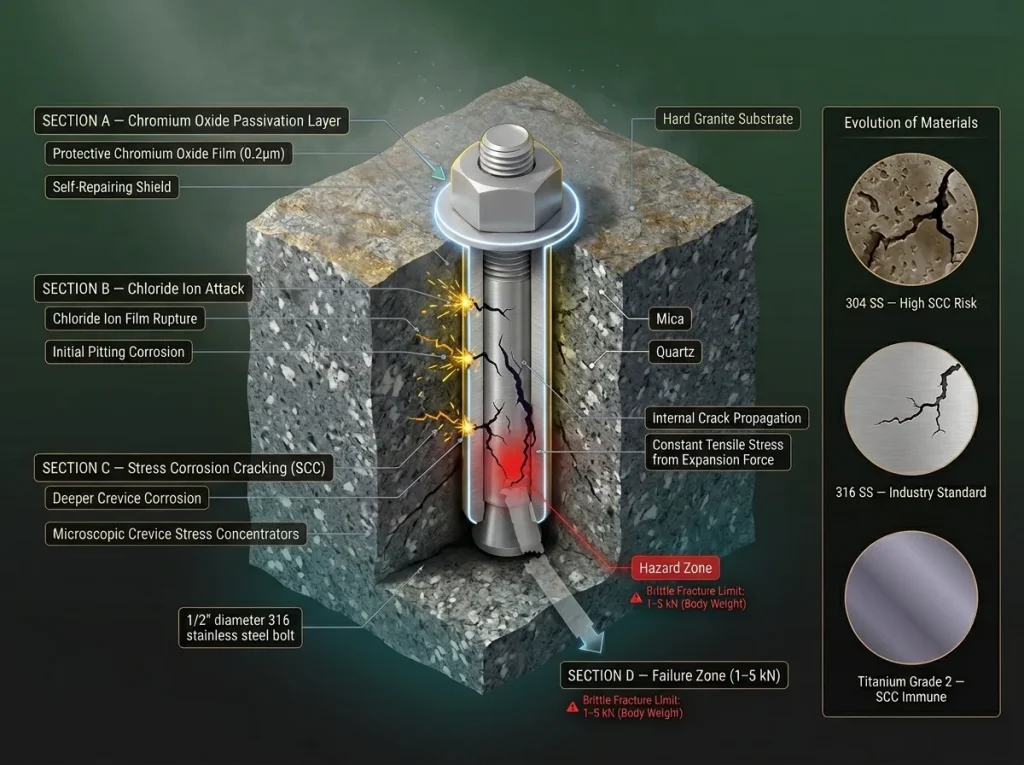
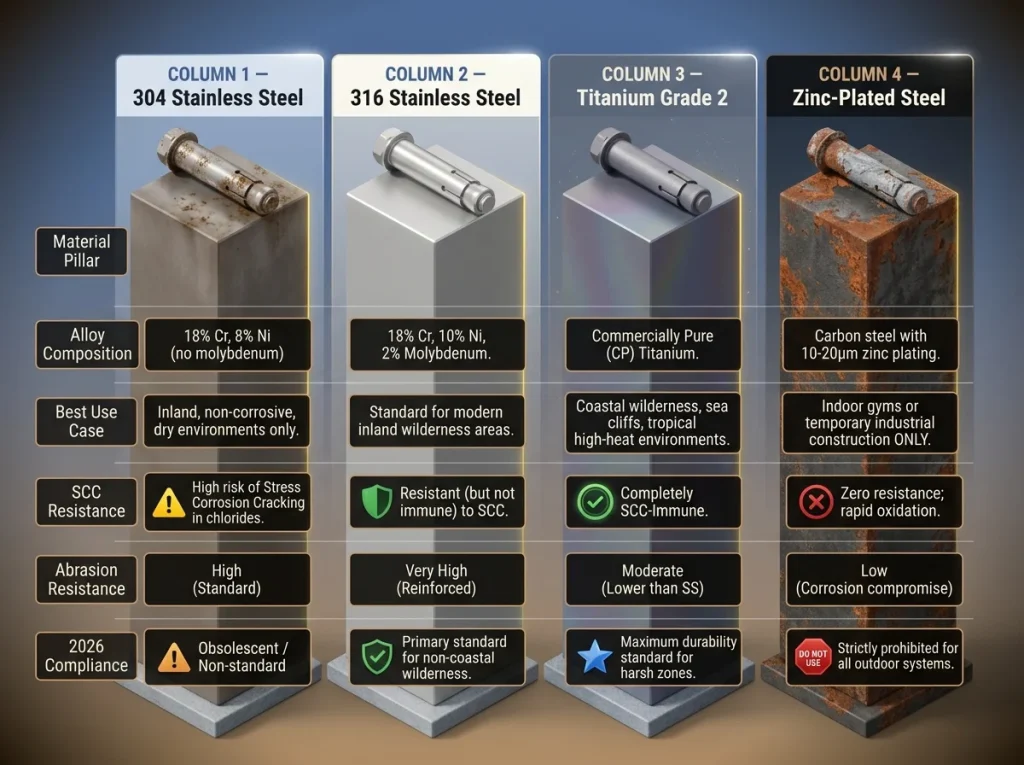
“Stainless” doesn’t mean corrosion-proof. 316 stainless steel is the 2026 wilderness standard — 18% chromium, 10% nickel, 2% molybdenum. That 2% molybdenum is what separates it from 304 SS and gives it resistance to chloride attack. But “resistance” has a ceiling. In coastal wilderness, splash zones, or high-mineral acidity environments, 316 SS is susceptible to Stress Corrosion Cracking (SCC) — a failure mode where expansion stress plus a corrosive environment drives microscopic cracks through the bolt shaft.
Here’s how it actually works: chloride ions attack the chromium oxide layer on the bolt surface. Once that layer fractures, cracks begin propagating inward. Those cracks grow under the continuous load of the installed expansion bolt. Eventually the crack hits a critical length and the bolt fails — not at 25 kN where it’s rated, but as low as 1–5 kN. That’s body weight. The UIAA warning on corrosion-induced anchor failure and SCC mechanisms documents this failure mode in detail. Read it once and you won’t install another 304 SS bolt in your life.
The material selection matrix is clear once you understand the environment:
| Wilderness Hardware Material Comparison | ||
|---|---|---|
| Material | Best Use Case | Key Risk |
| 304 SS | Inland, non-corrosive — obsolescent | Rapid pitting and SCC in chloride environments |
| 316 SS | Standard for most inland wilderness | SCC in coastal or high-heat zones |
| Titanium Grade 2/5 | Coastal wilderness, sea cliffs, splash zones | Lower abrasion resistance vs. SS |
| Zinc-plated steel | Never use outdoors | Rapid oxidation; no place in any wilderness system |
The 2026 UIAA Safety Commission recommendation is unambiguous: Titanium Grade 2 is the only definitive solution for high-SCC-risk coastal environments. But in hard granite wilderness like the Sierra Nevada, 316 SS is still the preferred choice — it offers roughly 2x the abrasion resistance of titanium under rope loading. Match material to environment.
The 1980s bolts are the problem nobody talks about plainly. Those 1/4″ hand-drilled carbon steel or low-grade stainless bolts — the ones that were “wilderness legal” under looser standards — are now hazards hiding in plain sight. Decades of SCC loading, undersized geometry, and no modern inspection. Study the real-world anchor failure case studies where substrate and geometry compounded the metallurgy problem before you trust legacy hardware on any rappel.
The Mechanics of Hand Drilling — Professional Protocol for Primitive Tools
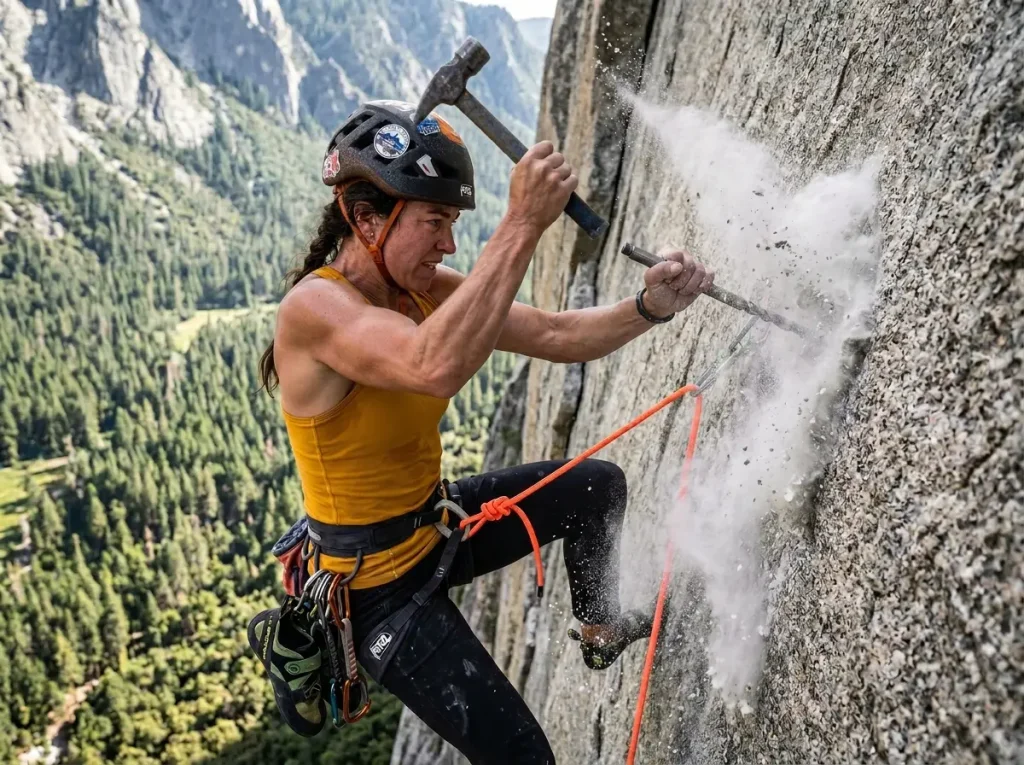
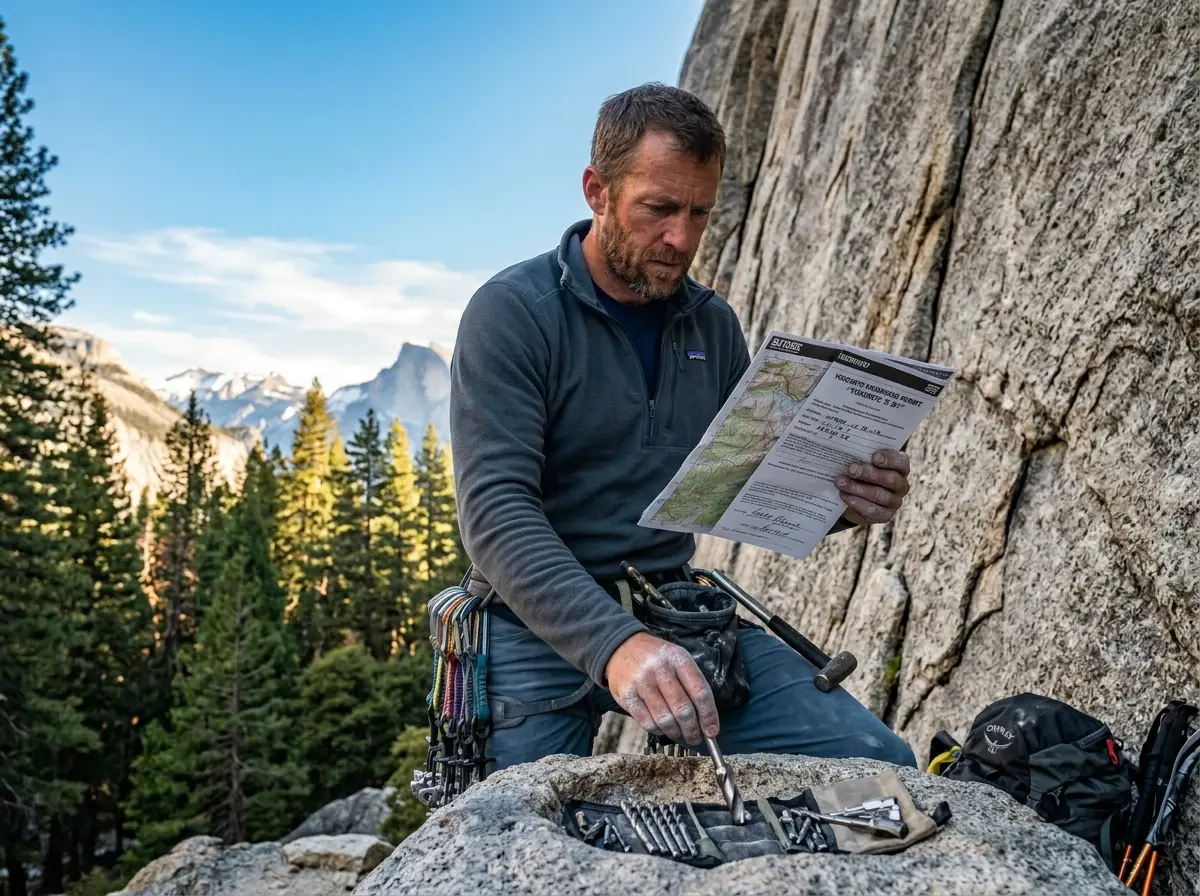
Hand-drilling isn’t a workaround for wilderness rules. It’s a skill. Most sport climbers have never drilled a hole by hand. Most trad climbers who’ve been to wilderness areas haven’t either. The 2026 standard treats this as a mandatory technical competency, and the gap between “I know how to drill” and “I can produce a bombproof hole in Yosemite granite efficiently” is real.
Pre-Drill Assessment — Rock Quality and Site Selection
Start with the spot-tap test: a clear, bright sound under hammer strike means solid stone. A hollow thud means exfoliating flake or internal void. Don’t drill. Any anchor installed in hollow rock will fail under the expansion force of the bolt before it ever sees a climber. This sounds obvious until you’re at 5 p.m. on a route development trip and trying to justify one more placement before dark.
Rock type sets your time budget before you start:
| Rock Drilling Estimates | ||
|---|---|---|
| Rock Type | Hits Required (1/2″ hole) | Time Estimate |
| Hard Granite (Yosemite) | 800–1,200 | 45–60 minutes |
| Sandstone (Red Rocks) | 150–300 | 10–15 minutes |
| Andesite/Basalt | 1,000+ | 30–45 minutes |
| Limestone | 400–600 | 20–30 minutes |
Granite is where beginners get surprised and give up halfway through. Understand your rock before you rack up.
The Strike-and-Turn Technique — Single Jacking Protocol
Single jacking is the solo wilderness drilling method: one hand hammers, the other holds and rotates the drill bit. The rotation is the critical piece — 45 degrees between every hammer strike. That rotation ensures the bit chips fresh rock rather than jamming and bouncing. Skip it and you’ll be pounding the same frustrating spot for twice as long, producing a ragged, undersized hole.
Clear the hole with a blow tube every 100 hits. Accumulated rock dust creates a cushion that absorbs hammer energy instead of transmitting it to the rock face. It doubles your drilling time without you noticing it’s happening. Use fresh carbide bits. A worn bit creates an undersized hole — the bolt can seize mid-installation or damage its own shaft during hammering. Carry 2–3 fresh bits on any route development trip. One is not enough.
The hole must go in perpendicular to the rock face. A skewed hole means the hanger won’t sit flush, which creates a lever arm that multiplies shear force on the bolt head. That’s invisible under inspection. It shows up under load. Check perpendicularity constantly while drilling, not just at the end.
Pro tip: Drill deeper than the manufacturer’s minimum spec by about 3–5mm. That extra depth allows future “hammer-in” removal, which is the cleanest extraction method and leaves the hole in the best condition for reuse or patching.
Final Seating and Load Testing
Follow manufacturer torque specs for expansion bolts, then add a quarter turn. Over-torqueing 316 SS threads can strip them. The hanger must sit flush against the rock surface — any visible gap means the hole is skewed and needs re-assessment before you commit any weight.
Bounce-test the anchor progressively. Start with body weight on a short sling, increase to full rappel load in stages. The USFS national policy summary on climbing and primitive tool requirements in wilderness makes clear that understanding the kN rating system and how load forces apply to wilderness bolt placements isn’t a formality — the margin for error on a hand-drilled placement is smaller than on a power-drilled one.
The 2026 visual minimization requirement also applies to final seating: hangers must be rust-brown or rock-matched color, not polished stainless. This isn’t cosmetic preference — it’s regulatory compliance under most Climbing Management Plans now in effect.
The Ethics of Removal — Chopping, Replacing, and Hole Restoration
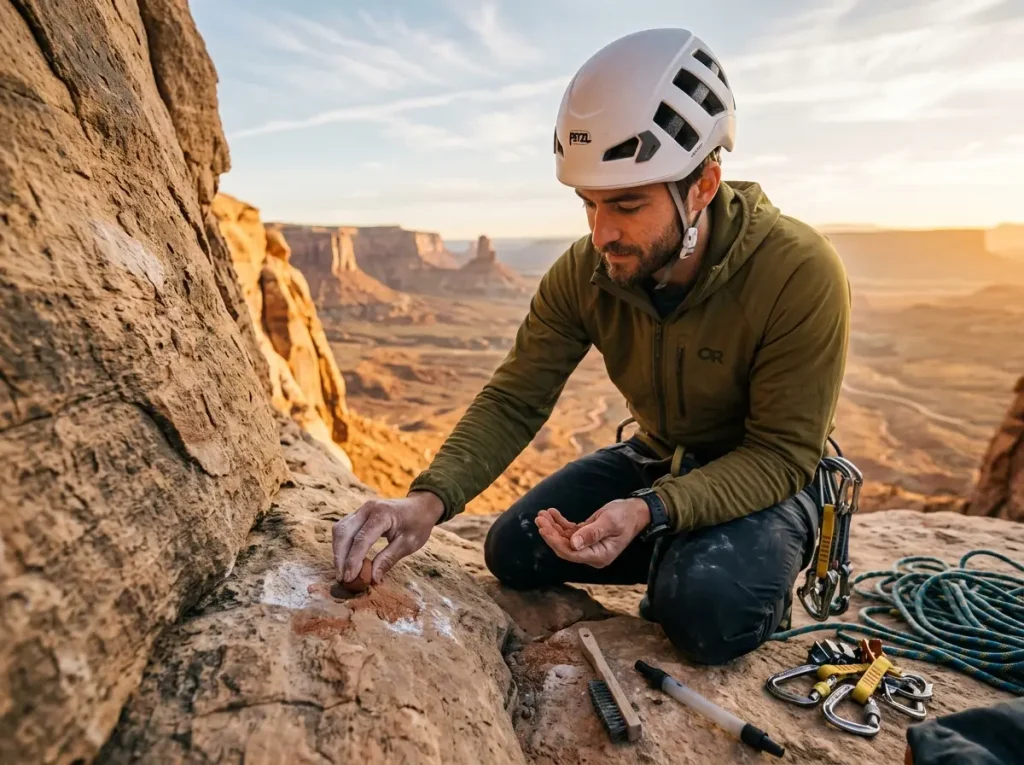
The PARC Act protects your right to maintain routes. That includes removing unsafe hardware. What most people don’t nail is the distinction between “chopping” and “replacing” — and the community cares about that line intensely.
When to Chop — The Decision to Remove Legacy Hardware
Chopping means removing a bolt the local consensus considers unethical — wrong location, wrong style, route crowding. Replacing means removing an objectively hazardous bolt for route maintenance. These are completely different acts with completely different ethical weight. Know which one you’re doing before you pick up a breaker bar.
The retirement decision has a clear diagnostic. Visible red surface streaking, a hollow sound when tapped, visible “eggshell” cracking around the bolt head — any one of those alone warrants immediate decommissioning. All three together means don’t touch it with body weight, period.
The PARC Act protects the right to pull those old bolts. What it doesn’t make optional is notification. Contact the Local Climbing Organization (LCO) before removing hardware from any wilderness route, and register the work with the relevant agency. A well-intentioned removal without documentation creates access disputes with rangers who weren’t briefed. The American Safe Climbing Association (ASCA) coordinates route replacement grants and has technical standards for legacy hardware — use that resource. The ethics and craft of the modern first ascent — where hardware choices become part of the route’s permanent record applies here as much as to new-route development.
Extraction Techniques for Seized and Corroded Hardware
Different bolt types need different extraction approaches, and using the wrong one damages the hole or cracks the surrounding rock.
The spinning method works for wedge bolts. A breaker bar spins the bolt until the expansion clip wears a groove into the shaft, then the bolt pulls out clean for hole reuse. Tuning fork / piton extraction handles button-head bolts and rivets — a modified piton driven behind the hanger to lever the bolt out without cracking the surrounding rock face. When the bolt can’t be extracted for hole reuse, over-tightening with an 18″ breaker bar snaps a 316 SS stud just below the rock surface, leaving the hole available for patching.
Power tools are prohibited in wilderness for extraction by the same rule that prohibits them for installation. Don’t. A ranger can confiscate equipment on site.
Pro tip: Rub petroleum jelly on the hole edges before installing a new bolt in an existing hole. It prevents epoxy from bonding to rock you might need to clear for a future replacement. It costs nothing and saves a destroyed hole in 20 years.
Hole Patching and Wilderness Character Restoration
When a bolt comes out and the hole isn’t being reused, the 2026 standard requires patching. The goal isn’t to cover the hole — it’s functional invisibility, a patch that reads as rock under visual inspection. A flat gray button is a fail.
Wire-brush the inside of the hole and blow out dust and rust completely. Knead two-part epoxy putty until the components react and you have a uniform color throughout. Mix in local rock dust or sand — pull it from the base of the route. Press the mixed putty into the hole, then press small rock crystals or pebbles from the surrounding area into the wet surface. The grain and texture match is what sells it. ASCA’s technical standard for bolt removal and wilderness rock restoration has the full protocol.
Safety Data and the Risk of Natural Anchors vs. Fixed Hardware
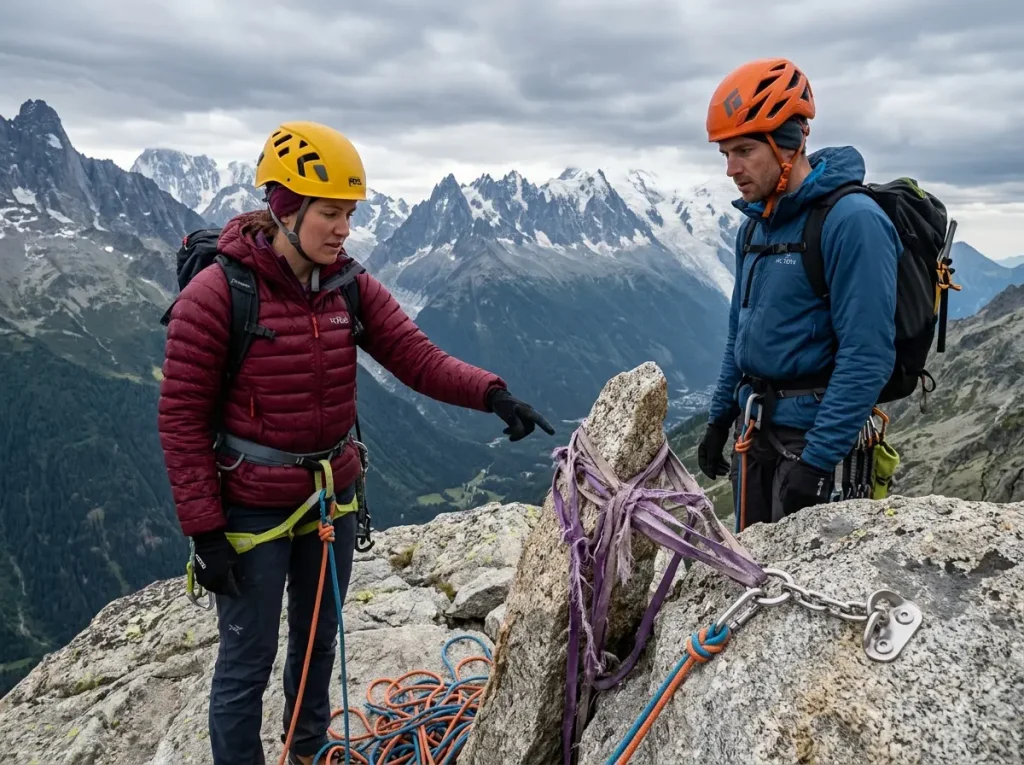
The opposition argument is honest: “For wilderness to remain wild, it must remain unmanipulated.” Wilderness Watch isn’t wrong to make it. The counter-argument isn’t that wilderness doesn’t deserve protection — it’s that the safety math cuts hard against tat and natural anchors.
2024–2025 Climbing Accident Data — What the Numbers Show
The American Alpine Club’s 2024 report counted 51 climbing fatalities in the U.S. — the highest since the 1950s. Breaking down by mechanism: leading falls at 58.8%, unroped movement at 20%, rappelling errors at 10%, anchor failure at under 1%. Anchor failure is statistically rare in developed areas. But the operative phrase is “developed areas.” The 10-year epidemiological analysis of U.S. climbing injuries (2014–2023) shows the pattern clearly: wilderness objectives, legacy hardware, and experienced climbers form a specific risk cluster that the raw numbers don’t capture.
The expert-vs-beginner breakdown from 2024 is the number most guides don’t bring up: 33 expert accidents versus 6 beginner accidents. Experienced climbers in wilderness face higher objective hazards and are more likely to be complacent about anchor integrity. The bolt that’s been there for 25 years is the one nobody questions.
Rappelling errors — 10% of accidents — are frequently downstream effects of upstream anchor problems. A corroded, frozen anchor that can’t equalize properly causes rope management errors at the station. The rappelling mistake is the visible event; the anchor condition is the actual cause.
The “Natural Anchor” Paradox — Why Fixed Hardware Is More Wilderness-Friendly
The PARC Act explicitly invokes this comparison. UV degradation, rot, and mechanical instability of rock blocks make tat (old slings) both an eyesore and a genuine hazard. A bolted rappel station eliminates tree damage, eliminates party tat accumulation, and gives every subsequent party a fixed reference point for a safe descent without disturbing vegetation.
This is exactly where how Leave No Trace principles actually align with proper fixed hardware use — not against it becomes the argument: a properly placed, maintained bolt is a smaller wilderness footprint than three generations of webbing wrapped around a dying tree.
The Wilderness Watch position deserves a fair hearing. For some terrain, in some contexts, the unmanipulated ideal holds. The PARC Act doesn’t eliminate judgment — it clarifies the legal framework within which that judgment operates. “The safety of the descent must not be sacrificed to the aesthetic of the wilderness” isn’t a slogan anymore. It’s codified law.
Pro tip: When evaluating a natural anchor on descent, ask whether the next party will trust it. Not whether you trust it. If you wouldn’t stake a beginner’s life on it, it shouldn’t be the permanent solution for that descent.
The Decision Matrix — To Bolt or Not to Bolt?
Legal protection doesn’t mean open season. The PARC Act gives you the right. Whether to exercise it on any given placement is still on you.
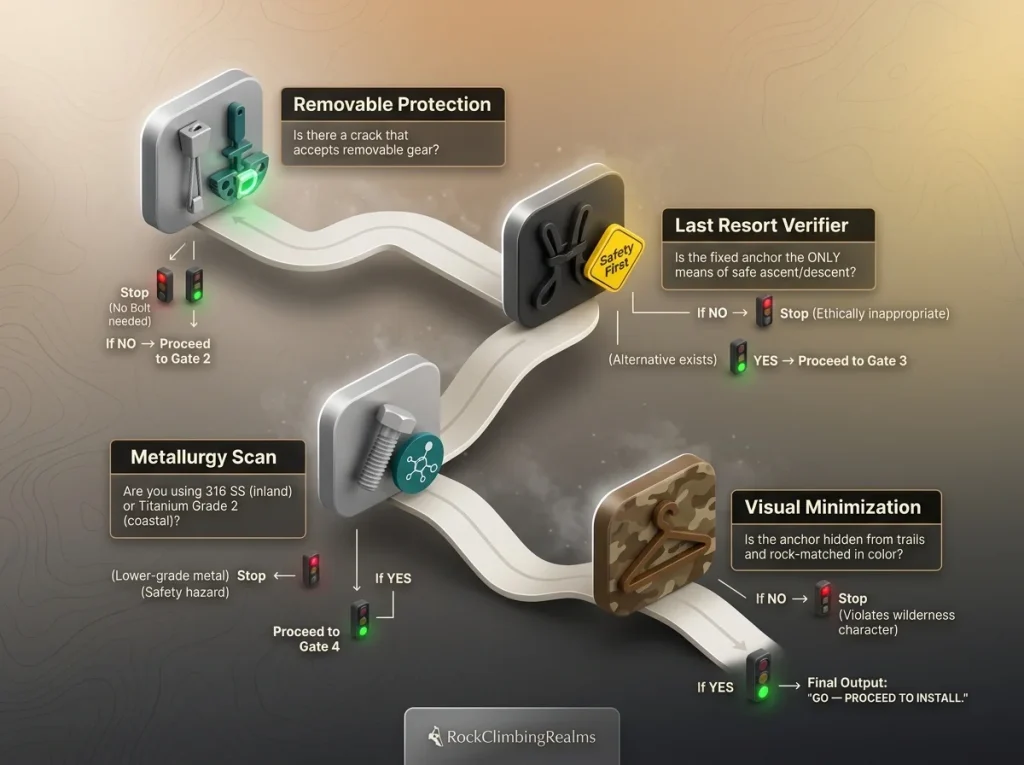
The Four-Gate Framework for Bolt Justification
This isn’t a beginner checklist. It’s a decision framework for route developers doing first ascents or route rehabilitation. Run all four gates before setting a bit.
Gate 1 — Is it removable? Solid crack accepting cams or nuts means a fixed anchor is ethically inappropriate and often legally so. No justification to bolt what traditional protection covers competently. This is where the clean climbing ethic still lives inside the PARC Act world.
Gate 2 — Is it a last resort? Joshua Tree’s permit standard puts it plainly: fixed anchors are appropriate only when they are the sole means of safe ascent or descent. Not the convenient means. Not the preferred means. The only means.
Gate 3 — Is the metallurgy correct? 316 SS minimum for all inland wilderness environments. Titanium Grade 2 for coastal zones or anywhere with high mineral acidity. Using anything below standard is a violation of professional safety ethics and a future maintainer’s problem.
Gate 4 — Is visual impact minimized? 2026 regulations require hangers to be camouflaged or placed out of direct sightlines from established trails. Rock-matched or rust-brown hardware. This is how you protect access for the next fifty years — not by legal technicality but by visible stewardship.
The Self-Regulation 2.0 Model — Where the Law Ends and the Community Begins
As of mid-2026, EXPLORE Act implementation has been “positive but mixed.” Agency staffing reductions mean the legal clarity of the PARC Act exists faster than the administrative capacity to support it. Permit staff at major parks are stretched. Rangers applying the old framework haven’t all been retrained yet.
The climbing community’s answer is Self-Regulation 2.0. LCOs and the ASCA are taking the lead on hardware maintenance, route documentation, and coordinating with underfunded agency offices. This reduces dependency on permit timelines and builds the institutional relationships that protect access long-term. Learn how to show up at a climbing access meeting and actually move the needle on local bolting policy — this is the operating environment now.
According to The Mountaineers’ coverage of the EXPLORE Act victory, climbers are now legally recognized stakeholders in public land management. That’s a responsibility, not just a benefit.
Conclusion
Three things to carry away from here:
The law is settled, but the standards aren’t optional. The PARC Act protects the right to bolt. USFS FSM 2355, NPS RM41, UIAA chemistry standards, and the metallurgy of SCC dictate the how. Legal compliance and safety compliance are not the same sentence.
Your hardware choices become part of the route’s permanent record. A 1/4″ zinc-plated bolt placed today is someone else’s crisis in 2046. Minimum: 1/2″ 316 SS inland, Titanium Grade 2 in coastal and splash-zone environments. There is no budget version of this.
The ethics of stewardship are now clearly defined. The 2026 framework asks you to operate as a recognized stakeholder — with the permit, the LCO coordination, the documentation, and the hole-patching kit to prove it. That’s a higher bar than “don’t get caught.” It’s the bar the community earned through forty years of fighting for access.
Next time you pull up to a wilderness crag with a hand drill and a rack of 1/2″ stainless bolt kits, run the four gates before you set a single bit. The law gives you the right. The community is counting on you to earn it.
FAQ
Are bolts allowed in wilderness areas?
Yes. As of January 4, 2025, the PARC Act (embedded in the EXPLORE Act) explicitly codifies fixed anchor placement, use, and maintenance as legal and appropriate in National Wilderness areas. Most wilderness designations require hand drilling only, and parks like Joshua Tree require a Special Use Permit with a processing time of up to six months.
What was the Bolt War in climbing?
The Bolt Wars were a cultural and legal conflict from the 1980s–90s between trad climbers who relied on removable protection and sport climbers using pre-placed, fixed bolts in wilderness routes. The core dispute was whether a stainless steel bolt constituted a permanent improvement under the Wilderness Act of 1964 — the same legal category as a trail bridge. The legislative resolution came forty years later with the PARC Act of 2025.
Is power drilling allowed in National Parks?
No. Power drills are strictly prohibited in all designated wilderness areas under the Wilderness Act’s ban on motorized equipment (Section 4(c)). This applies to NPS, USFS, BLM, and USFWS lands equally. Hand drills and hammers are the only legal tools for anchor installation in wilderness. Outside of official wilderness designation, power drill rules vary by park and Climbing Management Plan.
What is the PARC Act for climbing?
The Protecting America’s Rock Climbing (PARC) Act is a provision within the EXPLORE Act (Public Law 118-234) signed January 4, 2025. It legally defines fixed anchors as appropriate in National Wilderness, protects all routes established before January 4, 2025 from retroactive enforcement, and mandated that federal agencies issue unified climbing management guidance within 18 months — completed in 2026 through USFS FSM 2355 and NPS RM41 updates.
What bolt material should I use in wilderness areas?
316 stainless steel (minimum 3/8 × 2.5, ideally 1/2) is the standard for most inland wilderness environments. For coastal wilderness, splash zones, or areas with high mineral acidity, Titanium Grade 2 is what the 2026 UIAA Safety Commission recommends as definitively SCC-resistant. Never use zinc-plated steel — it oxidizes rapidly and has no place in any outdoor anchor system.
Safety Notice: Rock climbing and mountaineering are inherently high-risk
activities that can involve physical trauma or fatal incidents. The information on Rock Climbing Realms is for
educational and informational purposes only. Techniques and advice presented here are not a substitute
for professional, hands-on instruction. Conditions and risks vary by location. Always seek guidance
from a qualified instructor before attempting new techniques. By using this website, you agree that you
are solely responsible for your own safety. Any reliance you place on this information is strictly
at your own risk, and you assume all liability for your actions. Rock Climbing Realms and its authors
will not be held liable for any harm, damage, or loss sustained in connection with the use of this information.
Affiliate Disclosure: We are a participant in the Amazon Services LLC Associates Program, an
affiliate advertising program designed to provide a means for us to earn advertising fees by advertising and linking
to Amazon.com. As an Amazon Associate, we earn from qualifying purchases. We are also an official affiliate partner
of Black Diamond Equipment via the AvantLink network. If you click on a Black Diamond affiliate link and make a
purchase, we may earn a commission at no additional cost to you. We also participate in other affiliate programs.
Additional terms are found in the terms of service.