
In this article
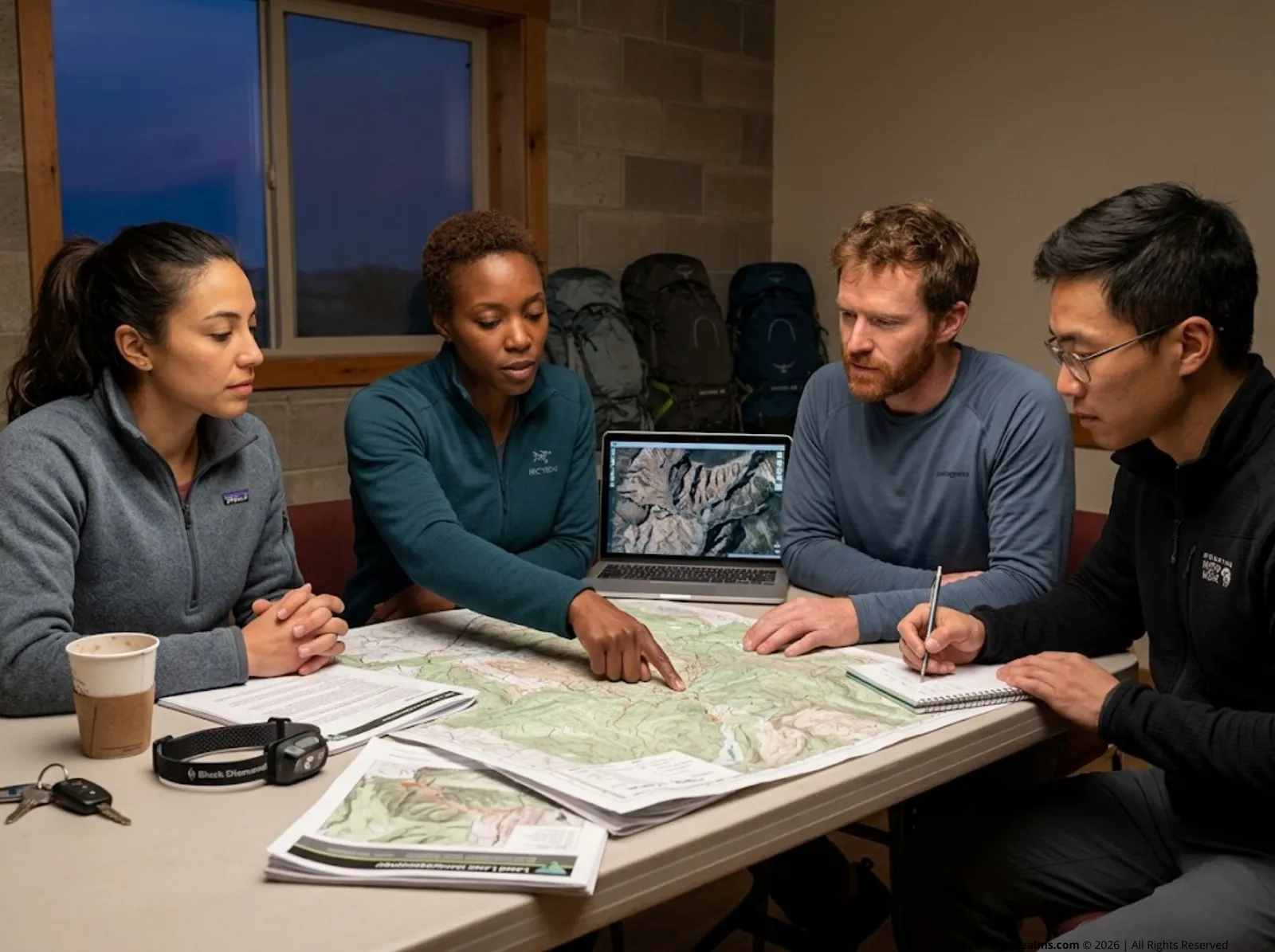
You walked into the community center at 6:58 p.m. — two minutes before your first LCO board meeting. Eleven people sat around a folding table. A ranger opened a laptop showing a topographic overlay of your favorite crag. Then he said the words that froze every climber in the room: “seasonal closure, effective March 1.”
You had driven ninety minutes to say something. You had no idea what to say.
Most climbers don’t — until it’s too late. After fifteen years of attending public hearings, scoping sessions, and board meetings across three states, the difference between keeping your crag open and watching it close comes down to preparation, performance at the mic, and follow-through. This guide gives you the exact protocol — from finding your local climbing organization to delivering a substantive public comment that land managers are legally required to address.
⚡ Quick Answer: You need three things: preparation (read the draft document and gather GPS data), a substantive comment (challenge methodology or introduce new data — not “I love this crag”), and follow-through (written reinforcement within 48 hours plus volunteer stewardship hours). Find your nearest LCO through the Access Fund directory and set a calendar alert for their monthly meeting.
What a Climbing Access Meeting Actually Is (And Why Most Climbers Skip It)
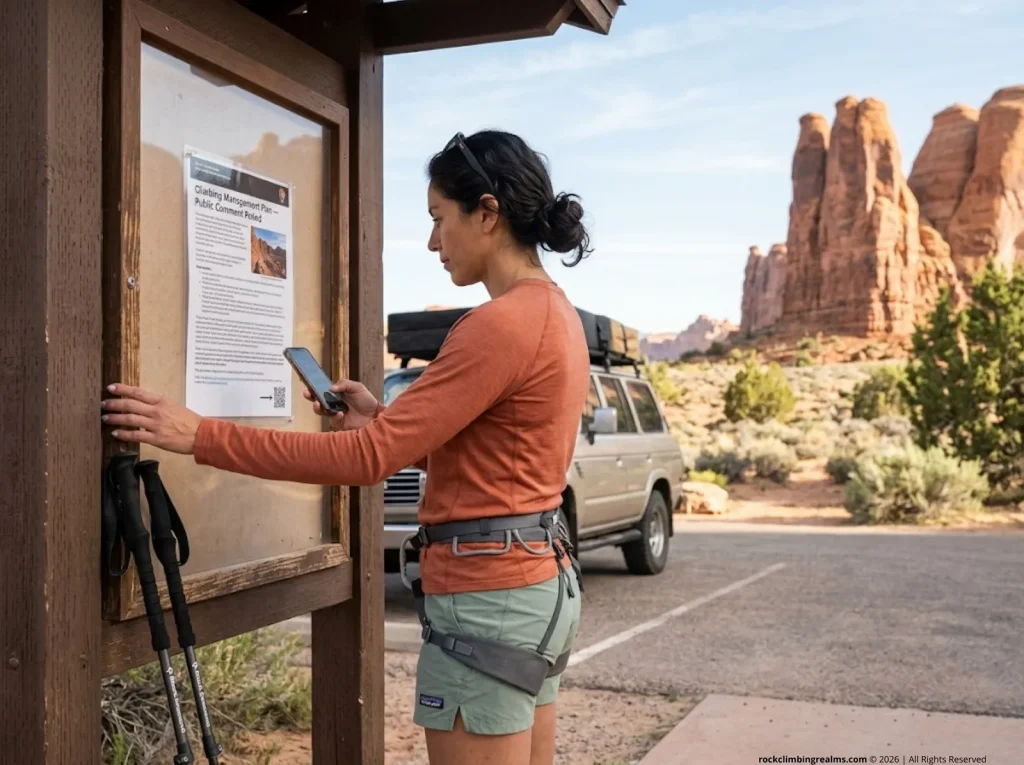
There are three types of meetings that determine the future of your crag access, and most climbers have never heard of any of them.
The first is the LCO board meeting — a monthly gathering run by your Local Climbing Organization, a 501(c)(3) nonprofit that links climbers to the agencies managing your public land. These handle trail maintenance scheduling, landowner negotiations, and event planning. Usually informal, sometimes at a brewery, rarely advertised beyond a Facebook post.
The second is the federal scoping session. When the National Park Service or Bureau of Land Management proposes a Climbing Management Plan or seasonal closure, they must open a public comment period under NEPA — typically 90 days for BLM plans and 45-60 days for NPS environmental assessments.
The third is the public hearing — a legally mandated proceeding where your testimony goes on the official record and the agency must respond to it. This is different from a public meeting, where your right to observe is guaranteed but speaking is at the chair’s discretion. Getting this wrong wastes your preparation.
The ranger proposing that closure? He’s been in monthly meetings for three years. If you show up once, you’re already behind. In 2025, climbing access advocacy efforts across the country preserved access at 191 climbing areas and distributed $160,886 in grants to local groups through the Access Fund’s role in climbing stewardship. That money and those wins came from the people who showed up consistently — not once.
Pro tip: Call the hosting agency 48 hours before to confirm hearing vs. meeting format and whether written comments are accepted. This ten-second call can save wasted preparation.
Finding your local meeting takes ten minutes. The Access Fund maintains a searchable LCO Directory by state. Mountain Project forums and climbing Facebook groups often post dates before official channels. For federal scoping, check the Federal Register and parkplanning.nps.gov. Set a calendar alert. Consistency matters more than eloquence.
How to Prepare Before You Walk In
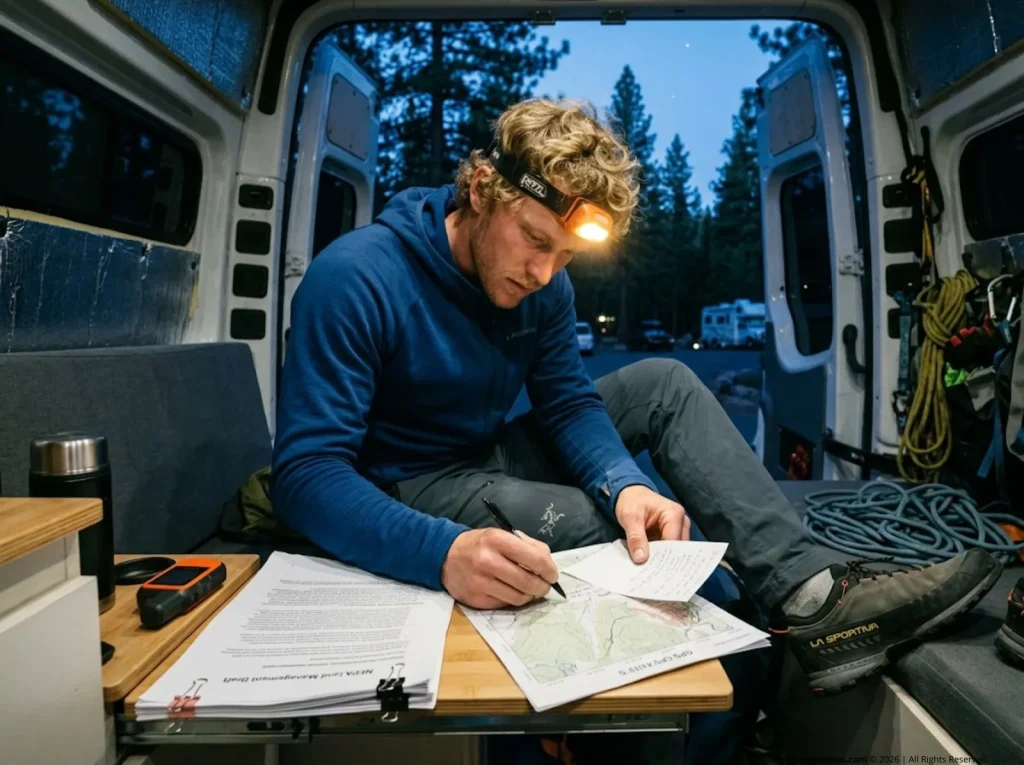
The biggest mistake first-time attendees make is walking into a meeting cold. For an LCO board meeting, this means reading the posted agenda. For a federal scoping session, it means downloading and actually reading the draft Environmental Assessment or Climbing Management Plan posted on parkplanning.nps.gov.
Reading the Draft Document (The NEPA Decoder)
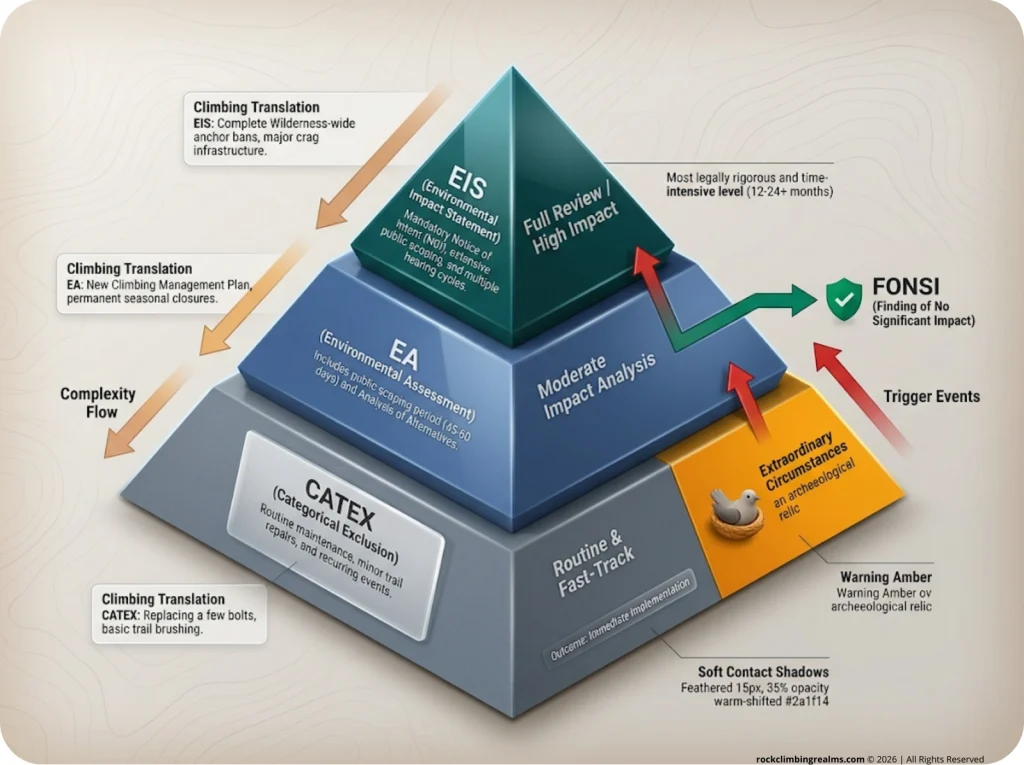
NEPA governs every significant federal land management action. Every proposed restriction must pass through one of three levels of review: Categorical Exclusion (CATEX), Environmental Assessment (EA), or Environmental Impact Statement (EIS).
Focus your reading on the “Affected Environment” section — where the agency describes current conditions and where data gaps live. Your local knowledge of social trails, staging areas, and seasonal use patterns gives you information agency staff often don’t have.
Mark the specific page, section number, and management action you plan to address. Vague input gets filed and forgotten.
Building Your Evidence Kit
GPS coordinates and timestamped photos of trail conditions, approach routes, and vegetation recovery transform your opinion into data. Historical records — guidebook references, Mountain Project logs, LCO maintenance reports — establish baseline conditions the agency may not have captured. Challenging a raptor nesting buffer distance? Bring peer-reviewed research. It’s the language land managers respond to.
Pro tip: Package your evidence as a single-page handout with GPS coordinates and a map screenshot. Print five copies. Land managers keep handouts on their desks for weeks. They forget verbal testimony by the parking lot.
The Five Terms That Change Everything
Five acronyms cover 90% of what you’ll hear at any federal climbing access meeting. Learn them before your first session:
CATEX (Categorical Exclusion) is the agency’s fast-track for minor actions — routine trail maintenance, small campsite modifications. It skips full analysis unless “Extraordinary Circumstances” bump it up, like the presence of endangered species or cultural sites.
EA (Environmental Assessment) is the middle tier. It requires public scoping, alternatives analysis, and ends in either a FONSI (Finding of No Significant Impact — the agency’s “all clear” to proceed) or an escalation to a full EIS.
EIS (Environmental Impact Statement) is the full process — public scoping, mandatory Notice of Intent, extensive alternatives analysis. Major Wilderness management plans and large-scale climbing decisions happen here.
MRA (Minimum Requirement Analysis) applies specifically to designated Wilderness areas and tests whether a proposed action — like installing a fixed anchor — is the least impactful tool for achieving a legitimate purpose. If you’re attending a meeting about bolting in Wilderness, the MRA is the test your testimony needs to address. Understanding the fixed anchor policy fight that nearly banned bolts on federal land gives you the full context for this debate.
The EPA’s NEPA review process overview provides the full procedural framework if you want to go deeper.
How to Deliver a Substantive Public Comment
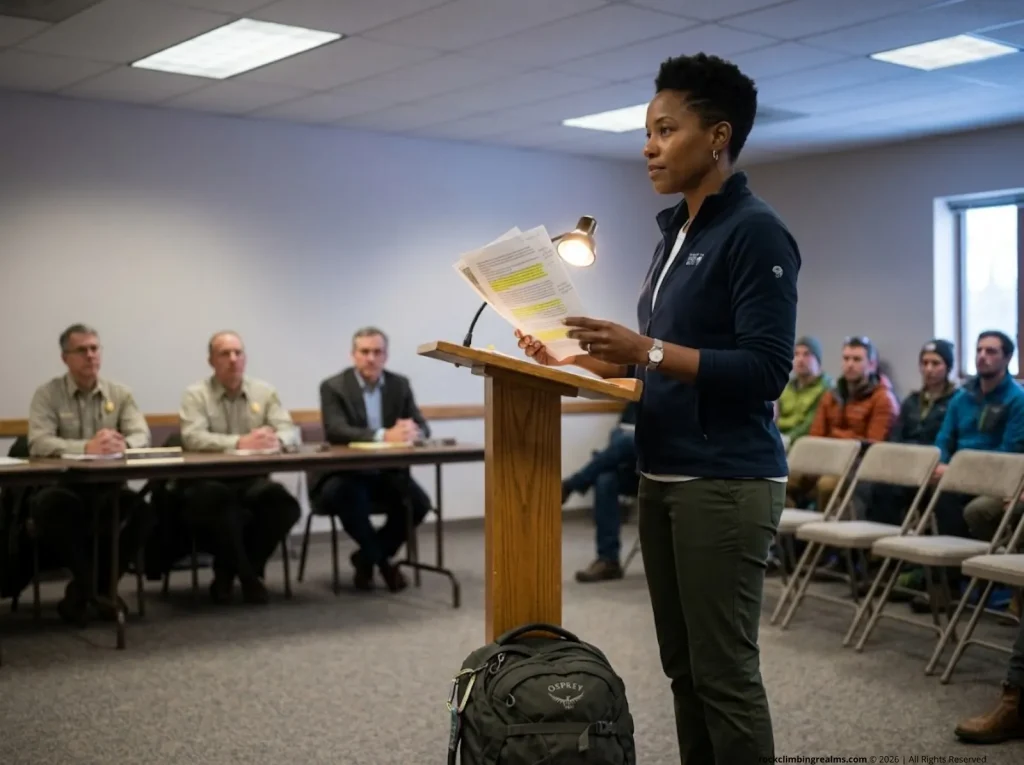
Here is the single most important thing you will learn in this article: in administrative law, comments are not votes. An agency is not required to follow the majority opinion. It is, however, legally mandated to respond to every substantive comment — and it can ignore everything else.
A comment is substantive when it challenges the accuracy of data, the adequacy of methodology, or the assumptions behind the analysis — and provides a “reasonable basis” supported by evidence. “I love this crag” is formally categorized as non-substantive and carries zero weight in the final Record of Decision.
The Joshua Tree Climbing Management Plan scoping period received over 4,000 correspondences. Only the comments that questioned methodology or introduced new environmental data forced revisions to the draft. Everything else was acknowledged and set aside.
The Anatomy of a Winning Comment
Open with credentials: “I am a member of [LCO name] and have climbed at [area] for [X] years.” Cite the draft’s page number and specific management action. Present evidence. Propose an alternative the agency didn’t consider. Request formal written response.
If you’ve already taken the step to document and report climbing access threats before meetings, you’ll have much of this evidence organized and ready.
Avoid the form letter trap. Agencies routinely treat 500 identical emails as a single comment. Unique writing that reflects your personal experience and site-specific knowledge is exponentially more effective at demonstrating the diversity of the stakeholder group.
Verbal Testimony in Public Hearings
You typically get two to three minutes. Script your opening line — it sets the entire tone. Print your statement on paper and practice saying it out loud three times before you arrive. Reading from your phone signals that you prepared in the parking lot.
Make eye contact with the panel, not the audience. The decision-makers need to see your conviction. Cover one strong point with evidence rather than five weak ones. Depth beats breadth when the clock is running.
The Written Comment Alternative
Federal comment portals — regulations.gov and parkplanning.nps.gov — accept written submissions during the open public comment period. Written comments carry the same legal weight as in-person testimony, with one advantage: you can attach maps, GPS files, photo documentation, and structured evidence that verbal testimony can’t convey.
Pro tip: Submit your written comment AND appear at the hearing. Double coverage signals commitment, and now your position is documented in two separate channels of the administrative record.
Meeting Etiquette and the “4 A’s” Framework
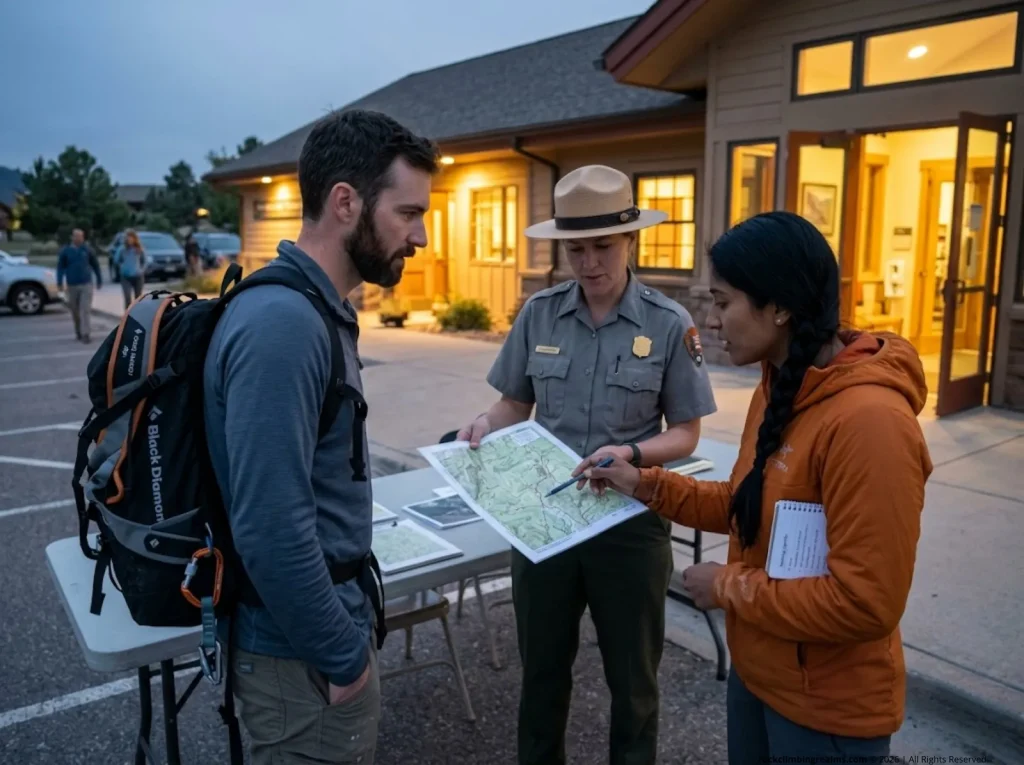
The meeting room is a regulated social environment. I have watched climbers get dismissed in 30 seconds because they opened with “you people are ruining our sport.” Don’t be that person.
The 4 A’s framework — Attitude, Awareness, Action, and Accountability — comes from safety protocols in high-consequence industries and provides the behavioral blueprint for climbing advocacy meetings.
Attitude means standing side-by-side with the land manager, not facing off against them. The problem — trail erosion, overcrowding, wildlife disturbance — is shared. Frame it that way. “How can we solve this together?” gets you further than “You’re wrong.”
Awareness means reading the room. Know which stakeholder groups are present — wildlife advocates, tribal representatives, recreational users with competing interests. Speak to shared values. A bighorn sheep advocate and a climber both want healthy ecosystems; start there.
Action means substantive, repeated participation. Showing up once is a start. Showing up monthly turns you from a stranger into a trusted voice. Understanding the full picture of climbing access threats and advocacy solutions strengthens the context behind every point you raise.
Accountability means following through. If you promise to organize an Adopt-a-Crag event or deliver trail count data by next month, deliver it. Broken commitments at the table destroy credibility faster than anything you could say at the microphone.
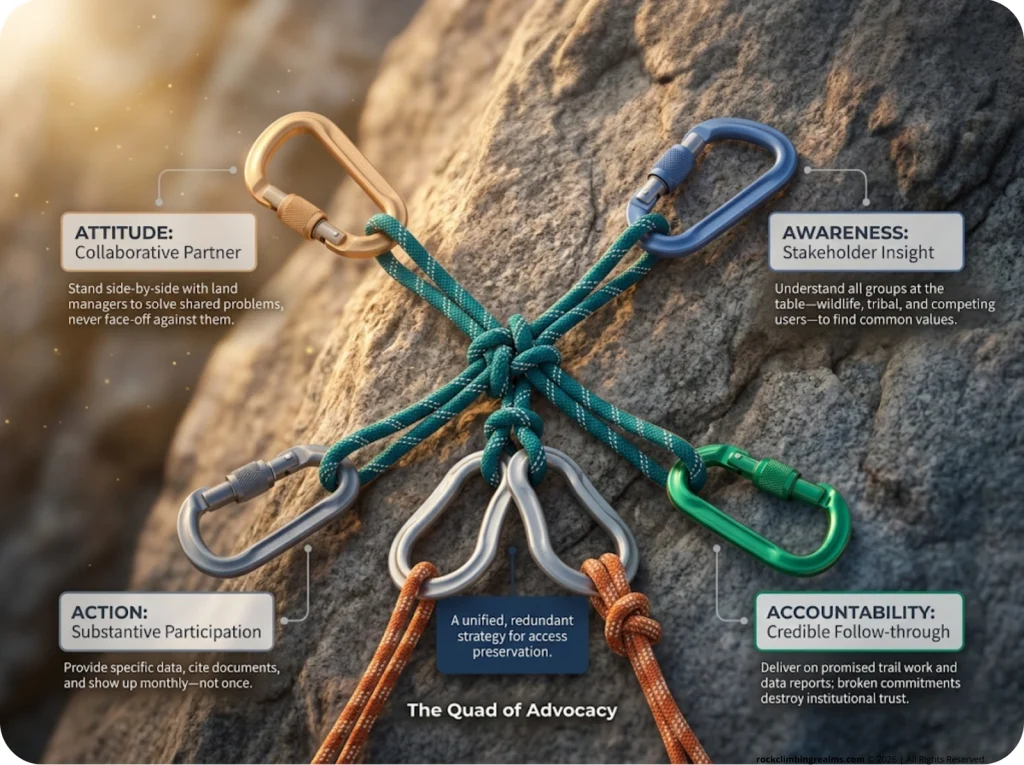
The First 15 Minutes (Pre-Meeting Reconnaissance)
Arrive fifteen minutes early. Walk the room. Find where the microphone is, where the panel sits, where the sign-in sheet is. Introduce yourself to at least one agency staffer before the session starts. First names matter when you need a follow-up contact.
Sit where you can see the panel’s faces — not behind them. You need to read their reactions while others speak.
The Introvert’s Advantage
If speaking up makes your stomach knot, know this: the traits that make you hesitate — deep thinking, careful preparation, precision with words — are exactly what formal advocacy rewards. The loudest voice rarely carries the most weight. The most prepared one does.
The “Hitch Your Wagon” strategy pairs you with an extroverted LCO member who handles the pre-meeting networking while you provide the technical analysis and data. You don’t need to work the room. You need to nail the three minutes at the mic.
Practice your key points in different orders — flexible talking points, not a memorized script. This “rehearse for deviation” approach builds confidence that rigid memorization can’t. And remember: one meaningful conversation with a land manager after the meeting is worth more than a dozen handshakes.
After the Meeting — The Follow-Through That Seals the Win
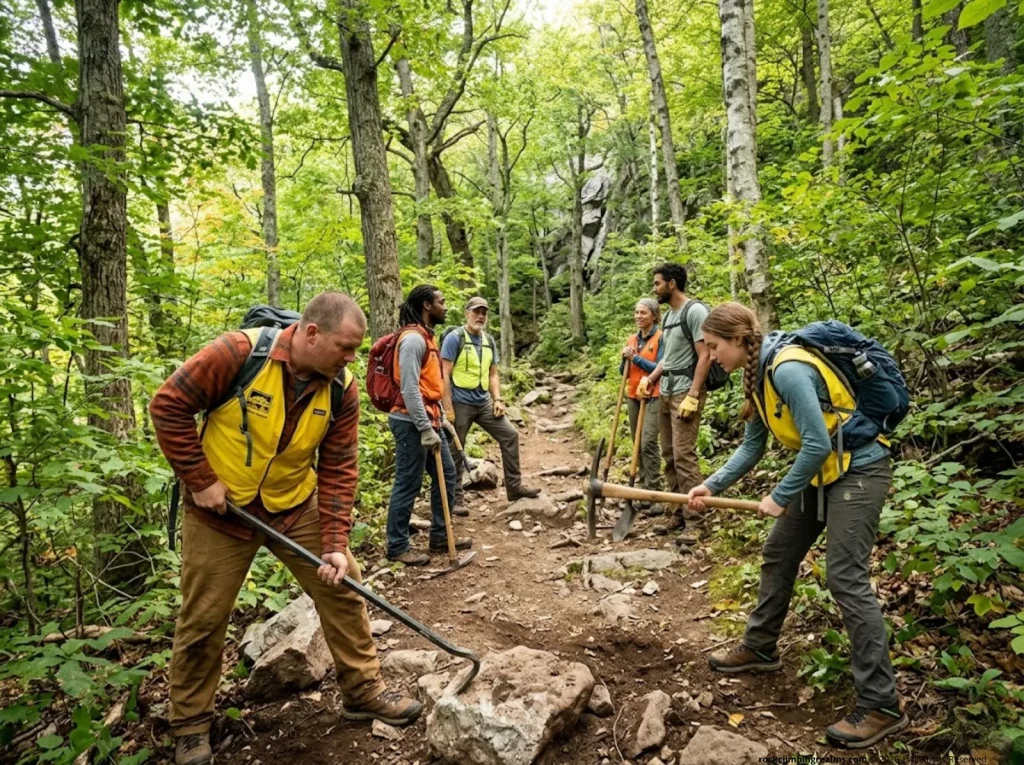
The meeting ends. The work doesn’t.
The 48-Hour Written Follow-Up
Within 48 hours, send a written follow-up that references your verbal testimony by date and specific points. Attach any evidence you couldn’t present in person — GPS files, additional photos, maps. Send it to both the project lead and your LCO representative. This ensures your input enters both the official agency record and the local advocacy pipeline.
Converting Attendance Into Stewardship Hours
Stewardship projects are the evidence that matters most. In 2025, climbing communities logged 4,078 volunteer hours and built 7,042 feet of sustainable trail. Those numbers get cited in decisions. The Access Fund’s Adopt-a-Crag program connects you with scheduled trail maintenance events — invasive species removal, erosion control, approach trail work — directly addressing concerns that drive seasonal closures. Crag stewardship credibility builds fastest when you show up with loppers and a trip report.
Understanding the practitioner’s guide to climbing stewardship beyond Leave No Trace gives you the full framework for making your volunteer hours count toward long-term access protection.
Track your hours and report them to your LCO. Aggregate volunteer data is the strongest single piece of evidence that the climbing community is self-regulating.
When To File a Formal Protest
If the final plan does not address your substantive comment, you have standing to file a formal protest during the 30-day protest window for BLM resource management plans. The protest must cite your original comment, the agency’s non-response, and the specific procedural violation.
Pro tip: Coordinate formal protests through your LCO or the Access Fund legal team rather than filing solo. Individual protests are procedurally valid, but collective submissions from an established organization carry significantly more weight in the administrative review.
The Legislative Picture — PARC Act, EXPLORE Act, and Your Role
Your local advocacy exists within a federal framework that has shifted dramatically in the last two years.
How the EXPLORE Act Changes Your Local Meeting
The EXPLORE Act Section 122 directs federal agencies to issue guidance recognizing “recreational climbing, including the placement and use of fixed anchors” as an allowable activity in Wilderness. Read the full text of the EXPLORE Act (H.R. 6492) for the complete language.
Section 122 gives you a federal citation for defending bolt installations in Wilderness — but it directs agencies to create guidance, not binding rules. Your local testimony shapes interpretation. The PARC Act, signed in early 2025, further recognized climbing as a legitimate use of public land. Together, these laws change the legal foundation for every access negotiation at the local level.
From Local Data to National Policy
Local climbing organizations identify threats — bolting moratoria, raptor closures, trail erosion assessments. National organizations like the Access Fund provide legal counsel and technical trail crews. But they cannot act without local data.
That GPS data from a Tuesday evening scoping session can become evidence in a Congressional briefing. The 2025 Impact Report documented 245 hours of D.C. representation — built on local data from LCO members at exactly these kinds of meetings. Six private properties opened. A hundred and ninety-one areas protected.
Understanding the peer-reviewed science behind raptor nesting closures that informs your testimony strengthens your position when seasonal closures are on the agenda.
Conclusion
Three things determine whether your crag stays open.
First, preparation. Reading the draft document and gathering site-specific evidence — GPS coordinates, trail photos, maintenance records — before you walk into that meeting separates a substantive contributor from background noise.
Second, professional diplomacy. The 4 A’s — Attitude, Awareness, Action, Accountability — transform you from a spectator into a trusted collaborator that land managers want at the table.
Third, follow-through. Your volunteer hours, written reinforcements, and sustained presence over months and years build the institutional credibility that wins access fights — not a single passionate speech.
Find your LCO this week. Set a recurring calendar alert for the next board meeting. Read the agenda before you drive out. And when the ranger asks for public input, be the climber who raises a hand with evidence instead of just emotion.
Now go send something.
FAQ
Do I need to be an expert to attend a climbing access meeting?
No. Showing up is the first step, and your firsthand climbing experience at the area in question is a form of expertise that land managers value. Start by listening at your first meeting, then ask questions afterward. Expertise in climbing access advocacy grows from consistent attendance, not from a credential.
What is a Local Climbing Organization (LCO)?
An LCO is a 501(c)(3) nonprofit serving as the formal liaison between climbers and land management agencies like the NPS, BLM, and US Forest Service. LCOs handle trail maintenance, coordinate stewardship projects, and represent climbers in policy negotiations. The Access Fund maintains a directory of every active LCO.
How do I comment on NPS climbing management plans?
Visit parkplanning.nps.gov, search for the park’s Climbing Management Plan, and submit a written comment during the open public comment period. Make it substantive — challenge data, cite evidence, propose alternatives. Non-substantive opinions carry no procedural weight.
Can I attend a public hearing virtually?
Many federal agencies now offer virtual meeting options for scoping sessions and public meetings. Check the Federal Register notice or parkplanning.nps.gov for remote participation details. Written comments submitted through the online portal carry the same legal weight as in-person testimony.
Where can I find climbing stewardship events near me?
The Access Fund’s Adopt-a-Crag program lists scheduled events by region on their website. Your local climbing organization also posts trail days and stewardship projects through their website, social media channels, or Mountain Project forums. Volunteering for even one event gives you standing and credibility at the next crag access meeting.
Safety Notice: Rock climbing and mountaineering are inherently high-risk
activities that can involve physical trauma or fatal incidents. The information on Rock Climbing Realms is for
educational and informational purposes only. Techniques and advice presented here are not a substitute
for professional, hands-on instruction. Conditions and risks vary by location. Always seek guidance
from a qualified instructor before attempting new techniques. By using this website, you agree that you
are solely responsible for your own safety. Any reliance you place on this information is strictly
at your own risk, and you assume all liability for your actions. Rock Climbing Realms and its authors
will not be held liable for any harm, damage, or loss sustained in connection with the use of this information.
Affiliate Disclosure: We are a participant in the Amazon Services LLC Associates Program, an
affiliate advertising program designed to provide a means for us to earn advertising fees by advertising and linking
to Amazon.com. As an Amazon Associate, we earn from qualifying purchases. We are also an official affiliate partner
of Black Diamond Equipment via the AvantLink network. If you click on a Black Diamond affiliate link and make a
purchase, we may earn a commission at no additional cost to you. We also participate in other affiliate programs.
Additional terms are found in the terms of service.