

In this article
Brooke Raboutou is staring at Boulder 3. She’s already burned five attempts, and the skin on her right index is tipping toward that glassy feeling that means she’s got maybe four tries left before it splits. The 100-point scale math is running in her head — 0.1 down with every failed attempt, and Boulder 4 is still untouched. This is what the LA28 format does. It turns a climbing competition into a thinking game wrapped inside a physical one.
The 2028 Los Angeles Games mark the first time all three disciplines — bouldering, lead climbing, and speed climbing — compete for their own standalone medals. Six total medals, up from four at Paris 2024 and two at Tokyo 2020. On paper it sounds like a scheduling change. In practice it rewires how athletes train, how route setters design problems, and how scoring decides who stands on the podium.
⚡ Quick Answer: LA28 is the first Olympics with standalone medals for all three climbing disciplines — Speed, Boulder, and Lead — with a total of six medals and 76 athletes. Boulder and Lead each use a 100-point scoring system where failed attempts cost 0.1 points. Speed uses a head-to-head bracket with objective time. The format rewards specialists who train deeply in one discipline, and eliminates the compromise that hurt both boulderers and lead climbers in previous combined formats.
From Combined to Standalone — Why the Format Changed
The combined format at Tokyo 2020 wasn’t born from strategy — it was born from constraints. The IOC gave climbing one medal slot and 40 total athletes. To make it work, the IFSC (rebranded as World Climbing on December 10, 2025) crammed Speed, Boulder, and Lead into one event using a multiplicative ranking system that even most climbers can’t explain without a diagram.
That punished specialists. A boulderer who couldn’t match a speed time got wrecked in the standings before touching their actual discipline. It’s the equivalent of making a 100-meter sprinter run the 1500m first — except the scoring is multiplicative, so a bad placing trashes the entire result. Paris 2024 moved partway there — Speed got its own medal, but Boulder and Lead stayed combined under a 200-point scale. Route setters still had to calibrate walls for athletes who trained in completely opposite physiological directions.
LA28 closes that loop. Three medals per gender, 76 athletes, each competing in one discipline. USA Climbing’s official LA28 medal expansion announcement confirmed the breakdown: Speed at 28 spots, Boulder and Lead at a minimum of 24 each. Route setters will no longer sandbag lead walls because boulderers need to survive them. This is how climbing earned its Olympic status through decades of lobbying — the combined format was always a placeholder while the sport proved it could pull Olympic-level audiences.
Pro tip: Watch the OQS qualifying events over the next two seasons. They’re live experiments in what the standalone format does to competitive tactics at the elite level — and the first real read on which athletes thrived in the combined era by accident.
The Biomechanics of Specialization — Power vs. Endurance
Here’s where most coverage stops at the surface. “Boulderers are stronger, lead climbers have more endurance.” Fine. But what actually changes when you separate the medals, physiologically?
Rate of Force Development — The Boulderer’s Weapon
Bouldering problems at LA28 will require individual moves in the V14–V15 range. That threshold isn’t about grip strength in the gym-testing sense. It’s about Rate of Force Development — how fast the finger flexors, lats, and biceps brachii can go from zero to maximum force output. The distinction matters.
You can have massive grip strength and still get spit off a V14 coordination move if your RFD is slow. That’s why modern competition bouldering looks like parkour on a wall — athletes initiate force explosively on volumes and slopers, not just hang on crimps. This peer-reviewed comparison of climbing-specific strength between bouldering and lead specialists puts numbers to it: boulderers show measurably higher explosive output than lead climbers tested on the same strength metrics.
Bouldering runs on the ATP-CP pathway — five to ten moves, maximum output. Higher density of Type IIb fast-twitch fibers drives that output, but those fibers fatigue fast. With standalone specialization, route setters can design for this without compromise. A move requiring 150%+ bodyweight crimp force is now the target, not the outlier. The athletes who train specifically for these demands get to find out exactly where the ceiling is. Previous combined formats kept that ceiling artificially low.
Pro tip: Competition boulderers at the elite level rely on ultra-soft, high-friction rubber shoes — Vibram XS Grip 2 is the current standard — to maximize mechanical interlock on volumes. It’s a shoe choice that would actively hurt you on lead. That separation now extends from training protocols to kit. How to read competition boulder problems like a route setter covers how minimizing attempts is as much about problem-reading as strength.
Forearm Endurance and the Metaboreflex — The Lead Climber’s Race
The hardest thing to explain to someone who doesn’t climb lead is the pump. Not “my arms are tired” tired. The kind where you’re gripping a hold that should be fine and your forearm just shuts off.
That’s the metaboreflex: blood flow to the forearm flexors gets cut off during isometric contractions, lactic acid accumulates, and the muscle can’t clear byproducts fast enough. According to physiology of rock climbing research published in PubMed, elite lead climbers manage this through higher capillary density and better localized aerobic capacity, which lets “shakes” on rest positions actually clear lactate instead of just burning time on the clock.
At LA28, lead semi-finals project to 5.14d (8c+) sustained, with headwall cruxes at 5.15b (9b) in finals. Those numbers couldn’t exist in a combined format — you can’t train the aerobic capacity lead demands at that grade while maintaining the explosive power bouldering needs. You’d have to be two athletes at once. The six-minute clock adds another layer: inefficient movement on lower-value holds burns anaerobic reserves you need on the headwall. How forearm occlusion training builds the endurance that LA28 lead routes demand covers ARC training and G-Tox methodology — the actual protocols elite athletes use to develop this capacity.
The 100-Point Scoring System Deconstructed
This section is where mainstream coverage consistently goes wrong. People describe the scoring, but they don’t explain the tactical logic baked inside it.
Bouldering Scoring — Four Problems, Perfect Math
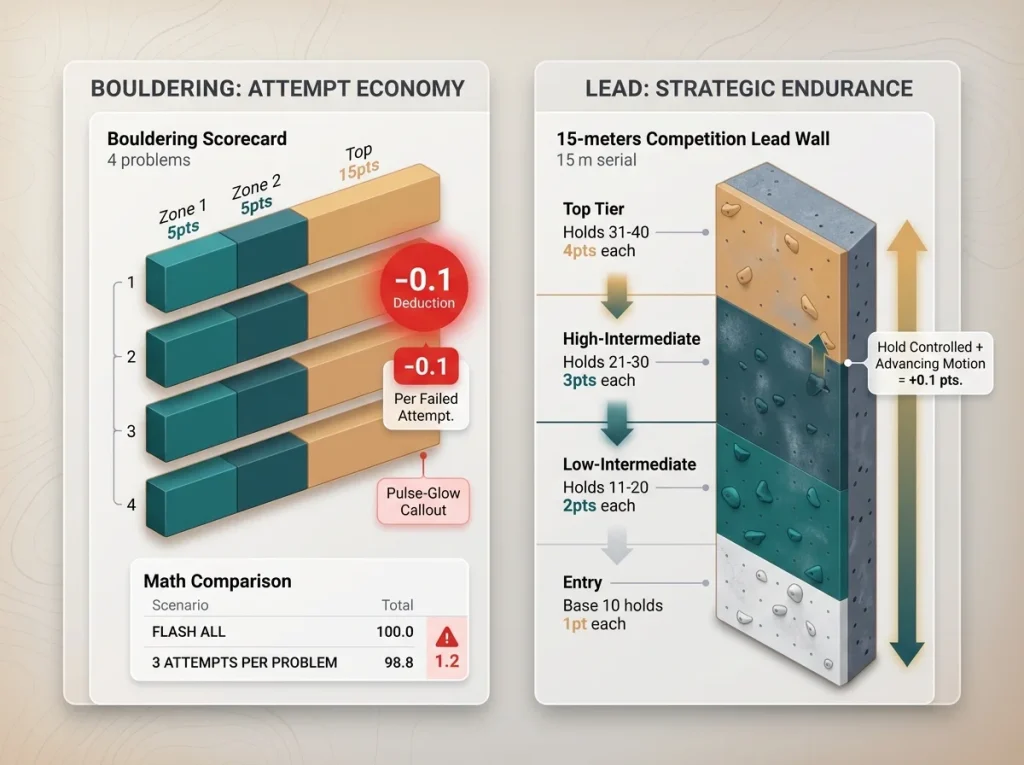
Four boulder problems. Each one is worth 25 points max: 5 points for the first zone hold, 5 for the second zone hold, 15 for topping out. Every failed attempt costs 0.1 points from your score on that problem.
Flash all four: 100.0. Average three attempts per problem: 96.4. That gap separates gold from fourth place at the World Cup level — it’s not marginal. How IFSC technical officials determine hold control and zone awards gets into the judging nuance, but the core rule is simple: zone holds and tops require static control, not just contact.
What the math actually creates is attempt economy as a competitive variable. Reading a problem quickly, committing to a sequence, and executing cleanly matters as much as raw strength. An athlete who spends 10 attempts on Boulder 1 might reach the zone and top — but they’ve just biologically damaged their chances on Boulder 4. Skin is the hidden currency, and every failed attempt spends it.
The smartest athletes at LA28 will treat their attempts like a chess player treats moves: think longer before committing, know when to punt on an unsolvable problem to preserve resources for the rest of the circuit, and build a pre-competition game plan that accounts for skin degradation as a real variable — not an afterthought.
Lead Hold Value Tiers — Why the Headwall Pays More
Lead scoring works on a tier system that deliberately front-loads the difficulty. The wall splits into four sections of ten holds each: Entry tier at 1 point per hold, Low-Intermediate at 2, High-Intermediate at 3, and Top Tier at 4 points per hold. A “+” modifier awards an extra 0.1 if a climber controls a hold and makes an advancing movement toward the next without securing it.
Do the math: the last ten holds on the wall are worth 40 points. That’s more than a full bouldering problem. Every second you burn on the entry tier is borrowed from your shot at those 4-point holds.
The official IFSC competition rules for lead hold value tiers lays this out directly from the governing body. But the tactical implication is what guides miss: efficient clipping and minimal rest time in the lower sections isn’t just good style — it’s protecting your chance at the holds that actually decide the competition. Building the forearm endurance to spend time on high-value headwall holds is what separates athletes who top out from those who flame out at the High-Intermediate tier.
Pro tip: Watch where athletes shake out on lead. Not all rest positions are equal. A climber who shakes on a 2-point hold they could move through quickly is leaving points on the table — and burning time they need on the headwall.
Speed Climbing Mechanics — The Vertical Sprint Decoded
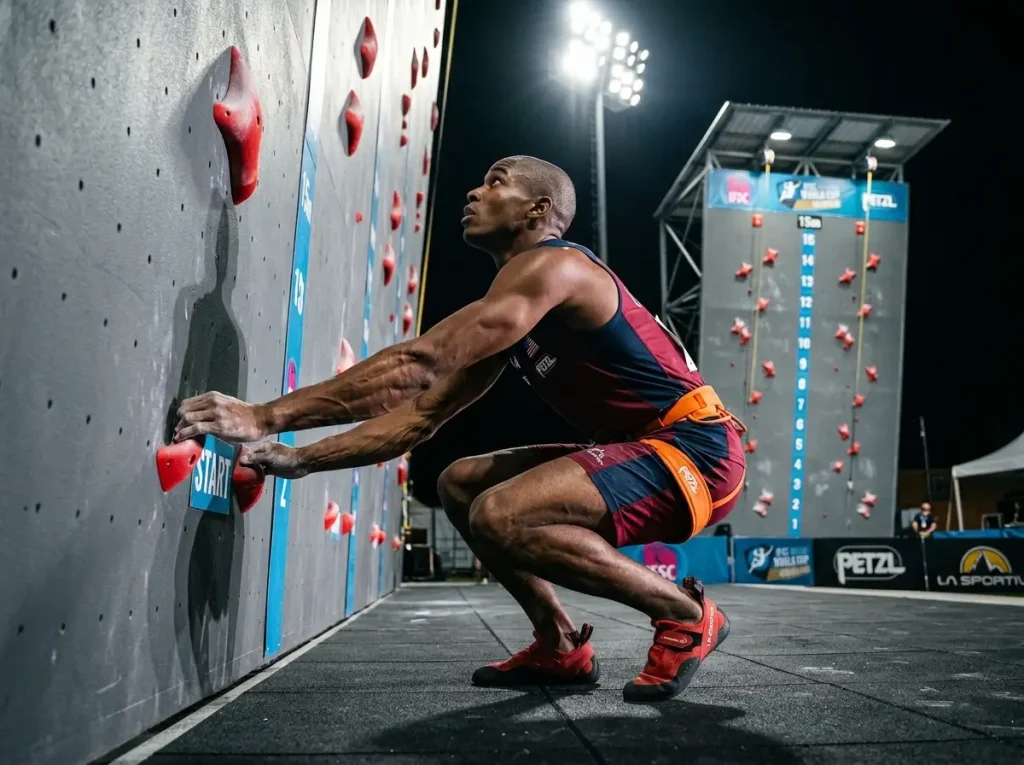
Speed climbing is the most misunderstood discipline in the mix, including by climbers. People see fast times and assume it’s just explosive power. It’s not. It’s closer to gymnastics floor exercise than climbing — the movement is choreographed and rehearsed, not reactive. The wall never changes. The athlete is running a memorized program, not solving a problem.
Kinematics, Limb Frequency, and the Tomoa Skip
The speed wall is identical everywhere, globally: a standardized 15-meter IFSC wall where every hold, angle, and bolt position is fixed. Athletes aren’t reading the wall. They’re executing a memorized movement sequence. AI-powered computer vision research has identified limb frequency as the primary predictor of elite performance. Sam Watson (USA) averages hand contact times of approximately 0.35 seconds per hold. Shaving 0.01 seconds per hold compounds across 22+ contacts. That’s what separates a 4.8-second run from a 4.6-second one.
The Tomoa Skip — a footwork pattern that bypasses one hold in sequence — is one of the non-repeating acyclic movement patterns that define modern speed climbing. Every phase needs near-perfect synchronization between upper and lower body. Lateral sway wastes energy and adds time. Vertical center-of-mass trajectory is non-negotiable.
The reaction threshold cuts off at 0.1 seconds — react faster and you’re out for false start, which is also the physical limit of human auditory-to-motor processing. A pre-competition neuromuscular activation protocol matters more here than in any other discipline. The physics of elite speed climbing technique breaks down the ATP-CP system demand and IFSC wall geometry in depth.
Resolved Time Ranking and the Olympic Qualification Bracket
Getting to LA28 in Speed uses the Resolved Time Ranking system — your times across multiple World Cup events get analyzed for consistency. A single 4.6-second run doesn’t get you in if you’re running 5.8 most other weekends. Consistency over the OQS season matters more than peak performances.
Once inside the Olympic bracket, that changes entirely. Every round is head-to-head. One false start, one slip, and you’re eliminated regardless of your qualification rank. The Two-Athlete Rule adds another constraint: no country can enter more than two athletes per gender per discipline. In Indonesia and Ukraine — speed powerhouses — that rule turns national trials into events harder than the Olympics themselves. According to USA Climbing’s confirmed LA28 Olympic qualification system breakdown, the Resolved Time Ranking is the primary pathway, with continental OQS routes for smaller nations.
The Long Beach Variable — Coastal Physics Nobody Covers
The Long Beach Climbing Theater sits within hundreds of meters of the Pacific Ocean. That venue geography is not a backdrop detail — it’s a physics problem.
Salt Aerosols, Hold Chemistry, and Friction Loss
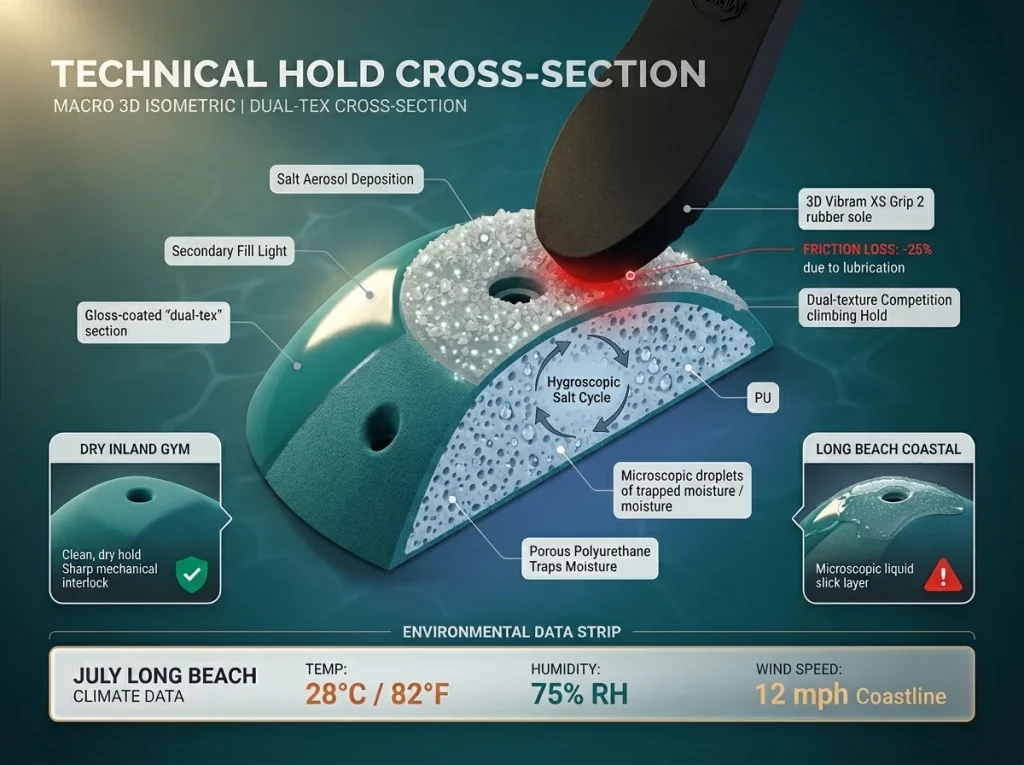
Coastal air carries hygroscopic salt aerosols. These particles settle on the synthetic polyurethane (PU) holds that every IFSC comp uses — and PU is porous. Salt trapped in those pores attracts moisture even when conditions feel dry, creating a microscopic slick layer on dual-texture holds that is invisible to the eye and catastrophic for friction.
July daytime highs in Long Beach average 27–29°C, which softens PU material and reduces the friction at the hold-rubber interface. Relative humidity runs 70–75% — high enough to saturate loose chalk and create glassy hold conditions. The official Long Beach Climbing Theater venue specifications confirm the coastal proximity. Athletes from dry inland environments — Japan’s interior, Austria, Colorado — face a steeper acclimatization curve than those who regularly train in humid coastal gyms. The Pacific wind adds a deceptive drying effect that tricks athletes into underestimating how greasy the holds already are.
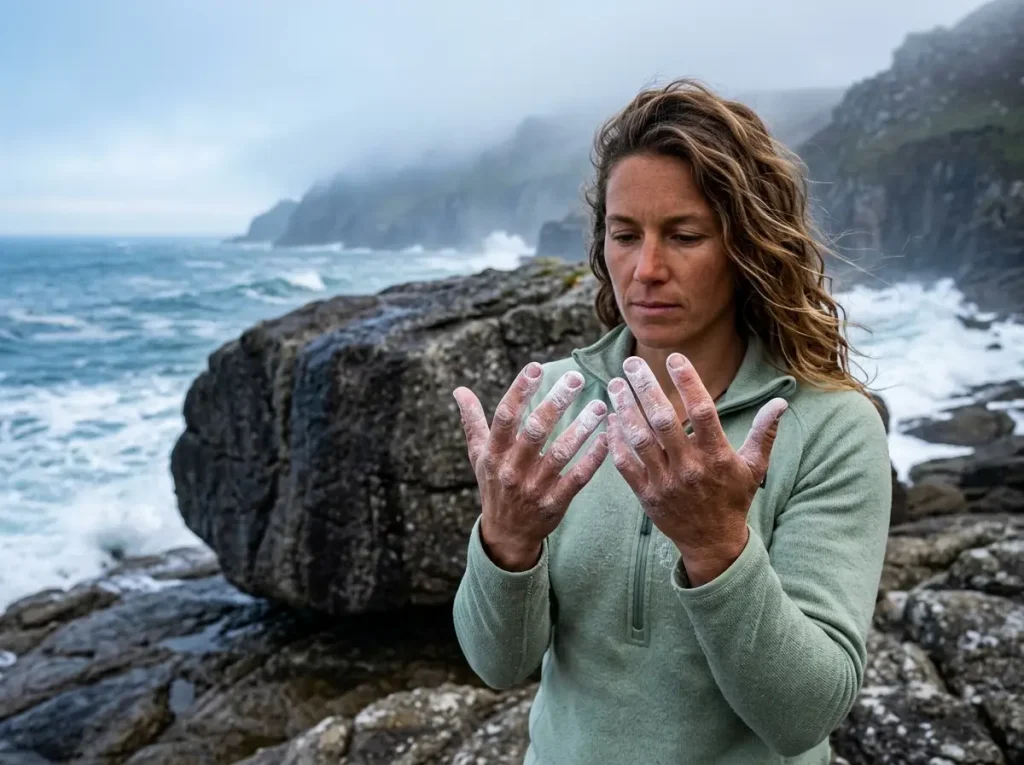
Managing skin hydration and callus conditioning for coastal competition conditions is reading worth doing before arrival. Liquid chalk deposits a continuous barrier layer rather than loose powder — it will likely outperform standard chalk on glassy dual-texture holds. Expect chalk strategy to become a visible competitive variable at an Olympic level for the first time.
The Skin Management Crisis — The True Cost of Extra Attempts
The visible cost of a failed bouldering attempt is 0.1 points. The invisible cost is biological.
In coastal humidity, fingertip skin hydrates and softens, making splits and flappers on sharp edges more likely. The complete climber’s skin care protocol for high-humidity conditions outlines what callus management looks like in practice. An athlete who burns 10 attempts on Boulder 1 might score 24.0 — but they’ve spent something they can’t buy back: the skin integrity needed for Boulder 4.
Elite coaches at LA28 will build three-attempt thresholds into game plans — punt on a boulder, sacrifice 0.5 to 1.0 points, preserve skin and ATP for what’s left. Calluses too hard slip on smooth holds. Too soft and they tear on edges. The calibration window takes weeks, not days. Athletes who show up to Long Beach without a humid-conditions skin protocol will figure this out on Boulder 2, which is the worst possible time to figure anything out.
Pro tip: Speed climbers face a specific skin problem in multi-round formats: repeated contact with the same standardized holds loads the exact same skin points every run. Liquid chalk as base layer, plus block chalk for re-application between rounds, is the protocol worth testing long before the competition arrives.
Qualification Deep Dive — Quota Math and the NOC Bottleneck
The 76-Athlete Quota and Discipline Distribution
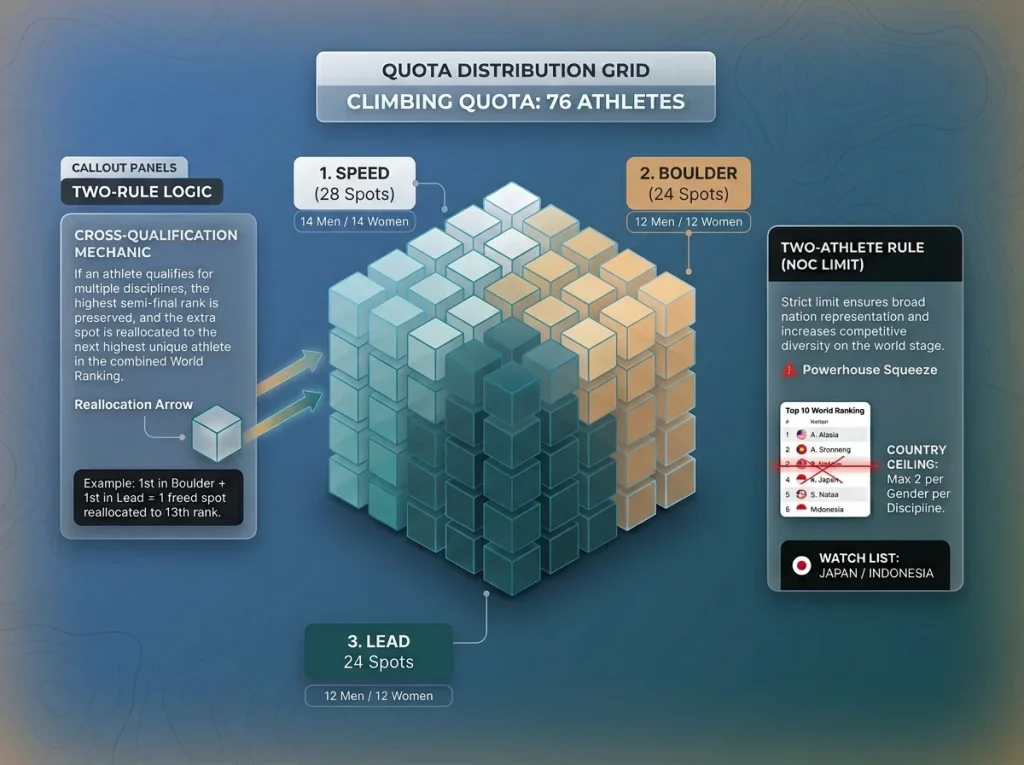
LA28 climbing slots: Speed at 28 (14 per gender), Boulder at a minimum of 24 (12 per gender), Lead at a minimum of 24 (12 per gender) — 76 athletes total, split 38 men / 38 women. The minimums matter. A climber ranked 13th globally could miss the Games entirely if their country already has two qualified athletes. Country ceiling operates independently of world ranking. USA Climbing’s full LA28 qualification system and quota breakdown has the complete breakdown of how this shakes out by discipline and gender.
The Cross-Qualification Mechanic and the Two-Athlete Rule
If Janja Garnbret qualifies in both Boulder and Lead, she takes only one spot from the 38 available for women. World Climbing’s official LA28 qualification system release explains how that freed spot reallocates: the semi-final bracket for one of her disciplines can expand beyond the 12-athlete minimum, total participants still capped at 76.
The Two-Athlete Rule is where powerhouse nations get squeezed hardest. Japan’s top five boulderers are often all inside the world’s top ten. The national trial is harder than the Olympic semi-final. The athlete who grips hardest in the domestic selection round might be watching the opening ceremony from home. That’s not hyperbole — it’s the documented reality of how climbing’s top nations operate under quota constraints. Follow the OQS series to watch this unfold in real time — how to stream IFSC World Cup qualification events leading to LA28 covers where to find the broadcasts.
What LA28 Means for How You Train Right Now

Grade Expectations and the New Difficulty Frontier
You’re not training for V14. But knowing why V14 is the floor at LA28 tells you what physical qualities actually separate grades at the elite level — and by extension, what separates your current grade from the next one.
Boulder problems require individual moves in the V14–V15 range, with V12 as the minimum for any medal position. Lead semi-finals project to 5.14d (8c+) sustained, with headwall cruxes at 5.15b (9b) in finals. Speed pushes toward 4.6 seconds for men, from a world record already below 4.8. These projections exist because specialization removes the ceiling. A bouldering specialist trains pure explosive RFD without needing aerobic base for lead. A lead specialist logs ARC training without worrying about how muscle mass affects dynamic moves. Understanding the V-scale grades that set the floor for LA28 bouldering is worth reading for context on where these numbers sit in the broader grade spectrum.
For recreational climbers: if you primarily boulder, RFD and precision movement are your training levers. If you primarily lead, sustained forearm endurance and efficient clipping separate grades. The LA28 format didn’t create those distinctions — it just made them official.
Gear Divergence — What Specialization Does to Your Kit
As disciplines separate, so does the gear. The all-purpose climbing shoe that works okay everywhere is the equivalent of the combined-format athlete: fine at everything, optimized for nothing.
Bouldering specialists at LA28 wear shoes with ultra-soft, sock-like fits and high-friction rubber — Vibram XS Grip 2 is the current competition standard — to maximize mechanical interlock on volumes and compression moves. Speed climbers wear the opposite: ultra-stiff soles for force transfer to the standardized IFSC speed holds, no sensitivity needed whatsoever. Lead climbers prioritize ropes with the lowest possible impact force for dynamic belay scenarios, reducing energy transfer on clips.
For chalk: in Long Beach’s coastal humidity, liquid chalk as a base layer with block chalk for re-applications is worth practicing before you arrive. The standard approach to chalk stops working on glassy holds. You want to learn this in training, not on a competition attempt.
A 12-week bouldering competition training plan built on LA28-era specialization principles translates these gear and training concepts into a structured protocol you can run right now, built around the same energy system demands that the LA28 route setters are designing for.
Three Things to Take Away from LA28
First: the generalist era is over. Three standalone medals let route setters push to absolute limits — V15 boulder moves, 5.15b lead cruxes. Spreading training across three disciplines means mediocrity in all three. Depth wins here.
Second: the 0.1 deduction is a biological tax. In Long Beach’s coastal heat and humidity, every failed attempt costs skin as much as points. The athletes who compete smartest will manage attempt budgets the way a chess player manages clock time — they’ll think before they pull.
Third: in lead, the last ten holds pay 40 points. In boulder, a flash earns a compounding dividend. Both scoring systems reward athletes who waste the least movement. That’s what training is for — not to get stronger, but to get more efficient at exactly the right moments.
Before the next OQS qualifier, pull up the broadcast and watch through this lens: count boulder attempts against the 25-point ceiling, track which lead climbers reach the High-Intermediate tier before the clock, notice how speed athletes toe the false-start line. The individual discipline format is a live masterclass in systematic efficiency and competitive sport climbing at its most precise. Now go send something.
FAQ
How does the new bouldering scoring work at LA28?
Each of the four bouldering problems is worth 25 points: 5 for the first zone hold, 5 for the second, and 15 for topping out. Every failed attempt costs 0.1 points from your final score on that problem. Athletes who flash all four score 100.0. The 0.1 deduction creates tactical pressure around attempt economy — not just physical execution. Read the problem wrong and take three extra attempts; you’ve given back nearly a full boulder’s worth of points.
What is the difference between Lead and Boulder scoring in LA28?
Bouldering uses a problem-based system (4 problems × 25 pts = 100-pt ceiling) where failed attempts subtract 0.1, rewarding efficiency. Lead uses a hold value tier system — Entry holds pay 1 point, Top Tier pays 4 — with a + modifier for advancing movement. The systems favor completely different physiological profiles. Bouldering rewards explosive power and tactical patience. Lead rewards sustained forearm endurance and upward movement efficiency.
Is Speed climbing completely separate at LA28?
Yes. Speed has its own standalone medal (first separated at Paris 2024) with a head-to-head knockout bracket on a standardized 15-meter wall. Its scoring is objective — faster time wins — and its qualification pathway (Resolved Time Ranking) and athlete profile are completely different from Boulder or Lead. The 3 disciplines are now fully independent events with different qualification routes, different physiological demands, and different gear requirements.
How many medals are in climbing for LA 2028?
6 medals total — three per gender: one each in Speed, Boulder, and Lead. Up from four at Paris 2024 and two at Tokyo 2020. The individual discipline format reflects the IOC’s acknowledgment that these three disciplines demand genuinely different athletes.
Will LA28 climbing be harder than previous Olympics?
Yes, by design. With all three disciplines standalone, route setters are no longer constrained by the physical compromises of a combined format. Boulder problems are expected to require V14–V15 individual moves. Lead routes in finals may reach 5.15b. This is the direct result of biomechanical specialization: athletes train for one discipline’s demands without compromise, pushing limits rather than averaging them across three.
Safety Notice: Rock climbing and mountaineering are inherently high-risk
activities that can involve physical trauma or fatal incidents. The information on Rock Climbing Realms is for
educational and informational purposes only. Techniques and advice presented here are not a substitute
for professional, hands-on instruction. Conditions and risks vary by location. Always seek guidance
from a qualified instructor before attempting new techniques. By using this website, you agree that you
are solely responsible for your own safety. Any reliance you place on this information is strictly
at your own risk, and you assume all liability for your actions. Rock Climbing Realms and its authors
will not be held liable for any harm, damage, or loss sustained in connection with the use of this information.
Affiliate Disclosure: We are a participant in the Amazon Services LLC Associates Program, an
affiliate advertising program designed to provide a means for us to earn advertising fees by advertising and linking
to Amazon.com. As an Amazon Associate, we earn from qualifying purchases. We are also an official affiliate partner
of Black Diamond Equipment via the AvantLink network. If you click on a Black Diamond affiliate link and make a
purchase, we may earn a commission at no additional cost to you. We also participate in other affiliate programs.
Additional terms are found in the terms of service.